welcom
e
Campylobacter jejuni in
Milk & Milk Product
Soniya Ashok Ranveer
Ph. D (Dairy Microbiology)
Campylobacter (curved rod in Greek) may have been
discovered in the late nineteenth century (1886) by
Theodor Escherich from an infant who died of cholera and
called the disease “cholera infantum”
In the last 30 years, Campylobacter has been recognized
as a leading pathogen causing diseases in both animals and
humans and considered a zoonotic pathogen
Campylobacters (formerly Vibrio fetus) were first
associated with diseases of cattle and sheep at the
beginning of 20th century
Introduction
Introduction
 Campylobacter enteritis, caused by C. jejuni and C.
coli, is a relatively recent disease
 First recognized following several water and milk borne
epidemics in the mid-1970s
 Epidemics involving C. jejuni have been reported from
both developed and underdeveloped countries and it is
also one of the causative agents of traveller's diarrhea
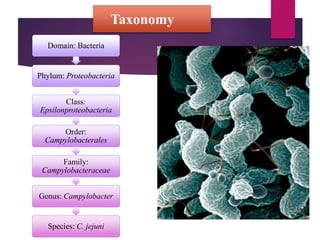
Taxonomy
Domain: Bacteria
Phylum: Proteobacteria
Class:
Epsilonproteobacteria
Order:
Campylobacterales
Family:
Campylobacteraceae
Genus: Campylobacter
Species: C. jejuni
Characteristic of Campylobacter jejuni
Gram negative rod (1.5-5 µm)
Spiral
Microaerophilic
Non spore forming
Motile(polar, unsheathed flagella)
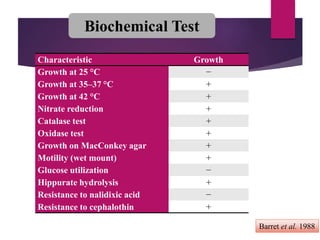
Characteristic Growth
Growth at 25 °C −
Growth at 35–37 °C +
Growth at 42 °C +
Nitrate reduction +
Catalase test +
Oxidase test +
Growth on MacConkey agar +
Motility (wet mount) +
Glucose utilization −
Hippurate hydrolysis +
Resistance to nalidixic acid −
Resistance to cephalothin +
Biochemical Test
Barret et al. 1988
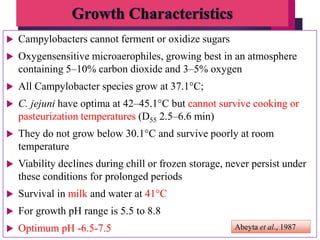
 Campylobacters cannot ferment or oxidize sugars
 Oxygensensitive microaerophiles, growing best in an atmosphere
containing 5–10% carbon dioxide and 3–5% oxygen
 All Campylobacter species grow at 37.1°C;
 C. jejuni have optima at 42–45.1°C but cannot survive cooking or
pasteurization temperatures (D55 2.5–6.6 min)
 They do not grow below 30.1°C and survive poorly at room
temperature
 Viability declines during chill or frozen storage, never persist under
these conditions for prolonged periods
 Survival in milk and water at 41°C
 For growth pH range is 5.5 to 8.8
 Optimum pH -6.5-7.5 Abeyta et al., 1987
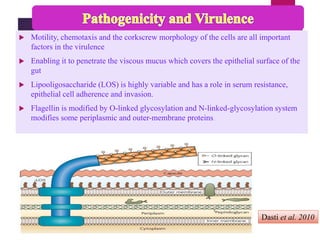
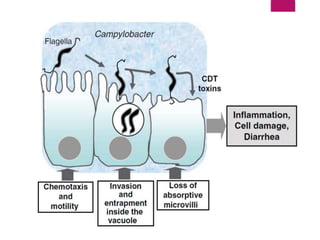
 Motility, chemotaxis and the corkscrew morphology of the cells are all important
factors in the virulence
 Enabling it to penetrate the viscous mucus which covers the epithelial surface of the
gut
 Lipooligosaccharide (LOS) is highly variable and has a role in serum resistance,
epithelial cell adherence and invasion.
 Flagellin is modified by O-linked glycosylation and N-linked-glycosylation system
modifies some periplasmic and outer-membrane proteins
Dasti et al. 2010
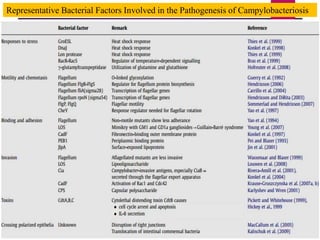
Representative Bacterial Factors Involved in the Pathogenesis of Campylobacteriosis
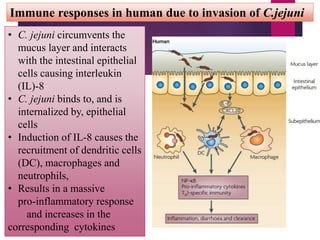
• C. jejuni circumvents the
mucus layer and interacts
with the intestinal epithelial
cells causing interleukin
(IL)-8
• C. jejuni binds to, and is
internalized by, epithelial
cells
• Induction of IL-8 causes the
recruitment of dendritic cells
(DC), macrophages and
neutrophils,
• Results in a massive
pro-inflammatory response
and increases in the
corresponding cytokines
Immune responses in human due to invasion of C.jejuni
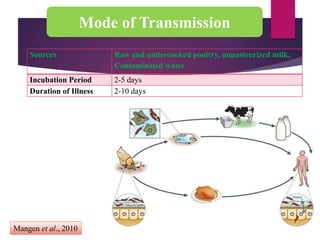
Mode of Transmission
Sources Raw and undercooked poultry, unpasteurized milk,
Contaminated water
Incubation Period 2-5 days
Duration of Illness 2-10 days
Mangen et al., 2010
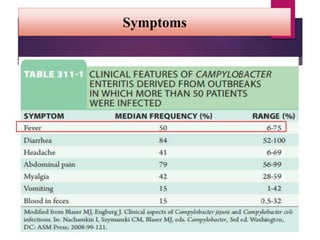
Symptoms
Vulnerability
 Bacteremia is detected in <1% of patients with Campylobacter
enteritis
 immunocompromised or
 among the very young(<1 year of age) or
 very old
 Guillain-Barré syndrome (GBS) - 1–2 persons per 100,000
population (USA)
 Post-infectious complication
 Fatality rate - 0.05 per 1000 infections
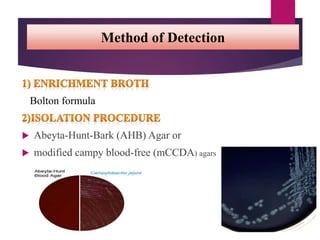
Method of Detection
Bolton formula
 Abeyta-Hunt-Bark (AHB) Agar or
 modified campy blood-free (mCCDA) agars
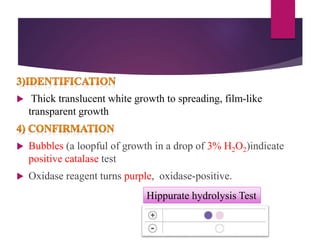
 Thick translucent white growth to spreading, film-like
transparent growth
 Bubbles (a loopful of growth in a drop of 3% H2O2)indicate
positive catalase test
 Oxidase reagent turns purple, oxidase-positive.
Hippurate hydrolysis Test
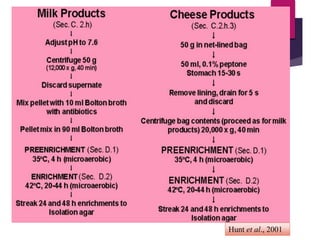
Hunt et al., 2001
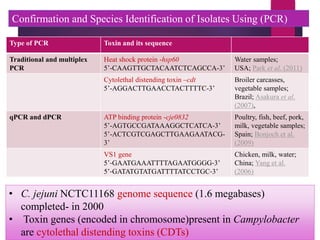
Confirmation and Species Identification of Isolates Using (PCR)
Type of PCR Toxin and its sequence
Traditional and multiplex
PCR
Heat shock protein -hsp60
5’-CAAGTTGCTACAATCTCAGCCA-3’
Water samples;
USA; Park et al. (2011)
Cytolethal distending toxin –cdt
5’-AGGACTTGAACCTACTTTTC-3’
Broiler carcasses,
vegetable samples;
Brazil; Asakura et al.
(2007),
qPCR and dPCR ATP binding protein -cje0832
5’-AGTGCCGATAAAGGCTCATCA-3’
5’-ACTCGTCGAGCTTGAAGAATACG-
3’
Poultry, fish, beef, pork,
milk, vegetable samples;
Spain; Bonjoch et al.
(2009)
VS1 gene
5’‐GAATGAAATTTTAGAATGGGG‐3’
5’‐GATATGTATGATTTTATCCTGC‐3’
Chicken, milk, water;
China; Yang et al.
(2006)
• C. jejuni NCTC11168 genome sequence (1.6 megabases)
completed- in 2000
• Toxin genes (encoded in chromosome)present in Campylobacter
are cytolethal distending toxins (CDTs)
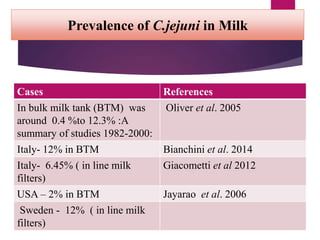
Prevalence of C.jejuni in Milk
Cases References
In bulk milk tank (BTM) was
around 0.4 %to 12.3% :A
summary of studies 1982-2000:
Oliver et al. 2005
Italy- 12% in BTM Bianchini et al. 2014
Italy- 6.45% ( in line milk
filters)
Giacometti et al 2012
USA – 2% in BTM Jayarao et al. 2006
Sweden - 12% ( in line milk
filters)
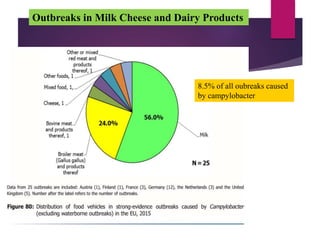
Outbreaks in Milk Cheese and Dairy Products
8.5% of all oubreaks caused
by campylobacter
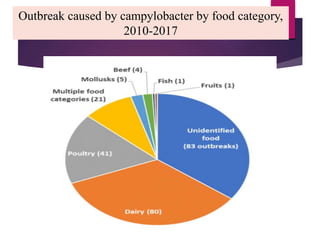
Outbreak caused by campylobacter by food category,
2010-2017
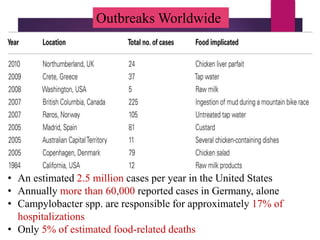
Outbreaks Worldwide
• An estimated 2.5 million cases per year in the United States
• Annually more than 60,000 reported cases in Germany, alone
• Campylobacter spp. are responsible for approximately 17% of
hospitalizations
• Only 5% of estimated food-related deaths
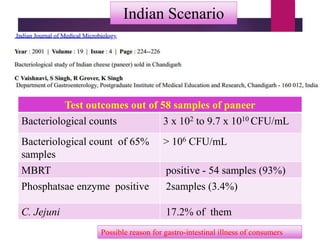
Test outcomes out of 58 samples of paneer
Bacteriological counts 3 x 10² to 9.7 x 10¹⁰ CFU/mL
Bacteriological count of 65%
samples
> 106 CFU/mL
MBRT positive - 54 samples (93%)
Phosphatsae enzyme positive 2samples (3.4%)
C. Jejuni 17.2% of them
Possible reason for gastro-intestinal illness of consumers
Indian Scenario
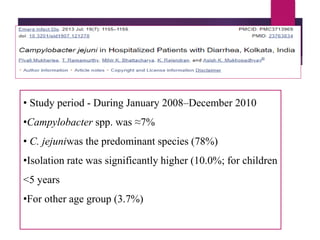
• Study period - During January 2008–December 2010
•Campylobacter spp. was ≈7%
• C. jejuniwas the predominant species (78%)
•Isolation rate was significantly higher (10.0%; for children
<5 years
•For other age group (3.7%)
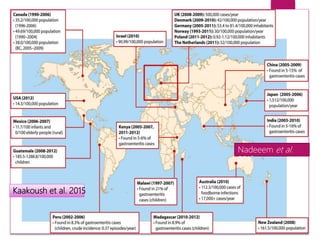
Kaakoush et al. 2015
Nadeeem et al.
2015
Scientific reports on risk factors for human infection indicate that
C. jejuni can contaminate various foodstuffs, including raw milk
and dairy products, and that raw milk has been responsible for
major disease outbreaks
In that study, 378 in-line milk filters were collected from 27 farms
authorized for the production and sale of raw milk (14 filters for
each farm) and evaluated qualitatively (presence or absence) by
culturing. C. jejuni was detected in eight samples from three farms,
indicating intrafarm variability during the survey period
Risk output
For each pathogen considered, two dose output models
were achieved:
one for the best and the other for the worst storage milk
chain scenarios
Dose Campylobacter40C
~10˄ (C-[DRT(Camp 4°)X T(h)]-Boil) x Si
Dose CampylobacterDT
~10˄ (C-DRT(Camp ΔTX T(h)]-Boil) x Si
Pathogen dose per serving size
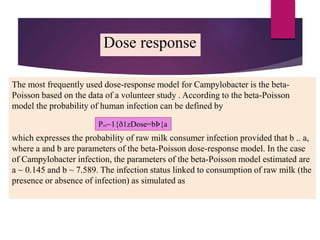
The most frequently used dose-response model for Campylobacter is the beta-
Poisson based on the data of a volunteer study . According to the beta-Poisson
model the probability of human infection can be defined by
which expresses the probability of raw milk consumer infection provided that b .. a,
where a and b are parameters of the beta-Poisson dose-response model. In the case
of Campylobacter infection, the parameters of the beta-Poisson model estimated are
a ~ 0.145 and b ~ 7.589. The infection status linked to consumption of raw milk (the
presence or absence of infection) as simulated as
Dose response
Pinf~1{ð1zDose=bÞ{a
• Data were collected in one province of the Emilia Romagna Region
from all farms authorized to produce and sell raw cow’s milk
• These farms served 60 vending machines and together sold about
3,000 liters of raw milk daily
• The province was used as the epidemiologic unit because the direct
sale of raw milk is allowed only for the local area, i.e., the province
where the raw milk is produced and the neighboring provinces
•
• The province has a population of around 995,000 people with a
surface area of around 370,000 ha
Exposure assessment
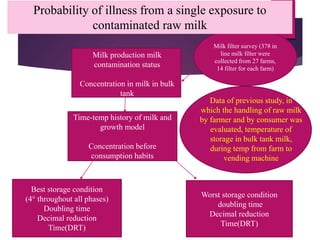
Time-temp history of milk and
growth model
Concentration before
consumption habits
Milk filter survey (378 in
line milk filter were
collected from 27 farms,
14 filter for each farm)
Best storage condition
(4° throughout all phases)
Doubling time
Decimal reduction
Time(DRT)
Worst storage condition
doubling time
Decimal reduction
Time(DRT)
Milk production milk
contamination status
Concentration in milk in bulk
tank
Data of previous study, in
which the handling of raw milk
by farmer and by consumer was
evaluated, temperature of
storage in bulk tank milk,
during temp from farm to
vending machine
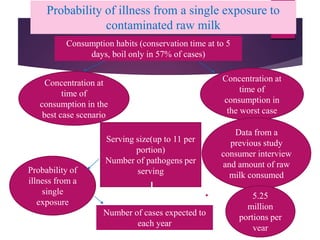
Probability of illness from a single exposure to
contaminated raw milk
Consumption habits (conservation time at to 5
days, boil only in 57% of cases)
Serving size(up to 11 per
portion)
Number of pathogens per
serving
Concentration at
time of
consumption in the
best case scenario
Concentration at
time of
consumption in
the worst case
Data from a
previous study
consumer interview
and amount of raw
milk consumed
Probability of
illness from a
single
exposure
Number of cases expected to
each year
5.25
million
portions per
vear
Probability of illness from a single exposure to
contaminated raw milk
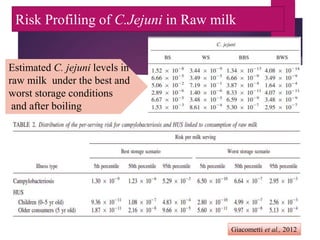
Risk Profiling of C.Jejuni in Raw milk
Estimated C. jejuni levels in
raw milk under the best and
worst storage conditions
and after boiling
Giacometti et al., 2012
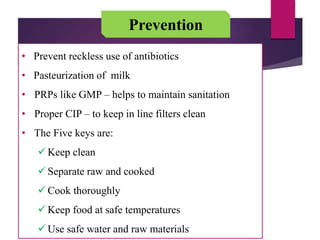
Prevention
• Prevent reckless use of antibiotics
• Pasteurization of milk
• PRPs like GMP – helps to maintain sanitation
• Proper CIP – to keep in line filters clean
• The Five keys are:
 Keep clean
 Separate raw and cooked
 Cook thoroughly
 Keep food at safe temperatures
 Use safe water and raw materials
Thank You

c. jejuni.pptx

  • 1.
  • 2.
    Campylobacter jejuni in Milk& Milk Product Soniya Ashok Ranveer Ph. D (Dairy Microbiology)
  • 3.
    Campylobacter (curved rodin Greek) may have been discovered in the late nineteenth century (1886) by Theodor Escherich from an infant who died of cholera and called the disease “cholera infantum” In the last 30 years, Campylobacter has been recognized as a leading pathogen causing diseases in both animals and humans and considered a zoonotic pathogen Campylobacters (formerly Vibrio fetus) were first associated with diseases of cattle and sheep at the beginning of 20th century Introduction
  • 4.
    Introduction  Campylobacter enteritis,caused by C. jejuni and C. coli, is a relatively recent disease  First recognized following several water and milk borne epidemics in the mid-1970s  Epidemics involving C. jejuni have been reported from both developed and underdeveloped countries and it is also one of the causative agents of traveller's diarrhea
  • 5.
  • 6.
    Characteristic of Campylobacterjejuni Gram negative rod (1.5-5 µm) Spiral Microaerophilic Non spore forming Motile(polar, unsheathed flagella)
  • 7.
    Characteristic Growth Growth at25 °C − Growth at 35–37 °C + Growth at 42 °C + Nitrate reduction + Catalase test + Oxidase test + Growth on MacConkey agar + Motility (wet mount) + Glucose utilization − Hippurate hydrolysis + Resistance to nalidixic acid − Resistance to cephalothin + Biochemical Test Barret et al. 1988
  • 8.
     Campylobacters cannotferment or oxidize sugars  Oxygensensitive microaerophiles, growing best in an atmosphere containing 5–10% carbon dioxide and 3–5% oxygen  All Campylobacter species grow at 37.1°C;  C. jejuni have optima at 42–45.1°C but cannot survive cooking or pasteurization temperatures (D55 2.5–6.6 min)  They do not grow below 30.1°C and survive poorly at room temperature  Viability declines during chill or frozen storage, never persist under these conditions for prolonged periods  Survival in milk and water at 41°C  For growth pH range is 5.5 to 8.8  Optimum pH -6.5-7.5 Abeyta et al., 1987
  • 9.
     Motility, chemotaxisand the corkscrew morphology of the cells are all important factors in the virulence  Enabling it to penetrate the viscous mucus which covers the epithelial surface of the gut  Lipooligosaccharide (LOS) is highly variable and has a role in serum resistance, epithelial cell adherence and invasion.  Flagellin is modified by O-linked glycosylation and N-linked-glycosylation system modifies some periplasmic and outer-membrane proteins Dasti et al. 2010
  • 10.
    Representative Bacterial FactorsInvolved in the Pathogenesis of Campylobacteriosis
  • 11.
    • C. jejunicircumvents the mucus layer and interacts with the intestinal epithelial cells causing interleukin (IL)-8 • C. jejuni binds to, and is internalized by, epithelial cells • Induction of IL-8 causes the recruitment of dendritic cells (DC), macrophages and neutrophils, • Results in a massive pro-inflammatory response and increases in the corresponding cytokines Immune responses in human due to invasion of C.jejuni
  • 13.
    Mode of Transmission SourcesRaw and undercooked poultry, unpasteurized milk, Contaminated water Incubation Period 2-5 days Duration of Illness 2-10 days Mangen et al., 2010
  • 14.
  • 15.
    Vulnerability  Bacteremia isdetected in <1% of patients with Campylobacter enteritis  immunocompromised or  among the very young(<1 year of age) or  very old  Guillain-Barré syndrome (GBS) - 1–2 persons per 100,000 population (USA)  Post-infectious complication  Fatality rate - 0.05 per 1000 infections
  • 16.
    Method of Detection Boltonformula  Abeyta-Hunt-Bark (AHB) Agar or  modified campy blood-free (mCCDA) agars
  • 17.
     Thick translucentwhite growth to spreading, film-like transparent growth  Bubbles (a loopful of growth in a drop of 3% H2O2)indicate positive catalase test  Oxidase reagent turns purple, oxidase-positive. Hippurate hydrolysis Test
  • 18.
  • 19.
    Confirmation and SpeciesIdentification of Isolates Using (PCR) Type of PCR Toxin and its sequence Traditional and multiplex PCR Heat shock protein -hsp60 5’-CAAGTTGCTACAATCTCAGCCA-3’ Water samples; USA; Park et al. (2011) Cytolethal distending toxin –cdt 5’-AGGACTTGAACCTACTTTTC-3’ Broiler carcasses, vegetable samples; Brazil; Asakura et al. (2007), qPCR and dPCR ATP binding protein -cje0832 5’-AGTGCCGATAAAGGCTCATCA-3’ 5’-ACTCGTCGAGCTTGAAGAATACG- 3’ Poultry, fish, beef, pork, milk, vegetable samples; Spain; Bonjoch et al. (2009) VS1 gene 5’‐GAATGAAATTTTAGAATGGGG‐3’ 5’‐GATATGTATGATTTTATCCTGC‐3’ Chicken, milk, water; China; Yang et al. (2006) • C. jejuni NCTC11168 genome sequence (1.6 megabases) completed- in 2000 • Toxin genes (encoded in chromosome)present in Campylobacter are cytolethal distending toxins (CDTs)
  • 20.
    Prevalence of C.jejuniin Milk Cases References In bulk milk tank (BTM) was around 0.4 %to 12.3% :A summary of studies 1982-2000: Oliver et al. 2005 Italy- 12% in BTM Bianchini et al. 2014 Italy- 6.45% ( in line milk filters) Giacometti et al 2012 USA – 2% in BTM Jayarao et al. 2006 Sweden - 12% ( in line milk filters)
  • 21.
    Outbreaks in MilkCheese and Dairy Products 8.5% of all oubreaks caused by campylobacter
  • 22.
    Outbreak caused bycampylobacter by food category, 2010-2017
  • 23.
    Outbreaks Worldwide • Anestimated 2.5 million cases per year in the United States • Annually more than 60,000 reported cases in Germany, alone • Campylobacter spp. are responsible for approximately 17% of hospitalizations • Only 5% of estimated food-related deaths
  • 24.
    Test outcomes outof 58 samples of paneer Bacteriological counts 3 x 10² to 9.7 x 10¹⁰ CFU/mL Bacteriological count of 65% samples > 106 CFU/mL MBRT positive - 54 samples (93%) Phosphatsae enzyme positive 2samples (3.4%) C. Jejuni 17.2% of them Possible reason for gastro-intestinal illness of consumers Indian Scenario
  • 25.
    • Study period- During January 2008–December 2010 •Campylobacter spp. was ≈7% • C. jejuniwas the predominant species (78%) •Isolation rate was significantly higher (10.0%; for children <5 years •For other age group (3.7%)
  • 26.
    Kaakoush et al.2015 Nadeeem et al. 2015
  • 27.
    Scientific reports onrisk factors for human infection indicate that C. jejuni can contaminate various foodstuffs, including raw milk and dairy products, and that raw milk has been responsible for major disease outbreaks In that study, 378 in-line milk filters were collected from 27 farms authorized for the production and sale of raw milk (14 filters for each farm) and evaluated qualitatively (presence or absence) by culturing. C. jejuni was detected in eight samples from three farms, indicating intrafarm variability during the survey period Risk output
  • 28.
    For each pathogenconsidered, two dose output models were achieved: one for the best and the other for the worst storage milk chain scenarios Dose Campylobacter40C ~10˄ (C-[DRT(Camp 4°)X T(h)]-Boil) x Si Dose CampylobacterDT ~10˄ (C-DRT(Camp ΔTX T(h)]-Boil) x Si Pathogen dose per serving size
  • 29.
    The most frequentlyused dose-response model for Campylobacter is the beta- Poisson based on the data of a volunteer study . According to the beta-Poisson model the probability of human infection can be defined by which expresses the probability of raw milk consumer infection provided that b .. a, where a and b are parameters of the beta-Poisson dose-response model. In the case of Campylobacter infection, the parameters of the beta-Poisson model estimated are a ~ 0.145 and b ~ 7.589. The infection status linked to consumption of raw milk (the presence or absence of infection) as simulated as Dose response Pinf~1{ð1zDose=bÞ{a
  • 30.
    • Data werecollected in one province of the Emilia Romagna Region from all farms authorized to produce and sell raw cow’s milk • These farms served 60 vending machines and together sold about 3,000 liters of raw milk daily • The province was used as the epidemiologic unit because the direct sale of raw milk is allowed only for the local area, i.e., the province where the raw milk is produced and the neighboring provinces • • The province has a population of around 995,000 people with a surface area of around 370,000 ha Exposure assessment
  • 31.
    Time-temp history ofmilk and growth model Concentration before consumption habits Milk filter survey (378 in line milk filter were collected from 27 farms, 14 filter for each farm) Best storage condition (4° throughout all phases) Doubling time Decimal reduction Time(DRT) Worst storage condition doubling time Decimal reduction Time(DRT) Milk production milk contamination status Concentration in milk in bulk tank Data of previous study, in which the handling of raw milk by farmer and by consumer was evaluated, temperature of storage in bulk tank milk, during temp from farm to vending machine Probability of illness from a single exposure to contaminated raw milk
  • 32.
    Consumption habits (conservationtime at to 5 days, boil only in 57% of cases) Serving size(up to 11 per portion) Number of pathogens per serving Concentration at time of consumption in the best case scenario Concentration at time of consumption in the worst case Data from a previous study consumer interview and amount of raw milk consumed Probability of illness from a single exposure Number of cases expected to each year 5.25 million portions per vear Probability of illness from a single exposure to contaminated raw milk
  • 33.
    Risk Profiling ofC.Jejuni in Raw milk Estimated C. jejuni levels in raw milk under the best and worst storage conditions and after boiling Giacometti et al., 2012
  • 34.
    Prevention • Prevent recklessuse of antibiotics • Pasteurization of milk • PRPs like GMP – helps to maintain sanitation • Proper CIP – to keep in line filters clean • The Five keys are:  Keep clean  Separate raw and cooked  Cook thoroughly  Keep food at safe temperatures  Use safe water and raw materials
  • 35.