BusinessGuide
     The Russian Toy Market


ASIA-PACIFIC   INDIA   JAPAN   MIDDLE EAST   NORTH AMERICA    RUSSIA    SOUTH AMERICA


                                                             www.toy-russia.de
                                                              www.world-of-toys.org/russia
The Russian Toy Market


Contents


General Market                                                               3

Toy Market                                                                   8

Sales Structures                                                           13

Russian Etiquette                                                          14


This brochure is also available on the Internet at www.world-of-toys.org/russia
All information has been researched and compiled to the best of our knowledge
and belief, but no responsibility is accepted for errors.

September 2010


 www.world-of-toys.org/russia                              Gesamtmarkt • Seite 2
The Russian Toy Market


General Market


Russia – the largest
country in the world

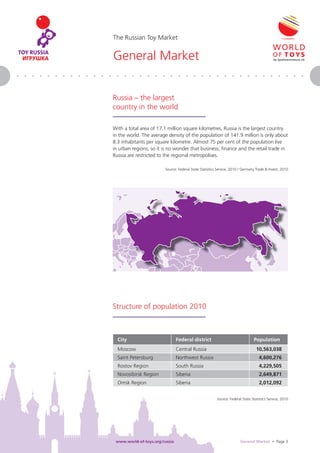
With a total area of 17.1 million square kilometres, Russia is the largest country
in the world. The average density of the population of 141.9 million is only about
8.3 inhabitants per square kilometre. Almost 75 per cent of the population live
in urban regions, so it is no wonder that business, finance and the retail trade in
Russia are restricted to the regional metropolises.

                        Source: Federal State Statistics Service, 2010 / Germany Trade & Invest, 2010


Structure of population 2010


  City                          Federal district                               Population
  Moscow                        Central Russia                                   10,563,038
  Saint Petersburg              Northwest Russia                                   4,600,276
  Rostov Region                 South Russia                                       4,229,505
  Novosibirsk Region            Siberia                                            2,649,871
  Omsk Region                   Siberia                                            2,012,092


                                                        Source: Federal State Statistics Service, 2010


 www.world-of-toys.org/russia                                          General Market • Page 3
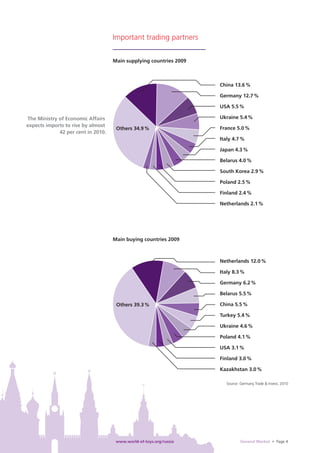
Important trading partners


                                    Main supplying countries 2009


                                                                    China 13.6 %

                                                                    Germany 12.7 %

                                                                    USA 5.5 %

The Ministry of Economic Affairs                                    Ukraine 5.4 %
expects imports to rise by almost
                                     Others 34.9 %                  France 5.0 %
             42 per cent in 2010.
                                                                    Italy 4.7 %

                                                                    Japan 4.3 %

                                                                    Belarus 4.0 %

                                                                    South Korea 2.9 %

                                                                    Poland 2.5 %

                                                                    Finland 2.4 %

                                                                    Netherlands 2.1 %


                                    Main buying countries 2009


                                                                    Netherlands 12.0 %

                                                                    Italy 8.3 %

                                                                    Germany 6.2 %

                                                                    Belarus 5.5 %

                                     Others 39.3 %                  China 5.5 %

                                                                    Turkey 5.4 %

                                                                    Ukraine 4.6 %

                                                                    Poland 4.1 %

                                                                    USA 3.1 %

                                                                    Finland 3.0 %

                                                                    Kazakhstan 3.0 %

                                                                      Source: Germany Trade & Invest, 2010


                                     www.world-of-toys.org/russia             General Market • Page 4
Development potential of
                                    retail trade

                                    • In terms of the attractiveness of the retail trade, Russia is still the leader in
                                      Eastern Europe and one of the top destinations for foreign investment.
                                    • The modern forms of retail trade and the establishment of trading chains con-
                                      tinued to develop dynamically in 2009, whereas the importance of unregulated
                                      markets and fairs declined.
                                    • The specialist trade dominates heavily in Russia; the sales share of so-called
                                      hypermarkets is larger than in other market segments.
                                    • The Ministry of Economic Affairs expects retail trade sales to grow by at least
                                      4 per cent in 2010 and 2011.

                                    Source: A. T. Kearney, Global Retail Development Index, 2010 / Germany Trade & Invest, 2010 / RNTA Expo, 2010


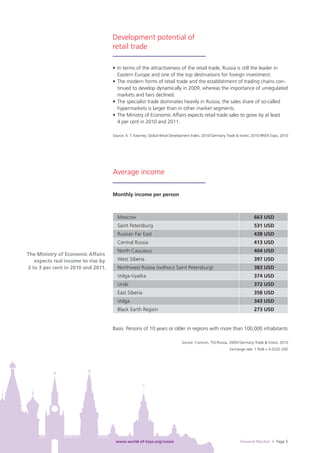
                                    Average income

                                    Monthly income per person


                                      Moscow                                                                               663 USD
                                      Saint Petersburg                                                                     531 USD
                                      Russian Far East                                                                     438 USD
                                      Central Russia                                                                       413 USD
                                      North Caucasus                                                                       404 USD
The Ministry of Economic Affairs
   expects real income to rise by     West Siberia                                                                         397 USD
2 to 3 per cent in 2010 and 2011.     Northwest Russia (without Saint Petersburg)                                          383 USD
                                      Volga-Vyatka                                                                         374 USD
                                      Urals                                                                                372 USD
                                      East Siberia                                                                         358 USD
                                      Volga                                                                                343 USD
                                      Black Earth Region                                                                   273 USD


                                    Basis: Persons of 10 years or older in regions with more than 100,000 inhabitants

                                                                              Source: Comcon, TGI-Russia, 2009 / Germany Trade & Invest, 2010
                                                                                                            Exchange rate: 1 RUB = 0.0332 USD


                                     www.world-of-toys.org/russia                                                  General Market • Page 5
Average income


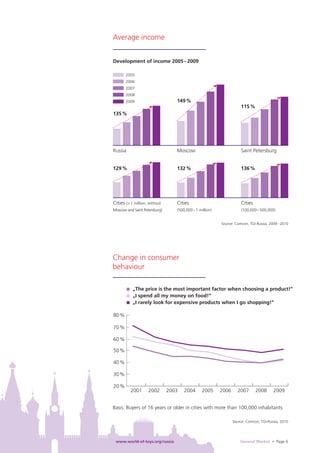
Development of income 2005 – 2009

       2005
       2006
       2007
       2008
       2009                       149 %
                                                                     115 %
135 %


Russia                            Moscow                             Saint Petersburg


129 %                             132 %                              136 %


Cities (> 1 million; without      Cities                             Cities
Moscow and Saint Petersburg)      (500,000 – 1 million)              (100,000 – 500,000)


                                                          Source: Comcon, TGI-Russia, 2009 – 2010


Change in consumer
behaviour

           „The price is the most important factor when choosing a product!“
           „I spend all my money on food!“
           „I rarely look for expensive products when I go shopping!“

80 %

70 %

60 %

50 %

40 %

30 %

20 %
          2001      2002       2003   2004       2005     2006     2007       2008      2009


Basis: Buyers of 16 years or older in cities with more than 100,000 inhabitants

                                                                 Source: Comcon, TGI-Russia, 2010


 www.world-of-toys.org/russia                                        General Market • Page 6
Change in consumer
                                    behaviour

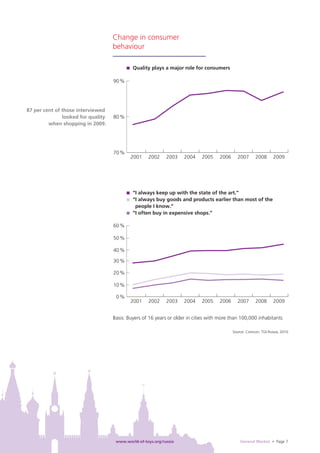
                                             Quality plays a major role for consumers

                                    90 %


87 per cent of those interviewed
               looked for quality   80 %
         when shopping in 2009.


                                    70 %
                                            2001    2002     2003    2004    2005    2006     2007       2008      2009


                                             “I always keep up with the state of the art.”
                                             “I always buy goods and products earlier than most of the
                                              people I know.”
                                             “I often buy in expensive shops.”

                                    60 %

                                    50 %

                                    40 %

                                    30 %

                                    20 %

                                    10 %

                                     0%
                                            2001    2002     2003    2004    2005    2006     2007       2008      2009


                                    Basis: Buyers of 16 years or older in cities with more than 100,000 inhabitants

                                                                                            Source: Comcon, TGI-Russia, 2010


                                     www.world-of-toys.org/russia                               General Market • Page 7
The Russian Toy Market


Toy Market


General market
information

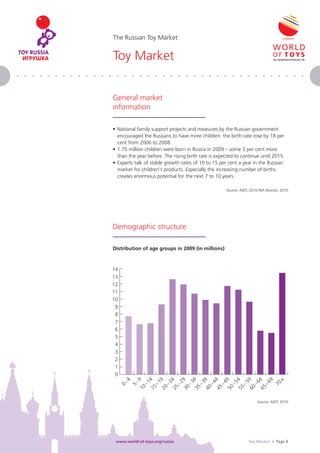
• National family support projects and measures by the Russian government
  encouraged the Russians to have more children: the birth rate rose by 18 per
  cent from 2006 to 2008.
• 1.75 million children were born in Russia in 2009 – some 3 per cent more
  than the year before. The rising birth rate is expected to continue until 2015.
• Experts talk of stable growth rates of 10 to 15 per cent a year in the Russian
  market for children‘s products. Especially the increasing number of births
  creates enormous potential for the next 7 to 10 years.

                                                     Source: AIDT, 2010 / RIA Novosti, 2010


Demographic structure

Distribution of age groups in 2009 (in millions)


14
13
12
11
10
 9
 8
 7
 6
 5
 4
 3
 2
 1
 0
      4

           10 9

           15 4

           20 9

           25 4

           30 9

           35 4

           40 9

           45 4

           50 9

           55 4

           60 9

           65 4
                9

                +
             –1

             –1

             –2

             –2

             –3

             –3

             –4

             –4

             –5

             –5

             –6

             –6
     0–

          5–


             70


                                                                        Source: AIDT, 2010


 www.world-of-toys.org/russia                                     Toy Market • Page 8
Demographic structure

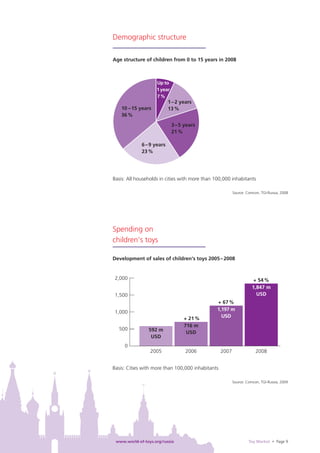
Age structure of children from 0 to 15 years in 2008


                    Up to
                    1 year
                    7%
                           1 – 2 years
   10 – 15 years           13 %
   36 %
                             3 – 5 years
                             21 %

             6 – 9 years
             23 %


Basis: All households in cities with more than 100,000 inhabitants

                                                          Source: Comcon, TGI-Russia, 2008


Spending on
children‘s toys

Development of sales of children‘s toys 2005 – 2008


 2,000                                                               + 54 %
                                                                     1,847 m
 1,500                                                                 USD
                                                + 67 %
                                                1,197 m
 1,000
                                  + 21 %          USD
                                  716 m
  500           592 m              USD
                 USD
     0
                 2005              2006            2007                2008


Basis: Cities with more than 100,000 inhabitants

                                                          Source: Comcon, TGI-Russia, 2009


 www.world-of-toys.org/russia                                      Toy Market • Page 9
Spending on
                                       children`s toys

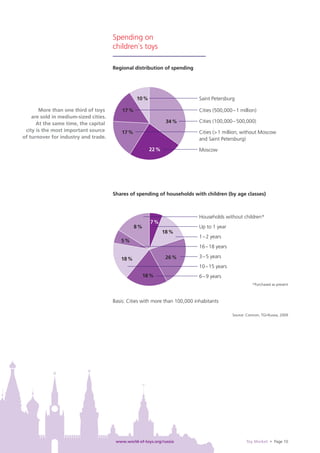
                                       Regional distribution of spending


                                                  10 %                        Saint Petersburg

       More than one third of toys         17 %                               Cities (500,000 – 1 million)
    are sold in medium-sized cities.
      At the same time, the capital                              34 %         Cities (100,000 – 500,000)
 city is the most important source         17 %                               Cities (> 1 million; without Moscow
of turnover for industry and trade.                                           and Saint Petersburg)

                                                         22 %                 Moscow


                                       Shares of spending of households with children (by age classes)


                                                                              Households without children*
                                                         7%
                                                  8%                          Up to 1 year
                                                                18 %
                                                                              1 – 2 years
                                          5%
                                                                              16 – 18 years

                                          18 %                   26 %         3 – 5 years
                                                                              10 – 15 years
                                                    18 %                      6 – 9 years
                                                                                                         *Purchased as present


                                       Basis: Cities with more than 100,000 inhabitants

                                                                                              Source: Comcon, TGI-Russia, 2009


                                        www.world-of-toys.org/russia                                 Toy Market • Page 10
Toy purchases in a
                                three-months period


                                 80 %


                                 60 %                                                       65 %
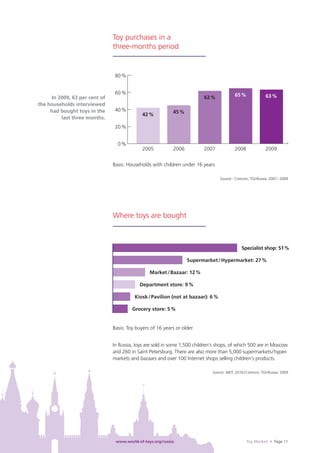
      In 2009, 63 per cent of                                              62 %                               63 %
the households interviewed
     had bought toys in the      40 %                       45 %
                                              42 %
          last three months.
                                 20 %


                                  0%
                                              2005          2006           2007             2008              2009


                                Basis: Households with children under 16 years

                                                                                   Source:: Comcon, TGI-Russia, 2007 – 2009


                                Where toys are bought


                                                                                                Specialist shop: 51 %

                                                                   Supermarket / Hypermarket: 27 %

                                                 Market / Bazaar: 12 %

                                            Department store: 9 %

                                          Kiosk / Pavilion (not at bazaar): 6 %

                                         Grocery store: 5 %


                                Basis: Toy buyers of 16 years or older


                                In Russia, toys are sold in some 1,500 children‘s shops, of which 500 are in Moscow
                                and 260 in Saint Petersburg. There are also more than 5,000 supermarkets / hyper-
                                markets and bazaars and over 100 Internet shops selling children‘s products.

                                                                               Source: AIDT, 2010 / Comcon, TGI-Russia, 2009


                                 www.world-of-toys.org/russia                                      Toy Market • Page 11
Factors in the choice of toys


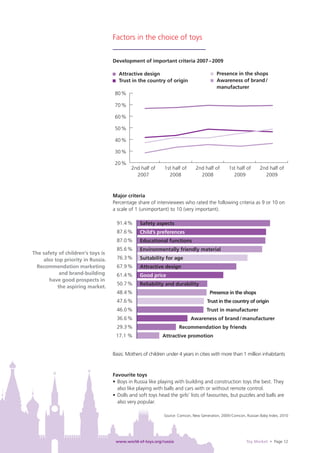
                                   Development of important criteria 2007 – 2009

                                      Attractive design                                   Presence in the shops
                                      Trust in the country of origin                      Awareness of brand /
                                                                                          manufacturer
                                    80 %

                                    70 %

                                    60 %

                                    50 %

                                    40 %

                                    30 %

                                    20 %
                                            2nd half of      1st half of      2nd half of        1st half of      2nd half of
                                              2007             2008             2008               2009             2009


                                   Major criteria
                                   Percentage share of interviewees who rated the following criteria as 9 or 10 on
                                   a scale of 1 (unimportant) to 10 (very important).

                                     91.4 %     Safety aspects
                                     87.6 %     Child’s preferences
                                     87.0 %     Educational functions
                                     85.6 %     Environmentally friendly material
The safety of children‘s toys is
    also top priority in Russia.     76.3 %     Suitability for age
  Recommendation marketing           67.9 %     Attractive design
           and brand-building        61.4 %     Good price
       have good prospects in
                                     50.7 %     Reliability and durability
          the aspiring market.
                                     48.4 %                                           Presence in the shops
                                     47.6 %                                         Trust in the country of origin
                                     46.0 %                                         Trust in manufacturer
                                     36.6 %                                Awareness of brand / manufacturer
                                     29.3 %                         Recommendation by friends
                                    17.1 %                  Attractive promotion


                                   Basis: Mothers of children under 4 years in cities with more than 1 million inhabitants


                                   Favourite toys
                                   • Boys in Russia like playing with building and construction toys the best. They
                                     also like playing with balls and cars with or without remote control.
                                   • Dolls and soft toys head the girls‘ lists of favourites, but puzzles and balls are
                                     also very popular.

                                                            Source: Comcon, New Generation, 2009 / Comcon, Russian Baby Index, 2010


                                    www.world-of-toys.org/russia                                           Toy Market • Page 12
The Russian Toy Market


              Sales Structures*


              Distributors                         Importers
              (mainly brands of European           (mainly China)
              manufacturers)


              1.    Saks                           1.   Simbat
              2.    Unitoys-M                      2.   Alisa
              3.    Gulliver                       3.   Grand Toys
              4.    S-Toys                         4.   Nasha Mama
              5.    LK-99                          5.   Premier-Igrushka


              Manufacturers                        Retail trade

              1.    Nordplast                      1.   Detski Mir
              2.    Zvezda                         2.   Begemot
              3.    Vesna                          3.   Dety / Zdorovyj Malysh
              4.    Stellar                        4.   Korablik
              5.    Russkij Stil                   5.   Dochki-Synochki
              6.    Elf Market
              7.    Tom-Servis (Tomik)
              8.    Smolyenskiye Igrushki
              9.    Drofa-Media
              10.   Step Puzzle                               *Arranged according to market shares
                                                                               Source: RNTA, 2010


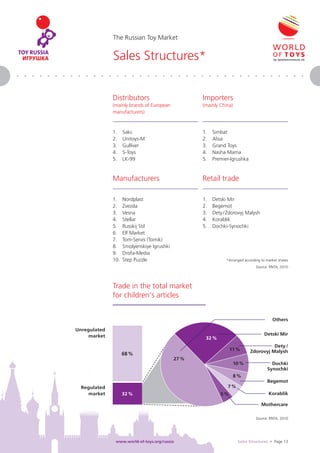
              Trade in the total market
              for children‘s articles


                                                                                        Others

Unregulated
     market                                                                         Detski Mir
                                                    32 %
                                                                                     Dety /
                                                                11 %       Zdorovyj Malysh
                    68 %
                                            27 %
                                                                 10 %                  Dochki
                                                                                     Synochki
                                                                    8%
                                                                                     Begemot
  Regulated                                                    7%
     market         32 %                                   5%                         Korablik

                                                                                  Mothercare

                                                                               Source: RNTA, 2010


               www.world-of-toys.org/russia                          Sales Structures • Page 13
The Russian Toy Market


                                Russian Etiquette


                                Body language

                                The Russians are mostly considered as “stony” in public, as they are reluctant
                                to show their emotions to strangers. In familiar surroundings, however, and
                                especially in established business relationships, the Russians usually seek close
                                contact. This is shown by a light pat on the back or a hearty embrace of their
                                counterpart to express satisfaction and liking.

                                Business

  Check shortly before an       “Zavtra” means “tomorrow” in Russian and is very often used in Russia. This
appointment to make sure        mentality is a major change for many Western businesspeople and you must adjust
   it really will take place.   to it. Many things are not done immediately, but usually not until tomorrow, and
                                appointments are accordingly not always kept. In terms of specific situations, this
                                means you should check before a meeting to make sure it will actually take place.
                                Your Russian business partners will also try to establish a personal relationship with
                                you to find out whom they are dealing with. You should therefore also take lots
                                of time for your business partner in this respect beyond the level of small talk. You
                                should take invitations to sightseeing tours and visits to the theatre or their weekend
                                cottage (Datscha) on the outskirts of the city just as seriously. The Russians also
                                sometimes quickly change to using personal forms of address.

                                Business meals

        The host proposes       Dining with business friends usually means four- to five-course meals. If you
            the first toast.     are full up before the end of the meal, you should politely indicate – ideally with
                                a few Russian words – that it tasted good (“Spasiba, bylo otschen wkusno”)
                                or you can’t eat any more (“Spasiba”). The cliché of constantly drinking vodka
                                is outdated, however, as Russians must also be fit to work the next day. If the
                                ability to hold one’s drink is to be tested, the first toast is made by the host.

                                Business negotiations

                                Anyone wanting to do business in Russia should expect long negotiations. Spon-
                                taneous solutions tend to be seldom, as everything possible must be discussed
                                and planned in order to avoid risks. Compromises are only accepted if the business
                                partner is also prepared to make appropriate concessions. Your business partner
                                will attempt to assert as many of his own interests as possible – and you should
                                also firmly represent your position because power plays a major role as well. But
                                be careful! Do not show a strong negotiating position too obviously because this
                                could damage your counterpart‘s pride. As Russians distrust anything official and
                                rely on personal contacts, this could then be your downfall.


                                 www.world-of-toys.org/russia                               Russian Etiquette • Page 14
Greeting

                 Hello =    Shake hands with your host as greeting and say “Sdrastwuitje” or “Dobri djien”
Sdrastwuitje, Dobri djien   (Hello). You can follow this up with “Kak vashi dela?” (How are you?). On official
        How are you? =      occasions, address people by their title and surname, older or senior people by
        Kak vashi dela?     their first name and patronym.

                            Language

                            Many Russians think it is essential for business partners to speak Russian. If you
                            do not speak the language, you should at least obtain an interpreter because
                            this is the only way you can actually achieve anything.

                            Mobile phones

                            In your dealings with Russian business partners, you must always expect your
                            counterpart to answer their mobile phone when it rings. Rejecting a call is
                            regarded as impolite. On the contrary, the Russian apologises to the caller and
                            calls back later. So expect to hear mobiles ringing in all situations.

                            Numbers and colours

                            Certain numbers and colours also have special meanings in Russia. Three, seven
                            and twelve are positive numbers and thirteen as a “baker’s dozen” is negative.
                            Red symbolises joy and beauty, green hope and blue stands for loyalty. Black
                            stands for illegality or sadness, white as well, which is also associated with purity
                            and innocence.

                            Presents

     Small presents help    It is usual to offer presents in Russian business relationships. The interest of the
    to preserve business    new business partner should be aroused by promotional gifts from your own
           relationships.   company or souvenirs from your home country at the beginning of the cooperation.
                            The more familiar the relationship with your business partner becomes, the more
                            personal the choice of your present should be.

                            Small presents from guests are also appreciated for private visits. Presents such
                            as exquisitely packed fine chocolates or typical delicacies from your home country
                            are welcomed with pleasure. If you wish to present a bunch of flowers, you should
                            note the following: your host/hostess will only be pleased to receive long-stemmed
                            flowers and only an odd number of them. White or yellow flowers, especially
                            yellow roses, are extremely unsuitable as presents, as they symbolise approaching
                            death or sadness for the recipient.


                             www.world-of-toys.org/russia                              Russian Etiquette • Page 15
Status

Always arrive by taxi     Show what you have! You should possess status symbols appropriate to your
 or private limousine.    position and also show them. You should also pay due respect to the minor and
                          major possessions of your counterpart. Important for travel: always arrive by
                          taxi or private limousine, even though public transport is quicker because of the
                          traffic chaos.

                          Superstition

           Kick back!     Russians are very superstitious. Guests are therefore not greeted on the doorstep.
                          You should certainly not whistle in the presence of your host – he will think he
                          is threatened with financial disaster. The same applies if you lay your key on the
                          table. And don’t be surprised to be kicked back if you accidentally kick someone.
                          According to superstition, this avoids a serious conflict for both parties.

                          Taboos

Avoid direct criticism.   It’s best to ask where you can wash your hands and not use the word “toilet” at
                          all. Never use handkerchiefs at the table either, only in the bathroom. Also avoid
                          direct criticism and criticise very diplomatically in a roundabout way. Never speak
                          badly of the czar family, which is highly respected in Russia. You should also avoid
                          talking politics; here it is best to pretend you cannot assess the situation well
                          enough.

                          Women

  The woman offers        Women are allowed to show their femininity in Russia, dress elegantly and wear
      her hand first.      appropriate make-up, but showing too much skin should be avoided. A masculine
                          manner is frowned upon, so the men always pay the bills. For greetings and
                          goodbyes, the women decide for themselves whom they shake hands with. This
                          means the woman makes the first move, the man must wait. A slight nod of the
                          head and brief eye contact are usual as an alternative.

                                           Source: www.russlandjournal.de / www.wiwo.de / www.leitz.de / www.reiseknigge.eu


                           www.world-of-toys.org/russia                                     Russian Etiquette • Page 16

Business Guide in Russia

  • 1.
    BusinessGuide The Russian Toy Market ASIA-PACIFIC INDIA JAPAN MIDDLE EAST NORTH AMERICA RUSSIA SOUTH AMERICA www.toy-russia.de www.world-of-toys.org/russia
  • 2.
    The Russian ToyMarket Contents General Market 3 Toy Market 8 Sales Structures 13 Russian Etiquette 14 This brochure is also available on the Internet at www.world-of-toys.org/russia All information has been researched and compiled to the best of our knowledge and belief, but no responsibility is accepted for errors. September 2010 www.world-of-toys.org/russia Gesamtmarkt • Seite 2
  • 3.
    The Russian ToyMarket General Market Russia – the largest country in the world With a total area of 17.1 million square kilometres, Russia is the largest country in the world. The average density of the population of 141.9 million is only about 8.3 inhabitants per square kilometre. Almost 75 per cent of the population live in urban regions, so it is no wonder that business, finance and the retail trade in Russia are restricted to the regional metropolises. Source: Federal State Statistics Service, 2010 / Germany Trade & Invest, 2010 Structure of population 2010 City Federal district Population Moscow Central Russia 10,563,038 Saint Petersburg Northwest Russia 4,600,276 Rostov Region South Russia 4,229,505 Novosibirsk Region Siberia 2,649,871 Omsk Region Siberia 2,012,092 Source: Federal State Statistics Service, 2010 www.world-of-toys.org/russia General Market • Page 3
  • 4.
    Important trading partners Main supplying countries 2009 China 13.6 % Germany 12.7 % USA 5.5 % The Ministry of Economic Affairs Ukraine 5.4 % expects imports to rise by almost Others 34.9 % France 5.0 % 42 per cent in 2010. Italy 4.7 % Japan 4.3 % Belarus 4.0 % South Korea 2.9 % Poland 2.5 % Finland 2.4 % Netherlands 2.1 % Main buying countries 2009 Netherlands 12.0 % Italy 8.3 % Germany 6.2 % Belarus 5.5 % Others 39.3 % China 5.5 % Turkey 5.4 % Ukraine 4.6 % Poland 4.1 % USA 3.1 % Finland 3.0 % Kazakhstan 3.0 % Source: Germany Trade & Invest, 2010 www.world-of-toys.org/russia General Market • Page 4
  • 5.
    Development potential of retail trade • In terms of the attractiveness of the retail trade, Russia is still the leader in Eastern Europe and one of the top destinations for foreign investment. • The modern forms of retail trade and the establishment of trading chains con- tinued to develop dynamically in 2009, whereas the importance of unregulated markets and fairs declined. • The specialist trade dominates heavily in Russia; the sales share of so-called hypermarkets is larger than in other market segments. • The Ministry of Economic Affairs expects retail trade sales to grow by at least 4 per cent in 2010 and 2011. Source: A. T. Kearney, Global Retail Development Index, 2010 / Germany Trade & Invest, 2010 / RNTA Expo, 2010 Average income Monthly income per person Moscow 663 USD Saint Petersburg 531 USD Russian Far East 438 USD Central Russia 413 USD North Caucasus 404 USD The Ministry of Economic Affairs expects real income to rise by West Siberia 397 USD 2 to 3 per cent in 2010 and 2011. Northwest Russia (without Saint Petersburg) 383 USD Volga-Vyatka 374 USD Urals 372 USD East Siberia 358 USD Volga 343 USD Black Earth Region 273 USD Basis: Persons of 10 years or older in regions with more than 100,000 inhabitants Source: Comcon, TGI-Russia, 2009 / Germany Trade & Invest, 2010 Exchange rate: 1 RUB = 0.0332 USD www.world-of-toys.org/russia General Market • Page 5
  • 6.
    Average income Development ofincome 2005 – 2009 2005 2006 2007 2008 2009 149 % 115 % 135 % Russia Moscow Saint Petersburg 129 % 132 % 136 % Cities (> 1 million; without Cities Cities Moscow and Saint Petersburg) (500,000 – 1 million) (100,000 – 500,000) Source: Comcon, TGI-Russia, 2009 – 2010 Change in consumer behaviour „The price is the most important factor when choosing a product!“ „I spend all my money on food!“ „I rarely look for expensive products when I go shopping!“ 80 % 70 % 60 % 50 % 40 % 30 % 20 % 2001 2002 2003 2004 2005 2006 2007 2008 2009 Basis: Buyers of 16 years or older in cities with more than 100,000 inhabitants Source: Comcon, TGI-Russia, 2010 www.world-of-toys.org/russia General Market • Page 6
  • 7.
    Change in consumer behaviour Quality plays a major role for consumers 90 % 87 per cent of those interviewed looked for quality 80 % when shopping in 2009. 70 % 2001 2002 2003 2004 2005 2006 2007 2008 2009 “I always keep up with the state of the art.” “I always buy goods and products earlier than most of the people I know.” “I often buy in expensive shops.” 60 % 50 % 40 % 30 % 20 % 10 % 0% 2001 2002 2003 2004 2005 2006 2007 2008 2009 Basis: Buyers of 16 years or older in cities with more than 100,000 inhabitants Source: Comcon, TGI-Russia, 2010 www.world-of-toys.org/russia General Market • Page 7
  • 8.
    The Russian ToyMarket Toy Market General market information • National family support projects and measures by the Russian government encouraged the Russians to have more children: the birth rate rose by 18 per cent from 2006 to 2008. • 1.75 million children were born in Russia in 2009 – some 3 per cent more than the year before. The rising birth rate is expected to continue until 2015. • Experts talk of stable growth rates of 10 to 15 per cent a year in the Russian market for children‘s products. Especially the increasing number of births creates enormous potential for the next 7 to 10 years. Source: AIDT, 2010 / RIA Novosti, 2010 Demographic structure Distribution of age groups in 2009 (in millions) 14 13 12 11 10 9 8 7 6 5 4 3 2 1 0 4 10 9 15 4 20 9 25 4 30 9 35 4 40 9 45 4 50 9 55 4 60 9 65 4 9 + –1 –1 –2 –2 –3 –3 –4 –4 –5 –5 –6 –6 0– 5– 70 Source: AIDT, 2010 www.world-of-toys.org/russia Toy Market • Page 8
  • 9.
    Demographic structure Age structureof children from 0 to 15 years in 2008 Up to 1 year 7% 1 – 2 years 10 – 15 years 13 % 36 % 3 – 5 years 21 % 6 – 9 years 23 % Basis: All households in cities with more than 100,000 inhabitants Source: Comcon, TGI-Russia, 2008 Spending on children‘s toys Development of sales of children‘s toys 2005 – 2008 2,000 + 54 % 1,847 m 1,500 USD + 67 % 1,197 m 1,000 + 21 % USD 716 m 500 592 m USD USD 0 2005 2006 2007 2008 Basis: Cities with more than 100,000 inhabitants Source: Comcon, TGI-Russia, 2009 www.world-of-toys.org/russia Toy Market • Page 9
  • 10.
    Spending on children`s toys Regional distribution of spending 10 % Saint Petersburg More than one third of toys 17 % Cities (500,000 – 1 million) are sold in medium-sized cities. At the same time, the capital 34 % Cities (100,000 – 500,000) city is the most important source 17 % Cities (> 1 million; without Moscow of turnover for industry and trade. and Saint Petersburg) 22 % Moscow Shares of spending of households with children (by age classes) Households without children* 7% 8% Up to 1 year 18 % 1 – 2 years 5% 16 – 18 years 18 % 26 % 3 – 5 years 10 – 15 years 18 % 6 – 9 years *Purchased as present Basis: Cities with more than 100,000 inhabitants Source: Comcon, TGI-Russia, 2009 www.world-of-toys.org/russia Toy Market • Page 10
  • 11.
    Toy purchases ina three-months period 80 % 60 % 65 % In 2009, 63 per cent of 62 % 63 % the households interviewed had bought toys in the 40 % 45 % 42 % last three months. 20 % 0% 2005 2006 2007 2008 2009 Basis: Households with children under 16 years Source:: Comcon, TGI-Russia, 2007 – 2009 Where toys are bought Specialist shop: 51 % Supermarket / Hypermarket: 27 % Market / Bazaar: 12 % Department store: 9 % Kiosk / Pavilion (not at bazaar): 6 % Grocery store: 5 % Basis: Toy buyers of 16 years or older In Russia, toys are sold in some 1,500 children‘s shops, of which 500 are in Moscow and 260 in Saint Petersburg. There are also more than 5,000 supermarkets / hyper- markets and bazaars and over 100 Internet shops selling children‘s products. Source: AIDT, 2010 / Comcon, TGI-Russia, 2009 www.world-of-toys.org/russia Toy Market • Page 11
  • 12.
    Factors in thechoice of toys Development of important criteria 2007 – 2009 Attractive design Presence in the shops Trust in the country of origin Awareness of brand / manufacturer 80 % 70 % 60 % 50 % 40 % 30 % 20 % 2nd half of 1st half of 2nd half of 1st half of 2nd half of 2007 2008 2008 2009 2009 Major criteria Percentage share of interviewees who rated the following criteria as 9 or 10 on a scale of 1 (unimportant) to 10 (very important). 91.4 % Safety aspects 87.6 % Child’s preferences 87.0 % Educational functions 85.6 % Environmentally friendly material The safety of children‘s toys is also top priority in Russia. 76.3 % Suitability for age Recommendation marketing 67.9 % Attractive design and brand-building 61.4 % Good price have good prospects in 50.7 % Reliability and durability the aspiring market. 48.4 % Presence in the shops 47.6 % Trust in the country of origin 46.0 % Trust in manufacturer 36.6 % Awareness of brand / manufacturer 29.3 % Recommendation by friends 17.1 % Attractive promotion Basis: Mothers of children under 4 years in cities with more than 1 million inhabitants Favourite toys • Boys in Russia like playing with building and construction toys the best. They also like playing with balls and cars with or without remote control. • Dolls and soft toys head the girls‘ lists of favourites, but puzzles and balls are also very popular. Source: Comcon, New Generation, 2009 / Comcon, Russian Baby Index, 2010 www.world-of-toys.org/russia Toy Market • Page 12
  • 13.
    The Russian ToyMarket Sales Structures* Distributors Importers (mainly brands of European (mainly China) manufacturers) 1. Saks 1. Simbat 2. Unitoys-M 2. Alisa 3. Gulliver 3. Grand Toys 4. S-Toys 4. Nasha Mama 5. LK-99 5. Premier-Igrushka Manufacturers Retail trade 1. Nordplast 1. Detski Mir 2. Zvezda 2. Begemot 3. Vesna 3. Dety / Zdorovyj Malysh 4. Stellar 4. Korablik 5. Russkij Stil 5. Dochki-Synochki 6. Elf Market 7. Tom-Servis (Tomik) 8. Smolyenskiye Igrushki 9. Drofa-Media 10. Step Puzzle *Arranged according to market shares Source: RNTA, 2010 Trade in the total market for children‘s articles Others Unregulated market Detski Mir 32 % Dety / 11 % Zdorovyj Malysh 68 % 27 % 10 % Dochki Synochki 8% Begemot Regulated 7% market 32 % 5% Korablik Mothercare Source: RNTA, 2010 www.world-of-toys.org/russia Sales Structures • Page 13
  • 14.
    The Russian ToyMarket Russian Etiquette Body language The Russians are mostly considered as “stony” in public, as they are reluctant to show their emotions to strangers. In familiar surroundings, however, and especially in established business relationships, the Russians usually seek close contact. This is shown by a light pat on the back or a hearty embrace of their counterpart to express satisfaction and liking. Business Check shortly before an “Zavtra” means “tomorrow” in Russian and is very often used in Russia. This appointment to make sure mentality is a major change for many Western businesspeople and you must adjust it really will take place. to it. Many things are not done immediately, but usually not until tomorrow, and appointments are accordingly not always kept. In terms of specific situations, this means you should check before a meeting to make sure it will actually take place. Your Russian business partners will also try to establish a personal relationship with you to find out whom they are dealing with. You should therefore also take lots of time for your business partner in this respect beyond the level of small talk. You should take invitations to sightseeing tours and visits to the theatre or their weekend cottage (Datscha) on the outskirts of the city just as seriously. The Russians also sometimes quickly change to using personal forms of address. Business meals The host proposes Dining with business friends usually means four- to five-course meals. If you the first toast. are full up before the end of the meal, you should politely indicate – ideally with a few Russian words – that it tasted good (“Spasiba, bylo otschen wkusno”) or you can’t eat any more (“Spasiba”). The cliché of constantly drinking vodka is outdated, however, as Russians must also be fit to work the next day. If the ability to hold one’s drink is to be tested, the first toast is made by the host. Business negotiations Anyone wanting to do business in Russia should expect long negotiations. Spon- taneous solutions tend to be seldom, as everything possible must be discussed and planned in order to avoid risks. Compromises are only accepted if the business partner is also prepared to make appropriate concessions. Your business partner will attempt to assert as many of his own interests as possible – and you should also firmly represent your position because power plays a major role as well. But be careful! Do not show a strong negotiating position too obviously because this could damage your counterpart‘s pride. As Russians distrust anything official and rely on personal contacts, this could then be your downfall. www.world-of-toys.org/russia Russian Etiquette • Page 14
  • 15.
    Greeting Hello = Shake hands with your host as greeting and say “Sdrastwuitje” or “Dobri djien” Sdrastwuitje, Dobri djien (Hello). You can follow this up with “Kak vashi dela?” (How are you?). On official How are you? = occasions, address people by their title and surname, older or senior people by Kak vashi dela? their first name and patronym. Language Many Russians think it is essential for business partners to speak Russian. If you do not speak the language, you should at least obtain an interpreter because this is the only way you can actually achieve anything. Mobile phones In your dealings with Russian business partners, you must always expect your counterpart to answer their mobile phone when it rings. Rejecting a call is regarded as impolite. On the contrary, the Russian apologises to the caller and calls back later. So expect to hear mobiles ringing in all situations. Numbers and colours Certain numbers and colours also have special meanings in Russia. Three, seven and twelve are positive numbers and thirteen as a “baker’s dozen” is negative. Red symbolises joy and beauty, green hope and blue stands for loyalty. Black stands for illegality or sadness, white as well, which is also associated with purity and innocence. Presents Small presents help It is usual to offer presents in Russian business relationships. The interest of the to preserve business new business partner should be aroused by promotional gifts from your own relationships. company or souvenirs from your home country at the beginning of the cooperation. The more familiar the relationship with your business partner becomes, the more personal the choice of your present should be. Small presents from guests are also appreciated for private visits. Presents such as exquisitely packed fine chocolates or typical delicacies from your home country are welcomed with pleasure. If you wish to present a bunch of flowers, you should note the following: your host/hostess will only be pleased to receive long-stemmed flowers and only an odd number of them. White or yellow flowers, especially yellow roses, are extremely unsuitable as presents, as they symbolise approaching death or sadness for the recipient. www.world-of-toys.org/russia Russian Etiquette • Page 15
  • 16.
    Status Always arrive bytaxi Show what you have! You should possess status symbols appropriate to your or private limousine. position and also show them. You should also pay due respect to the minor and major possessions of your counterpart. Important for travel: always arrive by taxi or private limousine, even though public transport is quicker because of the traffic chaos. Superstition Kick back! Russians are very superstitious. Guests are therefore not greeted on the doorstep. You should certainly not whistle in the presence of your host – he will think he is threatened with financial disaster. The same applies if you lay your key on the table. And don’t be surprised to be kicked back if you accidentally kick someone. According to superstition, this avoids a serious conflict for both parties. Taboos Avoid direct criticism. It’s best to ask where you can wash your hands and not use the word “toilet” at all. Never use handkerchiefs at the table either, only in the bathroom. Also avoid direct criticism and criticise very diplomatically in a roundabout way. Never speak badly of the czar family, which is highly respected in Russia. You should also avoid talking politics; here it is best to pretend you cannot assess the situation well enough. Women The woman offers Women are allowed to show their femininity in Russia, dress elegantly and wear her hand first. appropriate make-up, but showing too much skin should be avoided. A masculine manner is frowned upon, so the men always pay the bills. For greetings and goodbyes, the women decide for themselves whom they shake hands with. This means the woman makes the first move, the man must wait. A slight nod of the head and brief eye contact are usual as an alternative. Source: www.russlandjournal.de / www.wiwo.de / www.leitz.de / www.reiseknigge.eu www.world-of-toys.org/russia Russian Etiquette • Page 16