ELEMENTS OF
FINANCIAL
POSITION
ANIMAL
CHORUS
LUPANG HINIRANG
4
BAHAY-KUBO
5
BOOMTARAT-
TARAT
OTSO-OTSO
LERON-LERON
SINTA
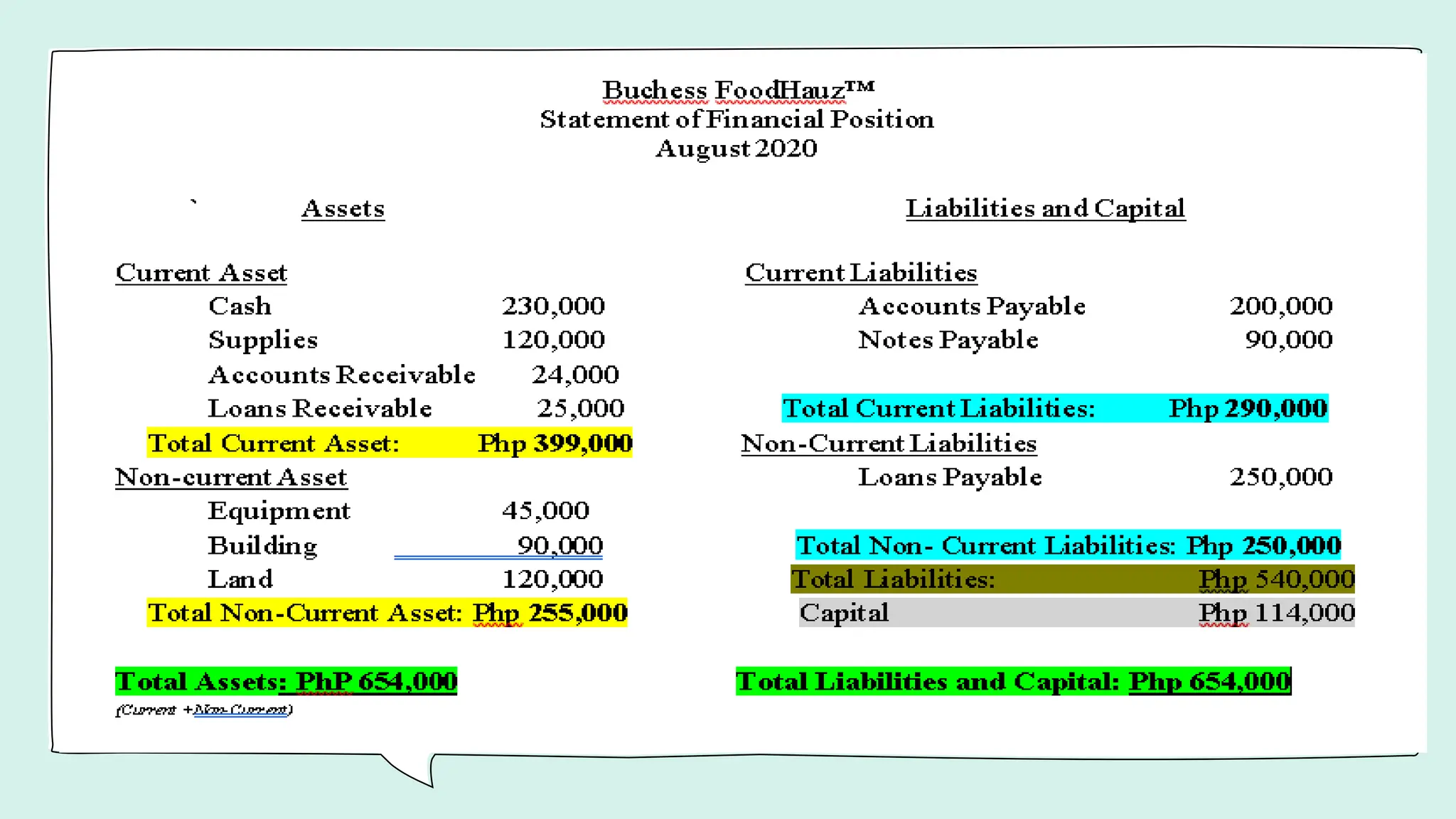
ELEMENTS OF FINANCIAL POSITION
Learning Targets:
 I can differentiate and give examples of current and
non-current assets and liabilities.
 I can exemplify the value of excellence by identifying
properly the elements of Statement of Financial
Position and describe each of them.
A Statement of Financial Position is a financial
statement that reports a company's assets,
liabilities, and shareholders' equity at a specific
point in time. It is a financial statement that
provides a snapshot of what a company owns
and owes, as well as the amount invested by
shareholders. (Hayes, 2020, 1)
Classification of Assets
and Liabilities
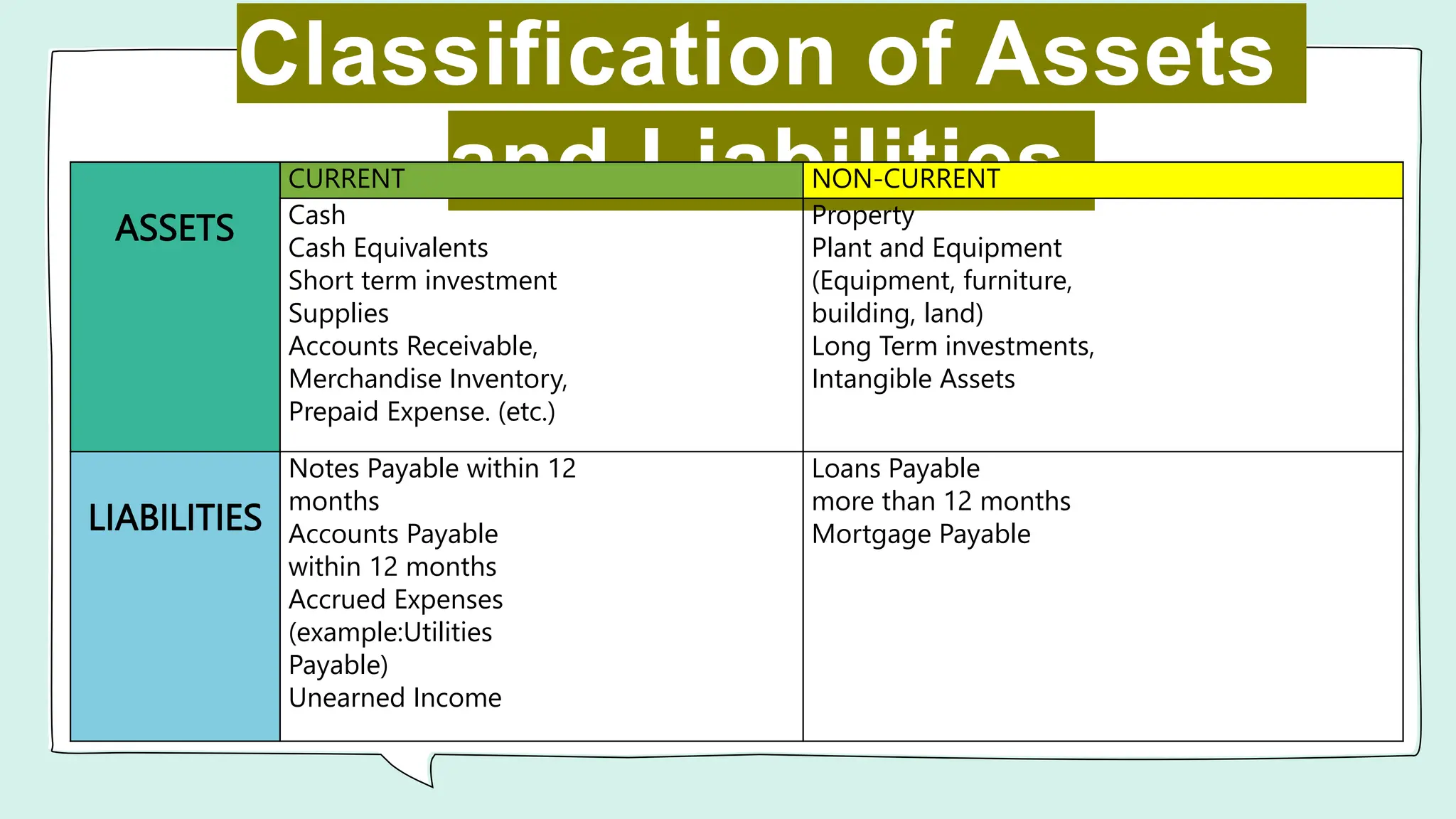
Both assets and liabilities can be classified into two, namely CURRENT and
NON-CURRENT.
Current Assets – Assets that can be realized (collected, sold, used up) one year
after year-end date. Examples include Cash, Accounts Receivable,
Merchandise Inventory, Prepaid Expense, etc.
Noncurrent Assets – Assets that cannot be realized (collected, sold, used up)
one year after yearend date. Examples include Property, Plant and Equipment
(equipment, furniture, building, land), Long Term investments, Intangible
Assets etc
Classification of Assets
and Liabilities
Current Liabilities – Liabilities that fall due (paid, recognized as revenue)
within one year after yearend date. Examples include Notes Payable,
Accounts Payable, Accrued Expenses (example: Utilities Payable),
Unearned Income, etc.
Noncurrent Liabilities – Liabilities that do not fall due (paid, recognized
as revenue) within one year after year-end date. Examples include Loans
Payable, Mortgage Payable, etc.
Classification of Assets
and Liabilities
ASSETS
CURRENT NON-CURRENT
Cash
Cash Equivalents
Short term investment
Supplies
Accounts Receivable,
Merchandise Inventory,
Prepaid Expense. (etc.)
Property
Plant and Equipment
(Equipment, furniture,
building, land)
Long Term investments,
Intangible Assets
LIABILITIES
Notes Payable within 12
months
Accounts Payable
within 12 months
Accrued Expenses
(example:Utilities
Payable)
Unearned Income
Loans Payable
more than 12 months
Mortgage Payable
Capital or Equity
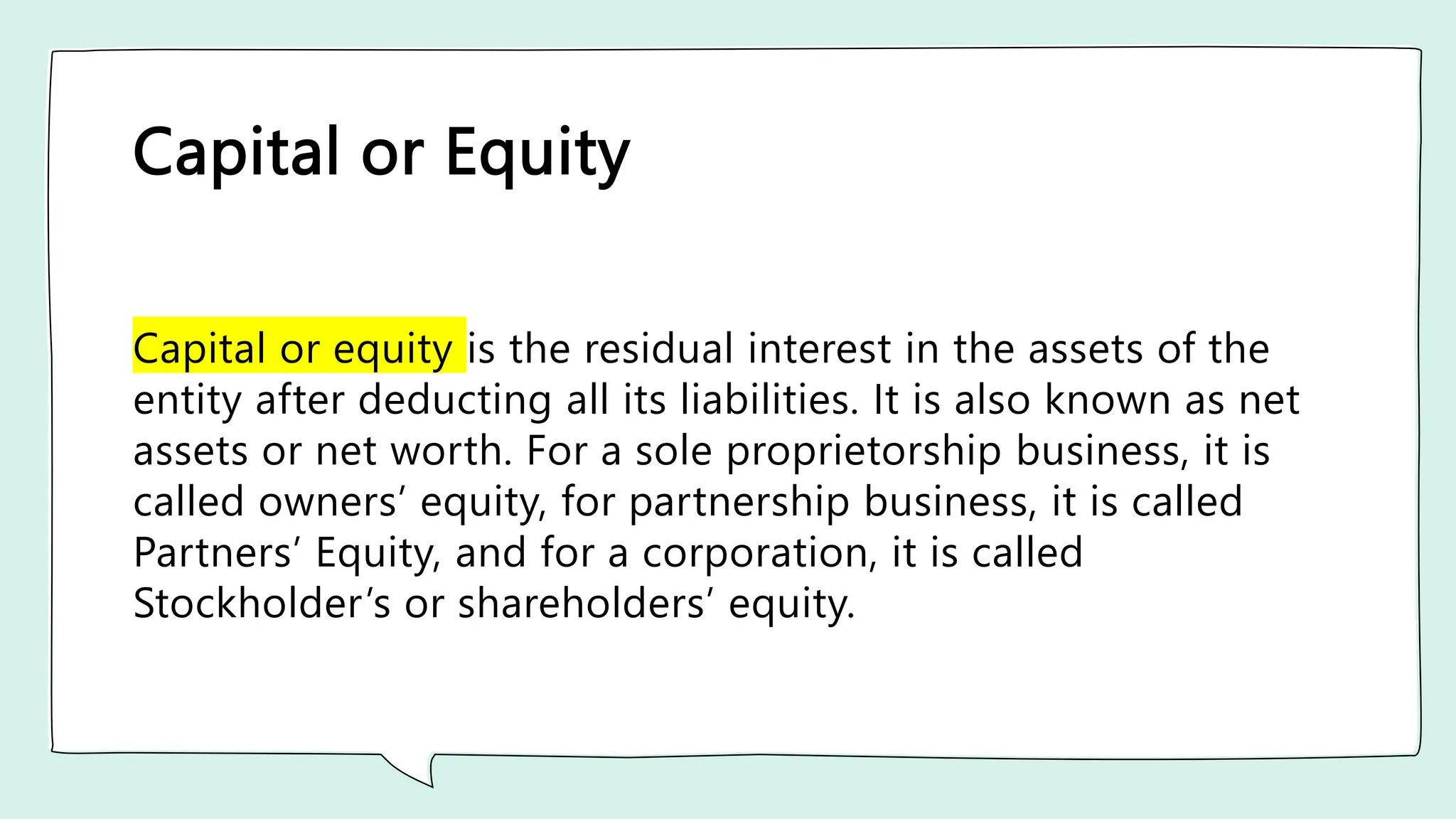
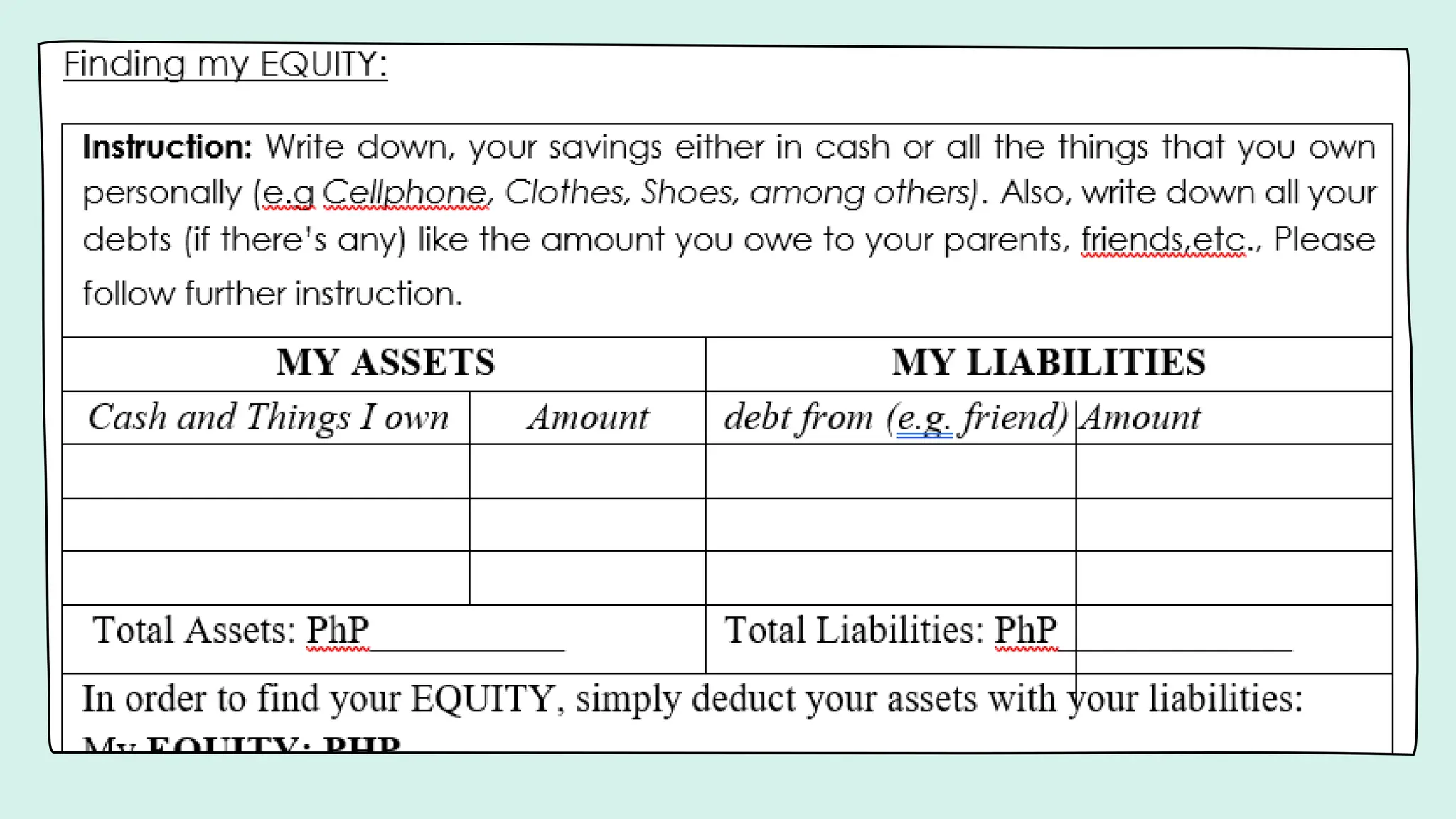
Capital or equity is the residual interest in the assets of the
entity after deducting all its liabilities. It is also known as net
assets or net worth. For a sole proprietorship business, it is
called owners’ equity, for partnership business, it is called
Partners’ Equity, and for a corporation, it is called
Stockholder’s or shareholders’ equity.
Identify the assets from the
given sari-sari store
Is it important to
determine your available
money or other sources
and your daily
expenses?
What company logo is this?
Let us
assess
ourselv
es?
Reference/Instructional Materials
Florendo, J. G. (2016). Fundamentals of
Accountancy, Business, and Management 1.
Quezon City: Rex Book Store Inc, .
Binuya, M. V. (2016). Fundamentals of
Accountancy, Business, and Management (Book
2). Manila,Philippines: JFS Publishing Services.
Mr. Lester Ryan A. Alcana,CPA- Mindanao Mission Academy-
learning module for grade 12 fundamentals of accountancy,
business, and management 2.

Business Finance_Week1_Lesson1 Fundamentals

  • 2.
  • 3.
  • 4.
  • 5.
  • 6.
  • 7.
  • 8.
  • 9.
    ELEMENTS OF FINANCIALPOSITION Learning Targets:  I can differentiate and give examples of current and non-current assets and liabilities.  I can exemplify the value of excellence by identifying properly the elements of Statement of Financial Position and describe each of them.
  • 13.
    A Statement ofFinancial Position is a financial statement that reports a company's assets, liabilities, and shareholders' equity at a specific point in time. It is a financial statement that provides a snapshot of what a company owns and owes, as well as the amount invested by shareholders. (Hayes, 2020, 1)
  • 14.
    Classification of Assets andLiabilities Both assets and liabilities can be classified into two, namely CURRENT and NON-CURRENT. Current Assets – Assets that can be realized (collected, sold, used up) one year after year-end date. Examples include Cash, Accounts Receivable, Merchandise Inventory, Prepaid Expense, etc. Noncurrent Assets – Assets that cannot be realized (collected, sold, used up) one year after yearend date. Examples include Property, Plant and Equipment (equipment, furniture, building, land), Long Term investments, Intangible Assets etc
  • 15.
    Classification of Assets andLiabilities Current Liabilities – Liabilities that fall due (paid, recognized as revenue) within one year after yearend date. Examples include Notes Payable, Accounts Payable, Accrued Expenses (example: Utilities Payable), Unearned Income, etc. Noncurrent Liabilities – Liabilities that do not fall due (paid, recognized as revenue) within one year after year-end date. Examples include Loans Payable, Mortgage Payable, etc.
  • 16.
    Classification of Assets andLiabilities ASSETS CURRENT NON-CURRENT Cash Cash Equivalents Short term investment Supplies Accounts Receivable, Merchandise Inventory, Prepaid Expense. (etc.) Property Plant and Equipment (Equipment, furniture, building, land) Long Term investments, Intangible Assets LIABILITIES Notes Payable within 12 months Accounts Payable within 12 months Accrued Expenses (example:Utilities Payable) Unearned Income Loans Payable more than 12 months Mortgage Payable
  • 17.
    Capital or Equity Capitalor equity is the residual interest in the assets of the entity after deducting all its liabilities. It is also known as net assets or net worth. For a sole proprietorship business, it is called owners’ equity, for partnership business, it is called Partners’ Equity, and for a corporation, it is called Stockholder’s or shareholders’ equity.
  • 18.
    Identify the assetsfrom the given sari-sari store
  • 20.
    Is it importantto determine your available money or other sources and your daily expenses?
  • 22.
  • 23.
  • 24.
    Reference/Instructional Materials Florendo, J.G. (2016). Fundamentals of Accountancy, Business, and Management 1. Quezon City: Rex Book Store Inc, . Binuya, M. V. (2016). Fundamentals of Accountancy, Business, and Management (Book 2). Manila,Philippines: JFS Publishing Services. Mr. Lester Ryan A. Alcana,CPA- Mindanao Mission Academy- learning module for grade 12 fundamentals of accountancy, business, and management 2.