Emotions, Moods and Values
PRACTICE AND IMPLICATION IN LOCAL ORGANIZATION
Presenting to you
(Group # C)
Rahat Ferdous
Esrar Uddin khan
Md. Sharif Khan
INDUSTRY ANALYSIS
TELECOMMUNICATION
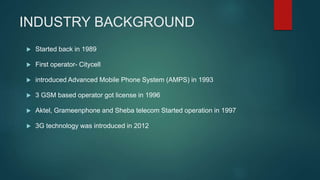
INDUSTRY BACKGROUND
 Started back in 1989
 First operator- Citycell
 introduced Advanced Mobile Phone System (AMPS) in 1993
 3 GSM based operator got license in 1996
 Aktel, Grameenphone and Sheba telecom Started operation in 1997
 3G technology was introduced in 2012
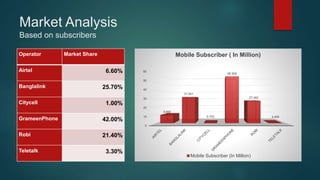
Market Analysis
Based on subscribers
0
10
20
30
40
50
60
9.892
31.941
0.702
56.909
27.442
4.490
Mobile Subscriber ( In Million)
Mobile Subscriber (In Million)
Operator Market Share
Airtel 6.60%
Banglalink 25.70%
Citycell 1.00%
GrameenPhone 42.00%
Robi 21.40%
Teletalk 3.30%
Company Analysis
ROBI AXIATA LIMITED
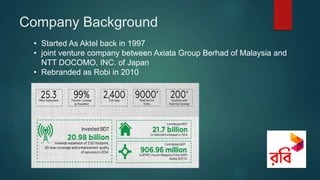
Company Background
• Started As Aktel back in 1997
• joint venture company between Axiata Group Berhad of Malaysia and
NTT DOCOMO, INC. of Japan
• Rebranded as Robi in 2010
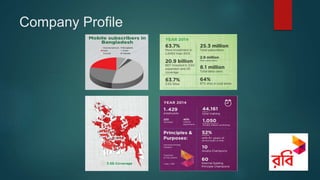
Company Profile
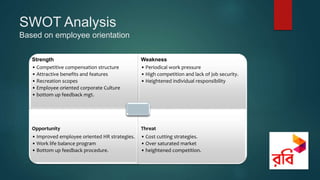
SWOT Analysis
Based on employee orientation
Strength
• Competitive compensation structure
• Attractive benefits and features
• Recreation scopes
• Employee oriented corporate Culture
• bottom up feedback mgt.
Weakness
• Periodical work pressure
• High competition and lack of job security.
• Heightened individual responsibility
Opportunity
• Improved employee oriented HR strategies.
• Work life balance program
• Bottom up feedback procedure.
Threat
• Cost cutting strategies.
• Over saturated market
• heightened competition.
Case 01
Organizational stress and practices of stress management
Scenario:
 Mr. Ahmed Ullah Chowdhury has encountered with excessive work pressure
 Key Performance Index (KPI) was set too high
 Periodical target was set without proper sales forecasting method
 Significant drop in sales has observed.
 Rise in absenteeism identified.
Case 01
Key Findings
 Target was not set on a rational basis
 Stress management process was not executed despite of the privilege
 Lack of work life balance
 Supervisor was not prompt in taking actions
 Moods and emotions are greatly influenced by work stress.
Case 01
Discussion Questions
 Is stress management is considered with significance in the organization?
 Was the supervisor aware about the stressing impact of the excessive work pressure?
 Despite of the presence of the scopes of annual/casual leaves, do supervisors really appreciate
their employees to take breaks from their work schedule?
 Though company facilitated Mr. Ahmed with scopes of managing stress, what made him unable to
utilize that opportunity?
 Is it always negative for an employee to be on stress? Explain.
 What are the future course of actions that might help the company to have a balanced environment
with reduced stress?
Case 02
Organizational Values and its implication in the organization
Situation 01
 Ms. Maniza Tabassum works in customer care center
 Recognized for creating exceptional customer service
 Proper value orientation has been done though company value workshop
 Crossed extra mile for creating customer delight
Case 02
Organizational Values and its implication in the organization
Situation 02
 Frontline employees emotional state hindering quality customer service.
 Employees are facing emotional dissonance.
 Organizational values fail if it lacks proper orientation.
 Job limitations often conflict with organizational values.
Case 02
Key Findings
 A balanced mix of individual values and organizational values works best.
 Employee’s mental state is an inevitable issue.
 There isn’t much effort on identifying the issues which leads to employee dissatisfaction.
 It’s not always possible to act or execute certain things because of the limitations in authority.
 There could be a conflict between the value sets and the job limitations.
 Empathy, presence of mind is certainly connected to individual values and cannot be learnt.
Case 02
Discussion Questions
 What are the values that the organization provided which leaded to the eventual
customer satisfaction in the mentioned situation?
 Does Emotional Dissonance represent a conflict between individual and organizational
values?
 Did value workshop played any significant role in developing the organizational values
within the employees?
 Did the organization measured any techniques to alleviate any conflicts between
individual and organizational values?
 Was there a service benchmark provided? What driven Ms. Maniza to go out of the box
and focus on customer satisfaction?
 What lesson does this incident provide the service employee?
Case 03
Moods, emotions have whether positive or negative impact in workplace
Scenario
 Mr. Shahriar has negative moods in his work life.
 Excessive work pressure.
 Projects were not successful.
 Servicing was set without consider the manpower.
 Facing personality problems.
Case 03
Moods, emotions have whether positive or negative impact in workplace
Key Findings
 No one has control on feelings, moods & emotions.
 Work life balanced not maintained.
 Negative moods leads to making bad decision & performance.
 Behavioral change.
 Leaves are necessary for healthy work life.
Case 03
Discussion Questions
 Are employees who have negative mood considered with significance in the
organization?
 Did managers monitor and control type of moods and emotions employees have?
 Despite of the presence of the scopes of annual/ casual leaves, do employees have
freedom to enjoy taking break from their work schedule?
 What are the techniques being applied to ensure a better mental state for the
employees?
 Can the managers take actions when external factors are affecting the moods and
emotions of the employees?
 Do emotions affect our rational judgment and decision making process in our work life?
Conclusion
Future Directions:
 Launching of Young Talent Program (YTP)
 Introduction of the Value Workshop
 UI-EP Cultural reformation
 Launching of Employee Engagement Survey

BUS520 final presentation

  • 1.
    Emotions, Moods andValues PRACTICE AND IMPLICATION IN LOCAL ORGANIZATION
  • 2.
    Presenting to you (Group# C) Rahat Ferdous Esrar Uddin khan Md. Sharif Khan
  • 3.
  • 4.
    INDUSTRY BACKGROUND  Startedback in 1989  First operator- Citycell  introduced Advanced Mobile Phone System (AMPS) in 1993  3 GSM based operator got license in 1996  Aktel, Grameenphone and Sheba telecom Started operation in 1997  3G technology was introduced in 2012
  • 5.
    Market Analysis Based onsubscribers 0 10 20 30 40 50 60 9.892 31.941 0.702 56.909 27.442 4.490 Mobile Subscriber ( In Million) Mobile Subscriber (In Million) Operator Market Share Airtel 6.60% Banglalink 25.70% Citycell 1.00% GrameenPhone 42.00% Robi 21.40% Teletalk 3.30%
  • 6.
  • 7.
    Company Background • StartedAs Aktel back in 1997 • joint venture company between Axiata Group Berhad of Malaysia and NTT DOCOMO, INC. of Japan • Rebranded as Robi in 2010
  • 8.
  • 9.
    SWOT Analysis Based onemployee orientation Strength • Competitive compensation structure • Attractive benefits and features • Recreation scopes • Employee oriented corporate Culture • bottom up feedback mgt. Weakness • Periodical work pressure • High competition and lack of job security. • Heightened individual responsibility Opportunity • Improved employee oriented HR strategies. • Work life balance program • Bottom up feedback procedure. Threat • Cost cutting strategies. • Over saturated market • heightened competition.
  • 10.
    Case 01 Organizational stressand practices of stress management Scenario:  Mr. Ahmed Ullah Chowdhury has encountered with excessive work pressure  Key Performance Index (KPI) was set too high  Periodical target was set without proper sales forecasting method  Significant drop in sales has observed.  Rise in absenteeism identified.
  • 11.
    Case 01 Key Findings Target was not set on a rational basis  Stress management process was not executed despite of the privilege  Lack of work life balance  Supervisor was not prompt in taking actions  Moods and emotions are greatly influenced by work stress.
  • 12.
    Case 01 Discussion Questions Is stress management is considered with significance in the organization?  Was the supervisor aware about the stressing impact of the excessive work pressure?  Despite of the presence of the scopes of annual/casual leaves, do supervisors really appreciate their employees to take breaks from their work schedule?  Though company facilitated Mr. Ahmed with scopes of managing stress, what made him unable to utilize that opportunity?  Is it always negative for an employee to be on stress? Explain.  What are the future course of actions that might help the company to have a balanced environment with reduced stress?
  • 13.
    Case 02 Organizational Valuesand its implication in the organization Situation 01  Ms. Maniza Tabassum works in customer care center  Recognized for creating exceptional customer service  Proper value orientation has been done though company value workshop  Crossed extra mile for creating customer delight
  • 14.
    Case 02 Organizational Valuesand its implication in the organization Situation 02  Frontline employees emotional state hindering quality customer service.  Employees are facing emotional dissonance.  Organizational values fail if it lacks proper orientation.  Job limitations often conflict with organizational values.
  • 15.
    Case 02 Key Findings A balanced mix of individual values and organizational values works best.  Employee’s mental state is an inevitable issue.  There isn’t much effort on identifying the issues which leads to employee dissatisfaction.  It’s not always possible to act or execute certain things because of the limitations in authority.  There could be a conflict between the value sets and the job limitations.  Empathy, presence of mind is certainly connected to individual values and cannot be learnt.
  • 16.
    Case 02 Discussion Questions What are the values that the organization provided which leaded to the eventual customer satisfaction in the mentioned situation?  Does Emotional Dissonance represent a conflict between individual and organizational values?  Did value workshop played any significant role in developing the organizational values within the employees?  Did the organization measured any techniques to alleviate any conflicts between individual and organizational values?  Was there a service benchmark provided? What driven Ms. Maniza to go out of the box and focus on customer satisfaction?  What lesson does this incident provide the service employee?
  • 17.
    Case 03 Moods, emotionshave whether positive or negative impact in workplace Scenario  Mr. Shahriar has negative moods in his work life.  Excessive work pressure.  Projects were not successful.  Servicing was set without consider the manpower.  Facing personality problems.
  • 18.
    Case 03 Moods, emotionshave whether positive or negative impact in workplace Key Findings  No one has control on feelings, moods & emotions.  Work life balanced not maintained.  Negative moods leads to making bad decision & performance.  Behavioral change.  Leaves are necessary for healthy work life.
  • 19.
    Case 03 Discussion Questions Are employees who have negative mood considered with significance in the organization?  Did managers monitor and control type of moods and emotions employees have?  Despite of the presence of the scopes of annual/ casual leaves, do employees have freedom to enjoy taking break from their work schedule?  What are the techniques being applied to ensure a better mental state for the employees?  Can the managers take actions when external factors are affecting the moods and emotions of the employees?  Do emotions affect our rational judgment and decision making process in our work life?
  • 20.
    Conclusion Future Directions:  Launchingof Young Talent Program (YTP)  Introduction of the Value Workshop  UI-EP Cultural reformation  Launching of Employee Engagement Survey