1
Presidential Commission
for the Study of Bioethical Issues
Hot Topics at the Presidential Commission
for the Study of Bioethical Issues
Michelle Groman, J.D.
Associate Director
Harvard Law School
Petrie-Flom Center for Health Law Policy, Biotechnology,
and Bioethics
April 11, 2014
2
Outline
• U.S. Bioethics Commissions – A Brief
History
• The Presidential Commission for the Study
of Bioethical Issues
• The Bioethics Commission and Research
Ethics
• Bioethics Commission Impact
• Questions and Discussion
3
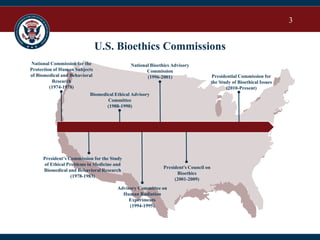
U.S. Bioethics Commissions
National Commission for the
Protection of Human Subjects
of Biomedical and Behavioral
Research
(1974-1978)
President’s Commission for the Study
of Ethical Problems in Medicine and
Biomedical and Behavioral Research
(1978-1983)
Biomedical Ethical Advisory
Committee
(1988-1990)
Advisory Committee on
Human Radiation
Experiments
(1994-1995)
National Bioethics Advisory
Commission
(1996-2001)
President's Council on
Bioethics
(2001-2009)
Presidential Commission for
the Study of Bioethical Issues
(2010-Present)
4
Outline
• U.S. Bioethics Commissions – A Brief
History
• The Presidential Commission for the Study
of Bioethical Issues
• The Bioethics Commission and Research
Ethics
• Bioethics Commission Impact
• Questions and Discussion
5
Creation of the Bioethics Commission
“As our nation invests in science
and innovation and pursues
advances in biomedical research
and health care, it’s imperative
that we do so in a responsible
manner.”
- President Barack Obama
6
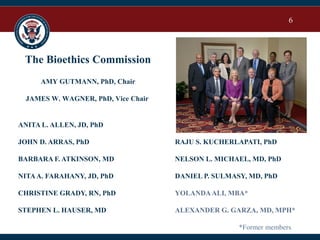
The Bioethics Commission
AMY GUTMANN, PhD, Chair
JAMES W. WAGNER, PhD, Vice Chair
ANITA L. ALLEN, JD, PhD
JOHN D. ARRAS, PhD
BARBARA F. ATKINSON, MD
NITAA. FARAHANY, JD, PhD
CHRISTINE GRADY, RN, PhD
STEPHEN L. HAUSER, MD
RAJU S. KUCHERLAPATI, PhD
NELSON L. MICHAEL, MD, PhD
DANIEL P. SULMASY, MD, PhD
YOLANDAALI, MBA*
ALEXANDER G. GARZA, MD, MPH*
*Former members
7
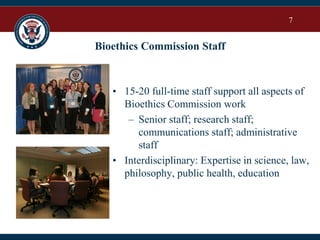
Bioethics Commission Staff
• 15-20 full-time staff support all aspects of
Bioethics Commission work
– Senior staff; research staff;
communications staff; administrative
staff
• Interdisciplinary: Expertise in science, law,
philosophy, public health, education
8
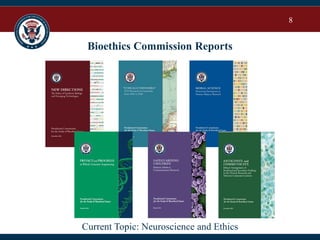
Bioethics Commission Reports
Current Topic: Neuroscience and Ethics
9
Inputs to Bioethics Commission Reports
• Expert presentations, discussion, and
deliberation at public meetings
• Subcommittee recommendations or
preparatory work
• Federal Register requests for public
comment
• Targeted requests to federal departments
and agencies
• Review of relevant literature
10
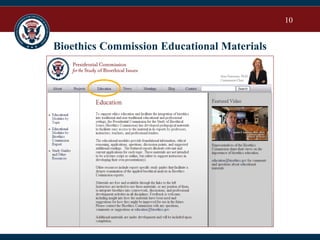
Bioethics Commission Educational Materials
11
Outline
• U.S. Bioethics Commissions – A Brief
History
• The Presidential Commission for the Study
of Bioethical Issues
• The Bioethics Commission and Research
Ethics
• Bioethics Commission Impact
• Questions and Discussion
12
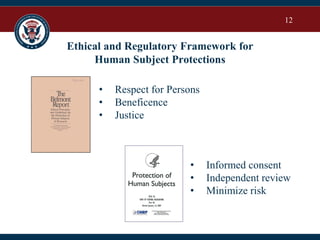
Ethical and Regulatory Framework for
Human Subject Protections
• Respect for Persons
• Beneficence
• Justice
• Informed consent
• Independent review
• Minimize risk
13
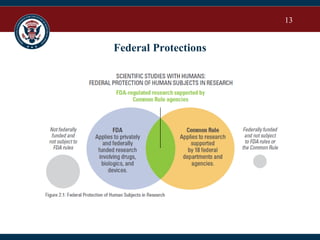
Federal Protections
14
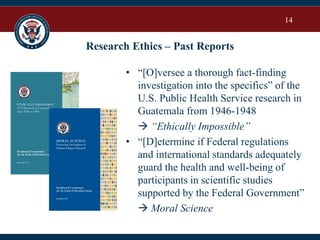
Research Ethics – Past Reports
• “[O]versee a thorough fact-finding
investigation into the specifics” of the
U.S. Public Health Service research in
Guatemala from 1946-1948
 “Ethically Impossible”
• “[D]etermine if Federal regulations
and international standards adequately
guard the health and well-being of
participants in scientific studies
supported by the Federal Government”
 Moral Science
15
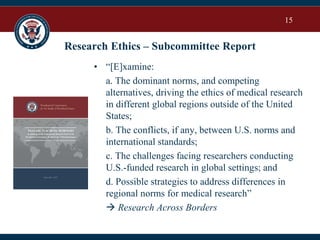
Research Ethics – Subcommittee Report
• “[E]xamine:
a. The dominant norms, and competing
alternatives, driving the ethics of medical research
in different global regions outside of the United
States;
b. The conflicts, if any, between U.S. norms and
international standards;
c. The challenges facing researchers conducting
U.S.-funded research in global settings; and
d. Possible strategies to address differences in
regional norms for medical research”
 Research Across Borders
16
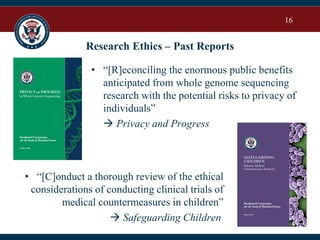
Research Ethics – Past Reports
• “[C]onduct a thorough review of the ethical
considerations of conducting clinical trials of
medical countermeasures in children”
 Safeguarding Children
• “[R]econciling the enormous public benefits
anticipated from whole genome sequencing
research with the potential risks to privacy of
individuals”
 Privacy and Progress
17
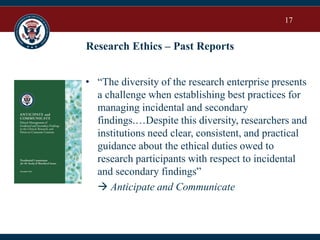
Research Ethics – Past Reports
• “The diversity of the research enterprise presents
a challenge when establishing best practices for
managing incidental and secondary
findings.…Despite this diversity, researchers and
institutions need clear, consistent, and practical
guidance about the ethical duties owed to
research participants with respect to incidental
and secondary findings”
 Anticipate and Communicate
18
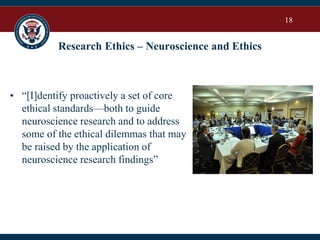
Research Ethics – Neuroscience and Ethics
• “[I]dentify proactively a set of core
ethical standards—both to guide
neuroscience research and to address
some of the ethical dilemmas that may
be raised by the application of
neuroscience research findings”
19
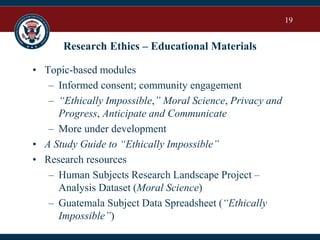
Research Ethics – Educational Materials
• Topic-based modules
– Informed consent; community engagement
– “Ethically Impossible,” Moral Science, Privacy and
Progress, Anticipate and Communicate
– More under development
• A Study Guide to “Ethically Impossible”
• Research resources
– Human Subjects Research Landscape Project –
Analysis Dataset (Moral Science)
– Guatemala Subject Data Spreadsheet (“Ethically
Impossible”)
20
Research Ethics – Common Themes
• Informed consent
• Community engagement
• Compensation or treatment for research-
related injury
• Transparency and accountability
• Vulnerable populations
• Equitable selection of research populations
and sites
• Emerging science and technologies
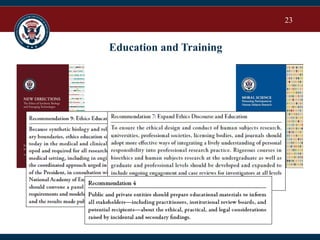
• Education and training
21
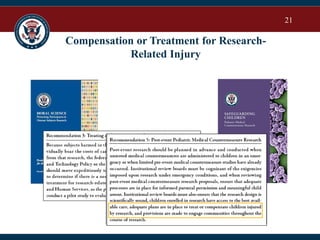
Compensation or Treatment for Research-
Related Injury
22
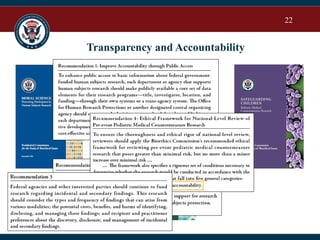
Transparency and Accountability
23
Education and Training
24
Outline
• U.S. Bioethics Commissions – A Brief
History
• The Presidential Commission for the Study
of Bioethical Issues
• The Bioethics Commission and Research
Ethics
• Bioethics Commission Impact
• Questions and Discussion
25
Bioethics Commission’s Potential Impact
• Direct implementation of recommendations
• Consideration of recommendations, even if
not implemented
• Heightened visibility of bioethics generally
and of specific issues
– Public visibility
– Outreach to stakeholder groups
– Foundation for future research and
scholarship
26
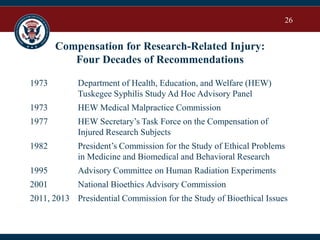
Compensation for Research-Related Injury:
Four Decades of Recommendations
1973 Department of Health, Education, and Welfare (HEW)
Tuskegee Syphilis Study Ad Hoc Advisory Panel
1973 HEW Medical Malpractice Commission
1977 HEW Secretary’s Task Force on the Compensation of
Injured Research Subjects
1982 President’s Commission for the Study of Ethical Problems
in Medicine and Biomedical and Behavioral Research
1995 Advisory Committee on Human Radiation Experiments
2001 National Bioethics Advisory Commission
2011, 2013 Presidential Commission for the Study of Bioethical Issues
27
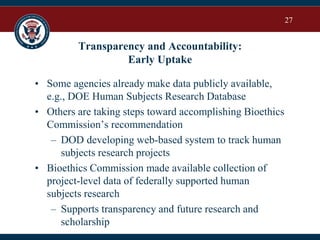
Transparency and Accountability:
Early Uptake
• Some agencies already make data publicly available,
e.g., DOE Human Subjects Research Database
• Others are taking steps toward accomplishing Bioethics
Commission’s recommendation
– DOD developing web-based system to track human
subjects research projects
• Bioethics Commission made available collection of
project-level data of federally supported human
subjects research
– Supports transparency and future research and
scholarship
28
Education and Training:
Bioethics Commission Implementation
• Develop educational materials
– Support ethics education
– Facilitate integration of bioethical analysis into
existing curricula
– Target audiences in traditional, non-traditional, and
professional settings
• Conduct training at conferences and universities
• Support scholarship in bioethics education
29
Outline
• U.S. Bioethics Commissions – A Brief
History
• The Presidential Commission for the Study
of Bioethical Issues
• The Bioethics Commission and Research
Ethics
• Bioethics Commission Impact
• Questions and Discussion
30
@Bioethicsgov
Bioethicsgov
info@bioethics.gov
Thank you!
Bioethics.gov
Blog.bioethics.gov