ksjp,
7/01
MEMS Design & Fab
MEMS-specific fabrication
• Bulk micromachining
• Surface micromachining
• Deep reactive ion etching (DRIE)
• Other materials/processes
ksjp,
7/01
Bulk, Surface, DRIE
MEMS Design & Fab
• Bulk micromachining involves removing material from
the silicon wafer itself
• Typically wet etched
• Traditional MEMS industry
• Artistic design, inexpensive equipment
• Issues with IC compatibility
• Surface micromachining leaves the wafer untouched,
but adds/removes additional layers above the wafer
surface, First widely used in 1990s
• Typically plasma etched
• IC-like design philosophy, relatively expensive equipment
• Different issues with IC compatibility
• Deep Reactive Ion Etch (DRIE) removes substrate
but looks like surface micromachining!
ksjp,
7/01
Bulk Micromachining
MEMS Design & Fab
• Many liquid etchants demonstrate dramatic etch rate
differences in different crystal directions
• <111> etch rate is slowest, <100> and <110> fastest
• Fastest:slowest can be more than 400:1
• KOH, EDP, TMAH most common anisotropic silicon etchants
• Isotropic silicon etchants
• HNA
• HF, nitric, and acetic acids
• Lots of neat features, tough to work with
• XeF2, BrF3
• gas phase, gentle
• Xactix, STS selling research & production equipment
ksjp,
7/01
KOH Etching
MEMS Design & Fab
• Etches PR and Aluminum instantly
• Masks:
• SiO2
• compressive
• SixNy
• tensile
• Parylene!
• Au?
ksjp,
7/01
Crystal Planes & Miller Indices
• [abc] in a cubic crystal is just a direction vector
• (abc) is any plane perpendicular to the [abc] vector
• (…)/[…] indicate a specific plane/direction
• {…}/<…> indicate equivalent planes/direction
Angles between directions can be determined by scalar
product: the angle between [abc] and [xyz] is given by
ax+by+cz = |(a,b,c)|*|(x,y,z)|*cos(theta)
e.g.: ((1 0  0) /(1)( 3))
MEMS Design & Fab
1
(100),(111)  Cos
ksjp,
7/01
Miller indices
[100]
[010]
[001]
b
c
a
[abc]
MEMS Design & Fab
ksjp,
7/01
MEMS Design & Fab
[010]
[001]
a
b
c
[abc]
1/a
[100]
1/b
1/c
(abc)
ksjp,
7/01
MEMS Design & Fab
[100]
[001]
(100)
{100}
(001)
[010]
(010)
ksjp,
7/01
MEMS Design & Fab
[100]
[001]
(110)
[010]
(111)
ksjp,
7/01
MEMS Design & Fab
Typical 100 wafer
Cross-section in (110) plane
<111>
<100>
The wafer flat is oriented in the [110] direction
ksjp,
7/01
MEMS Design & Fab
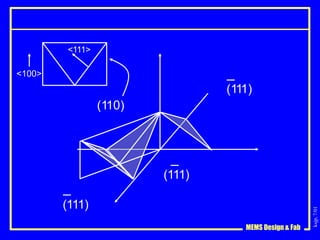
(111)
(111)
(111)
(110)
<111>
<100>
ksjp,
7/01
Anisotropic Etching of Silicon
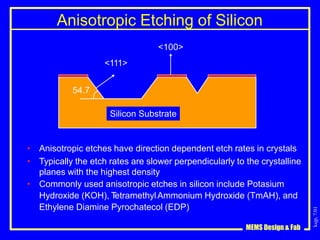
• Anisotropic etches have direction dependent etch rates in crystals
• Typically the etch rates are slower perpendicularly to the crystalline
planes with the highest density
• Commonly used anisotropic etches in silicon include Potasium
Hydroxide (KOH), T
etramethylAmmonium Hydroxide (TmAH), and
Ethylene Diamine Pyrochatecol (EDP)
Silicon Substrate
<100>
<111>
54.7
MEMS Design & Fab
ksjp,
7/01
Etch stops in anisotropic silicon etching
MEMS Design & Fab
• Electrochemical etch stop
• High boron doping (~1e20/cm)
ksjp,
7/01
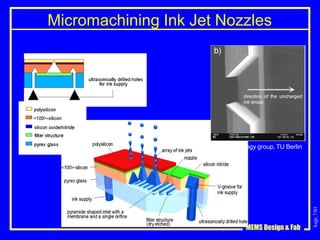
Micromachining Ink Jet Nozzles
MEMS Design & Fab
logy group, TU Berlin
ksjp,
7/01
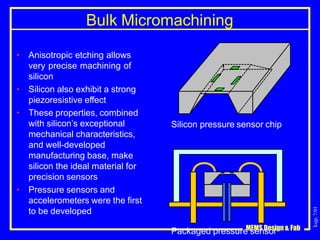
Bulk Micromachining
• Anisotropic etching allows
very precise machining of
silicon
• Silicon also exhibit a strong
piezoresistive effect
• These properties, combined
with silicon’s exceptional
mechanical characteristics,
and well-developed
manufacturing base, make
silicon the ideal material for
precision sensors
• Pressure sensors and
accelerometers were the first
to be developed
Silicon pressure sensor chip
Packaged pressure
Ms
EM
eS
nD
se
o
sr
ign & Fab
ksjp,
7/01
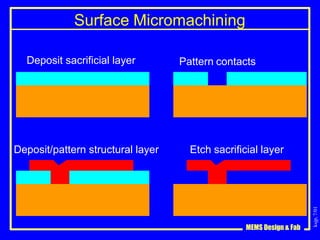
Surface Micromachining
Deposit sacrificial layer Pattern contacts
Deposit/pattern structural layer Etch sacrificial layer
MEMS Design & Fab
ksjp,
7/01
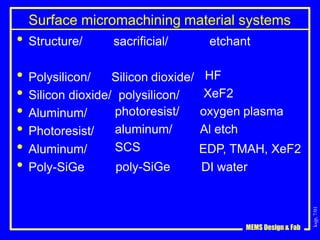
Surface micromachining material systems
MEMS Design & Fab
• Structure/ sacrificial/ etchant
• Polysilicon/ Silicon dioxide/
• Silicon dioxide/ polysilicon/
• Aluminum/
• Photoresist/
• Aluminum/
• Poly-SiGe
photoresist/
aluminum/
SCS
poly-SiGe
HF
XeF2
oxygen plasma
Al etch
EDP, TMAH, XeF2
DI water
ksjp,
7/01
MEMS Design & Fab
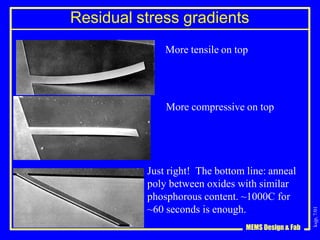
Residual stress gradients
More tensile on top
More compressive on top
Just right! The bottom line: anneal
poly between oxides with similar
phosphorous content. ~1000C for
~60 seconds is enough.
ksjp,
7/01
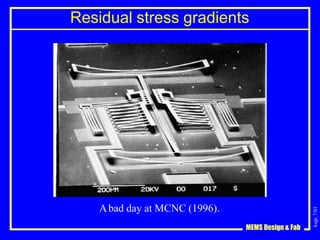
Residual stress gradients
Abad day at MCNC (1996).
MEMS Design & Fab
ksjp,
7/01
Hinges
Deposit first sacrificial
Deposit and pattern first poly
Etch sacrificial
Pattern contacts
Deposit and pattern 2nd poly
Deposit and pattern second
sacrificial
MEMS Design & Fab
ksjp,
7/01
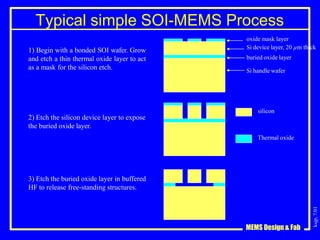
1) Begin with a bonded SOI wafer. Grow
and etch a thin thermal oxide layer to act
as a mask for the silicon etch.
2) Etch the silicon device layer to expose
the buried oxide layer.
3) Etch the buried oxide layer in buffered
HF to release free-standing structures.
oxide mask layer
Si device layer, 20 µm thick
buried oxide layer
Si handle wafer
silicon
MEMS Design & Fab
Thermal oxide
Typical simple SOI-MEMS Process
ksjp,
7/01
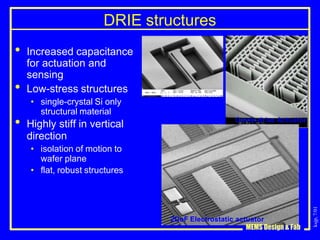
DRIE structures
• Increased capacitance
for actuation and
sensing
• Low-stress structures
• single-crystal Si only
structural material
• Highly stiff in vertical
direction
• isolation of motion to
wafer plane
• flat, robust structures
2DoF Electrostatic actuator
MEMS Design & Fab
Thermal Actuator
Comb-drive Actuator

bulk surface micromachining and engg stuff about mems

  • 1.
    ksjp, 7/01 MEMS Design &Fab MEMS-specific fabrication • Bulk micromachining • Surface micromachining • Deep reactive ion etching (DRIE) • Other materials/processes
  • 2.
    ksjp, 7/01 Bulk, Surface, DRIE MEMSDesign & Fab • Bulk micromachining involves removing material from the silicon wafer itself • Typically wet etched • Traditional MEMS industry • Artistic design, inexpensive equipment • Issues with IC compatibility • Surface micromachining leaves the wafer untouched, but adds/removes additional layers above the wafer surface, First widely used in 1990s • Typically plasma etched • IC-like design philosophy, relatively expensive equipment • Different issues with IC compatibility • Deep Reactive Ion Etch (DRIE) removes substrate but looks like surface micromachining!
  • 3.
    ksjp, 7/01 Bulk Micromachining MEMS Design& Fab • Many liquid etchants demonstrate dramatic etch rate differences in different crystal directions • <111> etch rate is slowest, <100> and <110> fastest • Fastest:slowest can be more than 400:1 • KOH, EDP, TMAH most common anisotropic silicon etchants • Isotropic silicon etchants • HNA • HF, nitric, and acetic acids • Lots of neat features, tough to work with • XeF2, BrF3 • gas phase, gentle • Xactix, STS selling research & production equipment
  • 4.
    ksjp, 7/01 KOH Etching MEMS Design& Fab • Etches PR and Aluminum instantly • Masks: • SiO2 • compressive • SixNy • tensile • Parylene! • Au?
  • 5.
    ksjp, 7/01 Crystal Planes &Miller Indices • [abc] in a cubic crystal is just a direction vector • (abc) is any plane perpendicular to the [abc] vector • (…)/[…] indicate a specific plane/direction • {…}/<…> indicate equivalent planes/direction Angles between directions can be determined by scalar product: the angle between [abc] and [xyz] is given by ax+by+cz = |(a,b,c)|*|(x,y,z)|*cos(theta) e.g.: ((1 0  0) /(1)( 3)) MEMS Design & Fab 1 (100),(111)  Cos
  • 6.
  • 7.
    ksjp, 7/01 MEMS Design &Fab [010] [001] a b c [abc] 1/a [100] 1/b 1/c (abc)
  • 8.
    ksjp, 7/01 MEMS Design &Fab [100] [001] (100) {100} (001) [010] (010)
  • 9.
    ksjp, 7/01 MEMS Design &Fab [100] [001] (110) [010] (111)
  • 10.
    ksjp, 7/01 MEMS Design &Fab Typical 100 wafer Cross-section in (110) plane <111> <100> The wafer flat is oriented in the [110] direction
  • 11.
    ksjp, 7/01 MEMS Design &Fab (111) (111) (111) (110) <111> <100>
  • 12.
    ksjp, 7/01 Anisotropic Etching ofSilicon • Anisotropic etches have direction dependent etch rates in crystals • Typically the etch rates are slower perpendicularly to the crystalline planes with the highest density • Commonly used anisotropic etches in silicon include Potasium Hydroxide (KOH), T etramethylAmmonium Hydroxide (TmAH), and Ethylene Diamine Pyrochatecol (EDP) Silicon Substrate <100> <111> 54.7 MEMS Design & Fab
  • 13.
    ksjp, 7/01 Etch stops inanisotropic silicon etching MEMS Design & Fab • Electrochemical etch stop • High boron doping (~1e20/cm)
  • 14.
    ksjp, 7/01 Micromachining Ink JetNozzles MEMS Design & Fab logy group, TU Berlin
  • 15.
    ksjp, 7/01 Bulk Micromachining • Anisotropicetching allows very precise machining of silicon • Silicon also exhibit a strong piezoresistive effect • These properties, combined with silicon’s exceptional mechanical characteristics, and well-developed manufacturing base, make silicon the ideal material for precision sensors • Pressure sensors and accelerometers were the first to be developed Silicon pressure sensor chip Packaged pressure Ms EM eS nD se o sr ign & Fab
  • 16.
    ksjp, 7/01 Surface Micromachining Deposit sacrificiallayer Pattern contacts Deposit/pattern structural layer Etch sacrificial layer MEMS Design & Fab
  • 17.
    ksjp, 7/01 Surface micromachining materialsystems MEMS Design & Fab • Structure/ sacrificial/ etchant • Polysilicon/ Silicon dioxide/ • Silicon dioxide/ polysilicon/ • Aluminum/ • Photoresist/ • Aluminum/ • Poly-SiGe photoresist/ aluminum/ SCS poly-SiGe HF XeF2 oxygen plasma Al etch EDP, TMAH, XeF2 DI water
  • 18.
    ksjp, 7/01 MEMS Design &Fab Residual stress gradients More tensile on top More compressive on top Just right! The bottom line: anneal poly between oxides with similar phosphorous content. ~1000C for ~60 seconds is enough.
  • 19.
    ksjp, 7/01 Residual stress gradients Abadday at MCNC (1996). MEMS Design & Fab
  • 20.
    ksjp, 7/01 Hinges Deposit first sacrificial Depositand pattern first poly Etch sacrificial Pattern contacts Deposit and pattern 2nd poly Deposit and pattern second sacrificial MEMS Design & Fab
  • 21.
    ksjp, 7/01 1) Begin witha bonded SOI wafer. Grow and etch a thin thermal oxide layer to act as a mask for the silicon etch. 2) Etch the silicon device layer to expose the buried oxide layer. 3) Etch the buried oxide layer in buffered HF to release free-standing structures. oxide mask layer Si device layer, 20 µm thick buried oxide layer Si handle wafer silicon MEMS Design & Fab Thermal oxide Typical simple SOI-MEMS Process
  • 22.
    ksjp, 7/01 DRIE structures • Increasedcapacitance for actuation and sensing • Low-stress structures • single-crystal Si only structural material • Highly stiff in vertical direction • isolation of motion to wafer plane • flat, robust structures 2DoF Electrostatic actuator MEMS Design & Fab Thermal Actuator Comb-drive Actuator