Student: Rigu Anca
Group: 8218
Teacher: Mihai Daniel Frumuselu
1.Facts about Bucovina
2.Facts about Monasteries
3.Voronet Monastery
4.Sucevita Monastery
5.Putna Monastery
6.Moldovita Monastery
7.Humor Monastery
Facts about Bucovina
Location: Northeastern Romania -
between the Carpathian Mountains
and the Prut River. Bucovina is
situated in the northern part of the
region of Moldova, bordering with
Ukraine.
Bucovina is one of the most attractive and
visited touristic areas in Romania. No
wonder this area(famous today all over the
world) was given in 1975 the Pomme d’Or
international prize by The International
Federation of Travel Writers and Tourism
Journalists.
Bucovina is known for its folk
costumes, furniture, pottery,
tapestries and carpets. The
craftsmen continue the traditions
handed down from generation to
generation. Masks, traditional
costumes, painted eggs, carved
wooden objects, embroideries and
carpets are still part of daily life.
Woodworking is much appreciated in
Bucovina, where the material is plentiful.
It is used for most household objects, as
well as building the houses. The different
parts of the house are decorated with
carvings, such as the pillars of the veranda
or the farmyard gate. The dowry includes,
apart from the trousseau of textiles, also
carved wooden cups, spoons, barrels,
ladles and pots.
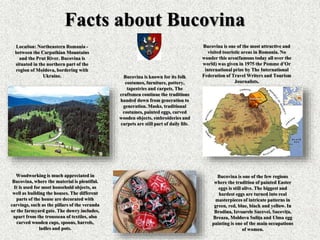
Bucovina is one of the few regions
where the tradition of painted Easter
eggs is still alive. The biggest and
hardest eggs are turned into real
masterpieces of intricate patterns in
green, red, blue, black and yellow. In
Brodina, Izvoarele Sucevei, Suceviţa,
Breaza, Moldova Suliţa and Ulma egg
painting is one of the main occupations
of women.
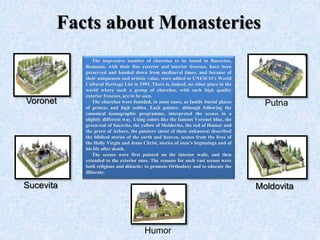
Facts about Monasteries
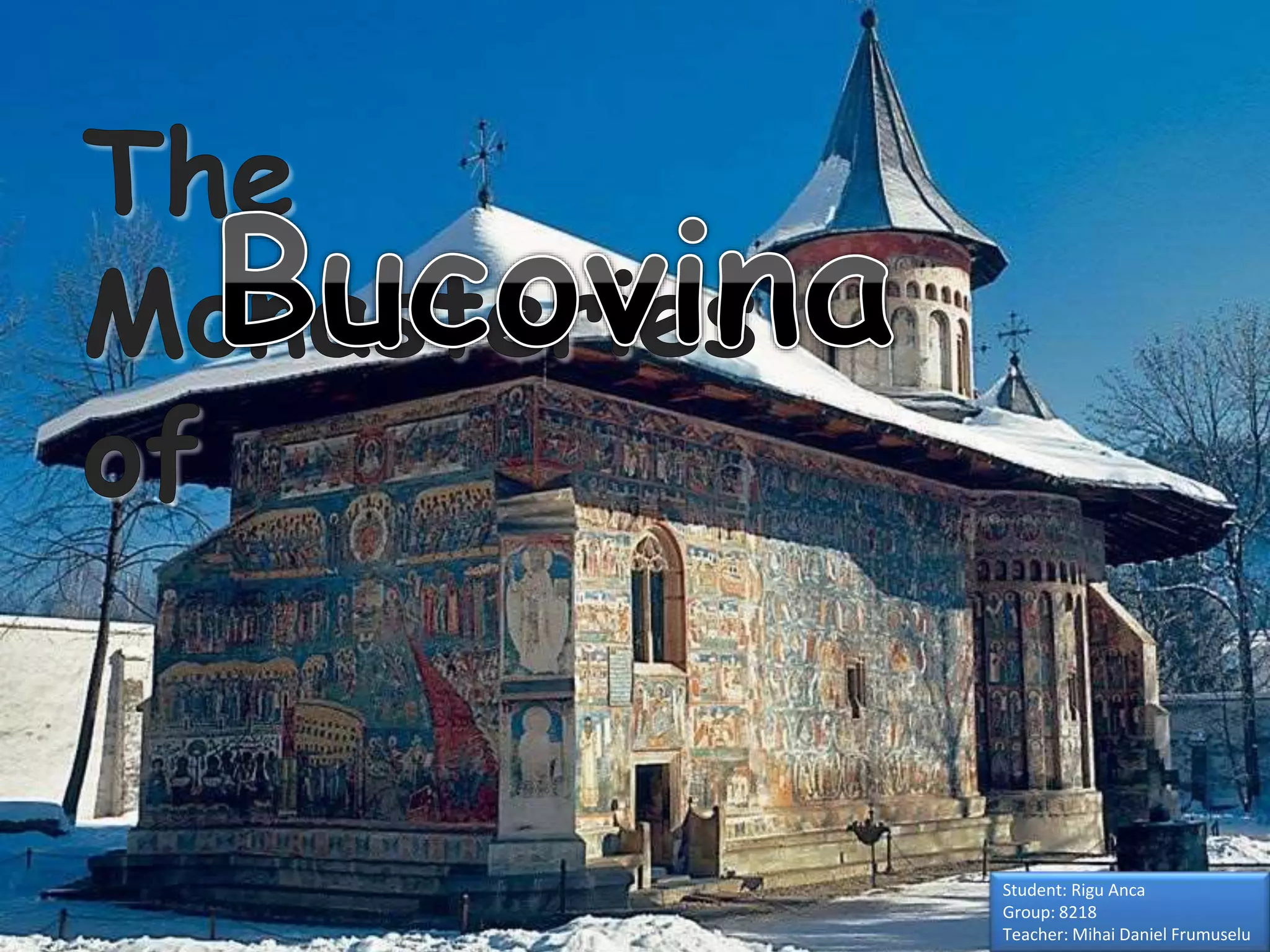
The impressive number of churches to be found in Bucovina,
Romania, with their fine exterior and interior frescoes, have been
preserved and handed down from mediaeval times, and because of
their uniqueness and artistic value, were added to UNESCO’s World
Cultural Heritage List in 1993. There is, indeed, no other place in the
world where such a group of churches, with such high quality
exterior frescoes, are to be seen.
The churches were founded, in most cases, as family burial places
of princes and high nobles. Each painter, although following the
canonical iconographic programme, interpreted the scenes in a
slightly different way. Using colors like the famous Voronet blue, the
green-red of Sucevita, the yellow of Moldovita, the red of Humor and
the green of Arbore, the painters (most of them unknown) described
the biblical stories of the earth and heaven, scenes from the lives of
the Holly Virgin and Jesus Christ, stories of man’s beginnings and of
his life after death.
The scenes were first painted on the interior walls, and then
extended to the exterior ones. The reasons for such vast scenes were
both religious and didactic: to promote Orthodoxy and to educate the
illiterate.
Voronet Putna
Sucevita Moldovita
Humor
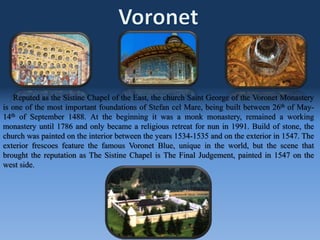
Reputed as the Sistine Chapel of the East, the church Saint George of the Voronet Monastery
is one of the most important foundations of Stefan cel Mare, being built between 26th of May-
14th of September 1488. At the beginning it was a monk monastery, remained a working
monastery until 1786 and only became a religious retreat for nun in 1991. Build of stone, the
church was painted on the interior between the years 1534-1535 and on the exterior in 1547. The
exterior frescoes feature the famous Voronet Blue, unique in the world, but the scene that
brought the reputation as The Sistine Chapel is The Final Judgement, painted in 1547 on the
west side.
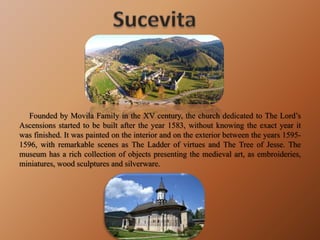
Founded by Movila Family in the XV century, the church dedicated to The Lord’s
Ascensions started to be built after the year 1583, without knowing the exact year it
was finished. It was painted on the interior and on the exterior between the years 1595-
1596, with remarkable scenes as The Ladder of virtues and The Tree of Jesse. The
museum has a rich collection of objects presenting the medieval art, as embroideries,
miniatures, wood sculptures and silverware.
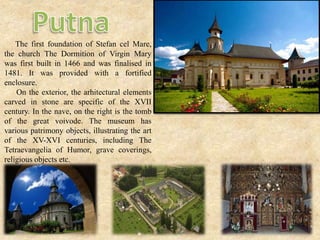
The first foundation of Stefan cel Mare,
the church The Dormition of Virgin Mary
was first built in 1466 and was finalised in
1481. It was provided with a fortified
enclosure.
On the exterior, the arhitectural elements
carved in stone are specific of the XVII
century. In the nave, on the right is the tomb
of the great voivode. The museum has
various patrimony objects, illustrating the art
of the XV-XVI centuries, including The
Tetraevangelia of Humor, grave coverings,
religious objects etc.
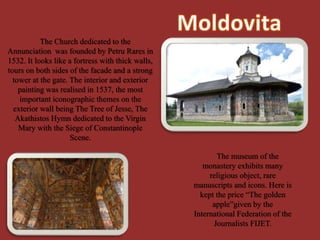
The Church dedicated to the
Annunciation was founded by Petru Rares in
1532. It looks like a fortress with thick walls,
tours on both sides of the facade and a strong
tower at the gate. The interior and exterior
painting was realised in 1537, the most
important iconographic themes on the
exterior wall being The Tree of Jesse, The
Akathistos Hymn dedicated to the Virgin
Mary with the Siege of Constantinople
Scene.
The museum of the
monastery exhibits many
religious object, rare
manuscripts and icons. Here is
kept the price “The golden
apple”given by the
International Federation of the
Journalists FIJET.
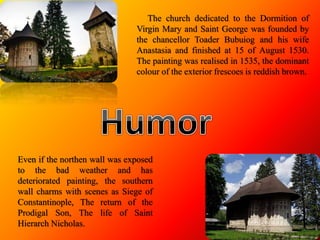
The church dedicated to the Dormition of
Virgin Mary and Saint George was founded by
the chancellor Toader Bubuiog and his wife
Anastasia and finished at 15 of August 1530.
The painting was realised in 1535, the dominant
colour of the exterior frescoes is reddish brown.
Even if the northen wall was exposed
to the bad weather and has
deteriorated painting, the southern
wall charms with scenes as Siege of
Constantinople, The return of the
Prodigal Son, The life of Saint
Hierarch Nicholas.
Bibliography
1. http://www.romanianmonasteries.org/bucovina/all-bucovina-
monasteries
2. http://romaniatourism.com/bucovina-moldova.html

Bucovina

  • 1.
    Student: Rigu Anca Group:8218 Teacher: Mihai Daniel Frumuselu
  • 2.
    1.Facts about Bucovina 2.Factsabout Monasteries 3.Voronet Monastery 4.Sucevita Monastery 5.Putna Monastery 6.Moldovita Monastery 7.Humor Monastery
  • 3.
    Facts about Bucovina Location:Northeastern Romania - between the Carpathian Mountains and the Prut River. Bucovina is situated in the northern part of the region of Moldova, bordering with Ukraine. Bucovina is one of the most attractive and visited touristic areas in Romania. No wonder this area(famous today all over the world) was given in 1975 the Pomme d’Or international prize by The International Federation of Travel Writers and Tourism Journalists. Bucovina is known for its folk costumes, furniture, pottery, tapestries and carpets. The craftsmen continue the traditions handed down from generation to generation. Masks, traditional costumes, painted eggs, carved wooden objects, embroideries and carpets are still part of daily life. Woodworking is much appreciated in Bucovina, where the material is plentiful. It is used for most household objects, as well as building the houses. The different parts of the house are decorated with carvings, such as the pillars of the veranda or the farmyard gate. The dowry includes, apart from the trousseau of textiles, also carved wooden cups, spoons, barrels, ladles and pots. Bucovina is one of the few regions where the tradition of painted Easter eggs is still alive. The biggest and hardest eggs are turned into real masterpieces of intricate patterns in green, red, blue, black and yellow. In Brodina, Izvoarele Sucevei, Suceviţa, Breaza, Moldova Suliţa and Ulma egg painting is one of the main occupations of women.
  • 4.
    Facts about Monasteries Theimpressive number of churches to be found in Bucovina, Romania, with their fine exterior and interior frescoes, have been preserved and handed down from mediaeval times, and because of their uniqueness and artistic value, were added to UNESCO’s World Cultural Heritage List in 1993. There is, indeed, no other place in the world where such a group of churches, with such high quality exterior frescoes, are to be seen. The churches were founded, in most cases, as family burial places of princes and high nobles. Each painter, although following the canonical iconographic programme, interpreted the scenes in a slightly different way. Using colors like the famous Voronet blue, the green-red of Sucevita, the yellow of Moldovita, the red of Humor and the green of Arbore, the painters (most of them unknown) described the biblical stories of the earth and heaven, scenes from the lives of the Holly Virgin and Jesus Christ, stories of man’s beginnings and of his life after death. The scenes were first painted on the interior walls, and then extended to the exterior ones. The reasons for such vast scenes were both religious and didactic: to promote Orthodoxy and to educate the illiterate. Voronet Putna Sucevita Moldovita Humor
  • 5.
    Reputed as theSistine Chapel of the East, the church Saint George of the Voronet Monastery is one of the most important foundations of Stefan cel Mare, being built between 26th of May- 14th of September 1488. At the beginning it was a monk monastery, remained a working monastery until 1786 and only became a religious retreat for nun in 1991. Build of stone, the church was painted on the interior between the years 1534-1535 and on the exterior in 1547. The exterior frescoes feature the famous Voronet Blue, unique in the world, but the scene that brought the reputation as The Sistine Chapel is The Final Judgement, painted in 1547 on the west side.
  • 6.
    Founded by MovilaFamily in the XV century, the church dedicated to The Lord’s Ascensions started to be built after the year 1583, without knowing the exact year it was finished. It was painted on the interior and on the exterior between the years 1595- 1596, with remarkable scenes as The Ladder of virtues and The Tree of Jesse. The museum has a rich collection of objects presenting the medieval art, as embroideries, miniatures, wood sculptures and silverware.
  • 7.
    The first foundationof Stefan cel Mare, the church The Dormition of Virgin Mary was first built in 1466 and was finalised in 1481. It was provided with a fortified enclosure. On the exterior, the arhitectural elements carved in stone are specific of the XVII century. In the nave, on the right is the tomb of the great voivode. The museum has various patrimony objects, illustrating the art of the XV-XVI centuries, including The Tetraevangelia of Humor, grave coverings, religious objects etc.
  • 8.
    The Church dedicatedto the Annunciation was founded by Petru Rares in 1532. It looks like a fortress with thick walls, tours on both sides of the facade and a strong tower at the gate. The interior and exterior painting was realised in 1537, the most important iconographic themes on the exterior wall being The Tree of Jesse, The Akathistos Hymn dedicated to the Virgin Mary with the Siege of Constantinople Scene. The museum of the monastery exhibits many religious object, rare manuscripts and icons. Here is kept the price “The golden apple”given by the International Federation of the Journalists FIJET.
  • 9.
    The church dedicatedto the Dormition of Virgin Mary and Saint George was founded by the chancellor Toader Bubuiog and his wife Anastasia and finished at 15 of August 1530. The painting was realised in 1535, the dominant colour of the exterior frescoes is reddish brown. Even if the northen wall was exposed to the bad weather and has deteriorated painting, the southern wall charms with scenes as Siege of Constantinople, The return of the Prodigal Son, The life of Saint Hierarch Nicholas.
  • 10.

Editor's Notes

  • #2 Student: Rigu Anca
  • #4 The impressive number of churches to be found in Bucovina, Romania, with their fine exterior and interior frescoes, have been preserved and handed down from mediaeval times, and because of their uniqueness and artistic value, were added to UNESCO’s World Cultural Heritage List in 1993. There is, indeed, no other place in the world where such a group of churches, with such high quality exterior frescoes, are to be seen. The churches were founded, in most cases, as family burial places of princes and high nobles. Each painter, although following the canonical iconographic programme, interpreted the scenes in a slightly different way. Using colors like the famous Voronet blue, the green-red of Sucevita, the yellow of Moldovita, the red of Humor and the green of Arbore, the painters (most of them unknown) described the biblical stories of the earth and heaven, scenes from the lives of the Holly Virgin and Jesus Christ, stories of man’s beginnings and of his life after death. The scenes were first painted on the interior walls, and then extended to the exterior ones. The reasons for such vast scenes were both religious and didactic: to promote Orthodoxy and to educate the illiterate.
  • #5 Voronet