www.howtospell.co.uk	
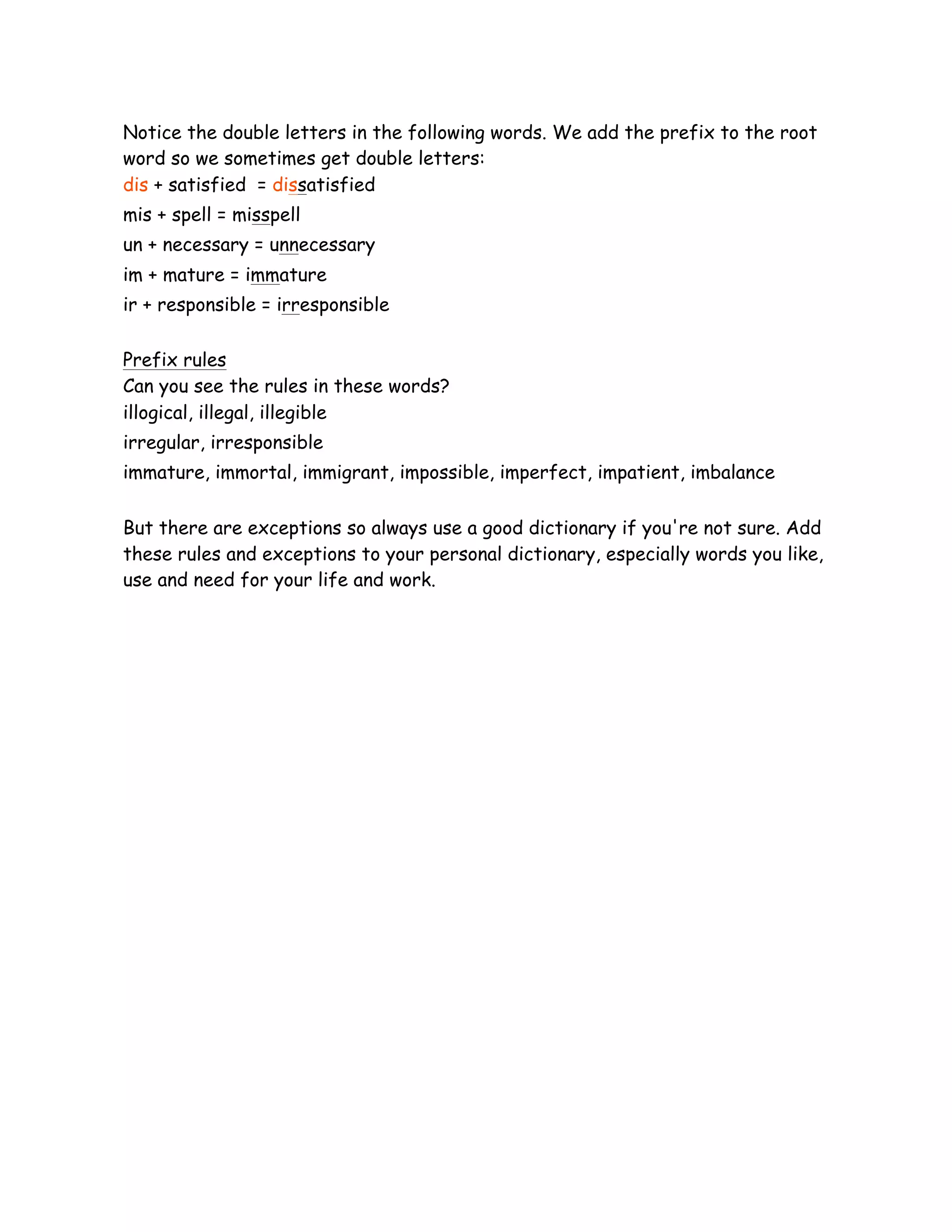
Building Words with Prefixes Worksheet
by Joanne Rudling
www.howtospell.co.uk
www.howtospell.co.uk	
Knowing how words are built with prefixes is a really important strategy to help
you improve your spelling, reading and vocabulary.
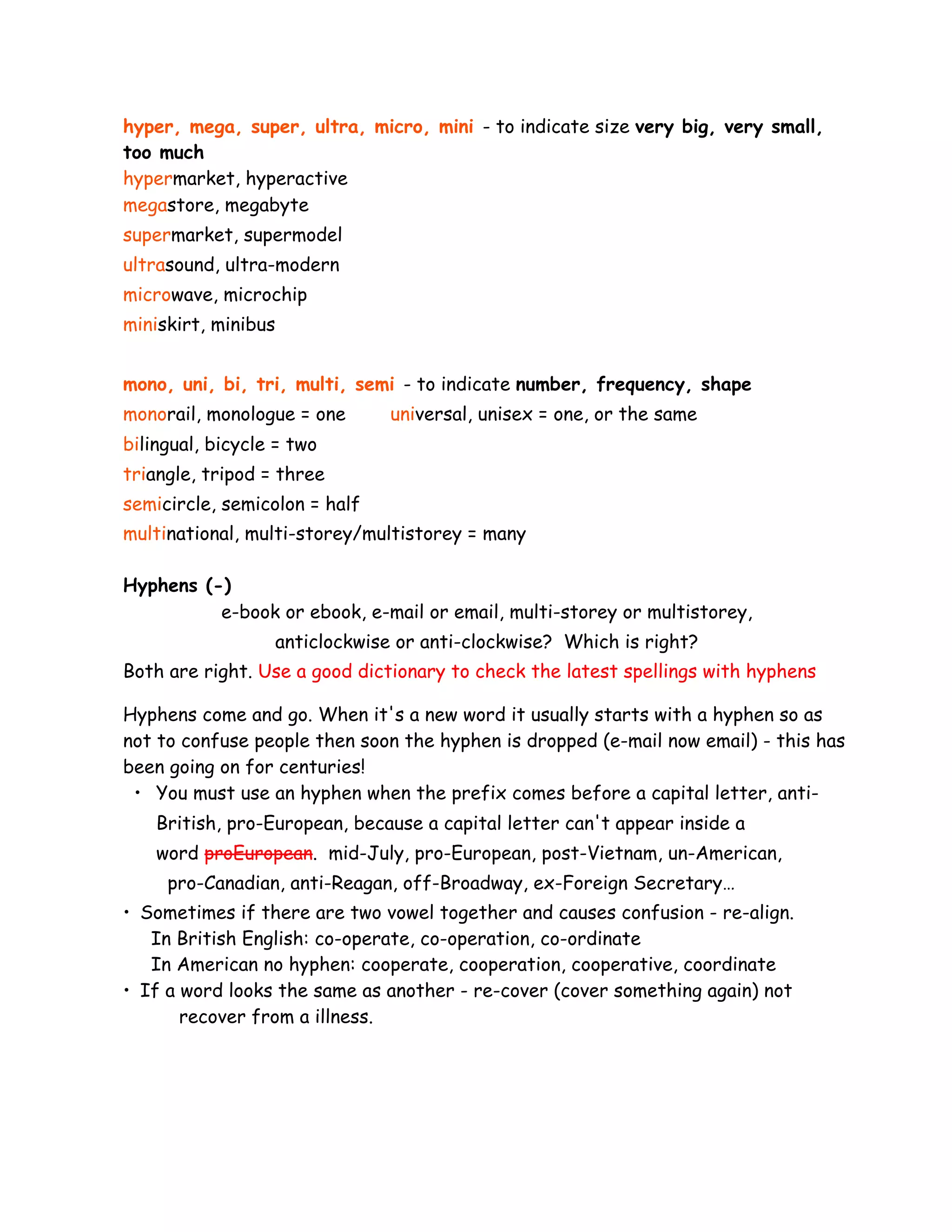
Prefixes are little words we add to the beginning of root words to make the word
negative or the opposite meaning:
un + happy = unhappy = not happy = sad
re + paint = repaint = paint again
under + cooked = undercooked = not cooked enough
un + comfortable = uncomfortable = not comfortable
in + correct = incorrect = wrong = not correct, not right
dis + like = dislike = don't like
There are hundreds of prefixes, some of the most popular are:
in-, ir-, il-, im-, un-, dis-, pre-, ex-, anti-, uni-, bi-
happy – unhappy = not happy/sad
legal – illegal = not legal
like - dislike = don't like
patient – impatient = not patient
usual - unusual = not usual
correct – incorrect = not correct or wrong or not right
complete - incomplete = not complete
www.howtospell.co.uk	
Notice the double letters in the following words. We add the prefix to the root
word so we sometimes get double letters:
dis + satisfied = dissatisfied
mis + spell = misspell
un + necessary = unnecessary
im + mature = immature
ir + responsible = irresponsible
Prefix rules
Can you see the rules in these words?
illogical, illegal, illegible
irregular, irresponsible
immature, immortal, immigrant, impossible, imperfect, impatient, imbalance
But there are exceptions so always use a good dictionary if you're not sure. Add
these rules and exceptions to your personal dictionary, especially words you like,
use and need for your life and work.
www.howtospell.co.uk	
Prefix rules and exceptions
*Use ‘il’ before words starting with ‘l’
legible - illegible, illegal, illuminate
(But - unlawful, unlearn, unless...)
Use ‘ir’ before words starting with ‘r’
relevant - irrelevant irreconcilable, irregular, irradiate
(But - unreliable, unreal, unrated…)
Use ‘im’ before words stating with ‘m’, ‘p’, ‘b’ mature-immature, immigrant,
immortal, immaculate, possible- impossible, perfect – imperfect, impair, impact
(But we have unpack, unpick, unpaid... unmarked, unmarried, unmask)
balance – imbalance, imbecile, imbibe, imbue
(But inbox, inbound, inbuilt…)
Let's look at some common prefixes with their meanings (some mean different
things with different words).
un, in, il, im, ir, dis, non... - these make nouns, verbs, adjectives into
the negative, opposite meaning and mean 'not'.
unfair, untidy not fair not tidy incomplete, informal illegal, illegitimate immature,
impatient irregular, irrational dishonest, dislike non-smoker, non-toxic
de, dis, un, re these indicate reversal of verb's actions - reverse, back, again
defrost, debug
untie, unwrap, undo
repaint, retry, redo
disconnect
return, retell, regain
over, under, sub, mis means something is wrong or bad, under, lowly
oversleep, overpopulated ( = too much sleep too many people, excessive)
undervalued, undercooked (= not valued enough, not cooked enough)
substandard, subspecies (= well below standard, not enough, lowly)
misunderstand, miscalculate (= bad) - to not understand, to not calculate right/to
calculate badly
www.howtospell.co.uk	
hyper, mega, super, ultra, micro, mini - to indicate size very big, very small,
too much
hypermarket, hyperactive
megastore, megabyte
supermarket, supermodel
ultrasound, ultra-modern
microwave, microchip
miniskirt, minibus
mono, uni, bi, tri, multi, semi - to indicate number, frequency, shape
monorail, monologue = one universal, unisex = one, or the same
bilingual, bicycle = two
triangle, tripod = three
semicircle, semicolon = half
multinational, multi-storey/multistorey = many
Hyphens (-)
e-book or ebook, e-mail or email, multi-storey or multistorey,
anticlockwise or anti-clockwise? Which is right?
Both are right. Use a good dictionary to check the latest spellings with hyphens
Hyphens come and go. When it's a new word it usually starts with a hyphen so as
not to confuse people then soon the hyphen is dropped (e-mail now email) - this has
been going on for centuries!
• You must use an hyphen when the prefix comes before a capital letter, anti-
British, pro-European, because a capital letter can't appear inside a
word proEuropean. mid-July, pro-European, post-Vietnam, un-American,
pro-Canadian, anti-Reagan, off-Broadway, ex-Foreign Secretary…
• Sometimes if there are two vowel together and causes confusion - re-align.
In British English: co-operate, co-operation, co-ordinate
In American no hyphen: cooperate, cooperation, cooperative, coordinate
• If a word looks the same as another - re-cover (cover something again) not
recover from a illness.
www.howtospell.co.uk	
• Prefixes such as re-, co-, pre, anti-, self- sometimes have hyphens when added
to words sometimes they don't.
co-owner / coexist
pre-war / preview
anti-hero / antibiotic
self-assured / selfsame
sub-branch / subcontinent
up-market / upbeat
off-Broadway / offbeat
• For single letter prefixes most have hyphens:
X-ray, X-rated, X-certificate, A-list, T-shirt, T-junction/T-intersection,
T-bone, Y-chromosome, U-turn… Notice the single letter is a capital.
But these newer, internet-related words have lowercase single letters. The ‘e’
stands for electronic:
e-book/ebook, e-mail/email, e-commerce, e-cash (the hyphen will probably be
dropped soon).
www.howtospell.co.uk	
Exercise 1
Make the following words opposite
1. happy ___________________
2. like ___________________
3. legal ___________________
4. kind ___________________
5. patient ___________________
6. mature ___________________
7. understanding ___________________
8. practical ___________________
www.howtospell.co.uk	
Exercise 1 Answers
Make the following words opposite
1. happy - unhappy
2. like - dislike
3. legal - illegal
4. kind - unkind
5. patient - impatient
6. mature - immature
7. understanding – misunderstanding
8. practical - impractical
www.howtospell.co.uk	
Exercise 2
Add a prefix to these words:
For example: not comfortable = uncomfortable
1. not regular = _____________
2. not correct = _____________
3. not personal = _____________
4. not mobile = _____________
5. not patient = _____________
6. not logical = _____________
7. not possible = _____________
8. not responsible = _____________
9. not proper = _____________
www.howtospell.co.uk	
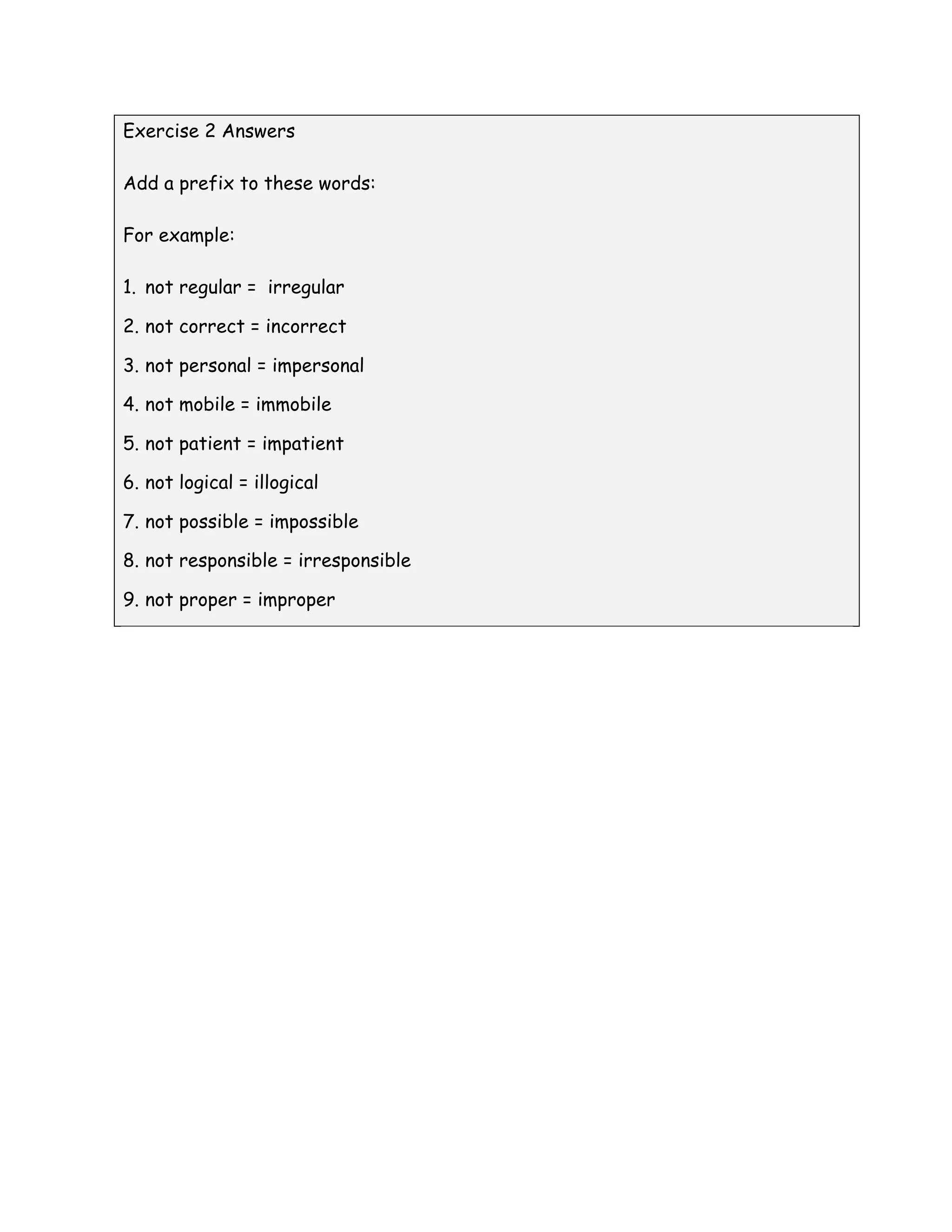
Exercise 2 Answers
Add a prefix to these words:
For example:
1. not regular = irregular
2. not correct = incorrect
3. not personal = impersonal
4. not mobile = immobile
5. not patient = impatient
6. not logical = illogical
7. not possible = impossible
8. not responsible = irresponsible
9. not proper = improper
www.howtospell.co.uk	
Exercise 3
Prefixes can be used to give adjectives a
negative or opposite meaning.
Add a prefix to these words:
1. convenient 2. comfortable 3. loyal
4. patient 5. regular 6. polite
7. adequate 8. possible 9. legal
Prefixes can also be used in verbs:
Add a prefix to these verbs:
10. appear 11. dress 12. like 13. zip
www.howtospell.co.uk	
Exercise 3 Answers
1. inconvenient 2. uncomfortable 3. disloyal
4. impatient 5. irregular 6. impolite
7. inadequate 8. impossible 9. illegal
10. disappear 11. undress 11. dislike 11. unzip

Building words-with-prefixes-information-sheet

  • 1.
    www.howtospell.co.uk Building Words withPrefixes Worksheet by Joanne Rudling www.howtospell.co.uk
  • 2.
    www.howtospell.co.uk Knowing how wordsare built with prefixes is a really important strategy to help you improve your spelling, reading and vocabulary. Prefixes are little words we add to the beginning of root words to make the word negative or the opposite meaning: un + happy = unhappy = not happy = sad re + paint = repaint = paint again under + cooked = undercooked = not cooked enough un + comfortable = uncomfortable = not comfortable in + correct = incorrect = wrong = not correct, not right dis + like = dislike = don't like There are hundreds of prefixes, some of the most popular are: in-, ir-, il-, im-, un-, dis-, pre-, ex-, anti-, uni-, bi- happy – unhappy = not happy/sad legal – illegal = not legal like - dislike = don't like patient – impatient = not patient usual - unusual = not usual correct – incorrect = not correct or wrong or not right complete - incomplete = not complete
  • 3.
    www.howtospell.co.uk Notice the doubleletters in the following words. We add the prefix to the root word so we sometimes get double letters: dis + satisfied = dissatisfied mis + spell = misspell un + necessary = unnecessary im + mature = immature ir + responsible = irresponsible Prefix rules Can you see the rules in these words? illogical, illegal, illegible irregular, irresponsible immature, immortal, immigrant, impossible, imperfect, impatient, imbalance But there are exceptions so always use a good dictionary if you're not sure. Add these rules and exceptions to your personal dictionary, especially words you like, use and need for your life and work.
  • 4.
    www.howtospell.co.uk Prefix rules andexceptions *Use ‘il’ before words starting with ‘l’ legible - illegible, illegal, illuminate (But - unlawful, unlearn, unless...) Use ‘ir’ before words starting with ‘r’ relevant - irrelevant irreconcilable, irregular, irradiate (But - unreliable, unreal, unrated…) Use ‘im’ before words stating with ‘m’, ‘p’, ‘b’ mature-immature, immigrant, immortal, immaculate, possible- impossible, perfect – imperfect, impair, impact (But we have unpack, unpick, unpaid... unmarked, unmarried, unmask) balance – imbalance, imbecile, imbibe, imbue (But inbox, inbound, inbuilt…) Let's look at some common prefixes with their meanings (some mean different things with different words). un, in, il, im, ir, dis, non... - these make nouns, verbs, adjectives into the negative, opposite meaning and mean 'not'. unfair, untidy not fair not tidy incomplete, informal illegal, illegitimate immature, impatient irregular, irrational dishonest, dislike non-smoker, non-toxic de, dis, un, re these indicate reversal of verb's actions - reverse, back, again defrost, debug untie, unwrap, undo repaint, retry, redo disconnect return, retell, regain over, under, sub, mis means something is wrong or bad, under, lowly oversleep, overpopulated ( = too much sleep too many people, excessive) undervalued, undercooked (= not valued enough, not cooked enough) substandard, subspecies (= well below standard, not enough, lowly) misunderstand, miscalculate (= bad) - to not understand, to not calculate right/to calculate badly
  • 5.
    www.howtospell.co.uk hyper, mega, super,ultra, micro, mini - to indicate size very big, very small, too much hypermarket, hyperactive megastore, megabyte supermarket, supermodel ultrasound, ultra-modern microwave, microchip miniskirt, minibus mono, uni, bi, tri, multi, semi - to indicate number, frequency, shape monorail, monologue = one universal, unisex = one, or the same bilingual, bicycle = two triangle, tripod = three semicircle, semicolon = half multinational, multi-storey/multistorey = many Hyphens (-) e-book or ebook, e-mail or email, multi-storey or multistorey, anticlockwise or anti-clockwise? Which is right? Both are right. Use a good dictionary to check the latest spellings with hyphens Hyphens come and go. When it's a new word it usually starts with a hyphen so as not to confuse people then soon the hyphen is dropped (e-mail now email) - this has been going on for centuries! • You must use an hyphen when the prefix comes before a capital letter, anti- British, pro-European, because a capital letter can't appear inside a word proEuropean. mid-July, pro-European, post-Vietnam, un-American, pro-Canadian, anti-Reagan, off-Broadway, ex-Foreign Secretary… • Sometimes if there are two vowel together and causes confusion - re-align. In British English: co-operate, co-operation, co-ordinate In American no hyphen: cooperate, cooperation, cooperative, coordinate • If a word looks the same as another - re-cover (cover something again) not recover from a illness.
  • 6.
    www.howtospell.co.uk • Prefixes suchas re-, co-, pre, anti-, self- sometimes have hyphens when added to words sometimes they don't. co-owner / coexist pre-war / preview anti-hero / antibiotic self-assured / selfsame sub-branch / subcontinent up-market / upbeat off-Broadway / offbeat • For single letter prefixes most have hyphens: X-ray, X-rated, X-certificate, A-list, T-shirt, T-junction/T-intersection, T-bone, Y-chromosome, U-turn… Notice the single letter is a capital. But these newer, internet-related words have lowercase single letters. The ‘e’ stands for electronic: e-book/ebook, e-mail/email, e-commerce, e-cash (the hyphen will probably be dropped soon).
  • 7.
    www.howtospell.co.uk Exercise 1 Make thefollowing words opposite 1. happy ___________________ 2. like ___________________ 3. legal ___________________ 4. kind ___________________ 5. patient ___________________ 6. mature ___________________ 7. understanding ___________________ 8. practical ___________________
  • 8.
    www.howtospell.co.uk Exercise 1 Answers Makethe following words opposite 1. happy - unhappy 2. like - dislike 3. legal - illegal 4. kind - unkind 5. patient - impatient 6. mature - immature 7. understanding – misunderstanding 8. practical - impractical
  • 9.
    www.howtospell.co.uk Exercise 2 Add aprefix to these words: For example: not comfortable = uncomfortable 1. not regular = _____________ 2. not correct = _____________ 3. not personal = _____________ 4. not mobile = _____________ 5. not patient = _____________ 6. not logical = _____________ 7. not possible = _____________ 8. not responsible = _____________ 9. not proper = _____________
  • 10.
    www.howtospell.co.uk Exercise 2 Answers Adda prefix to these words: For example: 1. not regular = irregular 2. not correct = incorrect 3. not personal = impersonal 4. not mobile = immobile 5. not patient = impatient 6. not logical = illogical 7. not possible = impossible 8. not responsible = irresponsible 9. not proper = improper
  • 11.
    www.howtospell.co.uk Exercise 3 Prefixes canbe used to give adjectives a negative or opposite meaning. Add a prefix to these words: 1. convenient 2. comfortable 3. loyal 4. patient 5. regular 6. polite 7. adequate 8. possible 9. legal Prefixes can also be used in verbs: Add a prefix to these verbs: 10. appear 11. dress 12. like 13. zip
  • 12.
    www.howtospell.co.uk Exercise 3 Answers 1.inconvenient 2. uncomfortable 3. disloyal 4. impatient 5. irregular 6. impolite 7. inadequate 8. impossible 9. illegal 10. disappear 11. undress 11. dislike 11. unzip