WHY Spring Boot?
Youcan build REST API WITHOUT Spring Boot
What is the need for Spring Boot?
HOW to build a great REST API?
Identifying Resources (/users, /users/{id}/posts)
Identifying Actions (GET, POST, PUT, DELETE, ...)
Defining Request and Response structures
Using appropriate Response Status (200, 404, 500, ..)
Understanding REST API Best Practices
Thinking from the perspective of your consumer
Validation, Internationalization - i18n, Exception Handling, HATEOAS, Versioning,
Documentation, Content Negotiation and a lot more!
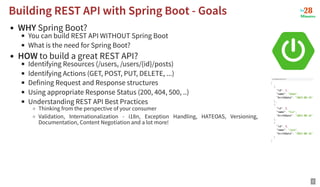
Building REST API with Spring Boot - Goals
Building REST API with Spring Boot - Goals
2
4.
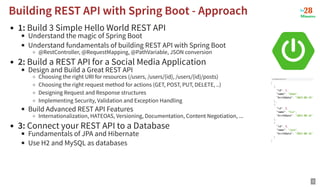
1: Build 3Simple Hello World REST API
Understand the magic of Spring Boot
Understand fundamentals of building REST API with Spring Boot
@RestController, @RequestMapping, @PathVariable, JSON conversion
2: Build a REST API for a Social Media Application
Design and Build a Great REST API
Choosing the right URI for resources (/users, /users/{id}, /users/{id}/posts)
Choosing the right request method for actions (GET, POST, PUT, DELETE, ..)
Designing Request and Response structures
Implementing Security, Validation and Exception Handling
Build Advanced REST API Features
Internationalization, HATEOAS, Versioning, Documentation, Content Negotiation, ...
3: Connect your REST API to a Database
Fundamentals of JPA and Hibernate
Use H2 and MySQL as databases
Building REST API with Spring Boot - Approach
Building REST API with Spring Boot - Approach
3
5.
Let's explore someSpring Boot Magic: Enable Debug Logging
WARNING: Log change frequently!
1: How are our requests handled?
DispatcherServlet - Front Controller Pattern
Mapping servlets: dispatcherServlet urls=[/]
Auto Configuration (DispatcherServletAutoConfiguration)
2: How does HelloWorldBean object get converted to JSON?
@ResponseBody + JacksonHttpMessageConverters
Auto Configuration (JacksonHttpMessageConvertersConfiguration)
3: Who is configuring error mapping?
Auto Configuration (ErrorMvcAutoConfiguration)
4: How are all jars available(Spring, Spring MVC, Jackson, Tomcat)?
Starter Projects - Spring Boot Starter Web (spring-webmvc, spring-web, spring-
boot-starter-tomcat, spring-boot-starter-json)
What's Happening in the Background?
What's Happening in the Background?
4
6.
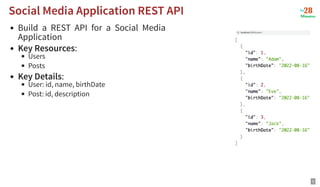
Build a RESTAPI for a Social Media
Application
Key Resources:
Users
Posts
Key Details:
User: id, name, birthDate
Post: id, description
Social Media Application REST API
Social Media Application REST API
5
7.
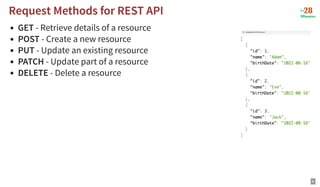
GET - Retrievedetails of a resource
POST - Create a new resource
PUT - Update an existing resource
PATCH - Update part of a resource
DELETE - Delete a resource
Request Methods for REST API
Request Methods for REST API
6
8.
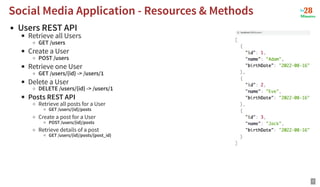
Users REST API
Retrieveall Users
GET /users
Create a User
POST /users
Retrieve one User
GET /users/{id} -> /users/1
Delete a User
DELETE /users/{id} -> /users/1
Posts REST API
Retrieve all posts for a User
GET /users/{id}/posts
Create a post for a User
POST /users/{id}/posts
Retrieve details of a post
GET /users/{id}/posts/{post_id}
Social Media Application - Resources & Methods
Social Media Application - Resources & Methods
7
9.
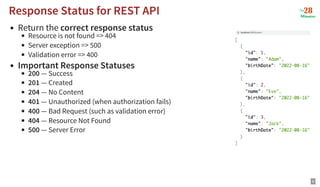
Return the correctresponse status
Resource is not found => 404
Server exception => 500
Validation error => 400
Important Response Statuses
200 — Success
201 — Created
204 — No Content
401 — Unauthorized (when authorization fails)
400 — Bad Request (such as validation error)
404 — Resource Not Found
500 — Server Error
Response Status for REST API
Response Status for REST API
8
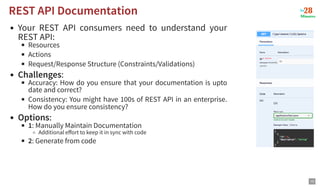
Your REST APIconsumers need to understand your
REST API:
Resources
Actions
Request/Response Structure (Constraints/Validations)
Challenges:
Accuracy: How do you ensure that your documentation is upto
date and correct?
Consistency: You might have 100s of REST API in an enterprise.
How do you ensure consistency?
Options:
1: Manually Maintain Documentation
Additional effort to keep it in sync with code
2: Generate from code
REST API Documentation
REST API Documentation
10
12.
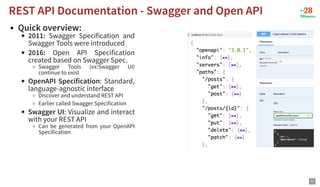
Quick overview:
2011: SwaggerSpecification and
Swagger Tools were introduced
2016: Open API Specification
created based on Swagger Spec.
Swagger Tools (ex:Swagger UI)
continue to exist
OpenAPI Specification: Standard,
language-agnostic interface
Discover and understand REST API
Earlier called Swagger Specification
Swagger UI: Visualize and interact
with your REST API
Can be generated from your OpenAPI
Specification
REST API Documentation - Swagger and Open API
REST API Documentation - Swagger and Open API
11
13.
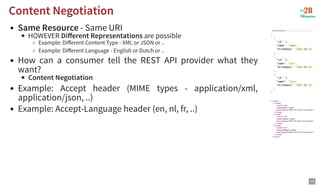
Same Resource -Same URI
HOWEVER Different Representations are possible
Example: Different Content Type - XML or JSON or ..
Example: Different Language - English or Dutch or ..
How can a consumer tell the REST API provider what they
want?
Content Negotiation
Example: Accept header (MIME types - application/xml,
application/json, ..)
Example: Accept-Language header (en, nl, fr, ..)
Content Negotiation
Content Negotiation
12
14.
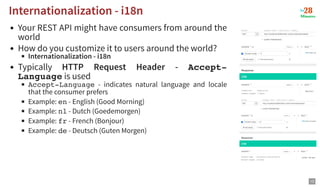
Your REST APImight have consumers from around the
world
How do you customize it to users around the world?
Internationalization - i18n
Typically HTTP Request Header - Accept-
Language is used
Accept-Language - indicates natural language and locale
that the consumer prefers
Example: en - English (Good Morning)
Example: nl - Dutch (Goedemorgen)
Example: fr - French (Bonjour)
Example: de - Deutsch (Guten Morgen)
Internationalization - i18n
Internationalization - i18n
13
15.
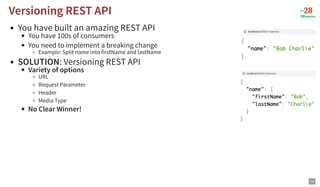
You have builtan amazing REST API
You have 100s of consumers
You need to implement a breaking change
Example: Split name into firstName and lastName
SOLUTION: Versioning REST API
Variety of options
URL
Request Parameter
Header
Media Type
No Clear Winner!
Versioning REST API
Versioning REST API
14
16.
URI Versioning -Twitter
Request Parameter versioning - Amazon
(Custom) headers versioning - Microsoft
SAME-URL headers=[X-API-VERSION=1]
SAME-URL headers=[X-API-VERSION=2]
Media type versioning (a.k.a “content negotiation” or “accept
header”) - GitHub
SAME-URL produces=application/vnd.company.app-v1+json
SAME-URL produces=application/vnd.company.app-v2+json
Versioning REST API - Options
Versioning REST API - Options
http://localhost:8080/v1/person
http://localhost:8080/v2/person
http://localhost:8080/person?version=1
http://localhost:8080/person?version=2
15
17.
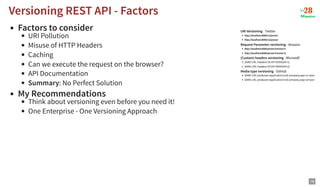
Factors to consider
URIPollution
Misuse of HTTP Headers
Caching
Can we execute the request on the browser?
API Documentation
Summary: No Perfect Solution
My Recommendations
Think about versioning even before you need it!
One Enterprise - One Versioning Approach
Versioning REST API - Factors
Versioning REST API - Factors
16
18.
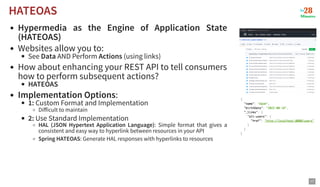
Hypermedia as theEngine of Application State
(HATEOAS)
Websites allow you to:
See Data AND Perform Actions (using links)
How about enhancing your REST API to tell consumers
how to perform subsequent actions?
HATEOAS
Implementation Options:
1: Custom Format and Implementation
Difficult to maintain
2: Use Standard Implementation
HAL (JSON Hypertext Application Language): Simple format that gives a
consistent and easy way to hyperlink between resources in your API
Spring HATEOAS: Generate HAL responses with hyperlinks to resources
HATEOAS
HATEOAS
17
19.
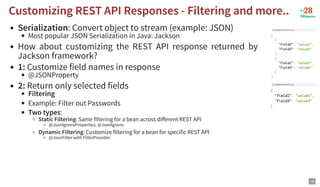
Serialization: Convert objectto stream (example: JSON)
Most popular JSON Serialization in Java: Jackson
How about customizing the REST API response returned by
Jackson framework?
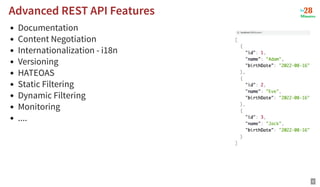
1: Customize field names in response
@JSONProperty
2: Return only selected fields
Filtering
Example: Filter out Passwords
Two types:
Static Filtering: Same filtering for a bean across different REST API
@JsonIgnoreProperties, @JsonIgnore
Dynamic Filtering: Customize filtering for a bean for specific REST API
@JsonFilter with FilterProvider
Customizing REST API Responses - Filtering and more..
Customizing REST API Responses - Filtering and more..
18
20.
Spring Boot Actuator:Provides Spring Boot’s production-
ready features
Monitor and manage your application in your production
Spring Boot Starter Actuator: Starter to add Spring Boot
Actuator to your application
spring-boot-starter-actuator
Provides a number of endpoints:
beans - Complete list of Spring beans in your app
health - Application health information
metrics - Application metrics
mappings - Details around Request Mappings
and a lot more .......
Get Production-ready with Spring Boot Actuator
Get Production-ready with Spring Boot Actuator
19
21.
1: HAL (JSONHypertext Application Language)
Simple format that gives a consistent and easy way to hyperlink between
resources in your API
2: HAL Explorer
An API explorer for RESTful Hypermedia APIs using HAL
Enable your non-technical teams to play with APIs
3: Spring Boot HAL Explorer
Auto-configures HAL Explorer for Spring Boot Projects
spring-data-rest-hal-explorer
Explore REST API using HAL Explorer
Explore REST API using HAL Explorer
20


![Let's explore some Spring Boot Magic: Enable Debug Logging
WARNING: Log change frequently!
1: How are our requests handled?
DispatcherServlet - Front Controller Pattern
Mapping servlets: dispatcherServlet urls=[/]
Auto Configuration (DispatcherServletAutoConfiguration)
2: How does HelloWorldBean object get converted to JSON?
@ResponseBody + JacksonHttpMessageConverters
Auto Configuration (JacksonHttpMessageConvertersConfiguration)
3: Who is configuring error mapping?
Auto Configuration (ErrorMvcAutoConfiguration)
4: How are all jars available(Spring, Spring MVC, Jackson, Tomcat)?
Starter Projects - Spring Boot Starter Web (spring-webmvc, spring-web, spring-
boot-starter-tomcat, spring-boot-starter-json)
What's Happening in the Background?
What's Happening in the Background?
4](https://image.slidesharecdn.com/building-rest-api-with-spring-boot-in28minutes-presentation-250226110632-7ec00369/85/building-rest-api-with-spring-boot-in28minutes-presentation-pdf-5-320.jpg)
![URI Versioning - Twitter
Request Parameter versioning - Amazon
(Custom) headers versioning - Microsoft
SAME-URL headers=[X-API-VERSION=1]
SAME-URL headers=[X-API-VERSION=2]
Media type versioning (a.k.a “content negotiation” or “accept
header”) - GitHub
SAME-URL produces=application/vnd.company.app-v1+json
SAME-URL produces=application/vnd.company.app-v2+json
Versioning REST API - Options
Versioning REST API - Options
http://localhost:8080/v1/person
http://localhost:8080/v2/person
http://localhost:8080/person?version=1
http://localhost:8080/person?version=2
15](https://image.slidesharecdn.com/building-rest-api-with-spring-boot-in28minutes-presentation-250226110632-7ec00369/85/building-rest-api-with-spring-boot-in28minutes-presentation-pdf-16-320.jpg)