Download to read offline
![International Journal of Artificial Intelligence and Applications (IJAIA), Vol.14, No.6, November 2023
DOI:10.5121/ijaia.2023.14601 1
BUILDING PYTHON APPLICATION FOR WEBMAIL
INTERFACES NAVIGATION USING VOICE
RECOGNITION TECHNOLOGY
Mokhtar Alkhattali1
, Mostafa Dow2
, Khawla Azwee1
and Mohamed Sayah2
1
Department of Computer Science, High Institute of Science and Technology, Qaser Bin
Ghashir, Libya
2
Department of Computer Science, College of Science and Technology, Jadu, Libya
ABSTRACT
Voice Recognition Technology (VRT) has played a crucial role in technology development, finding
extensive use in the development of humanitarian assistance applications, including assistance programs
for individuals with disabilities to use smart vehicles and smart homes, as well as websites. This paper
discusses implementing a Computer Application (PC-App) for humanitarian assistance written in Python
to enable Arabic-speaking elderly and handicapped employees to access and navigate webmail accounts
using Arabic Voice Commands (AVC). Furthermore, a survey was conducted for elderly and disabled
employees to assess the effectiveness of the application, with participants evaluating that it was useful in
addition to improving their interaction with their accounts in Webmail. Ultimately, this application
promotes independence and functionality for Arabic-speaking individuals, regardless of their mobility
disability levels, by allowing them to independently use the Webmail interface using AVC.
KEYWORDS
Voice Recognition Technology, Arabic Voice Commands, Webmail,Elderly Employees, Assistant
Applications.
1. INTRODUCTION
Technology has become our means of communication and interaction in both our daily and work
lives. One significant development in communication history has been the innovation of E-mail,
which has become an indispensable tool in various fields [40-52]. Although everyone can utilize
this technology completely, disabled individuals are having difficulty fully utilizing it due to
physical impairments. Consequentially, developers should work on assistive technology (AT) in
order to ensure equal access to and benefit from advanced technology for disabled individuals. To
ensure equal access to Technological developments for disabled individuals, the focus must be on
AT[11-15-48]. Webmail accounts can be conveniently created and accessed online through
hosting websites and control panels (cPanel) [34]. Therefore, accessibility measures and benefits
from technologies are particularly crucial for people with disabilities and older employees who
may struggle to keep up with technological advances. Although technological advancements like
speech recognition and eye-tracking have made it possible for those with severe disabilities to
interact actively with the world, there remains a need for accessible online systems that provide
support and assistance[26-43-45]. Accordingly, investing in accessibility measures can
significantly improve the quality of life for everyone, including disabled and elderly individuals.
Through the use of AT, employers can support these segments of the population in employment
and reduce isolation and confinement to their homes [9-14-35]. Notably, it is vital to ensure that
VRT is accessible and usable for handicapped individuals and older employees [54-57].](https://image.slidesharecdn.com/14623ijaia01-231208122801-4c35b87b/85/BUILDING-PYTHON-APPLICATION-FOR-WEBMAIL-INTERFACES-NAVIGATION-USING-VOICE-RECOGNITION-TECHNOLOGY-1-320.jpg)
![International Journal of Artificial Intelligence and Applications (IJAIA), Vol.14, No.6, November 2023
2
This study investigates the accessibility of Webmail interfaces at the control panel of hosting
(cPanel) for individuals with disabilities, handicaps, and the elderly using VRT. The research
emphasizes the significance of integrating this technology to enhance accessibility and ensure
equal opportunities for all individuals. By adopting an inclusive approach, this study aims to
enable active participation in society, irrespective of physical abilities or age.
1.1. Statistics
These statistics provide valuable insights into many important aspects. They reveal the rapid
growth of the email market and how important to use it for communicating with job applicants. In
addition to the rapid development in the use of voice recognition and the popularity of Python
packages in computer science, all these factors have motivated the submission of this paper.
To begin with, it is noteworthy that in Denmark, a remarkable 93% of the population used email
in 2016. This indicates that email is widely used and holds immense importance as a means of
communication. Additionally, even individuals aged 65-74 showed a high email usage rate of
98% [1].
A research study conducted in the Netherlands found that 60% of job researchers used job
vacancy websites to find work. Interestingly, most individuals who changed employers relied on
personal networks. These findings underscore the significance of personal connections when
transitioning jobs [46].
Next,into applicant preferences in the United States. In 2018, 76% of job applicants preferred to
receive personalized email acknowledgement of their receipt[47]. This finding aligns with a
survey conducted by The Balance Careers, indicating that 84% of respondents preferred receiving
a personalized email acknowledging their application. These statistics emphasize the importance
of personalized communication and the impact it can have on applicant satisfaction[49].
Shifting our attention to the sheer volume of emails sent globally, there is a study discovered that
over 231 million emails were sent in just one minute in April 2022. Additionally, the daily email
count in countries like the Netherlands, Japan, India, and Germany reached a staggering 8.3
billion. These numbers highlight the immense reliance on email as a primary mode of
communication in today's digital age[19].
Furthermore, approximately $50 billion will be generated by voice recognition by 2029, up from
$10 billion in 2020. Consequently, the compound annual growth rate will be 23.7% [51]. This
growth underscores the increasing importance and integration of VRT in various aspects of our
lives. In the United States alone, there were approximately 142 million users of voice assistants in
2022, with predictions indicating a rise to 157.1 million users by 2026[50].
Lastly, others examine the popularity of Python packages in the field of data science. Numpy and
Pandas emerged as the most widely used Python frameworks, with respective market shares of
60% and 55% in 2021. These statistics highlight the dominance of Python packages in facilitating
data analysis and manipulation[55].
2. STUDY BACKGROUND
AT has emerged as an indispensable tool for disabled individuals, facilitating their engagement in
various tasks and enabling their full participation within society [4-24-31]. The sphere of AT
encompasses a diverse array of solutions, ranging from rudimentary to sophisticated. For](https://image.slidesharecdn.com/14623ijaia01-231208122801-4c35b87b/85/BUILDING-PYTHON-APPLICATION-FOR-WEBMAIL-INTERFACES-NAVIGATION-USING-VOICE-RECOGNITION-TECHNOLOGY-2-320.jpg)
![International Journal of Artificial Intelligence and Applications (IJAIA), Vol.14, No.6, November 2023
3
individuals with physical impairments, AT offers opportunities to enhance their mobility and
foster independence by employing a multitude of aids, including but not limited to crutches,
electric wheelchairs, specialized vehicles, and supplementary devices specifically designed to
provide bodily support [7-21].
The software aids are another facet of AT that greatly benefit those with sensory or mobility
issues. These include computer software-aided mobile devices, screen readers, voice recognition
tools, and screen enlargement applications [5-30-32-39]. By utilizing these technologies,
individuals can overcome barriers associated with visual or movement impairments and access
information or communicate effectively. Electrical or software-backed assistive devices are
employed to provide support and enable better engagement in educational, medical, professional,
and personal things. These developments vary depending on the work tool and disability type,
which can greatly enhance the ability of disabled individuals to complete specific activities
independently [36-41-58].
2.1. Voice Recognition Technology
The VRT, also known as Automatic Speech Recognition (ASR), revolutionizes the way users
interact with modern systems by using spoken commands. By converting spoken human language
into written text or translating it into specific actions. The ASR technology heavily relies on
complex algorithms and machine learning (ML) methods to accurately decipher spoken words
and interpret their intended meaning. With its ability to understand and respond to human speech,
VRT opens up a world of possibilities for hands-free communication in several industries[17-23-
42-44].
2.2. Arabic Speech Recognition
The development of accurate and efficient Arabic Speech Recognition (ASR) systems presents
unique obstacles due to the intricate phonetic structure and grammar of the Arabic language.
Recent advancements in technology have employed various techniques to address these
challenges, including the combination of deep learning models and traditional acoustic models to
enhance ASR capabilities. This approach has resulted in promising results in the accurate
transcription of Arabic speech [2-6-8-12].
Moreover, ASR has already been integrated by applications and AT developers, enabling
individuals to control wheelchairs and access computers using only AVC [10-28]. This
advancement enhances accessibility and empowers Arabic-speaking individuals, especially those
with disabilities, to perform everyday tasks independently. Despite the existing language
variances and numerous dialects, researchers are continuously refining speech recognition
algorithms and data sets to develop accurate and efficient ASR on technology [33-37].
2.3. Accessibility Using Voice Commands
The increasing use of voice commands in PC-App applications has become popular mainly due
to the convenience and accessibility they offer. These applications allow for hands-free
interaction and make tasks easy for disabled individuals, particularly those with physical
impairments that limit their dexterity [18-24]. An example of such applications is the voice
access applications developed by Google to enable users to navigate and operate smartphones
solely using voice commands [29-53]. This feature makes it easier for users to access functions
like texting, making calls, and opening applications through voice instructions. Furthermore, it
supports a variety of human languages. The integration of voice recognition into various assistive
technologies has proven to be beneficial for individuals with disabilities to access technology,](https://image.slidesharecdn.com/14623ijaia01-231208122801-4c35b87b/85/BUILDING-PYTHON-APPLICATION-FOR-WEBMAIL-INTERFACES-NAVIGATION-USING-VOICE-RECOGNITION-TECHNOLOGY-3-320.jpg)
![International Journal of Artificial Intelligence and Applications (IJAIA), Vol.14, No.6, November 2023
4
communicate, and interact with digital systems effectively. Thus, these applications promote
inclusivity and independence for users with physical limitations [13-16-27-56].
3. THE DEVELOPED SYSTEM
This paper presents an integrated system that enables users to access Webmail accounts by using
VRT, especially those who have difficulty using a mouse or keyboard.
3.1. System Components
The system architecture consists of a user, a personal computer PC, a microphone, a web
browser, as well as a developed application. The user controls the developed system by speaking
into the microphone.
3.2. The Developed Application
The developed application is responsible for processing the speech of the user and executing the
corresponding commands on the PC. It is programmed by the Python language that supports
multiple libraries and paradigms, such as "PyAudio", to receive and process the speech of the
user, as well as to use the "Recognize Google API" to enhance the accuracy of the process of
converting the voice. Additionally, utilize the "Pyautogui" library responsible for keys on the
keyboard to control key events. Figures 1 and 2 illustrate a sample of the Python code that shows
the essential functions of the developed application.
Figure 1. Python code written in the developed application
Figure 2. Python code written in the developed application
3.3. System Description
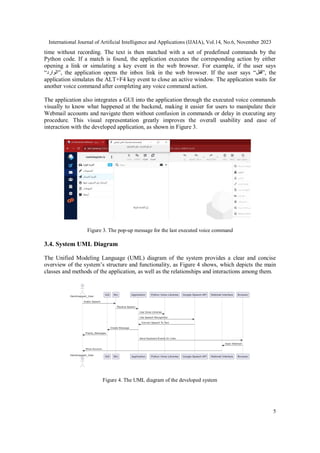
The system operates as follows: the user says a voice command into the microphone. then
received and converted into text by the voice libraries and the Google recognition API in real-](https://image.slidesharecdn.com/14623ijaia01-231208122801-4c35b87b/85/BUILDING-PYTHON-APPLICATION-FOR-WEBMAIL-INTERFACES-NAVIGATION-USING-VOICE-RECOGNITION-TECHNOLOGY-4-320.jpg)
![International Journal of Artificial Intelligence and Applications (IJAIA), Vol.14, No.6, November 2023
6
3.5. Voice Commands Flowchart
The integration of application commands with voice commands facilitated smooth execution
main events. The user is able to effortlessly communicate their desired actions through Arabic
spoken language, and the application would promptly execute them accordingly. This operational
concept is visually depicted in flowchart as shown in figure 5.
Upon the user issuing the speech as a voice command, the application receives and converts it to
a string variable represented by a word. Thereafter, if this word exists within the available options
of the application, it is executed as key-events or open hyperlinks. then going back to receiving
further voice commands. Conversely, if the word does not correspond to any of the pre-defined
command words within the application, the application repeats its sound reception process. This
loop continues until the application is finished.
Figure 5. The user speech flowchart
3.6. Developed System Requirements
The core component of the system is a developed application called Application Assistance for
Webmail (AAW). To develop and implement AAW, both hardware and software components
had to be provided to facilitate the development and smooth implementation of the application
within the system.
A Windows 10-compatible computer system was required, along with an external or built-in
microphone for receiving speech input from the user. During the development phase, open-source
software was preferred to minimize costs. As a result, the AAW incorporated numerous programs
and libraries that are essential to its functioning. These include:
• Python 3.12:This particular version of the Python language was utilized for developing the
application. Python is renowned for its simplicity in coding, versatility, and supportive
community, making it an excellent choice for this project[38].
• Tkinter library:It works as the standard library in Python to allow developers to create
applications with visually appealing and user-friendly interfaces through a GUI.
• Recognize_Google library:a specific library is designed for programming speech
recognition applications using Google's services. Utilizing the API of speech recognition in
Google's capabilities, it converts audio input from a microphone into text. Furthermore,
multiple languages are supported.
• Pyautogui library: It is a Python library that provides platform support for automating tasks
on a PC. Developers can use it to create scripts that automate this process as well as to
simulate human-like interactions with the computer, such as opening links, pressing keys,
clicking buttons, moving the mouse cursor, more even to even typing text. This makes it
useful for testing user interfaces or performing actions that require human input [20-22].](https://image.slidesharecdn.com/14623ijaia01-231208122801-4c35b87b/85/BUILDING-PYTHON-APPLICATION-FOR-WEBMAIL-INTERFACES-NAVIGATION-USING-VOICE-RECOGNITION-TECHNOLOGY-6-320.jpg)
![International Journal of Artificial Intelligence and Applications (IJAIA), Vol.14, No.6, November 2023
7
3.7. System Launching
The system consists of two sections. the computer and the developed application. Initially, the
user must operate the computer and subsequently launch the application from within it. Closing
both components is also required.
3.7.1. Turn Computer On
For people who are disabled or elderly, using motion sensors or push buttons on PCs can be a
useful way to operate them. These methods can be set up for the PC depending on the user's
needs and disability.
• One method is to use a push button that is medium-sized and easy to press with the head or
leg. It is placed in a suitable location for the user and connected to the PC as a replacement
for the normal operating button.
• Another approach involves employing a motion sensor as an alternative mechanism for
regulating the operation of PCs. This technique functions as a switch on/off by using a
Passive InfraRed (PIR) [25]. The PC power supply powers the sensor's electronic circuitry
after it has been configured. Additionally, it necessitates placement in proximity to the user
while ensuring minimal interference from any extraneous movements.
3.7.2. Run The Application
The application AAW is installed on a PC following the provided installation instructions. Once
installed, it is added to the list of programs that automatically run when Windows boots up. This
ensures that the application starts up automatically and is ready to receive voice commands
through the microphone. The first command to activate Webmail in the browser is ""حسابي. And if
there are any unknown voice commands, the application does not respond to them. Additionally,
there are alert pop-up messages to guide users and allow them to repeat their commands if they
are unclear.
The application immediately recognizes specific command words such as ""التالي, ""فوق, ""إرسال,
""إنشاء, as well as ""قفل It accurately identifies these words and takes appropriate action
accordingly. Table No. 1 displays a portion of the speech commands and corresponding reactions
used within the application. It should be noted that when writing a lengthy message in Arabic, the
voice command ""رسالة is used. The AAW characterized by the command voice "اللغة "اإلنجليزية, is
used to switch to receiving speech in English for writing letters and numbers or writing long
messages solely in English. The command "Arabic language" can be used to go back to receiving
AVC. Using this method, you can type the recipient's name, email address, subject, or any
sentence using the appropriate language.
Table 1. Some of the AVCs with its reaction in the system
Arabic Voice Commands Reaction
حسابي To open the browser on the Webmail account
إنشاء To open Composein Webmail
قفل To Close the currently active window
تحت As if you were pressing the Down arrow key](https://image.slidesharecdn.com/14623ijaia01-231208122801-4c35b87b/85/BUILDING-PYTHON-APPLICATION-FOR-WEBMAIL-INTERFACES-NAVIGATION-USING-VOICE-RECOGNITION-TECHNOLOGY-7-320.jpg)
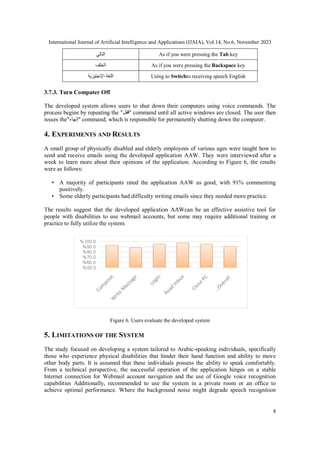
![International Journal of Artificial Intelligence and Applications (IJAIA), Vol.14, No.6, November 2023
9
results, which can be a primary obstacle to efficiently using the developed system in outdoor
areas and large public places.
6. CONCLUSION
This paper presents a specialized Windows application for Arabic speakers with disabilities or
old age that has successfully addressed the challenges they face in using Webmail accounts. The
application uses VRT to enable users to interact with their Webmail platform without relying on
keyboards or mice, which can be difficult for them. Thus, it enables the users to effortlessly
access all the features of the Webmail account, such as logging in and out, browsing their
Webmail pages, and turning their PCs on and off. The system is cost-effective. Moreover, it can
be easily used. Ultimately, the system improves the well-being and productivity of disabled or
elderly workers who face challenges with traditional input methods.
7. FUTURE WORK
Even though the system has demonstrated promising results, future work is suggested to increase
its development. One potential area of development is expanding the system's capability to
include compatibility with other popular communication platforms, such as Gmail, WhatsApp,
Facebook, and Outlook, all within the same application. By integrating artificial intelligence, the
system could also learn multiple languages as voice commands directly from users, providing
them with the flexibility to choose their preferred language. Moreover, making the system
compatible with several operating systems would enhance its accessibility and appeal to a
broader range of users.
ACKNOWLEDGEMENTS
This study was financially supported by "DIGITAL VERSION Company for Import Digital
Devises Company". The authors extend their sincere appreciation to the volunteers, which
include both the staff and physically challenged elderly individuals, who willingly participated in
this study.
REFERENCES
[1] Agnes T, Nielsen MB, Jakobsen DT. It-anvendelseibefolkningen 2019. Statistics Denmark. URL:
https://www.dst.dk/Site/Dst/Udgivelser/GetPubFile.aspx?id=29449&sid=itbef2019
[2] Ahmed, A., Bader, M., Shahin, I., Nassif, A. B., Werghi, N., & Basel, M. (2023). Arabic
Mispronunciation Recognition System Using LSTM Network. Information, 14(7), 413.
[3] Akash, S., Jayaram, N., &Jesudoss, A. (2022, May). Desktop based Smart Voice Assistant using
Python Language Integrated with Arduino. In 2022 6th International Conference on Intelligent
Computing and Control Systems (ICICCS) (pp. 374-379). IEEE.
[4] Al Omoush, M. H., & Mehigan, T. (2023, June). Leveraging Robotics to Enhance Accessibility and
Engagement in Mathematics Education for Vision-Impaired Students. In 2023 5th International
Congress on Human-Computer Interaction, Optimization and Robotic Applications (HORA) (pp. 1-
6). IEEE.
[5] Alkhattali, M. (2019). Development of a computer application for handicapped people to use Gmail.
International Journal of Emerging Technology and Innovative Engineering,5(11), 784–
790.https://www.ijetie.com/issue511.html
[6] Alsayadi, H. A., Abdelhamid, A. A., Hegazy, I., Alotaibi, B., & Fayed, Z. T. (2022). Deep
investigation of the recent advances in dialectal arabic speech recognition. IEEE Access, 10, 57063-
57079.](https://image.slidesharecdn.com/14623ijaia01-231208122801-4c35b87b/85/BUILDING-PYTHON-APPLICATION-FOR-WEBMAIL-INTERFACES-NAVIGATION-USING-VOICE-RECOGNITION-TECHNOLOGY-9-320.jpg)
![International Journal of Artificial Intelligence and Applications (IJAIA), Vol.14, No.6, November 2023
10
[7] Apostolidou, E., &Fokaides, P. A. (2023). Enhancing Accessibility: A Comprehensive Study of
Current Apps for Enabling Accessibility of Disabled Individuals in Buildings. Buildings, 13(8),
2085.
[8] Azim, M. A., Hussein, W., & Badr, N. L. (2023). Using Character-Level Sequence-to-Sequence
Model for Word Level Text Generation to Enhance Arabic Speech Recognition. IEEE Access.
[9] Bong, W. K., Chen, W., & Bergland, A. (2018). Tangible user interface for social interactions for
the elderly: a review of literature. Advances in Human-Computer Interaction, 2018.
[10] Bouafif, L., &Ellouze, N. (2020). Implementation of a Biometric Interface in Voice Controlled
Wheelchairs. Sound & Vibration, 54(1).
[11] Castilla, D., Garcia-Palacios, A., Miralles, I., Breton-Lopez, J., Parra, E., Rodriguez-Berges, S., &
Botella, C. (2016). Effect of Web navigation style in elderly users. Computers in Human Behaviour,
55, 909-920.
[12] Chemnad, K., & Othman, A. (2023). Advancements in Arabic Text-to-Speech Systems: A 22-Year
Literature Review. IEEE Access.
[13] Chenumalla, K., Gottam, S., Kusuma, P., & Shri, P. B. (2019). Google assistant controlled home
automation. International Research Journal of Engineering and Technology (IRJET), 5(5), 2074-
2077.
[14] Czaja, S. J. (2006, October). Technology and older adults: designing for accessibility and usability.
In Proceedings of the 8th international ACM SIGACCESS conference on computers and
accessibility (pp. 1-1).
[15] de Freitas, M. P., Piai, V. A., Farias, R. H., Fernandes, A. M., de Moraes Rossetto, A. G.,
&Leithardt, V. R. Q. (2022). Artificial intelligence of things applied to assistive technology: a
systematic literature review. Sensors, 22(21), 8531.
[16] de Oliveira, G. A., Oliveira, O. D. F., de Abreu, S., de Bettio, R. W., & Freire, A. P. (2022).
Opportunities and accessibility challenges for open-source general-purpose home automation
mobile applications for visually disabled users. Multimedia Tools and Applications, 81(8), 10695-
10722.
[17] Deng, L., & Li, X. (2013). Machine learning paradigms for speech recognition: An overview. IEEE
Transactions on Audio, Speech, and Language Processing, 21(5), 1060-1089.
[18] Dhanraj, V. K., &Lokeshkriplani, S. M. (2022). Research Paper on Desktop Voice Assistant.
International Journal of Research in Engineering and Science (IJRES), 10(2), 15-20.
[19] Dixon, S. (2023, April 4). Countries with highest number of emails sent April 2023. Statista.
https://www.statista.com/statistics/1270459/daily-emails-sent-by-country/
[20] Fapal, A., Kanade, T., Janrao, B., Kamble, M., & Raule, M. (2021). Personal Virtual Assistant for
Windows Using Python. International Research Journal of Modernization in Engineering, 3(07),
485-491.
[21] Florio, J., Arnet, U., Gemperli, A., Hinrichs, T., &SwiSCI Study Group. (2016). Need and use of
assistive devices for personal mobility by individuals with spinal cord injury. The journal of spinal
cord medicine, 39(4), 461-470.
[22] Geetha, V., Gomathy, C. K., Vardhan, K. M. S., & Kumar, N. P. (2021). The voice enabled personal
assistant for Pc using python. International Journal of Engineering and Advanced Technology, 10,
162-165.
[23] Gonge, S., Jain, A., Joshi, R., Vora, D., & Kotecha, K. (2023). Voice Recognition System for
Desktop Assistant. In Computational Vision and Bio-Inspired Computing: Proceedings of ICCVBIC
2022 (pp. 675-690). Singapore: Springer Nature Singapore.
[24] Gubareva, R., & Lopes, R. P. (2020). Virtual Assistants for Learning: A Systematic Literature
Review. CSEDU (1), 97-103.
[25] Htwe, T. Z., Tun, A. T., & Aung, C. S. (2020). Power saving system using ldr and pir sensor. Iconic
Research and Engineering Journals, 4(2), 51-55.
[26] Iancu, I., & Iancu, B. (2020). Designing mobile technology for elderly. A theoretical overview.
Technological Forecasting and Social Change, 155, 119977.
[27] Isyanto, H., Arifin, A. S., &Suryanegara, M. (2020, October). Performance of smart personal
assistant applications based on speech recognition technology using IoT-based voice commands. In
2020 International conference on information and communication technology convergence (ICTC)
(pp. 640-645). IEEE.
[28] Jaradat, G. A., Alzubaidi, M. A., &Otoom, M. (2022). A novel human-vehicle interaction assistive
device for Arab drivers using speech recognition. IEEE Access, 10, 127514-127529.](https://image.slidesharecdn.com/14623ijaia01-231208122801-4c35b87b/85/BUILDING-PYTHON-APPLICATION-FOR-WEBMAIL-INTERFACES-NAVIGATION-USING-VOICE-RECOGNITION-TECHNOLOGY-10-320.jpg)
![International Journal of Artificial Intelligence and Applications (IJAIA), Vol.14, No.6, November 2023
11
[29] Lancioni, G. E., Singh, N. N., O’Reilly, M. F., Sigafoos, J., Alberti, G., Chiariello, V., &Desideri,
L. (2022). People with intellectual and visual disabilities access basic leisure and communication
using a smartphone’s Google Assistant and voice recording devices. Disability and Rehabilitation:
Assistive Technology, 17(8), 957-964.
[30] Lee, H. N. (2023). Enhancing the Usability of Computer Applications for People With Visual
Impairments via UI Augmentation (Doctoral dissertation, State University of New York at Stony
Brook).
[31] Machado, F., Loureiro, M., Mello, R. C., Diaz, C. A., &Frizera, A. (2023). A novel mixed reality
assistive system to aid the visually and mobility impaired using a multimodal feedback system.
Displays, 102480.
[32] Mashiata, M., Ali, T., Das, P., Tasneem, Z., Badal, M. F. R., Sarker, S. K., ... & Das, S. K. (2022).
Towards assisting visually impaired individuals: A review on currentstatus and future prospects.
Biosensors and Bioelectronics: X, 12, 100265.
[33] Nasr, S., Duwairi, R., &Quwaider, M. (2023). End-to-End Speech Recognition For Arabic Dialects.
Arabian Journal for Science and Engineering, 1-17.
[34] Pedersen, A. (2006). CPanel user guide and tutorial. Packt Publishing Ltd.
[35] Perez, A. J., Siddiqui, F., Zeadally, S., & Lane, D. (2022). A review of IoT systems to enable
independence for the elderly and disabled individuals. Internet of Things, 100653.
[36] Pydala, B., Kumar, T. P., & Baseer, K. K. (2023). Smart_Eye: A Navigation and Obstacle Detection
for Visually Impaired People through Smart App. Journal of Applied Engineering and
Technological Science (JAETS), 4(2), 992-1011.
[37] Qidwai, U., & Ibrahim, F. (2010, May). Arabic speech-controlled wheelchair: A fuzzy scenario. In
10th International conference on information science, signal processing and their applications
(ISSPA 2010) (pp. 153-156). IEEE.
[38] Ramalho, L. (2022). Fluent python. " O'Reilly Media, Inc.".
[39] S. Abhishek, H. Sathish, A. K. K and A. T, "Aiding the Visually Impaired using Artificial
Intelligence and Speech Recognition Technology," 2022 4th International Conference on Inventive
Research in Computing Applications (ICIRCA), Coimbatore, India, 2022, pp. 1356-1362, doi:
10.1109/ICIRCA54612.2022.9985659.
[40] Saarijärvi, M., & Bratt, E. L. (2021). When face-to-face interviews are not possible: tips and tricks
for video, telephone, online chat, and email interviews in qualitative research.
[41] Schladant, M., Ocasio-Stoutenburg, L., Nunez, C., Dowling, M., Shearer, R., Bailey, J., ... & Natale,
R. (2023). Promoting a culture of inclusion: impact of professional development on teachers’
assistive technology practices to support early literacy. Journal of Early Childhood Teacher
Education, 44(2), 147-166.
[42] Sen, M., Jana, S., Bhattacharya, S., & Maity, G. (2023). AI-Based DBMS Controlled Speech
Recognition Model for Some Common Computing Commands. In Novel Research and
Development Approaches in Heterogeneous Systems and Algorithms (pp. 143-154). IGI Global.
[43] Sharma, H. K., Choudhury, T., Soni, R., & Sharma, S. (2023, January). Human Computer Interface
(HCI) controlled AI enabled System for Optimization. In 2023 13th International Conference on
Cloud Computing, Data Science & Engineering (Confluence) (pp. 552-557). IEEE.
[44] Sharma, K., Suryakanthi, T., & Prasad, T. V. (2013). Exploration of speech enabled system for
english. arXiv preprint arXiv:1304.8013.
[45] Shree, T. N., & Sundari, N. A. (2023, August). A Virtual Assistor for Impaired People by using
Gestures and Voice. In 2023 5th International Conference on Inventive Research in Computing
Applications (ICIRCA) (pp. 546-550). IEEE.
[46] Statista Research Department. (2022, July 25). Netherlands: most popular channels to search for a
new job 2019.
[47] Statista. (2018). Leading ways employees want job applications acknowledged in the United States
in 2018. Retrieved from https://www.statista.com/statistics/951108/preferred-job-application-
acknowledgement-methods-employees-united-states
[48] Stewart, S., Hansen, T. S., & Carey, T. A. (2010). Opportunities for people with disabilities in the
virtual world of Second Life. Rehabilitation Nursing, 35(6), 254-259.
[49] The Balance Careers. (2021). How to acknowledge a job application. Retrieved from
https://www.thebalancecareers.com/how-to-acknowledge-a-job-application-2062561
[50] Thormundsson, B. (2022, September 28). Number of voice assistant users in the United States 2017-
2022. Statista. https://www.statista.com/statistics/1029573/us-voice-assistant-users](https://image.slidesharecdn.com/14623ijaia01-231208122801-4c35b87b/85/BUILDING-PYTHON-APPLICATION-FOR-WEBMAIL-INTERFACES-NAVIGATION-USING-VOICE-RECOGNITION-TECHNOLOGY-11-320.jpg)
![International Journal of Artificial Intelligence and Applications (IJAIA), Vol.14, No.6, November 2023
12
[51] Thormundsson, B. (2023, May 11). Global voice recognition market size 2020 to 2029. Statista.
https://www.statista.com/statistics/1133875/global-voice-recognition-market-size
[52] Tiwari, P. A., Zodawan, P., Nimkar, H. P., Rotke, T., Wanjari, P. G., & Samarth, U. (2020,
February). A Review on Voice based E-Mail System for Blind. In 2020 International Conference on
Inventive Computation Technologies (ICICT) (pp. 435-438). IEEE.
[53] Trabelsi, A., Warichet, S., Aajaoun, Y., &Soussilane, S. (2022). Evaluation of the efficiency of
state-of-the-art Speech Recognition engines. Procedia Computer Science, 207, 42-2252.
[54] Tsatsou, P. (2021). Is digital inclusion fighting disability stigma? Opportunities, barriers, and
recommendations. Disability & Society, 36(5), 702-729.
[55] Vailshery, L. S. (2022, November 22). Python frameworks in data science 2021. Statista.
https://www.statista.com/statistics/1338424/python-use-frameworks-data-science
[56] Vu, M. D., Wang, H., Li, Z., Haffari, G., Xing, Z., & Chen, C. (2023). Voicify Your UI: Towards
Android App Control with Voice Commands. Proceedings of the ACM on Interactive, Mobile,
Wearable and Ubiquitous Technologies, 7(1), 1-22.
[57] Werner, L., Huang, G., & Pitts, B. J. (2023). Smart speech systems: A focus group study on older
adult user and non-user perceptions of speech interfaces. International Journal of Human–Computer
Interaction, 39(5), 1149-1161.
[58] Zdravkova, K. (2022). The potential of artificial intelligence for assistive technology in education.
In Handbook on Intelligent Techniques in the Educational Process: Vol 1 Recent Advances and
Case Studies (pp. 61-85). Cham: Springer International Publishing.
AUTHORS
Mokhtar S. Alkhattali is a dedicated lecturer and the head of the Department of
Computer Science at the High Institute of Science and Technology (HIST), Qaser Bin
Ghashir, Libya. He earned his bachelor's degree in Electrical and Electronic Engineering
from HIST. He graduated at the top of his class. In pursuit of further knowledge, he
completed an MSc degree from Near East University in North Cyprus in the computer
information systems field with distinction in 2016. His research work on voice
recognition. Interest in networks, and developing computer applications. For more
information, contact:alkhtale@gmail.com https://orcid.org/0009-0007-2167-9322
Mostafa Dow is a dedicated lecturer and the head of the Department of Computer
Science at the Collage of Science and Technology (HIST), Jadu, Libya. He completed an
MSc degree from Near East University in North Cyprus.He research interests include
computer networks and IoT. For more information, contact:mustafa.dwo@gmail.com
https://orcid.org/0009-0005-3730-3819
Khawla Azwee is presently working as an lecturer assistant ofNetwork Computing in the Department of
Computer & Information Technology, at the Higher Institute of Science and Technology, Qaser Bin
Ghashir, Libya. She obtained her Master of Science in Network Computing in, 2016 from Coventry
University in Uk. She has more than 14 years of teaching experience. Her research interests include
computer networks and information Security.For more information, contact: kazwee190@gmail.com
https://orcid.org/0009-0000-3381-835X
Mohamed ES Sayah is a computer engineer and researcher who works as lecturer in
the Computer Department of the Higher Institute for Comprehensive Professions in
Haraba, Libya. He has a master’s degree in Computer Engineering from the Middle
East University, which he obtained in 2016. He also has a higher diploma in Computer
Science from the same institute, which he earned in 2005.For more information,
contactmmaa59787@gmail.com.](https://image.slidesharecdn.com/14623ijaia01-231208122801-4c35b87b/85/BUILDING-PYTHON-APPLICATION-FOR-WEBMAIL-INTERFACES-NAVIGATION-USING-VOICE-RECOGNITION-TECHNOLOGY-12-320.jpg)

This paper presents a Python-based application using voice recognition technology to assist Arabic-speaking elderly and handicapped users in navigating webmail interfaces via voice commands. A survey showed that participants found the application effective in enhancing their interaction with webmail accounts, promoting independence for individuals with disabilities. The study emphasizes the importance of accessible technology to ensure equal opportunities for all users, regardless of their physical abilities or age.


![final_ppt[1].pptxCCCCCCCCCCCCCCCCCCCCCCCC](https://cdn.slidesharecdn.com/ss_thumbnails/finalppt1-240530120839-258d1296-thumbnail.jpg?width=640&height=640&fit=bounds)


![[DSC Europe 25] Andrzej Kowalczyk - AI - how to start small and grow in the f...](https://cdn.slidesharecdn.com/ss_thumbnails/oy1zmo94qv6vpcqjvno2-andrzej-kowalczyk-ai-how-to-start-small-and-grow-in-the-future-1-260119121559-cf093b23-thumbnail.jpg?width=640&height=640&fit=bounds)

![[DSC Europe 25] Borko Kozomora - Optimizing business workflows with advances ...](https://cdn.slidesharecdn.com/ss_thumbnails/hbgekyb0txw0xpo4yfml-borko-kozomora-leading-ai-transformation-260122103838-cc29ee38-thumbnail.jpg?width=640&height=640&fit=bounds)
![[DSC Europe 25] Milos Belcevic - Product Professional's Journey to Full-Stack...](https://cdn.slidesharecdn.com/ss_thumbnails/1zovd6fgsycdg4wvgvls-milos-belcevic-product-professionals-journey-to-full-stack-product-developer-260123083019-d993120d-thumbnail.jpg?width=640&height=640&fit=bounds)


![[DSC Europe 25] Dubravko Culibrk - Deep Learning for Mammography.pptx](https://cdn.slidesharecdn.com/ss_thumbnails/yiscimuktacgqoiu4dkp-deep-learning-for-mammography-260119121559-aad59182-thumbnail.jpg?width=640&height=640&fit=bounds)

![[DSC Europe 25] Gordana Milutinovic Dumbelovic - From Insight to Oversight: A...](https://cdn.slidesharecdn.com/ss_thumbnails/t7dkjsfxqwwzceropjv4-gordana-milutinovicdumbelovic-from-insight-to-oversight-ai-driven-power-bi-moni-260119121559-9e0bf11b-thumbnail.jpg?width=640&height=640&fit=bounds)


![[DSC Europe 25] Bojan Banjac - AI is always right when it comes to the matter...](https://cdn.slidesharecdn.com/ss_thumbnails/syoxtqierpydwxm5srcb-4-bojan-banjac-ai-is-always-right-when-it-comes-to-the-matters-of-taste-260119101519-694ee7d7-thumbnail.jpg?width=640&height=640&fit=bounds)

![[DSC Europe 25] Tamas Srancsik - How To Teach Your AI Football? An Argument f...](https://cdn.slidesharecdn.com/ss_thumbnails/bcjh1m9xtbosv20ucftb-tamas-srancsik-how-to-teach-your-ai-football-260121115910-08b53e9e-thumbnail.jpg?width=640&height=640&fit=bounds)


