Event driven Microservices (μs) and CQRS
Vikash Kodati
8/10/2016
AGENDA
4/6/2016 T-MobileConfidential2
• Why Event driven Microservice (μs)
• Overview of event sourcing
• Implementing Queries in an event sourced application
• Let’s imagine you are building a large, complex
application, e.g., an online store
6/13/2016 T-MobileConfidential3
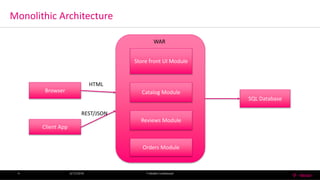
Monolithic Architecture
6/13/2016 T-MobileConfidential4
Store front UI Module
WAR
Catalog Module
Reviews Module
Orders Module
Browser
Client App
HTML
REST/JSON
SQL Database
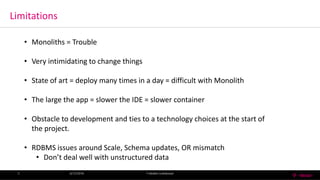
Limitations
6/13/2016 T-MobileConfidential5
• Monoliths = Trouble
• Very intimidating to change things
• State of art = deploy many times in a day = difficult with Monolith
• The large the app = slower the IDE = slower container
• Obstacle to development and ties to a technology choices at the start of
the project.
• RDBMS issues around Scale, Schema updates, OR mismatch
• Don’t deal well with unstructured data
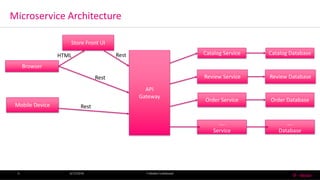
Microservice Architecture
6/13/2016 T-MobileConfidential6
Browser
Mobile Device
Store Front UI
API
Gateway
Catalog Service
Review Service
Order Service
….
Service
Catalog Database
Review Database
Order Database
….
Database
HTML Rest
Rest
Rest
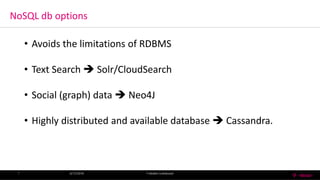
NoSQL db options
6/13/2016 T-MobileConfidential7
• Avoids the limitations of RDBMS
• Text Search  Solr/CloudSearch
• Social (graph) data  Neo4J
• Highly distributed and available database  Cassandra.
Drawbacks
6/13/2016 T-MobileConfidential8
• Complexity of developing a distributed system
• Implementing inter-process Communication
• Handling partial failure
• Complexity of implementing business transactions that span multiple
databases (without 2pc)
• Complexity of testing a distributed system
• Complexity of deploying and operating a distributed system
• Managing the development and deployment of features that span
multiple services
Issues to address
6/13/2016 T-MobileConfidential9
• How to deploy the services?
• How do the services communicate?
• How do client of application communicate with the services?
• How to partition the system into services?
• How to deal with distributed data management problems?
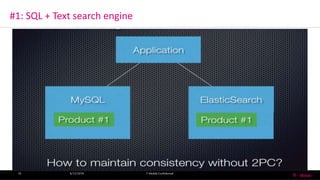
#1: SQL + Text search engine
6/13/2016 T-MobileConfidential10
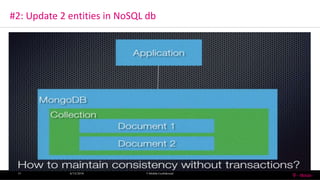
#2: Update 2 entities in NoSQL db
6/13/2016 T-MobileConfidential11
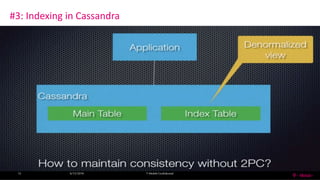
#3: Indexing in Cassandra
6/13/2016 T-MobileConfidential12
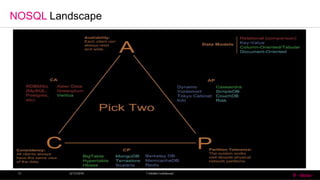
NOSQL Landscape
6/13/2016 T-MobileConfidential13
6/13/2016 T-MobileConfidential14
How to deal with distributed data management problems?
Solution: Event-Based Architecture
4/6/2016 T-Mobile Confidential15
• Components (e.g., services) publish events when state changes
• Components subscribe to events
• Maintain eventual consistency across multiple aggregates
• Synchronize replicated data
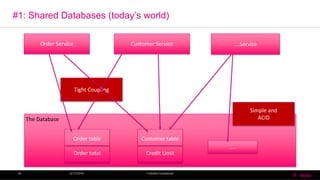
#1: Shared Databases (today’s world)
6/13/2016 T-MobileConfidential16
Order Service Customer Service ….Service
Tight Coupling
Customer table
Credit Limit
Order table
Order total
…..
The Database
Simple and
ACID
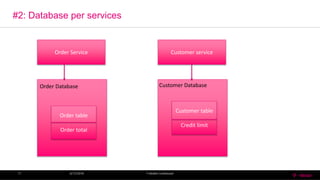
#2: Database per services
6/13/2016 T-MobileConfidential17
Order Service
Order table
Order total
Customer table
Credit limit
Customer service
Order Database Customer Database
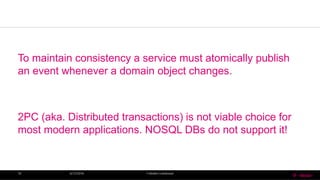
To maintain consistency a service must atomically publish
an event whenever a domain object changes.
2PC (aka. Distributed transactions) is not viable choice for
most modern applications. NOSQL DBs do not support it!
6/13/2016 T-MobileConfidential18
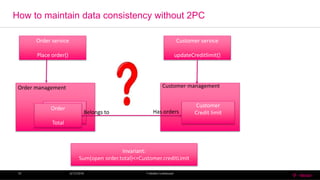
How to maintain data consistency without 2PC
6/13/2016 T-MobileConfidential19
Order service
Place order()
Customer service
updateCreditlimit()
Invariant:
Sum(open order.total)<=Customer.creditLimit
Order
Total
Customer
Credit limit
Order management Customer management
Belongs to Has orders
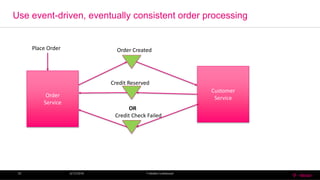
Use event-driven, eventually consistent order processing
6/13/2016 T-MobileConfidential20
Order
Service
Customer
Service
Place Order Order Created
Credit Reserved
OR
Credit Check Failed
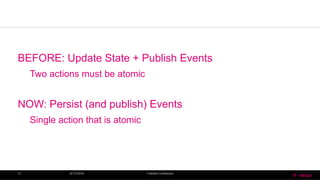
BEFORE: Update State + Publish Events
Two actions must be atomic
NOW: Persist (and publish) Events
Single action that is atomic
6/13/2016 T-MobileConfidential21
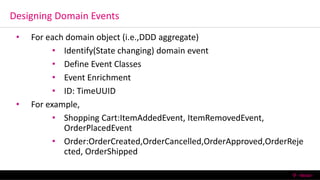
Designing Domain Events
6/13/2016 T-Mobile Confidential22
• For each domain object (i.e.,DDD aggregate)
• Identify(State changing) domain event
• Define Event Classes
• Event Enrichment
• ID: TimeUUID
• For example,
• Shopping Cart:ItemAddedEvent, ItemRemovedEvent,
OrderPlacedEvent
• Order:OrderCreated,OrderCancelled,OrderApproved,OrderReje
cted, OrderShipped
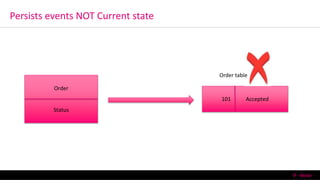
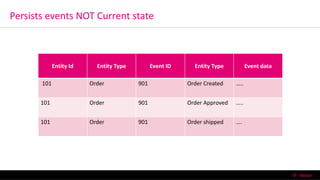
Persists events NOT Current state
6/13/2016 T-Mobile Confidential23
Order
Status
101 Accepted
Order table
Persists events NOT Current state
6/13/2016 T-Mobile Confidential24
Entity Id Entity Type Event ID Entity Type Event data
101 Order 901 Order Created …..
101 Order 901 Order Approved …..
101 Order 901 Order shipped ….
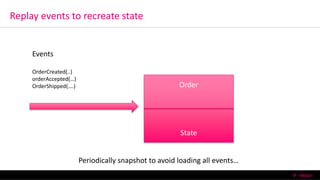
Replay events to recreate state
6/13/2016 T-Mobile Confidential25
Order
State
Events
OrderCreated(..)
orderAccepted(…)
OrderShipped(….)
Periodically snapshot to avoid loading all events…
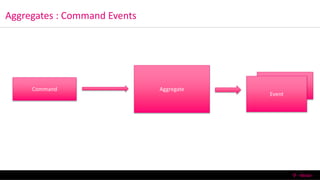
Aggregates : Command Events
6/13/2016 T-Mobile Confidential26
Command Aggregate
Event
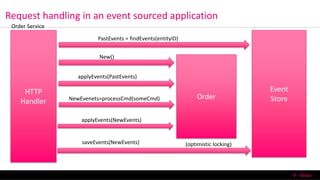
Request handling in an event sourced application
6/13/2016 T-Mobile Confidential27
HTTP
Handler
Order
Event
Store
PastEvents = findEvents(entityID)
New()
applyEvents(PastEvents)
NewEvenets=processCmd(someCmd)
applyEvents(NewEvents)
saveEvents(NewEvents) (optimistic locking)
Order Service
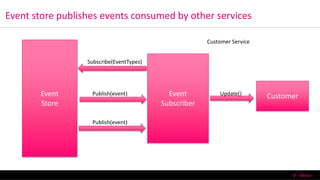
Event store publishes events consumed by other services
6/13/2016 T-Mobile Confidential28
Event
Store
Event
Subscriber
Customer
Subscribe(EventTypes)
Publish(event)
Publish(event)
Update()
Customer Service
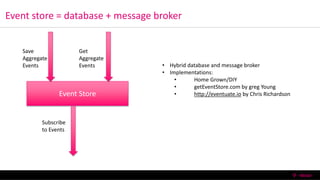
Event store = database + message broker
6/13/2016 T-Mobile Confidential29
Event Store
Save
Aggregate
Events
Get
Aggregate
Events
Subscribe
to Events
• Hybrid database and message broker
• Implementations:
• Home Grown/DIY
• getEventStore.com by greg Young
• http://eventuate.io by Chris Richardson
Benefits of event Sourcing
6/13/2016 T-Mobile Confidential30
• Solves data consistency issues in a microservice/NoSQL based
architecture
• Reliable event publishes events needed by predictive analytics etc, user
notifications
• Eliminates O/R mapping problem(mostly)
• Reifies state changes:
• Built in, reliable audit log
• Temporal queries
• Preserved history More easily implement future requirements
Drawbacks of event Sourcing
6/13/2016 T-Mobile Confidential31
• Requires application rewrite
• Weird and unfamiliar style of programming
• Events = a historical record of your bad design decisions
• Must detect and ignore duplicate events:
• Idempotent event handlers
• Track most recent event and ignore old ones
• Querying the event store can be challenging
• Some queries might be complex/inefficient e.g. accounts with balance> x
• Event store might only support lookup of events by entity id
• Must use command Query Responsibility Segeration(CQRS) to handle queries application
must handle eventually consistent data
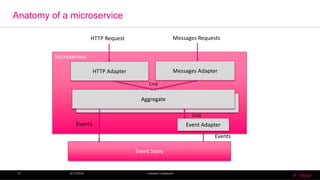
Anatomy of a microservice
6/13/2016 T-MobileConfidential32
Microservice
Event Store
Messages AdapterHTTP Adapter
HTTP Request Messages Requests
Aggregate
Aggregate
Event AdapterEvents
Events
Cmd
Cmd
Implementing queries in an event sourced application
4/6/2016 T-Mobile Confidential33
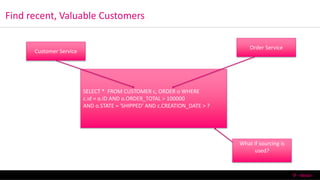
Find recent, Valuable Customers
6/13/2016 T-Mobile Confidential34
SELECT * FROM CUSTOMER c, ORDER o WHERE
c.id = o.ID AND o.ORDER_TOTAL > 100000
AND o.STATE = 'SHIPPED‘ AND c.CREATION_DATE > ?
Customer Service
Order Service
What if sourcing is
used?
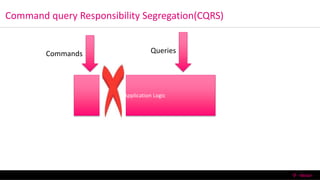
Command query Responsibility Segregation(CQRS)
6/13/2016 T-Mobile Confidential35
Application Logic
Commands Queries
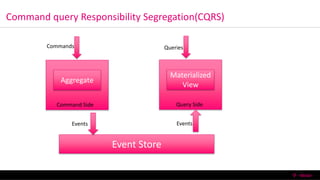
Command query Responsibility Segregation(CQRS)
6/13/2016 T-Mobile Confidential36
Aggregate
Command Side
Materialized
View
Query Side
Event Store
Commands Queries
Events Events
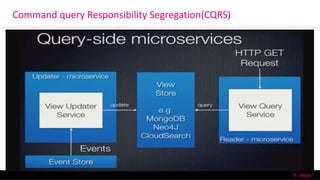
Command query Responsibility Segregation(CQRS)
6/13/2016 T-Mobile Confidential37
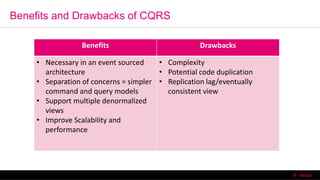
Benefits and Drawbacks of CQRS
6/13/2016 T-Mobile Confidential38
Benefits Drawbacks
• Necessary in an event sourced
architecture
• Separation of concerns = simpler
command and query models
• Support multiple denormalized
views
• Improve Scalability and
performance
• Complexity
• Potential code duplication
• Replication lag/eventually
consistent view
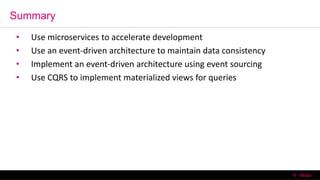
Summary
6/13/2016 T-Mobile Confidential39
• Use microservices to accelerate development
• Use an event-driven architecture to maintain data consistency
• Implement an event-driven architecture using event sourcing
• Use CQRS to implement materialized views for queries

Brown bag eventdrivenmicroservices-cqrs

  • 1.
    Event driven Microservices(μs) and CQRS Vikash Kodati 8/10/2016
  • 2.
    AGENDA 4/6/2016 T-MobileConfidential2 • WhyEvent driven Microservice (μs) • Overview of event sourcing • Implementing Queries in an event sourced application
  • 3.
    • Let’s imagineyou are building a large, complex application, e.g., an online store 6/13/2016 T-MobileConfidential3
  • 4.
    Monolithic Architecture 6/13/2016 T-MobileConfidential4 Storefront UI Module WAR Catalog Module Reviews Module Orders Module Browser Client App HTML REST/JSON SQL Database
  • 5.
    Limitations 6/13/2016 T-MobileConfidential5 • Monoliths= Trouble • Very intimidating to change things • State of art = deploy many times in a day = difficult with Monolith • The large the app = slower the IDE = slower container • Obstacle to development and ties to a technology choices at the start of the project. • RDBMS issues around Scale, Schema updates, OR mismatch • Don’t deal well with unstructured data
  • 6.
    Microservice Architecture 6/13/2016 T-MobileConfidential6 Browser MobileDevice Store Front UI API Gateway Catalog Service Review Service Order Service …. Service Catalog Database Review Database Order Database …. Database HTML Rest Rest Rest
  • 7.
    NoSQL db options 6/13/2016T-MobileConfidential7 • Avoids the limitations of RDBMS • Text Search  Solr/CloudSearch • Social (graph) data  Neo4J • Highly distributed and available database  Cassandra.
  • 8.
    Drawbacks 6/13/2016 T-MobileConfidential8 • Complexityof developing a distributed system • Implementing inter-process Communication • Handling partial failure • Complexity of implementing business transactions that span multiple databases (without 2pc) • Complexity of testing a distributed system • Complexity of deploying and operating a distributed system • Managing the development and deployment of features that span multiple services
  • 9.
    Issues to address 6/13/2016T-MobileConfidential9 • How to deploy the services? • How do the services communicate? • How do client of application communicate with the services? • How to partition the system into services? • How to deal with distributed data management problems?
  • 10.
    #1: SQL +Text search engine 6/13/2016 T-MobileConfidential10
  • 11.
    #2: Update 2entities in NoSQL db 6/13/2016 T-MobileConfidential11
  • 12.
    #3: Indexing inCassandra 6/13/2016 T-MobileConfidential12
  • 13.
  • 14.
    6/13/2016 T-MobileConfidential14 How todeal with distributed data management problems?
  • 15.
    Solution: Event-Based Architecture 4/6/2016T-Mobile Confidential15 • Components (e.g., services) publish events when state changes • Components subscribe to events • Maintain eventual consistency across multiple aggregates • Synchronize replicated data
  • 16.
    #1: Shared Databases(today’s world) 6/13/2016 T-MobileConfidential16 Order Service Customer Service ….Service Tight Coupling Customer table Credit Limit Order table Order total ….. The Database Simple and ACID
  • 17.
    #2: Database perservices 6/13/2016 T-MobileConfidential17 Order Service Order table Order total Customer table Credit limit Customer service Order Database Customer Database
  • 18.
    To maintain consistencya service must atomically publish an event whenever a domain object changes. 2PC (aka. Distributed transactions) is not viable choice for most modern applications. NOSQL DBs do not support it! 6/13/2016 T-MobileConfidential18
  • 19.
    How to maintaindata consistency without 2PC 6/13/2016 T-MobileConfidential19 Order service Place order() Customer service updateCreditlimit() Invariant: Sum(open order.total)<=Customer.creditLimit Order Total Customer Credit limit Order management Customer management Belongs to Has orders
  • 20.
    Use event-driven, eventuallyconsistent order processing 6/13/2016 T-MobileConfidential20 Order Service Customer Service Place Order Order Created Credit Reserved OR Credit Check Failed
  • 21.
    BEFORE: Update State+ Publish Events Two actions must be atomic NOW: Persist (and publish) Events Single action that is atomic 6/13/2016 T-MobileConfidential21
  • 22.
    Designing Domain Events 6/13/2016T-Mobile Confidential22 • For each domain object (i.e.,DDD aggregate) • Identify(State changing) domain event • Define Event Classes • Event Enrichment • ID: TimeUUID • For example, • Shopping Cart:ItemAddedEvent, ItemRemovedEvent, OrderPlacedEvent • Order:OrderCreated,OrderCancelled,OrderApproved,OrderReje cted, OrderShipped
  • 23.
    Persists events NOTCurrent state 6/13/2016 T-Mobile Confidential23 Order Status 101 Accepted Order table
  • 24.
    Persists events NOTCurrent state 6/13/2016 T-Mobile Confidential24 Entity Id Entity Type Event ID Entity Type Event data 101 Order 901 Order Created ….. 101 Order 901 Order Approved ….. 101 Order 901 Order shipped ….
  • 25.
    Replay events torecreate state 6/13/2016 T-Mobile Confidential25 Order State Events OrderCreated(..) orderAccepted(…) OrderShipped(….) Periodically snapshot to avoid loading all events…
  • 26.
    Aggregates : CommandEvents 6/13/2016 T-Mobile Confidential26 Command Aggregate Event
  • 27.
    Request handling inan event sourced application 6/13/2016 T-Mobile Confidential27 HTTP Handler Order Event Store PastEvents = findEvents(entityID) New() applyEvents(PastEvents) NewEvenets=processCmd(someCmd) applyEvents(NewEvents) saveEvents(NewEvents) (optimistic locking) Order Service
  • 28.
    Event store publishesevents consumed by other services 6/13/2016 T-Mobile Confidential28 Event Store Event Subscriber Customer Subscribe(EventTypes) Publish(event) Publish(event) Update() Customer Service
  • 29.
    Event store =database + message broker 6/13/2016 T-Mobile Confidential29 Event Store Save Aggregate Events Get Aggregate Events Subscribe to Events • Hybrid database and message broker • Implementations: • Home Grown/DIY • getEventStore.com by greg Young • http://eventuate.io by Chris Richardson
  • 30.
    Benefits of eventSourcing 6/13/2016 T-Mobile Confidential30 • Solves data consistency issues in a microservice/NoSQL based architecture • Reliable event publishes events needed by predictive analytics etc, user notifications • Eliminates O/R mapping problem(mostly) • Reifies state changes: • Built in, reliable audit log • Temporal queries • Preserved history More easily implement future requirements
  • 31.
    Drawbacks of eventSourcing 6/13/2016 T-Mobile Confidential31 • Requires application rewrite • Weird and unfamiliar style of programming • Events = a historical record of your bad design decisions • Must detect and ignore duplicate events: • Idempotent event handlers • Track most recent event and ignore old ones • Querying the event store can be challenging • Some queries might be complex/inefficient e.g. accounts with balance> x • Event store might only support lookup of events by entity id • Must use command Query Responsibility Segeration(CQRS) to handle queries application must handle eventually consistent data
  • 32.
    Anatomy of amicroservice 6/13/2016 T-MobileConfidential32 Microservice Event Store Messages AdapterHTTP Adapter HTTP Request Messages Requests Aggregate Aggregate Event AdapterEvents Events Cmd Cmd
  • 33.
    Implementing queries inan event sourced application 4/6/2016 T-Mobile Confidential33
  • 34.
    Find recent, ValuableCustomers 6/13/2016 T-Mobile Confidential34 SELECT * FROM CUSTOMER c, ORDER o WHERE c.id = o.ID AND o.ORDER_TOTAL > 100000 AND o.STATE = 'SHIPPED‘ AND c.CREATION_DATE > ? Customer Service Order Service What if sourcing is used?
  • 35.
    Command query ResponsibilitySegregation(CQRS) 6/13/2016 T-Mobile Confidential35 Application Logic Commands Queries
  • 36.
    Command query ResponsibilitySegregation(CQRS) 6/13/2016 T-Mobile Confidential36 Aggregate Command Side Materialized View Query Side Event Store Commands Queries Events Events
  • 37.
    Command query ResponsibilitySegregation(CQRS) 6/13/2016 T-Mobile Confidential37
  • 38.
    Benefits and Drawbacksof CQRS 6/13/2016 T-Mobile Confidential38 Benefits Drawbacks • Necessary in an event sourced architecture • Separation of concerns = simpler command and query models • Support multiple denormalized views • Improve Scalability and performance • Complexity • Potential code duplication • Replication lag/eventually consistent view
  • 39.
    Summary 6/13/2016 T-Mobile Confidential39 •Use microservices to accelerate development • Use an event-driven architecture to maintain data consistency • Implement an event-driven architecture using event sourcing • Use CQRS to implement materialized views for queries

Editor's Notes

  • #2 Encourage interactive session Informal discussion Eat lunch My Goal is to keep us all on the same page at a conceptual level. Please stop me and ask questions
  • #3 Event sourcing and Command Query Responsibility Segregations Great ways to build microservices
  • #5 Imagine our Apps: Monolith We have backend services Deploy: pkg it in tomcat = war file Backend : RDMS ACID Simple way of building apps (dev,test, deploy at scale) Any changes applied atomically Scale out by running multiple copied behind load balancer Adoption new technologies
  • #6 X Y Z scalaing Z = sharding at db level Y: functional decomp X; Traditional scale out
  • #7 Distinct functional area is now a standalone service with its own database Helps with scalability We can use no-sql db
  • #8 We end up with a polyglot persistence architecture.
  • #9 How do we bridge the gap between the current realities and our new MISSION? Make them granular
  • #10 Distributed data management is the issue to solve.
  • #11 Elastic search in our app Update rdbms and how to keep the search in sync?
  • #12 Update two document how do I do that w/o real transactions
  • #13 How to keep the index tables of Cassandra in sync with the main table. Without a transactionally consistent manner. How to keep it consistent w/o 2PC
  • #14 Talk about eventual consistency This concept is also known as BASE (as opposed to ACID) – Basically Available, Soft State, Eventually Consistent ACID (Atomicity, Consistency, Isolation, Durability)
  • #15 Distributed data management is the issue to solve.
  • #16 Subscribers = Other interested parties = they update their data to reflect the change. Moving from 2 PC to event driven approach.
  • #17 Atomicity, Consistency, Isolation, Durability BASE: Basically available soft state eventually consistent
  • #18 When looking to split a large application into parts, often management focuses on the technology layer, leading to UI teams, server-side logic teams, and database teams.  We can relate this to: Applications having dev and Op responsibilities under different leaderships Deloitte team doing the dev all by themselves
  • #19 How do we atomically publish and update a datastore? Message broker does not support 2PC
  • #22 How do we atomically publish and update a datastore? Message broker does not support 2PC
  • #23 Has a huge impact on architecture. Monolith has this huge single database containing all the data for all business functions. MS should be responsible for its own data and its peristence. Removes integrated at db level Use data store that makes sense for the problem You may never talk to another service’s datastore. You may only talk to another service via its API Choice of db tech will be upto the service group Including languages. Event oriented architecture. What if Service-A needs the data of Service-B How a service landscape is governed and also in terms of data management
  • #24 Don’t persist state Persist events
  • #25 One table to rule all domain objects.!
  • #34 Again a set of statements.
  • #35 Divide into two modules: Commands (updates) and Queries ()
  • #36 Has a huge impact on architecture. Monolith has this huge single database containing all the data for all business functions. MS should be responsible for its own data and its peristence. Removes integrated at db level Use data store that makes sense for the problem You may never talk to another service’s datastore. You may only talk to another service via its API Choice of db tech will be upto the service group Including languages. Event oriented architecture. What if Service-A needs the data of Service-B How a service landscape is governed and also in terms of data management
  • #37 View Store = MaterializedView Mongo Neo4J Cassandra or Mysql Text Queries = Cloud Search
  • #38 View Store = MaterializedView Mongo Neo4J Cassandra or Mysql Text Queries = Cloud Search
  • #39 How do we bridge the gap between the current realities and our new MISSION? Make them granular
  • #40 How do we bridge the gap between the current realities and our new MISSION? Make them granular