BUILDING MATERIAL & CONSTRUCTION TECHNOLOGY
CLASS-01
STONE
❑ Stones are naturally occurring compact, solid & massive material that
make the crust of the earth
❑Stones are technically rocks which are in use since time
immemorial(ancient).
Classification of rocks
1. Geological 2. Physical 3. Chemical
Geological classification : -
1. Igneous rock 2. Sedimentary rock 3.Metamorphic rock
❑Rocks formed by cooling & solidification of magma or lava.
❑These rocks are strong & durable
❑They have crystalline & compact grains
Igneous rock is of two types : -
a) Intrusive rock b) Extrusive rock
Ex- Hypo basal(Dolerite), Ex- Volcanic rock (basalt)
Plutonic rock( Granite)
MAGMA- inside earth’s surface
LAVA- Outside earth’s surface
Intrusive Igneous Rocks
When cooling & crystallization of magma occurs deep inside earth surface.
1. Plutonic Rocks
- When magma cools deep inside earth
- Ex- Granite
2. Hypobassel Rocks
- When magma cools at shallow depth
- Ex- Gabbro, diorite, pegmatite etc.
Extrusive Igneous Rocks
When cooling & crystallization of magma occurs on top of earth surface.
- Ex- Basalt, trap, Andesite, Dacite, Rhyolite etc.
Igneous Rocks
Sedimentary Rocks
These rocks are formed by weathering of pre-exiting rock by external
agencies such as wind, air, water etc.
1. Mechanical (Clastic) Sedimentary Rocks:
- These rocks are formed due to physical weathering by external agencies
such as running water, moving air etc.
- Ex- Sandstone, Shale, Gravel, Sand, Mud stone, Silt stone, Breccia,
Conglomerate
2. Chemical Sedimentary Rocks :
- These rocks are formed by chemical action of water, acids, alkalies etc.
- Ex- Gypsum, Clay, Limestone, Dolostone, Evaporites, dolomite etc.
Sedimentary Rocks
3. Biological (Organic) Sedimentary Rocks :
- These rocks are formed by remains of organisms such as sea animals
- Ex-Coal, Chert etc.
Sedimentary Rocks
Metamorphic Rocks
❑ These rocks are formed when pre-existing rocks have been changed in
texture and composition by increased temperature and pressure.
❑ Igneous rocks
Sedimentary rocks
Metamorphic rocks
High Temperature & Pressure
Metamorphic Rocks
1. Foliated Rocks
❑ These rocks have bands or strips on there surface throughout there body
❑ Ex- Slate, Schist, Gneiss etc.
2. Non-foliated Rocks
❑ These rocks do not have bands or strips on their surface or body
❑ Ex- Quartzite , Marble etc.
STONE TYPE AFTER
METAMORPHISM
Granite IGNEOUS Gneiss
Basalt IGNEOUS Laterite
Limestone Sedimentary Marble
Sandstone Sedimentary Quartzite
Mud stone (Shales) Sedimentary Slate
Physical classification
1. Stratified rock – layered formation
- Ex: Limestone, sandstone, shale (sedimentary rocks)
2. Unstratified rock- Rocks not showing layered structure
- Ex: Granite, Trap (Igneous Rocks)
- Ex- Marble, Quartzite (Metamorphic rocks)
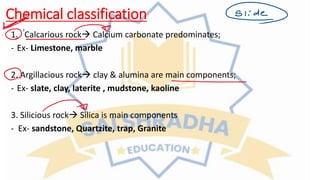
Chemical classification
1. Calcarious rock→ Calcium carbonate predominates;
- Ex- Limestone, marble
2. Argillacious rock→ clay & alumina are main components;
- Ex- slate, clay, laterite , mudstone, kaoline
3. Silicious rock→ Silica is main components
- Ex- sandstone, Quartzite, trap, Granite

Building Materials Civil Engineering Full Slide

  • 1.
    BUILDING MATERIAL &CONSTRUCTION TECHNOLOGY CLASS-01
  • 6.
    STONE ❑ Stones arenaturally occurring compact, solid & massive material that make the crust of the earth ❑Stones are technically rocks which are in use since time immemorial(ancient).
  • 7.
    Classification of rocks 1.Geological 2. Physical 3. Chemical Geological classification : - 1. Igneous rock 2. Sedimentary rock 3.Metamorphic rock ❑Rocks formed by cooling & solidification of magma or lava. ❑These rocks are strong & durable ❑They have crystalline & compact grains Igneous rock is of two types : - a) Intrusive rock b) Extrusive rock Ex- Hypo basal(Dolerite), Ex- Volcanic rock (basalt) Plutonic rock( Granite)
  • 8.
    MAGMA- inside earth’ssurface LAVA- Outside earth’s surface Intrusive Igneous Rocks When cooling & crystallization of magma occurs deep inside earth surface. 1. Plutonic Rocks - When magma cools deep inside earth - Ex- Granite 2. Hypobassel Rocks - When magma cools at shallow depth - Ex- Gabbro, diorite, pegmatite etc.
  • 9.
    Extrusive Igneous Rocks Whencooling & crystallization of magma occurs on top of earth surface. - Ex- Basalt, trap, Andesite, Dacite, Rhyolite etc.
  • 10.
  • 11.
    Sedimentary Rocks These rocksare formed by weathering of pre-exiting rock by external agencies such as wind, air, water etc. 1. Mechanical (Clastic) Sedimentary Rocks: - These rocks are formed due to physical weathering by external agencies such as running water, moving air etc. - Ex- Sandstone, Shale, Gravel, Sand, Mud stone, Silt stone, Breccia, Conglomerate 2. Chemical Sedimentary Rocks : - These rocks are formed by chemical action of water, acids, alkalies etc. - Ex- Gypsum, Clay, Limestone, Dolostone, Evaporites, dolomite etc.
  • 12.
    Sedimentary Rocks 3. Biological(Organic) Sedimentary Rocks : - These rocks are formed by remains of organisms such as sea animals - Ex-Coal, Chert etc.
  • 13.
  • 14.
    Metamorphic Rocks ❑ Theserocks are formed when pre-existing rocks have been changed in texture and composition by increased temperature and pressure. ❑ Igneous rocks Sedimentary rocks Metamorphic rocks High Temperature & Pressure
  • 15.
    Metamorphic Rocks 1. FoliatedRocks ❑ These rocks have bands or strips on there surface throughout there body ❑ Ex- Slate, Schist, Gneiss etc. 2. Non-foliated Rocks ❑ These rocks do not have bands or strips on their surface or body ❑ Ex- Quartzite , Marble etc.
  • 16.
    STONE TYPE AFTER METAMORPHISM GraniteIGNEOUS Gneiss Basalt IGNEOUS Laterite Limestone Sedimentary Marble Sandstone Sedimentary Quartzite Mud stone (Shales) Sedimentary Slate
  • 17.
    Physical classification 1. Stratifiedrock – layered formation - Ex: Limestone, sandstone, shale (sedimentary rocks) 2. Unstratified rock- Rocks not showing layered structure - Ex: Granite, Trap (Igneous Rocks) - Ex- Marble, Quartzite (Metamorphic rocks)
  • 18.
    Chemical classification 1. Calcariousrock→ Calcium carbonate predominates; - Ex- Limestone, marble 2. Argillacious rock→ clay & alumina are main components; - Ex- slate, clay, laterite , mudstone, kaoline 3. Silicious rock→ Silica is main components - Ex- sandstone, Quartzite, trap, Granite