• Building ManagementSystem (BMS) is one of the most
important components in constructing green building it
ensures that the building remains 'green' through it’s life.
• BMS is basically a solution is put into a facility to ensure
an environment that is safe, secure, comfortable and
energy efficient.
• When properly installing into a facility, BMS can result in
the following benefits:
o Optimize energy conception.
o Provide alarm systems so as to take corrective actions.
o Monitor and control indoor comfort conditions
3.
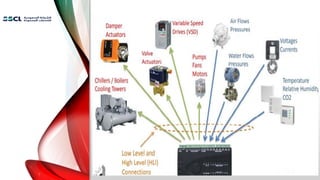
• BMS :is a computer-based control system installed in
buildings that controls and monitors the building’s
mechanical, electronical and electrical equipment such as
ventilation, lighting, power systems, fire systems, and
security systems.
• BMS systems are “Intelligent” microprocessor based
controller networks installed to monitor and control a
buildings technical systems and services such as air
conditioning, ventilation, lighting and hydraulics.
• More specifically they link the functionality of individual
pieces of building equipment so that they operate as one
complete integrated system.
• Now installed in every major building or facility with the
availability of direct integration into all other building
services such as security, access control, CCTV, fire, Lifts
and other life and safety systems.
6.
DATA SHEET
It’s theproper way to get all the information you need for
that field devices, the data sheet contain the following
information:
1.Features:
where all the features of that device are mentioned.
2. Specifications:
where are technical information are mentioned, it
helps in understanding the operation conditions for
that field devices.
3. General:
it’s a general description for the device and functions
that can be implemented using that device.
4. Rest of information
related to that device, like field wiring diagrams,
models, accessories and dimensions, where it gives
valuable information about that device.
7.
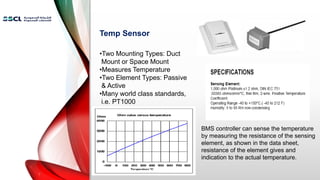
Temp Sensor
•Two MountingTypes: Duct
Mount or Space Mount
•Measures Temperature
•Two Element Types: Passive
& Active
•Many world class standards,
i.e. PT1000
BMS controller can sense the temperature
by measuring the resistance of the sensing
element, as shown in the data sheet,
resistance of the element gives and
indication to the actual temperature.
8.
Deferential Pressure SwitchDPS
•Used for Monitoring Differential Pressure Across
Filters and Fans .
•Adjustable pressure value.
•Gives a Voltage-Free Contact
• Normally Open / Normally Closed
The signal is given to BMS through
closing a free voltage contact when
the differential pressure exceeded the
limits, as its shown in the picture from
the data sheet
9.
Damper Actuator
•Direct wiredDevices for Damper Actuating.
•Available with LON Network Type
•Available with different torque ratings (5N,
10N, 25N and 34N)
•Available for both digital and analogue
uses.
•Available with either spring return or non-
spring return.
BMS controller gives the command
through DC voltage, 0-10 present 0-
100 percentage.
i.e. A command of 50% from the
BMS is represented by a 5Vdc signal
to the device.
10.
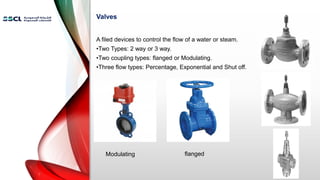
Valves
A filed devicesto control the flow of a water or steam.
•Two Types: 2 way or 3 way.
•Two coupling types: flanged or Modulating.
•Three flow types: Percentage, Exponential and Shut off.
flanged
Modulating
11.
Valves Actuators
•Direct wiredDevices for Valves Actuating.
•Available with LON Network type.
•Available with different power ratings.
•Available for both digital and analogue uses.
•Available for multi medium temperatures (i.e. chilled
water, hot water and steam)