Building Information Modeling (BIM)
for Infrastructure
Introduction to BIM for Infrastructure:
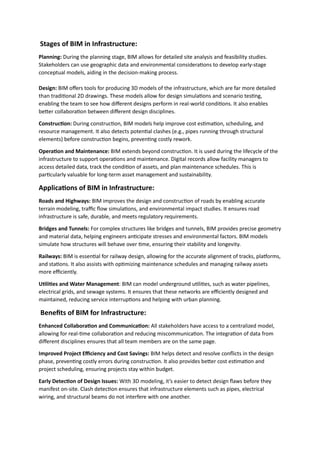
Building Information Modeling (BIM) is a digital process used to design, construct, and manage
physical infrastructures. In infrastructure projects—such as roads, railways, bridges, utilities, and
water systems—BIM enables the creation of highly detailed 3D models that integrate data from all
project stages. These models allow all stakeholders (architects, engineers, contractors, and owners)
to collaborate more effectively, improving design precision and project outcomes.
Unlike traditional methods, where designs are created in isolation, BIM offers a shared platform
where information about materials, costs, schedules, and operations is available. This ensures that
infrastructure projects are well-coordinated, reducing the risk of errors, delays, and cost overruns.
Key Components of BIM in Infrastructure:
3D Modeling and Visualization: BIM enables the creation of realistic 3D models of infrastructure
assets, providing visual representations that help identify potential problems early in the design
stage.
Data Integration and Management: BIM captures and stores all relevant data, such as materials,
dimensions, costs, and scheduling information. It allows this information to be shared between
stakeholders in real-time, fostering better decision-making.
Collaborative Design and Planning: BIM promotes collaboration by creating a central digital
environment. Architects, engineers, and contractors can work together on the same model, making it
easier to align designs, detect clashes, and avoid delays.
Stages of BIM in Infrastructure:
Planning: During the planning stage, BIM allows for detailed site analysis and feasibility studies.
Stakeholders can use geographic data and environmental considerations to develop early-stage
conceptual models, aiding in the decision-making process.
Design: BIM offers tools for producing 3D models of the infrastructure, which are far more detailed
than traditional 2D drawings. These models allow for design simulations and scenario testing,
enabling the team to see how different designs perform in real-world conditions. It also enables
better collaboration between different design disciplines.
Construction: During construction, BIM models help improve cost estimation, scheduling, and
resource management. It also detects potential clashes (e.g., pipes running through structural
elements) before construction begins, preventing costly rework.
Operation and Maintenance: BIM extends beyond construction. It is used during the lifecycle of the
infrastructure to support operations and maintenance. Digital records allow facility managers to
access detailed data, track the condition of assets, and plan maintenance schedules. This is
particularly valuable for long-term asset management and sustainability.
Applications of BIM in Infrastructure:
Roads and Highways: BIM improves the design and construction of roads by enabling accurate
terrain modeling, traffic flow simulations, and environmental impact studies. It ensures road
infrastructure is safe, durable, and meets regulatory requirements.
Bridges and Tunnels: For complex structures like bridges and tunnels, BIM provides precise geometry
and material data, helping engineers anticipate stresses and environmental factors. BIM models
simulate how structures will behave over time, ensuring their stability and longevity.
Railways: BIM is essential for railway design, allowing for the accurate alignment of tracks, platforms,
and stations. It also assists with optimizing maintenance schedules and managing railway assets
more efficiently.
Utilities and Water Management: BIM can model underground utilities, such as water pipelines,
electrical grids, and sewage systems. It ensures that these networks are efficiently designed and
maintained, reducing service interruptions and helping with urban planning.
Benefits of BIM for Infrastructure:
Enhanced Collaboration and Communication: All stakeholders have access to a centralized model,
allowing for real-time collaboration and reducing miscommunication. The integration of data from
different disciplines ensures that all team members are on the same page.
Improved Project Efficiency and Cost Savings: BIM helps detect and resolve conflicts in the design
phase, preventing costly errors during construction. It also provides better cost estimation and
project scheduling, ensuring projects stay within budget.
Early Detection of Design Issues: With 3D modeling, it’s easier to detect design flaws before they
manifest on-site. Clash detection ensures that infrastructure elements such as pipes, electrical
wiring, and structural beams do not interfere with one another.
Better Resource Management: BIM facilitates better resource planning by providing detailed data on
material quantities, equipment, and labor needs. This minimizes waste and optimizes the use of
resources.
Lifecycle Management and Sustainability: BIM’s data-rich models are invaluable for managing
infrastructure over its entire lifecycle. Detailed records make it easier to maintain infrastructure
assets, plan renovations, and ensure sustainable practices are followed.
Challenges of Implementing BIM in Infrastructure:
Integration with Traditional Workflows: Transitioning from traditional 2D designs to BIM can be
challenging. It requires a shift in thinking and new workflows for design and construction teams.
High Initial Costs: Implementing BIM requires upfront investment in software, training, an hardware.
However, these costs are typically offset by long-term savings in efficiency and reduced errors.
Need for Specialized Skills and Training: BIM requires skilled professionals who understand how to
use the technology. This includes training team members in BIM software, workflows, and data
management.
Future of BIM in Infrastructure:
Automation and AI Integration: Future developments in BIM will involve the integration of AI and
automation. AI can help optimize design processes, simulate real-world scenarios more accurately,
and even predict future infrastructure needs.
Digital Twins for Infrastructure: A digital twin is a real-time digital replica of a physical asset. BIM will
increasingly be used to create digital twins of infrastructure, allowing for real-time monitoring and
analysis of structures during their entire lifecycle.
Sustainability and Smart Infrastructure Management: BIM is evolving to support green building
practices and smart infrastructure systems. This includes integrating renewable energy systems and
sustainable materials, as well as smart sensors for real-time monitoring.
Conclusion:
Building Information Modeling (BIM) for infrastructure is transforming the way projects are designed,
constructed, and maintained. By enabling better collaboration, improving design accuracy, and
facilitating lifecycle management, BIM reduces project risks, increases efficiency, and ensures
infrastructure systems are built to last. The future of BIM lies in its integration with AI, automation,
and smart technology, promising a new era of sustainable, efficient, and data-driven infrastructure
management.
Contact Us: BIMelite Project Management LLC
Jebel Ali Village, Dubai, United Arab Emirates
+971 4 272 7592
Bimelite22@gmail.com
6/202, Kalyani Apartments, LB Nagar, Hyderabad, Telangana, 500068, India
+91 8019416295

Building Information Modeling (BIM) for Infrastructure

  • 1.
    Building Information Modeling(BIM) for Infrastructure Introduction to BIM for Infrastructure: Building Information Modeling (BIM) is a digital process used to design, construct, and manage physical infrastructures. In infrastructure projects—such as roads, railways, bridges, utilities, and water systems—BIM enables the creation of highly detailed 3D models that integrate data from all project stages. These models allow all stakeholders (architects, engineers, contractors, and owners) to collaborate more effectively, improving design precision and project outcomes. Unlike traditional methods, where designs are created in isolation, BIM offers a shared platform where information about materials, costs, schedules, and operations is available. This ensures that infrastructure projects are well-coordinated, reducing the risk of errors, delays, and cost overruns. Key Components of BIM in Infrastructure: 3D Modeling and Visualization: BIM enables the creation of realistic 3D models of infrastructure assets, providing visual representations that help identify potential problems early in the design stage. Data Integration and Management: BIM captures and stores all relevant data, such as materials, dimensions, costs, and scheduling information. It allows this information to be shared between stakeholders in real-time, fostering better decision-making. Collaborative Design and Planning: BIM promotes collaboration by creating a central digital environment. Architects, engineers, and contractors can work together on the same model, making it easier to align designs, detect clashes, and avoid delays.
  • 2.
    Stages of BIMin Infrastructure: Planning: During the planning stage, BIM allows for detailed site analysis and feasibility studies. Stakeholders can use geographic data and environmental considerations to develop early-stage conceptual models, aiding in the decision-making process. Design: BIM offers tools for producing 3D models of the infrastructure, which are far more detailed than traditional 2D drawings. These models allow for design simulations and scenario testing, enabling the team to see how different designs perform in real-world conditions. It also enables better collaboration between different design disciplines. Construction: During construction, BIM models help improve cost estimation, scheduling, and resource management. It also detects potential clashes (e.g., pipes running through structural elements) before construction begins, preventing costly rework. Operation and Maintenance: BIM extends beyond construction. It is used during the lifecycle of the infrastructure to support operations and maintenance. Digital records allow facility managers to access detailed data, track the condition of assets, and plan maintenance schedules. This is particularly valuable for long-term asset management and sustainability. Applications of BIM in Infrastructure: Roads and Highways: BIM improves the design and construction of roads by enabling accurate terrain modeling, traffic flow simulations, and environmental impact studies. It ensures road infrastructure is safe, durable, and meets regulatory requirements. Bridges and Tunnels: For complex structures like bridges and tunnels, BIM provides precise geometry and material data, helping engineers anticipate stresses and environmental factors. BIM models simulate how structures will behave over time, ensuring their stability and longevity. Railways: BIM is essential for railway design, allowing for the accurate alignment of tracks, platforms, and stations. It also assists with optimizing maintenance schedules and managing railway assets more efficiently. Utilities and Water Management: BIM can model underground utilities, such as water pipelines, electrical grids, and sewage systems. It ensures that these networks are efficiently designed and maintained, reducing service interruptions and helping with urban planning. Benefits of BIM for Infrastructure: Enhanced Collaboration and Communication: All stakeholders have access to a centralized model, allowing for real-time collaboration and reducing miscommunication. The integration of data from different disciplines ensures that all team members are on the same page. Improved Project Efficiency and Cost Savings: BIM helps detect and resolve conflicts in the design phase, preventing costly errors during construction. It also provides better cost estimation and project scheduling, ensuring projects stay within budget. Early Detection of Design Issues: With 3D modeling, it’s easier to detect design flaws before they manifest on-site. Clash detection ensures that infrastructure elements such as pipes, electrical wiring, and structural beams do not interfere with one another.
  • 3.
    Better Resource Management:BIM facilitates better resource planning by providing detailed data on material quantities, equipment, and labor needs. This minimizes waste and optimizes the use of resources. Lifecycle Management and Sustainability: BIM’s data-rich models are invaluable for managing infrastructure over its entire lifecycle. Detailed records make it easier to maintain infrastructure assets, plan renovations, and ensure sustainable practices are followed. Challenges of Implementing BIM in Infrastructure: Integration with Traditional Workflows: Transitioning from traditional 2D designs to BIM can be challenging. It requires a shift in thinking and new workflows for design and construction teams. High Initial Costs: Implementing BIM requires upfront investment in software, training, an hardware. However, these costs are typically offset by long-term savings in efficiency and reduced errors. Need for Specialized Skills and Training: BIM requires skilled professionals who understand how to use the technology. This includes training team members in BIM software, workflows, and data management. Future of BIM in Infrastructure: Automation and AI Integration: Future developments in BIM will involve the integration of AI and automation. AI can help optimize design processes, simulate real-world scenarios more accurately, and even predict future infrastructure needs. Digital Twins for Infrastructure: A digital twin is a real-time digital replica of a physical asset. BIM will increasingly be used to create digital twins of infrastructure, allowing for real-time monitoring and analysis of structures during their entire lifecycle. Sustainability and Smart Infrastructure Management: BIM is evolving to support green building practices and smart infrastructure systems. This includes integrating renewable energy systems and sustainable materials, as well as smart sensors for real-time monitoring. Conclusion: Building Information Modeling (BIM) for infrastructure is transforming the way projects are designed, constructed, and maintained. By enabling better collaboration, improving design accuracy, and facilitating lifecycle management, BIM reduces project risks, increases efficiency, and ensures infrastructure systems are built to last. The future of BIM lies in its integration with AI, automation, and smart technology, promising a new era of sustainable, efficient, and data-driven infrastructure management. Contact Us: BIMelite Project Management LLC Jebel Ali Village, Dubai, United Arab Emirates +971 4 272 7592 Bimelite22@gmail.com 6/202, Kalyani Apartments, LB Nagar, Hyderabad, Telangana, 500068, India +91 8019416295