Building Hypermedia Apis With Html5 And Node Mike Amundsen
Building Hypermedia Apis With Html5 And Node Mike Amundsen
Building Hypermedia Apis With Html5 And Node Mike Amundsen
Building Hypermedia Apis With Html5 And Node Mike Amundsen
Building Hypermedia Apis With Html5 And Node Mike Amundsen
1.
Building Hypermedia ApisWith Html5 And Node
Mike Amundsen download
https://ebookbell.com/product/building-hypermedia-apis-with-
html5-and-node-mike-amundsen-2434266
Explore and download more ebooks at ebookbell.com
2.
Here are somerecommended products that we believe you will be
interested in. You can click the link to download.
Building Hypermedia Apis With Html5 And Node Amundsen Mike
https://ebookbell.com/product/building-hypermedia-apis-with-html5-and-
node-amundsen-mike-10812158
Building Spas With Django And Html Over The Wire Learn To Build
Realtime Single Page Applications With Python 1st Edition Andros
Fenollosa
https://ebookbell.com/product/building-spas-with-django-and-html-over-
the-wire-learn-to-build-realtime-single-page-applications-with-
python-1st-edition-andros-fenollosa-44868684
Building The Snowflake Data Cloud Monetizing And Democratizing Your
Data Andrew Carruthers
https://ebookbell.com/product/building-the-snowflake-data-cloud-
monetizing-and-democratizing-your-data-andrew-carruthers-44888670
Building Web Applications With Vuejs Mvvm Patterns For Conventional
And Singlepage Websites Ralph Steyer
https://ebookbell.com/product/building-web-applications-with-vuejs-
mvvm-patterns-for-conventional-and-singlepage-websites-ralph-
steyer-44898498
3.
Building Bridges BetweenSoft And Statistical Methodologies For Data
Science Luis A Garcaescudero
https://ebookbell.com/product/building-bridges-between-soft-and-
statistical-methodologies-for-data-science-luis-a-
garcaescudero-44905084
Building Microservices Designing Finegrained Systems 2nd Edition 2nd
Release 2nd 20220708 Second Release Sam Newman
https://ebookbell.com/product/building-microservices-designing-
finegrained-systems-2nd-edition-2nd-release-2nd-20220708-second-
release-sam-newman-45010590
Building Python Microservices With Fastapi Build Secure Scalable And
Structured Python Microservices From Design Concepts To Infrastructure
1st Sherwin John C Tragura
https://ebookbell.com/product/building-python-microservices-with-
fastapi-build-secure-scalable-and-structured-python-microservices-
from-design-concepts-to-infrastructure-1st-sherwin-john-c-
tragura-45036900
Building Resilient Organizations Predicaments Prospects Falguni H
Pandya
https://ebookbell.com/product/building-resilient-organizations-
predicaments-prospects-falguni-h-pandya-45209622
Building Information Modeling For A Smart And Sustainable Urban Space
Rafika Hajji
https://ebookbell.com/product/building-information-modeling-for-a-
smart-and-sustainable-urban-space-rafika-hajji-45333528
7.
Building Hypermedia APIswith
HTML5 and Node
Mike Amundsen
Beijing • Cambridge • Farnham • Köln • Sebastopol • Tokyo
“The human mind... operates by association.
With one item in its grasp, it snaps instantly to the
next that is suggested by the association of
thoughts, in accordance with some intricate web
of trails carried by the cells of the brain.”
—Vannevar Bush, 1945
“If computers are the wave of the future, displays
are the surfboards”.
—Ted Nelson, 1974
“HyperText is a way to link and access informa-
tion of various kinds as a web of nodes in which
the user can browse at will.”
—Tim Berners-Lee, 1992
“Hypermedia is defined by the presence of appli-
cation control information embedded within, or
as a layer above, the presentation of information.”
—Roy T. Fielding, 2001
“The WWW is fundamentally a distributed hy-
permedia application.”
—Richard Taylor, 2010
11.
Table of Contents
Foreword. . . . . . . . . . . . . . . . . . . . . . . . . . . . . . . . . . . . . . . . . . . . . . . . . . . . . . . . . . . . . . . . . . . ix
Preface . . . . . . . . . . . . . . . . . . . . . . . . . . . . . . . . . . . . . . . . . . . . . . . . . . . . . . . . . . . . . . . . . . . . . xi
1. Understanding Hypermedia . . . . . . . . . . . . . . . . . . . . . . . . . . . . . . . . . . . . . . . . . . . . . . 1
HTTP, MIME, and Hypermedia 2
HTTP Is the Transfer Protocol 3
MIME Is the Media Type Standard 3
Hypermedia Is the Engine 5
Programming the Web with Hypermedia APIs 6
The Type-Marshaling Dilemma 7
The Hypermedia Solution 10
Identifying Hypermedia : H-Factors 13
Link Factors 15
Control Factors 17
Hypermedia Design Elements 20
Base Format 21
State Transfer 24
Domain Style 26
Application Flow 29
Summary 33
What’s Next? 34
2. XML Hypermedia . . . . . . . . . . . . . . . . . . . . . . . . . . . . . . . . . . . . . . . . . . . . . . . . . . . . . . . 35
Scenario 35
Designing the Maze XML Media Type 36
Identifying the State Transitions 36
Selecting the Basic Design Elements 37
The Maze+XML Document 38
Sample Data 42
The Server Code 43
v
12.
The Collection StateResponse 43
The Item State Response 43
The Cell State Response 44
The Exit State Response 45
The Client Code 46
Maze Game Example 46
Maze Bot Example 51
Summary 56
3. JSON Hypermedia . . . . . . . . . . . . . . . . . . . . . . . . . . . . . . . . . . . . . . . . . . . . . . . . . . . . . . 57
Scenario 57
Designing the Collection+JSON Media-Type 58
Identifying the State Transitions 58
Selecting the Basic Design Elements 59
The Collection+JSON Document 60
The Tasks Application Semantics 64
The Data Model 66
The Write Template 67
Predefined Queries 67
Sample Data 68
Task Documents 69
Design Document 69
The Server Code 71
The Collection Response 71
The Item Response 72
The Query Representations 73
Handling Template Writes 75
The Client Code 77
The Tasks SPI Example 77
The Tasks Command Line Example 88
Summary 92
4. HTML5 Hypermedia . . . . . . . . . . . . . . . . . . . . . . . . . . . . . . . . . . . . . . . . . . . . . . . . . . . . 95
Scenario 95
Designing the Microblog Media Type 96
Expressing Application Domain Semantics in HTML5 96
Identifying the State Transitions 98
Selecting the Basic Design Elements 103
The Microblog Application Profile 104
Sample Data 110
User Documents 110
Message Documents 110
Follow Documents 111
vi | Table of Contents
Foreword
You can’t talkabout something if you don’t have the words.
The World Wide Web is driven by hypermedia: the ability of a document to describe
its possible states, and its relationship to other documents. Hypermedia is not just a
way of making websites that average people can use; it’s a new style for distributed
computing, powerful and flexible.
There’s nothing new about the web technologies or the hypermedia concept: in another
world, we could have been using hypermedia for distributed computing since the
mid-1990s. Instead, we’ve been slow to adopt hypermedia for anything but consumer
use. It’s an easy concept to grasp intuitively—we all use the Web—but it’s difficult to
understand in a context of development.
Our problems stem from conceptual blocks. The Web invaded our everyday lives years
before its architecture was formally described. We’ve spent the twenty-first century
making gradual progress, coming up with new vocabulary to help developers come to
terms with the power of the Web—power that was there all along.
The description of hypermedia you’ll read in this book is, in my opinion, one of the
biggest conceptual advances since Roy Fielding first defined the REST architectural
style. Mike Amundsen has taken the blanket term “hypermedia” and taken it apart to
see exactly what it can mean and how it works.
What makes a data format useful for some applications and not others? Why is HTML
so versatile, even for nonconsumer applications, and where does it fall short? Under
Mike’s view of hypermedia, these questions have precise answers—answers that I hope
will drive the next generation of web services and web-based technologies.
Mike has not only found the words to describe hypermedia, he’s given voice to our
intuitions about how it works.
—Leonard Richardson, November 2011
ix
17.
Preface
When you setout on your journey to Ithaca,
pray that the road is long, full of adventure,
full of knowledge.
- Constantine P. Cavafy
Hypermedia API Design
This book’s primary focus is on designing hypermedia APIs. That may seem a bit
strange to some readers. There are many books on programming languages, data stor-
age systems, web frameworks, etc. This is not one of those books. Instead, this book
covers the nature of the messages passed between client and server, and how to improve
the content and value of those messages. I, personally, find this to be an exciting and
fascinating area.
As of this writing anecdotal trends seem to indicate an ever-increasing reliance on APIs
inwebdevelopment.Ingeneral,thisisagoodthing.Itmeansmoreandmoredevelopers
are catching on to the notion that the World Wide Web is a great place to share not
only data, but also services, a goal of those who championed the web in its early days.
However, I believe that this explosion of web APIs may lead us down a troublesome
path. In my experience over the last few years, I have seen too many examples of im-
plementations that rely on concepts of APIs rooted in desktop and local area network
patterns that will not scale well at the WWW level, solutions still exhibiting brittleness
that can lead to costly and frustrating maintenance issues as time goes by. In short, I
don’t see enough hypermedia in API offerings for the web.
This book is an attempt to improve the chances that new APIs added to the WWW
will be easier to use and maintain over time, and that they will take their cue from those
who were responsible for the discovery of the value of hypermedia linking; the codifi-
cation of the HTTP protocol; and the implementation of HTML, Atom/AtomPub, and
other native hypermedia formats that still drive the growth of the web today.
xi
18.
Intended Audience
The primarygoal of this book is to increase both the quantity and quality of hypermedia
content in use on the web. To that end, the audience for this text is two-fold.
First, this book is offered as a guide to system architects. Hopefully the text can be a
valuable guide for those responsible for designing systems that rely on hypermedia to
improve the evolvability and stability of long-lived implementations. When viewed as
an integral part of system architecture, hypermedia provides a wealth of possibilities
to architects. Hopefully this book will illustrate that, by treating hypermedia data as a
key architectural component (rather than merely a payload to be pushed about by
clients and servers), architects can increase future stability and flexibility of their sys-
tems.
Second, readers tasked with implementing clients and servers will find valuable advice
and examples on how to deal with hypermedia messages themselves. Up to now, most
books on web implementations have focused too often on the role of servers in dealing
hypermedia. It is the author’s view that this oversight too often results in improper
client implementations that not only ignore, but often negate the value of hypermedia
messages on the web. One of the key advantages of hypermedia as an architectural
pillar is that hypermedia encourages clients to “code for the media type” instead of
writing applications that treat messages as simple data. Writing hypermedia-aware cli-
ents is a skill that takes time to master. And while this book does not focus solely on
writing hypermedia clients, the author hopes that it will show enough examples and
advantages as to spur other, more talented individuals to establish new practices and
techniques aimed at taking direct advantage of hypermedia.
What Is Not Covered
While the examples in this book use HTML5, Node.js, and CouchDB, this book should
not be used as a source for learning these technologies. Astute readers may find the
author’s use of these tools—HTML5, Node.js, CouchDB—somewhat stilted and pos-
sibly, to some, blasphemous. The author makes no claims at expertise in these tech-
nologies. Instead, in the context of this book, they are used as tools for illustrating
points about hypermedia design and implementation. The appendices list several good
books on the technologies used in the writing of this text that the reader is encouraged
to refer to for a more authoritative voice on these matters.
This book does not cover the details of the HTTP protocol and associated web stand-
ards. There is a wealth of writing available and the appendices reference important
RFCs and other standards documents used while preparing this text. The reader will
also find several book recommendations in the appendices well worth the time to read
and become acquainted.
xii | Preface
19.
Finally, while thesubject of the Representation State Transfer (REST) architectural
style comes up occasionally, this book does not explore the topic at all. It is true that
REST identifies hypermedia as an important aspect of the style, but this is not the case
for the inverse. Increasing attention to hypermedia designs can improve the quality and
functionality of many styles of distributed network architecture including REST. Read-
ers who want to learn more about Fielding’s style will find helpful recommendations
in the appendices.
Contents of This Book
The book is designed to allow readers to jump around to sections they find interesting;
you do not need to read it cover-to-cover in sequential order. There are a number of
links within the chapters to point the reader to related material that may have been
missed when skipping around in the text. Hopefully this format will also make the text
more useful as a reference when the reader wants to refer back to content at a later date.
The general layout of the book is as follows:
Chapter 1: Understanding Hypermedia
This is the conceptual chapter of the book. It provides some historical references
for hypermedia, HTTP, and HTML, and then goes on to lay out the basic premise
of the text including making a case for more hypermedia, offering an analysis of
existing hypermedia content, and a suggested methodology for creating new hy-
permedia designs.
Chapters 2, 3, and 4: Implementations
The middle chapters contain complete walk-throughs of fully functional hyper-
media examples. These chapters are meant to lead the reader through the process
of assessing an application scenario, selecting design elements, creating sample
data, and implementing complete server and client solutions that meet the use case
requirements. While the examples are kept relatively basic, they are still meant to
convey most of the details the reader is expected to encounter when creating real-
life production-ready solutions.
Chapter 5: Documenting Hypermedia
This is the housekeeping chapter of the book. It provides tips on documenting
media type designs and registering those designs with standards bodies such as the
IANA, IEFT, and WC3. There is a section covering the concepts of Versioning and
Extending hypermedia types as well as some general tips on good API and hyper-
media designs.
Appendices
This book contains a number of appendices. These are included as pointers to
quoted and referenced materials as well as to hold additional content that did not
fit well into the flow of the chapters. The information here may also be valuable
for future reference after the reader has already completed the body of the book.
Preface | xiii
20.
Coding Style forThis Book
One of the reasons Node.js and CouchDB were selected for this book is that, from the
beginning, these products are HTTP-aware. That means the software works well using
the existing HTTP application protocol and in a state-less environment like the World
Wide Web. As a result, there is very little friction between the components I created
using Node and CouchDB, and the protocol used to communicate with those compo-
nents.
It is also an advantage that these software systems all use the same front-facing pro-
gramming language for scripting (Javascript). While not all readers will be proficient
in Javascript, hopefully this single language format can reduce the need for mental
context-switching when moving between client code, server code, and data storage
implementation.
The important point, though, is that the software is not the focus for this book; it is
merely the medium for the hypermedia message. You will likely find that many of the
examples contain code that is either too brief or too fragile to run in a production
environment. This is mostly a matter of expediency; I’m anxious to illustrate the details
of the hypermedia, not the code used to implement that design. These designs will work
well when implemented for any platform, using any language, running on any operating
system. I suspect many readers will find better ways to implement these media type
designs using their own languages and platforms, and that’s all the better.
Conventions Used in This Book
The following typographical conventions are used in this book:
Italic
Indicates new terms, URLs, email addresses, filenames, and file extensions.
Constant width
Used for program listings, as well as within paragraphs to refer to program elements
such as variable or function names, databases, data types, environment variables,
statements, and keywords.
Constant width bold
Shows commands or other text that should be typed literally by the user.
Constant width italic
Shows text that should be replaced with user-supplied values or by values deter-
mined by context.
This icon signifies a tip, suggestion, or general note.
xiv | Preface
21.
This icon indicatesa warning or caution.
Using Code Examples
This book is here to help you get your job done. In general, you may use the code in
this book in your programs and documentation. You do not need to contact us for
permission unless you’re reproducing a significant portion of the code. For example,
writing a program that uses several chunks of code from this book does not require
permission. Selling or distributing a CD-ROM of examples from O’Reilly books does
require permission. Answering a question by citing this book and quoting example
code does not require permission. Incorporating a significant amount of example code
from this book into your product’s documentation does require permission.
We appreciate, but do not require, attribution. An attribution usually includes the title,
author, publisher, and ISBN. For example: “Building Hypermedia APIs with HTML5
and Node by Mike Amundsen (O’Reilly). Copyright 2012 O’Reilly Media, Inc.,
978-1-449-30657-1.”
If you feel your use of code examples falls outside fair use or the permission given above,
feel free to contact us at permissions@oreilly.com.
Safari® Books Online
Safari Books Online is an on-demand digital library that lets you easily
search over 7,500 technology and creative reference books and videos to
find the answers you need quickly.
Withasubscription,youcanreadanypageandwatchanyvideofromourlibraryonline.
Read books on your cell phone and mobile devices. Access new titles before they are
available for print, and get exclusive access to manuscripts in development and post
feedback for the authors. Copy and paste code samples, organize your favorites, down-
load chapters, bookmark key sections, create notes, print out pages, and benefit from
tons of other time-saving features.
O’Reilly Media has uploaded this book to the Safari Books Online service. To have full
digital access to this book and others on similar topics from O’Reilly and other pub-
lishers, sign up for free at http://my.safaribooksonline.com.
How to Contact Us
Please address comments and questions concerning this book to the publisher:
O’Reilly Media, Inc.
Preface | xv
22.
1005 Gravenstein HighwayNorth
Sebastopol, CA 95472
800-998-9938 (in the United States or Canada)
707-829-0515 (international or local)
707-829-0104 (fax)
We have a web page for this book, where we list errata, examples, and any additional
information. You can access this page at:
http://shop.oreilly.com/product/0636920020530.do
To comment or ask technical questions about this book, send email to:
bookquestions@oreilly.com
For more information about our books, courses, conferences, and news, see our website
at http://www.oreilly.com.
Find us on Facebook: http://facebook.com/oreilly
Follow us on Twitter: http://twitter.com/oreillymedia
Watch us on YouTube: http://www.youtube.com/oreillymedia
Acknowledgements
There are quite a number of people who deserve acknowledgement for the completion
of this book.
Several people volunteered to review early drafts of this book and provided excellent
feedback and suggestions. Thanks to Leonard Richardson, Erik Wilde, Ian Robinson,
Jan Algermissen, Mike Kelly, Will Hartung, William Martinez Pomares, Erlend Ham-
naberg, Darrel Miller, Glenn Block, David Zulke, Erik Morgensen, Kevin Burns Jr.,
Jonathan Moore, and Subbu Allamaraju. If the book is accurate, clear, and concise,
that is likely due to the contributions of these individuals. Any remaining shortcomings
are solely the responsibility of the author.
Julian Reschke, Mykyta Yevstifeyev, Frank Ellermann, and others were very helpful
and generous as I worked to learn the details of IETF and IANA procedures and pro-
cesses.
I’d like to thank Benjamin Young for introducing me to CouchDB and for all his efforts
to teach me how to improve my understanding and coding of CouchDB. His willingness
to spend one-on-one time to help me get past some hurdles was invaluable. If there are
shortcomings or errors in the CouchDB code, it’s most likely because I failed to grasp
what Benjamin tried to teach me; my apologies to the reader and to Benjamin Young.
Simon St. Laurent, my editor, has been a great champion of this book. Without his
tireless efforts, this book would never have seen the light of day. Thanks also to Melanie
Yarbrough for all her proofreading and editing work.
xvi | Preface
23.
I want tothank the organizers of CodeStock, Stir Trek, JAOO (aka Gotocon), and
OSCON. My presentations at these and other events over the last few years has given
me a chance to explore, refine, and correct initial concepts and methodologies.
I owe special thanks to all of the attendees of REST Fest 2010 and 2011. It was during
very productive and enjoyable weekends in lovely Greenville, South Carolina, that I
was able to first publicly describe and refine my ideas about analyzing and designing
hypermedia.
I’ve benefited quite a bit from the conversations on the REST IRC channel on free-
node.org. My thanks to all who hang out there for all of the great feedback and ideas.
Thanks, finally, to the moderators and members of the REST-Discuss list. Over the
years I’ve posted many questions, assertions, and comments to that list in an effort to
learn more about Fielding’s style and HTTP implementation in general. In most cases,
many of the correct things I learned about REST and HTTP were a result of my REST-
Discuss experience.
Preface | xvii
25.
CHAPTER 1
Understanding Hypermedia
Thereis no end to the adventures that we can
have if only we seek them with our eyes open.
- Nehru
Designing scalable, flexible implementations that live on the web relies on many con-
cepts, technologies, and implementation details. Understanding the history behind the
way the World Wide Web (WWW) works today and the various standards and prac-
tices created to support it is an essential part of developing skills as a web architect and
hypermedia designer.
In addition to understanding the technologies behind the Web, designers also need to
be aware of the differences between implementing applications on a distributed net-
work that leverages coarse-grained message protocols like HTTP that span multiple
platforms, programming languages, and storage systems, and more traditional local
networked applications where most components in the network share similar storage,
programming, and operating details. Programming for distributed hypermedia envi-
ronments usually means that message transfers must carry more than just data; they
mustcarryadditionalinformationincludingmetadataandhigher-levelapplicationflow
control options. The Web thrives on this style of rich hypermedia, and it is important
to design APIs that support this method of sharing understanding of the data sent
between network participants.
The way in which hypermedia information is shared varies between data formats, but
the actual hypermedia concepts—links, templated queries, idempotent updates, etc.
—arethesameacrosstheWeb.Havingaclearunderstandingofthevarioushypermedia
factors that can be expressed within a message is an essential part of developing the
skills needed to implement successful hypermedia APIs.
Finally, the implementation details of creating hypermedia types include selecting an
appropriate data format and state transfer style, expressing the application domain
details properly within the format, and determining the way in which application flow
1
26.
control options areexposed in responses. These basics of hypermedia design are similar
regardless of data to be shared or the application domain involved.
This chapter covers some key technologies that make the Web possible, the importance
ofhypermediaasanarchitecturalapproach,andtheconceptsanddetailsofhypermedia
designs. Armed with this understanding the reader will have the tools necessary to build
scalable, flexible implementations that do not simply run on the Web but that actually
exist in the web in a way that acknowledges, as stated by Richard Taylor, that the
“WWW is fundamentally a distributed hypermedia application.”
HTTP, MIME, and Hypermedia
Designing hypermedia applications for the Web is just that: a design process. This
process depends on a handful of important standards and technologies. Chief among
these are the protocols, message standards, and message content that allows partici-
pants to drive the system forward, often toward some designated goal (completing a
search, purchasing an item online, etc.).
The most commonly used protocol for transferring content on the Web today is HTTP.
Initially designed as a read-only protocol for exchanging HTML documents, HTTP
quickly expanded from a file-based transfer protocol into a more generalized protocol
that supports both read and write operations across multiple intermediaries that allow
real-time negotiation of representation formats for a wide range of information stored
on servers.
The ability to represent data instead of just mirror files derives from HTTP’s use of the
Multipurpose Internet Mail Extensions (MIME) media type system. Originally created
for supporting electronic mail transfers, the MIME typing standard allows HTTP trans-
fers to support a wide range of data formats including ones that are designed specifically
for transferring application-related requests such as search parameters and data storage
operations. Also important is the built-in ability to support new media types over time
in order to support new, unanticipated uses for data transfer on the Web.
The creation of the Web was heavily influenced by the notion of hypermedia and the
ability to link related material and easily follow these links in real time. To this end,
media types have been designed to natively support hypermedia controls as a way to
enable client applications to make selections found within responses and drive the state
of the application to the desired outcome. This allows client applications to discover
the specific controls within the media type message with which to modify the state of
the Web (or at least that client’s view of the Web). It is hypermedia, and the design and
implementation of it, that makes the Web a unique and powerful environment for
building distributed network applications.
2 | Chapter 1: Understanding Hypermedia
27.
HTTP Is theTransfer Protocol
The first version of HTTP (documented in 1991 as HTTP/0.9) was a simple read-only
protocol. It allowed clients to send a request string made up of the letters GET followed
by a space and a document address (what we know as a URI today) and servers could
then respond by returning the associated document. HTTP/0.9 had no metadata head-
ers and the response was always assumed to be in HTML form.
By 1992, a Basic HTTP (considered a full specification) was documented. This version
included several new methods including HEAD, PUT, POST, and DELETE. Other
methods such as CHECKIN, CHECKOUT, LINK, UNLINK, SEARCH, and several
others are no longer in the specification today. This document included the concept of
response codes (1xx, 2xx, 3xx, 4xx, 5xx), an early form of content negotiation, and
meta-information (later known as HTTP Headers).
Although the 1992 document was never officially released through a governing body
(IETF, etc.), over the next few years, browser clients and web servers extended the read-
only features of HTTP/0.9 to include many of the headers and additional request
methods identified as Basic HTTP. The results of these additions were documented in
1996 in RFC1945 and named HTTP/1.0. Not long after RFC1945 was released, in
January of 1997, HTTP/1.1 was documented and released as RFC2068. This refined
many of the implementation details of HTTP as we know it today. An additional update
was released in June of 1999 as RFC2616. This is the version of HTTP that is most
commonly deployed today.
Throughout the history of specifying HTTP, the protocol was always designed to work
as a client-initiated, stateless protocol for transferring messages between parties run-
ning over TCP/IP. There are other transfer protocols including FTP, BitTorrent, and
rsync, but HTTP has remained the dominant transfer protocol for the Web. This focus
on stateless transfer as well as HTTP’s support for negotiating the format used to rep-
resent server data (via the Accept and Content-Type headers) are key to understanding
how to best utilize HTTP and design efficient and effective applications for the Web.
Architects and developers who create applications that run counter to these design
principles not only ignore the strengths of HTTP but also add unnecessary complexity
and complications to their implementations.
MIME Is the Media Type Standard
HTTP’s standard for defining the body of the message sent between parties is based on
the MIME standard (RFC2046). Although this standard was designed to support ex-
changing messages via email, MIME was adopted by HTTP in order to support the
notion of resource representations and to allow for future extensibility.
One of HTTP’s important concepts is the idea that responses are only representations
of the actual data. For example, under the FTP (File Transfer Protocol) specifications,
the goal is to send an exact copy of the data between parties. However in HTTP, servers
HTTP, MIME, and Hypermedia | 3
28.
are free torepresent the data in various ways and clients are encouraged to inform
servers which representation formats are preferred. In order to support this additional
feature, the MIME standard is used to indicate the current representation format.
MIME Type, Media Type, and Content Type
The terms MIME Type, Media Type, and Content Type as often used in similar ways.
The term MIME comes from the initial RFCs describing media type handling for SMTP.
Part two of that document collection regarding MIME (RFC2046) carries the sub-title
of “Media Type.” Subsequent RFC documents (e.g. RFC4288) refer to Media Type as
the object of public registration for use in MIME and other Internet protocols. “Content
Type” is the name of the HTTP Header that carries the media type information for the
response message. Usually, when people use any one of these three phrases, they are
referring to the media type registration string (e.g. application/xml, text/plain, etc.).
Throughout this book the phrase “Media Type” is most often used unless there is a
reference directly to the HTTP Header (Content-Type) or an historical reference to the
original standards (MIME).
HTTP’s support for varying response representations via a media type indicator opens
the door to using the message as a key component in web architecture. Messages no
longer need to be relegated to simply carrying raw data. Instead, designers and archi-
tects can leverage this opportunity to create new message formats and standards that
can allow responses and requests to convey not just the raw data, but also metadata
about the content. It also means that formats can be created to support very specific
purposes independent of the application in use or the data that is transferred between
parties.
For example, the same set of data points could be represented for use in a spreadsheet
(text/csv), for display in a tabular view (text/html), or as a graphical pie chart display
(image/png). Data sent from client to server can be represented as simple name-value
pairs (application/x-www-formurlencoded), as plain text (text/plain), or even as part
of a multiple-format collection (multipart/form-data).
There are more than a dozen multipart media types registered with the
Internet Assigned Numbers Authority (IANA). These types are designed
to support multiple unique media types within the same message body,
each separated by a boundary. The HTTP/1.1 spec also defines mes-
sage/http and application/http as similar container media types. These
container media types are not covered in this book, but their very exis-
tence and use is evidence of flexibility and extensibility of the MIME
media type standard.
The reliance on MIME media types also points to an important aspect of HTTP’s mes-
sage model: it was designed to send coarse-grained messages. Unlike some transfer
4 | Chapter 1: Understanding Hypermedia
29.
protocols whose aimis to send the smallest data packets possible, HTTP is concerned
with including as much descriptive information as possible with each message, even if
this means the message is longer than it needs to be. While there are some efforts
underway to reduce message sizes (mostly by shortening or compressing HTTP Head-
ers), designers and architects are free to use the body of the message to carry whatever
is deemed important.
This freedom to design new message bodies for HTTP via the MIME standard leads to
another unique aspect of the use of HTTP on the Web: in-message hypermedia. HTTP
and MIME together make it not only possible, but common to include hypermedia
information such as links and forms directly in the body of the response message. It is
this ability to include hypermedia controls within messages that makes HTTP so well
suited for use in distributed networks like the World Wide Web.
Hypermedia Is the Engine
The concept of hypermedia has been with us for quite a while. Vannevar Bush’s 1945
article “As We May Think” envisioned a device (the “Memex”) that allowed researchers
to discover and follow links between topics and phrases in projected documents. Doug
Engelbart’s 1968 NLS (oN-Line System), one of the first graphical computer systems,
used a new mechanical pointer device dubbed “the mouse” and allowed users to click
on links to display related data on the screen. Similar examples of enabling links via
computer display cropped up in the 1970s and 1980s. Ted Nelson coined the terms
“hypertext” and “hypermedia” in the mid-1960s, and his work “Computer Lib/Deam
Machines,” published in 1974, is considered by many to be the first to establish the
notion of “surfing the ‘net” and cyberculture in general.
From links to controls
The initial concept for hypermedia was as a read-only link between related items and
to this day, this is the most common way hypermedia is used on the Web. For example,
many media types only support read-only links between elements. However, with the
introduction of graphical user interfaces based on the use of Englebart’s mouse as a
way to activate elements of the interface (including buttons), the idea of using links as
a way to perform other actions (sending a message, saving data, etc.) became accepted.
The development of HTTP mirrored this development from read-only (HTTP/0.9) to
read/write linking (HTTP/1.0 and 1.1). Along the way, the de facto media type for
HTTP (HTML) developed to include controls within messages that allowed users to
supply arguments and send this data to remote servers for processing. These hyper-
media controls included the FORM and INPUT elements among others. This ability to
support not only navigational links (HTML anchor tags) and in-place rendering of
related content (e.g. the IMG tag) but also parameterized queries and write operations
helped HTML be become the lingua franca of the Web.
HTTP, MIME, and Hypermedia | 5
30.
Hypermedia types
HTML’s successas a media type on the web is due in large part to its unique status as
a media type that supports a wide range of hypermedia controls. Unlike plain text,
XML, JSON, and other common formats, HTML has native support for hypermedia.
HTML is, in effect, a Hypermedia Type. There are other media types that share this
distinction; ones that contain native support for some form of hypermedia linking.
Other well-known types include SVG (read-only), VoiceXML, and Atom.
A Hypermedia Type is a media type that contains native hyperlinking
elements that can be used to control application flow.
Media types that exhibit native hypermedia controls can be used by client applications
to control the flow of the application itself by activating one or more of these hyper-
media elements. In this way, hypermedia types become, as Fielding stated, “the engine
of application state.” This use of MIME media types to define how data is transferred
and also how application flow control is communicated, is an essential aspect to build-
ing scalable, flexible applications using HTTP on the Web.
Programming the Web with Hypermedia APIs
Knowing about HTTP, MIME, and hypermedia is the easy part. Using them to design
and implement stable, flexible applications on the Web is something else. The Web
poses unique challenges to building long-lived applications that can safely evolve over
time. Many web developers and architects have experienced these challenges firsthand:
• Updating server-side web APIs only to learn that client applications no longer work
as expected without undergoing code updates.
• Moving long-lived server applications to a new DNS name (e.g. from www.exam-
ple.org to www.new-example.org) and having to completely rewrite all of the API
documentation as well as update all existing client code.
• Implementing new or modified process flow within the server-side application and
discovering that existing clients break when encountering the new rules, ignore the
rules, or, worse, continue to execute their own code in a way that creates invalid
results on the server.
These challenges are sometimes mistakenly attributed to the nature of HTTP (the most
common transfer protocol in use on the Web to date). However, implementations that
rely on SOAP-based messages sent directly over TCP/IP are just as likely to experience
the failures listed here. Instead these difficulties, and others like them, stem from the
way information is shared between parties on the network.
6 | Chapter 1: Understanding Hypermedia
31.
The most commonpattern for crafting and shipping messages is to serialize existing
programming objects (e.g. classes and structures) into a common format (XML, JSON,
etc.) and send the content to another party. This results in an architecture based on
simple data and smart applications. Applications that must be constantly kept in sync
with each other to make sure their understanding of the data is always compatible.
Type-Marshaling vs. Object Serialization
Throughout this section of the text, you will see the phrases “Type-Marshaling” and
“Object Serialization” used interchangeably to mean converting an object’s state into
a byte-stream and shipping that byte-stream to another party that can then reconstitute
the bytes into a copy of the original object. For some programming environments (e.g.
Python), these phrases are considered equivalent. However, for others (e.g. Java) they
carry slightly different meaning. In Java, “Type-Marshaling” means not just converting
the state of the object, but also its basic coding.
For the purposes of this discussion, the details of what is shipped across the wire are
not as important as the pattern of converting an internal object into a message and
recreating a copy of that object upon receipt of the message.
This method of marshaling internal types over HTTP can easily lead to brittle and
inflexible implementations on the Web. Often, introduction of new arguments for re-
questing data, new addressees to which requests must be targeted, and/or new data
elements in the response messages will cause a mismatch between parties that can only
be resolved by reprogramming one or more participants on the network. This is the
antithesis of how the Web was designed to work. Reprogramming participants on the
Web may be possible when there are only a few parties involved, but it does not scale
up to the thousands and millions of participants that interact on the Web today.
In this section, the drawbacks of various forms of type-marshaling are explored and an
alternative approach to message design based on hypermedia is identified.
The Type-Marshaling Dilemma
Probably the most common model for web programming today is to serialize internal
object types (“customer,” “order,” “product,” etc.) in a common data format (XML,
JSON, HTML, etc.) and pass them back and forth between client and server. Most of
the available web frameworks encourage this style of programming with built-in seri-
alizers and other helpers that make it easy to publish internal objects. Examples of these
type-marshaling helpers include schema documents that can be generated from existing
source code; run-time services that automatically respond to URIs that include type
names; response bodies that contain attributes or elements containing type names to
aid in automated serialization selection; and routing rules that use the HTTP Accept
and Content-Type headers as object type indicators.
Programming the Web with Hypermedia APIs | 7
32.
While these patternsare convenient, they had a number of drawbacks. For example,
they are very server-centric; they meet the needs of server developers but usually leave
client programmers to fend for themselves. Also, by focusing on internal types kept on
the server, these patterns introduce risks to client code that is built independent of the
server code. Changes to any internal objects can easily introduce changes to public
interfaces (shared schema, URIs, payload details, and/or media type definitions).
Below is a short review of each of these popular approaches to sharing data over HTTP
along with some commentary on the appeal and shortcomings of these techniques.
Shared schema
Probably the best understood method is to publish a detailed schema document that
lists arguments and interaction details. This is the way SOAP was designed to work.
The advantage of this approach is that it provides clear description for all parties. The
downside is that it most often is used as a way to express the details of private objects
(almost always on the server). When these objects change, all previously deployed cli-
ents can become broken and must be rebuilt using the newly published schema docu-
ment. While it is true that this compile-time binding is not a requirement of the SOAP
model, to date no major web libraries exist for clients and servers that treat this schema
information in a dynamic way that scales for the Internet.
<?xml version="1.0"?>
<definitions name="StockQuote"
targetNamespace="http://example.com/stockquote.wsdl"
xmlns:tns="http://example.com/stockquote.wsdl"
xmlns:xsd1="http://example.com/stockquote.xsd"
xmlns:soap="http://schemas.xmlsoap.org/wsdl/soap/"
xmlns="http://schemas.xmlsoap.org/wsdl/">
<types>
<schema
targetNamespace="http://example.com/stockquote.xsd"
xmlns="http://www.w3.org/2000/10/XMLSchema">
<element name="TradePriceRequest">
<complexType>
<all>
<element name="tickerSymbol" type="string"/>
</all>
</complexType>
</element>
.....
</definitions>
URI construction
Another common solution is to try to make the URI carry type information. This is a
popular solution since most frameworks can easily generate these URIs from metadata
within the source code. This method also makes things relatively easy for frameworks
that use templating and other processing based on the type. Of course the biggest
8 | Chapter 1: Understanding Hypermedia
33.
drawback is thatyou lose control of your public URI space. Typing via URIs means
private source code decides what your URIs look like and any change to source code
threatens to invalidate previously published (and possibly cached) URIs.
http://www.example.org/orders/123
http://www.example.org/customer/big-co/orders/123
http://www.example.org/users/mike/address/home
Payload decoration
Developers who want to remain in control of their URIs can opt for the another com-
mon typing option: decorating the payload. This is usually done by adding a type ele-
menttotheJSON orXML bodyor,inrarecases,addinga<meta> tagorprofile attribute
toHTMLdocuments.Thisapproachhasthedistinctadvantageofallowingframeworks
to sniff the contents of the payload in order to find the type hint and process the data
accordingly. The primary drawback of this method, however, is that the payload is now
tightly bound to source code and, again, changes to the source code on the server will
modify response payloads and may invalidate incoming request payloads from clients
who have no idea the server has changed the details of the typed object.
{
"__type":"Circle:#MyApp.Shapes",
"x":50,
"y":70,
"radius":10
}
Narrow media types
Another solution is to create a custom public media type for each private object on the
server. The advantage here is that you have full control over both the public URI and
the payload (although most frameworks link a private class to these custom media
types). The downfall of this approach is that it merely pushes the problem along; in
this scenario a single application could generate dozens of new media types. It would
be an incredible feat for an independent client application to try to keep up with rec-
ognizing and parsing the thousands of media types that might be produced in a single
year.
...
@PUT
@Consumes("application/stockquote+xml")
public void createStock(Stock stock ) {
...
}
...
@Provider
@Produces("application/stockquote+xml")
Public class StockProvider implements MessageBodyWriter<Stock> {
Programming the Web with Hypermedia APIs | 9
34.
...
}
As is probablyevident to the reader, type-marshaling is a difficult challenge for dis-
tributed networks where client and server applications are built, modified, and main-
tained independently, and where public-facing connectors may be expected to be
maintained in production for a decade or more. The solutions illustrated above all fall
short of supporting this kind of environment because they all suffer from the same flaw:
they all attempt to solve the wrong problem.
The question architects and designers of distributed network applications need to ask
themselves is not, “How can a server successfully export its private objects in a way
that clients can see and use them?” Instead the question that should be asked is, “How
can a server and client share a common understanding of the payloads passed between
them?”
The short answer is to stop trying to keep clients and servers in sync by working out
ways to share private types. Instead what is needed is a technique for describing data
in a way that is not bound to any internal type, programming language, web framework,
or operating system.
And one answer is to look beyond payloads based on marshaled types and toward
payloads based on the principles of hypermedia.
The Hypermedia Solution
Relying on payloads based on hypermedia designs avoids the common pitfalls of the
type-marshaling dilemma. That’s because hypermedia payloads carry more informa-
tion than just the data stored on the server. Hypermedia payloads carry two types of
vital metadata: metadata about the data itself and metadata about the possible options
for modifying the state of the application at that moment. Both are important to ena-
bling stable and flexible distributed network applications.
By committing to message designs without the constraints of a particular internal type
system, designers are free to craft payloads to more directly address the needs of the
problem domain. By creating messages that contain not just data points but also in-
formation about the data (e.g. shared labels, hierarchies and relationships), both client
and server can increase the shared understanding of the information passed between
them.
Finally, by crafting responses that include data (and its metadata); information about
thecurrentstateoftheapplicationitself;andpossibletransitionsavailableatthepresent
moment, distributed network applications can offer interfaces—interfaces that take
advantage of new state transitions and new information flows that may appear over the
lifetime of the application—to both human and machine-driven agents. This type of
message design places stability and flexibility at the forefront of the architecture.
10 | Chapter 1: Understanding Hypermedia
35.
Metadata about thedata
Hypermedia messages contain not only the data requested but also metadata. To make
this point clear, consider a server that offers data on users defined for a network ap-
plication. The server might return the data in the following form:
darrel,admin,active
mike,manager,suspended
...
whartung,user,pending
Note that the data contains no descriptive information, or no metadata. This works if
both the client and server have a complete shared understanding over all the possible
requests and responses ahead of time. It works if a human is assumed to be able to infer
the missing details. However, in a distributed network where independent individuals
might be able to create new applications to access this same data—individuals that
might not know all of the details of every shared request and response—this raw data
can be a problem.
Hypermedia designs can send additional metadata that describes the raw data. Here is
the same data marked up using the HTML hypermedia format:
...
<ul class="users">
<li class="user">
<a href="..." rel="user">darrel</a>
<span class="role">admin</span>
<span class="status">active</span>
</li>
<li class="user">
<a href="..." rel="user">mike</a>
<span class="role">manager</span>
<span class="suspended">suspended</span>
</li>
...
<li class="user">
<a href="..." rel="user">whartung</a>
<span class="role">user</span>
<span class="suspended">pending</span>
</li>
</ul>
...
The example here is simplistic (this is just one possible way to add metadata to the
reponse), but it conveys the idea. Hypermedia designs include more than raw data;
they include metadata in a form easily consumed by both humans and machines. The
details of selecting an appropriate data format to carry the metadata is part of the design
process that will be explored later in this chapter (see “Hypermedia Design Ele-
ments” on page 20).
Programming the Web with Hypermedia APIs | 11
36.
Metadata about theapplication
Marking up the raw data is only part of the process of designing hypermedia. Another
important task is to include metadata about the state of the application itself. It is the
availability of application metadata in the message that turns an ordinary media type
into a hypermedia type. This metadata provides information to clients on what possible
actions can be taken (“Can I create a new record?”, “Can I filter or sort the data?”, etc.).
This kind of application metadata allows the client to modify the state of the applica-
tion, and to drive the application forward in a way that gives the client the power to
add, edit, and delete content, compute results, and submit filters and sorts on the
available data. This is hypermedia. This is the engine of application state to which
Fielding refers in his dissertation.
Below are some examples of application metadata in an HTML message. You can see
a list of users (as in the previous example) along with navigation, filtering, and search
options that are appropriate for this response (and the identified user making the re-
quest).
...
<ul class="users">
<li class="navigation">
<a href="..." rel="next-page">next-page</a>
</li>
<li class="navigation">
<a href="..." rel="last-page">last-page</a>
</li>
<li class="user">
<a href="..." rel="user">darrel</a>
<span class="role">admin</span>
<span class="status">active</span>
</li>
<li class="user">
<a href="..." rel="user">mike</a>
<span class="role">manager</span>
<span class="suspended">suspended</span>
</li>
<li class="user">
<a href="..." rel="user">whartung</a>
<span class="role">user</span>
<span class="suspended">pending</span>
</li>
...
</ul>
<!-- defined filters -->
<ul class="queries">
<li class="query"><a href="..." rel="admins">admins</a></li>
<li class="query"><a href="..." rel="pending">pending</a></li>
<li class="query"><a href="..." rel="suspended">suspended</a></li>
...
</ul>
<!-- user search -->
<form name="user-search" action="...">
<input name="search-name" value="" />
12 | Chapter 1: Understanding Hypermedia
37.
<input type="submit" />
</form>
...
Ascan be seen in this example, a set of HTML anchor tags and an HTML form have
beenincludedintheserver’sresponse.Thisinformationletstheclientapplicationknow
thattherearewaystonavigatethroughthelist,filterthedata,andsearchitbyusername.
Note that the navigation links only include “next” and “last” options since “previous”
and “first” are not appropriate at the start of the list. Good hypermedia designs make
sure the application metadata is context-sensitive. Just as human users can become
confused or frustrated when offered too many options, quality hypermedia design in-
cludes making decisions on the most appropriate metadata to provide with each re-
sponse.
Most of the examples in this section use the HTML media type, a well-
known format. But HTML is not the only possible way to provide hy-
permedia to clients. In fact, HTML is lacking in some key hypermedia
elements that might be important in your use cases. There are a handful
of hypermedia elements that you can use to express application meta-
data. HTML has many; others appear in different media types. In order
to allow clients to drive the application state, these elements must ap-
pear within the server responses. Fielding calls these “affordances.” In
this book they are called “Hypermedia Factors.” These factors are the
building blocks for hypermedia APIs.
Summary
This section identifies one of the common pitfalls of implementing applications on the
Web: the type-marshaling dilemma. Many web applications today suffer from this
problem, often because the programming languages, frameworks, and editors in use
today encourage it. However, a more stable and flexible approach is available using
hypermedia-rich messages as the primary way to share understanding between clients
and servers. Unlike data-only messages based on type-marshaling, hypermedia mes-
sages contain the raw data, metadata about that data, and metadata about the state of
the application.
The next section describes a set of abstract factors that make up a set of building blocks
for designing hypermedia messages. These building blocks are called H-Factors.
Identifying Hypermedia : H-Factors
Designing hypermedia messages involves deciding how to represent the requested data
(including metadata about the requested data) as well as deciding how to represent
application metadata such as possible filters, searches, and options for sending data to
the server for processing and storage. The details of representing the application met-
adata is handled by hypermedia elements within the message. The actual message el-
Identifying Hypermedia : H-Factors | 13
38.
ements, attributes, etc.used to represent these options vary depending on the base
format and the registered media type in use. However, despite these variances, the
abstract options represented are the same across all media types and format. These are
referred to in this book as “Hypermedia Factors” or “H-Factors.”
Table 1-1. H-Factor Table
Links LE Embed Links
LO Outbound Links
LT Templated Links
LI Idempotent Links
LN Non-Idempotent Links
Control Data CR Read Controls
CU Update Controls
CM Method Controls
CL Link Annotation Controls
There are nine H-Factors, and they can be placed into two groups: link factors (repre-
sented as LO, LE, LT, LI, and LN) and control factors (represented as CR, CU, CM,
and CL). The five link factors denote specific linking interactions between client and
server: Outbound, Embedded, Templated, Idempotent, and Non-Idempotent. The re-
maining four control factors provide support for customizing metadata details (e.g.
HTTP Headers) of the hypermedia interaction: Reads, Updates, Method, and Link
Annotations.
Each of the H-Factors provide unique support for hypermedia designs. In this way, H-
Factors are the building blocks for adding application hypermedia to messages. It is
Figure 1-1. H-Factor Diagram
14 | Chapter 1: Understanding Hypermedia
39.
not important thatyour design use every one of these factors. In fact, to date, there is
no widely used hypermedia design that incorporates all of these factors. What is im-
portant, however, is knowing the role each factor plays and how it can be used to meet
the needs of your particular implementation.
Below are brief descriptions of each of these factors along with examples from existing
media types and formats.
Link Factors
Link factors represent opportunities for a client to advance the state of the application.
This is done by activating a link. Some links are designed to update a portion of the
display content with new material (LE) while other links are used to navigate to a new
location (LO). Some links allow for additional inputs for read-only operations (LT),
and some links are designed to support sending data to the server for storage (LI and
LN).
Below are examples of each of the link factors identified here.
Embedding Links (LE)
The LE factor indicates to the client application that the accompanying URI should be
de-referenced using the application level protocol’s read operation (e.g. HTTP GET),
and the resulting response should be displayed within the current output window. In
effect, this results in merging the current content display with that of the content at the
other end of the resolved URI. This is sometimes called transclusion. A typical imple-
mentation of the LE factor is the IMG markup tag in HTML:
<img src="..." />
In the above example, the URI in the src attribute is used as the read target and the
resulting response is rendered inline on the web page.
In XML, the same LE factor can be expressed using the x:include element:
<x:include href"..." />
Outbound Links (LO)
The LO factor indicates to the client application that the accompanying URI should be
de-referenced using the application level protocol’s read operation, and the resulting
response should be treated as a complete display. Depending on additional control
information, this may result in replacing the current display with the response or it may
result in displaying an entirely new viewport/window for the response. This is also
known as a traversal or navigational link.
An example of the LO factor in HTML is the A markup tag:
<a href="...">...</a>
Identifying Hypermedia : H-Factors | 15
40.
In a commonweb browser, activating this control would result in replacing the current
contents of the viewport with the response. If the intent is to indicate to the client
application to create a new viewport/window in which to render the response, the
following HTML markup (or a similar variation) can be used:
<a href="..." target="_blank">...</a>
Templated Links (LT)
The LT factor provides a way to indicate one or more parameters that can be supplied
when executing a read operation. Like the LE and LO factors, LT factors are read-only.
However, LT factors offer additional information in the message to instruct clients on
accepting additional inputs and including those inputs as part of the request.
The LT element is, in effect, a link template. Below is an example LT factor expressed
in HTML using the FORM markup tag:
<form method="get" action="http://www.example.org/">
<input type="text" name="search" value="" />
<input type="submit" />
</form>
HTML clients understand that this LT requires the client to perform URI construction
based on the provided inputs. In the example above, if the user typed “hypermedia”
into the first input element, the resulting constructed URI would look like this:
http://www.example.org/?search=hypermedia
The details on how link templates (LT) are expressed and the rules for constructing
URIs depends on the documentation provided within the media type itself.
Templated links can also be expressed directly using tokens within the link itself. Below
is an example of a templated link using specifications from the URI Template Internet
Draft:
<link href="http://www.example.org/?search={search}" />
Idempotent Links (LI)
The LI factor provides a way for media types to define support for idempotent sub-
missions to the server. These types of requests in the HTTP protocol are supported
using the PUT and DELETE methods. While HTML does not have direct support for
idempotent submits within markup (e.g. FORM method="PUT"), it is possible to execute
idempotent submits within an HTML client using downloaded code-on-demand.
<script type="text/javascript">
function delete(id)
{
var client = new XMLHttpRequest();
client.open("DELETE", "http://example.org/comments/"+id);
}
</script>
16 | Chapter 1: Understanding Hypermedia
41.
The Atom mediatype implements the LI factor using a link element with a relation
attribute set to “edit” (rel="edit"):
<link rel="edit" href="http://example.org/edit/1"/>
Clients that understand the Atom specifications know that any link decorated in this
way can be used for sending idempotent requests (HTTP PUT, HTTP DELETE) to the
server.
Non-Idempotent Links (LN)
The LN factor offers a way to send data to the server using a non-idempotent “submit.”
This type of request is implemented in the HTTP protocol using the POST method.
Like the LT factor, LN can offer the client a template that contains one or more elements
that act as a hint for clients. These data elements can be used to construct a message
body using rules defined within the media type documentation.
The HTML FORM element is an example of a non-idempotent (LN) factor:
<form method="post" action="http://example.org/comments/">
<textarea name="comment"></textarea>
<input type="submit" />
</form>
In the above example, clients that understand and support the HTML media type can
construct the following request and submit it to the server:
POST /comments/ HTTP/1.1
Host: example.org
Content-Type: application/x-www-form-urlencoded
Length: XX
comment=this+is+my+comment
It should be noted that the details of how clients compose valid payloads can vary
between media types. The important point is that the media type identifies and defines
support for non-idempotent operations.
Control Factors
Control factors provide support for additional metadata when executing link opera-
tions. The possible metadata elements (and their values) can vary between supported
protocols (FTP, HTTP, etc.) as does the details for communicating this link metadata.
For example, in HTTP, this is accomplished through HTTP Headers. Regardless of the
mechanism, control factors fall into four categories: Read, Update, Method, and Link
Annotation.
What follows is a brief discussion of Control Factors along with examples.
Identifying Hypermedia : H-Factors | 17
42.
Read Controls (CR)
Oneway in which media types can expose control information to clients is to support
manipulation of control data for read operations (CR). The HTTP protocol identifies
a number of HTTP Headers for controlling read operations. One example is the Accept-
Language header. Below is an example of XInclude markup that contains a custom
accept-language attribute:
<x:include href="http://www.exmaple.org/newsfeed" accept-language="da, en-gb;q=0.8,
en;q=0.7" />
In the example above, the hypermedia type adopted a direct mapping between a control
factor (the accept-language XML attribute) and the HTTP protocol header (Accept-
Language). There does not need to be a direct correlation in names as long as the doc-
umentation of the hypermedia design provides details on how the message element and
the protocol element are associated.
Update Controls (CU)
Support for control data during send/update operations (CU) is also possible. For ex-
ample, in HTML, the FORM can be decorated with the enctype attribute. The value for
this attribute is used to populate the Content-Type header when sending the request to
the server.
<form method="post"
action="http://example.org/comments/"
enctype="text/plain">
<textarea name="comment"></textarea>
<input type="submit" />
</form>
In the above example, clients that understand and support the HTML media type can
construct the following request and submit it to the server:
POST /comments/ HTTP/1.1
Host: example.org
Content-Type: text/plain
Length: XX
this+is+my+comment
Method Controls (CM)
Media types may also support the ability to change the control data for the protocol
method used for the request. HTML exposes this CM factor via the method attribute of
the FORM element.
In the first part of the example below, the markup indicates a send operation (using
the POST method). The second part uses the same markup with the exception that the
GET method is indicated. This second example results in a read operation:
18 | Chapter 1: Understanding Hypermedia
43.
<!-- update operation-->
<form method="post" action="..." />
<input name="keywords" type="text" value="" />
<input type="submit" />
</form>
<!-- read operation -->
<form method="get" action="..." />
<input name="keywords" type="text" value="" />
<input type="submit" />
</form>
Link Annotation Controls (CL)
In addition to the ability to directly modify control data for read and submit operations,
media types can define CL factors that provide inline metadata for the links themselves.
Link control data allows client applications to locate and understand the meaning of
selected link elements with the document. These CL factors provide a way for servers
to “decorate” links with additional metadata using an agreed-upon set of keywords.
For example, Atom documentation identifies a list of registered Link Relation Values
that clients may encounter within responses. Clients can use these link relation values
as explanatory remarks on the meaning and possible uses of the provided link. In the
example below, the Atom entry element has a link child element with a link relation
attribute set to “edit” (rel="edit"):
<entry xmlns="http://www.w3.org/2005/Atom">
<title>Atom-Powered Robots Run Amok</title>
<id>urn:uuid:1225c695-cfb8-4ebb-aaaa-80da344efa6a</id>
<updated>2003-12-13T18:30:02Z</updated>
<author><name>John Doe</name></author>
<content>Some text.</content>
<link rel="edit" href="http://example.org/edit/1"/>
</entry>
Clients that understand the Atom and AtomPub specifications know (based on the
documentation) that the URI value of links decorated in this way can be used when
executing idempotent submits (HTTP PUT, HTTP DELETE) to the server.
Another example of using CL factors is HTML’s use of the rel="stylesheet" directive:
<link rel="stylesheet" href="..." />
In the above example, the client application (web browser) can use the URI supplied
in the href attribute as the source of style rendering directives for the HTML document.
Summary
This section has identified a limited set of elements (H-Factors) that describe well-
known protocol-related operations. These operations make up a complete set of hy-
permedia factors. These factors can be found, to some degree, in media types designed
Identifying Hypermedia : H-Factors | 19
44.
to support hypermediaon the Web. H-Factors are the building blocks for designing
your own hypermedia APIs.
Hypermedia Design Elements
Along with knowing the set of hypermedia factors that can be expressed within a mes-
sage, there are a number of basic design elements that need to be addressed when
authoring hypermedia types. These elements are:
Base Format
Every hypermedia design relies on a base-level message format; it’s the format that
is used to express the hypermedia information. Typical base formats for hyperme-
dia messages sent over HTTP are XML, JSON, and HTML. They each have their
advantages and limitations, which will be covered in this section. It is also possible
to design hypermedia types using other base formats (CSV, YAML, Markdown,
Binary formats, etc.), but this book does not cover these additional base formats.
State Transfer
Many hypermedia types allow client-initiated state transfer (sending data from the
client to the server). In “Identifying Hypermedia : H-Factors” on page 13, several
hypermedia factors were identified as supporting state transfer. Hypermedia de-
signs typically have three styles of state transfer: None (i.e. read-only), Predefined
(via external documentation), and Ad-Hoc (via in-message hypermedia controls).
Domain Style
Hypermedia designs usually express some level of domain affinity. In this context,
“domain” refers to the application domain, or the problem space. Domain styles
can be categorized as Specific, General, or Agnostic.
Application Flow
Hypermedia designs may also contain elements that express possible application
flow options. This allows client applications to recognize and respond to possible
options that allow for advancing the application through state transitions at the
appropriate times. Application Flow styles for hypermedia can be identified as
None, Intrinsic, or Applied.
These hypermedia design elements (minus the Base Format element) can be viewed as
a matrix. (See Figure 1-2.)
All hypermedia types can be inspected for these design elements (Format, State Trans-
fer, Domain Style, and Application Flow) and their values identified. In this way, you
can analyze existing hypermedia types and use the same information in making selec-
tions for your own hypermedia type designs.
20 | Chapter 1: Understanding Hypermedia
45.
Just as theprevious section (“Identifying Hypermedia : H-Fac-
tors” on page 13) identified a set of factors or building blocks for hy-
permedia, this section describes a set of design elements or techniques
for applying those factors to a hypermedia design.
The following sections explore each of these design elements, provide examples, and
offer some guidance on their use in your hypermedia designs.
Base Format
A critical element in any hypermedia design is the base-level message format. As of this
writing, the most often used formats over HTTP are XML, JSON, and HTML. This
section explores the advantages and limitations of these common formats.
XML
The XML media type is a common base format for designing hypermedia. There are
several advantages to using XML as your base format. First, XML is a mature format
and there are a number of supporting technologies including transformation (XSLT),
querying (XPath, XQuery), validation (XSD, Schematron), and even transclusion
(XPointer, XInclude). XML data types are also standardized. Even better, almost all
programming environments support these technologies in a consistent way. It’s safe to
bet that you can count on XPath to work the same way across platforms and languages.
Another nice aspect of XML is its element + attribute design. Designers can take ad-
vantage of this pattern in many ways, including using elements to define top-level data
descriptors in the media type, and attributes as additional or metadata items.
One of the drawbacks of XML is that the original media type contains no native H-
Factors: no predefined links, forms, etc. There are some related XML standards (XLink,
XForms) that can be applied, but these may or may not be exactly what the use case
requires and these additional standards may not be widely supported on all target plat-
forms.
Figure 1-2. Hypermedia Design Matrix
Hypermedia Design Elements | 21
46.
However, if youruse cases require strong standardized support for your hypermedia
type across a wide range of platforms and environments, XML can be an excellent
choice as a base format.
JSON
The rise of the HTTP web as a platform has brought with it an increased use of Java-
Script. Today it is possible to find JavaScript as the default programming language for
clients (web browsers), servers (Node.js), data storage (CouchDB) and more. Java-
Script’s language model supports a very simple and portable data structure based on
name-value pairs and lists called JSON. This data structure has been standardized, and
parsers are available for a wide range of languages outside JavaScript, too. Another
advantage of JSON is that it is a very terse format. For example, unlike XML, whose
design can end up using more bytes for element names than for the data these elements
describe, JSON has relatively low overhead and this can make messages very small and
easy to move about.
While JSON is a standard, it is still relatively new. There are no RFC-level standards
for querying and validating JSON although there are some commonly used approaches.
For example, JSONPath is a query pattern similar to XPath and JSON Schema provides
an XSD-like validator service to JSON. Finding implementations of JSONPath and
JSON Schema may be difficult for environments where JavaScript is not the chosen
programming language.
Another downside for using JSON is that, like XML, JSON has no native H-Factors
and there are no established standards to rely upon for expressing links and forms.
Designing a hypermedia type with JSON requires the definition of all the H-Factor
elements from scratch, including figuring out the best way to express control data in-
formation such as language preferences and protocol method names, etc.
Despite these drawbacks, if your target audience is made up of web browsers and other
environments where JavaScript is common, JSON may be a good fit as the base format
for your hypermedia type design.
HTML
HTML can be an excellent choice as a base format for your hypermedia design for a
number of reasons. First, it is a mature and stable technology that is more than twenty
years old. Second, HTML has one of the most ubiquitous client applications (common
web browsers) available on almost any platform. Third, browsers support code-on-
demand via JavaScript, which adds a power dimension to delivering hypermedia via
HTML.
However, HTML (and its cousins, XHTML and HTML5) is often overlooked when
designing hypermedia types for a use case. This is probably because HTML suffers from
an unfair assumption that it is an old-school, bloated technology appropriate only for
cases where a human is driving a web browser client.
22 | Chapter 1: Understanding Hypermedia
47.
HTMLdoeshavesomedrawbacks.Asofthiswriting,HTMLstillonlysupportsasubset
of the HTTPmethod set (GET, HEAD, and POST). If your use case relies on using
HTTP PUT and/or DELETE, plain HTML will not be a good fit. One of the biggest
downsides to using HTML as your base format is that it is domain-agnostic (see
“Agnostic” on page 28). That means it can be a bit more work to define elements and
attributes that match closely to your application domain, but it is certainly possible, as
you will see in Chapter 4.
But these limitations are usually outweighed by the advantages of HTML. HTML is
the only base format considered here that has a rich set of native hypermedia controls
to support LO H-Factors (via links), and LT and LN H-Factors (via forms). Since web
browsers can easily render HTML links and forms, defining your hypermedia API using
HTML usually means that humans can easily surf your API* by stepping through the
HTML as it is rendered in a browser. There are now a number of libraries capable of
parsing HTML, XHTML, and HTML5 that are available for several platforms and en-
vironments. That means it is relatively easy to use HTML for use cases that do not
require web browsers (e.g. command-line tools, desktop applications, etc.).
Since HTML can be used in wide number of client environments including web brows-
ers, HTML can be a very good choice as a base format for your hypermedia designs.
Others
As mentioned at the start of the section, XML, JSON, and HTML are not the only
possible base formats for hypermedia designs. Markdown, YAML, CSV, even binary
formats (i.e. Protocol Buffers) can be used in hypermedia designs. However, many of
these formats lack not only native hypermedia controls, but the document structure
needed to define them. For example, XML offers element names and attributes to hold
your application-specific metadata. JSON has hash tables and arrays that can be given
meaningful names to match your application domain. HTML has a number of attrib-
utesespeciallydesigned tohold domain-specific information.Mostofthealternatebase
formats mentioned here do not have these types of allowances. For the purposes of this
book, attention will remain on the three most commonly used base formats today. If
your use case calls for supporting hypermedia using one of these other formats, you
may have some additional challenges, but you should still be able to apply the same
design ideas shown here.
What about RDF?
One well-known format that is not covered in this book is RDF (Resource Description
Framework). Technically, RDF is not format or media type. It is a data interchange
standard that leverages the tuples pattern, relies heavily in URIs, and uses well-defined
ontologies. While there have been a number of attempts to define hypermedia controls
* I first heard the term “surfing your API” from Jonathan Moore in his presentation at Oredev in 2010, where
he demonstrated using browsers to explore hypermedia types based on XHTML.
Hypermedia Design Elements | 23
48.
for RDF (mostnotably RDF Forms), to date no ontology that supports a wide range of
H-Factors has emerged as a clear leader for RDF. There is an XML serialization for RDF
(RDF-XML) and a number of JSON variations, but none of those serializations of RDF
include strong support for H-Factors either. For those who want to use the RDF inter-
change standard and still need hypermedia support, the RDFa specification for ex-
pressing structured data using attributes (when applied to HTML) is probably the best
choice since it offers all the H-Factors of HTML (LO, LE, LT, LN) as well as the ability
to model RDF’s subject-predicate-object expressions.
State Transfer
Another key aspect of hypermedia design is supporting the transfer of information (i.e.
state) from the client to the server. This client-initiated state transfer is really the heart
of hypermedia messaging. There are many media type designs focused on efficient
transfer of data from servers to clients, but not many do a good job of defining how
clients can send data to servers. In some cases, read-only designs are appropriate for
the task. For example, bots that search for and index specific data on the Web usually
havenoreasontosenddatatootherservers.However,incaseswhereclientapplications
are expected to collect inputs (e.g. from human users or by other means) and store them
on a remote server; these same client applications will need to know how to locate and
use hypermedia-enabled link controls (the LT, LI, and LN H-Factors).
For the purposes of this book, we can divide the work of expressing client-initiated
state transfer for hypermedia types into three types: read-only, predefined, and ad-hoc.
Read-only
As was already mentioned, there are a number of scenarios where hypermedia types
do not need to support client-initiated state transfers. In these cases, the media types
are, essentially, read-only. That does not mean that the messages are devoid of hyper-
media controls. For example, the SVG [SVG11] media type is a read-only design that
uses outbound links (LO) and embedding links (LE). The CSS media type supports the
LE H-Factor.
If your use case does not require clients to transfer data directly to servers, using a media
type design that supports no client-initiated state transfer is a perfectly valid design
choice.
Predefined
Another common approach to handling client-initiated state transfer is to rely on pre-
defined transfer bodies that clients learn and then use when indicated. Media types that
rely on this design pattern usually provide documentation detailing the required and/
or optional elements for valid transfers, encoding rules, etc. The AtomPub (RFC5023)
24 | Chapter 1: Understanding Hypermedia
49.
protocol relies onpredefined state transfers to support creating and updating resources
via the Atom (RFC4287) media type.
The AtomPub/Atom RFC pair is an interesting example of one RFC
defining the format (RFC4287) and another, related RFC defining the
state-transfer rules (RFC5023).
One of the advantages of using predefined state transfers is that client-coding can be
relatively straightforward. Client applications can be pre-loaded with the complete set
of valid state transfer bodies along with rules regarding required elements, supported
data types, message encoding, etc. The only remaining task is to teach clients to rec-
ognize state transfer opportunities with response messages, and to know which transfer
body is appropriate.
In the case of the AtomPub protocol, there are two basic client-initiated state transfers
defined in the specification:
Entry resources
These transfers represent entries in an Atom feed document and can be treated as
a stand-alone resource.
Media resources
These transfers support binary uploads (images, etc.) to the server that are auto-
matically associated with an Entry Resource.
The details on how clients can recognize when state transfers are supported (e.g. iden-
tifying predefined rel attributes on link elements), how clients should compose valid
state transfer requests (e.g. which protocol method to use, etc.), and how servers should
respond to these requests are outlined in the AtomPub RFC.
In cases where your media type only needs to support a limited set of possible state
transfers from the client, it can be a good design choice to define these state transfer
bodies within documentation and encourage client applications to embed the rules for
handling this limited set directly in the client code.
Ad-Hoc
A very familiar method for handling client-initiated state transfers is to use an ad-hoc
design pattern. In this pattern, the details about what elements are valid for a particular
state transfer are sent within the hypermedia message itself. Since each message can
have one or more of these control sets, clients must not only know how to recognize
the hypermedia controls but also how to interpret the rules for composing valid trans-
fers as they appear. The HTML media type relies on this ad-hoc design pattern using
the form, input, and other elements to support LT and LN link H-Factors.
Hypermedia Design Elements | 25
50.
The primary advantageof adopting the ad-hoc style is flexibility. Document authors
are free to include any number of transfer elements (inputs) needed to fulfill the im-
mediate requirements. This also means that client applications must be prepared to
recognize and support the state transfer rules as they appear in each response.
For human-driven clients, ad-hoc state transfers can be handled by ren-
dering the inputs and waiting for activation. However, for clients that
have no human to intervene, the ad-hoc style can be an added challenge.
If your primary use case is for automated client applications, the ad-hoc
state transfer style may not be the best design choice.
The HTML documentation identifies the hypermedia elements (e.g. form, input,
select,textarea,etc.)thatclientapplicationsshouldsupportalongwithencodingrules
on how to convert values associated with these controls into valid state transfer bodies.
Once client applications know how to handle the designated elements, they will be
prepared to handle a wide range of hypermedia messages.
If your use case requires the power and flexibility of ad-hoc state transfers, this is prob-
ably the best choice for your media type design.
Domain Style
Hypermedia designs usually express some level of domain affinity. In this context,
“domain” refers to the application domain, or the problem space. The process of se-
lecting element and attribute names, deciding where hierarchies should exist, and so
on, is the essence of translating the problem domain into message form. Modeling the
problem domain focuses on the information that needs to be shared, stored, computed,
etc. There are many ways to accomplish this task, and the common approach is to
model domain data by declaring meaningful elements and/or attributes. These ele-
ments are then passed between parties where they can be processed, computed, stored,
and passed again when requested. Achieving a desirable domain model for messaging
is the art of hypermedia design.
The closer a design is to modeling the problem space, the easier it is to use the design
to accurately express important activities over a distributed network. However, the
more closely tied a message design is to a single problem domain, the less likely it is
that the design can be applied to a wide range of problems. This balance between
specificity and generality is at the core of hypermedia design.
It can be helpful to view this issue (like others covered here) in three broad categories:
specific, general, and agnostic.
Specific
Itisverycommon tousea verydomain-specific design when creatingacustommessage.
Domain-specific designs usually incorporate name and collection patterns that exist
26 | Chapter 1: Understanding Hypermedia
51.
within the problemspace itself. For example, consider a typical design for an Order in
a message:
<!-- domain-specific design -->
<order>
<id>...</id>
<shipping-address>...</shipping-address>
<billing-address>...</billing-address>
...
</order>
In the example shown above, it is very easy to identify the domain-specific elements
(order, order-id, customer-name, shipping-address, etc.). The primary advantage of a
domain-specific design is that it is easy for humans working with the design to deter-
minethemeaningandinfertheuseofthevariouselements.Thisisonethemanyreasons
XML is a popular format for custom message implementations: XML does an excellent
job of supporting domain-specific designs.
There are drawbacks to this style of message design, too. The more specific your design,
the more closely tied it is to a single problem domain. If your problem domain is quite
large, your message design becomes very large, too. If your domain space changes fre-
quently over time, your message design must do the same. Finally, if your problem
domain is rather small and very specific, it’s not likely that your design can be applied
to many other use cases.
If your domain space is well-established and stable (not likely to change over time) or
if your use case is relatively short-lived, domain-specific style designs can be a good
choice.
General
An alternate approach to domain-specific designs is to adopt a domain-general style.
In this style, elements are given generally understood names. Optionally, elements are
decorated with attributes that qualify the general name with something more domain-
specific. In this way, general style designs strike a balance between specificity and gen-
erality.
Here is one possible domain-general style design for the Order message shown earlier:
/* domain-general design */
{
"order":
{
"id" : "...",
"address" : {"type" : "shipping", "street-address" : "..."},
"address" : {"type" : "billing", "street-address" : "..."}
}
}
You can see that the domain-specific address elements from the first example have been
replaced by general “address” elements carry a “type” indicator to provide additional
Hypermedia Design Elements | 27
52.
domain-specific information. Theadvantage of this design style is that the “address”
elements could be applied to many other use cases within the problem domain (cus-
tomer address, user address, supplier address, etc.) without having to modify the actual
message design itself. In this way, your design takes on a level of modularity and reuse
that makes supporting new domain-specific elements easier over time. In addition,
client applications can create code that: 1) supports reusing these modular elements of
your message design, and 2) is able to adjust to evolving use cases in the domain space
more easily.
There are still downsides to this approach. First, creating domain-general designs adds
a level of indirection to implementations. It usually takes more coding logic to parse
boththeelement(“address”)andthedomain-specificindicator(“type”).Thiscanmake
finding the right address element in a particular message a bit more complicated. On
the other hand, domain-general messages can still suffer from enough specificity to
limit their wide use and adoption.
Care should be taken when employing a domain-general style since it is
possible to design a message that takes on the limitation and frustrations
of both domain-specific and domain-agnostic styles.
In cases where your domain has a core set of reusable elements and relatively simple
messages that are not likely to make for complicated parsing due to a high level of reuse
in the same message, a domain-general approach can be the best selection.
Agnostic
The most flexible and evolveable domain style is domain-agnostic. In this style, all the
element names are generic (i.e. “data” or “item,” etc.) and there is a strong reliance on
context-setting values (usually attributes) to establish the meaning of these generic
elements. The following example of a domain-agnostic design should look familiar to
the reader:
<!-- domain-agnostic design -->
<ul class="order">
<li class="id">...</li>
<ul class="shipping-address">
<li class="street-address">...</li>
...
</ul>
<ul class="billing-address">
<li class="street-address">...</li>
...
</ul>
...
</ul>
The primary advantage of the domain-agnostic style is that you can usually express a
wide range of domain-specific information using every few elements. A domain-ag-
28 | Chapter 1: Understanding Hypermedia
53.
nostic message designcan usually get by with just a few key elements used to express
collections, individual items in a collection, and one or more properties of a single item.
The trick to designing domain-agnostic messages is to employ a rich set of decorators
(attributes) that can be applied to almost any element in the design. HTML, for exam-
ple, supports the id and class attributes on almost all elements. HTML also uses the
name and rel attributes on key state transition elements.
An important aspect of HTML design is that some decorators support
only a single value (id="this-element") and others support multiple
values (class="important order pending"). This distinction in decora-
tors can be very handy when designing domain-agnostic hypermedia
types.
Ofcourse,thedomain-agnosticstylehasitslimitations.Chiefamongtheseisthatoverly
generic markup can pose a challenge to clients attempting to parse the message. This
includes humans, too. We naturally desire clear statements of meaning in messages
and using an agnostic approach that relies on one or more levels of indirection via
attribute decorators can be confusing and frustrating at times. There is also the possi-
bilitythatadesigncanbetooagnostic,wherethereisalmostnomeaningintheelements
themselves and all interesting information is tucked out of the way in decorators. This
can lead to overly complex coding for applications creating the messages as well as
those receiving, parsing, and rendering the results.
Ultimately, domain-agnostic messages require a slightly different approach to hyper-
media design; one that separates the semantics of the data with the message markup
itself. This notion of a dual-level design (the message markup and the domain-specific
design) will be explored more fully in Chapter 4.
For use cases where a single message design needs to be used across a wide range of
problem domains and/or where the problem domain is likely to change and evolve over
time, a domain-agnostic style can be very effective.
Application Flow
Hypermedia designs may also contain elements that express possible application flow
options. This allows client applications to recognize and respond to possible options
that allow for advancing the application through state transitions at the appropriate
times. Designing support for application flow in hypermedia types is more than just
including links and forms in responses. Application flows require identifications for
the various possible options for changing the state of the application.
In many existing media types, this is done using decorators on links (rel="edit" in
AtomPub) and forms (name="payment" in HTML). However, in VoiceXML, a domain-
specific design for telephony services, there are a number of application flow elements
such as goto, exit, return, help, log, and others. Other logical applications flow iden-
Hypermedia Design Elements | 29
54.
tifiers could be“write”, “update”, “remove”, “add”, “save”, and a whole host of nouns
and activities that are domain-specific (e.g. payment, order, customer, etc.).
Some media types define application flow identifiers as native to the media type (e.g.
HTML’s link relation values). Other designs rely on a public registry of values such as
the IANA Link Relation Registry, Microformats Existing Rel Values, and Dublin Core
Terms.
Whether the application flow is identified using unique elements, attributes, or unique
values for existing attributes, application flow styles for hypermedia can be categorized
into three general groups:
None
This hypermedia type contains no identifiers for application flow. Designs that are
read-only and/or cover a very limited domain may not support any application
flow identifiers.
Intrinsic
Theapplicationflowidentifiersaredefinedwithinthehypermediatypeitself.Atom
andAtomPubdefineasmallsetoflinkrelationstoindicateapplicationflow(“edit”,
“edit-media”, and “self”).
Applied
The application flow identifiers are not part of the hypermedia type, but the type
designs contain allowances (usually element decorators or attributes) for applying
externalvaluestoindicateapplicationflow.HTMLsupportsanumberofattributes
that can be used to add application flow information including the profile, id,
name, rel, and class attributes.
None
There are several cases where your hypermedia design does not require any application
flow identifiers. Usually this is when the problem space covered is rather limited and/
or read-only in nature. Hypermedia type designs for automated services (bots, machine-
to-machine interactions, etc.) are a good candidate for designs that do not contain
application flow identifiers.
For example, the text/uri-list media type is designed to hold a list of URIs only. It is a
read-only media type that supports the LO H-Factor and can be used for presenting
lists of URIs to bots and other automated services. There is no need for application flow
since the only work is to resolve the list of presented URIs.
# urn:isbn:0-201-08372-8
http://www.huh.org/books/foo.html
http://www.huh.org/books/foo.pdf
ftp://ftp.foo.org/books/foo.txt
Another hypermedia type that has no need for application flow is the OpenSearch
specification. Designed to support searching web indexes, the OpenSearch specifica-
tion uses the XML base format and supports only the LO H-Factor in responses.
30 | Chapter 1: Understanding Hypermedia
richtte den marscheenigszins naar rechts, waar zich een weinig
groen vertoonde en onze tent van bladeren werd onder Peruaansche
peperstruiken opgericht.
»Wat een leelijk land!” riep Lucien uit. „Zijn wij dan niet meer in
Mexico?”
—»Zeker,” antwoordde ik; »maar wij zijn op het groote bergvlak,
bijna op de hoogte van Mexico en Puebla.”
—Moeten wij die groote vlakte overtrekken? Ik zie er noch dieren
noch vogels, men zou zeggen, dat de boomen dorst hebben.
—Gij hebt meer gelijk dan gij misschien wel denkt, want het
regent hier niet meer dan viermaal in 't jaar. En toch is deze grond,
die op het eerste gezicht zoo dor schijnt, uitstekend ter bebouwing
geschikt. Hij brengt koren, gerst, aardappelen, peren, appelen,
kersen, perziken, druiven, in één woord, alle Europeesche vruchten
voort, die in de gematigde luchtstreek niet kunnen groeien, omdat
de warmte ze te spoedig doet ontwikkelen. Eindelijk groeit op dit
bergvlak de maguey,—agave mexicana, eene wonderbare plant, die
aan de Mexicanen evenveel diensten bewijst als de cocospalm aan
de bewoners van Afrika.
De Encuerado was onder een peperstruik neergehurkt en zijne
blikken dwaalden over den onmetelijken horizon. Wij bevonden ons
toch op de hoogte van zijn land en hij kon meenen, dat hij in de
nabijheid van zijn dorp was.
»Waar denkt ge zoo aan?” vroeg ik, terwijl ik hem op den
schouder klopte.
—Oh, Tatita, waarom hebt gij mij gestoord? Hier ben ik even
geleerd als gij, en ik zou u op mijne beurt de namen kunnen
noemen van al de bloemen, welke hare hoofdjes naar mij toeneigen,
alsof zij mij herkenden. Ik heb dikwijls in deze vlakte rondgedoold; ik
heb die struiken, die boomen, die planten reeds vroeger gezien... Gij
lacht, Chanito. Welnu! gij zult het zien! laat Tatita het maar gerust
zeggen, als ik de waarheid niet spreek.—»Zie hier,” sprak de Indiaan,
terwijl hij opstond en een plantje met dunne en witachtige bladeren
57.
uittrok, dit isde alfilerillo, dien de moeders aan de kinderen geven,
om ze van de keelpijn te genezen. De boomen, welke ons
overschaduwen, zijn de valsche peperboomen, die men tevergeefs in
het Warme Land zou zoeken; hunne fraaie roode trossen zullen
vruchten opleveren, die hier verloren gaan, maar die evenwel dienen
om de buikpijn te doen bedaren. Zie, Chanito, dat is een mizquitl,
een doornachtige boom, waarop wij gom zullen vinden. Wat heb ik u
gezegd? Ziedaar reeds drie stukken; gij kunt ze zuigen; eerst zullen
ze u wel bitter toeschijnen, maar ge zult spoedig aan den smaak
gewennen. Tatita, gij hebt mij in mijn land teruggebracht.
—Wij zijn op dezelfde lijn, het is dus geen wonder, dat gij hier
denzelfden plantengroei aantreft als dien, te midden waarvan gij zijt
opgegroeid!
De Indiaan bleef peinzend; Sumichrast en ik zagen hem met
nieuwsgierigheid aan en Lucien, verwonderd hem zoo ontroerd te
zien, bleef geheel ongerust bij hem staan.
—»Daar is het Engelenkruid,” hernam de Encuerado eensklaps.
»Wat was mijne moeder verheugd, toen ik haar een takje van dit
gras had meegebracht.”
—»Welke eigenschappen heeft het dan?” vroeg ik.
—»Het verschaft droomen, die ons ten hemel voeren; het is dat
zeldzame bloempje, dat het kind Jezus in de vlakten van Bethlehem
ging plukken. Ziet ge, Chanito, zonder uwe tegenwoordigheid
zouden wij dat plantje, dat de moeders uit mijn land zoo verheugd
maakt, niet gevonden hebben.
De Indiaan verviel weer in zijne droomerij, nu eens zijn blik over
den ruimen gezichteinder latende dwalen, dan weer het gras, dat
aan zijne voeten groeide, uittrekkende. »Er ontbreekt nog maar een
latania aan, om het landschap volkomen te maken,” sprak hij.
Na verloop van een oogenblik liep hij naar de struiken toe en
knielde neer; hij had een bundeltje van die gele vergeet-mij-nietjes
gevonden, die men in zijn land het »doodenbloempje” noemt.
Weldra hoorde ik hem snikken.
58.
»Oh, Chema, watscheelt er toch aan?” riep Lucien uit, terwijl hij
op zijn vriend toeijlde.
De Indiaan stond op en nam den knaap in zijne armen. »Ik had
eene moeder, ik had broers, ik had een Vaderland,” sprak hij; »en
deze bloemen herinneren mij, dat zij, die ik lief heb gehad, in het
graf slapen.”
—»Houdt gij dan niet veel van mij?” hernam Lucien, hem
omhelzende.
Als eenig antwoord drukte de Encuerado hem zoo vast tegen zijne
borst, dat hij hem een lichten kreet ontlokte; daarna droeg hij hem
naar het bivak.
Dit tooneel had ons ontroerd; met langzame schreden en zonder
een woord te wisselen gingen wij, mijn vriend en ik, naast elkander
voort. »O! macht van den dorpstoren en van de herinneringen der
jeugd!” dacht ik, »welk paleis zal ooit zooveel waarde hebben als het
ouderlijk dak; welk geluk zal ooit dat der eerste kinderjaren
evenaren? De herder, die groot-vizier is geworden, zal altijd in eene
kist het ruwe kleed bewaren, waaronder hij meende ongelukkig te
zijn. O roem! o fortuin! hebben de machtigste opkomelingen wel ooit
hunne jeugd kunnen vergeten? en dacht Napoleon, toen hij
beheerscher der wereld was geworden, nooit aan de tafel, zonder
tafellaken, die zijne moeder met vijgen en olijven bedekte?
De honger bracht mij tot meer prozaïsche gedachten. Het blanke
en sappige vleesch van den Iguano was eene smullerij zoowel voor
Gringalet als voor ons. Het maal duurde langer dan naar gewoonte;
wij waren over het vaderland aan 't praten geraakt en dat
onderwerp was onuitputtelijk. Ik herinnerde mijn vriend er aan, dat
hij een paar dagen te voren even ontroerd was geweest als de
Indiaan, toen hij twee vlinders zag verdwijnen, die hij meende tot
eene soort uit zijn land te behooren en ik stelde deze herinnering
tegenover het plan, dat hij zoo dikwijls had geuit, om midden in de
eenzaamheid te gaan wonen, teneinde daar onbekend te leven en te
sterven.
59.
Op het grootebergvlak blijft de zon een weinig langer schijnen
dan in de warme gewesten. Hoe meer de zon de aarde naderde, des
te meer begon de hemel in eene purperen tint te gloeien en aan
onze rechterhand zag ik de oneffenheden van de Cordilleras uit het
land van den Encuerado, zich afteekenen. Allengs nam de witachtige
grond een doorschijnend uiterlijk aan; onze misleide oogen waanden
eene onmetelijke watervlakte te zien, waarboven overstroomde
boomen hunne groene koppen uitstaken.
De maan kwam op, en verre van een einde aan de luchtspiegeling
te maken, deed zij het gezichtsbedrog nog duidelijker voorkomen. Ik
besloot den heuvel af te dalen, ten einde Lucien van deze
zonderlinge dwaling onzer zintuigen te overtuigen.
»Ik heb wel gezien dat de vlakte droog is,” sprak hij, zich
omkeerende, »maar hoe meer wij het bivak naderen, des te meer
zou men zeggen, dat het water achter ons stijgt.”
—»De luchtlagen zijn ongelijk verwarmd,” antwoordde ik, »en hare
weerkaatsing, die de lichtstralen doet afwijken, keert eendeels de
voorwerpen, die de vlakte bedekken, om en toont ons ze anderdeels
veel hooger dan ze werkelijk zijn.
—Maar wij zien water, waar het toch niet is.
—Telt gij den hemel dan voor niets? 't Is de hemel, die,
omgekeerd zijnde, zich aan onze voeten als een spiegel vertoont.
Maar de lucht koelt af en gij kunt waarnemen, dat het verschijnsel
langzaam verdwijnt, alsof eene onzichtbare hand deze denkbeeldige
watervlakte tot aan de grenzen van den horizon terugschoof.
Terwijl onze blikken, op het vlak gevestigd, de uitwerkselen van de
luchtspiegeling in al hunne bijzonderheden volgden, flikkerde er
plotseling een verwijderd licht op. Luide kreten begroetten dit
onbekende bivak; vervolgens verloor een ieder, de oogen op het
onbeweeglijk schijnsel gevestigd, zich in eindelooze gissingen. Wij
verwachtten er eerst den volgenden dag woningen te ontmoeten, en
het woord land, na eene lange reis aan boord van een schip
uitgesproken, had geen dieperen indruk op ons kunnen maken, dan
het zien van dat lichtend stipje. Niet dan nadat wij het hadden zien
60.
uitgaan, dachten wijer aan te gaan rusten. De lucht werd koel, en
toch stak de Encuerado het vuur, dat ons zou kunnen verraden, niet
meer aan. Helaas! sedert twintig dagen hadden wij geen enkel
menschelijk wezen ontmoet, en na de vreugde van onze gelijken
terug te zien, was ons tweede gevoel dat van wantrouwen; van alle
wezens is de wilde mensch zeker wel de minst menschelijke.
61.
XX.
MIST EN DAUW.—HETKOUDE LAND.—HOOZEN EN WERVELWINDEN.—DE BARBARIJSCHE
VIJGEN.—DE KAARSCACTUSSEN.—DE VIZNAGA.—TELEURGESTELDE HOOP.—DON BENITO
COYOTEPEC.
De zon kondigde hare komst nog niet aan en reeds waren wij
overeind en gereed om op weg te gaan. Wij rilden van kou, want op
het hooge bergvlak, hetwelk wij bereikt hadden en dat de inwoners
der lagere streken met den naam van het Koude Land bestempelen,
zijn de ochtendstonden zeer koud. Op de diepe duisternis volgde een
vaag schemerlicht, en daarna kwam een lichte nevel op, die ons als
een stortregen doornat maakte.
»Wat is dat nu?” riep Lucien uit, »het heeft niet geregend en toch
zijn wij nat.”
—Dat is de dauw, Chanito, hij is in het Warme Land bijna even
overvloedig als de mist.
—Zijn mist en dauw dan niet hetzelfde?
—»Niet geheel en al,” antwoordde ik; »de dauw is gewoonlijk
weldoende en valt alleen des morgens, terwijl de Mexicanen zeer
bevreesd zijn voor de mist, die na het ondergaan der zon komt en
aanvallen van koorts verwekt.
—Maar vanwaar komt dat water?
—Uit de lucht, die er altijd eene zekere hoeveelheid van bevat, en
dat zij op den grond, de planten en steenen afzet, naar gelang deze
door de uitstralingen kouder worden.
62.
Op dit oogenblikwerd onze aandacht getrokken door eenen
eersten straal, die, eene dunne wolk doorborende, de vlakte als een
lichtgevende pijl overtrok. De horizon, die tot dusverre zichtbaar was
geweest, bedekte zich met een vlokachtigen nevel, die zich
trapsgewijze tot onze voeten uitstrekte. De nu vrij geworden zon
steeg boven de toppen uit en haar levendig licht overstroomde den
hemel. Allengs verdunde de nevel, de boomen vertoonden van verre
hunne ronde toppen, terwijl zich hier en daar groote scheuren in den
half doorschijnenden sluier openden, die even spoedig verdween als
hij op was gekomen.
De kijker ging van hand tot hand en ieder zocht de hut te
ontdekken, waarvan de haard ons gister zijn schijnsel had
toegezonden. Het zoeken was vergeefsch, de weerkaatsing van het
licht verblindde ons en beperkte het vergezicht; maar eenmaal de
hoogte genomen zijnde, konden wij zonder vrees voorwaarts gaan;
wij moesten, volgens onze berekening, den volgenden dag op zijn
laatst woningen ontmoeten.
Gringalet liet zijne tong hangen; hij vond het loopen op dezen
salpeterachtigen grond, waar de Mimosa's de stralen der zon
tusschen hare wijd uiteenstaande bladeren temperden, moeielijk.
Welk een tegenstelling met de heerlijke streken, die wij tot nu toe
doorloopen hadden.
»Uw land is niet zoo mooi als het mijne,” sprak Lucien tot den
Encuerado.
—Mijn land is mooier dan dat, waar wij nu doortrekken, Chanito;
in de eerste plaats heeft het bergen en bosschen en het regent er
ook soms.
—Zullen wij nu sneeuw zien vallen, nu wij in het Koude Land zijn?
—»Neen,” antwoordde Sumichrast glimlachende, »gij zult geene
sneeuw zien vallen dan het volgende jaar, als gij in Frankrijk zult
zijn. De winters in het Koude Land van Mexico herinneren meer aan
onze Europeesche lentes; maar toch bereiken zij nooit eene
temperatuur, die de tropische vruchten doet rijpen; het Koude Land
63.
verdient slechts zijnnaam als men zijn klimaat vergelijkt met dat van
het Warme of het Gematigde Land.
—Ik vind, dat men het slecht genoemd heeft: want op dit
oogenblik is het bijna even warm, als op den dag, toen de
Zuidenwind zoo hard gewaaid heeft. Gringalet schijnt als ik te
denken,—hij laat zijne tong nog langer hangen dan naar gewoonte.
—»Drommels! drommels!” riep Sumichrast uit, »de opmerking van
meester Zonnestraal duidt aan, dat hij een waarnemer van de eerste
soort zal worden. Gij hebt honderdmaal gelijk,” vervolgde hij, terwijl
hij zijne hand op den schouder van den knaap legde; »in de vlakten
van het Koude Land is de warmte nog lastiger dan zelfs in het
Warme Land, waar een voortdurend zweeten aan de te felle steken
van de zon tegenstand biedt. Een marsch van eenige dagen onder
dit klimaat zou onze huid zwarter maken dan het geheele overige
gedeelte van de reis.”
Mijn makker bleef eensklaps staan, en wees ons met den vinger
den gezichteinder aan.
—Rook! riep Lucien uit.
—»Neen, Chanito,” antwoordde de Encuerado, »'t is een tornado.”
Ik had eerst dezelfde gedachte als mijn zoon, toen ik eene dunne
kolom slof tot aan de wolken zag opstijgen. Het was echter slechts
een dwarlwind, die na een oogenblik verdween.
—»De wind waait toch niet,” hernam Lucien; »hoe kan het stof
zoo hoog stijgen?
—»Gij moogt u met recht verwonderen; want geen enkele
geleerde heeft de werkelijke oorzaak van dit verschijnsel verklaard,”
gaf ik ten antwoord.
—Zouden wij meê gesleurd worden, als wij ons in een dezer
dwarlwinden bevonden.
—Neen, Chanito, de tornado zou ons alleen omwerpen.
—Hebt gij dit dan wel eens beproefd?
64.
—Ja, als ikmet de kinderen van mijn dorp speelde en er in onze
nabijheid een tornado kwam, vonden wij er pleizier in om er
doorheen te loopen.
Op honderd schreden van ons, zonder dat het minste windje de
lucht bewoog, dwarrelde het zand en steeg het snel naar omhoog.
Het gedraai was duizelingwekkend en had slechts op eene
uitgestrektheid van ongeveer een voet plaats. Zonder merkbare
oorzaak ontstaan, verdween het verschijnsel even zoo, en het stof
viel naar gelang de zwaarte met meer of minder snelheid neer.
Lucien verging van begeerte om door een dezer tornado's te
loopen; maar zij vertoonden zich altijd buiten ons bereik.
»Zou men er eindelijk niet in slagen om eene verklaring te vinden
voor de hoozen en typhons,” vroeg Sumichrast, »als men dit
verschijnsel, dat zich bijna onophoudelijk op de groote bergvlakten
van Mexico voordoet, bestudeerde? De dwarlwinden zijn toch niet
anders dan hoozen in 't klein.
—»Een hoos? wat is dat?” vroeg Lucien.
—Een meteorologisch verschijnsel, gelijk aan dat, wat gij nu
gezien hebt, maar duizendmaal aanzienlijker; want het rukt boomen
uit en neemt de woningen mee, die het op zijn doortocht ontmoet.
—Hebt gij er wel eens eene gezien, papa?
—Eenmaal slechts, op zee. De Engelsche pakketboot, waarop ik
mij bevond, had juist de haven van Sint-Thomas verlaten; wij waren
nog dwars voor het eiland; er woei eene lichte bries; de lucht bleef
helder, het water golfde zonder te schuimen, toen de zee recht
tegenover ons over eene groote uitgestrektheid in beweging begon
te komen; eene ontzaglijke waterzuil verhief zich snel en vormde
eene donkere en onheilspellende wolk. Na verloop van een kwartier
uurs bleef het verschrikkelijke verschijnsel, dat zich gelukkig van ons
af bewoog, onbeweeglijk. De wolk, die voortdurend opzwol, werd
zienderweg grooter en nam eene donkerblauwe tint aan, terwijl de
waterkolom, die haar voedde, donkergrijs afstak. Een dof gerommel,
gelijk aan een verwijderden donderslag, deed zich zonder ophouden
65.
hooren. De waterzuilbrak onverwacht in 't midden door, een
gedeelte van het vocht viel met een verschrikkelijken plons in de zee
terug en een overvloedige regen overstroomde ons. Een half uur
later voeren wij weer onder een wolkeloozen hemel en op een
sluimerenden Oceaan.
—»En wat zou er gebeurd zijn, als de hoos het vaartuig had
bereikt?” vroeg Lucien.
—Dan zouden wij waarschijnlijk verzwolgen zijn geworden.
—Wat zult ge bang geweest zijn, Tatita!
—»Zeker, en ik was niet de eenige; de officieren en matrozen
volgden den loop van de hoos met zichtbaren angst.”
Zoo pratende hadden wij ons te midden der raketcactussen—
cactus opuntia,—gewoonlijk Barbarijsche vijgen genoemd, begeven.
Deze planten, met gele bloemen bedekt, zouden eene maand later
met vreugdekreten begroet zijn geworden; dan zou elke stengel ons
eene van die waterachtige vruchten hebben aangeboden, waarop de
Kreolen zoo verlekkerd zijn. Lucien bleef voor een paar van deze
planten staan, welker grootte wel in staat was zijne verwondering op
te wekken. Sumichrast maakte van dit onderzoek gebruik, om hem
te vertellen dat de cactussen—een Grieksch woord dat doornig
beteekent—uit Amerika voortkomen; dat zij in droge en zandachtige
bodems groeien en doorns in plaats van bladeren dragen.
»Gij vergeet te zeggen,” voegde de Encuerado er bij, »dat de
laatste scheuten van den tunero onder de asch gebakken, ons dezen
avond eenen heerlijken schotel zullen opleveren.
Een weinig verder werden de Barbarijsche vijgen vervangen door
eene soort, kaarscactussen genoemd, (cactus cereus der geleerden).
Verscheidene dezer planten groeiden alleen staande tot eene hoogte
van drie of vier meter: anderen hadden twee of drie geledingen, wat
hun een nog zonderlinger uiterlijk gaf. Eene derde soort, die langs
den grond kruipt, maakte onzen marsch zeer moeielijk en dwong
ons telkens om wijdbeens te stappen. Niettegenstaande onze
66.
voorzorgen gebeurde hetmeer dan eens, dat wij ons vel aan de
scherpe stekels, die ons van alle kanten bedreigden, openscheurden.
Ik plaatste mij opnieuw aan 't hoofd van de kolonne; want
tusschen de kaarscactussen als 't ware bekneld, konden wij niet op
één gelid loopen. Ik beklom een heuveltje, vanwaar mijne blikken
den ruimen gezichteinder doorzochten. Nooit en in geen enkel land
ter wereld kan zulk eene grondige verandering zich in zoo weinig
uren voordoen. Geen boomen, geen heesters, geen struiken meer.
Overal schenen de cactussen, die twintig verschillende vormen
aannamen,—ronde, rechte, kegelvormige, platte—er vermaak in te
vinden door hun zonderling uiterlijk de verbeelding te trotseeren. Nu
eens wedijverden naast elkander staande kaarscactussen, wie de
hoogste zou zijn en bereikten soms eene lengte van acht tot tien
meter, terwijl de jonge scheuten eene borstwering of een dier
ondoordringbare heggen schenen te vormen, waarmede de Indianen
van het bergvlak hunne woningen omringen. Verderop spreidden
groote bollen, die met rooskleurige, hoornachtige en doorschijnende
doornen waren bezet, hunne ronde vormen ten toon, van een gewas
niets dan de kleur hebbende. Hier en daar vormde eene kruipende
soort groote bundels, waaruit met scherpe punten gewapende
stengels kwamen; men zou gezegd hebben eene honderdkoppige
hydra te zien.
»Zou men niet meenen in eene dier Hollandsche plantenhuizen te
zijn overgeplaatst, opgevuld met vetplanten met gouden bloemen?”
zeide Sumichrast.
—Ja, antwoordde ik, maar dan zou men zich moeten verbeelden
dat men ze door de lens van een microscoop beschouwt.
Wat zou een Parijzenaar wel van deze viznaga zeggen?
De plant, die ik bedoelde, had minstens eene hoogte van twee
meter bij een omtrek van drie of vier meter.
»Toen ik herder was,” sprak de Encuerado, »voerde ik mijne
geiten in de vlakten waar de viznaga's groeien. Met behulp van
mijne machete hakte ik eene der zijden in en dan begonnen mijne
geiten onmiddellijk het merg, dat er in zit, op te eten. Zoo holden zij
67.
er allengs eengat in uit, waarin twee of drie harer gemakkelijk te
gelijk konden staan, en deze schuilplaats beschutte mij voor de
stralen van de zon en de koelte van den nacht.
—»Och!” riep Lucien vol geestdrift uit, »als wij op dit veld moeten
kampeeren, moeten wij een huis in de viznaga uithollen.
Ik onderzocht opnieuw den gezichteinder; niets verried de
nabijheid van menschen. Overal spreidden de cactussen hunne
verschillende bloemen uit, maar bijna alle waren geel of rood. Boven
ons een hemel van vuur, die slechts door gieren doorkruist werd; op
den grond honderden hagedissen, met levendige, hortende
bewegingen.
Ik sloeg opnieuw den weg tusschen de cactussen in, door de hitte
uitgeput, en het hoofd vermoeid door de weerkaatsing van het licht,
sleepten wij ons op onze beenen voort.
Ik begon te vreezen, dat wij reeds voorbij de plek waren, waar wij
den vorigen avond het licht hadden zien schitteren.
Het oplettende oog van den Encuerado ontdekte op een cactus
opgedroogde sporen van inkervingen.
De Indiaan ging als verkenner voorop, door Lucien gevolgd.
»Een pad,” riep deze eensklaps uit.
—»Een mimosa,” zeide Sumichrast, die door zijne hooge gestalte
boven ons uitstak.
—»Eene hut,” mompelde de Encuerado, staan blijvende en een
vinger op den mond leggende.
Wij wisselden een blik; daarna, voorovergebogen naar het punt,
door onzen makker aangewezen, onderzocht ieder onzer een dak
van gras, waarvan men slechts den top kon zien.
Ik onderzocht vlug mijne wapens en schreed met omzichtigheid
voorwaarts, weldra door Sumichrast gevolgd. Lucien, de Encuerado
en Gringalet vormden de achterhoede.
Wij waren ontroerd; de gedachte dat wij onze gelijken zouden
weerzien, deed onze harten kloppen; maar zouden wij vrienden of
68.
vijanden ontmoeten?
Het padwerd breeder; wij waren nauwelijks tweehonderd
schreden van de hut verwijderd en verwonderden ons zeer dat de
honden, die gewoonlijk om de hutten der inboorlingen zwerven, niet
blaften. Sumichrast, die vooruit was gegaan, keerde terug.
»Deze stilte schijnt mij niets goeds te voorspellen,” sprak hij;
»laten wij oppassen, dat wij niet in eene hinderlaag vallen; ik ben er
volstrekt niet op gesteld om gekneveld te worden.”
Terwijl wij het pad aan onze linkerhand lieten liggen, drongen wij
tot groote verbazing van Lucien weer onder de cactussen door.
»Zijn wij dan in een land van wilden?” vroeg hij mij.
—»Misschien, en dat noodzaakt ons voorzichtig te zijn,” gaf ik ten
antwoord.
—Zou men ons kwaad doen?
—Het gezicht van onze wapens alleen zou de begeerlijkheid der
Indianen kunnen opwekken; hier, waar zij niemand rekenschap
hebben te geven, zou niets hun beletten ons uit te schudden en
naakt weg te zenden.
—Zijn het dan geen christenen?
—»Zeker, Chanito, zij moeten het zijn, maar de booze weet ieder
mensch te verleiden,” mompelde de Indiaan.
En na zich van zijne mars ontdaan te hebben, verdween hij al
kruipende.
Onder andere omstandigheden zou het angstige gelaat van
Lucien, toen hij ons zooveel voorzorgen zag nemen, om eene
menschelijke woning te naderen, ons vermaakt hebben; maar verre
van te lachen, leenden wij aan het minste gerucht het oor.
Daar klonk het hioe, hioe! van den Encuerado; ik hielp mijn vriend
om onze bagage te dragen, terwijl Lucien vooruitliep.—De hut was
leeg.
69.
Na verloop vaneen uur, dat de knaap had gebruikt om rondom de
hut, wier muren uit gedroogde leem bestonden, te dolen, gaf ik het
teeken tot vertrek. De Indiaan ging voorop, het nog zichtbare spoor
van een pad volgende. Het huisje, dat nauwelijks groot genoeg was
om drie personen te bevatten, geleek meer op eene schuilplaats dan
op eene woning; naar het beweren van den Encuerado, die in zulke
zaken een goed zegsman was, moest het bij een grooter gebouw
behooren. Na een vrij langen marsch kruiste een tweede pad
datgene, dat wij volgden; de indrukken van bloote voeten waren er
in zichtbaar—'t waren voeten van vrouwen en kinderen.
De Encuerado voerde ons naar links; de cactussen ruimden hunne
plaats voor Mimosa's in; maar onze oogen ondervroegen tevergeefs
den horizon; de onmetelijke witte vlakte, door de zon met licht
overgoten, strekte zich uit zoo ver uit als het oog reikte.
Dit vooruitzicht bekoelde onzen ijver; aangespoord door het licht,
dat wij den vorigen avond bemerkt hadden, liepen wij van den
morgen af, in de hoop eene woning te ontmoeten. Wij hadden
nauwelijks gegeten en met de moedeloosheid deden ook de honger
en de dorst zich gevoelen. Lucien stelde voor een viznaga uit te
hollen, in welk voorstel hij door den Encuerado ondersteund werd,
die hem verzekerde dat men zich zelfs de weelde van een venster
kon veroorloven en met alle roofdieren spotten, door den ingang
met kaarscactussen te versperren. Men begrijpt hoezeer het
denkbeeld om binnen eene plant te kampeeren, onzen jongen
reisgezel moest toelachen. Misschien zouden wij hem geholpen
hebben om zijn wensch tot werkelijkheid te maken, had niet het
blaffen van een hond onze aandacht getrokken.
De marsch werd met moed hervat; eene kleine helling bracht ons
bij boomvarens, welke verandering in den plantengroei ons van
goede voorbeteekenis scheen. Terwijl wij maar altijd het pad
volgden, hield de Encuerado stand op eene hoogte, vanwaar men
eene kleine, groene vallei overzag, die door een beekje doorsneden
werd; tot mijne groote vreugde telde ik tot zelfs zes hutten van
waaierpalm.
70.
Dit gezicht verdreefonze vermoeidheid als bij tooverslag en
Sumichrast daalde met groote schreden de helling af; nu en dan
kraaide een haan, klokte een kalkoen of blafte een hond en ik kan
niet zeggen, welke heerlijke gewaarwordingen die geluiden bij ons
opwekten. Hoe meer wij naderden, des te meer ontnamen de
heesters, die den weg omzoomden, ons het gezicht op de hutten.
Daar klonk een gehinnik, en een man op een ongezadeld mager
paard gezeten, verscheen op honderd schreden van ons.
»Halt!” riep ik mijnen makkers toe.
En mijn geweer op den rug dragende en met mijn punthoed in de
hand ging ik alleen naar den ruiter toe, die eensklaps zijn paard had
ingehouden.
»Ave Maria!” sprak ik, naar hem toegaande.
—»Dat haar naam gezegend zij,” antwoordde de ruiter, zijn hoed
afnemende, waaruit de grijze haren te voorschijn kwamen.
—Spreekt mijn vader Spaansch?
—Een weinig.
—Is hij het hoofd van zijn dorp?
—Wat wilt gij?
—Water en een dak.
—Gij zijt niet alleen? in wiens naam komt gij?
—Wij zijn reizigers en doortrekken de bosschen om planten en
dieren te zoeken, die genezen kunnen.
—Zijt gij gewapend?
—Wij hebben een kind te beschermen en de dieren van het woud
zijn wreed.
—Spreekt gij de waarheid?
Ik riep Lucien, die voor den grijsaard zijn hoofd ontblootte en hem
groette.
»Mijn kind, dat God van u een heilige make.”
71.
—Zijn wij uwegasten?
—»Ja, gij zijt de gasten van Coyotepec; komt mede.”
Sumichrast en de Encuerado naderden op hunne beurt den ruiter,
die afsteeg en ons den weg wees. Hij onderhield zich met den
Encuerado in de taal der Misteken, welk taaleigen alleen Lucien, die
het nog jong zijnde van zijn vriend geleerd had, verstond. Te
oordeelen naar de wijze waarop de grijsaard ons bekeek, raadde ik,
dat de Encuerado ons voorstelde als bekwame blanke toovenaars.
Coyotepec—steenen chacal—kon ongeveer zeventig jaren oud zijn.
Hij was in dit ravijn geboren, dat hij, ik weet niet waarom, mond van
den berg noemde. Nog jong door een zijner ooms naar Puebla
gebracht zijnde, verliet hij reeds spoedig de groote stad om de hut
van zijn vader weer op te zetten en voor hem bestond het gansche
heelal uit zijn grondgebied. Zijne zes kinderen, die allen gehuwd
waren, woonden bij hem en de kleine kolonie telde niet minder dan
een dertigtal personen. Het was een Indiaan van het ras der
Tlascaliers, van eene middelmatige gestalte, eene bruine
gelaatskleur, sterk en vlug als een man van veertig jaar. Hij droeg
een hoed van palmboomstroo en zijne kleeding bestond uit eene
soort van wit linnen jas, om het middel vastgebonden en een
katoenen broek, die nauwelijks de knieën bedekte.
»Welke is de naastbijzijnde stad?” vroeg Sumichrast.
—Puebla.
—Hoever is dat van hier?
—Acht dagen marsch.
Daar de gewone marsch van een Indiaan tien mijlen per dag is,
vertegenwoordigde de afstand ongeveer tachtig mijlen.
De grijsaard kon ons geene andere aardrijkskundige inlichtingen
geven; hij kende den naam van Orizava en Tehuacan, maar hij had
die steden nooit bezocht, en kende den afstand niet, die ons er van
verwijderde. Sedert veertig jaren waren wij, met uitzondering van de
bloedverwanten van zijne schoonzonen en schoondochters, die hem
72.
eens per jaarkwamen bezoeken, de eersten die zijne eenzaamheid
verstoorden.
Wij trokken de beek over een boomstam over en onze gids hield
voor eene hut stil. Vier bijna naakte kinderen, waarvan het oudste
tien jaar kon zijn, beschouwden ons met eene grappige
nieuwsgierigheid. Nooit hadden zij nog een blanke gezien, en
ofschoon onze door de zon gebronsde huid deze eigenschap zeer
verminderde, was hunne nieuwsgierigheid zeer natuurlijk. Eene
jonge vrouw, wier kleeding uit een om de heupen gerold stuk stof
bestond, begroette ons in gebroken Spaansch en heette ons
welkom. De grijsaard stelde ons aan zijn oudsten zoon voor, die
omstreeks veertig jaar oud kon zijn en Torribio heette. Minder
eenvoudig in zijne kleeding dan zijn vader, droeg hij een broek, die
op de zijden open en met zilveren knoopjes versierd was, een
katoenen hemd en een vilten hoed met verlakt leer overtrokken. De
kleine kolonie verzamelde cochenielje, die de oudste zoon in Puebla
ging verkoopen; vandaar zijne meer beschaafde kleeding. De
grijsaard noodigde ons ten slotte uit zijne hut binnen te gaan,
waarheen een groot gedeelte der familie zich ook begaf.
Hij riep zijne vrouw, een klein besje, in een lang katoenen gewaad
gekleed; vervolgens sprak hij, op zijne kinderen en kleinkinderen
wijzende:
»Gij zijt mijne gasten! dit huis is het uwe en ziedaar uwe
dienstknechten en dienstmaagden.”
73.
XXI.
BLANKEN EN ZWARTEN.—WIJWORDEN SCHRIJNWERKERS.—DE ENCUERADO GAAT
PREEKEN.—DE WAAIERPALMEN.—DE ADVOCAATBOOM.—DE KOESKOES.—DE GIER.—EENE
MOEIELIJKE ONDERHANDELING.—DE ENCUERADO BAL-ONDERNEMER.
De woning, zoo edelmoedig te onzer beschikking gesteld, was
eene ruime loods, door wanden van bamboe in drie vertrekken
verdeeld. Op den grond uitgespreide matten dienden voor bed; het
verdere huisraad bestond uit twee bankjes. De Encuerado veegde
eene der kamers uit en richtte voor ons eene slaapstede in, veel
zachter dan wij sedert een twintigtal dagen hadden gebruikt. Een
troep kinderen van beider kunne, in 't kleed der onschuld gehuld,
maakte een kring om ons en volgde onze bewegingen met
verbaasde blikken. Ik heb nog vergeten te gewagen van een half
dozijn honden, bij welke de tegenwoordigheid van Gringalet in den
beginne eene soort van razernij had opgewekt; maar weldra
vergenoegden zij zich nog maar met brommen, als de indringer in
hunne nabijheid kwam.
Toen ons goed in de loods was gebracht, ging ik op eenige
schreden van de hut op eene hoogte zitten, van waar men de beek
overzag. Sumichrast vervoegde zich bij mij, met eene uit
tabaksbladeren gerolde sigaar in den mond. Langzamerhand begon
de zon lager te staan, de kinderen begonnen in onze nabijheid te
spelen en plasten in het kristalheldere water. Ik spoorde Lucien, die
van begeerte verging om eveneens te doen, aan hen na te volgen.
Nauwelijks had hij zich ontkleed, of de jonge Indianen, die hem met
eene zichtbare nieuwsgierigheid hadden aangestaard, barstten in
lachen uit en kakelden onder elkander als jonge papegaaien.
74.
»Waarom lachen zijtoch zoo hard, als zij mij aanzien?” vroeg
Lucien aan den Encuerado.
—Om uwe blanke huid; wat wilt gij er aan doen? Zij hebben er
nooit eene van die kleur gezien.
—Vinden zij die dan zoo belachelijk? vroeg Sumichrast op zijne
beurt.
—»Een beetje,” hernam de Indiaan, »maar maak u daar niet
ongerust over, Chanito; 't is in elk geval uwe schuld niet.
Ons lachen paarde zich toen aan dat der jonge Indianen en was
oorzaak, dat er zich tusschen Sumichrast en mij een lang gesprek
ontspon. De Encuerado, dien wij meenden dat ons om onze blanke
huid benijdde, beklaagde ons dus, evenals hij door de Nubiërs
beklaagd zou worden, omdat hij slechts eene koperkleurige huid
bezat.
»Maar,” sprak Lucien, die bij ons was gekomen op het oogenblik
toen het gesprek begon, »waarom hebben niet alle menschen
dezelfde kleur? Waar ligt dat aan, mijnheer Sumichrast.”
—Aan den invloed van het licht, dat het pigment meer of minder
kleurt, mijn vriend.
—Het pigment.
—Ja, eene bruine zelfstandigheid, die zich onder de huid bevindt
en die haar eene meer of minder donkere tint verleent.
—Dan hebben de Europeanen zeker geen pigment?
—Zij bezitten het, evenals alle andere menschenrassen; slechts is
het bij hen niet over het gansche lichaam verspreid. De bruine
vlekken of zomersproeten, die het gelaat en de handen van
sommige personen bedekken, worden voortgebracht door het
pigment, dat door de huid heenkomt.
—»Beteekent dat dan dat de negers in Europa wit zouden
worden,” gaf Lucien ten antwoord.
—»Neen,” antwoordde ik lachende, »de zon schijnt in Europa even
goed als in Amerika, en hare inwerking, hoe zwak die ook zijn moge,
75.
is voldoende omhet pigment donker te kleuren.”
—»Maar als men hen in de schaduw grootbracht,” riep de
Encuerado uit.
—Daartoe zou eene volkomen duisternis gevorderd worden en dat
is onmogelijk.
Op dit oogenblik riep onze gastheer ons. Op eene kreupele tafel,
met een klein katoenen tafellaken gedekt, dampte eene magere
soep van maïskoeken en tomaten, waaraan iedereen eer bewees.
Deze schotel werd opgevolgd door eene kip, toebereid met eene
saus van piment en in 't vet gebraden bruine boonen; daarna
spreidden pataten—Convolvulus batata—de levendige kleuren van
hun meelachtig vleesch ten toon, te midden van eene siroop,
waarvan de Encuerado en Lucien smulden. Een groote kom koffie
voerde onze tevredenheid ten top. In plaats van brood aten wij
versch bereide maïskoeken. Misschien had nooit een maaltijd ons
zoo heerlijk toegeschenen. Het wild, dat sedert ons vertrek ons
gewoon voedsel uitmaakte, begon ons te vervelen; wij vergastten
ons het meest aan de boonen en aan de koeken, welke men tortillas
noemt.
Toen de maaltijd geëindigd was, nam Lucien zijne plaats in 't
midden der kinderen weer in, die, op den oever der beek gezeten,
bladeren van den waaierpalm vlochten.
Een hunner maakte een sprinkhaan, die zeer goed geslaagd mocht
heeten, en de jongens, verrukt over den lof van hunnen gast,
wedijverden in vindingrijkheid. Zij schonken hem een stier, eene kip,
een korfje en andere voorwerpen, die zeer aardig waren, vooral wat
de gebruikte stof en de bekwaamheid der uitvoering betreft.
Lucien was over deze geschenken verrukt. Daar hij vond, dat onze
bewondering de zijne niet evenaarde, wendde hij zich tot den
Encuerado, die als een kenner zijn oordeel uitsprak over de
voorwerpen, die men hem vertoonde.
»Kunt gij dan ook de bladeren van den waaierpalm vlechten?
76.
—Ja, Chanito, ikkan ook sprinkhanen, paarden en zelfs vogels
maken.
—En gij hebt er nooit een voor mij gevlochten.
—Daarin vergist gij u; toen ge nog klein waart, maakte ik uwe
wieg er vol mee. Als u dat vermaak kan doen, zal ik u leeren er zelf
te vlechten.
Bij het aanbreken van den nacht verdwenen de kinderen, en onze
gastheer kwam ons goeden nacht wenschen. Ik sprak hem over het
vuur, dat wij den vorigen dag gezien hadden.
»Dat is Juan,” zeide hij.
—Wie is dat, Juan?
—De oudste van mijne kleinzonen; hij bewaakt in de vlakte een
troep geiten, die ons toebehoort.
Den volgenden morgen werd ik gewekt door de stem van den
grijsaard en ik stond terzelfder tijd als Sumichrast nog geheel
droomerig op; zoo goed had ik geslapen. Lucien en de Encuerado,
die eerder wakker waren dan ik, hadden reeds, door de jongste
kinderen geleid, het ravijn onderzocht; de oudste waren reeds naar
hunne krachten aan den arbeid, hetzij om hout te sprokkelen of om
op het veld te werken.
Onze eerste zorg bestond in het uitpakken der insecten en
vogelhuiden, die wij sedert ons vertrek bereid hadden. De geheele
kolonie omringde ons en de Hemel weet hoeveel vragen ons gedaan
werden. Tot onzen grooten spijt konden wij slechts de
merkwaardigste van onze vondsten bewaren. Tot dusverre hadden
de huiden in de mars de plaats ingenomen van de verbruikte
levensmiddelen; maar toen ik de lijst van onze schatten opmaakte,
begreep ik, dat, als wij onzen voorraad vernieuwd zouden hebben,
de Encuerado onmogelijk met zulk eene vermeerdering zou kunnen
loopen. Wij begonnen derhalve een groot getal voorwerpen, onder
talrijke uitroepingen van leedwezen, ter zijde te leggen, toen het mij
eensklaps inviel om Coyotepec over de jaarlijksche reis van zijn zoon
te ondervragen.
77.
Welcome to ourwebsite – the perfect destination for book lovers and
knowledge seekers. We believe that every book holds a new world,
offering opportunities for learning, discovery, and personal growth.
That’s why we are dedicated to bringing you a diverse collection of
books, ranging from classic literature and specialized publications to
self-development guides and children's books.
More than just a book-buying platform, we strive to be a bridge
connecting you with timeless cultural and intellectual values. With an
elegant, user-friendly interface and a smart search system, you can
quickly find the books that best suit your interests. Additionally,
our special promotions and home delivery services help you save time
and fully enjoy the joy of reading.
Join us on a journey of knowledge exploration, passion nurturing, and
personal growth every day!
ebookbell.com


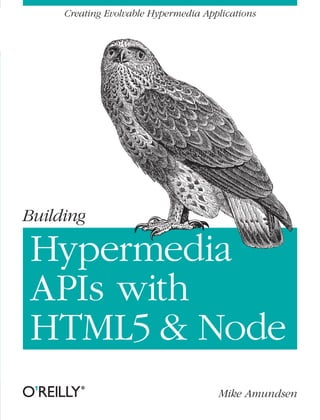
![Building Hypermedia APIs with HTML5 and Node
by Mike Amundsen
Copyright © 2012 amundsen.com, inc.. All rights reserved.
Printed in the United States of America.
Published by O’Reilly Media, Inc., 1005 Gravenstein Highway North, Sebastopol, CA 95472.
O’Reilly books may be purchased for educational, business, or sales promotional use. Online editions
are also available for most titles (http://my.safaribooksonline.com). For more information, contact our
corporate/institutional sales department: (800) 998-9938 or corporate@oreilly.com.
Editor: Simon St. Laurent
Production Editor: Melanie Yarbrough
Cover Designer: Karen Montgomery
Interior Designer: David Futato
Illustrator: Robert Romano
Revision History for the First Edition:
2011-11-21 First Release
See http://oreilly.com/catalog/errata.csp?isbn=9781449306571 for release details.
Nutshell Handbook, the Nutshell Handbook logo, and the O’Reilly logo are registered trademarks of
O’Reilly Media, Inc. Building Hypermedia APIs with HTML5 and Node, the image of a rough-legged
buzzard, and related trade dress are trademarks of O’Reilly Media, Inc.
Many of the designations used by manufacturers and sellers to distinguish their products are claimed as
trademarks. Where those designations appear in this book, and O’Reilly Media, Inc. was aware of a
trademark claim, the designations have been printed in caps or initial caps.
While every precaution has been taken in the preparation of this book, the publisher and authors assume
no responsibility for errors or omissions, or for damages resulting from the use of the information con-
tained herein.
ISBN: 978-1-449-30657-1
[LSI]
1321983647](https://image.slidesharecdn.com/1217133-250605130951-fa4ca5d5/85/Building-Hypermedia-Apis-With-Html5-And-Node-Mike-Amundsen-8-320.jpg)
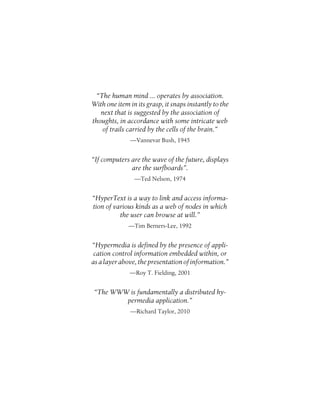

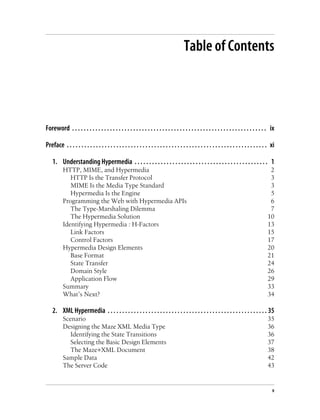
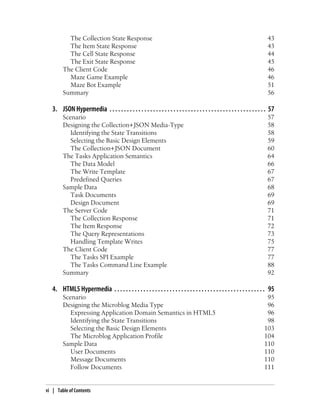
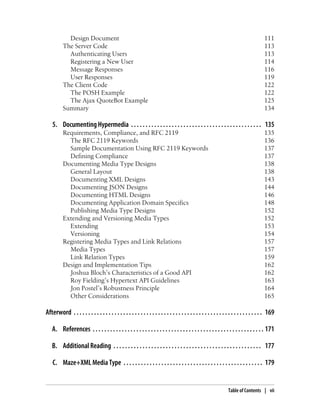


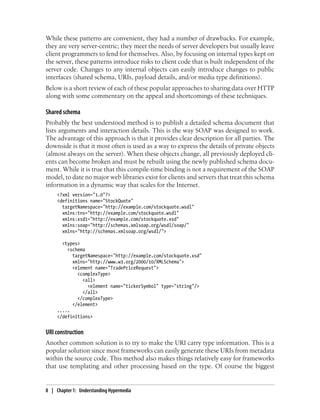
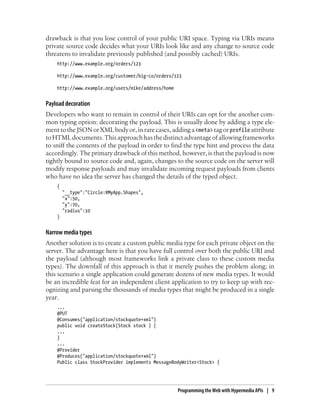
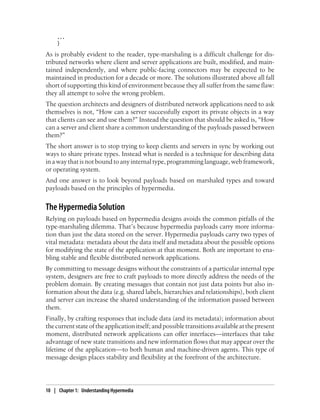
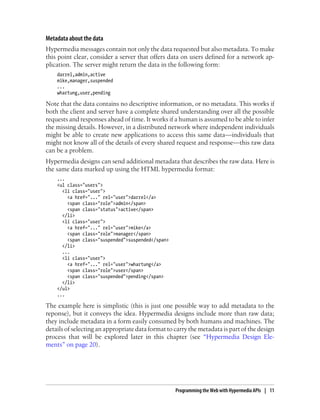
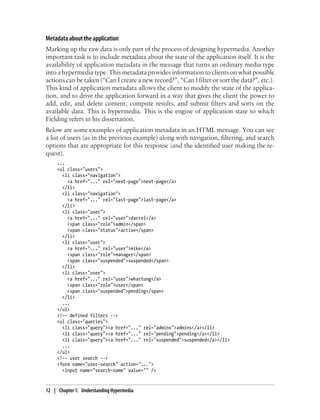
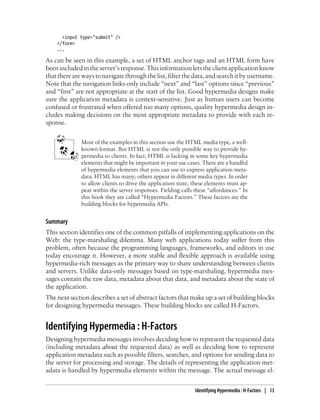
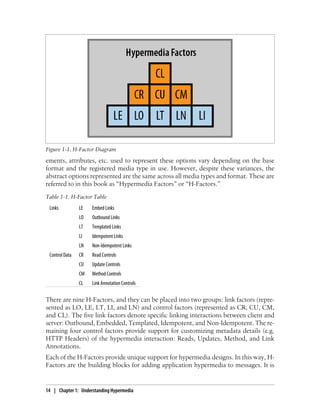
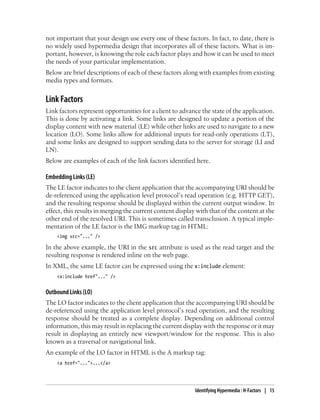
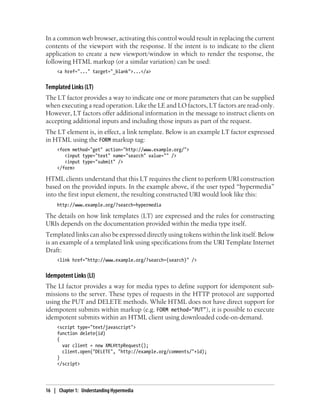
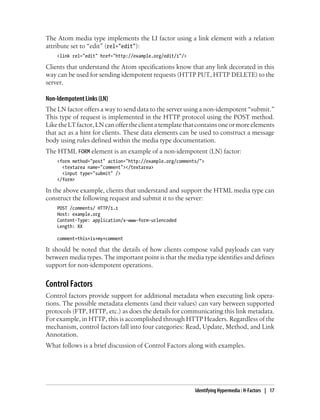
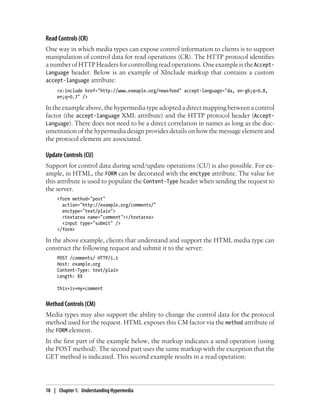
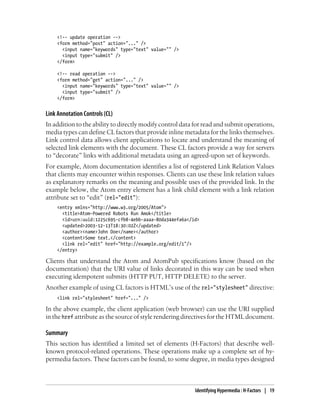
![for RDF (most notably RDF Forms), to date no ontology that supports a wide range of
H-Factors has emerged as a clear leader for RDF. There is an XML serialization for RDF
(RDF-XML) and a number of JSON variations, but none of those serializations of RDF
include strong support for H-Factors either. For those who want to use the RDF inter-
change standard and still need hypermedia support, the RDFa specification for ex-
pressing structured data using attributes (when applied to HTML) is probably the best
choice since it offers all the H-Factors of HTML (LO, LE, LT, LN) as well as the ability
to model RDF’s subject-predicate-object expressions.
State Transfer
Another key aspect of hypermedia design is supporting the transfer of information (i.e.
state) from the client to the server. This client-initiated state transfer is really the heart
of hypermedia messaging. There are many media type designs focused on efficient
transfer of data from servers to clients, but not many do a good job of defining how
clients can send data to servers. In some cases, read-only designs are appropriate for
the task. For example, bots that search for and index specific data on the Web usually
havenoreasontosenddatatootherservers.However,incaseswhereclientapplications
are expected to collect inputs (e.g. from human users or by other means) and store them
on a remote server; these same client applications will need to know how to locate and
use hypermedia-enabled link controls (the LT, LI, and LN H-Factors).
For the purposes of this book, we can divide the work of expressing client-initiated
state transfer for hypermedia types into three types: read-only, predefined, and ad-hoc.
Read-only
As was already mentioned, there are a number of scenarios where hypermedia types
do not need to support client-initiated state transfers. In these cases, the media types
are, essentially, read-only. That does not mean that the messages are devoid of hyper-
media controls. For example, the SVG [SVG11] media type is a read-only design that
uses outbound links (LO) and embedding links (LE). The CSS media type supports the
LE H-Factor.
If your use case does not require clients to transfer data directly to servers, using a media
type design that supports no client-initiated state transfer is a perfectly valid design
choice.
Predefined
Another common approach to handling client-initiated state transfer is to rely on pre-
defined transfer bodies that clients learn and then use when indicated. Media types that
rely on this design pattern usually provide documentation detailing the required and/
or optional elements for valid transfers, encoding rules, etc. The AtomPub (RFC5023)
24 | Chapter 1: Understanding Hypermedia](https://image.slidesharecdn.com/1217133-250605130951-fa4ca5d5/85/Building-Hypermedia-Apis-With-Html5-And-Node-Mike-Amundsen-48-320.jpg)