Download Full Version ebook - Visit ebookmeta.com
Practical Web Development 1st Edition Wellens Paul
https://ebookmeta.com/product/practical-web-development-1st-
edition-wellens-paul/
OR CLICK HERE
DOWLOAD NOW
Discover More Ebook - Explore Now at ebookmeta.com
Instant digital products (PDF, ePub, MOBI) ready for you
Download now and discover formats that fit your needs...
Start reading on any device today!
Web Service APIs and Libraries 1st Edition Jason Paul
Michel
https://ebookmeta.com/product/web-service-apis-and-libraries-1st-
edition-jason-paul-michel/
ebookmeta.com
Practical Salesforce Architecture Paul Mccollum
https://ebookmeta.com/product/practical-salesforce-architecture-paul-
mccollum/
ebookmeta.com
Web Development with Clojure Build Large Maintainable Web
Applications Interactively 3rd Edition Sotnikov
https://ebookmeta.com/product/web-development-with-clojure-build-
large-maintainable-web-applications-interactively-3rd-edition-
sotnikov/
ebookmeta.com
Artificial Intelligence and Applied Mathematics in
Engineering Problems 1st Edition D. Jude Hemanth
https://ebookmeta.com/product/artificial-intelligence-and-applied-
mathematics-in-engineering-problems-1st-edition-d-jude-hemanth/
ebookmeta.com
VCE Philosophy assessment and examination supplement for
VCE units 3 4 Third Edition. Edition Anna Symes Lenny
Robinson Mccarthy
https://ebookmeta.com/product/vce-philosophy-assessment-and-
examination-supplement-for-vce-units-3-4-third-edition-edition-anna-
symes-lenny-robinson-mccarthy/
ebookmeta.com
Intercultural Competence in Instructed Language Learning
Bridging Theory and Practice 1st Edition Paula Garrett
Rucks
https://ebookmeta.com/product/intercultural-competence-in-instructed-
language-learning-bridging-theory-and-practice-1st-edition-paula-
garrett-rucks/
ebookmeta.com
Greek Lyric A Selection 2019th Edition Felix Budelmann
(Editor)
https://ebookmeta.com/product/greek-lyric-a-selection-2019th-edition-
felix-budelmann-editor/
ebookmeta.com
The Software Developer's Career Handbook [Retail copy] 1st
Edition Michael Lopp
https://ebookmeta.com/product/the-software-developers-career-handbook-
retail-copy-1st-edition-michael-lopp/
ebookmeta.com
Getting to the Promised Land Black America and the
Unfinished Work of the Civil Rights Movement 1st Edition
Kevin W. Cosby
https://ebookmeta.com/product/getting-to-the-promised-land-black-
america-and-the-unfinished-work-of-the-civil-rights-movement-1st-
edition-kevin-w-cosby/
ebookmeta.com
Sassy and the Boss 1st Edition M.K. Moore
https://ebookmeta.com/product/sassy-and-the-boss-1st-edition-m-k-
moore/
ebookmeta.com
Practical Web Development
Table of Contents
Practical Web Development
Credits
About the Author
Acknowledgments
About the Reviewers
www.PacktPub.com
Support files, eBooks, discount offers, and more
Why subscribe?
Free access for Packt account holders
Preface
What this book covers
What you need for this book
Who this book is for
Conventions
Reader feedback
Customer support
Downloading the example code
Errata
Piracy
Questions
1. The World Wide Web
World Wide Web
The Internet
HTTP and HTML
HTML
HTTP
The World Wide Web Consortium (W3C)
Mosaic
The first browser
Netscape
Internet Explorer
The explosion of the Web
Amazon.com and e-commerce
Google and Yahoo!
Social networking
Web development
HTML
HTML editors and other tools
Browsers and web servers
CSS
JavaScript
PHP
Data
Summary
2. HTML
HTML versions
Semantic and presentational HTML
The structure and syntax of an HTML document
Doctype
<html>
<head>
<body>
Syntax for tags or elements inside the document
HTML comments
Links
The <a> tag and attributes
The href attribute
The <a> name attribute
The <a> target attribute
Classic document elements
<h1>, <h2>, <h3>, 
 <h6> – headings
<p> – paragraph
<span> – span
Lists
Images
<img> element and attributes
Image width and height
Input forms
Form elements
Form attributes
The label attribute
Input attributes
The name attribute
The value attribute
The checked attribute
The readonly attribute
Textarea
Dropdown lists
The disabled attribute
The selected attribute
Tables
Table elements
<table>
<thead> <tbody>
<tr>
<th> <td>
Table attributes
colspan (td)
rowspan (td)
<div>, the "uebertag"
HTML entities
HTML5-specific tags
Summary
3. CSS
Adding styles to our documents
External style sheets
Internal CSS
Inline styles
The Document Object Model (DOM)
Selectors
Multiple classes
Descendants
Selecting children or siblings
Specificity
Block elements and inline elements
Colors
Fonts
So what are fonts?
Font families
Serif fonts
Sans-serif fonts
Monospace fonts
The font-family property
Font-weight and font-style
Font-size
Line-height
The box model
Padding
Border
Margin
Collapsing margins
Positioning
Float
position:relative
position:absolute
Styling lists
list-style-type
list-style-image
list-style-position
Styling anchors – pseudo-classes
Firebug
Summary
4. JavaScript
Programming 101
Compiled and interpreted languages compared
JavaScript is not the same as Java
Java
JavaScript
Our first JavaScript program
Variables
Variable declarations
Values of variables
Numbers
Strings
Converting strings to numbers
Expressions and operators
Arithmetic operators
Addition(+)
Subtraction (-)
Multiplication (*)
Division (/)
Modulo (%)
Relational operators
Control flow
if
while
switch
Functions
Scope of variables
Objects
JSON
DOM objects, properties, methods, and events
The Window object
The Document object
write and writeln methods
Nodes and DOM traversing
Events
Summary
5. PHP
Introduction to PHP
Our first real PHP program
PHP and web hosting
Web hosting 101
Domain name
Web hosting companies
Server-side setup
Additional server-side services
PHP development environment
PHP as a web development language
Variables, values, operators, and expressions
Scope of variables
Local variables
Global variables
Static variables
String operators
To double quote or to single quote, that is the question
Control flow
Functions
String functions
strpos()
strlen()
substr()
Date functions
time()
date()
strtotime()
Arrays
Numeric arrays or indexed arrays
Associative arrays
Cool control statements for associative arrays
Sending data back to the server – forms
POST or GET, what should we get?
$_POST and $_GET arrays
Files
include, require, and require_once
Regular files
File functions or f-functions
fopen
file_exists(), is_file(), and is_dir()
fread and fwrite
One line at a time – fgets()
The printf family
Syntax of printf family of functions
Summary
6. PHP and MySQL
Databases
Relational databases
SQL
MySQL
phpMyAdmin
Creating databases
Creating and managing users
Creating and managing database tables
MySQLi in PHP
Connecting to the database
Our first SQL query, really!
Writing a MySQL query in PHP
Fetching the result
Obtaining data from more than one table
Adding data
Updating data
Summary
7. jQuery
Obtaining the jQuery library
Where to place the jQuery library on your page?
jQuery UI and jQuery Mobile
Using jQuery selectors and methods
html()
text()
attr()
.val()
show() and hide()
.find()
.parent()
.next()
.css()
jQuery documentation
Event handlers and jQuery
preventDefault()
$(this)
updateNewsContent()
Summary
8. Ajax
XMLHttpRequest
Ajax and jQuery
jQuery Ajax methods
$.load() method
$.post()
$.ajax()
Summary
9. The History API – Not Forgetting Where We Are
The problem we are trying to solve
The self-service restaurant
HTML5 History API and the history object
pushState()
popstate event
popstate and different browsers
The History plugin
Bookmarking
Summary
10. XML and JSON
XML
XML format
Displaying XML files
XML editors
XML Schema
SimpleXML
The XML file
The XML Schema file
The CSS file
The PHP file
Creating XML files with SimpleXML
Generating our HTML on the client side
XSLT
JSON
JSON syntax
JSON values
JSON objects
JSON strings
JSON arrays
JSON numbers
JSON and PHP
JSON with Ajax and jQuery
Two useful JSON methods
Summary
11. MongoDB
Relational database management systems
NoSQL databases
MongoDB
Installing MongoDB
The MongoDB shell
Creating databases, collections, and documents
_id and ObjectIds
Loading scripts
Removing documents
Updating documents
MongoDB data types
Basic data types
Dates
Embedded documents
One more example
MongoDB and PHP
Getting our gallery data
CRUD operations with MongoDB and PHP
Insert documents
Update documents
Queries with conditions
MongoDB cursor object
Summary
12. Mobile First, Responsive Design with Progressive Enhancement
Responsive design
Déjà vu
Media queries
Using the media attribute
Do more with less
Mobile first
Why mobile first?
We have come a long way
Mobile devices have newer capabilities
Mobile devices are not only used while on the road
Content first, navigation next
Small means big
Mobile input
Mobile first recap
Progressive enhancement
EnhanceJS
enhance.js
loadStyles and loadScripts
enhanced and FOUC
Modernizr
The Modernizr object
Polyfills and Modernizr
yepnope.js or Modernizr.load
Summary
13. Foundation – A Responsive CSS/JavaScript Framework
Our responsive toolkit – Foundation
Foundation components
The grid system
Class end
Visibility classes
The block grid system
Useful UI elements
Thumbnails – for simple galleries
Reveal modals – your better pop-up
Dropdowns
Example – a simple photo gallery
Accordions
Awesome Font awesome
Equalizer – the hardest thing to do with two <div>s made easy
Navigation
Top bar – not just your regular menu bar
Adding more magic
Yet more magic – off-canvas, the coolest thing
Summary
14. Node.js
Node.js
Installing node.js
npm
node
Adding HTML
Serving up static content
A tale of two (JavaScript) cities
node.js and MongoDB
Déjà vu 
 once more
Express
Installing Express
Our first Express app
An example with middleware
Templating and handlebars.js
Creating a layout
Our last Hello, World example
Summary
A. Bootstrap – An Alternative to Foundation
Bootstrap components
The Bootstrap grid system
Visibility classes
Buttons
Other UI elements
Thumbnails
Dropdowns
Modal – the Bootstrap popup
Combining dropdowns and modals
Collapse – an accordion for Bootstrap
Navigation
Summary
Index
Practical Web Development
Copyright © 2015 Packt Publishing All rights reserved. No part of this book
may be reproduced, stored in a retrieval system, or transmitted in any form or by
any means, without the prior written permission of the publisher, except in the
case of brief quotations embedded in critical articles or reviews.
Every effort has been made in the preparation of this book to ensure the accuracy
of the information presented. However, the information contained in this book is
sold without warranty, either express or implied. Neither the author, nor Packt
Publishing, and its dealers and distributors will be held liable for any damages
caused or alleged to be caused directly or indirectly by this book.
Packt Publishing has endeavored to provide trademark information about all of
the companies and products mentioned in this book by the appropriate use of
capitals. However, Packt Publishing cannot guarantee the accuracy of this
information.
First published: July 2015
Production reference: 1240715
Published by Packt Publishing Ltd.
Livery Place
35 Livery Street
Birmingham B3 2PB, UK.
ISBN 978-1-78217-591-9
www.packtpub.com
Credits
Author
Paul Wellens
Reviewers
Jorge Albaladejo
Elvis Boansi
Adam Maus
JesĂșs PĂ©rez Paz
Commissioning Editor
Edward Gordon
Acquisition Editors
James Jones
Sonali Vernekar
Content Development Editor
Ritika Singh
Technical Editor
Ryan Kochery
Copy Editors
Alpha Singh
Ameesha Green
Jasmine Nadar
Jasmine Nadar
Project Coordinator
Milton Dsouza
Proofreader
Safis Editing
Indexer
Rekha Nair
Production Coordinator
Manu Joseph
Cover Work
Manu Joseph
About the Author
Paul Wellens has been a senior product manager for a major computer company
in the Los Angeles area and Silicon Valley for over two decades. Before that, he
used to install Unix systems and train companies in Europe, from his native
Belgium. Later in his career, he became a web development aficionado because
it brought him back to another passion of his: programming.
This is not his first book. His prior publication is of a different nature. Nature is
what it is all about as it is a guidebook on Eastern California, which is illustrated
with his own photographs. Therefore, it should not come as a surprise to learn
that, besides experimenting with new web technologies, his major hobbies are
photography and hiking in the Eastern Sierra.
Acknowledgments
I have written books before and I know that the result can only be successful if
there are some nice people to assist you. This is the first time that I have worked
with a publisher, Packt Publishing, so these are the first people I would like to
thank. I would like to thank Shivani Wala for discovering me and James Jones
for working with me to figure out the right book for me to write and for you to
read. I enjoyed working with Priyanka Shah, Ritika Singh, and Ryan Kochery
who assisted me in bringing this cool project to completion, without a single
complaint, even though I was once again late with a deliverable. Thank you for
being so patient with me.
I would also like to thank (yes, this is a note of cynicism) the three companies
that "manage" the railroads in Belgium. Without their comedy of errors with
trains—delays, cancellations, failure to depart because of mechanical problems,
or trains departing from the station where you want to get to, as opposed to
depart from, I would never had so much time to work on this book on my iPad.
It is not in their honor, but, because for 2 years, it was the highlight of my day to
safely arrive at Antwerp Central Station—which was rated by an American
newspaper as the most beautiful train station in the world—that we decided to
use it as the cover photo.
Next, I would like to thank my web developer buddy, Björn Beheydt, for taking
the time to read the early versions of the chapters of this book and providing
constructive feedback. I would also like to mention Steve Drach and Bart
Reunes for always being there when I needed some technical advice.
Then, there are places that I would like to call a home away from home, where
folks did not mind that I was typing away on my Bluetooth keyboard when
inspiration kicked in. Most notably, I have to thank the folks at Trapke Op
(Caro, Maressa, Evi, Klaartje and Jill) in Brecht, Belgium, where I typed these
sentences. These wonderful people helped me make it to the finish line. Het
Boshuisje in Zoersel, where Hendrik Conscience wrote books over a hundred
years before I did, also comes to mind. I would like to thank Theo for always
giving me a seat to land with my iPad, keyboard, and work.
Less related to this book, but still in need of a mention, are all my friends in
California that inspired me to carry on doing great things in hard times. In
particular, I want to express my appreciation to the people that work(ed) at the
Gordon Biersch Restaurant in Palo Alto, which I can still proudly call my photo
gallery. I thank them for their support for over 11 years and for still welcoming
me when I visit them; they make me feel as if I only left last night. That also
includes the patrons of the place with whom I've had numerous conversations
and enjoyed every single one of them.
If you read this book, or my previous book, you will notice that I have a certain
affinity and passion for a particular part of California. So, I would like to thank
all the wonderful folks that live in the town of June Lake, California, for always
having inspired me to come back and be creative. My goal in life is to go there
as often as I can.
Finally, I would like to thank my mother. It has been hard for her since my father
passed away and her son returned. I am dedicating this book to her, not that I
expect her to read it, but I really appreciate the patience she had with me while I
was writing it.
About the Reviewers
Jorge Albaladejo is a software engineer with a master's degree in information
and communication technologies from HES-SO, Switzerland. With over a
decade of experience building cloud, SaaS, and web applications, he considers
himself to be a passionate and versatile full-stack web developer.
Throughout his professional experience, he has worked with many companies in
different fields, such as project management, social networks, quality assurance,
weather data visualization, and video games. He devours countless books about
software engineering, project management, and science fiction, and he is
passionate about clean, long-lasting software architectures.
He is currently working as a freelance contractor under the commercial name of
CometaStudio, and he is mostly interested in start-ups and mid-sized companies
that build great web experiences for great causes that make a difference. His next
dream is to become a digital nomad who travels around the globe while working
at the same time—and learn languages in the process!
Elvis Boansi is a software developer at John Jay College. He develops and
maintains custom web applications that are used by members of the college. In
his spare time, he enjoys playing soccer and basketball with his friends.
I'd like to thank my employers at John Jay College for all of their support. I
would also like to thank my supervisors, Ana and Juan, for their feedback. I
thank my friends, Sanga, Steve, and Loric, for constantly sharing their
knowledge with me.
Adam Maus is a software developer with a master's degree in computer science
and works at the Center for Health Enhancement Systems Studies at the
University of Wisconsin in Madison in the United States. His interests lie in
developing web technologies that utilize data mining to create better user
experiences. He primarily works on websites that help people undergoing
addiction recovery support, as well as people who are aging. In his free time, he
enjoys running, biking, and reading books.
JesĂșs PĂ©rez Paz is a full-stack web developer with experience in project
management. He works at PepitaStore Inc. and collaborates with Mozilla.
His main area of work is design, and he integrates the user interface (or
frontend) of web pages / applications; however, lately, he has been diving into
backend stuff and has become a full-stack web developer.
He loves the open/free Internet and thinks that the Internet is a global public
resource that must remain open and accessible to everyone.
www.PacktPub.com
Support files, eBooks, discount offers, and more
For support files and downloads related to your book, please visit
www.PacktPub.com.
Did you know that Packt offers eBook versions of every book published, with
PDF and ePub files available? You can upgrade to the eBook version at
www.PacktPub.com and as a print book customer, you are entitled to a discount
on the eBook copy. Get in touch with us at <service@packtpub.com> for more
details.
At www.PacktPub.com, you can also read a collection of free technical articles,
sign up for a range of free newsletters and receive exclusive discounts and offers
on Packt books and eBooks.
https://www2.packtpub.com/books/subscription/packtlib
Do you need instant solutions to your IT questions? PacktLib is Packt's online
digital book library. Here, you can search, access, and read Packt's entire library
of books.
Why subscribe?
Fully searchable across every book published by Packt
Copy and paste, print, and bookmark content
On demand and accessible via a web browser
Free access for Packt account holders
If you have an account with Packt at www.PacktPub.com, you can use this to
access PacktLib today and view 9 entirely free books. Simply use your login
credentials for immediate access.
Preface
I am fortunate to have lived and worked in California for a long time. The
majority of that time, I lived in Palo Alto, which is the center of Silicon Valley,
the home of Stanford University, and the birthplace of many companies, big and
small, such as Sun Microsystems, where I worked. I sat on the front row to see
how the World Wide Web developed, as well as being present for the advent of
social media. Facebook started on the other side of the wall of my favorite
restaurant. Now, some Facebook guy or girl is sitting in what used to be my
office at the bottom of the Dumbarton Bridge. As a product manager for Solaris,
one of my tasks was to make sure that Netscape Navigator was included with our
operating system. So, I was right at the source in which the development of the
Web began. I even went to the Web 2.0 conference and bought the book of the
same name.
Then, I felt the need to have my own website to display my photographs and
inform people about the beauty and interesting places of the parts of California
that I had discovered during my many journeys travelling around the state. So, I
created one. One day, I was telling a friend about it and he tried to look at it on
his mobile phone. It looked terrible. So, I bought a Nokia phone (a brick
compared to what we have today) so that I could test my own site to make sure
that it looked good on a phone as well. This is how I caught the bug of
responsive design, years before someone started calling it this.
Upon my return to Belgium, I decided that it was time to learn as much as
possible (I love to learn new things) about what is out there beyond creating
websites and took a 6-month course on PHP web development. A lot of it looked
familiar as I was previously a UNIX and C developer. There were only 12
people in the class, who were all bright minds, and I quickly discovered that
there was more to learn.
As the classes took place in Leuven, a major university town in Belgium, I went
to the local university bookstore and bought book after book on all kinds of
related topics and quickly became a jQuery fan. jQuery, by the way, was not
even included in the course. I started wondering why someone needed to have 35
different books to learn about web development and that writing a single book
that gave a comprehensive overview of what you need to know to engage in web
development would not be a bad idea.
Since then, web development has changed a lot; more books were needed,
eBooks this time, but the concept remained the same. So, now you know why I
wrote the book.
This book gives you an overview of all the general aspects of web development,
in a traditional way, using plain HTML to do static websites, as well as the
current way, to enable you to create your web pages dynamically and make sure
that they look great on mobile devices as well, by using responsive design. We
conclude by giving you a hint of what is yet to come if you replace the
traditional web server by writing your own using node.js.
What this book covers
Chapter 1, The World Wide Web, gives you an overview of the history of what
we know today as the World Wide Web.
Chapter 2, HTML, introduces HTML and gives you an overview of the most
commonly used HTML tags to do web development. You will be able to create a
basic website after reading this chapter.
Chapter 3, CSS, explains how to use Cascading Style Sheets (CSS). This is used
for the presentation part or layout of your website, from color to dimensions to
typefaces. The most commonly used CSS properties are explained here. Once
you are done with this chapter, you will be able to make your basic website look
good.
Chapter 4, JavaScript, first gives you an introduction to the world of
programming and programming languages. Next, the overall syntax of
JavaScript and how to use it for client-side programming is introduced.
Chapter 5, PHP, explains PHP, which is another programming language. This
one is used to do server-side programming. It requires a web server to do the
development of your website and deploy it. You will learn how to dynamically
create your web pages, rather than having to write a bunch of HTML files.
Chapter 6, PHP and MySQL, introduces MySQL, an open source database. You
will learn how to create a database, manage it using the phpMyAdmin tool, and
perform basic CRUD (create, replace, update, delete) operations from within a
PHP program.
Chapter 7, jQuery, covers a popular JavaScript library. It allows you to write
more compact and clean code and handles browser incompatibilities for you.
With this, it is going to be a lot easier and faster for you to write JavaScript code
that traverses and manipulates the web page. It does so by using selectors, which
you learned to use with CSS. So, with jQuery, you can write JavaScript code
without having to learn a lot of JavaScript.
Chapter 8, Ajax, introduces Ajax. It represents a collection of techniques to make
it easy to dynamically change only portions of a website. With this chapter, we
have entered the world of what I call "modern web development". The interface
that we use for our Ajax calls is jQuery.
Chapter 9, The History API—Not Forgetting Where We Are, explains a very
important piece of the web development puzzle. Once we are changing pages on
the fly so they look different but actually remain the same page (URL), strange
things can happen when visitors want to go back to what they think is the
previous page. A solution for this is described here that will not only work for
HTML5 but for HTML4 as well.
Chapter 10, XML and JSON, describes XML and JSON. They are two popular
formats to exchange data, for example the server and the client. Although XML
is used in a variety of environments, JSON is closer to the web development
community.
Chapter 11, MongoDB, describes an alternative to MySQL as a database. This is
a so-called NoSQL database and a document database. Documents are
conveniently in the JSON format. Here, how to access a MongoDB database
from within a PHP program is described.
Chapter 12, Mobile First, Responsive Design with Progressive Enhancement,
has the longest chapter title of the book. It explains how modern web
development has to be done now that more people are using mobile devices
instead of traditional computer screens to go to websites.
Chapter 13, Foundation – A Responsive CSS/JavaScript Framework, describes
most of the features of the Foundation framework, which helps you with your
responsive design. It contains everything that I have always wanted to write
myself but never had the time to do. This concludes the part of the book that
covers what I call modern web development.
Chapter 14, Node.js, gives an overview of what I call the avant-garde of web
development. It introduces node.js, which allows you to write your server-side
code in JavaScript, including your own web server, which is facilitated by using
the Express framework.
Appendix, Bootstrap – An Alternative to Foundation, describes the popular
CSS/JavaScript framework, which is an alternative to Foundation to help you
with responsive design. The main reason to include this is to point out key
differences and similarities.
The online chapter, The Mono County Site, provides a full example of a website
or application where we apply most, if not all, the things we learned. It is
available at
https://www.packtpub.com/sites/default/files/downloads/B03816_Appendix.pdf.
Discovering Diverse Content Through
Random Scribd Documents
“We’ll see about that, you fresh kid! Once more, now; I shan’t ask
you again; will you get those slippers?”
“For the last time, Holden, I won’t.”
“Very well. You’ll be mighty sorry, though.” Ben took refuge in
dignity. “It isn’t likely that we’re going to stand for having a new boy
come in here—and disrupt the school. We—we’ll deal with you later.”
Bert, without replying, washed for supper, and a moment later the
bell rang. Ben went down to the dining-room in his shoes. The
twelve boys sat at two tables, the seniors and upper middlers at
one, presided over by Mr. Folsom, and the lower middlers and
juniors at the other, under the supervision of Mr. Crane. Doctor
Merton, with his wife and daughter, occupied a small table at the
end of the room. Whispering was not countenanced, and so the
mutineers could not compare notes. Lanny looked flustered and
defiant, Kid excited and happy and Small worried. Once Bert
encountered Nan’s eyes across the room and received a look that he
couldn’t fathom, not knowing that Nan had learned of the mutiny
and was doing her best to convey to him that she was just terribly
excited and was dying to hear all about it. Then Mr. Crane, helping
the last portion of cold roast beef, remarked:
“Well, you boys want to eat plenty, you know. There’s hard work
ahead this evening.”
This pleasantry elicited no response and he pretended to be
surprised. As a matter of fact, Mr. Crane had found the proclamation
on the mantel, had laughed over it with Mr. Folsom and had
subsequently taken it to Doctor Merton.
“Eh?” he went on. “Isn’t this the night we fix the slide, Crandall?”
“Yes, sir, I believe so,” replied Crandall.
“I thought so. Well, there’s plenty of snow. Last year you had
rather hard work, if I remember.”
“Yes, sir, we did.”
“How are you with a snow shovel, Bryant; pretty husky?”
“Only fair, sir. No good at all after dark.”
“How’s that?”
Bert shook his head. “I hardly know how to explain it, sir,” he
replied, “but I can’t seem to hold a shovel in the evening.”
“Dear, dear! Quite remarkable, Bryant. You must have a new sort
of disease.” Kid was grinning delightedly. “Well, you haven’t any
trouble of that sort, have you, Fairchild?”
“I’m afraid I have,” piped the boy. “The thought of a snow-shovel
makes me quite ill, sir.”
“Good gracious! The disease is catching! And you, Grey? Are you
experiencing the symptoms, too?”
“Yes, sir,” muttered Lanny.
“What? Why, this is—is surprising! I must ask the Doctor to look
into it. Frye, you—don’t tell me you have it, too!”
Small looked at his plate and nodded silently. Mr. Crane leaned
back in his chair astounded.
“Well, well! But let’s learn the worst, Crandall?”
“No, sir,” replied Crandall with a grin.
“Ah! And Cupples?”
“Not yet, sir.”
“Good! There is hope! But what about the slide? You don’t think,
Bryant, that you could—ah—overcome this—this aversion?”
“No, sir,” answered Bert cheerfully. “It has a firm hold on me.”
“Really! And I can see by your countenance, Grey, that you, too,
are past recovery. And Frye, and Fairchild. Why, it looks to me as
though Crandall and Cupples would have to do all the work. That’s
too bad.”
“I’m willing to do my share,” said Crandall, “but I don’t propose to
go out there and cover that slide alone.”
“But you’ll have Cupples to help you.”
“Not much, Mr. Crane. What’s the matter with the upper grade
fellows doing it?”
“Tut, tut, Cupples! You surely wouldn’t propose that seriously?
Why, they might get their feet cold!”
“I guess they have the same disease we have,” said Kid.
“Um; maybe; perhaps another form of it. Well, things look bad for
the slide, don’t they? Perhaps the Doctor and Mr. Folsom and I will
have to attend to it this time.”
Kid grinned at the idea. “I’d like to see you,” he said.
After supper, in the hall, Pierce remarked pleasantly:
“Well, juniors and lowers, this is the night we fix the toboggan
slide, you know.”
“Do you?” asked Kid interestedly. “May I come and watch you,
Dick?”
A roar of laughter greeted this, even Ben being obliged to smile.
“You may come and get busy with a shovel and pail, little smarty,”
responded Gardner. “And all the rest of you. Now get a move on, for
you’ve only got about an hour before prayers.”
But Kid shook his head. “No, thanks. It’s too cold out there, Dick.
The doctor said I must be very careful of my health and avoid night
air.”
Gardner frowned and glanced inquiringly at the others. Ben came
to his support.
“You fellows think you’re awfully smart, I suppose,” he said, “but
you’re making fools of yourselves. Either you go out and get that
slide ready or you keep off it altogether. It’s either work or no
tobogganing for you chaps.”
“I’d like to know when we’d get a show at it, anyway,” said Lanny.
“You fellows would be using it all the time. It would be just like the
rinks. A lot of fun we juniors get there!”
“You’re entitled to use the rinks whenever we aren’t practising,”
said Ben.
“What of that? You always are practising!”
“Then you can use the slide,” said Steve Lovell. “Come on, Lanny,
don’t be silly.”
“No, sir, we aren’t going to fix that slide,” responded Lanny,
emphatically. “We aren’t going to do any more errands for anyone,
or any more shacking.”
“You mean you won’t fix that slide?” demanded Ben.
“That’s what I mean!”
“We’ll be glad to go out and help,” remarked Bert calmly, “if you
fellows will do your share. That’s fair enough, isn’t it?”
“You’ll do it all or it won’t be done,” snapped Ben.
“Then it won’t be done,” said Bert.
The upper grade fellows went into secret session in front of the
fireplace. Crandall and Cupples attempted to persuade the
youngsters to give in, but without success. Then Ben announced the
ultimatum.
“We are going to fix that slide ourselves,” he said sternly, “and if
we catch any of you juniors sliding on it we’ll wallop you good and
hard. Come on, fellows!”
T
IV
THE FIRST SKIRMISH
he war was on.
The juniors may be said to have won the first skirmish, for the
upper grade fellows, assisted by the two lower middlers, labored the
better part of an hour that night, shoveling and carrying snow to the
wooden part of the toboggan slide and subsequently sprinkling it
with water so that it might freeze over night into a good foundation
for further improvements; and this without help from the mutineers,
who from the darkened windows of Small’s room, watched the work
in warmth and comfort.
“First blood for our side,” murmured Kid gleefully.
When the workers returned with benumbed fingers and ice-coated
boots it was evident that their attitude toward the offending juniors
was to be one of silent contempt. Bert, Lanny, Small and Kid were
absolutely ignored by all save Cupples and Crandall, who, so far,
observed a difficult neutrality. During study hour Bert and Ben sat at
opposite sides of the green-topped table and exchanged never a
word, Bert deciding ruefully toward the end of the evening that
much of that sort of thing would probably become very tiresome.
In the morning the revolutionists gained a convert. The convert
was Nan. Nan was greatly excited and very enthusiastic. And she
assured Bert and Lanny, who had gone out after breakfast to slide
down the short coast afforded by the sloping driveway, that she was
heart and soul with the Cause. They must never give in, she
declared. She also said many other things about Tyranny, the
Despot’s Heel, Right and Justice and Suffering for a Principle. The
latter phrase misled Lanny until Nan explained that she was not
referring to her father. Her words sounded very fine and the two
boys were quite heartened. They had not thought of the thing as a
Cause before and now Lanny began to look quite noble and heroic,
or as noble and heroic as it is possible to look with a green plaid
Mackinaw jacket and ear-muffs.
“What you must do, though,” continued Nan, sinking her voice to
a sort of frozen whisper, “is to form a Society!”
“What sort of a society?” asked Bert.
“Why, a—a Society for Mutual Help and Protection.”
“Oh!” murmured Lanny, much impressed. “How would you do it?”
“Just—just do it, silly! I tell you what; come to the stable after
morning school and organize. And meanwhile I’ll think up a good
name for the Society. You must bring Small and Kid, too, you know.
And you must have a password and—and a grip.”
“We’ll have the grippe all right if we sit around the stable long,”
said Lanny. “It’s as cold in there as—as——”
“A barn,” suggested Bert. “All right, we’ll be there, Miss Merton,
right after school.”
“What do you call her Miss Merton for?” asked Lanny after Nan
had hurried indoors again. “Her name’s Nan; except when you want
to get her mad, and then it’s Nancy.”
“Well, I don’t know her very well yet,” answered Bert in excuse.
“She seems a pretty good sort.”
“She is. She’s all right—for a girl. Girls always want to stick their
noses into things, though. Just as though we couldn’t get up a
society without her help!”
“Well, we wouldn’t have thought of it, I guess. And I’m glad she
did. It’ll be rather fun, won’t it?”
“Sure. It must be a secret society, too. And we’ll vote for officers.”
This settled, they went on with the matter in hand, which was to
start at the corner of the house and see how far they could make
their sleds go around the corner into the road.
At ten minutes past twelve the four crept into the stable with
appropriate stealthiness and found Nan already there. She led the
way into the harness room, closed and locked the door and took
command of the situation. There was a stove in the harness room,
but as there was no fire in it it couldn’t be said to help the situation
much. It was undoubtedly cold and Small remarked sarcastically that
he didn’t see why the hall wasn’t good enough.
“Because,” replied Nan scathingly, “you can’t form a Secret Society
with the whole world hearing every word you say. You’d be
surrounded by your enemies in the hall.”
“I’d be surrounded by some heat, anyway,” muttered Small
ungraciously.
“Dry up, Small,” commanded Lanny. “Now, then, what’s the first
thing, Nan?”
“Choose a name. I’ve thought of several that might do. What do
you think of ‘The League of Emancipators’?”
“Um,” said Bert. “But I think something shorter would be better.”
“Well, then, there’s ‘The Secret Four.’”
“What’s the matter with ‘The Four’?” asked Small.
“‘The Junior Four’ sounds pretty well,” Bert suggested. And the
rest agreed that it did, Nan concurring and nobly striving to hide her
disappointment over the fact that her names had been rejected.
“‘The Junior Four’ it is, then,” said Lanny briskly, breathing on his
fingers to warm them. “Now what?”
“A password,” said Nan. “I couldn’t think of anything very—very
striking.”
“Justice!” suggested Lanny.
“No surrender!” said Small.
“Non plus ultra!” piped Kid.
“You’re a goose,” laughed Nan. “That means ‘None better.’”
“I know what it means,” replied Kid. “I guess I’ve studied as much
Latin as you have.”
“I guess you haven’t!” responded Nan indignantly. “The idea!”
“I’ve got a good one,” interrupted Lanny, who had been scowling
ferociously at the stove. “‘All for one, one for all!’”
“You got that out of ‘The Three Musketeers,’” charged Small. “And,
anyway, it’s ‘One for all and all for one.’”
“It is not! Is it, Bert?”
“I don’t know, but it sounds all right. ‘One for all and all for one.’”
“It’s fine!” declared Nan. “Now you must have officers.”
“What kind of officers?” asked Kid.
“Why, a—a president and a vice-president, I should think, and a
secretary, and—and——”
“A sergeant-at-arms,” said Small.
“I think Bert ought to be president,” declared Lanny, “because he
started it all.”
That was agreed to, and finally Lanny was made vice-president,
Small sergeant-at-arms and Kid secretary.
“I think,” said Bert, “we’d ought to make Miss—make Nan a
member.” Nan clapped her hands, but her face fell the next instant.
“I couldn’t be, though, because, don’t you see, the name is The
Junior Four. And I’m not a junior, and I’d be the fifth.”
“You could be an honorary member,” said Lanny. And so Nan was
duly elected and with a flattering unanimity. After that Small thought
they ought to have a grip and showed them three he knew of. Then
Lanny demonstrated one he liked and there was much handshaking
and confusion for several minutes. In the end Small won and they all
learned his grip. And as by that time the hour for dinner was near at
hand the first meeting of The Junior Four was adjourned, subject to
the call of the secretary. Kid, still smarting a little under Nan’s
aspersion on his knowledge of Latin, wanted to adjourn sine die and
had the pleasure of explaining that sine die meant “without day.”
Small said it sounded more like “without sense” and refused to
adjourn in any such manner. Nan cautioned them that it would be
best to avoid suspicion, and to this end they left the stable one by
one, at minute intervals; all except Small, who, left the last, refused
to freeze to death for any principle or cause and sneaked out long
before his time was up.
All this was on Thursday, and for the rest of the day The Junior
Four stayed very close together, not knowing at what moment the
upper grade fellows might tire of their present attitude of
contemptuous silence and indulge in violence. By the time afternoon
school was over the day students had learned of the situation and
had already begun to take sides, and by the next noon the school
was sharply divided into camps. The rivalry between house students
and day students was for the time forgotten and upper grade fellows
hastened to the support of Ben and his cohorts and lower grade
boys flocked to the standard of Bert and Lanny and the others.
Being at last forced to choose sides, Cupples and Crandall threw in
their lots with the revolutionists, and with their enlistment the last
semblance of peace vanished. Every room was divided against itself,
for every room was occupied by an upper grade fellow and a lower
grade fellow. The second floor of the house these evenings was
strangely quiet. To be sure, when study hour was over the lower
grade fellows managed to get together somewhere, while Stanley
Pierce’s room became the regular meeting place for the enemy. But
as these meetings were generally councils of war the usual chatter
of voices and ring of laughter were missing. The first real
engagement of the opposing forces occurred on Friday afternoon
and resulted in a victory for the revolutionists, as you shall see.
Small resided in Number 5 with George Waters. Waters had been,
from the first, in favor of strong methods and the heavy hand in
dealing with the mutiny, and on this occasion his patience deserted
him. Hurrying upstairs after school, he found Small struggling into a
sweater. Waters was after an extra skate strap, and, after searching
everywhere in vain, he charged Small with having hidden it. Small
denied it indignantly, and Waters, having worked himself into a fit of
bad temper, insisted that Small should help look for it. Small,
inwardly quaking, refused. There was a wordy war, and in the end
Waters took the key from the inside of the door.
“You’ll stay here until you find that, Small,” he declared from the
doorway. “We’ll see whether you’ll do as you’re told!”
With that Waters departed, locking the door after him and
pocketing the key. Left imprisoned, Small merely grinned and
shrugged his shoulders. He had promised to go skating on the creek
with the other juniors and Nan, but he much preferred a warm room
and a book to read. Ten minutes later, his feet on the radiator and a
rattling good book in his hands, Small had quite forgotten Waters,
his imprisonment, the Cause and all else. Half an hour passed
unheeded and then voices called from outside:
“Small! O you Small!”
Small, unheeding, read on. The hero was cutting his way through
the jungle of South Africa closely pursued by a band of head-
hunters.
“Small! Where are you, Small?”
This time Small heard and looked out of the window. Down below
in the snow stood Lanny and Bert, come in search of him. Small
opened the window.
“Hello,” he said. “I can’t come out. Waters has locked me in.”
Bert and Lanny thrilled. Here was war to the knife!
“Did he take the key?” asked Bert.
“I don’t know; I guess so. It’s all right, though; I don’t mind
staying here.”
“Don’t you worry,” cried Lanny, “we’ll get you out.”
They hurried into the house and upstairs. The second floor was
deserted. Every key they could lay their hands on was tried, but
none fitted. From beyond the door Small begged them not to
trouble, assuring them that he was quite resigned.
“One for all and all for one!” cried Lanny, undismayed. “Keep up
your courage. We’ll get a ladder.”
“Bully!” said Bert.
“But I don’t want—” began Small. It was quite lost, however, for
the others were already halfway down the stairs. Luckily the room
was on the back of the house, out of sight of the rink; although it is
probable that Waters was much too busy playing hockey to notice
what might be happening at the house. It was only a minute’s work
to carry the long ladder from the basement and set it up outside
Small’s window, one end in a rhododendron clump and the other
against the sill. Small viewed it doubtfully.
“I don’t want to climb down that thing,” he demurred. “I might
fall.”
“Hurry up,” Bert commanded. “They may come back. Get your
sweater and cap.”
“But—but I tell you——”
“Say,” interrupted Lanny impatiently, “you don’t want those fellows
to say that they got the better of us, do you? Get a move on, can’t
you? Gee, I never saw such a slow-poke!”
At that moment Nan and Kid, having waited some time for the
return of Bert and Lanny, appeared on the scene.
“Hello,” cried Kid, “what’s the fun, fellows?”
The matter was hurriedly explained, while Small frowned down
from the open window rebelliously.
“What ho! A rescue!” cried Kid. “Let me go up and carry him
down, will you, Lanny?”
Nan was visibly excited. “It’s perfectly lovely!” she declared. “Think
how chagrined they will be when they come back and find—find the
prey has escaped them! Oh, hurry, Small, hurry!”
“I don’t want to hurry,” growled Small. “I don’t intend to break my
neck getting down that old thing.”
“But you’ve got to,” said Bert. “How are we going to rescue you if
you don’t?”
“I don’t want to be rescued!”
“You’ve got to be,” declared Lanny. “Out you come, now. If you
don’t we’ll go up there and get you. I’m not going to have a
perfectly good rescue spoiled by you.”
“Yes, please do,” begged Nan.
“A rescue! A rescue!” chanted Kid shrilly, dancing around in the
snow. Small debated with himself a minute and finally disappeared
in search of sweater and cap.
“You fellows make me tired,” he growled when he returned to the
window. “Why can’t you let me alone? I don’t want to be rescued. I
don’t want to go skating. I don’t want——”
“Cut out the regrets and hurry the job,” advised Lanny.
Small cautiously climbed over the sill and set one foot tentatively
on the ladder. Then he looked down. It seemed an awfully long way
to the ground. “Some one hold it,” he grumbled. Lanny and Nan
obeyed. Small tried the second rung, found that it held and that he
was still alive, and essayed the third. His head was below the
window sill now and the rescue was progressing famously. At that
instant Kid harkened to the voice of the Imp of Mischief.
“Small,” he called, “try that next round with your foot before you
put your weight on it. It looks weak.”
Small turned and cast a horrified look at the rung in question, and
clung desperately to the ladder.
“It—it’s cracked, I think,” he stammered. “I—I guess I’ll go back.”
“It isn’t cracked; it’s all right,” said Bert. “Kid, you keep your
mouth shut.”
“I was just warning him,” muttered Kid. “Of course, if you fellows
want to see him fall and hurt himself, all right. But I don’t want any
man’s blood on my soul. I——”
“Shut up!” yelled Lanny. “Come on down, Small; it’s perfectly
safe.”
“It is, is it?” chattered Small. “Then what’s he talking that way for?
I’ll l-l-lick him when I g-g-get down!”
“You ought to be ashamed, Kid,” remonstrated Nan. “How would
you like it if——”
But at that moment Small put the weight of one foot on the rung,
there was a slight creak, he gave a cry of fright, tried to take his foot
off again and scramble up the ladder and lost his footing entirely.
“Look out!” yelled Bert. Lanny and Nan jumped aside and Small,
yelling lustily, came down the ladder like a shot, his feet waving
wildly and his arms wrapped around the sides. He reached the
ground in a heap. Bert hurried to him and picked him up.
“Are you hurt, Small?” he asked anxiously.
“I don’t know,” answered Small weakly, feeling himself inquiringly.
“Oh, I’m so sorry!” cried Nan. Small, very white of face, concluded
that no harm had been done. Then his eyes fell on Kid. That
irrepressible youth was seated in the middle of a clump of
rhododendrons doubled over with laughter.
“It was all his fault!” cried Small, and dashed at Kid. But Kid
recovered very suddenly from his laughter and rolled and scrambled
out the other side of the shrubs just as Small came crashing
through. Then ensued a race that presently took pursued and
pursuer out of sight around the building.
“It’s lucky he didn’t hurt himself,” said Bert, laughing. “I say, he
left the window open. The room will be as cold as Greenland when
Waters gets back.”
“And serve him right,” said Lanny.
“Couldn’t you go up and close it?” asked Nan.
“I guess I will.” So Lanny ran up the ladder. When he reached the
top, instead of closing the window, he disappeared into the room
and was gone several minutes. Finally he came out again, drew the
window shut and slid down the ladder. “I left the Sign of the Four,”
he explained, grinning. At that moment Small and Kid returned,
evidently reconciled, and the five went back to the creek to resume
their skating. When an hour or so later, Waters, who had quite
forgotten the prisoner, tried to open his room door and found it
locked he was quite surprised until he recalled the earlier events.
Then, a little conscience stricken, he unlocked the door and entered
the darkened room.
“Find that strap yet, Small?” he asked gruffly.
There was no answer and Waters lighted the gas and gazed in
bewilderment about the empty apartment. Then he looked under
both beds and in the closet, declaring in a loud voice that Small
might as well “come out of that now” because he knew just where
he was. But Small didn’t appear, and Waters, passing the study
table, caught sight of a sheet of paper. On it was what was evidently
intended for a skull and crossbones, and under that was printed:
“One for All and All for One!”
T
V
BATTLE ROYAL
he toboggan slide was in fine shape, and as soon as supper was
over the upper grade boys hurried out to it. Bert had never
tasted the joys of tobogganing and so was quite indifferent to the
fact that he was not to be allowed on the slide, but Lanny and Small
were inclined to be rueful.
“I wish now,” said Small, “that we’d fixed it for them.”
“I don’t see why we can’t use it if we want to,” said Kid. “It’s the
school slide and not Ben’s and Sam’s. I guess if we asked Mr. Crane
——”
“That would be a babyish thing to do,” said Lanny. “Let’s go out
and see them, anyway. Maybe they’ll let us go down a few times.”
“They’ve got all the toboggans,” said Small, as they scattered for
their sweaters and jackets. “Aren’t you coming, Bert?”
“No, I guess not. I don’t want to stand in the snow and watch
those fellows slide down hill.”
“Oh, come along,” begged Lanny. “Maybe we can have some fun.”
So Bert accompanied them and they went out and stood at the
foot of the incline and watched the more fortunate ones come
scooting down the ice-covered planks and go, rising and dipping and
rising again, down the long trough of snow until lost in the darkness
of the meadow. Their feet were beginning to get cold and Bert had
already announced his determination to return indoors when
Cupples and Crandall, drawing a fine new toboggan that the former
had received as a Christmas present, arrived at the foot of the
incline and started up the steps. It was Ben who saw them and
raised a warning shout to the others, who included three day
students from the village.
“Keep those fellows off!” cried Ben.
Four or five upper grade boys barred their way.
“We helped make this slide,” said Cupples indignantly, “and you
can just believe we’re going to slide on it.”
“Nothing doing,” declared Ben. “You two fellows have joined with
the juniors. That bars you out.”
“It does, eh?” Cupples tried to push by. “We’ll see about that!
Come on, Cran.”
But the others were too many for them, and, in the end, Crandall
and Cupples, protesting angrily and vowing vengeance, retreated to
the ground.
“Wouldn’t they let you slide?” asked Lanny.
“No, but they can’t help themselves. We’ll wait until they’ve all
coasted down,” said Cupples.
But it was soon evident that the enemy had other plans, for they
timed their descents so that there always remained four or five
fellows at the start. This effectually held Cupples and Crandall at
bay, but it made the tobogganing pretty slow, since it was necessary
to wait until one couple had started back from the meadow before
the next couple started down.
“I tell you what,” said Bert. “You two can get one slide anyway.”
“How?” asked Cupples.
“Wait until those three day chaps go down together. Then, before
they’re back, two more will go down. That only leaves four up there.
We’ll rush the slide and you two chaps get started before the others
come up again.”
“All right,” said Crandall. “And we can take another down you
know. Want to go?”
But Bert shook his head. “Take Kid,” he said. “The biggest of us
had better stay behind to cover your retreat.”
“To cover our own retreat, you mean,” said Small. “I’m not going
up there.”
“Yes, you are,” said Lanny. “There go the three chaps. Now, when
they reach the bottom two more will start. Then we’ll try it. I hope
Ben goes down next.”
And Lanny had his wish, for after some two or three minutes had
elapsed and it was safe to presume that the three day students were
well on their way back, Ben and Stanley Pierce started down. As
soon as they had flashed past the group at the bottom of the incline
Cupples gave the word and the six boys started up the steps. On the
platform at the top stood Waters, Gardner, Lovell and Perkins, and as
soon they saw the enemy approach they started down to meet
them.
“On the run!” cried Cupples and, with the toboggan bumping
along behind, he and Crandall leaped up the steps, slipping and
stumbling on the ice and snow. Behind them went Bert and Lanny,
Small and Kid, Small greatly against his inclinations and Kid
screeching joyously. They met the defenders halfway up the steps.
Cupples and Sam Perkins came to grips, lost their footing and
created so much confusion on the narrow stair that Crandall, passing
the toboggan rope back to Kid, gained the platform and Bert and
Lanny followed. Lovell only laughed, leaving for the moment the
repulsing of the invaders to Waters and Gardner, who proved
unequal to the task. Cupples and Perkins finally found their feet and
joined the others.
“We’re going down,” declared Crandall, trying to get the toboggan
in place, “and you can’t stop us.”
“Can’t we?” asked Perkins. “You watch.”
The ten boys pushed and scuffled on the small platform, Cupples
and Crandall striving to get their toboggan ready for the start and
the enemy kicking it out of place again. At last, however, Bert,
Lanny, Small and Kid, engaging the attention of the defenders
fiercely, Cupples got the toboggan in place, yelled to Crandall and
started down. Crandall stumbled over someone’s foot and threw
himself after the toboggan, just managing to grasp the rail on one
side. All the way down the incline he trailed behind, bumping against
the side board, but at the bottom, as the toboggan struck the
ground, he managed to pull himself on to it. And away they went,
Cupples sending back a shrill shout of triumph.
Meanwhile, not willing to trust to the mercies of the enemy, the
four juniors were in full retreat down the steps, pursued by Perkins
and Gardner. The latter gave up the pursuit before the bottom was
reached and the juniors drew off to a safe distance, Kid sending
back cries of defiance and insult. Then the three day students trailed
past with their toboggan, yelling as they neared the incline; “Who
was that just went down, fellows?”
“Cupples and Crandall,” was the reply from Perkins. “They rushed
us, they and those kids down there.”
“Get your toboggans ready,” advised one of the day fellows, “and
we’ll all down and catch them.”
“Good scheme,” answered Gardner. “Come on, fellows!” Down
shot Gardner and Lovell, while Perkins pushed his toboggan into
position for descent. The three day students rushed up the steps.
“Snowball them!” whispered Lanny, kneeling and hurriedly
fashioning his missiles. The others followed his example, armed
themselves with four or five snowballs and waited for Perkins and
Waters. They came. Four arms were raised and shot forward and the
soft snow thudded and spattered against the faces and bodies of the
two flying seniors. The juniors threw first as soon as the enemy was
within range and managed to get in a second fusillade before they
were out of shot. Angry remonstrances floated back on the night air.
At the top of the incline, the three day boys had failed to see the
attack and came down unsuspectingly. Again the snowballs sped to
their marks and again the cries of the victims arose as the toboggan
rushed away down the slope.
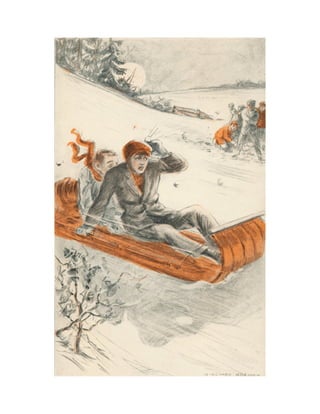
“The soft snow thudded and spattered against the two flying seniors.”
“Fine!” laughed Bert. “We got in some good ones. But they’ll make
it hot for us when they come back.”
“I wonder if they’ll catch Harold and Sewall,” said Lanny. “There’s
someone coming now.”
Into the dim radiance of the two lights on the platform came two
boys dragging a toboggan. They were Ben and Stanley Pierce.
“I say,” whispered Bert, “let’s get up there ahead and keep them
off. We can do it. Take all the snowballs you’ve got, fellows.” And
Bert started for the steps on the run. Had the others had time to
reflect they might have hesitated. As it was, they followed at once
and had gained the platform before Ben and Pierce had reached the
foot of the steps. When they did reach them a snowball, sent with
beautiful accuracy, banged against Ben’s woolen cap and another
hummed past Pierce’s head. The seniors stopped and held a council
of war.
“Quit that, you kids,” shouted Ben threateningly.
“We’ll come up there and give you fellows a good licking,” added
Pierce.
“Come on!” jeered Lanny, the joy of battle thrilling him. “Try it!”
They did try it, but such a shower of snowballs met them as soon
as they set foot on the steps that they thought better of it. For a
minute or so they fashioned missiles and retaliated, but throwing up
at the platform was difficult work and their snowballs either sailed
harmlessly overhead or wasted themselves against the boards. Then
two boys with a toboggan came into sight, running hard, and Ben
hailed them.
“Come on, you fellows! The kids have got the slide!”
The newcomers paused without answering.
“It’s Cupples and Crandall,” whispered Bert joyously. At that
moment the meaning of the pause was explained. Ben and Pierce
found themselves attacked from a new quarter, while from the
platform came a pitiless shower of snowballs. Discretion proved the
better part of valor. Ben and Pierce scampered away and, with a
shout, Cupples and Crandall rushed up the stairs and joined the
invaders at the top.
“Did they get you?” asked Lanny. “The whole crowd went down to
catch you.”
“No, we saw them first,” panted Crandall with a grin, “and ran like
the dickens. They’re after us, though. Come on, Harold, let’s go
down again before they catch us.”
“If you do that they’ll get you sure,” said Bert. “Stay up here with
us and we’ll stand them off. We can do it easily. There are some of
them now.”
Four figures came out of the darkness and were joined, at a
respectful distance from the platform by Ben and Pierce.
“They’ll try to rush us,” muttered Bert. “Got plenty of snowballs,
fellows?”
“What do you say, Harold?” asked Crandall.
“Oh, we’ll stay and help the kids,” answered Cupples, beginning to
make snowballs as fast as he could. “Pull the toboggan up, Cran,
and put it across the top of the slide there. We can get behind it if
we need to. Say, fellows, there isn’t much snow up here. First thing
we know we’ll be out of ammunition.”
“Kid, you gather all the snow you can find,” directed Bert, “and
pile it back of the toboggan.”
“I want to fight,” demurred Kid.
“Well, you can fight, too. Go ahead. I’ll help you until they start for
us.”
“They’ll wait until the other three fellows come,” said Cupples.
“We’ll have to shoot straight, fellows. Don’t waste your shots now.”
“We won’t,” muttered Lanny. “Don’t you worry.”
“There are the rest of them,” said Crandall, patting a fine, soggy
snowball into shape. “Get ready, fellows.”
“Hooray!” shrieked Kid, “paste them, paste them!”
The enemy, nine strong, started across the snow toward the foot
of the incline. On the platform the defenders lined up and waited.
Fortunately for them the attackers were forced to come up in single
file, since the steps were only about eighteen inches wide. Ben led
the way, Perkins at his heels and the others behind, yelling
fearsomely.
“Wait till they’re on the steps,” counseled Cupples, “and then give
it to ’em! Now!”
Six snowballs sped down at the enemy, three of the number
taking effect on Ben. Ben shook his head angrily and came on. Then
a lucky shot by Lanny struck him square on the chin, he faltered,
slipped against the railing, and Perkins took his place. By that time
the shots were falling thick and fast and there was a steady stream
of snowballs. To advance in the face of such a fire was out of the
question, and Perkins, ducking his head, turned and crowded back,
putting the line into confusion. One of the day boys slipped and
went to the bottom on his back. Ben, too, was in flight, and in a
moment the enemy had withdrawn again to a safe distance.
“Hurrah!” shrieked Kid, jumping about on the platform. “We gave
it to ’em!”
“Hurry up, fellows!” called Cupples. “More snowballs. They’ll be
back in a minute.”
“We can keep them off all night,” said Bert, “as long as they come
up one at a time. That was a dandy shot of yours, Lanny.”
“They’re coming again,” said Small nervously. “Let’s make terms
with them before it’s too late, Lanny.”
“Make terms!” cried Lanny. “Never!”
Then they came toward the slide again, but more cautiously this
time, halting just out of accurate range and then, at a signal, rushing
for the steps and up them, Ben again in the lead. Up and up they
came, slipping and faltering under the rain of missiles, but doggedly
winning the ascent. Now there was a scant ten feet between Ben
and the platform. Behind him, Pierce and Perkins and the others
were crowding, their faces and bodies blotched with snow. They
were angry clear through and met every broadside of shot stoically,
stubbornly determined to gain the summit and wreak revenge on the
foe. The garrison behind the toboggan fought furiously. Snowballs
slammed down upon lowered heads and sped past protecting arms
to spread against necks and faces. The invaders made no effort to
retaliate, since it was difficult enough to make the ascent as it was;
to have attempted to throw snowballs would have invited utter
disaster.
“Let ’em have it!” cried Cupples, stooping for more ammunition
and discovering that only a few snowballs remained behind the
breastworks. The file still came on, Ben a mass of white where the
snowballs had struck and clung to his head and body.
“Who’s got any snowballs?” gasped Lanny.
“All gone,” answered Bert, desperately searching the icy boards for
snow. Small and Kid, at the other side of the platform, farthest from
the steps, were still firing, Small wildly and ineffectually. Lanny ran
across and pushed him aside. Kid shouted shrilly and got in a
splendid shot against Perkins’s ear that made that youth stagger
against the railing.
Then the firing diminished and consternation seized the garrison.
Their ammunition was gone! Ben gave a roar of triumph and
plunged up the few remaining steps, and it would have been all over
with the defenders then and there had not Bert been visited by a
brilliant idea. Seizing the toboggan, he swung it around to the steps
and, holding the rope, sent it swiftly down. It caught Ben unawares
and swept his feet from under him. He clutched wildly at the railing,
saved himself from an actual fall, but kicked Pierce so savagely that
the latter emitted a shriek and fell to his knees. Perkins stumbled,
slipped, and spread the wildest disorder. The last of the snowballs
were fired, a final volley that decided the fortunes of the battle. The
enemy wavered, turned. Ben, recovering his equilibrium, strove to
hold his regiment, but all in vain. Down the steps they fled, and Ben,
finding himself deserted, followed.
The garrison gave a shout of triumph. Kid jumped and squealed.
And then Small, venturing too near the edge of the slide, turned the
retreat into a veritable rout. Losing his footing, he sat down
suddenly and forcibly just over the edge, and, with a shriek of
despair, shot down the ice-covered trough on his back, legs waving,
hands grasping at the empty air and voice raised in wild cries. The
enemy heard and supposing that the entire garrison was hot upon
their heels, plunged down the rest of the incline in mad flight and
scattered over the snow below just as Small, going now at a good
twenty miles an hour, flew by!
At the top of the slide the rest of the garrison leaned weakly
against the railing and laughed until the tears came. Kid was so
overcome that he slipped to the floor and rolled over and over,
emitting strange, gurgling sounds. Far down the slide, Small, an
indistinct figure in the darkness, crawled over the bank of the slide,
struggled to his feet, and, with one brief glance in the direction of
the enemy, streaked across the snow toward school. Three figures
gave chase and presently Small was in the hands of the enemy and
Ben advanced toward the slide, one mittened hand held aloft.
“Flag of truce, fellows!” he called.
“All right,” answered Cupples. “What do you want?”
“We’ve taken Small prisoner,” announced Ben, “and we’re going to
wash his face with snow unless you give in.”
A howl of protest from Small pierced the air.
“We’ll yield with all the honors of war,” announced Cupples after a
hurried conference.
“What’s that?” asked Ben.
“You fellows are not to touch us,” said Cupples, “and we’re to have
the use of this slide whenever we want it.”
“We won’t touch you,” replied Ben, “and you and Crandall can
slide here. But those other little ruffians must keep off.”
Cupples looked inquiringly at Crandall. The latter shook his head.
“Tell him they must let the juniors slide too.”
Cupples did so. Ben conferred. Small, captive between two of the
day boys, waited anxiously. At last Ben turned toward the platform
again.
“All right,” he said. “We agree. But you’ve spoiled our fun and you
must let us have the slide the rest of the time to-night.”
“That’s all right,” agreed Bert and Lanny in a breath.
Cupples graciously informed Ben that the terms were satisfactory.
“Then you fellows come down,” said Ben.
“You release your prisoner,” said Cupples.
An instant later Small was scooting homeward again as fast as his
legs would carry him. Then the garrison evacuated, Bert, Lanny and
Kid marching gravely down the steps and Cupples and Crandall flying
down the slide on their toboggan. The three juniors encountered the
enemy at the foot of the incline. Ben scowled wrathfully.
“You kids think you’re mighty smart, don’t you?” he sneered.
Bert and Lanny smiled sweetly, but forebore to make reply as they
turned homeward. Kid, however, irrepressible even in the face of
danger, executed a weird dance in the snow.
“Io triumphus!” exulted Kid.
Mr. Folsom was standing in front of the fireplace in the hall, watch
in hand, when they entered.
“Ha!” he said. “A close shave, Grey. It is thirty seconds past nine.
Where are the others?”
“On the slide, sir. May I call them? I—I guess they don’t know how
late it is.”
“No,” said Mr. Folsom, grimly, snapping his watch shut, “I will
attend to them myself.”
“Gee,” whispered Lanny as the teacher went in search of his hat
and coat, “that means house bounds to-morrow morning for all of
them! My, won’t they be peeved!”
“O joy! O glee!” cried Kid. “We’ll have the slide to ourselves!”
A
VI
A RESCUE
nd a bully time they had that next forenoon. To be sure, a few
day students appeared at the slide, but the four juniors had
things pretty much to themselves for all of that. They had their pick
of the school toboggans and the added satisfaction of knowing that
the hated enemy was envying them. For Lanny’s prophecy had
proved true, and the offending upper grade fellows had been
sentenced to house bounds for the entire morning.
Nan, in a fetching white blanket coat with red border and a white
and red toque, joined them at their invitation, and, in order to show
no partiality, alternately went down with Bert and Kid and Lanny and
Small. Small was in high feather this morning, and talked a good
deal about how he had scared the upper grade fellows into fits by
hurling himself down the slide after them. Small finally actually got
to believe that he had really performed that sensational feat on
purpose.
It was a cloudy Saturday, but crisp and cold, and the slide was
very fast. Starting at the platform, there came a breath-taking rush
down the icy boards, then a little bump as the toboggan took the
ground, then a slackening of speed for a moment over the level
ground, then a long dip down the meadow hill, a little rise, and
another and steeper descent and finally a gradual lessening of speed
in the fields above the river, the whole trip over almost before one
could really settle down to appreciation of it. Then came the long
tramp back, cheeks crimson and hearts merry. There was only one
spill all that morning, and that came when Lanny, yielding at last to
the imploring of Small, allowed that youth to occupy the back of the
toboggan. They had Nan with them that trip, and just after they had
reached the level Small managed in some way to shift his position so
that the toboggan plunged over the bank and sent them all
sprawling in the soft snow. Nan declared, as she shook the snow off,
that upsetting was lots of fun, and thereafter went down each time
with the hope that the toboggan would overturn!
But it never did again, and dinner time came all too soon. Not,
however, that they were lacking in appetite. Bert declared that he
could eat wire nails, while Kid, not to be outdone in picturesqueness
of language, maintained that a “raw dog would suit him finely!”
Their appetites contrasted strongly with those of the upper grade
fellows who had been mooning around indoors all the morning, and
Cupples, watching Lanny eat, sighed enviously.
At two o’clock the big sleigh came to the door to take those who
wished to ride down to the river where the annual ice carnival was
to be held. A few of the older boys went on snowshoes, and Kid
started off alone with his sled, but the others piled into the sleigh,
which had a seat running lengthwise at each side. Everyone went,
even the Doctor and Mrs. Merton; and Nan, of course. The river was
frozen a good five inches and save where, here and there near
shore, a snow-field hid the surface, was in the best of shape for the
races. A fire was started on the bank and the Doctor and Mrs.
Merton made themselves comfortable with robes from the sleigh.
Everyone else, including Mr. Crane and Mr. Folsom, who had the
affair in charge, donned skates and took to the surface. Most of the
day students were on hand, and by half past two practically all of
Mt. Pleasant Academy was there, one of the few absentees being
Kid. But Kid arrived in time to see the finish of the two-hundred-yard
dash, panting and puffing and pulling his beloved sled behind him.
Spooner, one of the day boys, a short, round-faced chap who
looked like anything but a fast skater, won the first event. Spooner,
in spite of his appearance, was a wonder on skates, and by reason
of that ability had won the captaincy of the Day Hockey team. Other
races followed; a quarter-mile event for seniors and upper middlers,
a race of the same distance for lower middlers and juniors, a half-
mile handicap and finally a rescue race of a quarter of a mile. Ben
Holden distanced the entire field of five in the senior quarter-mile
event, Cupples captured the next, with Lanny a close second, and
the half-mile handicap, which started with sixteen entries, went to a
day student, while Sam Perkins fought every foot of the distance and
managed to finish only some six yards behind. There were prizes for
first and second places, in each case a small pewter mug with the
date and event engraved on it and a place for the winner’s name.
Those mugs were highly prized and some of the seniors, during their
three years at Mt. Pleasant, had managed to make a very creditable
collection of them. Mr. Crane was kept pretty busy hustling the
events off, while Mr. Folsom, looking as serious as ever, timed each
event. As not even a school record was broken that day the time
need not interest us.
Bert had entered in the handicap, but had finished a poor sixth,
much to his chagrin since, although he was no hockey player, he
rather prided himself on his skating. But the distance was too short
for Bert to show up at his best, and when, after the rescue race was
over, the two-mile handicap was announced Bert gave his name to
Mr. Crane.
Before this, however, the rescue race had occasioned not a little
excitement and a great deal of mirth. A quarter of a mile up the river
from the starting place four small juniors, Kid, Small and two day
students waited each with his ankles bound together with a skate
strap. They wore no skates. At the word from Mr. Crane, Pierce,
Waters, Lovell and a day student named Tucker dashed off up the
ice. The first to arrive at the end of the course was at liberty to pick
his boy, and, as Kid was several pounds lighter than any of the other
three, the contestants all wanted Kid. Waters got him, beating the
others by a few yards. Then the task was to return to the starting
place with the rescued boy. They could carry him, pull him or push
him; the only thing was to get him back. But the mode generally
adopted was to get the rescued boy in front, seize him by the
elbows and push him, the burden slanting his body back and sliding
along on his heels. Of course, the rescued boy was required to aid to
the extent of keeping his body stiff and his feet straight ahead. But it

Practical Web Development 1st Edition Wellens Paul 2024 scribd download

  • 1.
    Download Full Versionebook - Visit ebookmeta.com Practical Web Development 1st Edition Wellens Paul https://ebookmeta.com/product/practical-web-development-1st- edition-wellens-paul/ OR CLICK HERE DOWLOAD NOW Discover More Ebook - Explore Now at ebookmeta.com
  • 2.
    Instant digital products(PDF, ePub, MOBI) ready for you Download now and discover formats that fit your needs... Start reading on any device today! Web Service APIs and Libraries 1st Edition Jason Paul Michel https://ebookmeta.com/product/web-service-apis-and-libraries-1st- edition-jason-paul-michel/ ebookmeta.com Practical Salesforce Architecture Paul Mccollum https://ebookmeta.com/product/practical-salesforce-architecture-paul- mccollum/ ebookmeta.com Web Development with Clojure Build Large Maintainable Web Applications Interactively 3rd Edition Sotnikov https://ebookmeta.com/product/web-development-with-clojure-build- large-maintainable-web-applications-interactively-3rd-edition- sotnikov/ ebookmeta.com Artificial Intelligence and Applied Mathematics in Engineering Problems 1st Edition D. Jude Hemanth https://ebookmeta.com/product/artificial-intelligence-and-applied- mathematics-in-engineering-problems-1st-edition-d-jude-hemanth/ ebookmeta.com
  • 3.
    VCE Philosophy assessmentand examination supplement for VCE units 3 4 Third Edition. Edition Anna Symes Lenny Robinson Mccarthy https://ebookmeta.com/product/vce-philosophy-assessment-and- examination-supplement-for-vce-units-3-4-third-edition-edition-anna- symes-lenny-robinson-mccarthy/ ebookmeta.com Intercultural Competence in Instructed Language Learning Bridging Theory and Practice 1st Edition Paula Garrett Rucks https://ebookmeta.com/product/intercultural-competence-in-instructed- language-learning-bridging-theory-and-practice-1st-edition-paula- garrett-rucks/ ebookmeta.com Greek Lyric A Selection 2019th Edition Felix Budelmann (Editor) https://ebookmeta.com/product/greek-lyric-a-selection-2019th-edition- felix-budelmann-editor/ ebookmeta.com The Software Developer's Career Handbook [Retail copy] 1st Edition Michael Lopp https://ebookmeta.com/product/the-software-developers-career-handbook- retail-copy-1st-edition-michael-lopp/ ebookmeta.com Getting to the Promised Land Black America and the Unfinished Work of the Civil Rights Movement 1st Edition Kevin W. Cosby https://ebookmeta.com/product/getting-to-the-promised-land-black- america-and-the-unfinished-work-of-the-civil-rights-movement-1st- edition-kevin-w-cosby/ ebookmeta.com
  • 4.
    Sassy and theBoss 1st Edition M.K. Moore https://ebookmeta.com/product/sassy-and-the-boss-1st-edition-m-k- moore/ ebookmeta.com
  • 6.
  • 7.
    Table of Contents PracticalWeb Development Credits About the Author Acknowledgments About the Reviewers www.PacktPub.com Support files, eBooks, discount offers, and more Why subscribe? Free access for Packt account holders Preface What this book covers What you need for this book Who this book is for Conventions Reader feedback Customer support Downloading the example code Errata Piracy Questions 1. The World Wide Web World Wide Web The Internet HTTP and HTML HTML HTTP The World Wide Web Consortium (W3C) Mosaic The first browser Netscape Internet Explorer The explosion of the Web Amazon.com and e-commerce Google and Yahoo! Social networking
  • 8.
    Web development HTML HTML editorsand other tools Browsers and web servers CSS JavaScript PHP Data Summary 2. HTML HTML versions Semantic and presentational HTML The structure and syntax of an HTML document Doctype <html> <head> <body> Syntax for tags or elements inside the document HTML comments Links The <a> tag and attributes The href attribute The <a> name attribute The <a> target attribute Classic document elements <h1>, <h2>, <h3>, 
 <h6> – headings <p> – paragraph <span> – span Lists Images <img> element and attributes Image width and height Input forms Form elements Form attributes The label attribute Input attributes The name attribute The value attribute
  • 9.
    The checked attribute Thereadonly attribute Textarea Dropdown lists The disabled attribute The selected attribute Tables Table elements <table> <thead> <tbody> <tr> <th> <td> Table attributes colspan (td) rowspan (td) <div>, the "uebertag" HTML entities HTML5-specific tags Summary 3. CSS Adding styles to our documents External style sheets Internal CSS Inline styles The Document Object Model (DOM) Selectors Multiple classes Descendants Selecting children or siblings Specificity Block elements and inline elements Colors Fonts So what are fonts? Font families Serif fonts Sans-serif fonts Monospace fonts The font-family property
  • 10.
    Font-weight and font-style Font-size Line-height Thebox model Padding Border Margin Collapsing margins Positioning Float position:relative position:absolute Styling lists list-style-type list-style-image list-style-position Styling anchors – pseudo-classes Firebug Summary 4. JavaScript Programming 101 Compiled and interpreted languages compared JavaScript is not the same as Java Java JavaScript Our first JavaScript program Variables Variable declarations Values of variables Numbers Strings Converting strings to numbers Expressions and operators Arithmetic operators Addition(+) Subtraction (-) Multiplication (*) Division (/) Modulo (%)
  • 11.
    Relational operators Control flow if while switch Functions Scopeof variables Objects JSON DOM objects, properties, methods, and events The Window object The Document object write and writeln methods Nodes and DOM traversing Events Summary 5. PHP Introduction to PHP Our first real PHP program PHP and web hosting Web hosting 101 Domain name Web hosting companies Server-side setup Additional server-side services PHP development environment PHP as a web development language Variables, values, operators, and expressions Scope of variables Local variables Global variables Static variables String operators To double quote or to single quote, that is the question Control flow Functions String functions strpos() strlen()
  • 12.
    substr() Date functions time() date() strtotime() Arrays Numeric arraysor indexed arrays Associative arrays Cool control statements for associative arrays Sending data back to the server – forms POST or GET, what should we get? $_POST and $_GET arrays Files include, require, and require_once Regular files File functions or f-functions fopen file_exists(), is_file(), and is_dir() fread and fwrite One line at a time – fgets() The printf family Syntax of printf family of functions Summary 6. PHP and MySQL Databases Relational databases SQL MySQL phpMyAdmin Creating databases Creating and managing users Creating and managing database tables MySQLi in PHP Connecting to the database Our first SQL query, really! Writing a MySQL query in PHP Fetching the result Obtaining data from more than one table Adding data
  • 13.
    Updating data Summary 7. jQuery Obtainingthe jQuery library Where to place the jQuery library on your page? jQuery UI and jQuery Mobile Using jQuery selectors and methods html() text() attr() .val() show() and hide() .find() .parent() .next() .css() jQuery documentation Event handlers and jQuery preventDefault() $(this) updateNewsContent() Summary 8. Ajax XMLHttpRequest Ajax and jQuery jQuery Ajax methods $.load() method $.post() $.ajax() Summary 9. The History API – Not Forgetting Where We Are The problem we are trying to solve The self-service restaurant HTML5 History API and the history object pushState() popstate event popstate and different browsers The History plugin Bookmarking
  • 14.
    Summary 10. XML andJSON XML XML format Displaying XML files XML editors XML Schema SimpleXML The XML file The XML Schema file The CSS file The PHP file Creating XML files with SimpleXML Generating our HTML on the client side XSLT JSON JSON syntax JSON values JSON objects JSON strings JSON arrays JSON numbers JSON and PHP JSON with Ajax and jQuery Two useful JSON methods Summary 11. MongoDB Relational database management systems NoSQL databases MongoDB Installing MongoDB The MongoDB shell Creating databases, collections, and documents _id and ObjectIds Loading scripts Removing documents Updating documents MongoDB data types Basic data types
  • 15.
    Dates Embedded documents One moreexample MongoDB and PHP Getting our gallery data CRUD operations with MongoDB and PHP Insert documents Update documents Queries with conditions MongoDB cursor object Summary 12. Mobile First, Responsive Design with Progressive Enhancement Responsive design DĂ©jĂ  vu Media queries Using the media attribute Do more with less Mobile first Why mobile first? We have come a long way Mobile devices have newer capabilities Mobile devices are not only used while on the road Content first, navigation next Small means big Mobile input Mobile first recap Progressive enhancement EnhanceJS enhance.js loadStyles and loadScripts enhanced and FOUC Modernizr The Modernizr object Polyfills and Modernizr yepnope.js or Modernizr.load Summary 13. Foundation – A Responsive CSS/JavaScript Framework Our responsive toolkit – Foundation Foundation components
  • 16.
    The grid system Classend Visibility classes The block grid system Useful UI elements Thumbnails – for simple galleries Reveal modals – your better pop-up Dropdowns Example – a simple photo gallery Accordions Awesome Font awesome Equalizer – the hardest thing to do with two <div>s made easy Navigation Top bar – not just your regular menu bar Adding more magic Yet more magic – off-canvas, the coolest thing Summary 14. Node.js Node.js Installing node.js npm node Adding HTML Serving up static content A tale of two (JavaScript) cities node.js and MongoDB DĂ©jĂ  vu 
 once more Express Installing Express Our first Express app An example with middleware Templating and handlebars.js Creating a layout Our last Hello, World example Summary A. Bootstrap – An Alternative to Foundation Bootstrap components The Bootstrap grid system Visibility classes
  • 17.
    Buttons Other UI elements Thumbnails Dropdowns Modal– the Bootstrap popup Combining dropdowns and modals Collapse – an accordion for Bootstrap Navigation Summary Index
  • 18.
  • 19.
    Practical Web Development Copyright© 2015 Packt Publishing All rights reserved. No part of this book may be reproduced, stored in a retrieval system, or transmitted in any form or by any means, without the prior written permission of the publisher, except in the case of brief quotations embedded in critical articles or reviews. Every effort has been made in the preparation of this book to ensure the accuracy of the information presented. However, the information contained in this book is sold without warranty, either express or implied. Neither the author, nor Packt Publishing, and its dealers and distributors will be held liable for any damages caused or alleged to be caused directly or indirectly by this book. Packt Publishing has endeavored to provide trademark information about all of the companies and products mentioned in this book by the appropriate use of capitals. However, Packt Publishing cannot guarantee the accuracy of this information. First published: July 2015 Production reference: 1240715 Published by Packt Publishing Ltd. Livery Place 35 Livery Street Birmingham B3 2PB, UK. ISBN 978-1-78217-591-9 www.packtpub.com
  • 20.
    Credits Author Paul Wellens Reviewers Jorge Albaladejo ElvisBoansi Adam Maus JesĂșs PĂ©rez Paz Commissioning Editor Edward Gordon Acquisition Editors James Jones Sonali Vernekar Content Development Editor Ritika Singh Technical Editor Ryan Kochery Copy Editors Alpha Singh Ameesha Green Jasmine Nadar
  • 21.
    Jasmine Nadar Project Coordinator MiltonDsouza Proofreader Safis Editing Indexer Rekha Nair Production Coordinator Manu Joseph Cover Work Manu Joseph
  • 22.
    About the Author PaulWellens has been a senior product manager for a major computer company in the Los Angeles area and Silicon Valley for over two decades. Before that, he used to install Unix systems and train companies in Europe, from his native Belgium. Later in his career, he became a web development aficionado because it brought him back to another passion of his: programming. This is not his first book. His prior publication is of a different nature. Nature is what it is all about as it is a guidebook on Eastern California, which is illustrated with his own photographs. Therefore, it should not come as a surprise to learn that, besides experimenting with new web technologies, his major hobbies are photography and hiking in the Eastern Sierra.
  • 23.
    Acknowledgments I have writtenbooks before and I know that the result can only be successful if there are some nice people to assist you. This is the first time that I have worked with a publisher, Packt Publishing, so these are the first people I would like to thank. I would like to thank Shivani Wala for discovering me and James Jones for working with me to figure out the right book for me to write and for you to read. I enjoyed working with Priyanka Shah, Ritika Singh, and Ryan Kochery who assisted me in bringing this cool project to completion, without a single complaint, even though I was once again late with a deliverable. Thank you for being so patient with me. I would also like to thank (yes, this is a note of cynicism) the three companies that "manage" the railroads in Belgium. Without their comedy of errors with trains—delays, cancellations, failure to depart because of mechanical problems, or trains departing from the station where you want to get to, as opposed to depart from, I would never had so much time to work on this book on my iPad. It is not in their honor, but, because for 2 years, it was the highlight of my day to safely arrive at Antwerp Central Station—which was rated by an American newspaper as the most beautiful train station in the world—that we decided to use it as the cover photo. Next, I would like to thank my web developer buddy, Björn Beheydt, for taking the time to read the early versions of the chapters of this book and providing constructive feedback. I would also like to mention Steve Drach and Bart Reunes for always being there when I needed some technical advice. Then, there are places that I would like to call a home away from home, where folks did not mind that I was typing away on my Bluetooth keyboard when inspiration kicked in. Most notably, I have to thank the folks at Trapke Op (Caro, Maressa, Evi, Klaartje and Jill) in Brecht, Belgium, where I typed these sentences. These wonderful people helped me make it to the finish line. Het Boshuisje in Zoersel, where Hendrik Conscience wrote books over a hundred years before I did, also comes to mind. I would like to thank Theo for always giving me a seat to land with my iPad, keyboard, and work. Less related to this book, but still in need of a mention, are all my friends in California that inspired me to carry on doing great things in hard times. In particular, I want to express my appreciation to the people that work(ed) at the
  • 24.
    particular, I wantto express my appreciation to the people that work(ed) at the Gordon Biersch Restaurant in Palo Alto, which I can still proudly call my photo gallery. I thank them for their support for over 11 years and for still welcoming me when I visit them; they make me feel as if I only left last night. That also includes the patrons of the place with whom I've had numerous conversations and enjoyed every single one of them. If you read this book, or my previous book, you will notice that I have a certain affinity and passion for a particular part of California. So, I would like to thank all the wonderful folks that live in the town of June Lake, California, for always having inspired me to come back and be creative. My goal in life is to go there as often as I can. Finally, I would like to thank my mother. It has been hard for her since my father passed away and her son returned. I am dedicating this book to her, not that I expect her to read it, but I really appreciate the patience she had with me while I was writing it.
  • 25.
    About the Reviewers JorgeAlbaladejo is a software engineer with a master's degree in information and communication technologies from HES-SO, Switzerland. With over a decade of experience building cloud, SaaS, and web applications, he considers himself to be a passionate and versatile full-stack web developer. Throughout his professional experience, he has worked with many companies in different fields, such as project management, social networks, quality assurance, weather data visualization, and video games. He devours countless books about software engineering, project management, and science fiction, and he is passionate about clean, long-lasting software architectures. He is currently working as a freelance contractor under the commercial name of CometaStudio, and he is mostly interested in start-ups and mid-sized companies that build great web experiences for great causes that make a difference. His next dream is to become a digital nomad who travels around the globe while working at the same time—and learn languages in the process! Elvis Boansi is a software developer at John Jay College. He develops and maintains custom web applications that are used by members of the college. In his spare time, he enjoys playing soccer and basketball with his friends. I'd like to thank my employers at John Jay College for all of their support. I would also like to thank my supervisors, Ana and Juan, for their feedback. I thank my friends, Sanga, Steve, and Loric, for constantly sharing their knowledge with me. Adam Maus is a software developer with a master's degree in computer science and works at the Center for Health Enhancement Systems Studies at the University of Wisconsin in Madison in the United States. His interests lie in developing web technologies that utilize data mining to create better user experiences. He primarily works on websites that help people undergoing addiction recovery support, as well as people who are aging. In his free time, he enjoys running, biking, and reading books. JesĂșs PĂ©rez Paz is a full-stack web developer with experience in project
  • 26.
    management. He worksat PepitaStore Inc. and collaborates with Mozilla. His main area of work is design, and he integrates the user interface (or frontend) of web pages / applications; however, lately, he has been diving into backend stuff and has become a full-stack web developer. He loves the open/free Internet and thinks that the Internet is a global public resource that must remain open and accessible to everyone.
  • 27.
    www.PacktPub.com Support files, eBooks,discount offers, and more For support files and downloads related to your book, please visit www.PacktPub.com. Did you know that Packt offers eBook versions of every book published, with PDF and ePub files available? You can upgrade to the eBook version at www.PacktPub.com and as a print book customer, you are entitled to a discount on the eBook copy. Get in touch with us at <service@packtpub.com> for more details. At www.PacktPub.com, you can also read a collection of free technical articles, sign up for a range of free newsletters and receive exclusive discounts and offers on Packt books and eBooks. https://www2.packtpub.com/books/subscription/packtlib Do you need instant solutions to your IT questions? PacktLib is Packt's online digital book library. Here, you can search, access, and read Packt's entire library of books.
  • 28.
    Why subscribe? Fully searchableacross every book published by Packt Copy and paste, print, and bookmark content On demand and accessible via a web browser
  • 29.
    Free access forPackt account holders If you have an account with Packt at www.PacktPub.com, you can use this to access PacktLib today and view 9 entirely free books. Simply use your login credentials for immediate access.
  • 30.
    Preface I am fortunateto have lived and worked in California for a long time. The majority of that time, I lived in Palo Alto, which is the center of Silicon Valley, the home of Stanford University, and the birthplace of many companies, big and small, such as Sun Microsystems, where I worked. I sat on the front row to see how the World Wide Web developed, as well as being present for the advent of social media. Facebook started on the other side of the wall of my favorite restaurant. Now, some Facebook guy or girl is sitting in what used to be my office at the bottom of the Dumbarton Bridge. As a product manager for Solaris, one of my tasks was to make sure that Netscape Navigator was included with our operating system. So, I was right at the source in which the development of the Web began. I even went to the Web 2.0 conference and bought the book of the same name. Then, I felt the need to have my own website to display my photographs and inform people about the beauty and interesting places of the parts of California that I had discovered during my many journeys travelling around the state. So, I created one. One day, I was telling a friend about it and he tried to look at it on his mobile phone. It looked terrible. So, I bought a Nokia phone (a brick compared to what we have today) so that I could test my own site to make sure that it looked good on a phone as well. This is how I caught the bug of responsive design, years before someone started calling it this. Upon my return to Belgium, I decided that it was time to learn as much as possible (I love to learn new things) about what is out there beyond creating websites and took a 6-month course on PHP web development. A lot of it looked familiar as I was previously a UNIX and C developer. There were only 12 people in the class, who were all bright minds, and I quickly discovered that there was more to learn. As the classes took place in Leuven, a major university town in Belgium, I went to the local university bookstore and bought book after book on all kinds of related topics and quickly became a jQuery fan. jQuery, by the way, was not even included in the course. I started wondering why someone needed to have 35 different books to learn about web development and that writing a single book that gave a comprehensive overview of what you need to know to engage in web development would not be a bad idea.
  • 31.
    Since then, webdevelopment has changed a lot; more books were needed, eBooks this time, but the concept remained the same. So, now you know why I wrote the book. This book gives you an overview of all the general aspects of web development, in a traditional way, using plain HTML to do static websites, as well as the current way, to enable you to create your web pages dynamically and make sure that they look great on mobile devices as well, by using responsive design. We conclude by giving you a hint of what is yet to come if you replace the traditional web server by writing your own using node.js.
  • 32.
    What this bookcovers Chapter 1, The World Wide Web, gives you an overview of the history of what we know today as the World Wide Web. Chapter 2, HTML, introduces HTML and gives you an overview of the most commonly used HTML tags to do web development. You will be able to create a basic website after reading this chapter. Chapter 3, CSS, explains how to use Cascading Style Sheets (CSS). This is used for the presentation part or layout of your website, from color to dimensions to typefaces. The most commonly used CSS properties are explained here. Once you are done with this chapter, you will be able to make your basic website look good. Chapter 4, JavaScript, first gives you an introduction to the world of programming and programming languages. Next, the overall syntax of JavaScript and how to use it for client-side programming is introduced. Chapter 5, PHP, explains PHP, which is another programming language. This one is used to do server-side programming. It requires a web server to do the development of your website and deploy it. You will learn how to dynamically create your web pages, rather than having to write a bunch of HTML files. Chapter 6, PHP and MySQL, introduces MySQL, an open source database. You will learn how to create a database, manage it using the phpMyAdmin tool, and perform basic CRUD (create, replace, update, delete) operations from within a PHP program. Chapter 7, jQuery, covers a popular JavaScript library. It allows you to write more compact and clean code and handles browser incompatibilities for you. With this, it is going to be a lot easier and faster for you to write JavaScript code that traverses and manipulates the web page. It does so by using selectors, which you learned to use with CSS. So, with jQuery, you can write JavaScript code without having to learn a lot of JavaScript. Chapter 8, Ajax, introduces Ajax. It represents a collection of techniques to make it easy to dynamically change only portions of a website. With this chapter, we have entered the world of what I call "modern web development". The interface
  • 33.
    that we usefor our Ajax calls is jQuery. Chapter 9, The History API—Not Forgetting Where We Are, explains a very important piece of the web development puzzle. Once we are changing pages on the fly so they look different but actually remain the same page (URL), strange things can happen when visitors want to go back to what they think is the previous page. A solution for this is described here that will not only work for HTML5 but for HTML4 as well. Chapter 10, XML and JSON, describes XML and JSON. They are two popular formats to exchange data, for example the server and the client. Although XML is used in a variety of environments, JSON is closer to the web development community. Chapter 11, MongoDB, describes an alternative to MySQL as a database. This is a so-called NoSQL database and a document database. Documents are conveniently in the JSON format. Here, how to access a MongoDB database from within a PHP program is described. Chapter 12, Mobile First, Responsive Design with Progressive Enhancement, has the longest chapter title of the book. It explains how modern web development has to be done now that more people are using mobile devices instead of traditional computer screens to go to websites. Chapter 13, Foundation – A Responsive CSS/JavaScript Framework, describes most of the features of the Foundation framework, which helps you with your responsive design. It contains everything that I have always wanted to write myself but never had the time to do. This concludes the part of the book that covers what I call modern web development. Chapter 14, Node.js, gives an overview of what I call the avant-garde of web development. It introduces node.js, which allows you to write your server-side code in JavaScript, including your own web server, which is facilitated by using the Express framework. Appendix, Bootstrap – An Alternative to Foundation, describes the popular CSS/JavaScript framework, which is an alternative to Foundation to help you with responsive design. The main reason to include this is to point out key differences and similarities.
  • 34.
    The online chapter,The Mono County Site, provides a full example of a website or application where we apply most, if not all, the things we learned. It is available at https://www.packtpub.com/sites/default/files/downloads/B03816_Appendix.pdf.
  • 35.
    Discovering Diverse ContentThrough Random Scribd Documents
  • 36.
    “We’ll see aboutthat, you fresh kid! Once more, now; I shan’t ask you again; will you get those slippers?” “For the last time, Holden, I won’t.” “Very well. You’ll be mighty sorry, though.” Ben took refuge in dignity. “It isn’t likely that we’re going to stand for having a new boy come in here—and disrupt the school. We—we’ll deal with you later.” Bert, without replying, washed for supper, and a moment later the bell rang. Ben went down to the dining-room in his shoes. The twelve boys sat at two tables, the seniors and upper middlers at one, presided over by Mr. Folsom, and the lower middlers and juniors at the other, under the supervision of Mr. Crane. Doctor Merton, with his wife and daughter, occupied a small table at the end of the room. Whispering was not countenanced, and so the mutineers could not compare notes. Lanny looked flustered and defiant, Kid excited and happy and Small worried. Once Bert encountered Nan’s eyes across the room and received a look that he couldn’t fathom, not knowing that Nan had learned of the mutiny and was doing her best to convey to him that she was just terribly excited and was dying to hear all about it. Then Mr. Crane, helping the last portion of cold roast beef, remarked: “Well, you boys want to eat plenty, you know. There’s hard work ahead this evening.” This pleasantry elicited no response and he pretended to be surprised. As a matter of fact, Mr. Crane had found the proclamation on the mantel, had laughed over it with Mr. Folsom and had subsequently taken it to Doctor Merton. “Eh?” he went on. “Isn’t this the night we fix the slide, Crandall?” “Yes, sir, I believe so,” replied Crandall. “I thought so. Well, there’s plenty of snow. Last year you had rather hard work, if I remember.” “Yes, sir, we did.”
  • 37.
    “How are youwith a snow shovel, Bryant; pretty husky?” “Only fair, sir. No good at all after dark.” “How’s that?” Bert shook his head. “I hardly know how to explain it, sir,” he replied, “but I can’t seem to hold a shovel in the evening.” “Dear, dear! Quite remarkable, Bryant. You must have a new sort of disease.” Kid was grinning delightedly. “Well, you haven’t any trouble of that sort, have you, Fairchild?” “I’m afraid I have,” piped the boy. “The thought of a snow-shovel makes me quite ill, sir.” “Good gracious! The disease is catching! And you, Grey? Are you experiencing the symptoms, too?” “Yes, sir,” muttered Lanny. “What? Why, this is—is surprising! I must ask the Doctor to look into it. Frye, you—don’t tell me you have it, too!” Small looked at his plate and nodded silently. Mr. Crane leaned back in his chair astounded. “Well, well! But let’s learn the worst, Crandall?” “No, sir,” replied Crandall with a grin. “Ah! And Cupples?” “Not yet, sir.” “Good! There is hope! But what about the slide? You don’t think, Bryant, that you could—ah—overcome this—this aversion?” “No, sir,” answered Bert cheerfully. “It has a firm hold on me.” “Really! And I can see by your countenance, Grey, that you, too, are past recovery. And Frye, and Fairchild. Why, it looks to me as though Crandall and Cupples would have to do all the work. That’s too bad.”
  • 38.
    “I’m willing todo my share,” said Crandall, “but I don’t propose to go out there and cover that slide alone.” “But you’ll have Cupples to help you.” “Not much, Mr. Crane. What’s the matter with the upper grade fellows doing it?” “Tut, tut, Cupples! You surely wouldn’t propose that seriously? Why, they might get their feet cold!” “I guess they have the same disease we have,” said Kid. “Um; maybe; perhaps another form of it. Well, things look bad for the slide, don’t they? Perhaps the Doctor and Mr. Folsom and I will have to attend to it this time.” Kid grinned at the idea. “I’d like to see you,” he said. After supper, in the hall, Pierce remarked pleasantly: “Well, juniors and lowers, this is the night we fix the toboggan slide, you know.” “Do you?” asked Kid interestedly. “May I come and watch you, Dick?” A roar of laughter greeted this, even Ben being obliged to smile. “You may come and get busy with a shovel and pail, little smarty,” responded Gardner. “And all the rest of you. Now get a move on, for you’ve only got about an hour before prayers.” But Kid shook his head. “No, thanks. It’s too cold out there, Dick. The doctor said I must be very careful of my health and avoid night air.” Gardner frowned and glanced inquiringly at the others. Ben came to his support. “You fellows think you’re awfully smart, I suppose,” he said, “but you’re making fools of yourselves. Either you go out and get that slide ready or you keep off it altogether. It’s either work or no tobogganing for you chaps.”
  • 39.
    “I’d like toknow when we’d get a show at it, anyway,” said Lanny. “You fellows would be using it all the time. It would be just like the rinks. A lot of fun we juniors get there!” “You’re entitled to use the rinks whenever we aren’t practising,” said Ben. “What of that? You always are practising!” “Then you can use the slide,” said Steve Lovell. “Come on, Lanny, don’t be silly.” “No, sir, we aren’t going to fix that slide,” responded Lanny, emphatically. “We aren’t going to do any more errands for anyone, or any more shacking.” “You mean you won’t fix that slide?” demanded Ben. “That’s what I mean!” “We’ll be glad to go out and help,” remarked Bert calmly, “if you fellows will do your share. That’s fair enough, isn’t it?” “You’ll do it all or it won’t be done,” snapped Ben. “Then it won’t be done,” said Bert. The upper grade fellows went into secret session in front of the fireplace. Crandall and Cupples attempted to persuade the youngsters to give in, but without success. Then Ben announced the ultimatum. “We are going to fix that slide ourselves,” he said sternly, “and if we catch any of you juniors sliding on it we’ll wallop you good and hard. Come on, fellows!”
  • 40.
    T IV THE FIRST SKIRMISH hewar was on. The juniors may be said to have won the first skirmish, for the upper grade fellows, assisted by the two lower middlers, labored the better part of an hour that night, shoveling and carrying snow to the wooden part of the toboggan slide and subsequently sprinkling it with water so that it might freeze over night into a good foundation for further improvements; and this without help from the mutineers, who from the darkened windows of Small’s room, watched the work in warmth and comfort. “First blood for our side,” murmured Kid gleefully. When the workers returned with benumbed fingers and ice-coated boots it was evident that their attitude toward the offending juniors was to be one of silent contempt. Bert, Lanny, Small and Kid were absolutely ignored by all save Cupples and Crandall, who, so far, observed a difficult neutrality. During study hour Bert and Ben sat at opposite sides of the green-topped table and exchanged never a word, Bert deciding ruefully toward the end of the evening that much of that sort of thing would probably become very tiresome. In the morning the revolutionists gained a convert. The convert was Nan. Nan was greatly excited and very enthusiastic. And she assured Bert and Lanny, who had gone out after breakfast to slide down the short coast afforded by the sloping driveway, that she was heart and soul with the Cause. They must never give in, she declared. She also said many other things about Tyranny, the Despot’s Heel, Right and Justice and Suffering for a Principle. The latter phrase misled Lanny until Nan explained that she was not referring to her father. Her words sounded very fine and the two
  • 41.
    boys were quiteheartened. They had not thought of the thing as a Cause before and now Lanny began to look quite noble and heroic, or as noble and heroic as it is possible to look with a green plaid Mackinaw jacket and ear-muffs. “What you must do, though,” continued Nan, sinking her voice to a sort of frozen whisper, “is to form a Society!” “What sort of a society?” asked Bert. “Why, a—a Society for Mutual Help and Protection.” “Oh!” murmured Lanny, much impressed. “How would you do it?” “Just—just do it, silly! I tell you what; come to the stable after morning school and organize. And meanwhile I’ll think up a good name for the Society. You must bring Small and Kid, too, you know. And you must have a password and—and a grip.” “We’ll have the grippe all right if we sit around the stable long,” said Lanny. “It’s as cold in there as—as——” “A barn,” suggested Bert. “All right, we’ll be there, Miss Merton, right after school.” “What do you call her Miss Merton for?” asked Lanny after Nan had hurried indoors again. “Her name’s Nan; except when you want to get her mad, and then it’s Nancy.” “Well, I don’t know her very well yet,” answered Bert in excuse. “She seems a pretty good sort.” “She is. She’s all right—for a girl. Girls always want to stick their noses into things, though. Just as though we couldn’t get up a society without her help!” “Well, we wouldn’t have thought of it, I guess. And I’m glad she did. It’ll be rather fun, won’t it?” “Sure. It must be a secret society, too. And we’ll vote for officers.” This settled, they went on with the matter in hand, which was to start at the corner of the house and see how far they could make
  • 42.
    their sleds goaround the corner into the road. At ten minutes past twelve the four crept into the stable with appropriate stealthiness and found Nan already there. She led the way into the harness room, closed and locked the door and took command of the situation. There was a stove in the harness room, but as there was no fire in it it couldn’t be said to help the situation much. It was undoubtedly cold and Small remarked sarcastically that he didn’t see why the hall wasn’t good enough. “Because,” replied Nan scathingly, “you can’t form a Secret Society with the whole world hearing every word you say. You’d be surrounded by your enemies in the hall.” “I’d be surrounded by some heat, anyway,” muttered Small ungraciously. “Dry up, Small,” commanded Lanny. “Now, then, what’s the first thing, Nan?” “Choose a name. I’ve thought of several that might do. What do you think of ‘The League of Emancipators’?” “Um,” said Bert. “But I think something shorter would be better.” “Well, then, there’s ‘The Secret Four.’” “What’s the matter with ‘The Four’?” asked Small. “‘The Junior Four’ sounds pretty well,” Bert suggested. And the rest agreed that it did, Nan concurring and nobly striving to hide her disappointment over the fact that her names had been rejected. “‘The Junior Four’ it is, then,” said Lanny briskly, breathing on his fingers to warm them. “Now what?” “A password,” said Nan. “I couldn’t think of anything very—very striking.” “Justice!” suggested Lanny. “No surrender!” said Small. “Non plus ultra!” piped Kid.
  • 43.
    “You’re a goose,”laughed Nan. “That means ‘None better.’” “I know what it means,” replied Kid. “I guess I’ve studied as much Latin as you have.” “I guess you haven’t!” responded Nan indignantly. “The idea!” “I’ve got a good one,” interrupted Lanny, who had been scowling ferociously at the stove. “‘All for one, one for all!’” “You got that out of ‘The Three Musketeers,’” charged Small. “And, anyway, it’s ‘One for all and all for one.’” “It is not! Is it, Bert?” “I don’t know, but it sounds all right. ‘One for all and all for one.’” “It’s fine!” declared Nan. “Now you must have officers.” “What kind of officers?” asked Kid. “Why, a—a president and a vice-president, I should think, and a secretary, and—and——” “A sergeant-at-arms,” said Small. “I think Bert ought to be president,” declared Lanny, “because he started it all.” That was agreed to, and finally Lanny was made vice-president, Small sergeant-at-arms and Kid secretary. “I think,” said Bert, “we’d ought to make Miss—make Nan a member.” Nan clapped her hands, but her face fell the next instant. “I couldn’t be, though, because, don’t you see, the name is The Junior Four. And I’m not a junior, and I’d be the fifth.” “You could be an honorary member,” said Lanny. And so Nan was duly elected and with a flattering unanimity. After that Small thought they ought to have a grip and showed them three he knew of. Then Lanny demonstrated one he liked and there was much handshaking and confusion for several minutes. In the end Small won and they all learned his grip. And as by that time the hour for dinner was near at
  • 44.
    hand the firstmeeting of The Junior Four was adjourned, subject to the call of the secretary. Kid, still smarting a little under Nan’s aspersion on his knowledge of Latin, wanted to adjourn sine die and had the pleasure of explaining that sine die meant “without day.” Small said it sounded more like “without sense” and refused to adjourn in any such manner. Nan cautioned them that it would be best to avoid suspicion, and to this end they left the stable one by one, at minute intervals; all except Small, who, left the last, refused to freeze to death for any principle or cause and sneaked out long before his time was up. All this was on Thursday, and for the rest of the day The Junior Four stayed very close together, not knowing at what moment the upper grade fellows might tire of their present attitude of contemptuous silence and indulge in violence. By the time afternoon school was over the day students had learned of the situation and had already begun to take sides, and by the next noon the school was sharply divided into camps. The rivalry between house students and day students was for the time forgotten and upper grade fellows hastened to the support of Ben and his cohorts and lower grade boys flocked to the standard of Bert and Lanny and the others. Being at last forced to choose sides, Cupples and Crandall threw in their lots with the revolutionists, and with their enlistment the last semblance of peace vanished. Every room was divided against itself, for every room was occupied by an upper grade fellow and a lower grade fellow. The second floor of the house these evenings was strangely quiet. To be sure, when study hour was over the lower grade fellows managed to get together somewhere, while Stanley Pierce’s room became the regular meeting place for the enemy. But as these meetings were generally councils of war the usual chatter of voices and ring of laughter were missing. The first real engagement of the opposing forces occurred on Friday afternoon and resulted in a victory for the revolutionists, as you shall see. Small resided in Number 5 with George Waters. Waters had been, from the first, in favor of strong methods and the heavy hand in dealing with the mutiny, and on this occasion his patience deserted
  • 45.
    him. Hurrying upstairsafter school, he found Small struggling into a sweater. Waters was after an extra skate strap, and, after searching everywhere in vain, he charged Small with having hidden it. Small denied it indignantly, and Waters, having worked himself into a fit of bad temper, insisted that Small should help look for it. Small, inwardly quaking, refused. There was a wordy war, and in the end Waters took the key from the inside of the door. “You’ll stay here until you find that, Small,” he declared from the doorway. “We’ll see whether you’ll do as you’re told!” With that Waters departed, locking the door after him and pocketing the key. Left imprisoned, Small merely grinned and shrugged his shoulders. He had promised to go skating on the creek with the other juniors and Nan, but he much preferred a warm room and a book to read. Ten minutes later, his feet on the radiator and a rattling good book in his hands, Small had quite forgotten Waters, his imprisonment, the Cause and all else. Half an hour passed unheeded and then voices called from outside: “Small! O you Small!” Small, unheeding, read on. The hero was cutting his way through the jungle of South Africa closely pursued by a band of head- hunters. “Small! Where are you, Small?” This time Small heard and looked out of the window. Down below in the snow stood Lanny and Bert, come in search of him. Small opened the window. “Hello,” he said. “I can’t come out. Waters has locked me in.” Bert and Lanny thrilled. Here was war to the knife! “Did he take the key?” asked Bert. “I don’t know; I guess so. It’s all right, though; I don’t mind staying here.” “Don’t you worry,” cried Lanny, “we’ll get you out.”
  • 46.
    They hurried intothe house and upstairs. The second floor was deserted. Every key they could lay their hands on was tried, but none fitted. From beyond the door Small begged them not to trouble, assuring them that he was quite resigned. “One for all and all for one!” cried Lanny, undismayed. “Keep up your courage. We’ll get a ladder.” “Bully!” said Bert. “But I don’t want—” began Small. It was quite lost, however, for the others were already halfway down the stairs. Luckily the room was on the back of the house, out of sight of the rink; although it is probable that Waters was much too busy playing hockey to notice what might be happening at the house. It was only a minute’s work to carry the long ladder from the basement and set it up outside Small’s window, one end in a rhododendron clump and the other against the sill. Small viewed it doubtfully. “I don’t want to climb down that thing,” he demurred. “I might fall.” “Hurry up,” Bert commanded. “They may come back. Get your sweater and cap.” “But—but I tell you——” “Say,” interrupted Lanny impatiently, “you don’t want those fellows to say that they got the better of us, do you? Get a move on, can’t you? Gee, I never saw such a slow-poke!” At that moment Nan and Kid, having waited some time for the return of Bert and Lanny, appeared on the scene. “Hello,” cried Kid, “what’s the fun, fellows?” The matter was hurriedly explained, while Small frowned down from the open window rebelliously. “What ho! A rescue!” cried Kid. “Let me go up and carry him down, will you, Lanny?”
  • 47.
    Nan was visiblyexcited. “It’s perfectly lovely!” she declared. “Think how chagrined they will be when they come back and find—find the prey has escaped them! Oh, hurry, Small, hurry!” “I don’t want to hurry,” growled Small. “I don’t intend to break my neck getting down that old thing.” “But you’ve got to,” said Bert. “How are we going to rescue you if you don’t?” “I don’t want to be rescued!” “You’ve got to be,” declared Lanny. “Out you come, now. If you don’t we’ll go up there and get you. I’m not going to have a perfectly good rescue spoiled by you.” “Yes, please do,” begged Nan. “A rescue! A rescue!” chanted Kid shrilly, dancing around in the snow. Small debated with himself a minute and finally disappeared in search of sweater and cap. “You fellows make me tired,” he growled when he returned to the window. “Why can’t you let me alone? I don’t want to be rescued. I don’t want to go skating. I don’t want——” “Cut out the regrets and hurry the job,” advised Lanny. Small cautiously climbed over the sill and set one foot tentatively on the ladder. Then he looked down. It seemed an awfully long way to the ground. “Some one hold it,” he grumbled. Lanny and Nan obeyed. Small tried the second rung, found that it held and that he was still alive, and essayed the third. His head was below the window sill now and the rescue was progressing famously. At that instant Kid harkened to the voice of the Imp of Mischief. “Small,” he called, “try that next round with your foot before you put your weight on it. It looks weak.” Small turned and cast a horrified look at the rung in question, and clung desperately to the ladder.
  • 48.
    “It—it’s cracked, Ithink,” he stammered. “I—I guess I’ll go back.” “It isn’t cracked; it’s all right,” said Bert. “Kid, you keep your mouth shut.” “I was just warning him,” muttered Kid. “Of course, if you fellows want to see him fall and hurt himself, all right. But I don’t want any man’s blood on my soul. I——” “Shut up!” yelled Lanny. “Come on down, Small; it’s perfectly safe.” “It is, is it?” chattered Small. “Then what’s he talking that way for? I’ll l-l-lick him when I g-g-get down!” “You ought to be ashamed, Kid,” remonstrated Nan. “How would you like it if——” But at that moment Small put the weight of one foot on the rung, there was a slight creak, he gave a cry of fright, tried to take his foot off again and scramble up the ladder and lost his footing entirely. “Look out!” yelled Bert. Lanny and Nan jumped aside and Small, yelling lustily, came down the ladder like a shot, his feet waving wildly and his arms wrapped around the sides. He reached the ground in a heap. Bert hurried to him and picked him up. “Are you hurt, Small?” he asked anxiously. “I don’t know,” answered Small weakly, feeling himself inquiringly. “Oh, I’m so sorry!” cried Nan. Small, very white of face, concluded that no harm had been done. Then his eyes fell on Kid. That irrepressible youth was seated in the middle of a clump of rhododendrons doubled over with laughter. “It was all his fault!” cried Small, and dashed at Kid. But Kid recovered very suddenly from his laughter and rolled and scrambled out the other side of the shrubs just as Small came crashing through. Then ensued a race that presently took pursued and pursuer out of sight around the building.
  • 49.
    “It’s lucky hedidn’t hurt himself,” said Bert, laughing. “I say, he left the window open. The room will be as cold as Greenland when Waters gets back.” “And serve him right,” said Lanny. “Couldn’t you go up and close it?” asked Nan. “I guess I will.” So Lanny ran up the ladder. When he reached the top, instead of closing the window, he disappeared into the room and was gone several minutes. Finally he came out again, drew the window shut and slid down the ladder. “I left the Sign of the Four,” he explained, grinning. At that moment Small and Kid returned, evidently reconciled, and the five went back to the creek to resume their skating. When an hour or so later, Waters, who had quite forgotten the prisoner, tried to open his room door and found it locked he was quite surprised until he recalled the earlier events. Then, a little conscience stricken, he unlocked the door and entered the darkened room. “Find that strap yet, Small?” he asked gruffly. There was no answer and Waters lighted the gas and gazed in bewilderment about the empty apartment. Then he looked under both beds and in the closet, declaring in a loud voice that Small might as well “come out of that now” because he knew just where he was. But Small didn’t appear, and Waters, passing the study table, caught sight of a sheet of paper. On it was what was evidently intended for a skull and crossbones, and under that was printed: “One for All and All for One!”
  • 50.
    T V BATTLE ROYAL he tobogganslide was in fine shape, and as soon as supper was over the upper grade boys hurried out to it. Bert had never tasted the joys of tobogganing and so was quite indifferent to the fact that he was not to be allowed on the slide, but Lanny and Small were inclined to be rueful. “I wish now,” said Small, “that we’d fixed it for them.” “I don’t see why we can’t use it if we want to,” said Kid. “It’s the school slide and not Ben’s and Sam’s. I guess if we asked Mr. Crane ——” “That would be a babyish thing to do,” said Lanny. “Let’s go out and see them, anyway. Maybe they’ll let us go down a few times.” “They’ve got all the toboggans,” said Small, as they scattered for their sweaters and jackets. “Aren’t you coming, Bert?” “No, I guess not. I don’t want to stand in the snow and watch those fellows slide down hill.” “Oh, come along,” begged Lanny. “Maybe we can have some fun.” So Bert accompanied them and they went out and stood at the foot of the incline and watched the more fortunate ones come scooting down the ice-covered planks and go, rising and dipping and rising again, down the long trough of snow until lost in the darkness of the meadow. Their feet were beginning to get cold and Bert had already announced his determination to return indoors when Cupples and Crandall, drawing a fine new toboggan that the former had received as a Christmas present, arrived at the foot of the incline and started up the steps. It was Ben who saw them and
  • 51.
    raised a warningshout to the others, who included three day students from the village. “Keep those fellows off!” cried Ben. Four or five upper grade boys barred their way. “We helped make this slide,” said Cupples indignantly, “and you can just believe we’re going to slide on it.” “Nothing doing,” declared Ben. “You two fellows have joined with the juniors. That bars you out.” “It does, eh?” Cupples tried to push by. “We’ll see about that! Come on, Cran.” But the others were too many for them, and, in the end, Crandall and Cupples, protesting angrily and vowing vengeance, retreated to the ground. “Wouldn’t they let you slide?” asked Lanny. “No, but they can’t help themselves. We’ll wait until they’ve all coasted down,” said Cupples. But it was soon evident that the enemy had other plans, for they timed their descents so that there always remained four or five fellows at the start. This effectually held Cupples and Crandall at bay, but it made the tobogganing pretty slow, since it was necessary to wait until one couple had started back from the meadow before the next couple started down. “I tell you what,” said Bert. “You two can get one slide anyway.” “How?” asked Cupples. “Wait until those three day chaps go down together. Then, before they’re back, two more will go down. That only leaves four up there. We’ll rush the slide and you two chaps get started before the others come up again.” “All right,” said Crandall. “And we can take another down you know. Want to go?”
  • 52.
    But Bert shookhis head. “Take Kid,” he said. “The biggest of us had better stay behind to cover your retreat.” “To cover our own retreat, you mean,” said Small. “I’m not going up there.” “Yes, you are,” said Lanny. “There go the three chaps. Now, when they reach the bottom two more will start. Then we’ll try it. I hope Ben goes down next.” And Lanny had his wish, for after some two or three minutes had elapsed and it was safe to presume that the three day students were well on their way back, Ben and Stanley Pierce started down. As soon as they had flashed past the group at the bottom of the incline Cupples gave the word and the six boys started up the steps. On the platform at the top stood Waters, Gardner, Lovell and Perkins, and as soon they saw the enemy approach they started down to meet them. “On the run!” cried Cupples and, with the toboggan bumping along behind, he and Crandall leaped up the steps, slipping and stumbling on the ice and snow. Behind them went Bert and Lanny, Small and Kid, Small greatly against his inclinations and Kid screeching joyously. They met the defenders halfway up the steps. Cupples and Sam Perkins came to grips, lost their footing and created so much confusion on the narrow stair that Crandall, passing the toboggan rope back to Kid, gained the platform and Bert and Lanny followed. Lovell only laughed, leaving for the moment the repulsing of the invaders to Waters and Gardner, who proved unequal to the task. Cupples and Perkins finally found their feet and joined the others. “We’re going down,” declared Crandall, trying to get the toboggan in place, “and you can’t stop us.” “Can’t we?” asked Perkins. “You watch.” The ten boys pushed and scuffled on the small platform, Cupples and Crandall striving to get their toboggan ready for the start and the enemy kicking it out of place again. At last, however, Bert,
  • 53.
    Lanny, Small andKid, engaging the attention of the defenders fiercely, Cupples got the toboggan in place, yelled to Crandall and started down. Crandall stumbled over someone’s foot and threw himself after the toboggan, just managing to grasp the rail on one side. All the way down the incline he trailed behind, bumping against the side board, but at the bottom, as the toboggan struck the ground, he managed to pull himself on to it. And away they went, Cupples sending back a shrill shout of triumph. Meanwhile, not willing to trust to the mercies of the enemy, the four juniors were in full retreat down the steps, pursued by Perkins and Gardner. The latter gave up the pursuit before the bottom was reached and the juniors drew off to a safe distance, Kid sending back cries of defiance and insult. Then the three day students trailed past with their toboggan, yelling as they neared the incline; “Who was that just went down, fellows?” “Cupples and Crandall,” was the reply from Perkins. “They rushed us, they and those kids down there.” “Get your toboggans ready,” advised one of the day fellows, “and we’ll all down and catch them.” “Good scheme,” answered Gardner. “Come on, fellows!” Down shot Gardner and Lovell, while Perkins pushed his toboggan into position for descent. The three day students rushed up the steps. “Snowball them!” whispered Lanny, kneeling and hurriedly fashioning his missiles. The others followed his example, armed themselves with four or five snowballs and waited for Perkins and Waters. They came. Four arms were raised and shot forward and the soft snow thudded and spattered against the faces and bodies of the two flying seniors. The juniors threw first as soon as the enemy was within range and managed to get in a second fusillade before they were out of shot. Angry remonstrances floated back on the night air. At the top of the incline, the three day boys had failed to see the attack and came down unsuspectingly. Again the snowballs sped to
  • 54.
    their marks andagain the cries of the victims arose as the toboggan rushed away down the slope.
  • 56.
    “The soft snowthudded and spattered against the two flying seniors.” “Fine!” laughed Bert. “We got in some good ones. But they’ll make it hot for us when they come back.” “I wonder if they’ll catch Harold and Sewall,” said Lanny. “There’s someone coming now.” Into the dim radiance of the two lights on the platform came two boys dragging a toboggan. They were Ben and Stanley Pierce. “I say,” whispered Bert, “let’s get up there ahead and keep them off. We can do it. Take all the snowballs you’ve got, fellows.” And Bert started for the steps on the run. Had the others had time to reflect they might have hesitated. As it was, they followed at once and had gained the platform before Ben and Pierce had reached the foot of the steps. When they did reach them a snowball, sent with beautiful accuracy, banged against Ben’s woolen cap and another hummed past Pierce’s head. The seniors stopped and held a council of war. “Quit that, you kids,” shouted Ben threateningly. “We’ll come up there and give you fellows a good licking,” added Pierce. “Come on!” jeered Lanny, the joy of battle thrilling him. “Try it!” They did try it, but such a shower of snowballs met them as soon as they set foot on the steps that they thought better of it. For a minute or so they fashioned missiles and retaliated, but throwing up at the platform was difficult work and their snowballs either sailed harmlessly overhead or wasted themselves against the boards. Then two boys with a toboggan came into sight, running hard, and Ben hailed them. “Come on, you fellows! The kids have got the slide!” The newcomers paused without answering. “It’s Cupples and Crandall,” whispered Bert joyously. At that moment the meaning of the pause was explained. Ben and Pierce
  • 57.
    found themselves attackedfrom a new quarter, while from the platform came a pitiless shower of snowballs. Discretion proved the better part of valor. Ben and Pierce scampered away and, with a shout, Cupples and Crandall rushed up the stairs and joined the invaders at the top. “Did they get you?” asked Lanny. “The whole crowd went down to catch you.” “No, we saw them first,” panted Crandall with a grin, “and ran like the dickens. They’re after us, though. Come on, Harold, let’s go down again before they catch us.” “If you do that they’ll get you sure,” said Bert. “Stay up here with us and we’ll stand them off. We can do it easily. There are some of them now.” Four figures came out of the darkness and were joined, at a respectful distance from the platform by Ben and Pierce. “They’ll try to rush us,” muttered Bert. “Got plenty of snowballs, fellows?” “What do you say, Harold?” asked Crandall. “Oh, we’ll stay and help the kids,” answered Cupples, beginning to make snowballs as fast as he could. “Pull the toboggan up, Cran, and put it across the top of the slide there. We can get behind it if we need to. Say, fellows, there isn’t much snow up here. First thing we know we’ll be out of ammunition.” “Kid, you gather all the snow you can find,” directed Bert, “and pile it back of the toboggan.” “I want to fight,” demurred Kid. “Well, you can fight, too. Go ahead. I’ll help you until they start for us.” “They’ll wait until the other three fellows come,” said Cupples. “We’ll have to shoot straight, fellows. Don’t waste your shots now.”
  • 58.
    “We won’t,” mutteredLanny. “Don’t you worry.” “There are the rest of them,” said Crandall, patting a fine, soggy snowball into shape. “Get ready, fellows.” “Hooray!” shrieked Kid, “paste them, paste them!” The enemy, nine strong, started across the snow toward the foot of the incline. On the platform the defenders lined up and waited. Fortunately for them the attackers were forced to come up in single file, since the steps were only about eighteen inches wide. Ben led the way, Perkins at his heels and the others behind, yelling fearsomely. “Wait till they’re on the steps,” counseled Cupples, “and then give it to ’em! Now!” Six snowballs sped down at the enemy, three of the number taking effect on Ben. Ben shook his head angrily and came on. Then a lucky shot by Lanny struck him square on the chin, he faltered, slipped against the railing, and Perkins took his place. By that time the shots were falling thick and fast and there was a steady stream of snowballs. To advance in the face of such a fire was out of the question, and Perkins, ducking his head, turned and crowded back, putting the line into confusion. One of the day boys slipped and went to the bottom on his back. Ben, too, was in flight, and in a moment the enemy had withdrawn again to a safe distance. “Hurrah!” shrieked Kid, jumping about on the platform. “We gave it to ’em!” “Hurry up, fellows!” called Cupples. “More snowballs. They’ll be back in a minute.” “We can keep them off all night,” said Bert, “as long as they come up one at a time. That was a dandy shot of yours, Lanny.” “They’re coming again,” said Small nervously. “Let’s make terms with them before it’s too late, Lanny.” “Make terms!” cried Lanny. “Never!”
  • 59.
    Then they cametoward the slide again, but more cautiously this time, halting just out of accurate range and then, at a signal, rushing for the steps and up them, Ben again in the lead. Up and up they came, slipping and faltering under the rain of missiles, but doggedly winning the ascent. Now there was a scant ten feet between Ben and the platform. Behind him, Pierce and Perkins and the others were crowding, their faces and bodies blotched with snow. They were angry clear through and met every broadside of shot stoically, stubbornly determined to gain the summit and wreak revenge on the foe. The garrison behind the toboggan fought furiously. Snowballs slammed down upon lowered heads and sped past protecting arms to spread against necks and faces. The invaders made no effort to retaliate, since it was difficult enough to make the ascent as it was; to have attempted to throw snowballs would have invited utter disaster. “Let ’em have it!” cried Cupples, stooping for more ammunition and discovering that only a few snowballs remained behind the breastworks. The file still came on, Ben a mass of white where the snowballs had struck and clung to his head and body. “Who’s got any snowballs?” gasped Lanny. “All gone,” answered Bert, desperately searching the icy boards for snow. Small and Kid, at the other side of the platform, farthest from the steps, were still firing, Small wildly and ineffectually. Lanny ran across and pushed him aside. Kid shouted shrilly and got in a splendid shot against Perkins’s ear that made that youth stagger against the railing. Then the firing diminished and consternation seized the garrison. Their ammunition was gone! Ben gave a roar of triumph and plunged up the few remaining steps, and it would have been all over with the defenders then and there had not Bert been visited by a brilliant idea. Seizing the toboggan, he swung it around to the steps and, holding the rope, sent it swiftly down. It caught Ben unawares and swept his feet from under him. He clutched wildly at the railing, saved himself from an actual fall, but kicked Pierce so savagely that
  • 60.
    the latter emitteda shriek and fell to his knees. Perkins stumbled, slipped, and spread the wildest disorder. The last of the snowballs were fired, a final volley that decided the fortunes of the battle. The enemy wavered, turned. Ben, recovering his equilibrium, strove to hold his regiment, but all in vain. Down the steps they fled, and Ben, finding himself deserted, followed. The garrison gave a shout of triumph. Kid jumped and squealed. And then Small, venturing too near the edge of the slide, turned the retreat into a veritable rout. Losing his footing, he sat down suddenly and forcibly just over the edge, and, with a shriek of despair, shot down the ice-covered trough on his back, legs waving, hands grasping at the empty air and voice raised in wild cries. The enemy heard and supposing that the entire garrison was hot upon their heels, plunged down the rest of the incline in mad flight and scattered over the snow below just as Small, going now at a good twenty miles an hour, flew by! At the top of the slide the rest of the garrison leaned weakly against the railing and laughed until the tears came. Kid was so overcome that he slipped to the floor and rolled over and over, emitting strange, gurgling sounds. Far down the slide, Small, an indistinct figure in the darkness, crawled over the bank of the slide, struggled to his feet, and, with one brief glance in the direction of the enemy, streaked across the snow toward school. Three figures gave chase and presently Small was in the hands of the enemy and Ben advanced toward the slide, one mittened hand held aloft. “Flag of truce, fellows!” he called. “All right,” answered Cupples. “What do you want?” “We’ve taken Small prisoner,” announced Ben, “and we’re going to wash his face with snow unless you give in.” A howl of protest from Small pierced the air. “We’ll yield with all the honors of war,” announced Cupples after a hurried conference.
  • 61.
    “What’s that?” askedBen. “You fellows are not to touch us,” said Cupples, “and we’re to have the use of this slide whenever we want it.” “We won’t touch you,” replied Ben, “and you and Crandall can slide here. But those other little ruffians must keep off.” Cupples looked inquiringly at Crandall. The latter shook his head. “Tell him they must let the juniors slide too.” Cupples did so. Ben conferred. Small, captive between two of the day boys, waited anxiously. At last Ben turned toward the platform again. “All right,” he said. “We agree. But you’ve spoiled our fun and you must let us have the slide the rest of the time to-night.” “That’s all right,” agreed Bert and Lanny in a breath. Cupples graciously informed Ben that the terms were satisfactory. “Then you fellows come down,” said Ben. “You release your prisoner,” said Cupples. An instant later Small was scooting homeward again as fast as his legs would carry him. Then the garrison evacuated, Bert, Lanny and Kid marching gravely down the steps and Cupples and Crandall flying down the slide on their toboggan. The three juniors encountered the enemy at the foot of the incline. Ben scowled wrathfully. “You kids think you’re mighty smart, don’t you?” he sneered. Bert and Lanny smiled sweetly, but forebore to make reply as they turned homeward. Kid, however, irrepressible even in the face of danger, executed a weird dance in the snow. “Io triumphus!” exulted Kid. Mr. Folsom was standing in front of the fireplace in the hall, watch in hand, when they entered.
  • 62.
    “Ha!” he said.“A close shave, Grey. It is thirty seconds past nine. Where are the others?” “On the slide, sir. May I call them? I—I guess they don’t know how late it is.” “No,” said Mr. Folsom, grimly, snapping his watch shut, “I will attend to them myself.” “Gee,” whispered Lanny as the teacher went in search of his hat and coat, “that means house bounds to-morrow morning for all of them! My, won’t they be peeved!” “O joy! O glee!” cried Kid. “We’ll have the slide to ourselves!”
  • 63.
    A VI A RESCUE nd abully time they had that next forenoon. To be sure, a few day students appeared at the slide, but the four juniors had things pretty much to themselves for all of that. They had their pick of the school toboggans and the added satisfaction of knowing that the hated enemy was envying them. For Lanny’s prophecy had proved true, and the offending upper grade fellows had been sentenced to house bounds for the entire morning. Nan, in a fetching white blanket coat with red border and a white and red toque, joined them at their invitation, and, in order to show no partiality, alternately went down with Bert and Kid and Lanny and Small. Small was in high feather this morning, and talked a good deal about how he had scared the upper grade fellows into fits by hurling himself down the slide after them. Small finally actually got to believe that he had really performed that sensational feat on purpose. It was a cloudy Saturday, but crisp and cold, and the slide was very fast. Starting at the platform, there came a breath-taking rush down the icy boards, then a little bump as the toboggan took the ground, then a slackening of speed for a moment over the level ground, then a long dip down the meadow hill, a little rise, and another and steeper descent and finally a gradual lessening of speed in the fields above the river, the whole trip over almost before one could really settle down to appreciation of it. Then came the long tramp back, cheeks crimson and hearts merry. There was only one spill all that morning, and that came when Lanny, yielding at last to the imploring of Small, allowed that youth to occupy the back of the toboggan. They had Nan with them that trip, and just after they had reached the level Small managed in some way to shift his position so
  • 64.
    that the tobogganplunged over the bank and sent them all sprawling in the soft snow. Nan declared, as she shook the snow off, that upsetting was lots of fun, and thereafter went down each time with the hope that the toboggan would overturn! But it never did again, and dinner time came all too soon. Not, however, that they were lacking in appetite. Bert declared that he could eat wire nails, while Kid, not to be outdone in picturesqueness of language, maintained that a “raw dog would suit him finely!” Their appetites contrasted strongly with those of the upper grade fellows who had been mooning around indoors all the morning, and Cupples, watching Lanny eat, sighed enviously. At two o’clock the big sleigh came to the door to take those who wished to ride down to the river where the annual ice carnival was to be held. A few of the older boys went on snowshoes, and Kid started off alone with his sled, but the others piled into the sleigh, which had a seat running lengthwise at each side. Everyone went, even the Doctor and Mrs. Merton; and Nan, of course. The river was frozen a good five inches and save where, here and there near shore, a snow-field hid the surface, was in the best of shape for the races. A fire was started on the bank and the Doctor and Mrs. Merton made themselves comfortable with robes from the sleigh. Everyone else, including Mr. Crane and Mr. Folsom, who had the affair in charge, donned skates and took to the surface. Most of the day students were on hand, and by half past two practically all of Mt. Pleasant Academy was there, one of the few absentees being Kid. But Kid arrived in time to see the finish of the two-hundred-yard dash, panting and puffing and pulling his beloved sled behind him. Spooner, one of the day boys, a short, round-faced chap who looked like anything but a fast skater, won the first event. Spooner, in spite of his appearance, was a wonder on skates, and by reason of that ability had won the captaincy of the Day Hockey team. Other races followed; a quarter-mile event for seniors and upper middlers, a race of the same distance for lower middlers and juniors, a half- mile handicap and finally a rescue race of a quarter of a mile. Ben
  • 65.
    Holden distanced theentire field of five in the senior quarter-mile event, Cupples captured the next, with Lanny a close second, and the half-mile handicap, which started with sixteen entries, went to a day student, while Sam Perkins fought every foot of the distance and managed to finish only some six yards behind. There were prizes for first and second places, in each case a small pewter mug with the date and event engraved on it and a place for the winner’s name. Those mugs were highly prized and some of the seniors, during their three years at Mt. Pleasant, had managed to make a very creditable collection of them. Mr. Crane was kept pretty busy hustling the events off, while Mr. Folsom, looking as serious as ever, timed each event. As not even a school record was broken that day the time need not interest us. Bert had entered in the handicap, but had finished a poor sixth, much to his chagrin since, although he was no hockey player, he rather prided himself on his skating. But the distance was too short for Bert to show up at his best, and when, after the rescue race was over, the two-mile handicap was announced Bert gave his name to Mr. Crane. Before this, however, the rescue race had occasioned not a little excitement and a great deal of mirth. A quarter of a mile up the river from the starting place four small juniors, Kid, Small and two day students waited each with his ankles bound together with a skate strap. They wore no skates. At the word from Mr. Crane, Pierce, Waters, Lovell and a day student named Tucker dashed off up the ice. The first to arrive at the end of the course was at liberty to pick his boy, and, as Kid was several pounds lighter than any of the other three, the contestants all wanted Kid. Waters got him, beating the others by a few yards. Then the task was to return to the starting place with the rescued boy. They could carry him, pull him or push him; the only thing was to get him back. But the mode generally adopted was to get the rescued boy in front, seize him by the elbows and push him, the burden slanting his body back and sliding along on his heels. Of course, the rescued boy was required to aid to the extent of keeping his body stiff and his feet straight ahead. But it