Building Community Buy in through Vision-based Comprehensive Planning MORPC Educational Forum January 8, 2010 Columbus
Objectives of Presentation Share comp plan model that incorporates sustainability cornerstones Demonstrate vision-based comp planning through West Carrollton case study Share tools, techniques and sources of assistance that build community buy-in
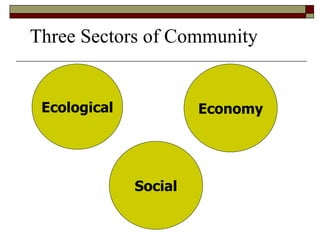
Ecological Economy Social Three Sectors of Community
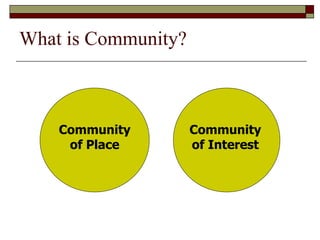
What is Community? Community of Place Community of Interest
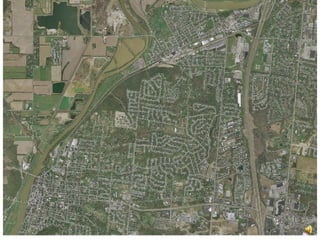
Profile of West Carrollton First ring suburb of Dayton Established 1830 Population and growth  Demographics  Current economic conditions Background that led to sustainable comp plan
 
Cornerstones of Sustainability Inclusive Long term Balances between three sectors of a community: social, environmental, economic Multi-dimensional indicators
Cornerstone #1: Inclusion Steering Committee membership Community visioning Balance within the three sectors of community
Discussion What organizations and/or groups in your community would you think to include in your comp plan process?
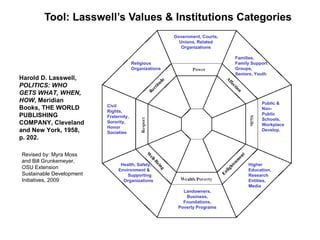
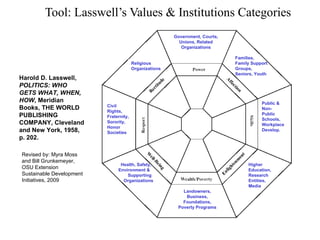
Tool: Lasswell’s Values & Institutions Categories Government, Courts, Unions, Related Organizations Health, Safety, Environment &  Supporting  Organizations Civil Rights, Fraternity, Sorority, Honor Societies Religious Organizations Families, Family Support Groups, Seniors, Youth Public & Non-Public Schools, Workplace Develop. Landowners, Business, Foundations, Poverty Programs Higher Education, Research  Entities, Media Harold D. Lasswell,  POLITICS: WHO GETS WHAT, WHEN, HOW , Meridian Books, THE WORLD PUBLISHING COMPANY, Cleveland and New York, 1958, p. 202. Revised by: Myra Moss and Bill Grunkemeyer, OSU Extension Sustainable Development Initiatives, 2009
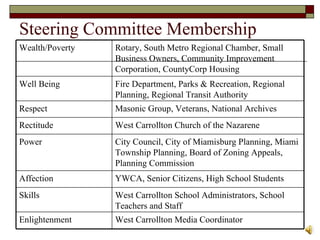
Steering Committee Membership Wealth/Poverty Rotary, South Metro Regional Chamber, Small Business Owners, Community Improvement Corporation, CountyCorp Housing Well Being Fire Department, Parks & Recreation, Regional Planning, Regional Transit Authority Respect Masonic Group, Veterans, National Archives Rectitude West Carrollton Church of the Nazarene Power City Council, City of Miamisburg Planning, Miami Township Planning, Board of Zoning Appeals, Planning Commission Affection YWCA, Senior Citizens, High School Students Skills West Carrollton School Administrators, School Teachers and Staff Enlightenment West Carrollton Media Coordinator
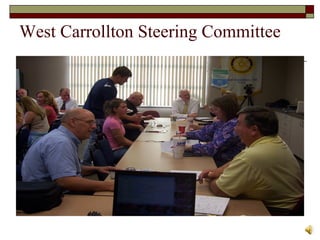
West Carrollton Steering Committee
Discussion How do residents in your community share their desires and goals in a comp planning process? Where/how do you meet to gain residents’ input?
Tool: Lasswell’s Values & Institutions Categories Government, Courts, Unions, Related Organizations Health, Safety, Environment &  Supporting  Organizations Civil Rights, Fraternity, Sorority, Honor Societies Religious Organizations Families, Family Support Groups, Seniors, Youth Public & Non-Public Schools, Workplace Develop. Landowners, Business, Foundations, Poverty Programs Higher Education, Research  Entities, Media Harold D. Lasswell,  POLITICS: WHO GETS WHAT, WHEN, HOW , Meridian Books, THE WORLD PUBLISHING COMPANY, Cleveland and New York, 1958, p. 202. Revised by: Myra Moss and Bill Grunkemeyer, OSU Extension Sustainable Development Initiatives, 2009
Visioning: Who, Where and How to Visit Determined by Steering Committee Goal: Reduce barriers to participation Technique: “Go to where people gather” Piggybacking on existing meetings and events
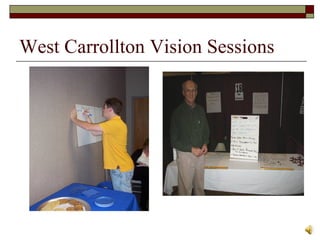
West Carrollton Vision Sessions
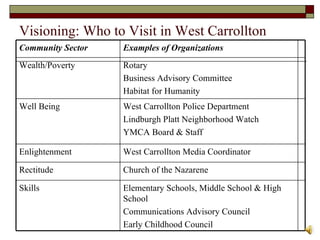
Visioning: Who to Visit in West Carrollton Community Sector  Examples of Organizations Wealth/Poverty Rotary Business Advisory Committee Habitat for Humanity Well Being West Carrollton Police Department Lindburgh Platt Neighborhood Watch YMCA Board & Staff Enlightenment West Carrollton Media Coordinator Rectitude Church of the Nazarene Skills Elementary Schools, Middle School & High School Communications Advisory Council Early Childhood Council
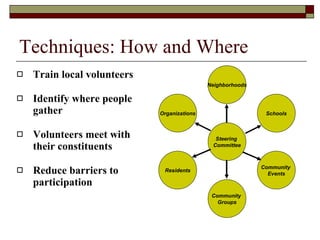
Techniques: How and Where Train local volunteers Identify where people gather Volunteers meet with their constituents Reduce barriers to participation Neighborhoods Schools Community  Events Community  Groups Residents Organizations Steering  Committee
Cornerstone #2: Long Term Consider impact of decisions made today on future generations Develop a shared vision looking 50 years into the future
Tools: Two Vision Questions What do you value about the West Carrollton community? (Identifies existing assets) What do you hope for the West Carrollton community for your grandchildren and great-grandchildren? (Identifies desired assets)
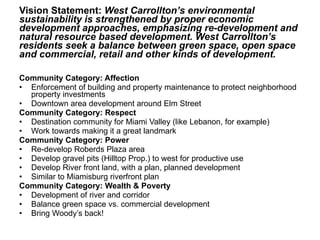
Vision Statement:  West Carrollton’s environmental sustainability is strengthened by proper economic development approaches, emphasizing re-development and natural resource based development. West Carrollton’s residents seek a balance between green space, open space and commercial, retail and other kinds of development. Community Category: Affection  Enforcement of building and property maintenance to protect neighborhood property investments Downtown area development around Elm Street Community Category: Respect Destination community for Miami Valley (like Lebanon, for example) Work towards making it a great landmark Community Category: Power Re-develop Roberds Plaza area Develop gravel pits (Hilltop Prop.) to west for productive use Develop River front land, with a plan, planned development Similar to Miamisburg riverfront plan Community Category: Wealth & Poverty Development of river and corridor Balance green space vs. commercial development Bring Woody’s back!
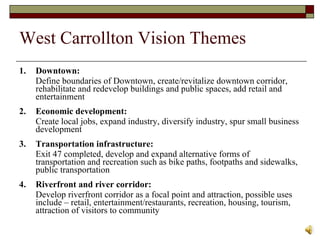
West Carrollton Vision Themes 1.  Downtown:   Define boundaries of Downtown, create/revitalize downtown corridor, rehabilitate and redevelop buildings and public spaces, add retail and entertainment 2. Economic development:  Create local jobs, expand industry, diversify industry, spur small business development 3. Transportation infrastructure:  Exit 47 completed, develop and expand alternative forms of transportation and recreation such as bike paths, footpaths and sidewalks, public transportation 4.  Riverfront and river corridor:  Develop riverfront corridor as a focal point and attraction, possible uses include – retail, entertainment/restaurants, recreation, housing, tourism, attraction of visitors to community
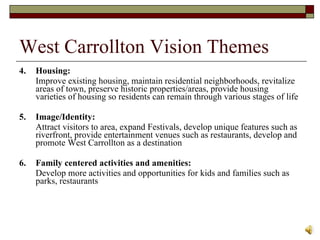
West Carrollton Vision Themes 4. Housing:   Improve existing housing, maintain residential neighborhoods, revitalize areas of town, preserve historic properties/areas, provide housing varieties of housing so residents can remain through various stages of life 5. Image/Identity:  Attract visitors to area, expand Festivals, develop unique features such as riverfront, provide entertainment venues such as restaurants, develop and promote West Carrollton as a destination 6. Family centered activities and amenities:  Develop more activities and opportunities for kids and families such as parks, restaurants
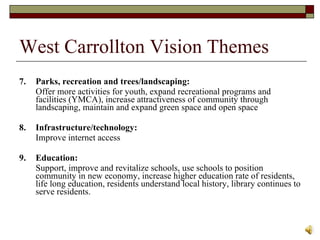
West Carrollton Vision Themes 7.  Parks, recreation and trees/landscaping:  Offer more activities for youth, expand recreational programs and facilities (YMCA), increase attractiveness of community through landscaping, maintain and expand green space and open space 8. Infrastructure/technology:  Improve internet access 9.  Education: Support, improve and revitalize schools, use schools to position community in new economy, increase higher education rate of residents, life long education, residents understand local history, library continues to serve residents.
West Carrollton Workgroups Economic Development Housing Parks & Recreation Education Community Facilities, Infrastructure & Transportation Capstone: Growth Management & Land Use
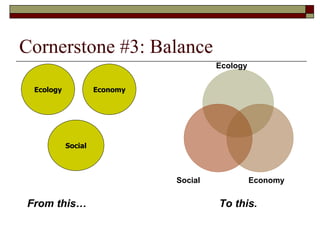
Cornerstone #3: Balance Ecology Economy Social Ecology Social Economy From this… To this.
Growth Management Section Definition of growth management Developed individual sections first to define growth management All Workgroup Chairs form Growth Management Team Added professional staff from City Outside support for technical assistance and data collection/analysis Professional staff developed the section and brought back to chairs for concurrence
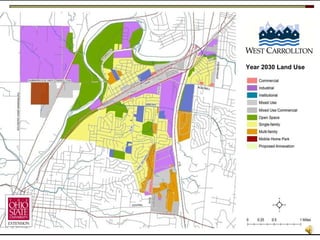
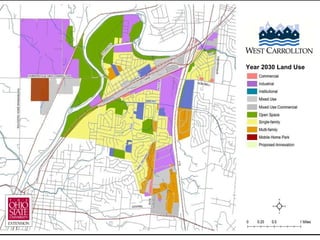
Show future land use map Year 2030 Land Use West Carrollton 2030 Year 2030 Land Use
Cornerstone #4: Multidimensional Multi-dimensionality built in at the goal prioritization stage 1. Social, economic and environmental goals linked to create “features” of the community 2. Interconnections lead to multi-disciplinary goals (features)
Growth Management Section Social, economic and environmental goals linked to identify planning areas of the community
Show future land use map Year 2030 Land Use West Carrollton 2030 Year 2030 Land Use
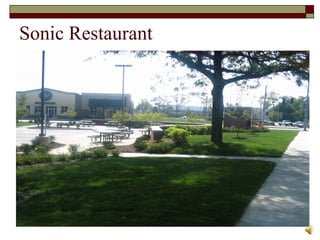
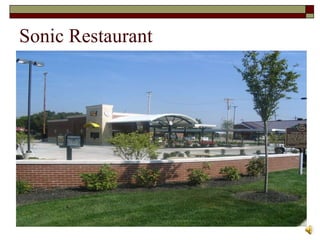
Sonic Restaurant
Sonic Restaurant
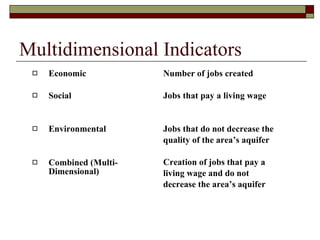
Multidimensional Indicators Economic Social Environmental Combined (Multi-Dimensional) Number of jobs created Jobs that pay a living wage Jobs that do not decrease the quality of the area’s aquifer Creation of jobs that pay a living wage and do not decrease the area’s aquifer
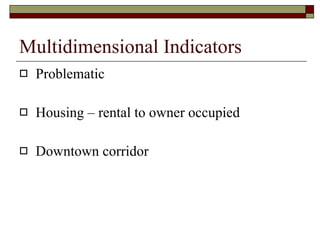
Multidimensional Indicators Problematic Housing – rental to owner occupied Downtown corridor
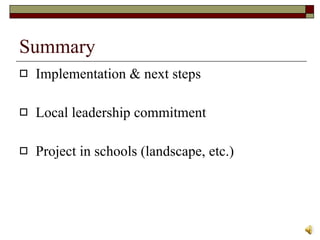
Summary Implementation & next steps Local leadership commitment Project in schools (landscape, etc.)
Contact Information Gregory Gaines, AICP, Director of City Planning, City of West Carrollton 300 East Central Avenue West Carrollton, OH 45449 [email_address] City of West Carrollton web site: http://www.westcarrollton.org/ OSU Extension Sustainable Development Initiatives web site: www.sustainabledevelopment.osu.edu Myra Moss, Educator Ohio State University Extension c/o Licking County, 771 E. Main St. Newark, OH 43055 Ph: 740.607.5177 [email_address] Bill Grunkemeyer, Specialist Ohio State University Extension OARDC, 1680 Madison Avenue Wooster, Ohio 44691 Phone: 330.263.3799 Email:  [email_address]

Building Community Buy-in Through Vision-based Comprehensive Planning

  • 1.
    Building Community Buyin through Vision-based Comprehensive Planning MORPC Educational Forum January 8, 2010 Columbus
  • 2.
    Objectives of PresentationShare comp plan model that incorporates sustainability cornerstones Demonstrate vision-based comp planning through West Carrollton case study Share tools, techniques and sources of assistance that build community buy-in
  • 3.
    Ecological Economy SocialThree Sectors of Community
  • 4.
    What is Community?Community of Place Community of Interest
  • 5.
    Profile of WestCarrollton First ring suburb of Dayton Established 1830 Population and growth Demographics Current economic conditions Background that led to sustainable comp plan
  • 6.
  • 7.
    Cornerstones of SustainabilityInclusive Long term Balances between three sectors of a community: social, environmental, economic Multi-dimensional indicators
  • 8.
    Cornerstone #1: InclusionSteering Committee membership Community visioning Balance within the three sectors of community
  • 9.
    Discussion What organizationsand/or groups in your community would you think to include in your comp plan process?
  • 10.
    Tool: Lasswell’s Values& Institutions Categories Government, Courts, Unions, Related Organizations Health, Safety, Environment & Supporting Organizations Civil Rights, Fraternity, Sorority, Honor Societies Religious Organizations Families, Family Support Groups, Seniors, Youth Public & Non-Public Schools, Workplace Develop. Landowners, Business, Foundations, Poverty Programs Higher Education, Research Entities, Media Harold D. Lasswell, POLITICS: WHO GETS WHAT, WHEN, HOW , Meridian Books, THE WORLD PUBLISHING COMPANY, Cleveland and New York, 1958, p. 202. Revised by: Myra Moss and Bill Grunkemeyer, OSU Extension Sustainable Development Initiatives, 2009
  • 11.
    Steering Committee MembershipWealth/Poverty Rotary, South Metro Regional Chamber, Small Business Owners, Community Improvement Corporation, CountyCorp Housing Well Being Fire Department, Parks & Recreation, Regional Planning, Regional Transit Authority Respect Masonic Group, Veterans, National Archives Rectitude West Carrollton Church of the Nazarene Power City Council, City of Miamisburg Planning, Miami Township Planning, Board of Zoning Appeals, Planning Commission Affection YWCA, Senior Citizens, High School Students Skills West Carrollton School Administrators, School Teachers and Staff Enlightenment West Carrollton Media Coordinator
  • 12.
  • 13.
    Discussion How doresidents in your community share their desires and goals in a comp planning process? Where/how do you meet to gain residents’ input?
  • 14.
    Tool: Lasswell’s Values& Institutions Categories Government, Courts, Unions, Related Organizations Health, Safety, Environment & Supporting Organizations Civil Rights, Fraternity, Sorority, Honor Societies Religious Organizations Families, Family Support Groups, Seniors, Youth Public & Non-Public Schools, Workplace Develop. Landowners, Business, Foundations, Poverty Programs Higher Education, Research Entities, Media Harold D. Lasswell, POLITICS: WHO GETS WHAT, WHEN, HOW , Meridian Books, THE WORLD PUBLISHING COMPANY, Cleveland and New York, 1958, p. 202. Revised by: Myra Moss and Bill Grunkemeyer, OSU Extension Sustainable Development Initiatives, 2009
  • 15.
    Visioning: Who, Whereand How to Visit Determined by Steering Committee Goal: Reduce barriers to participation Technique: “Go to where people gather” Piggybacking on existing meetings and events
  • 16.
  • 17.
    Visioning: Who toVisit in West Carrollton Community Sector Examples of Organizations Wealth/Poverty Rotary Business Advisory Committee Habitat for Humanity Well Being West Carrollton Police Department Lindburgh Platt Neighborhood Watch YMCA Board & Staff Enlightenment West Carrollton Media Coordinator Rectitude Church of the Nazarene Skills Elementary Schools, Middle School & High School Communications Advisory Council Early Childhood Council
  • 18.
    Techniques: How andWhere Train local volunteers Identify where people gather Volunteers meet with their constituents Reduce barriers to participation Neighborhoods Schools Community Events Community Groups Residents Organizations Steering Committee
  • 19.
    Cornerstone #2: LongTerm Consider impact of decisions made today on future generations Develop a shared vision looking 50 years into the future
  • 20.
    Tools: Two VisionQuestions What do you value about the West Carrollton community? (Identifies existing assets) What do you hope for the West Carrollton community for your grandchildren and great-grandchildren? (Identifies desired assets)
  • 21.
    Vision Statement: West Carrollton’s environmental sustainability is strengthened by proper economic development approaches, emphasizing re-development and natural resource based development. West Carrollton’s residents seek a balance between green space, open space and commercial, retail and other kinds of development. Community Category: Affection Enforcement of building and property maintenance to protect neighborhood property investments Downtown area development around Elm Street Community Category: Respect Destination community for Miami Valley (like Lebanon, for example) Work towards making it a great landmark Community Category: Power Re-develop Roberds Plaza area Develop gravel pits (Hilltop Prop.) to west for productive use Develop River front land, with a plan, planned development Similar to Miamisburg riverfront plan Community Category: Wealth & Poverty Development of river and corridor Balance green space vs. commercial development Bring Woody’s back!
  • 22.
    West Carrollton VisionThemes 1. Downtown: Define boundaries of Downtown, create/revitalize downtown corridor, rehabilitate and redevelop buildings and public spaces, add retail and entertainment 2. Economic development: Create local jobs, expand industry, diversify industry, spur small business development 3. Transportation infrastructure: Exit 47 completed, develop and expand alternative forms of transportation and recreation such as bike paths, footpaths and sidewalks, public transportation 4. Riverfront and river corridor: Develop riverfront corridor as a focal point and attraction, possible uses include – retail, entertainment/restaurants, recreation, housing, tourism, attraction of visitors to community
  • 23.
    West Carrollton VisionThemes 4. Housing: Improve existing housing, maintain residential neighborhoods, revitalize areas of town, preserve historic properties/areas, provide housing varieties of housing so residents can remain through various stages of life 5. Image/Identity: Attract visitors to area, expand Festivals, develop unique features such as riverfront, provide entertainment venues such as restaurants, develop and promote West Carrollton as a destination 6. Family centered activities and amenities: Develop more activities and opportunities for kids and families such as parks, restaurants
  • 24.
    West Carrollton VisionThemes 7. Parks, recreation and trees/landscaping: Offer more activities for youth, expand recreational programs and facilities (YMCA), increase attractiveness of community through landscaping, maintain and expand green space and open space 8. Infrastructure/technology: Improve internet access 9. Education: Support, improve and revitalize schools, use schools to position community in new economy, increase higher education rate of residents, life long education, residents understand local history, library continues to serve residents.
  • 25.
    West Carrollton WorkgroupsEconomic Development Housing Parks & Recreation Education Community Facilities, Infrastructure & Transportation Capstone: Growth Management & Land Use
  • 26.
    Cornerstone #3: BalanceEcology Economy Social Ecology Social Economy From this… To this.
  • 27.
    Growth Management SectionDefinition of growth management Developed individual sections first to define growth management All Workgroup Chairs form Growth Management Team Added professional staff from City Outside support for technical assistance and data collection/analysis Professional staff developed the section and brought back to chairs for concurrence
  • 28.
    Show future landuse map Year 2030 Land Use West Carrollton 2030 Year 2030 Land Use
  • 29.
    Cornerstone #4: MultidimensionalMulti-dimensionality built in at the goal prioritization stage 1. Social, economic and environmental goals linked to create “features” of the community 2. Interconnections lead to multi-disciplinary goals (features)
  • 30.
    Growth Management SectionSocial, economic and environmental goals linked to identify planning areas of the community
  • 31.
    Show future landuse map Year 2030 Land Use West Carrollton 2030 Year 2030 Land Use
  • 32.
  • 33.
  • 34.
    Multidimensional Indicators EconomicSocial Environmental Combined (Multi-Dimensional) Number of jobs created Jobs that pay a living wage Jobs that do not decrease the quality of the area’s aquifer Creation of jobs that pay a living wage and do not decrease the area’s aquifer
  • 35.
    Multidimensional Indicators ProblematicHousing – rental to owner occupied Downtown corridor
  • 36.
    Summary Implementation &next steps Local leadership commitment Project in schools (landscape, etc.)
  • 37.
    Contact Information GregoryGaines, AICP, Director of City Planning, City of West Carrollton 300 East Central Avenue West Carrollton, OH 45449 [email_address] City of West Carrollton web site: http://www.westcarrollton.org/ OSU Extension Sustainable Development Initiatives web site: www.sustainabledevelopment.osu.edu Myra Moss, Educator Ohio State University Extension c/o Licking County, 771 E. Main St. Newark, OH 43055 Ph: 740.607.5177 [email_address] Bill Grunkemeyer, Specialist Ohio State University Extension OARDC, 1680 Madison Avenue Wooster, Ohio 44691 Phone: 330.263.3799 Email: [email_address]

Editor's Notes

  • #6 Greg
  • #7 Greg
  • #12 Greg
  • #13 Greg
  • #17 Greg
  • #18 Greg
  • #23 Greg
  • #24 Greg
  • #25 Greg Themes: Downtown & Riverfront and River Corridor were so critical that they needed to be included in a number of different workgroups: infrastructure & transportation, parks and rec., economic development, housing
  • #29 Greg
  • #33 Greg
  • #34 Greg
  • #37 All three of us Design Standards Landscaping projects Questions?