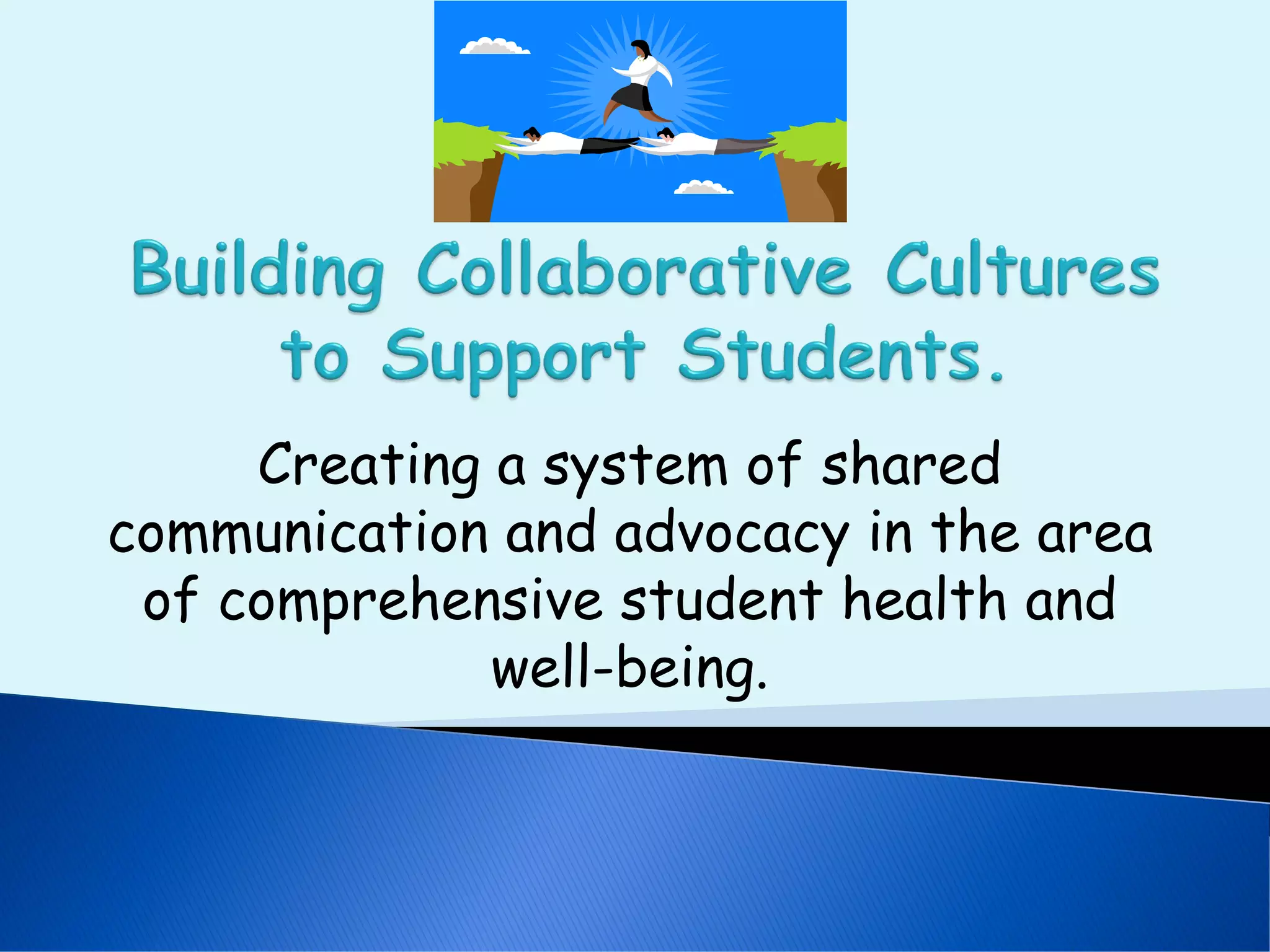
Creating a system of shared
communication and advocacy in the area
of comprehensive student health and
well-being.
The American School Counselor Association
Center for School Mental Health,
IDEA Partnership,
National Association for School Psychologists,
and American Council for School Social Work
developed the “Building Collaborative Cultures”
Practice Group as a part of the
National Community of Practice
on School Behavioral Health.
•Establish connections across groups.
•Build representation from states, agencies,
national organizations, technical assistance
providers and other stakeholder groups.
•Establish routine communication.
•Identify shared interests across
stakeholder groups.
• Articulate the issues that might be the
foundation for groups as collaborative
focus.
• Build an infrastructure that helps
individuals and groups doing related work
find each other and begin to collaborate.
By Building a Collaborative Culture to support
student health and well-being, stakeholders are
most able to:
• partner as leaders in systemic change
• ensure equity and access
• promote academic, career and personal,
and social development for every
student
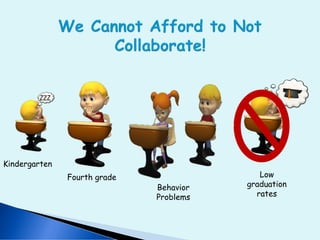
Kindergarten
Fourth grade
Behavior
Problems
Low
graduation
rates
 School Psychologists
 Special Educators
 School Counselors
 Contracted School Based Mental Health Providers
 School Nurses
 School Social Workers
 School Administrators
 Regular Education Teachers
 Juvenile Justice Professionals
 Medical Professional Partners
 Substance Use Agency Partners
“ How do we move from “expert driven”
one student at a time,
reactive approaches
to building capacity within schools
to support all students?”
Lucille Eber
Many people have wondered. . .
What do ALL these
professionals that work with
students do?
Do the different professionals even understand
what each stakeholder does or offers?
 Lack of legitimization.
 Lack of consistent identity.
 Limited or no involvement in reform
movements.
 Variation in roles from state to state and
site to site.
 Mis-assumptions and territorialism among
the helping professionals themselves.
 National School Psychologist Association:
 American Council for School Social Workers
 American School Counseling Association
 IDEA Partnership
 National Association of Elementary School Principals
 National Association of Secondary School Principals
 Center for School Mental Health
 National Association of School Nurses
 Office of Juvenile Justice and Delinquency
Prevention
What is a School Psychologist?
 School psychologists are highly trained in both psychology
and education, completing a minimum of a specialist-level
degree program (at least 60 graduate semester hours) that
includes a year-long supervised internship.
 NASP Practice Model: Improving outcomes for
students and schools by:
 Improve Academic Engagement and Achievement
 Facilitate Effective Instruction
 Support Positive Behavior and Socially Successful Students
 Support Diverse Learners
 Create Safe, Positive School Climates
Website: http://www.nasponline.org/index.aspx
Who are school social workers?
◦ School social workers are pupil services professionals who
generally hold a masters degree in social work and who have
unique training and experience specific to working in schools
and/or with children.
 How do school social workers assist students?
◦ School social workers provide an ecological approach to
insuring student success. They assist children and families by
examining those factors in the home, school and/or community
that are impacting a student’s educational success and then
assist in reducing those barriers to learning.
 Website: http://acssw.org/aboutschool.html
The Role of the Professional School Counselor
◦ Professional school counselors are certified/licensed
educators with a minimum of a master’s degree in school
counseling.
ASCA National Model
◦ Focused on students’ academic, personal/social and career
development needs by designing, implementing, evaluating and
enhancing a comprehensive school counseling program that
promotes and enhances student success.
◦ Video Overview:
http://www.schooltube.com/video/bfedcdeb28ad6966016f/
How-School-Counselors-Contribute-to-Student-Success
Website: http://www.schoolcounselor.org/
What is the IDEA Partnership?
◦ The IDEA Partnership reflects the collaborative work of
more than 50 national organizations, technical assistance
providers, and organizations and agencies at state and local
level.
◦ Together with the Office of Special Education Programs
(OSEP), the Partner Organizations form a community with the
potential to transform the way we work and improve outcomes
for students and youth with disabilities.
Communities of Practice
◦ A Community of Practice (CoP) is quite simply a group of
people that agree to interact regularly to solve a persistent
problem or improve practice in an area that is important to
them.
Website: http://www.ideapartnership.org/
Who We Are
◦ The National Association of Elementary School Principals
(NAESP), founded in 1921, is a professional organization
serving elementary and middle school principals and other
education leaders throughout the United States, Canada, and
overseas.
Our Vision
 The Association believes that the progress and well-being of
the individual child must be at the forefront of all elementary
and middle-school planning and operations. Further, NAESP
supports elementary and middle-level principals as the primary
catalyst for creating a lasting foundation for learning, driving
school and student performance, and shaping the long-term
impact of school improvement efforts.
 Website: http://www.naesp.org/about
Who We Are:
◦ NASSP works to provide school leaders with the information
and resources they need to address the many challenges in
today's schools.
Breaking Ranks Framework
 What Needs to Improve?
Regardless of grade level, all schools must address the
three core areas of collaborative leadership (CL);
personalizing your school environment (PER); and curriculum,
instruction, and assessment to improve student
performance (CIA). Only by addressing each of these three
overlapping areas can improved student performance occur.
Website: http://www.nassp.org/
Who is the Center for Mental Health?
◦ The CSMH is an energetic and committed team, including
youth and families, educators, social workers, psychologists,
licensed professional counselors, psychiatrists, graduate
students, postdoctoral fellows, administrative staff, and
other health and mental health staff.
What is Expanded School Mental Health?
◦ We use the term "expanded school mental health" (ESMH) to
describe what we believe are the core elements of effective
school mental health programs. ESMH programs are
developed through partnerships between schools and
community agencies to move toward a full continuum of
effective mental health promotion, early intervention, and
treatment for youth in general and special education.
◦ Website: http://csmh.umaryland.edu/
About NASN
 Mission: The National Association of School Nurses (NASN)
advances the specialty practice of school nursing to improve the
health and academic success of all students.
 Vision: NASN is the indispensable resource to the global health
community.
 Core Goal: Every child has a school nurse, all day, every day.
 Core Values:
 Scholarship
Excellence
Integrity
Collegiality
Diversity
Collaboration
 Website: http://www.nasn.org/
About OJJDP
 OJJDP collaborates with professionals from diverse disciplines to
improve juvenile justice policies and practices.
 OJJDP, a component of the Office of Justice Programs, U.S.
Department of Justice, accomplishes its mission by supporting states,
local communities, and tribal jurisdictions in their efforts to develop
and implement effective programs for juveniles.
 The Office strives to strengthen the juvenile justice system's efforts
to protect public safety, hold offenders accountable, and provide
services that address the needs of youth and their families.
 Through its components, OJJDP sponsors research, program, and
training initiatives; develops priorities and goals and sets policies to
guide federal juvenile justice issues; disseminates information about
juvenile justice issues; and awards funds to states to support local
programming.
◦ Website: http://www.ojjdp.gov/
School leaders, school staff
individual agency partners,
parents, and community members
may feel their agenda
ought to be the priority of each group.
The results often lead to confusion
and criticisms.
(Carolyn Maddy Bernstein, 1995)
When school systems fail to
clearly understand and define
stakeholder roles:
“We need to be the change
we want to see happen.
We are the leaders
we have been waiting for.”
– Gandhi
 The primary purpose to promote the active
exchange of ideas and collaboration between
school employed and community employed
partners.
 With a focus on having positive impact by
working together to create and sustain a
better informed and skilled team of
professionals to address the needs of students
and their families.
“What do ALL these
professionals do?”
The new question is…
“How are students doing better
because we have so many
professionals working together?”
o College and Career Readiness
o Positive Behavior Intervention and
Support
o RTI/MTSS: Response to
Intervention/Multi-tiered Systems of
Support
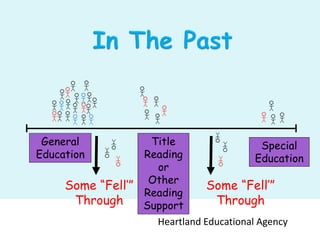
General
Education
Title
Reading
or
Other
Reading
Support
Special
Education
Some “Fell’”
Through
Some “Fell’”
Through
Heartland Educational Agency
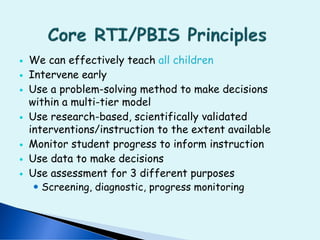
 We can effectively teach all children
 Intervene early
 Use a problem-solving method to make decisions
within a multi-tier model
 Use research-based, scientifically validated
interventions/instruction to the extent available
 Monitor student progress to inform instruction
 Use data to make decisions
 Use assessment for 3 different purposes
 Screening, diagnostic, progress monitoring
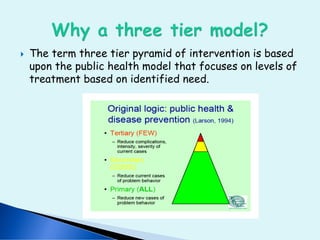
 The term three tier pyramid of intervention is based
upon the public health model that focuses on levels of
treatment based on identified need.
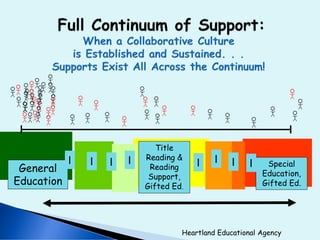
General
Education
Title
Reading &
Reading
Support,
Gifted Ed.
Special
Education,
Gifted Ed.
IIIIIIII
Heartland Educational Agency
Will help you to:
 Know immediately, “Is what we are doing working?”
 Know which students need more/different
 Know what each student needs
 Provide structures to deliver what students need
 Reduce rates of identification of student learning disabilities
 Prevent reading problems before they occur
 Raise student achievement
 Heartland Educational Agency
School Based Professionals
Work Together
to Positively Impact Students
In and Out of the Classroom!
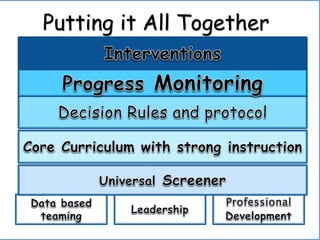
Putting it All Together
All this will not be finished in the first one
hundred days. Nor will it be finished in the
first thousand days, nor in the life of this
administration, nor even perhaps in our
lifetime on this planet.
– John F. Kennedy
But let us begin.

Building Collaborative Cultures Presentation

  • 1.
    Creating a systemof shared communication and advocacy in the area of comprehensive student health and well-being.
  • 2.
    The American SchoolCounselor Association Center for School Mental Health, IDEA Partnership, National Association for School Psychologists, and American Council for School Social Work developed the “Building Collaborative Cultures” Practice Group as a part of the National Community of Practice on School Behavioral Health.
  • 3.
    •Establish connections acrossgroups. •Build representation from states, agencies, national organizations, technical assistance providers and other stakeholder groups. •Establish routine communication. •Identify shared interests across stakeholder groups.
  • 4.
    • Articulate theissues that might be the foundation for groups as collaborative focus. • Build an infrastructure that helps individuals and groups doing related work find each other and begin to collaborate.
  • 5.
    By Building aCollaborative Culture to support student health and well-being, stakeholders are most able to: • partner as leaders in systemic change • ensure equity and access • promote academic, career and personal, and social development for every student
  • 6.
  • 7.
     School Psychologists Special Educators  School Counselors  Contracted School Based Mental Health Providers  School Nurses  School Social Workers  School Administrators  Regular Education Teachers  Juvenile Justice Professionals  Medical Professional Partners  Substance Use Agency Partners
  • 8.
    “ How dowe move from “expert driven” one student at a time, reactive approaches to building capacity within schools to support all students?” Lucille Eber
  • 9.
    Many people havewondered. . . What do ALL these professionals that work with students do? Do the different professionals even understand what each stakeholder does or offers?
  • 10.
     Lack oflegitimization.  Lack of consistent identity.  Limited or no involvement in reform movements.  Variation in roles from state to state and site to site.  Mis-assumptions and territorialism among the helping professionals themselves.
  • 11.
     National SchoolPsychologist Association:  American Council for School Social Workers  American School Counseling Association  IDEA Partnership  National Association of Elementary School Principals  National Association of Secondary School Principals  Center for School Mental Health  National Association of School Nurses  Office of Juvenile Justice and Delinquency Prevention
  • 12.
    What is aSchool Psychologist?  School psychologists are highly trained in both psychology and education, completing a minimum of a specialist-level degree program (at least 60 graduate semester hours) that includes a year-long supervised internship.  NASP Practice Model: Improving outcomes for students and schools by:  Improve Academic Engagement and Achievement  Facilitate Effective Instruction  Support Positive Behavior and Socially Successful Students  Support Diverse Learners  Create Safe, Positive School Climates Website: http://www.nasponline.org/index.aspx
  • 13.
    Who are schoolsocial workers? ◦ School social workers are pupil services professionals who generally hold a masters degree in social work and who have unique training and experience specific to working in schools and/or with children.  How do school social workers assist students? ◦ School social workers provide an ecological approach to insuring student success. They assist children and families by examining those factors in the home, school and/or community that are impacting a student’s educational success and then assist in reducing those barriers to learning.  Website: http://acssw.org/aboutschool.html
  • 14.
    The Role ofthe Professional School Counselor ◦ Professional school counselors are certified/licensed educators with a minimum of a master’s degree in school counseling. ASCA National Model ◦ Focused on students’ academic, personal/social and career development needs by designing, implementing, evaluating and enhancing a comprehensive school counseling program that promotes and enhances student success. ◦ Video Overview: http://www.schooltube.com/video/bfedcdeb28ad6966016f/ How-School-Counselors-Contribute-to-Student-Success Website: http://www.schoolcounselor.org/
  • 15.
    What is theIDEA Partnership? ◦ The IDEA Partnership reflects the collaborative work of more than 50 national organizations, technical assistance providers, and organizations and agencies at state and local level. ◦ Together with the Office of Special Education Programs (OSEP), the Partner Organizations form a community with the potential to transform the way we work and improve outcomes for students and youth with disabilities. Communities of Practice ◦ A Community of Practice (CoP) is quite simply a group of people that agree to interact regularly to solve a persistent problem or improve practice in an area that is important to them. Website: http://www.ideapartnership.org/
  • 16.
    Who We Are ◦The National Association of Elementary School Principals (NAESP), founded in 1921, is a professional organization serving elementary and middle school principals and other education leaders throughout the United States, Canada, and overseas. Our Vision  The Association believes that the progress and well-being of the individual child must be at the forefront of all elementary and middle-school planning and operations. Further, NAESP supports elementary and middle-level principals as the primary catalyst for creating a lasting foundation for learning, driving school and student performance, and shaping the long-term impact of school improvement efforts.  Website: http://www.naesp.org/about
  • 17.
    Who We Are: ◦NASSP works to provide school leaders with the information and resources they need to address the many challenges in today's schools. Breaking Ranks Framework  What Needs to Improve? Regardless of grade level, all schools must address the three core areas of collaborative leadership (CL); personalizing your school environment (PER); and curriculum, instruction, and assessment to improve student performance (CIA). Only by addressing each of these three overlapping areas can improved student performance occur. Website: http://www.nassp.org/
  • 18.
    Who is theCenter for Mental Health? ◦ The CSMH is an energetic and committed team, including youth and families, educators, social workers, psychologists, licensed professional counselors, psychiatrists, graduate students, postdoctoral fellows, administrative staff, and other health and mental health staff. What is Expanded School Mental Health? ◦ We use the term "expanded school mental health" (ESMH) to describe what we believe are the core elements of effective school mental health programs. ESMH programs are developed through partnerships between schools and community agencies to move toward a full continuum of effective mental health promotion, early intervention, and treatment for youth in general and special education. ◦ Website: http://csmh.umaryland.edu/
  • 19.
    About NASN  Mission:The National Association of School Nurses (NASN) advances the specialty practice of school nursing to improve the health and academic success of all students.  Vision: NASN is the indispensable resource to the global health community.  Core Goal: Every child has a school nurse, all day, every day.  Core Values:  Scholarship Excellence Integrity Collegiality Diversity Collaboration  Website: http://www.nasn.org/
  • 20.
    About OJJDP  OJJDPcollaborates with professionals from diverse disciplines to improve juvenile justice policies and practices.  OJJDP, a component of the Office of Justice Programs, U.S. Department of Justice, accomplishes its mission by supporting states, local communities, and tribal jurisdictions in their efforts to develop and implement effective programs for juveniles.  The Office strives to strengthen the juvenile justice system's efforts to protect public safety, hold offenders accountable, and provide services that address the needs of youth and their families.  Through its components, OJJDP sponsors research, program, and training initiatives; develops priorities and goals and sets policies to guide federal juvenile justice issues; disseminates information about juvenile justice issues; and awards funds to states to support local programming. ◦ Website: http://www.ojjdp.gov/
  • 21.
    School leaders, schoolstaff individual agency partners, parents, and community members may feel their agenda ought to be the priority of each group. The results often lead to confusion and criticisms. (Carolyn Maddy Bernstein, 1995) When school systems fail to clearly understand and define stakeholder roles:
  • 22.
    “We need tobe the change we want to see happen. We are the leaders we have been waiting for.” – Gandhi
  • 23.
     The primarypurpose to promote the active exchange of ideas and collaboration between school employed and community employed partners.  With a focus on having positive impact by working together to create and sustain a better informed and skilled team of professionals to address the needs of students and their families.
  • 24.
    “What do ALLthese professionals do?” The new question is… “How are students doing better because we have so many professionals working together?”
  • 25.
    o College andCareer Readiness o Positive Behavior Intervention and Support o RTI/MTSS: Response to Intervention/Multi-tiered Systems of Support
  • 26.
  • 27.
     We caneffectively teach all children  Intervene early  Use a problem-solving method to make decisions within a multi-tier model  Use research-based, scientifically validated interventions/instruction to the extent available  Monitor student progress to inform instruction  Use data to make decisions  Use assessment for 3 different purposes  Screening, diagnostic, progress monitoring
  • 28.
     The termthree tier pyramid of intervention is based upon the public health model that focuses on levels of treatment based on identified need.
  • 29.
  • 30.
    Will help youto:  Know immediately, “Is what we are doing working?”  Know which students need more/different  Know what each student needs  Provide structures to deliver what students need  Reduce rates of identification of student learning disabilities  Prevent reading problems before they occur  Raise student achievement  Heartland Educational Agency
  • 31.
    School Based Professionals WorkTogether to Positively Impact Students In and Out of the Classroom!
  • 32.
  • 33.
    All this willnot be finished in the first one hundred days. Nor will it be finished in the first thousand days, nor in the life of this administration, nor even perhaps in our lifetime on this planet. – John F. Kennedy But let us begin.