An API-led approach to integrating with core systems
APIs for Core Systems
An API-led approach to integrating with core
systems
APIs for Core Systems
Copyright © 2017 Deloitte Development LLC. All rights reserved.
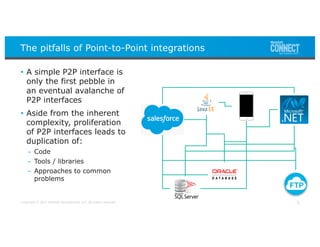
• A simple P2P interface is
only the first pebble in
an eventual avalanche of
P2P interfaces
• Aside from the inherent
complexity, proliferation
of P2P interfaces leads to
duplication of:
– Code
– Tools / libraries
– Approaches to common
problems
The pitfalls of Point-to-Point integrations
3
• A simple P2P interface is
only the first pebble in
an eventual avalanche of
P2P interfaces
Copyright © 2017 Deloitte Development LLC. All rights reserved.
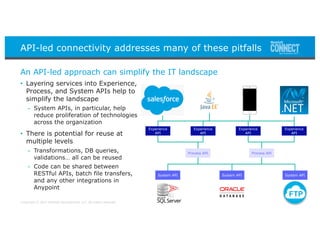
An API-led approach can simplify the IT landscape
API-led connectivity addresses many of these pitfalls
4
• Layering services into Experience,
Process, and System APIs help to
simplify the landscape
– System APIs, in particular, help
reduce proliferation of technologies
across the organization
• There is potential for reuse at
multiple levels
– Transformations, DB queries,
validations… all can be reused
– Code can be shared between
RESTful APIs, batch file transfers,
and any other integrations in
Anypoint
Experience
API
Experience
API
Experience
API
System API System API System API
Experience
API
Process API Process API
Copyright © 2017 Deloitte Development LLC. All rights reserved.
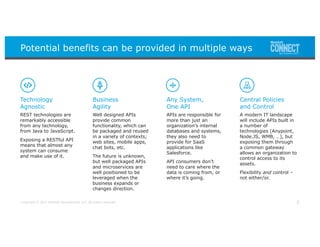
Potential benefits can be provided in multiple ways
5
Technology
Agnostic
Business
Agility
Any System,
One API
Central Policies
and Control
REST technologies are
remarkably accessible
from any technology,
from Java to JavaScript.
Exposing a RESTful API
means that almost any
system can consume
and make use of it.
Well designed APIs
provide common
functionality, which can
be packaged and reused
in a variety of contexts;
web sites, mobile apps,
chat bots, etc.
The future is unknown,
but well packaged APIs
and microservices are
well positioned to be
leveraged when the
business expands or
changes direction.
APIs are responsible for
more than just an
organization’s internal
databases and systems,
they also need to
provide for SaaS
applications like
Salesforce.
API consumers don’t
need to care where the
data is coming from, or
where it’s going.
A modern IT landscape
will include APIs built in
a number of
technologies (Anypoint,
Node.JS, WMB, …), but
exposing them through
a common gateway
allows an organization to
control access to its
assets.
Flexibility and control –
not either/or.
Copyright © 2017 Deloitte Development LLC. All rights reserved.
… and it all has to be agile
6
• Development cycles get faster and faster
• The more an organization starts to adopt Agile techniques, the more
the tools need to support the pipeline
• Anypoint is easily plugged into a DevOps pipeline, and supports
robust testing tools (e.g. MUnit)
– It's not just development that gets sped up, it's the entire lifecycle, from ideation
to implementation to support
Demonstration
System APIs for databases
Copyright © 2017 Deloitte Development LLC. All rights reserved.
Customers and Products
8
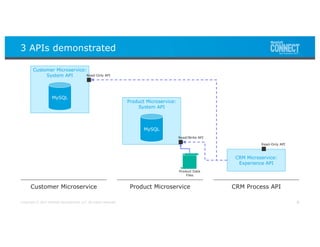
• This example leverages two systems: the systems of record for
Customers and for Products
• The systems use different back-end technologies, but these details
are hidden behind the System APIs
• Information is tied together by a Process API, which leverages the
two System APIs
Copyright © 2017 Deloitte Development LLC. All rights reserved.
3 APIs demonstrated
9
Customer Microservice Product Microservice CRM Process API
Customer Microservice:
System API
MySQL
Read-Only API
Product Microservice:
System API
MySQL
Read/Write API
Product Data
Files
CRM Microservice:
Experience API
Read-Only API
Questions?
Thank you!
Deloitte refers to one or more of Deloitte Touche Tohmatsu Limited, a UK private company limited by guarantee (“DTTL”), its network of member firms, and their
related entities. DTTL and each of its member firms are legally separate and independent entities. DTTL (also referred to as “Deloitte Global”) does not provide
services to clients. In the United States, Deloitte refers to one or more of the US member firms of DTTL, their related entities that operate using the “Deloitte”
name in the United States and their respective affiliates. Certain services may not be available to attest clients under the rules and regulations of public
accounting. Please see www.deloitte.com/about to learn more about our global network of member firms.

Building APIs for Core Systems with Anypoint Platform

  • 1.
    An API-led approachto integrating with core systems APIs for Core Systems
  • 2.
    An API-led approachto integrating with core systems APIs for Core Systems
  • 3.
    Copyright © 2017Deloitte Development LLC. All rights reserved. • A simple P2P interface is only the first pebble in an eventual avalanche of P2P interfaces • Aside from the inherent complexity, proliferation of P2P interfaces leads to duplication of: – Code – Tools / libraries – Approaches to common problems The pitfalls of Point-to-Point integrations 3 • A simple P2P interface is only the first pebble in an eventual avalanche of P2P interfaces
  • 4.
    Copyright © 2017Deloitte Development LLC. All rights reserved. An API-led approach can simplify the IT landscape API-led connectivity addresses many of these pitfalls 4 • Layering services into Experience, Process, and System APIs help to simplify the landscape – System APIs, in particular, help reduce proliferation of technologies across the organization • There is potential for reuse at multiple levels – Transformations, DB queries, validations… all can be reused – Code can be shared between RESTful APIs, batch file transfers, and any other integrations in Anypoint Experience API Experience API Experience API System API System API System API Experience API Process API Process API
  • 5.
    Copyright © 2017Deloitte Development LLC. All rights reserved. Potential benefits can be provided in multiple ways 5 Technology Agnostic Business Agility Any System, One API Central Policies and Control REST technologies are remarkably accessible from any technology, from Java to JavaScript. Exposing a RESTful API means that almost any system can consume and make use of it. Well designed APIs provide common functionality, which can be packaged and reused in a variety of contexts; web sites, mobile apps, chat bots, etc. The future is unknown, but well packaged APIs and microservices are well positioned to be leveraged when the business expands or changes direction. APIs are responsible for more than just an organization’s internal databases and systems, they also need to provide for SaaS applications like Salesforce. API consumers don’t need to care where the data is coming from, or where it’s going. A modern IT landscape will include APIs built in a number of technologies (Anypoint, Node.JS, WMB, …), but exposing them through a common gateway allows an organization to control access to its assets. Flexibility and control – not either/or.
  • 6.
    Copyright © 2017Deloitte Development LLC. All rights reserved. … and it all has to be agile 6 • Development cycles get faster and faster • The more an organization starts to adopt Agile techniques, the more the tools need to support the pipeline • Anypoint is easily plugged into a DevOps pipeline, and supports robust testing tools (e.g. MUnit) – It's not just development that gets sped up, it's the entire lifecycle, from ideation to implementation to support
  • 7.
  • 8.
    Copyright © 2017Deloitte Development LLC. All rights reserved. Customers and Products 8 • This example leverages two systems: the systems of record for Customers and for Products • The systems use different back-end technologies, but these details are hidden behind the System APIs • Information is tied together by a Process API, which leverages the two System APIs
  • 9.
    Copyright © 2017Deloitte Development LLC. All rights reserved. 3 APIs demonstrated 9 Customer Microservice Product Microservice CRM Process API Customer Microservice: System API MySQL Read-Only API Product Microservice: System API MySQL Read/Write API Product Data Files CRM Microservice: Experience API Read-Only API
  • 10.
  • 11.
    Thank you! Deloitte refersto one or more of Deloitte Touche Tohmatsu Limited, a UK private company limited by guarantee (“DTTL”), its network of member firms, and their related entities. DTTL and each of its member firms are legally separate and independent entities. DTTL (also referred to as “Deloitte Global”) does not provide services to clients. In the United States, Deloitte refers to one or more of the US member firms of DTTL, their related entities that operate using the “Deloitte” name in the United States and their respective affiliates. Certain services may not be available to attest clients under the rules and regulations of public accounting. Please see www.deloitte.com/about to learn more about our global network of member firms.