Building an Observability
platform with ClickHouse
Ankit Nayan (CTO, SigNoz)
https://github.com/SigNoz/signoz
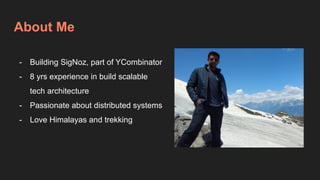
About Me
- Building SigNoz, part of YCombinator
- 8 yrs experience in build scalable
tech architecture
- Passionate about distributed systems
- Love Himalayas and trekking
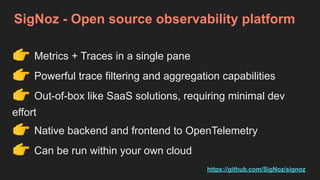
SigNoz - Open source observability platform
👉 Metrics + Traces in a single pane
👉 Powerful trace filtering and aggregation capabilities
👉 Out-of-box like SaaS solutions, requiring minimal dev
effort
👉 Native backend and frontend to OpenTelemetry
👉 Can be run within your own cloud
https://github.com/SigNoz/signoz
Quick Demo
https://github.com/SigNoz/signoz
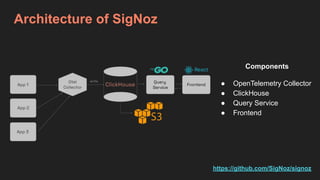
Architecture of SigNoz
Components
● OpenTelemetry Collector
● ClickHouse
● Query Service
● Frontend
https://github.com/SigNoz/signoz
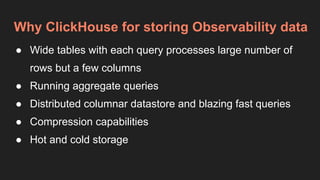
Why ClickHouse for storing Observability data
● Wide tables with each query processes large number of
rows but a few columns
● Running aggregate queries
● Distributed columnar datastore and blazing fast queries
● Compression capabilities
● Hot and cold storage
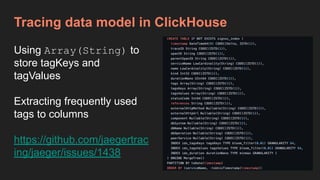
Tracing data model in ClickHouse
Using Array(String) to
store tagKeys and
tagValues
Extracting frequently used
tags to columns
https://github.com/jaegertrac
ing/jaeger/issues/1438
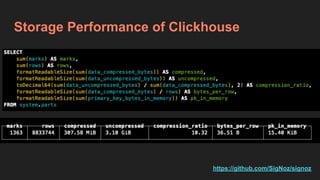
Storage Performance of Clickhouse
https://github.com/SigNoz/signoz
ClickHouse for Logs Management at Uber
[1] https://eng.uber.com/logging/
Comparison with Elastic
● A single ClickHouse node could
ingest 300K logs per second, 10x
a single ES node
● >80% queries are aggregation
queries, such as terms, histogram
and percentile aggregations.
Elastic is not designed to support
fast aggregation
[1] https://eng.uber.com/logging/
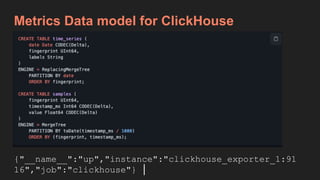
Metrics Data model for ClickHouse
{"__name__":"up","instance":"clickhouse_exporter_1:91
16","job":"clickhouse"} │
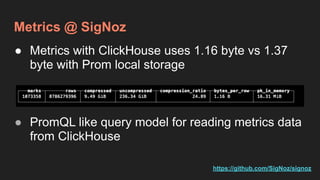
Metrics @ SigNoz
● Metrics with ClickHouse uses 1.16 byte vs 1.37
byte with Prom local storage
● PromQL like query model for reading metrics data
from ClickHouse
https://github.com/SigNoz/signoz
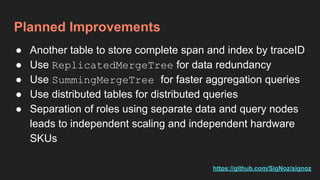
Planned Improvements
● Another table to store complete span and index by traceID
● Use ReplicatedMergeTree for data redundancy
● Use SummingMergeTree for faster aggregation queries
● Use distributed tables for distributed queries
● Separation of roles using separate data and query nodes
leads to independent scaling and independent hardware
SKUs
https://github.com/SigNoz/signoz
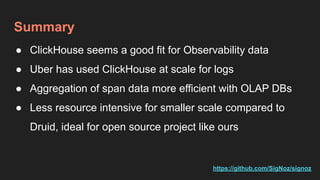
Summary
● ClickHouse seems a good fit for Observability data
● Uber has used ClickHouse at scale for logs
● Aggregation of span data more efficient with OLAP DBs
● Less resource intensive for smaller scale compared to
Druid, ideal for open source project like ours
https://github.com/SigNoz/signoz
Thank You
ankit@signoz.io
@ankitnayan
https://github.com/SigNoz/signoz
Give SigNoz a try. Check out our Github repo at

Building an Observability platform with ClickHouse

  • 1.
    Building an Observability platformwith ClickHouse Ankit Nayan (CTO, SigNoz) https://github.com/SigNoz/signoz
  • 2.
    About Me - BuildingSigNoz, part of YCombinator - 8 yrs experience in build scalable tech architecture - Passionate about distributed systems - Love Himalayas and trekking
  • 3.
    SigNoz - Opensource observability platform 👉 Metrics + Traces in a single pane 👉 Powerful trace filtering and aggregation capabilities 👉 Out-of-box like SaaS solutions, requiring minimal dev effort 👉 Native backend and frontend to OpenTelemetry 👉 Can be run within your own cloud https://github.com/SigNoz/signoz
  • 4.
  • 5.
    Architecture of SigNoz Components ●OpenTelemetry Collector ● ClickHouse ● Query Service ● Frontend https://github.com/SigNoz/signoz
  • 6.
    Why ClickHouse forstoring Observability data ● Wide tables with each query processes large number of rows but a few columns ● Running aggregate queries ● Distributed columnar datastore and blazing fast queries ● Compression capabilities ● Hot and cold storage
  • 7.
    Tracing data modelin ClickHouse Using Array(String) to store tagKeys and tagValues Extracting frequently used tags to columns https://github.com/jaegertrac ing/jaeger/issues/1438
  • 8.
    Storage Performance ofClickhouse https://github.com/SigNoz/signoz
  • 9.
    ClickHouse for LogsManagement at Uber [1] https://eng.uber.com/logging/
  • 10.
    Comparison with Elastic ●A single ClickHouse node could ingest 300K logs per second, 10x a single ES node ● >80% queries are aggregation queries, such as terms, histogram and percentile aggregations. Elastic is not designed to support fast aggregation [1] https://eng.uber.com/logging/
  • 11.
    Metrics Data modelfor ClickHouse {"__name__":"up","instance":"clickhouse_exporter_1:91 16","job":"clickhouse"} │
  • 12.
    Metrics @ SigNoz ●Metrics with ClickHouse uses 1.16 byte vs 1.37 byte with Prom local storage ● PromQL like query model for reading metrics data from ClickHouse https://github.com/SigNoz/signoz
  • 13.
    Planned Improvements ● Anothertable to store complete span and index by traceID ● Use ReplicatedMergeTree for data redundancy ● Use SummingMergeTree for faster aggregation queries ● Use distributed tables for distributed queries ● Separation of roles using separate data and query nodes leads to independent scaling and independent hardware SKUs https://github.com/SigNoz/signoz
  • 14.
    Summary ● ClickHouse seemsa good fit for Observability data ● Uber has used ClickHouse at scale for logs ● Aggregation of span data more efficient with OLAP DBs ● Less resource intensive for smaller scale compared to Druid, ideal for open source project like ours https://github.com/SigNoz/signoz
  • 15.