1
SDPM Group Project, Spring 2024
(Group No : 07)
Building a Traffic Avoidance Application
Section -B
NAME ID
MD IMRAN HOSSEN 20-43564-1
RAZWAN HOSSAIN RIFAT 20-43304-1
OMAR FARROK DIHAN 20-43089-1
THANVIR AHMED 20-43720-2
DATE 14/05/2024
2
Table of Contents
1.0 Introduction:.............................................................................................................................. 3
2.0 PROJECT MANAGEMENT APPROACH ............................................................................. 3
3.0 PROJECT TITLE: .................................................................................................................... 3
4.0 JUSTIFICATION: .................................................................................................................... 4
5.0 OBJECTIVES AND PROJECT SCOPES:............................................................................... 4
6.0 OVERVIEW OF THE PROJECT: { Give a brief description of the system with use case
diagram} ......................................................................................................................................... 5
7.0 STAKEHODERS ANALYSIS:............................................................................................... 6
8.0 MILESTONE LIST .................................................................................................................. 7
9.0 Process Model to be followed: {Justify why this process model has been selected}............... 9
10.0 WORK BREAKDOWN STRUCTURE:.............................................................................. 10
11.0: ESTIMATION: {At least two estimation process should be considered} .......................... 12
12.0 RESOURCE REQUIREMENTS......................................................................................... 13
13.1 SOFTWARE REQUIREMENTS ........................................................................................ 13
13.2 HARDWARE REQUIREMENTS....................................................................................... 14
13.3 HUMAN RESOURCE REQUIREMENTS.......................................................................... 14
13.0: PROJECT SCHEDULE:..................................................................................................... 14
14.0 DELIVERY PLAN: If you follow the agile model then give the schedule for delivery of
each increment .............................................................................................................................. 15
15.0 RISK ANALYSIS:............................................................................................................... 17
16.0 QUALITY CONTROL PLAN: ........................................................................................... 17
17.0 BUDGET: ............................................................................................................................ 20
18.0 CONCLUSION:.................................................................................................................... 21
3
1.0 Introduction:
Avoiding traffic With apps, users can save time and avoid traffic by receiving up-to-date traffic
information and route suggestions. People can avoid traffic jams and congested areas to reach
their destination more quickly and with less waiting time. Bangladesh is still developing, and a
lot of city highways are currently being constructed. Many people occasionally become stranded
while driving. You can avoid traffic congestion and select the best route with the aid of this
software. Conscious individuals can provide real-time input about the state of the road by
uploading images or videos, and it will be taken down after a day. These driving apps can give
you information about accidents, road dangers, and other things that might be unsafe. People can
get warnings and pick safer paths, making it less likely for accidents or other bad things to
happen. People can use less fuel by not spending a long time in traffic. Traffic apps often give us
different ways to go that our users will like. In general, this system gives people useful
information, helps them avoid traffic, saves time, and makes their experience better
2.0 PROJECT MANAGEMENT APPROACH
Avoiding Traffic Software development project management plans include application systems.
They entail various duties and pursuits required to guarantee the project's success. The project
plan outlines the project's objectives, goals, and deliverables as well as the milestones that will
be met. It also describes the project's setup, roles for each person, tasks they must complete, and
deadlines for completion. The plan minimizes risks and ensures that the project satisfies the
necessary requirements. The final section of the project plan is the budget plan, which contains
details on the amount of money that will be used, the price of items, and the method of managing
the funds. A solid plan can help project managers manage resources, reduce risks, and ensure
that the project is completed on schedule, within budget, and to the satisfaction of all parties
involved.
3.0 PROJECT TITLE:
Building a traffic avoidance application system for our busy city
4
4.0 JUSTIFICATION:
Providing up-to-date traffic information is a primary goal of traffic avoidance apps. These apps
forecast future traffic and congestion levels by analyzing historical and real-time traffic data.
This facilitates early trip planning and departure time selection. You can learn about hazardous
driving conditions, construction zones, and accident hotspots via apps that assist you in avoiding
traffic. This may encourage safer decision-making on the part of drivers. Voice-activated
assistants allow drivers to connect and receive real-time traffic updates and recommended routes
without taking their hands off the wheel.
5.0 OBJECTIVES AND PROJECT SCOPES:
The main objectives of this project are:
• To get a better transport experience throughout the city.
• Efficient distance measuring by using user destination.
• To provide users with real-time traffic information, alternative routes, and navigation
suggestions to avoid congested areas.
• To make data-driven decisions and save time for users.
Scopes :
• Providing real-time updates on traffic conditions is one of the main objectives of traffic
avoidance programs. These programs are able to forecast future traffic patterns and
congestion by evaluating both historical and current traffic data. This enables users to
schedule their trips in advance and select the best times to leave. By giving drivers
information about dangerous road conditions, construction zones, and accident-prone
regions, traffic avoidance apps can help them make safer judgments while driving. When
voice-activated assistants are integrated, customers can get hands-free real-time traffic
updates and route recommendations while driving.
5
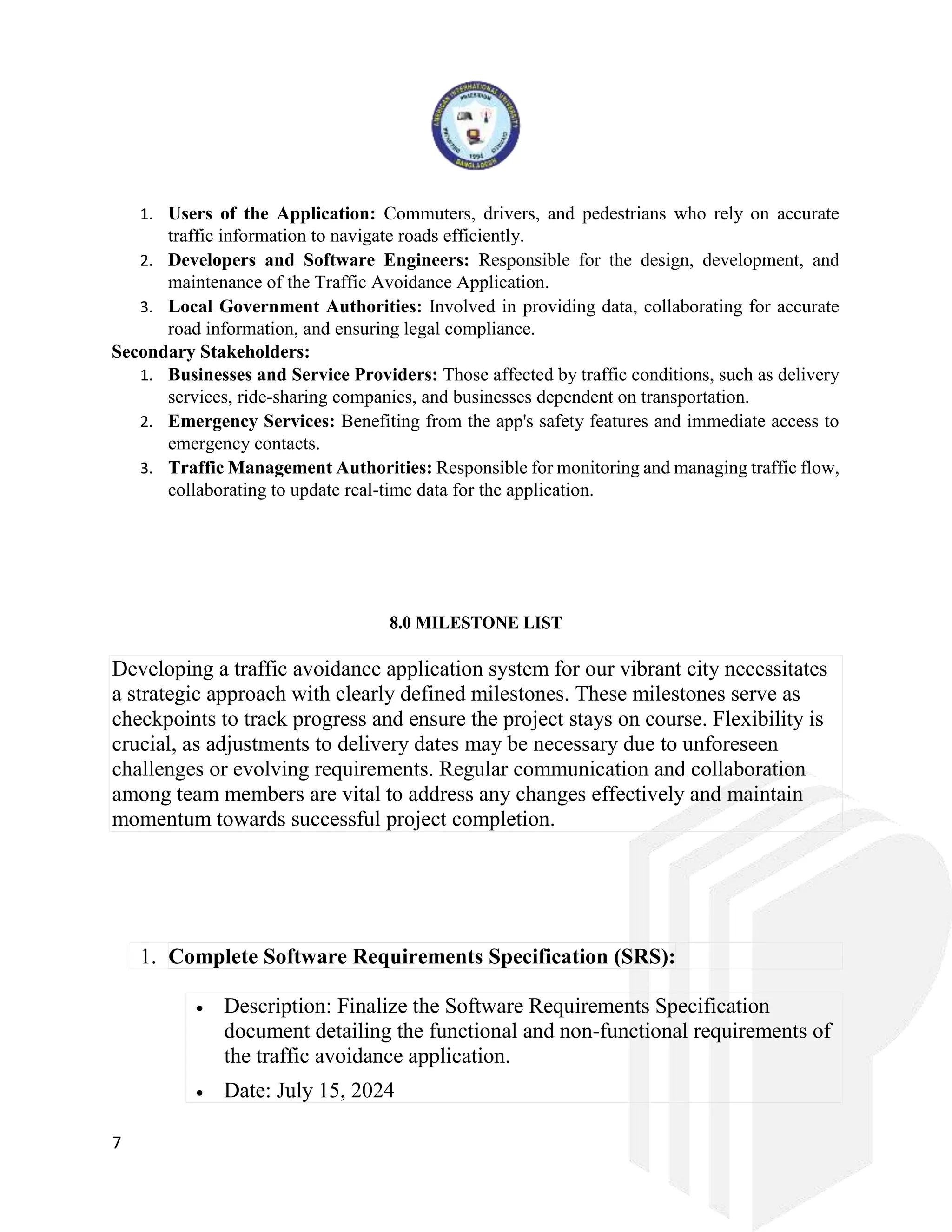
6.0 OVERVIEW OF THE PROJECT: { Give a brief description of the system with use case
diagram}
These days, because of various issues, construction on some highways, and heavy traffic, we
spend a lot of our precious time driving. On sometimes, the drive took an entire day. Apps for
traffic avoidance can effectively lessen this issue and enhance the number of people who can
assist. With the help of this software, users will be able to view live activity on a certain route
and, for example, assess the condition of the road before visiting. Certain capabilities allow users
to upload videos and images if they encounter traffic or unfavorable road conditions. The other
individual can then check this before this if they wish to avoid this path.This app's primary goal
is to assist users in determining the shortest possible route between two locations. People will
gain from this by receiving live events at the same time. This program is easy to use and
accessible online. Additional advantages include the linking of emergency hotline contacts in
case someone needs them. There is no requirement for the user to log in or register. If a user is
able to post films and photographs and share live activities, they will receive reward points.
Videos and pictures will be removed after a day.
6
Figure 1: Use case diagram
7.0 STAKEHODERS ANALYSIS:
Primary Stakeholders:
7
1. Users of the Application: Commuters, drivers, and pedestrians who rely on accurate
traffic information to navigate roads efficiently.
2. Developers and Software Engineers: Responsible for the design, development, and
maintenance of the Traffic Avoidance Application.
3. Local Government Authorities: Involved in providing data, collaborating for accurate
road information, and ensuring legal compliance.
Secondary Stakeholders:
1. Businesses and Service Providers: Those affected by traffic conditions, such as delivery
services, ride-sharing companies, and businesses dependent on transportation.
2. Emergency Services: Benefiting from the app's safety features and immediate access to
emergency contacts.
3. Traffic Management Authorities: Responsible for monitoring and managing traffic flow,
collaborating to update real-time data for the application.
8.0 MILESTONE LIST
Developing a traffic avoidance application system for our vibrant city necessitates
a strategic approach with clearly defined milestones. These milestones serve as
checkpoints to track progress and ensure the project stays on course. Flexibility is
crucial, as adjustments to delivery dates may be necessary due to unforeseen
challenges or evolving requirements. Regular communication and collaboration
among team members are vital to address any changes effectively and maintain
momentum towards successful project completion.
1. Complete Software Requirements Specification (SRS):
 Description: Finalize the Software Requirements Specification
document detailing the functional and non-functional requirements of
the traffic avoidance application.
 Date: July 15, 2024
8
2. Design Phase Completion:
 Description: Complete the design phase, including system
architecture, database schema, user interface wireframes, and
workflow diagrams.
 Date: September 30, 2024
3. Complete Coding:
 Description: Finish coding all modules and functionalities of the
traffic avoidance application based on the finalized design
specifications.
 Date: December 31, 2024
4. Complete Testing and Debugging:
 Description: Conduct comprehensive testing to identify and resolve
any bugs, errors, or performance issues in the application.
 Date: February 28, 2025
5. Documentation – User Guides and Installation:
 Description: Prepare user guides, installation manuals, and other
relevant documentation to assist users in understanding and installing
the traffic avoidance application.
 Date: April 15, 2025
Adaptation and Changes:
In the event of any changes to milestones or delivery dates, proactive measures
will be taken to address them effectively. This includes regular progress reviews,
risk assessments, and communication among team members and stakeholders. If
adjustments are required due to unforeseen challenges or shifts in project priorities,
the project manager will evaluate the impact on timelines and resources. Any
9
necessary changes will be communicated promptly, and mitigation strategies will
be implemented to ensure the project stays on track for successful completion.
9.0 Process Model to be followed: {Justify why this process model has been selected}
For building a traffic avoidance application system for a busy city, an iterative and incremental
process model like the Agile methodology would be most suitable. Here's why:
1. Iterative Development: Traffic patterns and conditions in a city can be highly dynamic
and unpredictable. An iterative approach allows for frequent feedback loops, enabling the
development team to adapt and adjust the application based on changing requirements or
emerging challenges.
2. Incremental Delivery: With an incremental approach, the application can be developed
and delivered in small, manageable increments. This allows for early releases of key
features, ensuring that users can start benefiting from the application sooner rather than
later. For instance, basic functionalities like route planning can be delivered first,
followed by additional features such as real-time traffic updates and alternative route
suggestions.
3. Continuous Improvement: An Agile approach fosters a culture of continuous
improvement. As the application is used by commuters and gathers data, the development
team can analyze user feedback and traffic patterns to identify areas for enhancement.
Regular iterations allow for these improvements to be incorporated into subsequent
releases, ensuring that the application remains relevant and effective over time.
4. Collaboration and Communication: Agile methodologies emphasize collaboration and
communication among team members and stakeholders. In the context of building a
traffic avoidance application, close collaboration with city authorities, transportation
agencies, and end users is crucial for understanding requirements, gathering real-time
traffic data, and validating the effectiveness of the application's features.
5. Risk Management: The iterative nature of Agile development allows for early
identification and mitigation of risks. By delivering functionality in small increments, the
team can quickly address any issues or challenges that arise, reducing the overall project
risk.
Overall, the Agile methodology provides the flexibility, adaptability, and focus on customer
value necessary for successfully developing a traffic avoidance application for a busy city.
10
10.0 WORK BREAKDOWN STRUCTURE:
Work Breakdown Structure (WBS) for Building a Traffic Avoidance
Application System:
1. Project Management:
 1.1 Project Initiation
 1.2 Stakeholder Engagement
 1.3 Progress Monitoring and Reporting
 1.4 Risk Management
2. Research and Requirements Gathering:
 2.1 Market Research
 2.2 User Interviews and Surveys
 2.3 Defining Functional and Non-functional Requirements
 2.4 Prioritizing Features and Use Cases
3. Design Phase:
 3.1 System Architecture Design
 3.2 Database Design
 3.3 User Interface Design
 3.4 Workflow Diagrams
4. Development:
 4.1 Backend Development
 4.2 Frontend Development
 4.3 Integration of APIs and External Data Sources
11
 4.4 Algorithm Development (Traffic Prediction, Route Optimization)
5. Testing and Quality Assurance:
 5.1 Unit Testing
 5.2 Integration Testing
 5.3 System Testing
 5.4 Performance Testing
 5.5 User Acceptance Testing (UAT)
6. Documentation:
 6.1 User Guides
 6.2 Installation Manuals
 6.3 Technical Documentation
 6.4 Training Materials
7. Deployment and Launch:
 7.1 Infrastructure Setup
 7.2 Beta Testing
 7.3 Final Deployment
 7.4 Promotional Activities
 7.5 User Support and Feedback Collection
8. Maintenance and Support:
 8.1 Bug Fixing and Updates
 8.2 Performance Monitoring
 8.3 Customer Support
 8.4 Continuous Improvement Initiatives
12
This WBS provides a structured breakdown of the project tasks, from inception to
post-launch support, ensuring all aspects of building a traffic avoidance application
system for the city are systematically addressed. Each work package can be further
decomposed into smaller tasks, allowing for better resource allocation, scheduling,
and monitoring of progress throughout the project lifecycle.
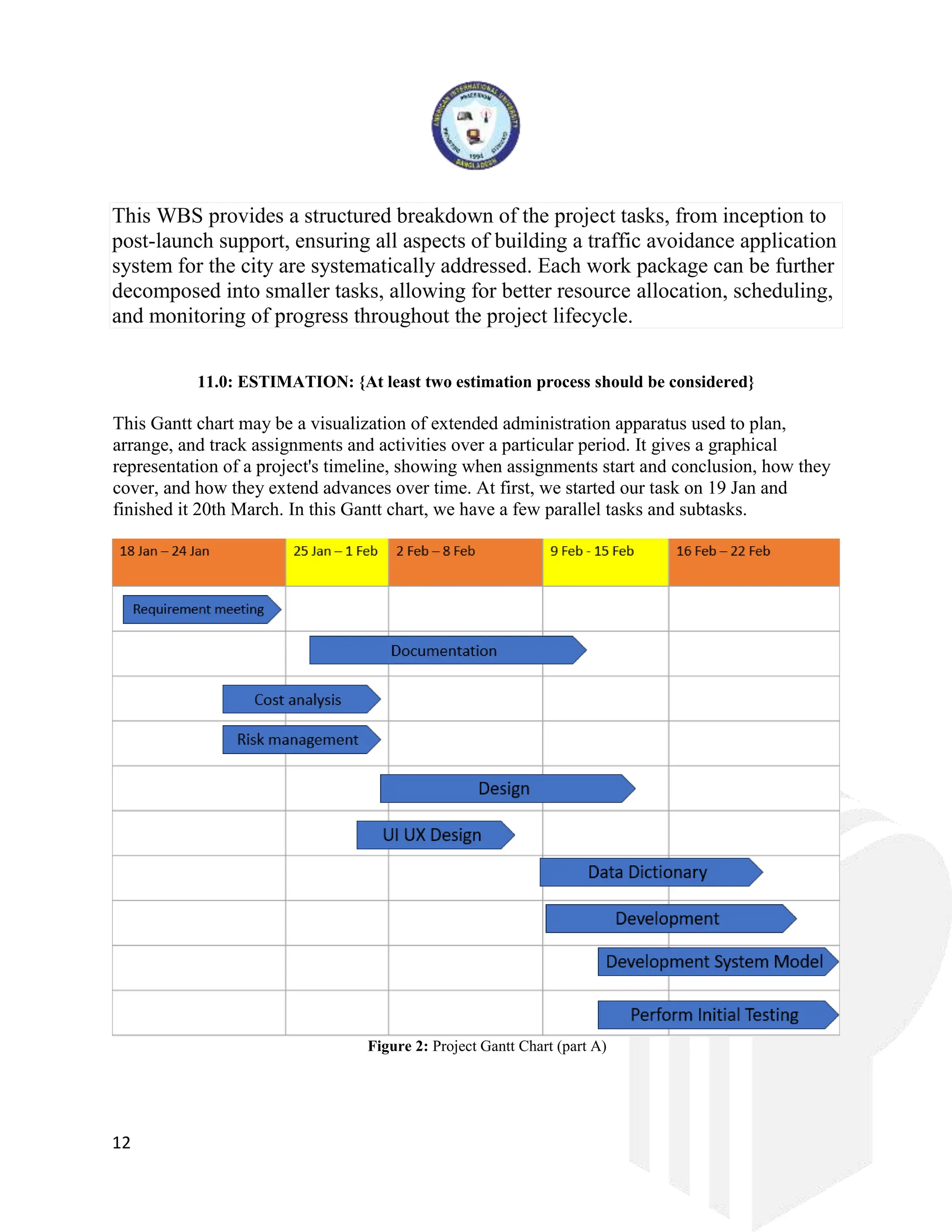
11.0: ESTIMATION: {At least two estimation process should be considered}
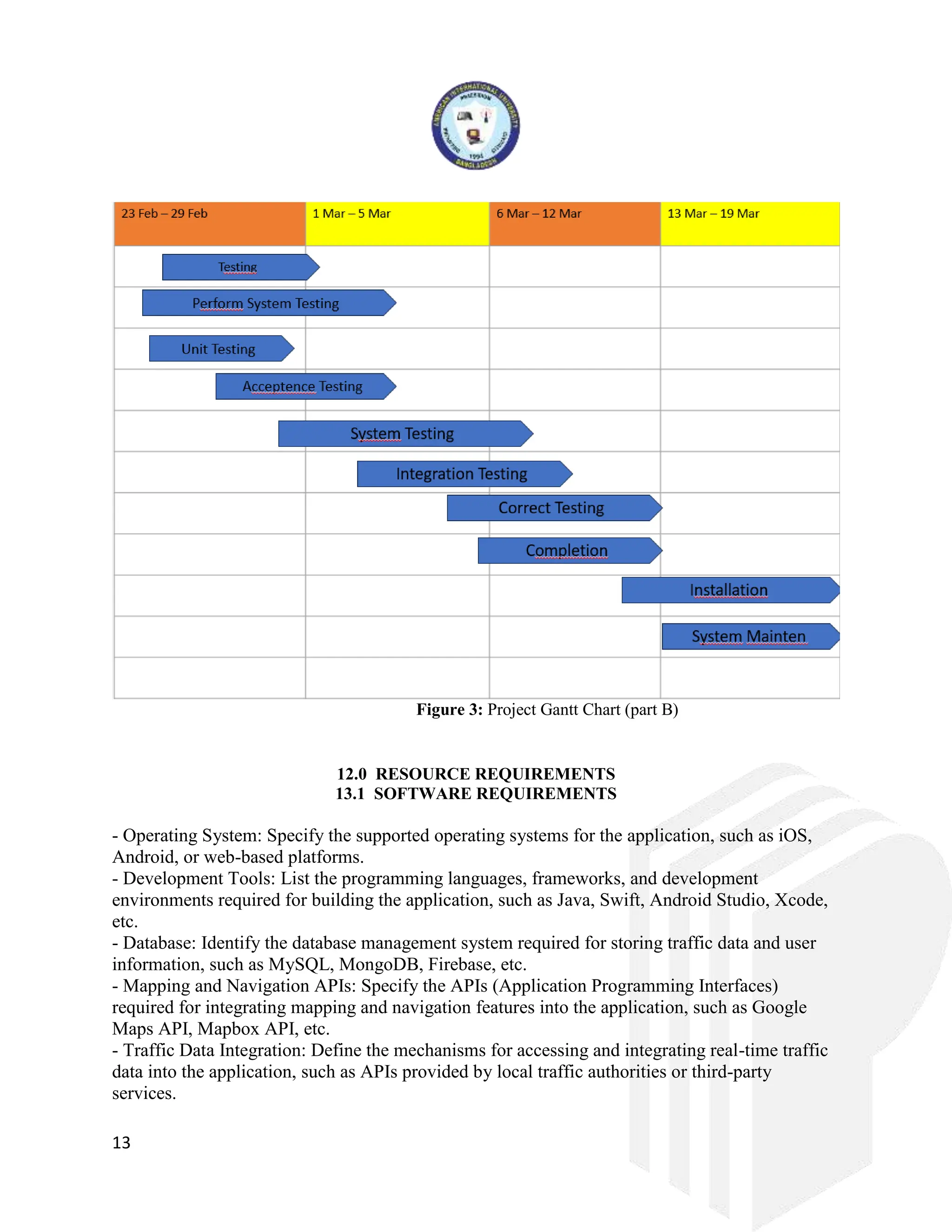
This Gantt chart may be a visualization of extended administration apparatus used to plan,
arrange, and track assignments and activities over a particular period. It gives a graphical
representation of a project's timeline, showing when assignments start and conclusion, how they
cover, and how they extend advances over time. At first, we started our task on 19 Jan and
finished it 20th March. In this Gantt chart, we have a few parallel tasks and subtasks.
Figure 2: Project Gantt Chart (part A)
13
Figure 3: Project Gantt Chart (part B)
12.0 RESOURCE REQUIREMENTS
13.1 SOFTWARE REQUIREMENTS
- Operating System: Specify the supported operating systems for the application, such as iOS,
Android, or web-based platforms.
- Development Tools: List the programming languages, frameworks, and development
environments required for building the application, such as Java, Swift, Android Studio, Xcode,
etc.
- Database: Identify the database management system required for storing traffic data and user
information, such as MySQL, MongoDB, Firebase, etc.
- Mapping and Navigation APIs: Specify the APIs (Application Programming Interfaces)
required for integrating mapping and navigation features into the application, such as Google
Maps API, Mapbox API, etc.
- Traffic Data Integration: Define the mechanisms for accessing and integrating real-time traffic
data into the application, such as APIs provided by local traffic authorities or third-party
services.
14
13.2 HARDWARE REQUIREMENTS
- Mobile Devices: Specify the minimum hardware specifications for mobile devices compatible
with the application, including smartphones and tablets.
- Internet Connectivity: Ensure that the application supports both Wi-Fi and cellular data
connections for accessing real-time traffic information and providing navigation services.
- GPS: Ensure that mobile devices have GPS functionality to enable accurate location tracking
and navigation features within the application.
- Processor and Memory: Specify the minimum processor speed and memory requirements for
smooth performance of the application on different devices.
13.3 HUMAN RESOURCE REQUIREMENTS
- Project Manager: Assign a project manager responsible for overseeing the entire software
development lifecycle, including planning, execution, and delivery of the traffic avoidance
application.
- Developers: Hire software developers with expertise in mobile app development, backend
development, and API integration to build and maintain the application.
- UI/UX Designers: Recruit designers to create intuitive and user-friendly interfaces for the
application, ensuring a seamless user experience.
- Quality Assurance/Testers: Employ QA testers to conduct thorough testing of the application,
including functional testing, usability testing, and performance testing, to identify and resolve
any issues before release.
- Technical Support: Establish a technical support team to provide assistance to users and address
any queries or technical issues related to the application post-launch.
These requirements will serve as a foundation for planning and executing the development of the
traffic avoidance application system effectively.
13.0: PROJECT SCHEDULE:
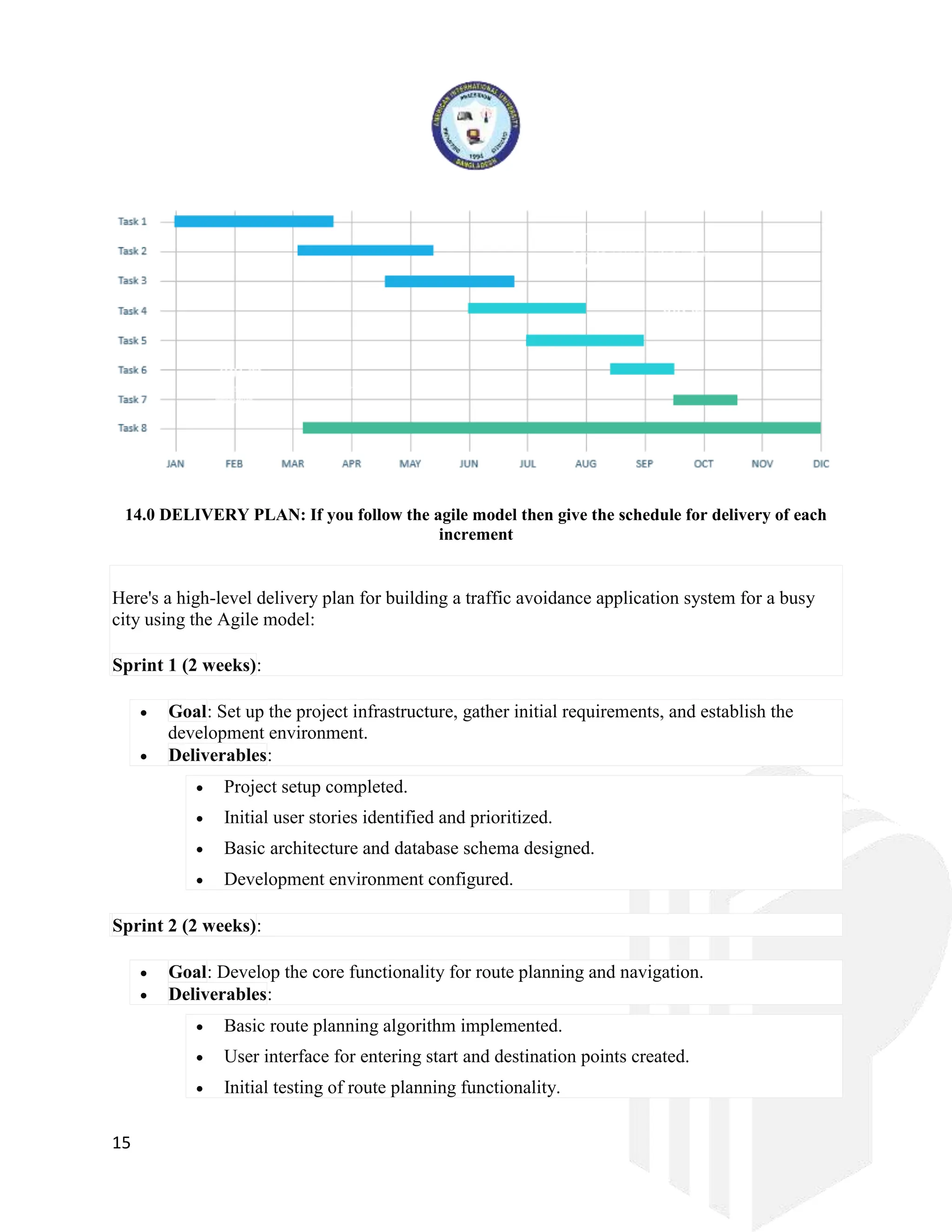
A project schedule is a timetable that organizes tasks, resources and due dates in an ideal
sequence so that a project can be completed on time.
15
14.0 DELIVERY PLAN: If you follow the agile model then give the schedule for delivery of each
increment
Here's a high-level delivery plan for building a traffic avoidance application system for a busy
city using the Agile model:
Sprint 1 (2 weeks):
 Goal: Set up the project infrastructure, gather initial requirements, and establish the
development environment.
 Deliverables:
 Project setup completed.
 Initial user stories identified and prioritized.
 Basic architecture and database schema designed.
 Development environment configured.
Sprint 2 (2 weeks):
 Goal: Develop the core functionality for route planning and navigation.
 Deliverables:
 Basic route planning algorithm implemented.
 User interface for entering start and destination points created.
 Initial testing of route planning functionality.
16
Sprint 3 (2 weeks):
 Goal: Enhance route planning with real-time traffic data integration.
 Deliverables:
 Integration with real-time traffic APIs.
 Implementation of traffic-aware route calculation.
 User interface updates to display traffic conditions.
Sprint 4 (2 weeks):
 Goal: Implement additional features such as alternative route suggestions and user
preferences.
 Deliverables:
 Alternative route generation based on user preferences.
 User settings and preferences interface.
 Initial user feedback collection.
Sprint 5 (2 weeks):
 Goal: Enhance application usability and performance.
 Deliverables:
 User interface refinements based on feedback.
 Performance optimizations.
 Bug fixes and stability improvements.
Sprint 6 (2 weeks):
 Goal: Prepare for public release and rollout.
 Deliverables:
 Final testing and quality assurance.
 Documentation updates.
 Deployment to production environment.
Sprint 7 (Ongoing):
17
 Goal: Continuous improvement and feature updates based on user feedback and
emerging needs.
 Deliverables:
 Regular updates and enhancements based on user feedback.
 Monitoring and addressing any issues or bugs reported by users.
 Iterative improvements to further optimize the application.
This plan outlines a series of sprints, each focused on delivering specific features or
enhancements to the traffic avoidance application. The iterative and incremental nature of Agile
development allows for flexibility in responding to changing requirements and feedback
throughout the project lifecycle.
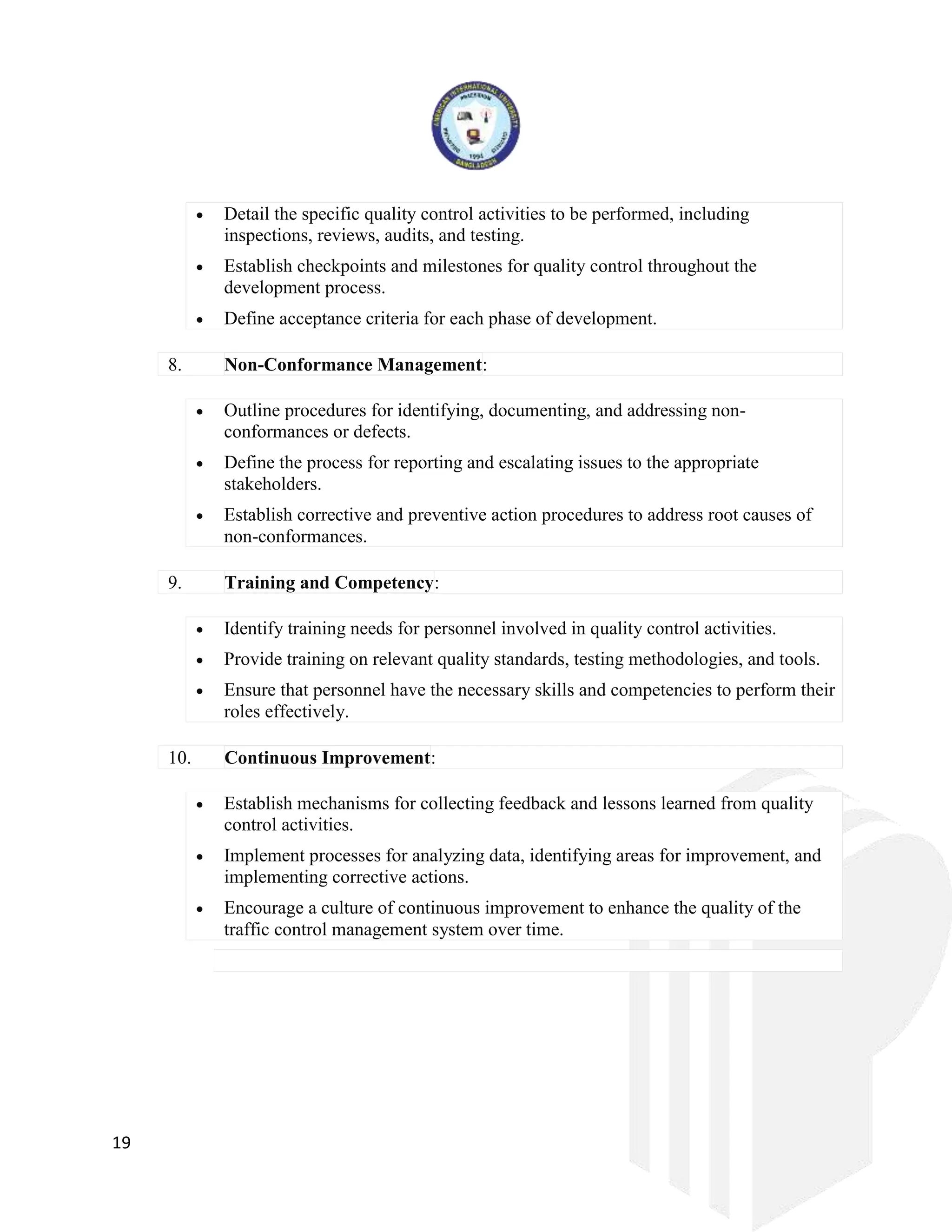
15.0 RISK ANALYSIS:
Some potential risks may occur during the build-out project if any of these fields are lacking like
if any technical issues happen. Highly risky terms as budget and lack of communication if any
project member leaves.
16.0 QUALITY CONTROL PLAN:
Creating a Quality Control Plan (QCP) for a traffic control management system involves several
steps to ensure that the system meets performance, reliability, and safety standards. Here's a
general outline to guide you through the process:
1. Introduction:
 Brief overview of the traffic control management system.
18
 Purpose and objectives of the Quality Control Plan.
2. Scope:
 Define the boundaries of the quality control process.
 Specify which aspects of the system will be covered.
3. Quality Standards and Criteria:
 Identify relevant industry standards, regulations, and best practices applicable to
traffic control systems.
 Establish specific quality criteria for the system, including performance,
reliability, usability, and safety requirements.
4. Roles and Responsibilities:
 Define the roles and responsibilities of individuals or teams involved in quality
control activities.
 Specify who is responsible for conducting tests, reviewing results, and
implementing corrective actions.
5. Documentation:
 Outline the documentation requirements for the system, including design
specifications, test plans, test results, and change control procedures.
 Specify how documentation will be managed, versioned, and maintained
throughout the project lifecycle.
6. Testing Procedures:
 Develop a comprehensive testing plan covering all aspects of the system.
 Include different types of testing such as unit testing, integration testing, system
testing, and acceptance testing.
 Define test scenarios, test cases, and expected outcomes for each testing phase.
 Specify testing tools and environments required for testing.
7. Quality Control Activities:
19
 Detail the specific quality control activities to be performed, including
inspections, reviews, audits, and testing.
 Establish checkpoints and milestones for quality control throughout the
development process.
 Define acceptance criteria for each phase of development.
8. Non-Conformance Management:
 Outline procedures for identifying, documenting, and addressing non-
conformances or defects.
 Define the process for reporting and escalating issues to the appropriate
stakeholders.
 Establish corrective and preventive action procedures to address root causes of
non-conformances.
9. Training and Competency:
 Identify training needs for personnel involved in quality control activities.
 Provide training on relevant quality standards, testing methodologies, and tools.
 Ensure that personnel have the necessary skills and competencies to perform their
roles effectively.
10. Continuous Improvement:
 Establish mechanisms for collecting feedback and lessons learned from quality
control activities.
 Implement processes for analyzing data, identifying areas for improvement, and
implementing corrective actions.
 Encourage a culture of continuous improvement to enhance the quality of the
traffic control management system over time.
20
17.0 BUDGET:
Budget estimation in a software project refers to the process of estimating the financial resources
required to complete the project successfully. It involves predicting the costs associated with
various aspects of the project, including personnel, equipment, software and hardware, third-
party services, overhead, and any other expenses that might arise during the project's lifecycle.
21
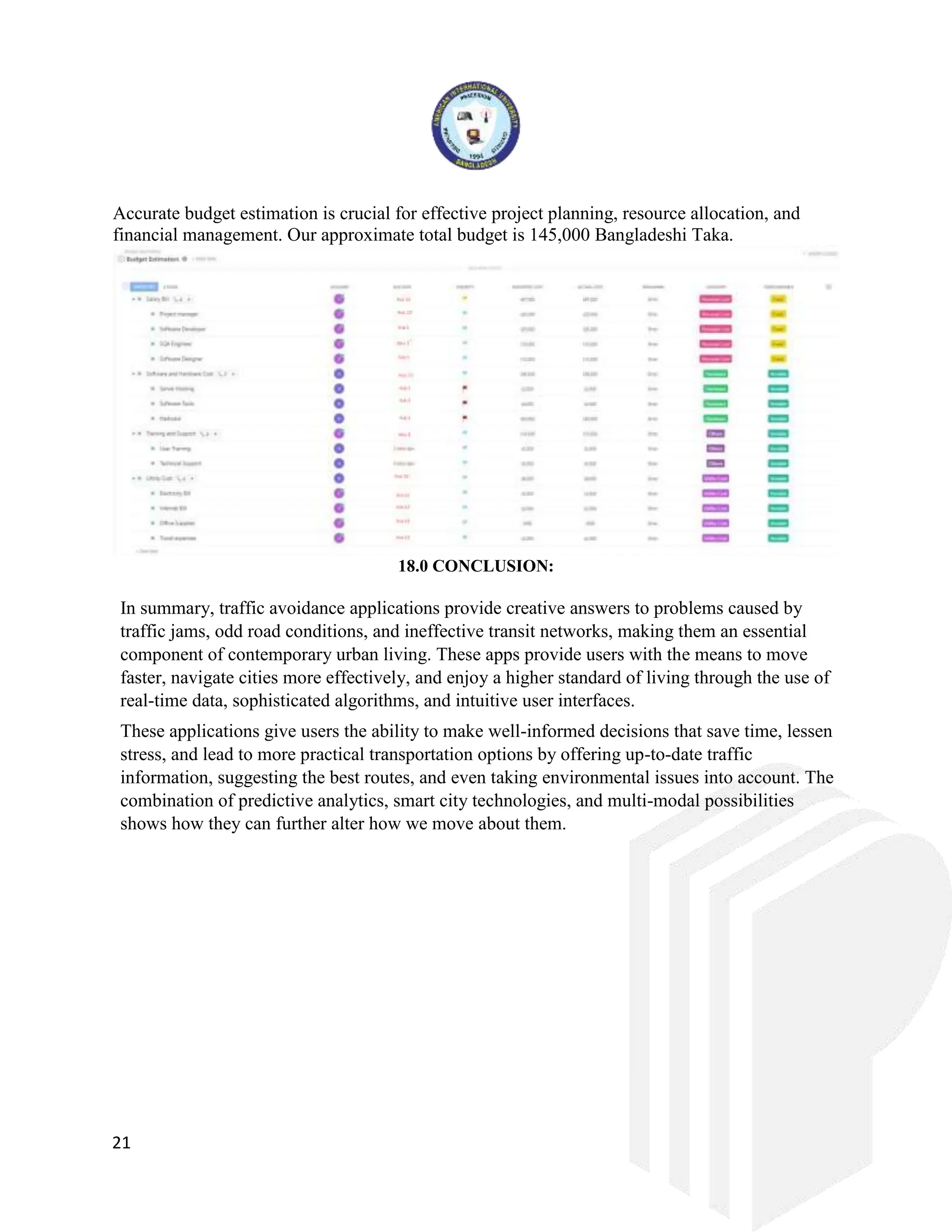
Accurate budget estimation is crucial for effective project planning, resource allocation, and
financial management. Our approximate total budget is 145,000 Bangladeshi Taka.
18.0 CONCLUSION:
In summary, traffic avoidance applications provide creative answers to problems caused by
traffic jams, odd road conditions, and ineffective transit networks, making them an essential
component of contemporary urban living. These apps provide users with the means to move
faster, navigate cities more effectively, and enjoy a higher standard of living through the use of
real-time data, sophisticated algorithms, and intuitive user interfaces.
These applications give users the ability to make well-informed decisions that save time, lessen
stress, and lead to more practical transportation options by offering up-to-date traffic
information, suggesting the best routes, and even taking environmental issues into account. The
combination of predictive analytics, smart city technologies, and multi-modal possibilities
shows how they can further alter how we move about them.

Building a Traffic Avoidance Application

  • 1.
    1 SDPM Group Project,Spring 2024 (Group No : 07) Building a Traffic Avoidance Application Section -B NAME ID MD IMRAN HOSSEN 20-43564-1 RAZWAN HOSSAIN RIFAT 20-43304-1 OMAR FARROK DIHAN 20-43089-1 THANVIR AHMED 20-43720-2 DATE 14/05/2024
  • 2.
    2 Table of Contents 1.0Introduction:.............................................................................................................................. 3 2.0 PROJECT MANAGEMENT APPROACH ............................................................................. 3 3.0 PROJECT TITLE: .................................................................................................................... 3 4.0 JUSTIFICATION: .................................................................................................................... 4 5.0 OBJECTIVES AND PROJECT SCOPES:............................................................................... 4 6.0 OVERVIEW OF THE PROJECT: { Give a brief description of the system with use case diagram} ......................................................................................................................................... 5 7.0 STAKEHODERS ANALYSIS:............................................................................................... 6 8.0 MILESTONE LIST .................................................................................................................. 7 9.0 Process Model to be followed: {Justify why this process model has been selected}............... 9 10.0 WORK BREAKDOWN STRUCTURE:.............................................................................. 10 11.0: ESTIMATION: {At least two estimation process should be considered} .......................... 12 12.0 RESOURCE REQUIREMENTS......................................................................................... 13 13.1 SOFTWARE REQUIREMENTS ........................................................................................ 13 13.2 HARDWARE REQUIREMENTS....................................................................................... 14 13.3 HUMAN RESOURCE REQUIREMENTS.......................................................................... 14 13.0: PROJECT SCHEDULE:..................................................................................................... 14 14.0 DELIVERY PLAN: If you follow the agile model then give the schedule for delivery of each increment .............................................................................................................................. 15 15.0 RISK ANALYSIS:............................................................................................................... 17 16.0 QUALITY CONTROL PLAN: ........................................................................................... 17 17.0 BUDGET: ............................................................................................................................ 20 18.0 CONCLUSION:.................................................................................................................... 21
  • 3.
    3 1.0 Introduction: Avoiding trafficWith apps, users can save time and avoid traffic by receiving up-to-date traffic information and route suggestions. People can avoid traffic jams and congested areas to reach their destination more quickly and with less waiting time. Bangladesh is still developing, and a lot of city highways are currently being constructed. Many people occasionally become stranded while driving. You can avoid traffic congestion and select the best route with the aid of this software. Conscious individuals can provide real-time input about the state of the road by uploading images or videos, and it will be taken down after a day. These driving apps can give you information about accidents, road dangers, and other things that might be unsafe. People can get warnings and pick safer paths, making it less likely for accidents or other bad things to happen. People can use less fuel by not spending a long time in traffic. Traffic apps often give us different ways to go that our users will like. In general, this system gives people useful information, helps them avoid traffic, saves time, and makes their experience better 2.0 PROJECT MANAGEMENT APPROACH Avoiding Traffic Software development project management plans include application systems. They entail various duties and pursuits required to guarantee the project's success. The project plan outlines the project's objectives, goals, and deliverables as well as the milestones that will be met. It also describes the project's setup, roles for each person, tasks they must complete, and deadlines for completion. The plan minimizes risks and ensures that the project satisfies the necessary requirements. The final section of the project plan is the budget plan, which contains details on the amount of money that will be used, the price of items, and the method of managing the funds. A solid plan can help project managers manage resources, reduce risks, and ensure that the project is completed on schedule, within budget, and to the satisfaction of all parties involved. 3.0 PROJECT TITLE: Building a traffic avoidance application system for our busy city
  • 4.
    4 4.0 JUSTIFICATION: Providing up-to-datetraffic information is a primary goal of traffic avoidance apps. These apps forecast future traffic and congestion levels by analyzing historical and real-time traffic data. This facilitates early trip planning and departure time selection. You can learn about hazardous driving conditions, construction zones, and accident hotspots via apps that assist you in avoiding traffic. This may encourage safer decision-making on the part of drivers. Voice-activated assistants allow drivers to connect and receive real-time traffic updates and recommended routes without taking their hands off the wheel. 5.0 OBJECTIVES AND PROJECT SCOPES: The main objectives of this project are: • To get a better transport experience throughout the city. • Efficient distance measuring by using user destination. • To provide users with real-time traffic information, alternative routes, and navigation suggestions to avoid congested areas. • To make data-driven decisions and save time for users. Scopes : • Providing real-time updates on traffic conditions is one of the main objectives of traffic avoidance programs. These programs are able to forecast future traffic patterns and congestion by evaluating both historical and current traffic data. This enables users to schedule their trips in advance and select the best times to leave. By giving drivers information about dangerous road conditions, construction zones, and accident-prone regions, traffic avoidance apps can help them make safer judgments while driving. When voice-activated assistants are integrated, customers can get hands-free real-time traffic updates and route recommendations while driving.
  • 5.
    5 6.0 OVERVIEW OFTHE PROJECT: { Give a brief description of the system with use case diagram} These days, because of various issues, construction on some highways, and heavy traffic, we spend a lot of our precious time driving. On sometimes, the drive took an entire day. Apps for traffic avoidance can effectively lessen this issue and enhance the number of people who can assist. With the help of this software, users will be able to view live activity on a certain route and, for example, assess the condition of the road before visiting. Certain capabilities allow users to upload videos and images if they encounter traffic or unfavorable road conditions. The other individual can then check this before this if they wish to avoid this path.This app's primary goal is to assist users in determining the shortest possible route between two locations. People will gain from this by receiving live events at the same time. This program is easy to use and accessible online. Additional advantages include the linking of emergency hotline contacts in case someone needs them. There is no requirement for the user to log in or register. If a user is able to post films and photographs and share live activities, they will receive reward points. Videos and pictures will be removed after a day.
  • 6.
    6 Figure 1: Usecase diagram 7.0 STAKEHODERS ANALYSIS: Primary Stakeholders:
  • 7.
    7 1. Users ofthe Application: Commuters, drivers, and pedestrians who rely on accurate traffic information to navigate roads efficiently. 2. Developers and Software Engineers: Responsible for the design, development, and maintenance of the Traffic Avoidance Application. 3. Local Government Authorities: Involved in providing data, collaborating for accurate road information, and ensuring legal compliance. Secondary Stakeholders: 1. Businesses and Service Providers: Those affected by traffic conditions, such as delivery services, ride-sharing companies, and businesses dependent on transportation. 2. Emergency Services: Benefiting from the app's safety features and immediate access to emergency contacts. 3. Traffic Management Authorities: Responsible for monitoring and managing traffic flow, collaborating to update real-time data for the application. 8.0 MILESTONE LIST Developing a traffic avoidance application system for our vibrant city necessitates a strategic approach with clearly defined milestones. These milestones serve as checkpoints to track progress and ensure the project stays on course. Flexibility is crucial, as adjustments to delivery dates may be necessary due to unforeseen challenges or evolving requirements. Regular communication and collaboration among team members are vital to address any changes effectively and maintain momentum towards successful project completion. 1. Complete Software Requirements Specification (SRS):  Description: Finalize the Software Requirements Specification document detailing the functional and non-functional requirements of the traffic avoidance application.  Date: July 15, 2024
  • 8.
    8 2. Design PhaseCompletion:  Description: Complete the design phase, including system architecture, database schema, user interface wireframes, and workflow diagrams.  Date: September 30, 2024 3. Complete Coding:  Description: Finish coding all modules and functionalities of the traffic avoidance application based on the finalized design specifications.  Date: December 31, 2024 4. Complete Testing and Debugging:  Description: Conduct comprehensive testing to identify and resolve any bugs, errors, or performance issues in the application.  Date: February 28, 2025 5. Documentation – User Guides and Installation:  Description: Prepare user guides, installation manuals, and other relevant documentation to assist users in understanding and installing the traffic avoidance application.  Date: April 15, 2025 Adaptation and Changes: In the event of any changes to milestones or delivery dates, proactive measures will be taken to address them effectively. This includes regular progress reviews, risk assessments, and communication among team members and stakeholders. If adjustments are required due to unforeseen challenges or shifts in project priorities, the project manager will evaluate the impact on timelines and resources. Any
  • 9.
    9 necessary changes willbe communicated promptly, and mitigation strategies will be implemented to ensure the project stays on track for successful completion. 9.0 Process Model to be followed: {Justify why this process model has been selected} For building a traffic avoidance application system for a busy city, an iterative and incremental process model like the Agile methodology would be most suitable. Here's why: 1. Iterative Development: Traffic patterns and conditions in a city can be highly dynamic and unpredictable. An iterative approach allows for frequent feedback loops, enabling the development team to adapt and adjust the application based on changing requirements or emerging challenges. 2. Incremental Delivery: With an incremental approach, the application can be developed and delivered in small, manageable increments. This allows for early releases of key features, ensuring that users can start benefiting from the application sooner rather than later. For instance, basic functionalities like route planning can be delivered first, followed by additional features such as real-time traffic updates and alternative route suggestions. 3. Continuous Improvement: An Agile approach fosters a culture of continuous improvement. As the application is used by commuters and gathers data, the development team can analyze user feedback and traffic patterns to identify areas for enhancement. Regular iterations allow for these improvements to be incorporated into subsequent releases, ensuring that the application remains relevant and effective over time. 4. Collaboration and Communication: Agile methodologies emphasize collaboration and communication among team members and stakeholders. In the context of building a traffic avoidance application, close collaboration with city authorities, transportation agencies, and end users is crucial for understanding requirements, gathering real-time traffic data, and validating the effectiveness of the application's features. 5. Risk Management: The iterative nature of Agile development allows for early identification and mitigation of risks. By delivering functionality in small increments, the team can quickly address any issues or challenges that arise, reducing the overall project risk. Overall, the Agile methodology provides the flexibility, adaptability, and focus on customer value necessary for successfully developing a traffic avoidance application for a busy city.
  • 10.
    10 10.0 WORK BREAKDOWNSTRUCTURE: Work Breakdown Structure (WBS) for Building a Traffic Avoidance Application System: 1. Project Management:  1.1 Project Initiation  1.2 Stakeholder Engagement  1.3 Progress Monitoring and Reporting  1.4 Risk Management 2. Research and Requirements Gathering:  2.1 Market Research  2.2 User Interviews and Surveys  2.3 Defining Functional and Non-functional Requirements  2.4 Prioritizing Features and Use Cases 3. Design Phase:  3.1 System Architecture Design  3.2 Database Design  3.3 User Interface Design  3.4 Workflow Diagrams 4. Development:  4.1 Backend Development  4.2 Frontend Development  4.3 Integration of APIs and External Data Sources
  • 11.
    11  4.4 AlgorithmDevelopment (Traffic Prediction, Route Optimization) 5. Testing and Quality Assurance:  5.1 Unit Testing  5.2 Integration Testing  5.3 System Testing  5.4 Performance Testing  5.5 User Acceptance Testing (UAT) 6. Documentation:  6.1 User Guides  6.2 Installation Manuals  6.3 Technical Documentation  6.4 Training Materials 7. Deployment and Launch:  7.1 Infrastructure Setup  7.2 Beta Testing  7.3 Final Deployment  7.4 Promotional Activities  7.5 User Support and Feedback Collection 8. Maintenance and Support:  8.1 Bug Fixing and Updates  8.2 Performance Monitoring  8.3 Customer Support  8.4 Continuous Improvement Initiatives
  • 12.
    12 This WBS providesa structured breakdown of the project tasks, from inception to post-launch support, ensuring all aspects of building a traffic avoidance application system for the city are systematically addressed. Each work package can be further decomposed into smaller tasks, allowing for better resource allocation, scheduling, and monitoring of progress throughout the project lifecycle. 11.0: ESTIMATION: {At least two estimation process should be considered} This Gantt chart may be a visualization of extended administration apparatus used to plan, arrange, and track assignments and activities over a particular period. It gives a graphical representation of a project's timeline, showing when assignments start and conclusion, how they cover, and how they extend advances over time. At first, we started our task on 19 Jan and finished it 20th March. In this Gantt chart, we have a few parallel tasks and subtasks. Figure 2: Project Gantt Chart (part A)
  • 13.
    13 Figure 3: ProjectGantt Chart (part B) 12.0 RESOURCE REQUIREMENTS 13.1 SOFTWARE REQUIREMENTS - Operating System: Specify the supported operating systems for the application, such as iOS, Android, or web-based platforms. - Development Tools: List the programming languages, frameworks, and development environments required for building the application, such as Java, Swift, Android Studio, Xcode, etc. - Database: Identify the database management system required for storing traffic data and user information, such as MySQL, MongoDB, Firebase, etc. - Mapping and Navigation APIs: Specify the APIs (Application Programming Interfaces) required for integrating mapping and navigation features into the application, such as Google Maps API, Mapbox API, etc. - Traffic Data Integration: Define the mechanisms for accessing and integrating real-time traffic data into the application, such as APIs provided by local traffic authorities or third-party services.
  • 14.
    14 13.2 HARDWARE REQUIREMENTS -Mobile Devices: Specify the minimum hardware specifications for mobile devices compatible with the application, including smartphones and tablets. - Internet Connectivity: Ensure that the application supports both Wi-Fi and cellular data connections for accessing real-time traffic information and providing navigation services. - GPS: Ensure that mobile devices have GPS functionality to enable accurate location tracking and navigation features within the application. - Processor and Memory: Specify the minimum processor speed and memory requirements for smooth performance of the application on different devices. 13.3 HUMAN RESOURCE REQUIREMENTS - Project Manager: Assign a project manager responsible for overseeing the entire software development lifecycle, including planning, execution, and delivery of the traffic avoidance application. - Developers: Hire software developers with expertise in mobile app development, backend development, and API integration to build and maintain the application. - UI/UX Designers: Recruit designers to create intuitive and user-friendly interfaces for the application, ensuring a seamless user experience. - Quality Assurance/Testers: Employ QA testers to conduct thorough testing of the application, including functional testing, usability testing, and performance testing, to identify and resolve any issues before release. - Technical Support: Establish a technical support team to provide assistance to users and address any queries or technical issues related to the application post-launch. These requirements will serve as a foundation for planning and executing the development of the traffic avoidance application system effectively. 13.0: PROJECT SCHEDULE: A project schedule is a timetable that organizes tasks, resources and due dates in an ideal sequence so that a project can be completed on time.
  • 15.
    15 14.0 DELIVERY PLAN:If you follow the agile model then give the schedule for delivery of each increment Here's a high-level delivery plan for building a traffic avoidance application system for a busy city using the Agile model: Sprint 1 (2 weeks):  Goal: Set up the project infrastructure, gather initial requirements, and establish the development environment.  Deliverables:  Project setup completed.  Initial user stories identified and prioritized.  Basic architecture and database schema designed.  Development environment configured. Sprint 2 (2 weeks):  Goal: Develop the core functionality for route planning and navigation.  Deliverables:  Basic route planning algorithm implemented.  User interface for entering start and destination points created.  Initial testing of route planning functionality.
  • 16.
    16 Sprint 3 (2weeks):  Goal: Enhance route planning with real-time traffic data integration.  Deliverables:  Integration with real-time traffic APIs.  Implementation of traffic-aware route calculation.  User interface updates to display traffic conditions. Sprint 4 (2 weeks):  Goal: Implement additional features such as alternative route suggestions and user preferences.  Deliverables:  Alternative route generation based on user preferences.  User settings and preferences interface.  Initial user feedback collection. Sprint 5 (2 weeks):  Goal: Enhance application usability and performance.  Deliverables:  User interface refinements based on feedback.  Performance optimizations.  Bug fixes and stability improvements. Sprint 6 (2 weeks):  Goal: Prepare for public release and rollout.  Deliverables:  Final testing and quality assurance.  Documentation updates.  Deployment to production environment. Sprint 7 (Ongoing):
  • 17.
    17  Goal: Continuousimprovement and feature updates based on user feedback and emerging needs.  Deliverables:  Regular updates and enhancements based on user feedback.  Monitoring and addressing any issues or bugs reported by users.  Iterative improvements to further optimize the application. This plan outlines a series of sprints, each focused on delivering specific features or enhancements to the traffic avoidance application. The iterative and incremental nature of Agile development allows for flexibility in responding to changing requirements and feedback throughout the project lifecycle. 15.0 RISK ANALYSIS: Some potential risks may occur during the build-out project if any of these fields are lacking like if any technical issues happen. Highly risky terms as budget and lack of communication if any project member leaves. 16.0 QUALITY CONTROL PLAN: Creating a Quality Control Plan (QCP) for a traffic control management system involves several steps to ensure that the system meets performance, reliability, and safety standards. Here's a general outline to guide you through the process: 1. Introduction:  Brief overview of the traffic control management system.
  • 18.
    18  Purpose andobjectives of the Quality Control Plan. 2. Scope:  Define the boundaries of the quality control process.  Specify which aspects of the system will be covered. 3. Quality Standards and Criteria:  Identify relevant industry standards, regulations, and best practices applicable to traffic control systems.  Establish specific quality criteria for the system, including performance, reliability, usability, and safety requirements. 4. Roles and Responsibilities:  Define the roles and responsibilities of individuals or teams involved in quality control activities.  Specify who is responsible for conducting tests, reviewing results, and implementing corrective actions. 5. Documentation:  Outline the documentation requirements for the system, including design specifications, test plans, test results, and change control procedures.  Specify how documentation will be managed, versioned, and maintained throughout the project lifecycle. 6. Testing Procedures:  Develop a comprehensive testing plan covering all aspects of the system.  Include different types of testing such as unit testing, integration testing, system testing, and acceptance testing.  Define test scenarios, test cases, and expected outcomes for each testing phase.  Specify testing tools and environments required for testing. 7. Quality Control Activities:
  • 19.
    19  Detail thespecific quality control activities to be performed, including inspections, reviews, audits, and testing.  Establish checkpoints and milestones for quality control throughout the development process.  Define acceptance criteria for each phase of development. 8. Non-Conformance Management:  Outline procedures for identifying, documenting, and addressing non- conformances or defects.  Define the process for reporting and escalating issues to the appropriate stakeholders.  Establish corrective and preventive action procedures to address root causes of non-conformances. 9. Training and Competency:  Identify training needs for personnel involved in quality control activities.  Provide training on relevant quality standards, testing methodologies, and tools.  Ensure that personnel have the necessary skills and competencies to perform their roles effectively. 10. Continuous Improvement:  Establish mechanisms for collecting feedback and lessons learned from quality control activities.  Implement processes for analyzing data, identifying areas for improvement, and implementing corrective actions.  Encourage a culture of continuous improvement to enhance the quality of the traffic control management system over time.
  • 20.
    20 17.0 BUDGET: Budget estimationin a software project refers to the process of estimating the financial resources required to complete the project successfully. It involves predicting the costs associated with various aspects of the project, including personnel, equipment, software and hardware, third- party services, overhead, and any other expenses that might arise during the project's lifecycle.
  • 21.
    21 Accurate budget estimationis crucial for effective project planning, resource allocation, and financial management. Our approximate total budget is 145,000 Bangladeshi Taka. 18.0 CONCLUSION: In summary, traffic avoidance applications provide creative answers to problems caused by traffic jams, odd road conditions, and ineffective transit networks, making them an essential component of contemporary urban living. These apps provide users with the means to move faster, navigate cities more effectively, and enjoy a higher standard of living through the use of real-time data, sophisticated algorithms, and intuitive user interfaces. These applications give users the ability to make well-informed decisions that save time, lessen stress, and lead to more practical transportation options by offering up-to-date traffic information, suggesting the best routes, and even taking environmental issues into account. The combination of predictive analytics, smart city technologies, and multi-modal possibilities shows how they can further alter how we move about them.