2.3.2021
Building a Data
Science Portfolio
That Rocks!
About Me
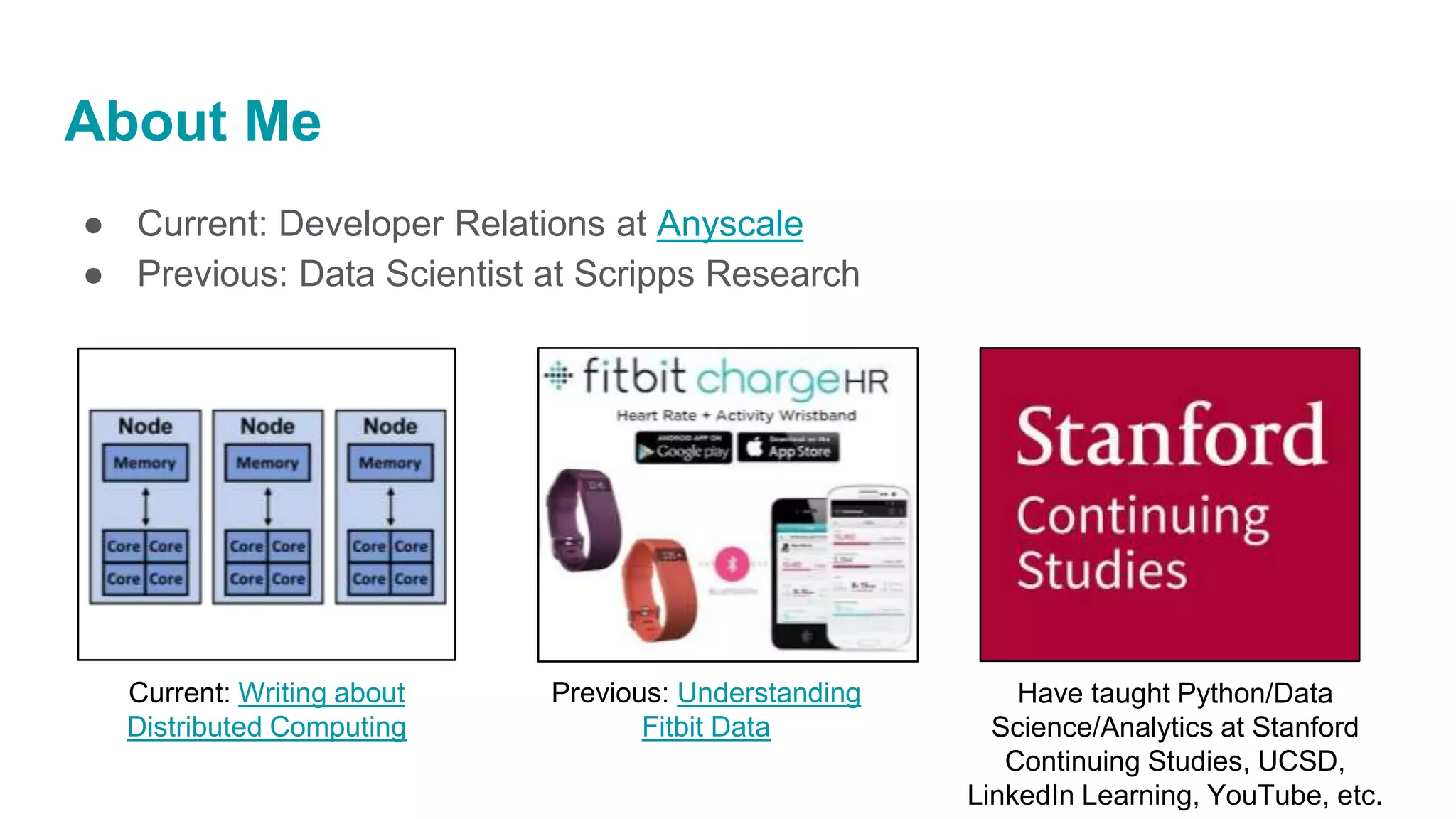
● Current: Developer Relations at Anyscale
● Previous: Data Scientist at Scripps Research
Current: Writing about
Distributed Computing
Previous: Understanding
Fitbit Data
Have taught Python/Data
Science/Analytics at Stanford
Continuing Studies, UCSD,
LinkedIn Learning, YouTube, etc.
1. What is a Portfolio
2. My Portfolio
3. Identifying what to put in your
Portfolio
4. Portfolio to help networking
5. Portfolio for interviews/take
home challenges
6. Resume Advice
7. Social Media Advice
Building a Data Science Portfolio that Rocks
What is a Portfolio?
● Public evidence of your data
analytics/science skills.
● You have Facebook, Pinterest,
Instagram, Snapchat so why don’t
you have public evidence of your
skills?
● Consider making a professional
online presence.
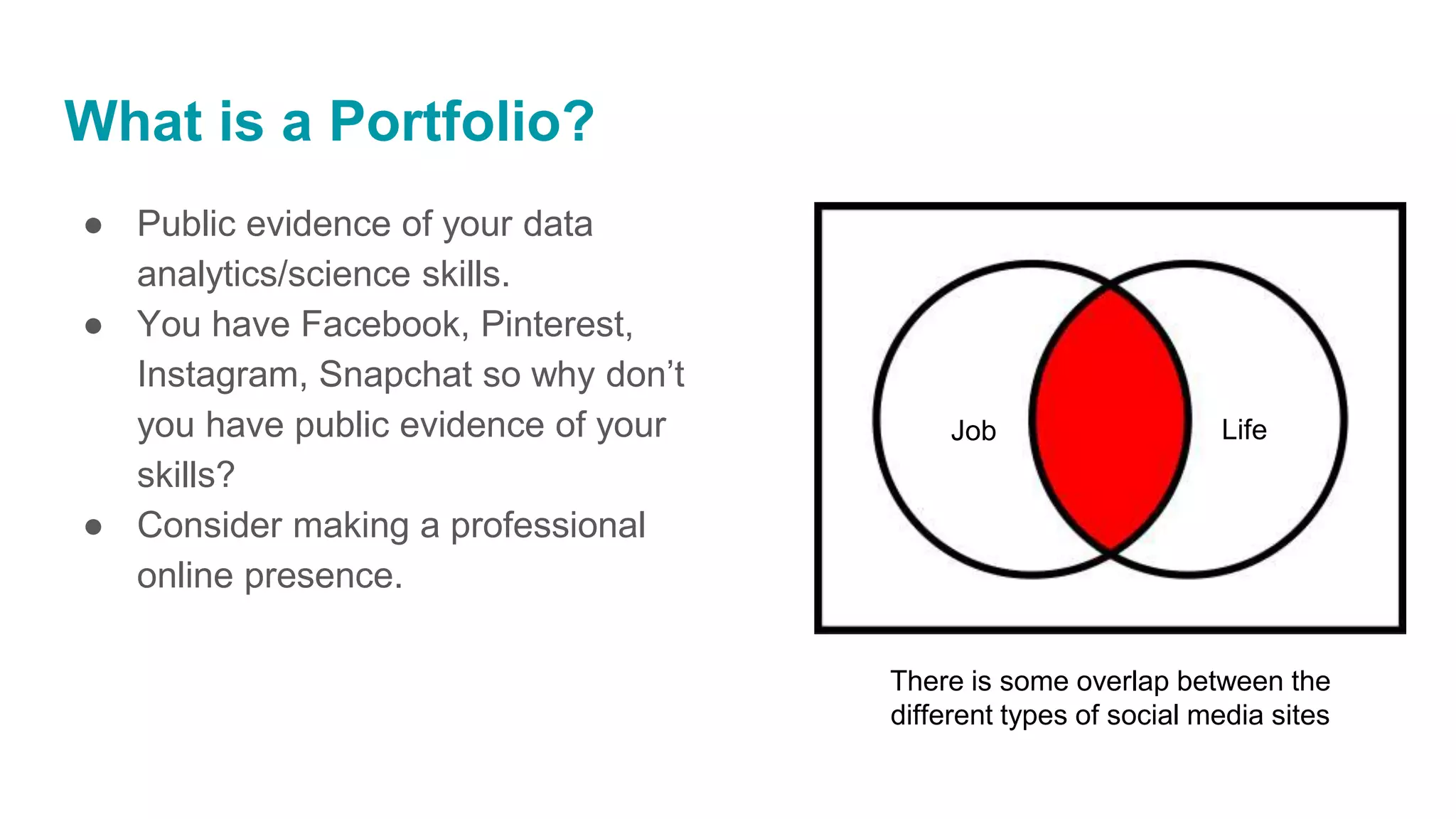
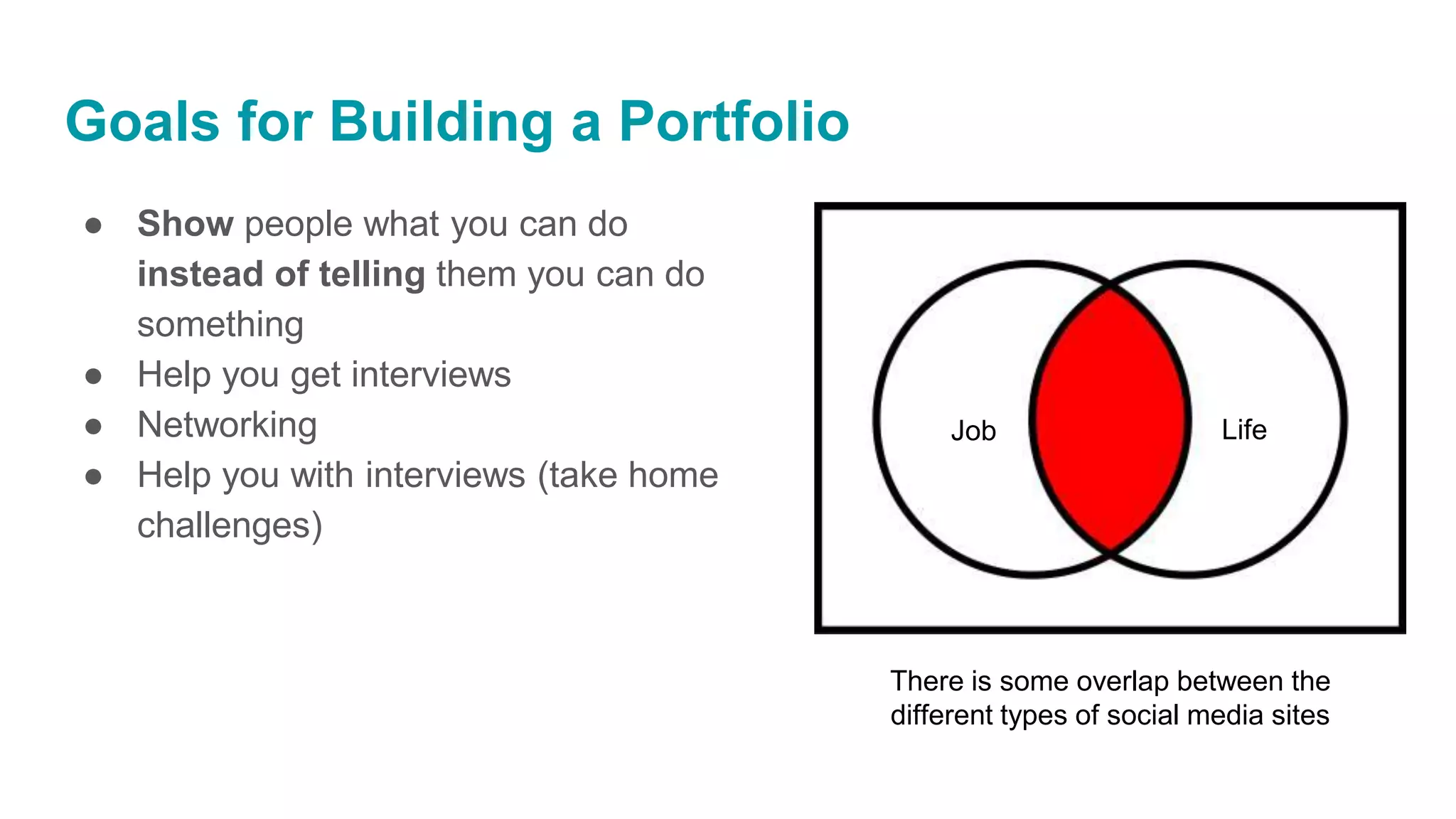
Job Life
There is some overlap between the
different types of social media sites
Goals for Building a Portfolio
● Show people what you can do
instead of telling them you can do
something
● Help you get interviews
● Networking
● Help you with interviews (take home
challenges)
Job Life
There is some overlap between the
different types of social media sites
Portfolios can consist of things like
● Resume (how people find your portfolio)
● GitHub
● Kaggle
● Tableau Public
● Blogging
● LinkedIn
● Twitter
● Various Forum Accounts
● Stack Overflow
● Open Source Contributions
● Podcast appearances
● Giving Talks
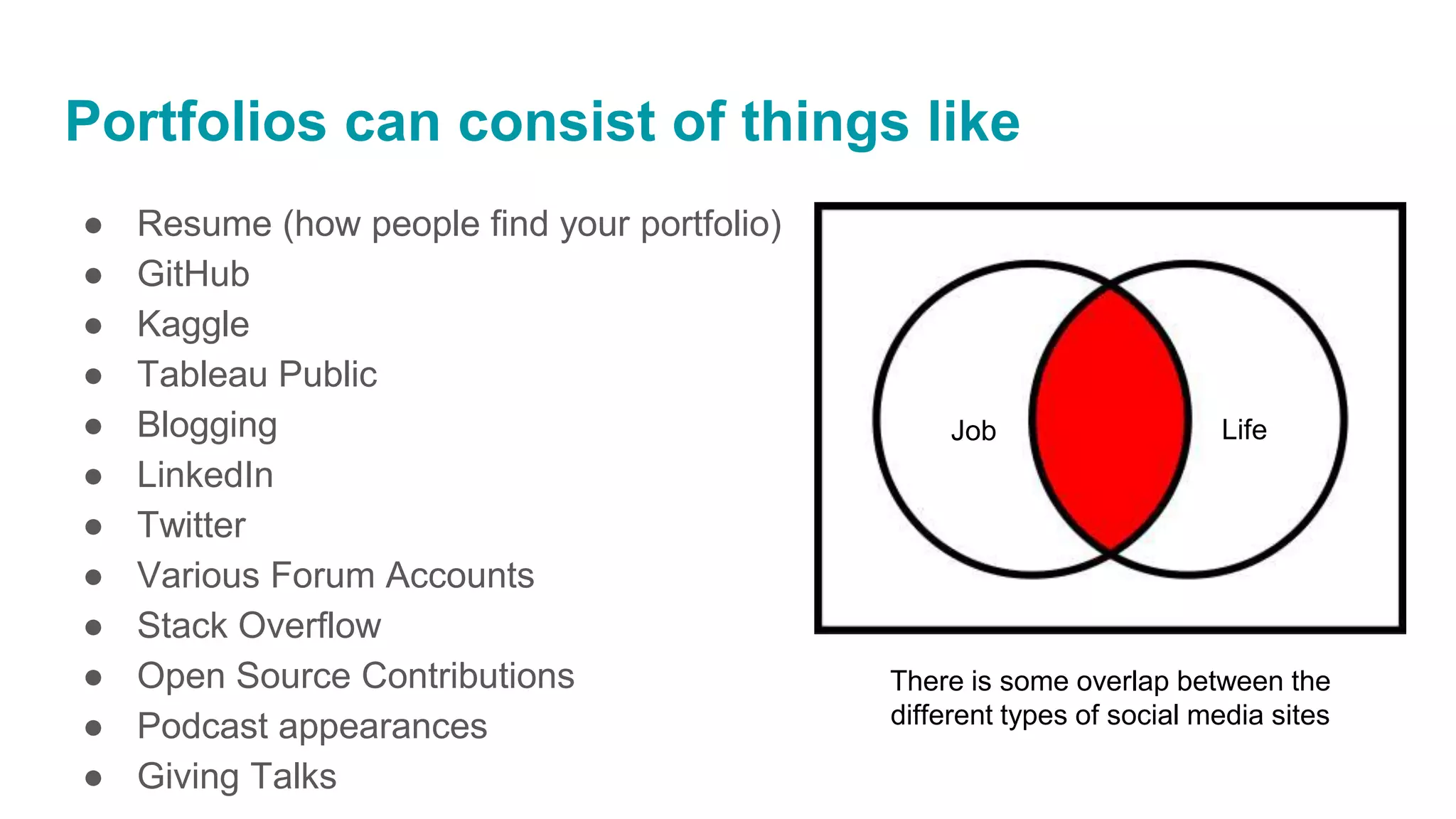
Job Life
There is some overlap between the
different types of social media sites
Importance of a Portfolio
The more public work you do, the
higher the chance of a freak
accident like that: of someone noticing
your work and pointing you towards a
job opportunity, or of someone who’s
interviewing you having heard of work
you’ve done.
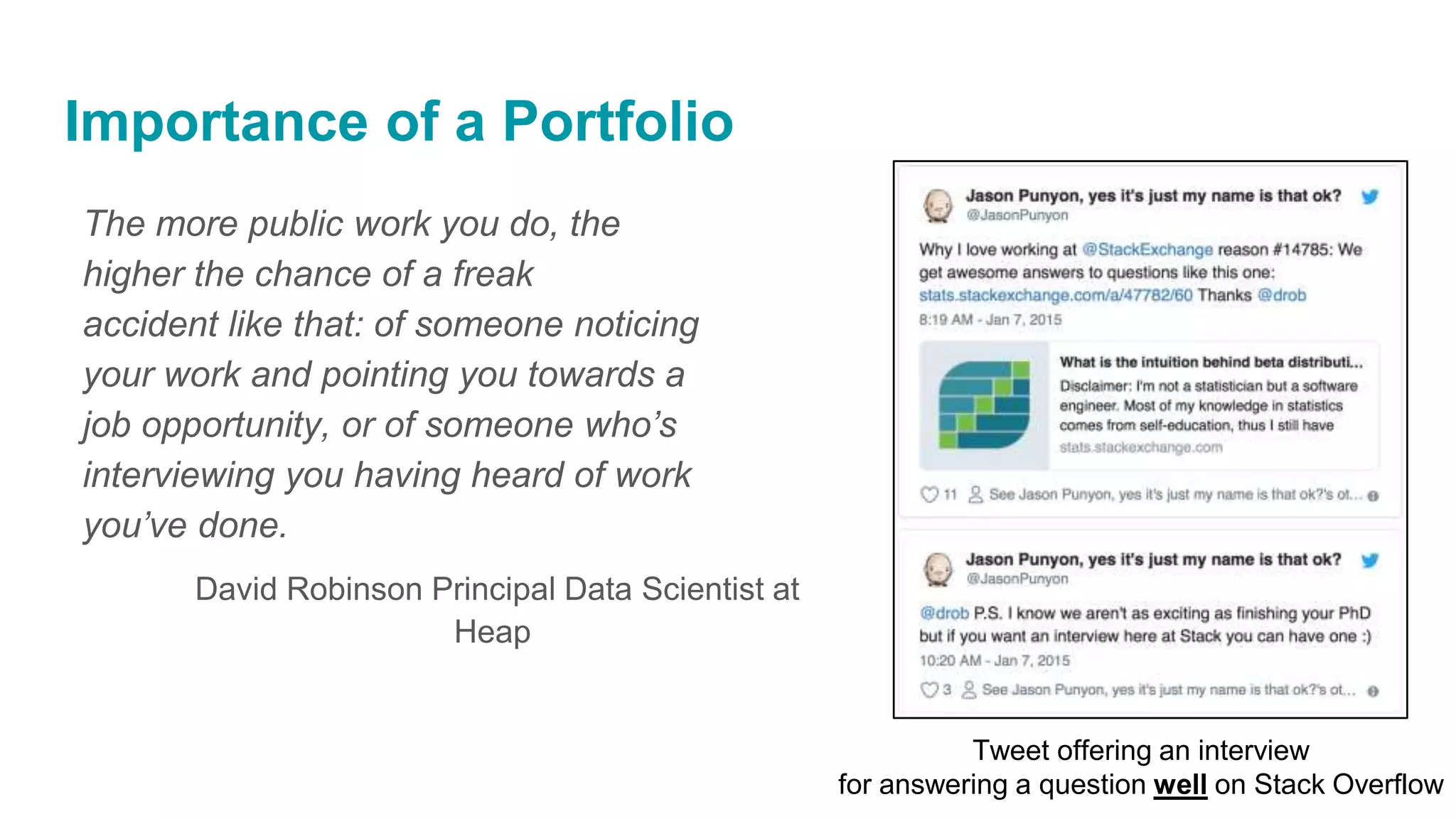
Tweet offering an interview
for answering a question well on Stack Overflow
David Robinson Principal Data Scientist at
Heap
● How do you get experience if you
need experience to get your first
job?
● If you don’t have any experience as
a data
analyst/scientist/programmer/anythi
ng, then you should do independent
projects.
Portfolio to get around an Experience Requirement
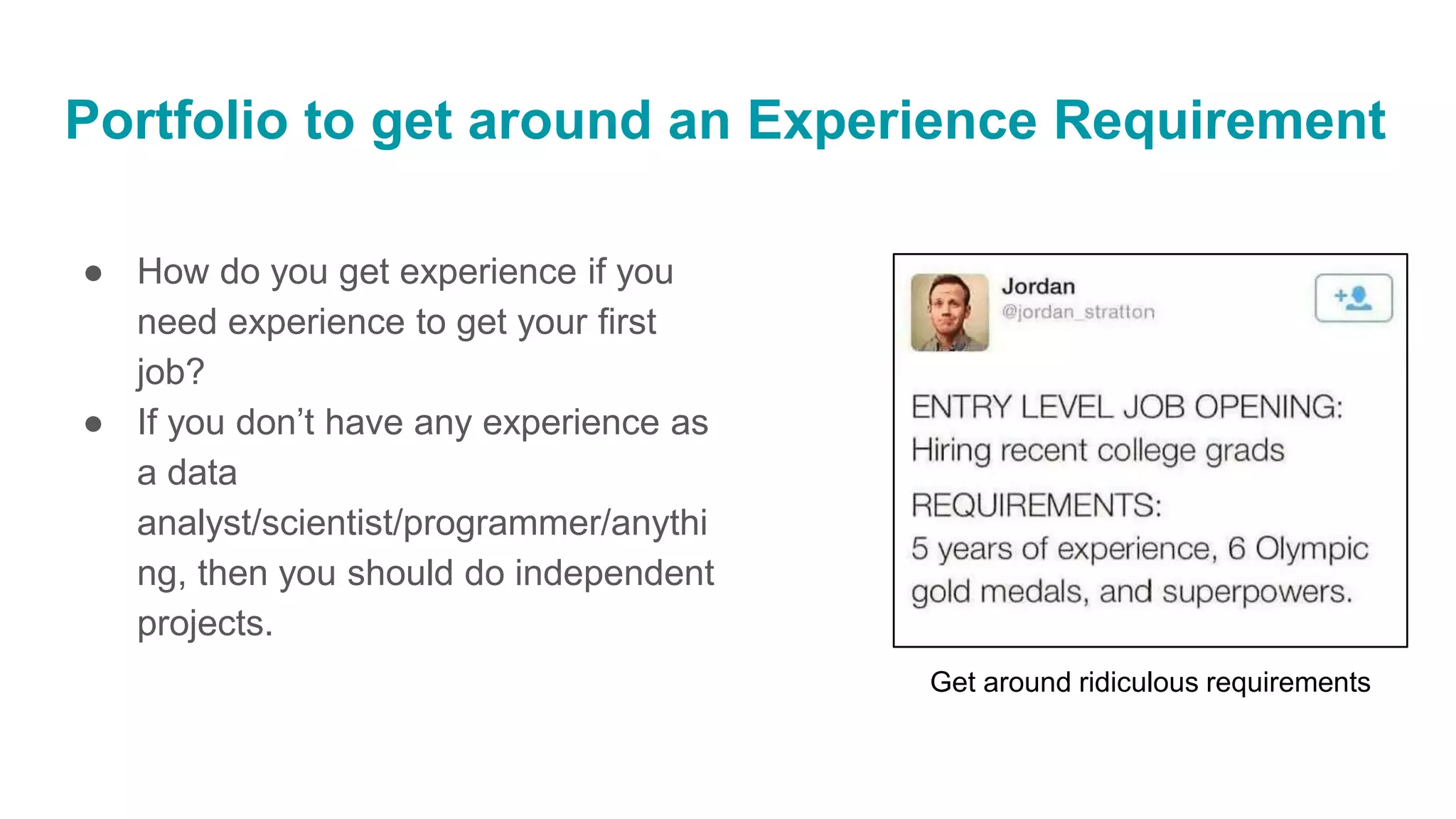
Get around ridiculous requirements
1. What is a Portfolio
2. My Portfolio
3. Identifying what to put in your
Portfolio
4. Portfolio to help networking
5. Portfolio for interviews/take
home challenges
6. Resume Advice
7. Social Media Advice
Building a Data Science Portfolio that Rocks
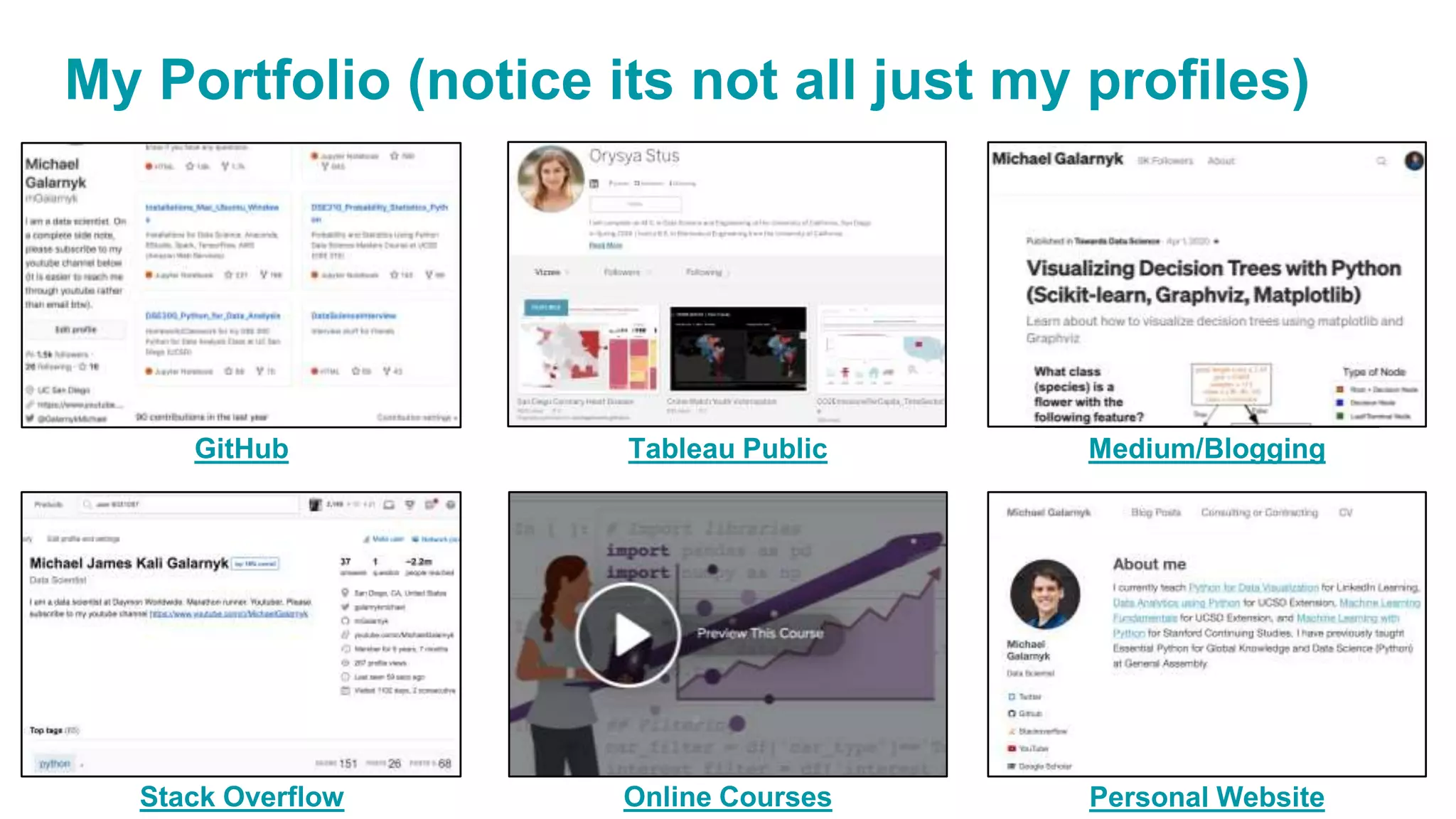
My Portfolio (notice its not all just my profiles)
GitHub Tableau Public Medium/Blogging
Stack Overflow Online Courses Personal Website
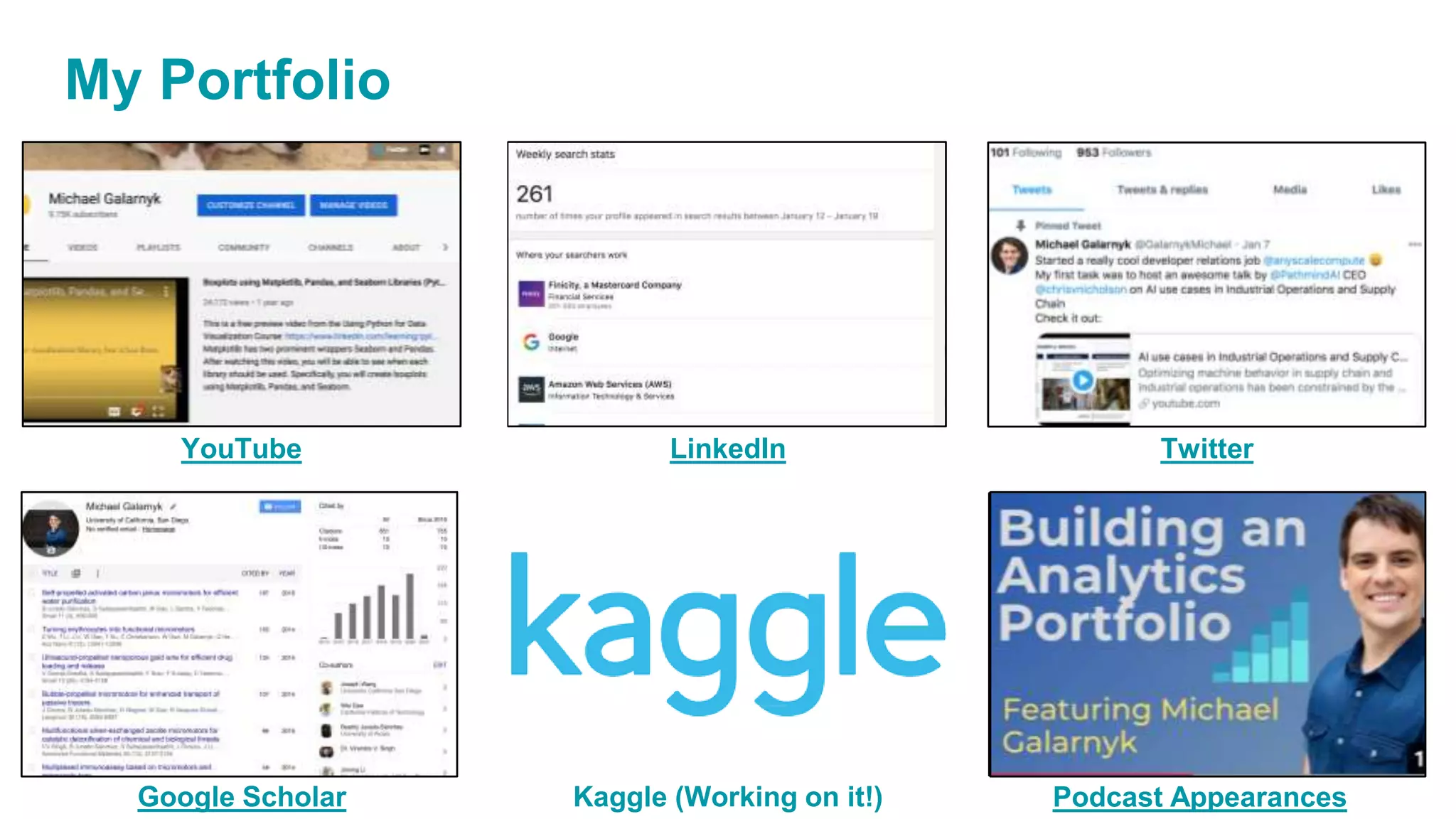
My Portfolio
YouTube LinkedIn Twitter
Google Scholar Kaggle (Working on it!) Podcast Appearances
This lecture
My Portfolio
Organizing/Attending Events This Talk Resume
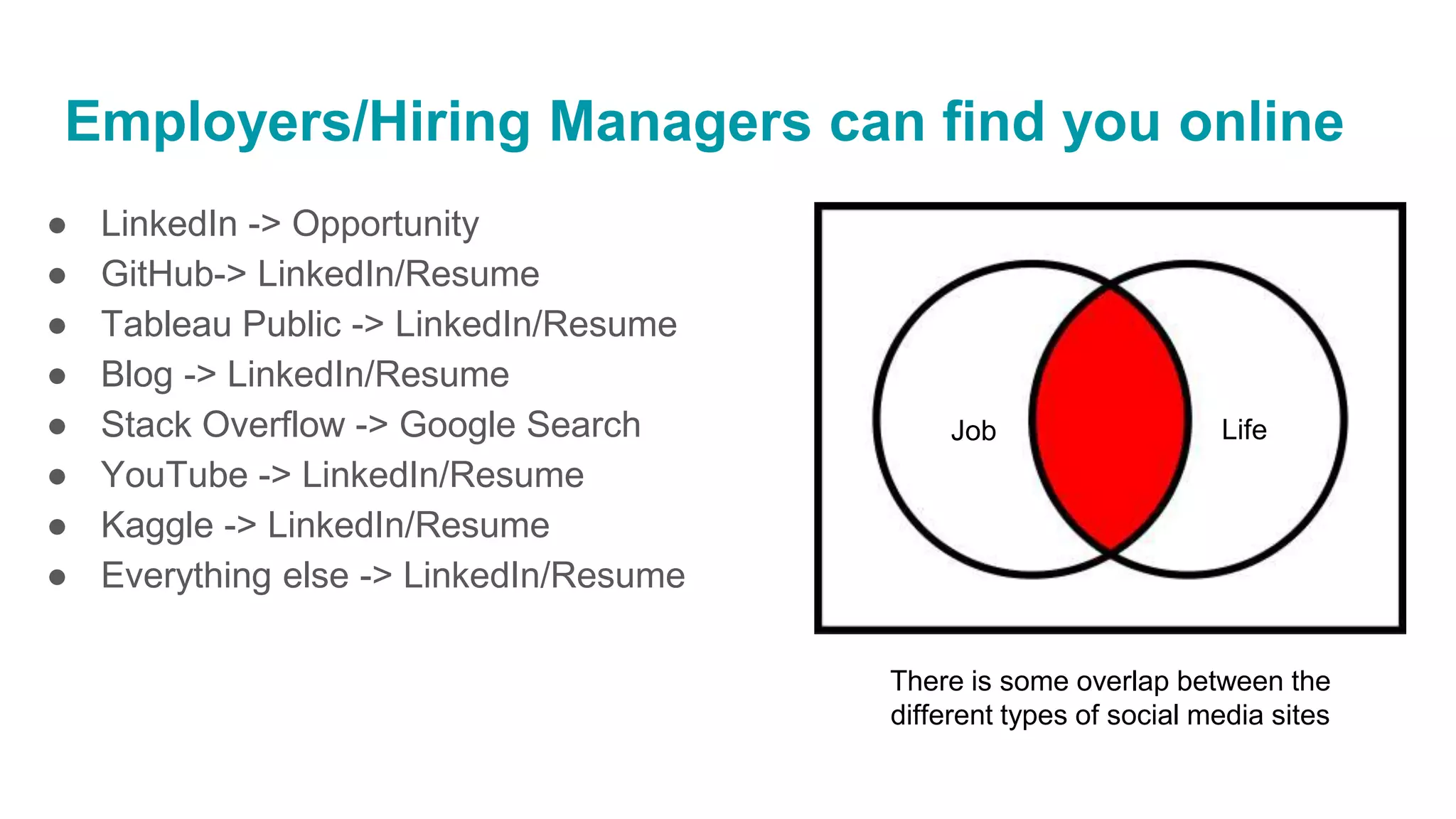
Employers/Hiring Managers can find you online
● LinkedIn -> Opportunity
● GitHub-> LinkedIn/Resume
● Tableau Public -> LinkedIn/Resume
● Blog -> LinkedIn/Resume
● Stack Overflow -> Google Search
● YouTube -> LinkedIn/Resume
● Kaggle -> LinkedIn/Resume
● Everything else -> LinkedIn/Resume
Job Life
There is some overlap between the
different types of social media sites
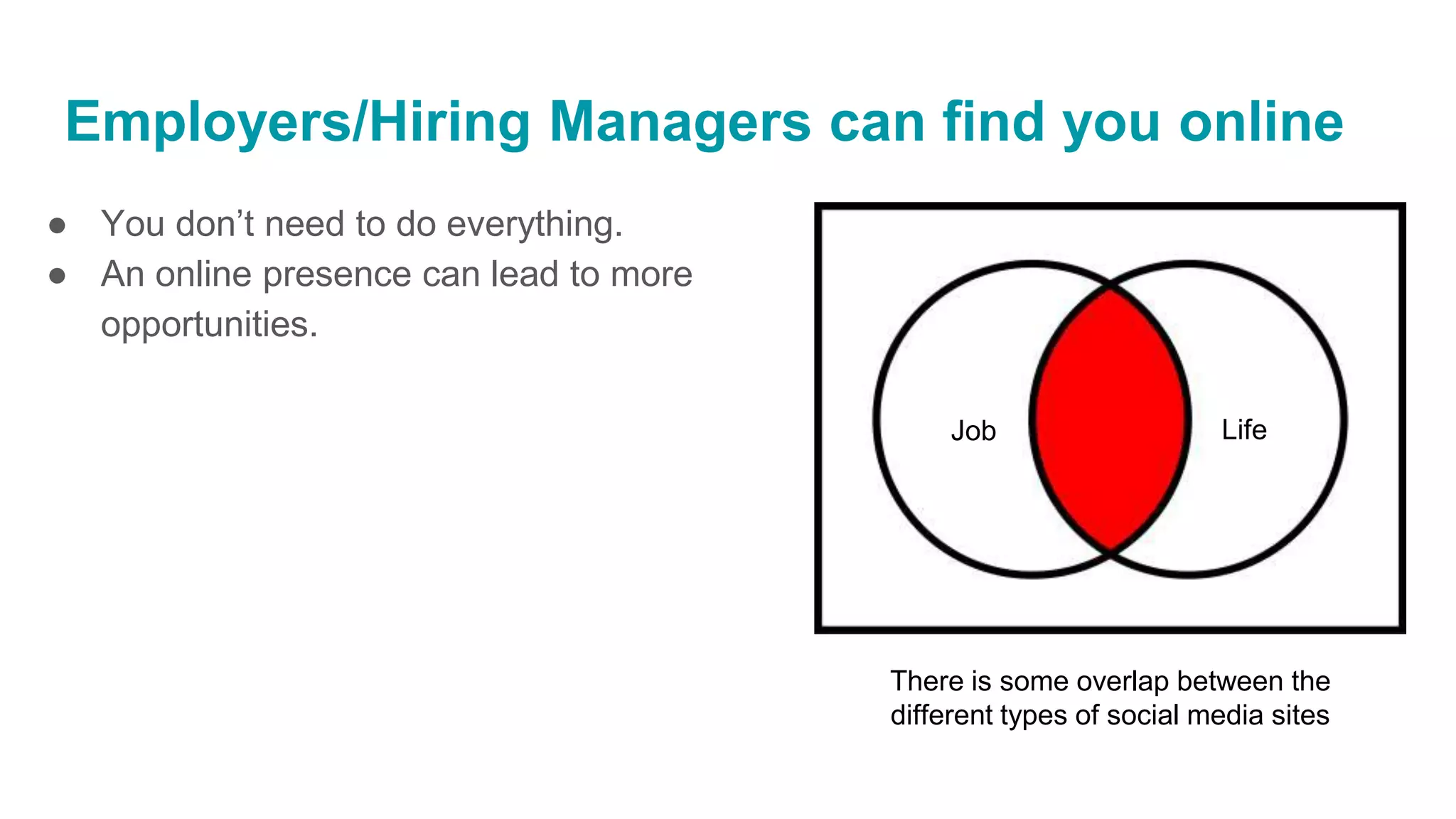
Employers/Hiring Managers can find you online
● You don’t need to do everything.
● An online presence can lead to more
opportunities.
Job Life
There is some overlap between the
different types of social media sites
1. What is a Portfolio
2. My Portfolio
3. Identifying what to put in
your Portfolio
4. Portfolio to help networking
5. Portfolio for interviews/take
home challenges
6. Resume Advice
7. Social Media Advice
Building a Data Science Portfolio that Rocks
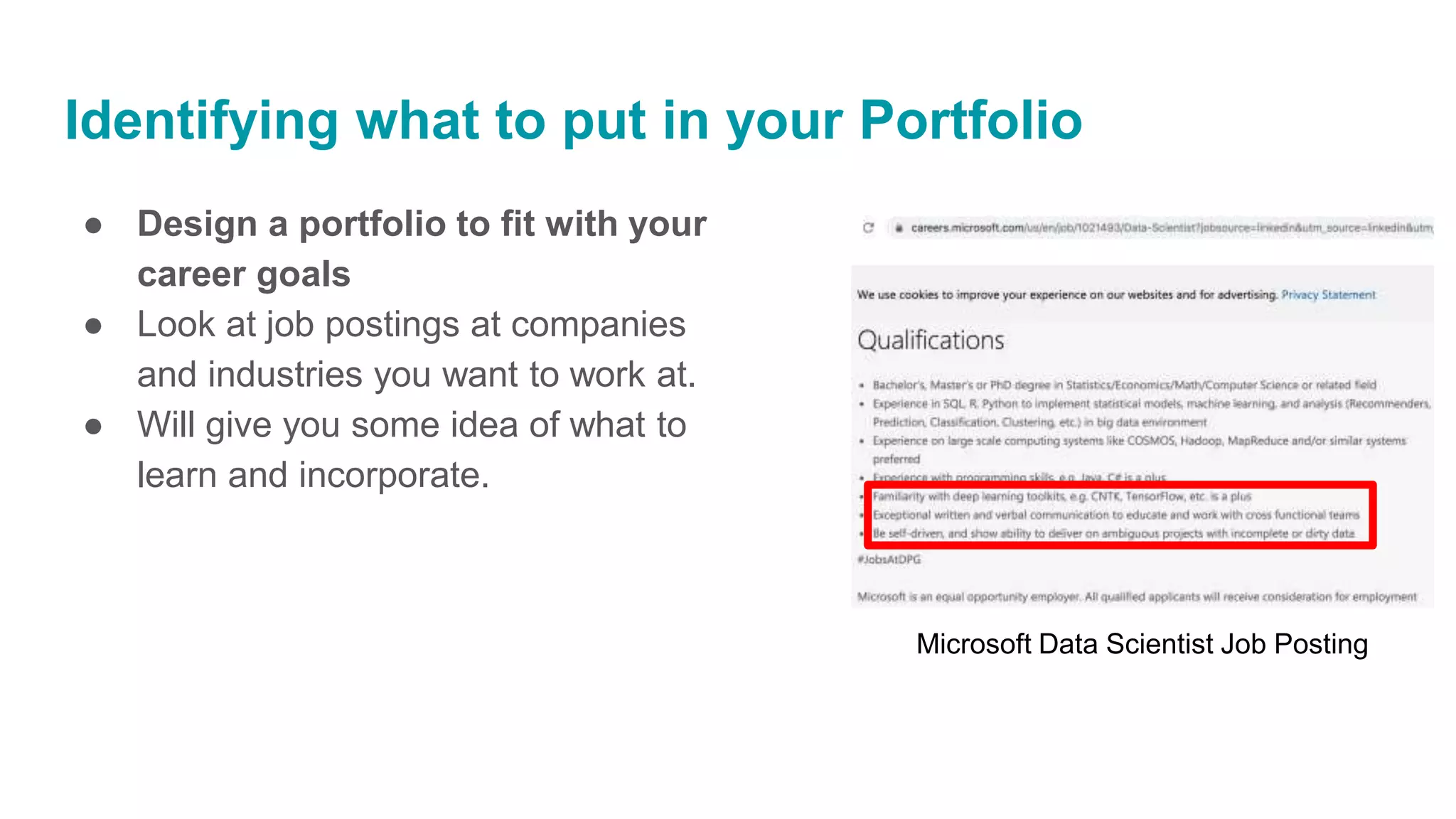
Identifying what to put in your Portfolio
Microsoft Data Scientist Job Posting
● Design a portfolio to fit with your
career goals
● Look at job postings at companies
and industries you want to work at.
● Will give you some idea of what to
learn and incorporate.
Identifying what to put in your Portfolio
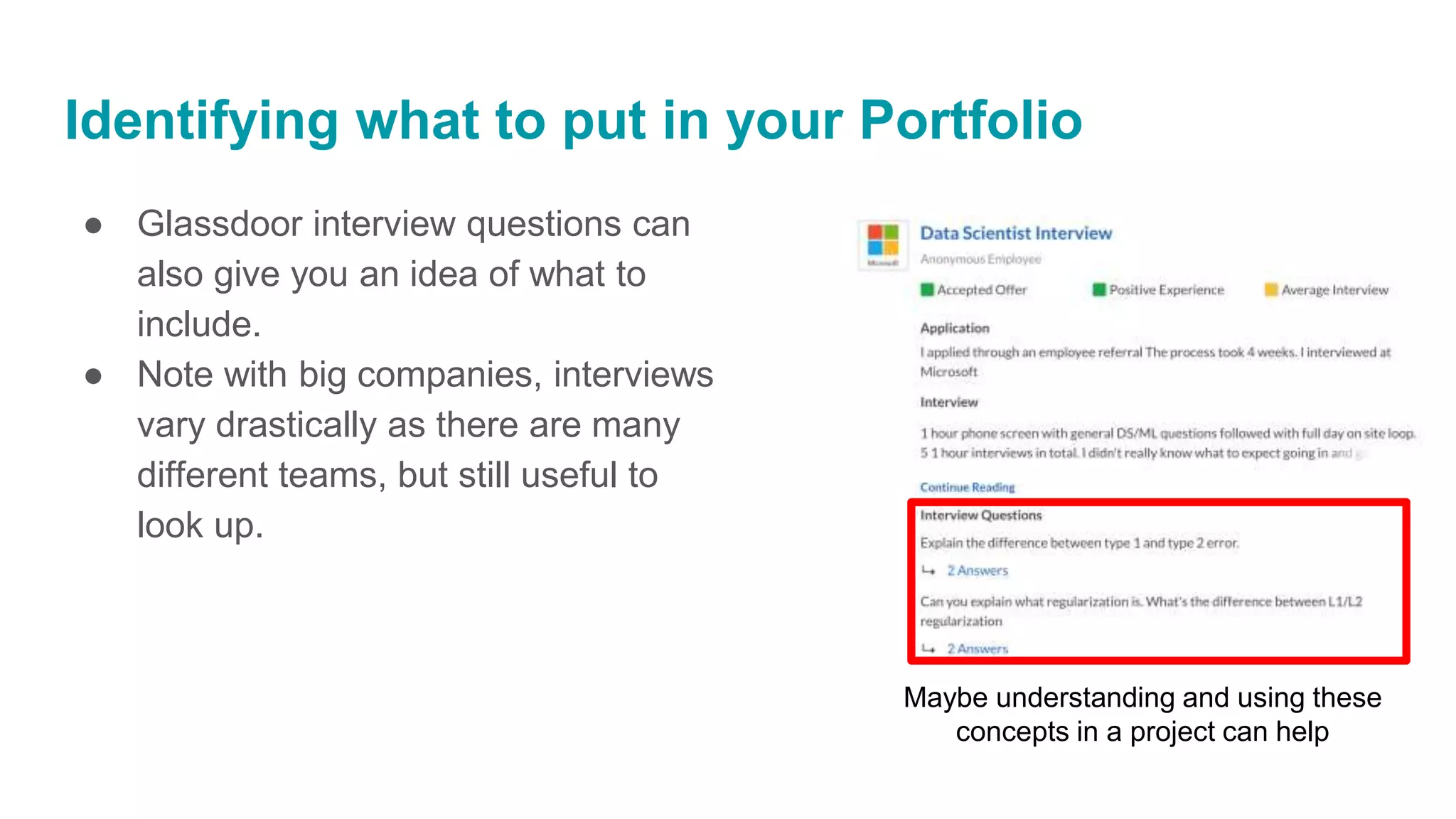
Maybe understanding and using these
concepts in a project can help
● Glassdoor interview questions can
also give you an idea of what to
include.
● Note with big companies, interviews
vary drastically as there are many
different teams, but still useful to
look up.
Identifying what to put in your Portfolio
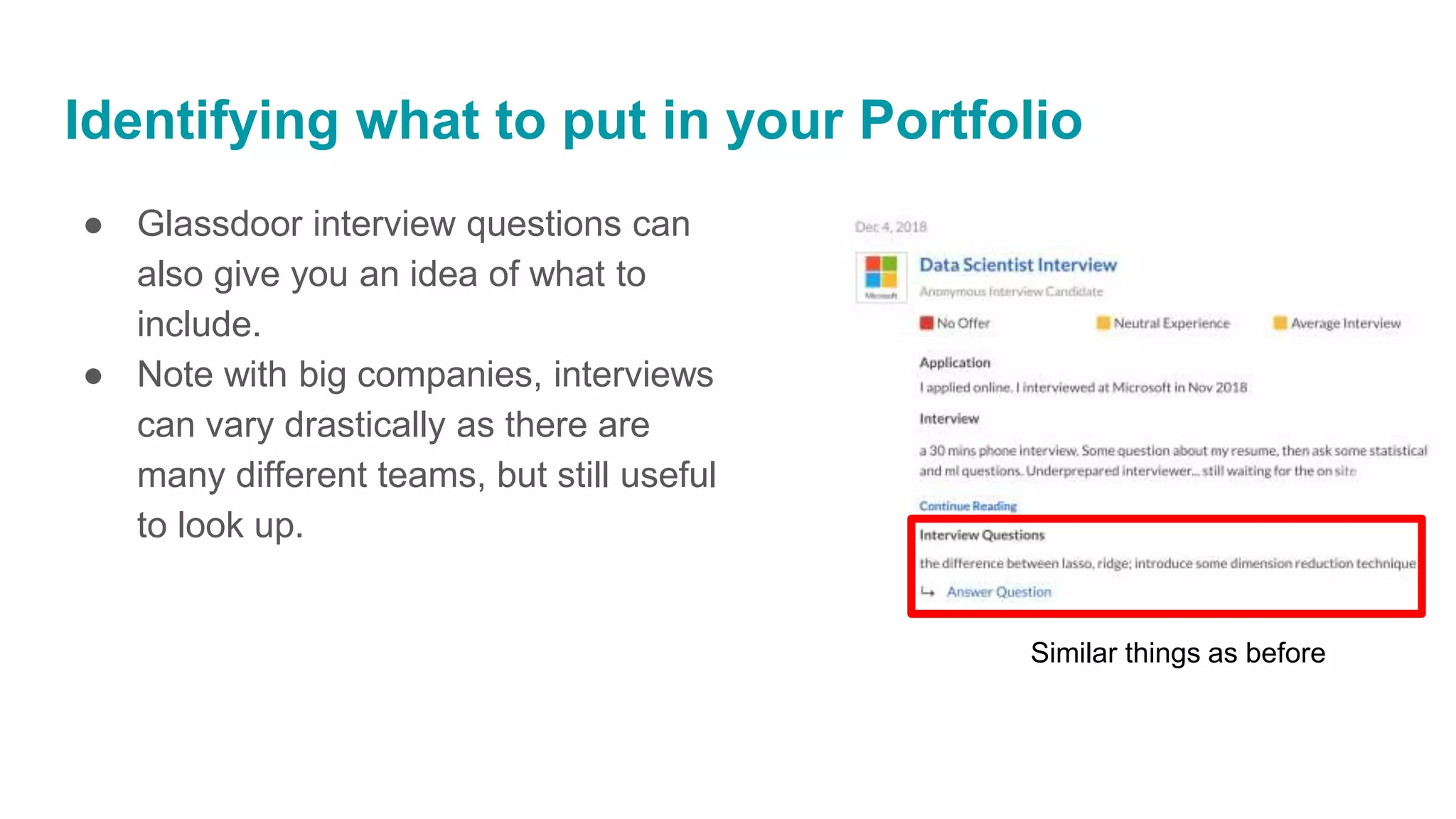
Similar things as before
● Glassdoor interview questions can
also give you an idea of what to
include.
● Note with big companies, interviews
can vary drastically as there are
many different teams, but still useful
to look up.
Identifying what to put in your Portfolio
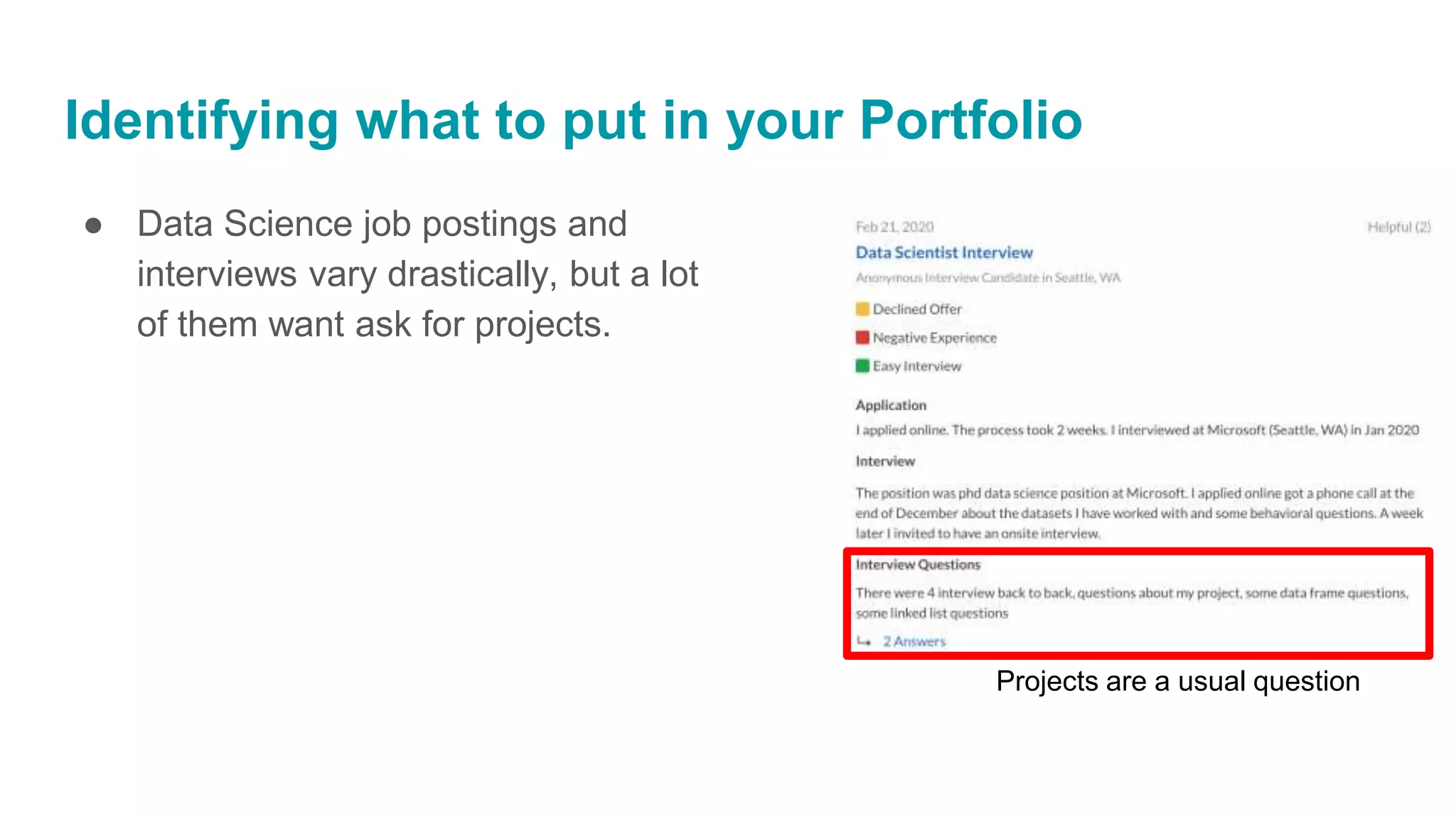
Projects are a usual question
● Data Science job postings and
interviews vary drastically, but a lot
of them want ask for projects.
Identifying what to put in your Portfolio
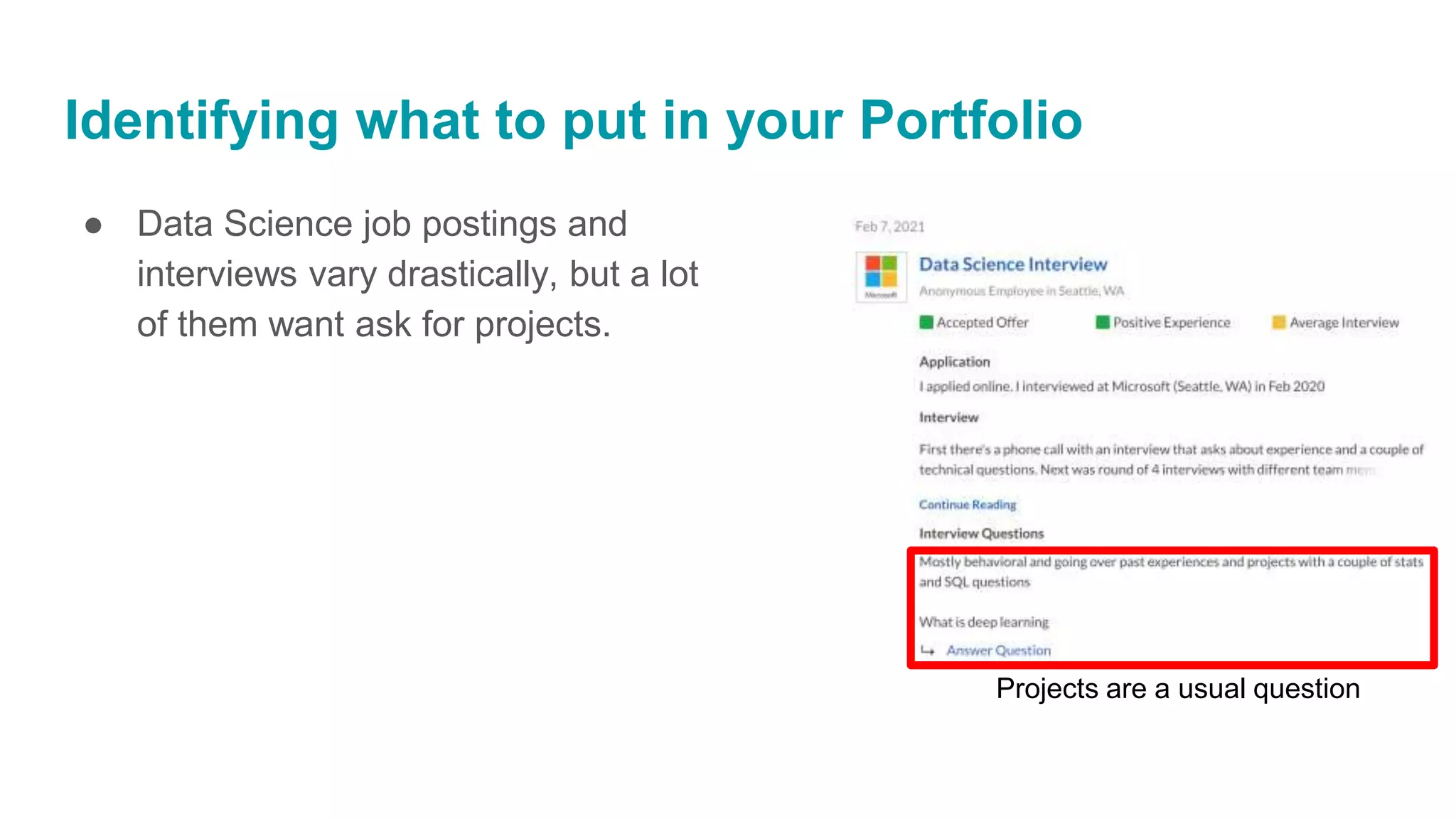
Projects are a usual question
● Data Science job postings and
interviews vary drastically, but a lot
of them want ask for projects.
Identifying what to put in your Portfolio
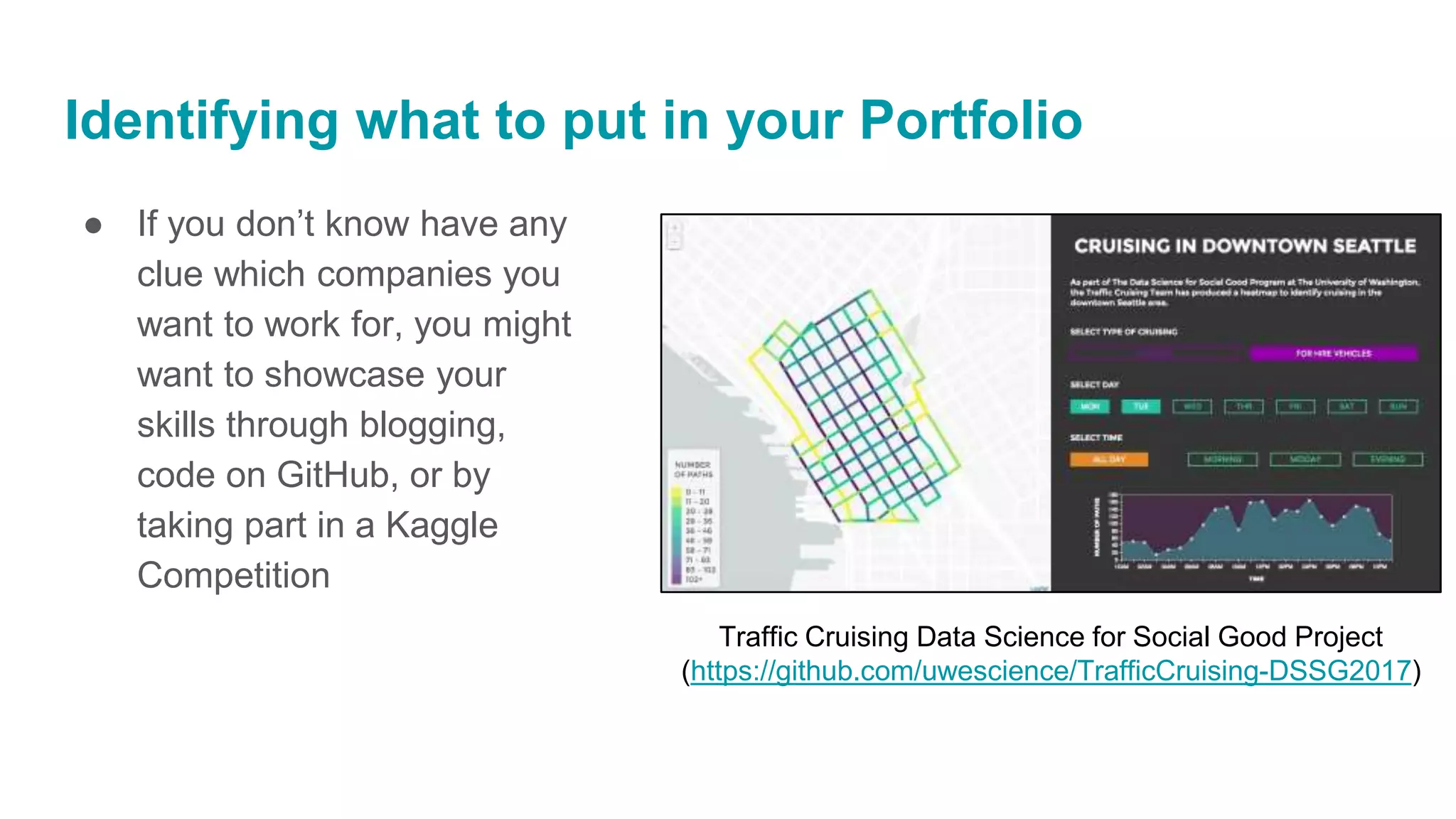
● If you don’t know have any
clue which companies you
want to work for, you might
want to showcase your
skills through blogging,
code on GitHub, or by
taking part in a Kaggle
Competition
Traffic Cruising Data Science for Social Good Project
(https://github.com/uwescience/TrafficCruising-DSSG2017)
Types of Projects to Include in a Portfolio
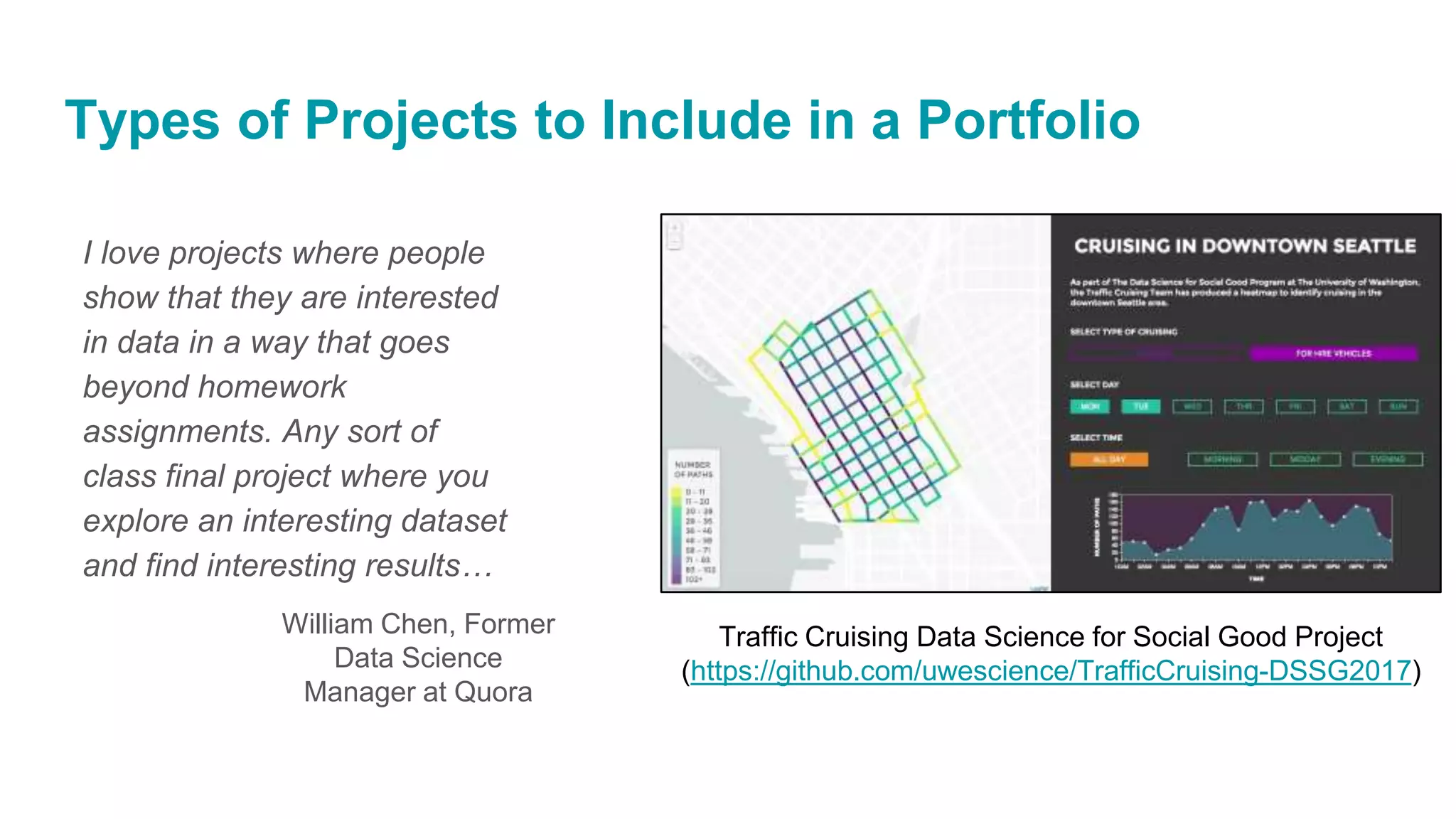
I love projects where people
show that they are interested
in data in a way that goes
beyond homework
assignments. Any sort of
class final project where you
explore an interesting dataset
and find interesting results…
William Chen, Former
Data Science
Manager at Quora
Traffic Cruising Data Science for Social Good Project
(https://github.com/uwescience/TrafficCruising-DSSG2017)
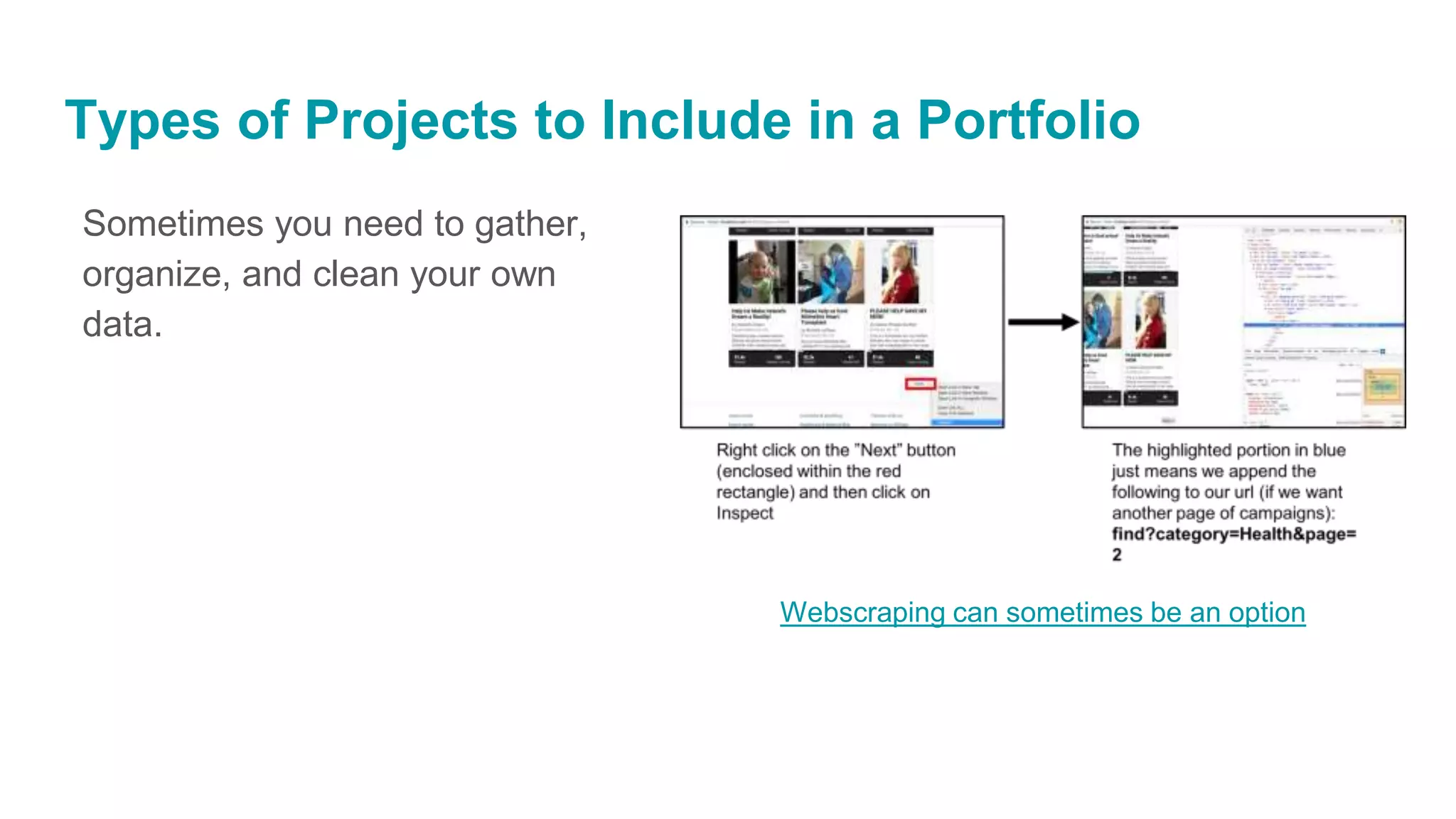
Sometimes you need to gather,
organize, and clean your own
data.
Types of Projects to Include in a Portfolio
Webscraping can sometimes be an option
1. What is a Portfolio
2. My Portfolio
3. Identifying what to put in your
Portfolio
4. Portfolio to help networking
5. Portfolio for interviews/take
home challenges
6. Resume Advice
7. Social Media Advice
Building a Data Science Portfolio that Rocks
Portfolio to help networking
● A lot of people approach networking/job hunting as “it’s not what you know,
it’s who you know”
● Networking is about establishing real connections with a person or
company.
● Real connections are about authentic two-way relationships.
● This means that your network should consist of people that you can help, not
just people who you think can help you.
Portfolio to help networking
● If you have helped someone out, they might think better of you and be
happier to see you succeed and potentially help you when you need help.
● Small example: If you post a blog on LinkedIn, people in your network might
share it to a broader audience.
● Medium example: If you brought value to your data analytics/science
community, they might be more receptive to referral requests.
● Large example: It’s possible someone in your network might reach out to you
about jobs to see if you are interested, instead of the other way around.
Portfolio to help networking
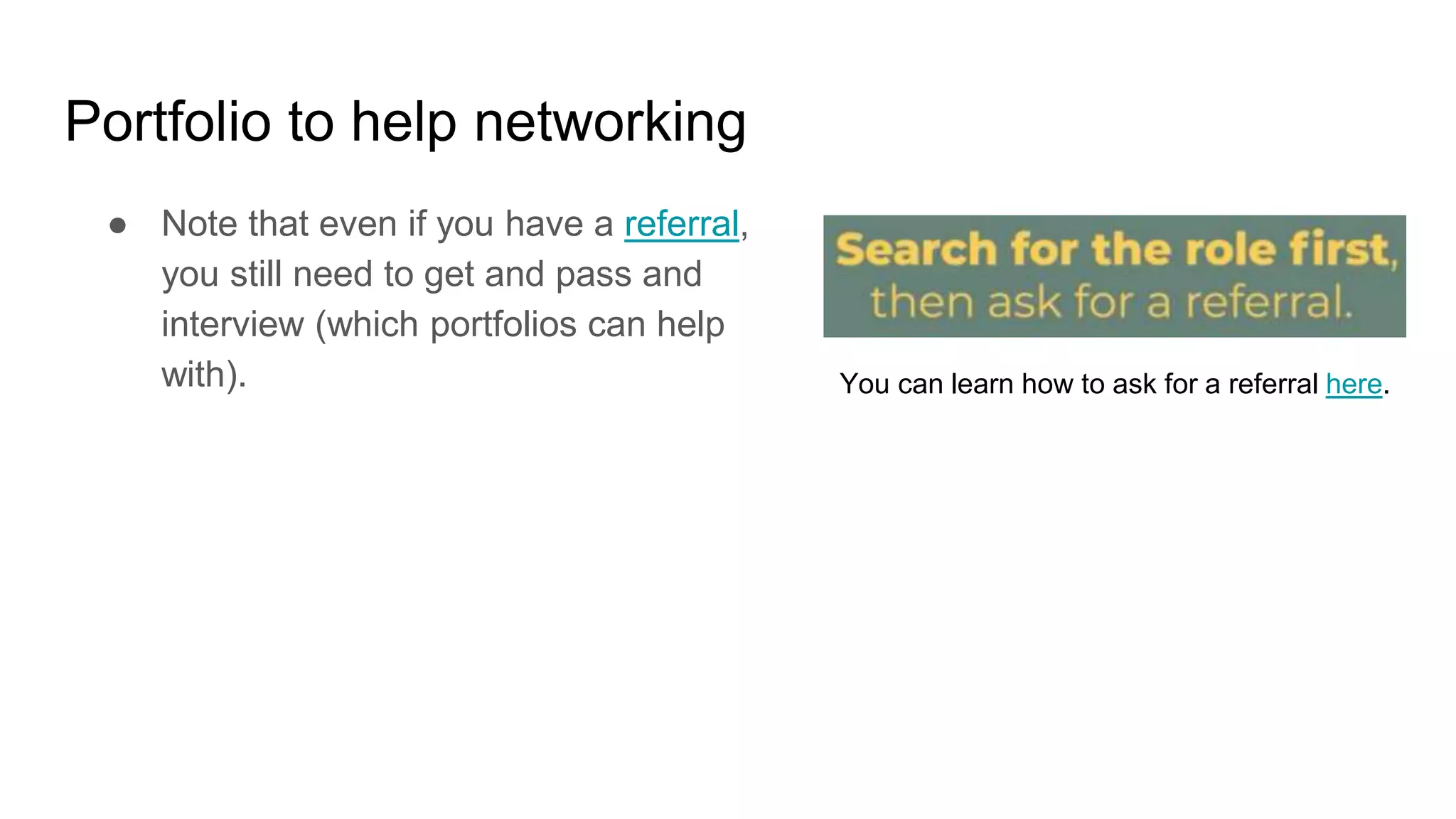
● Note that even if you have a referral,
you still need to get and pass and
interview (which portfolios can help
with). You can learn how to ask for a referral here.
Normal ways to build your network (portfolio helps with this too)
● Attend conferences
● Join data related meetup groups
● Participate in college or bootcamp alumni groups,
● Connect with people through LinkedIn and Twitter.
1. What is a Portfolio
2. My Portfolio
3. Identifying what to put in your
Portfolio
4. Portfolio to help networking
5. Portfolio for interviews/take
home challenges
6. Resume Advice
7. Social Media Advice
Building a Data Science Portfolio that Rocks
Take Home Challenges
● Interview processes often have case
studies
● Companies often send you sample
data analytics/science problems to
work on
● Idea: Give challenge that resembles
the work you would be doing on the
job.
Image Source
Take Home Challenges
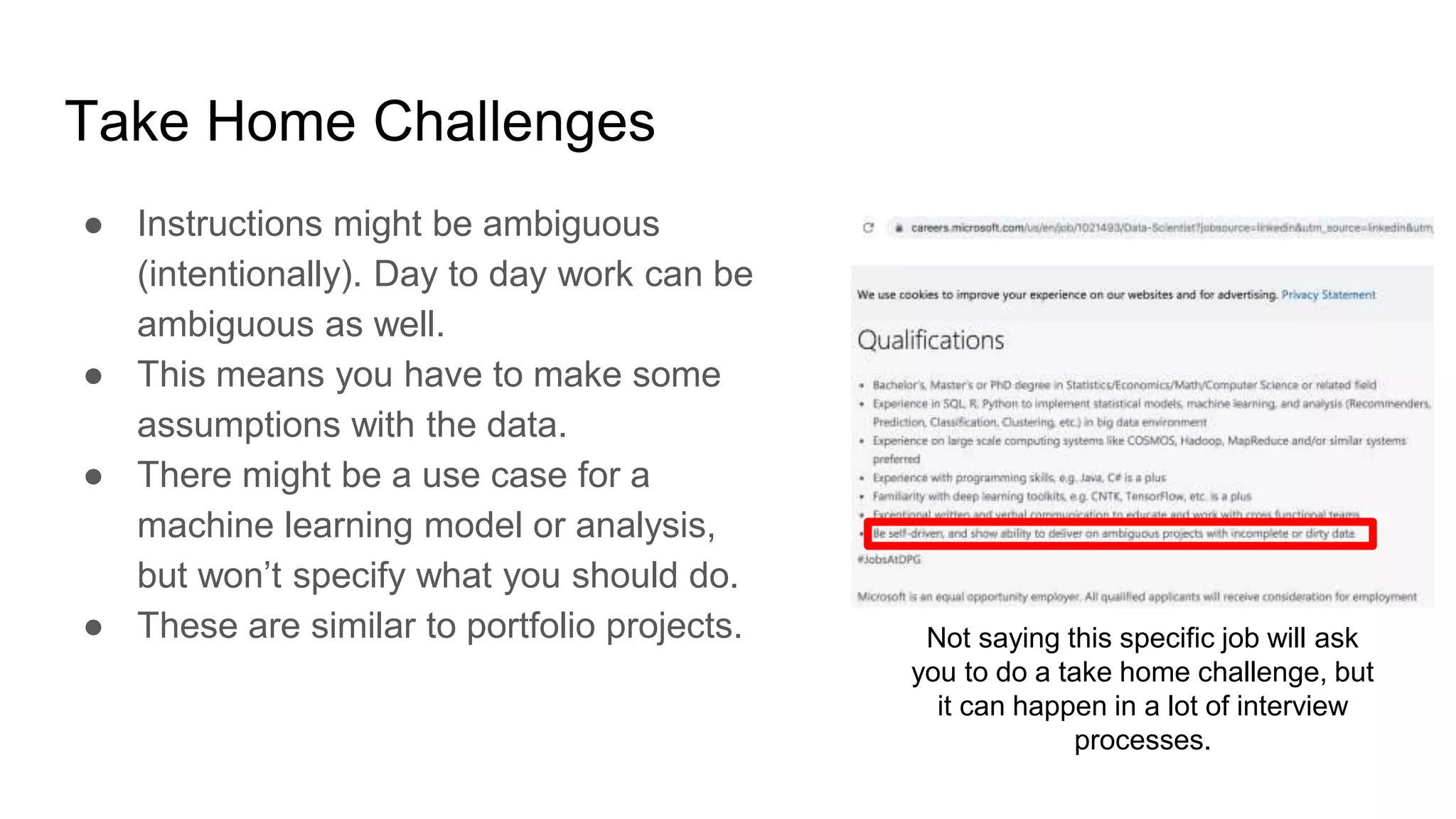
● Instructions might be ambiguous
(intentionally). Day to day work can be
ambiguous as well.
● This means you have to make some
assumptions with the data.
● There might be a use case for a
machine learning model or analysis,
but won’t specify what you should do.
● These are similar to portfolio projects. Not saying this specific job will ask
you to do a take home challenge, but
it can happen in a lot of interview
processes.
Take Home Challenges
● Instructions might be ambiguous
(intentionally). Day to day work can be
ambiguous as well.
● This means you have to make some
assumptions with the data.
● There might be a use case for a
machine learning model or analysis,
but won’t specify what you should do.
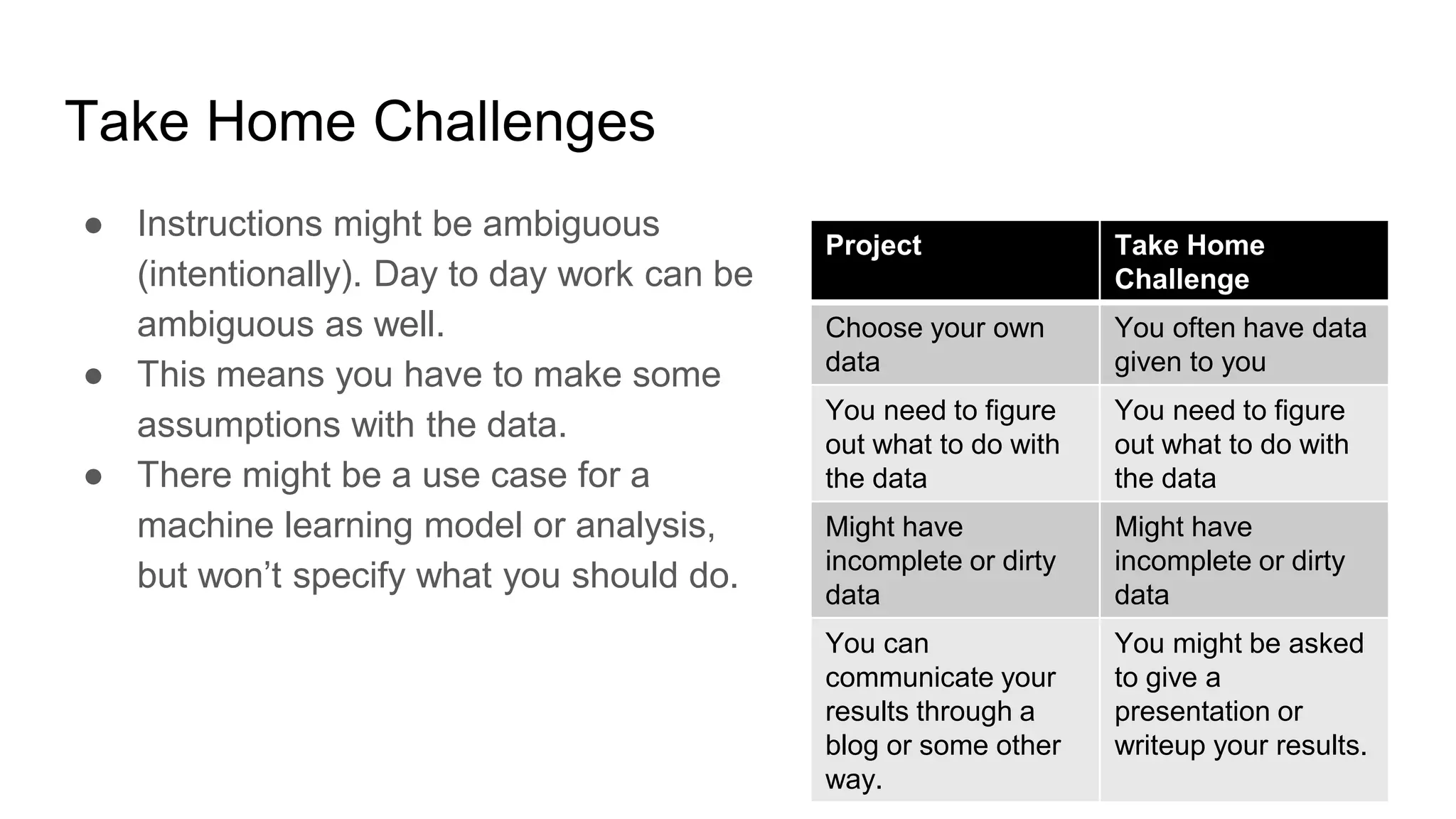
Project Take Home
Challenge
Choose your own
data
You often have data
given to you
You need to figure
out what to do with
the data
You need to figure
out what to do with
the data
Might have
incomplete or dirty
data
Might have
incomplete or dirty
data
You can
communicate your
results through a
blog or some other
way.
You might be asked
to give a
presentation or
writeup your results.
Take Home Challenges
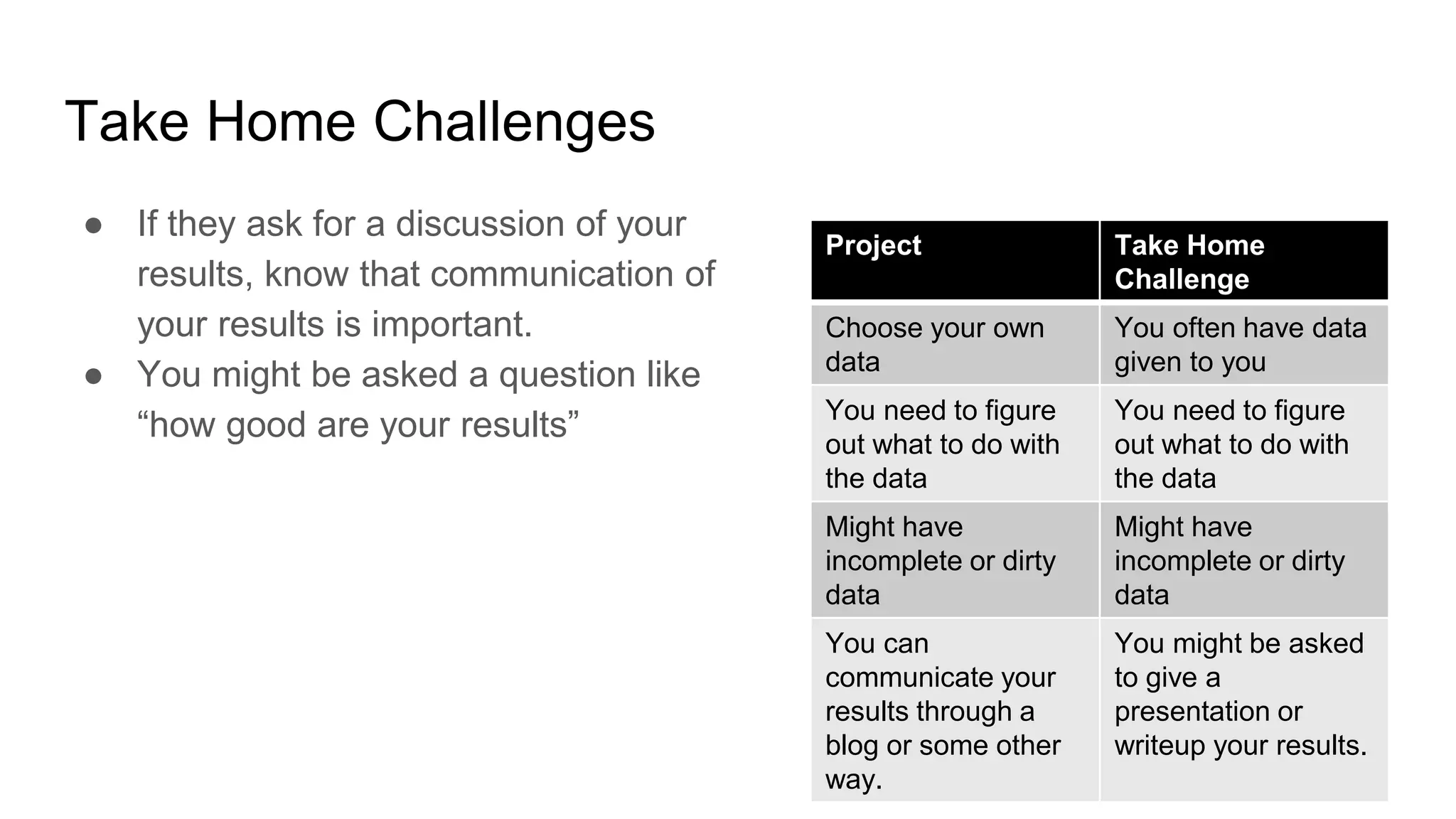
● If they ask for a discussion of your
results, know that communication of
your results is important.
● You might be asked a question like
“how good are your results”
Project Take Home
Challenge
Choose your own
data
You often have data
given to you
You need to figure
out what to do with
the data
You need to figure
out what to do with
the data
Might have
incomplete or dirty
data
Might have
incomplete or dirty
data
You can
communicate your
results through a
blog or some other
way.
You might be asked
to give a
presentation or
writeup your results.
Take Home Challenges
● Having a portfolio can make these
challenges easier.
● Often with a portfolio project, you have
to take data which may or may not be
clean and try to solve some problem.
● They both usually require you to
communicate how your analysis
works.
Project Take Home
Challenge
Choose your own
data
You often have data
given to you
You need to figure
out what to do with
the data
You need to figure
out what to do with
the data
Might have
incomplete or dirty
data
Might have
incomplete or dirty
data
You can
communicate your
results through a
blog or some other
way.
You might be asked
to give a
presentation or
writeup your results.
Project Take Home
Challenge
Choose your own
data
You often have data
given to you
You need to figure
out what to do with
the data
You need to figure
out what to do with
the data
Might have
incomplete or dirty
data
Might have
incomplete or dirty
data
You can
communicate your
results through a
blog or some other
way.
You might be asked
to give a
presentation or
writeup your results.
Take Home Challenges
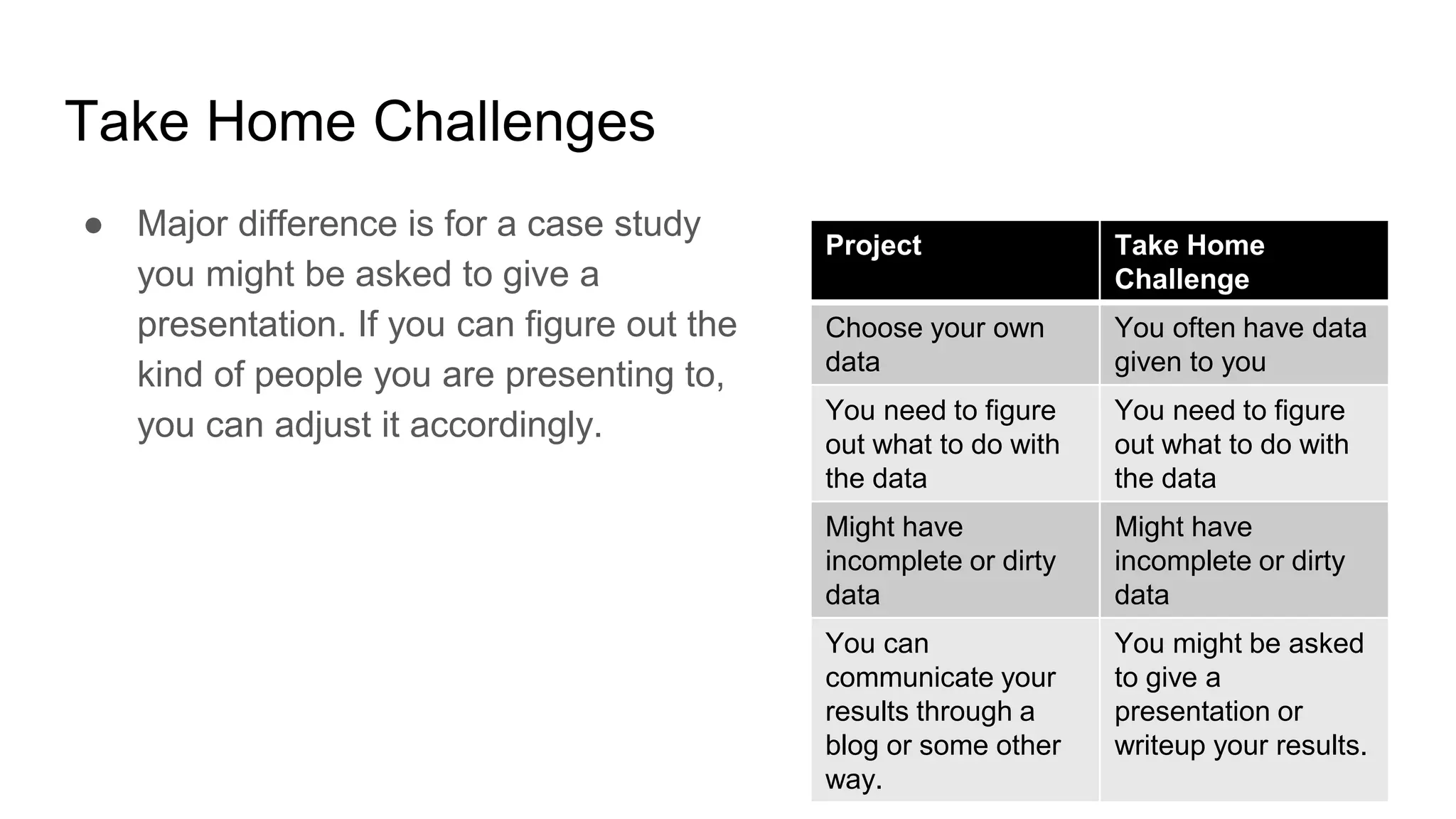
● Major difference is for a case study
you might be asked to give a
presentation. If you can figure out the
kind of people you are presenting to,
you can adjust it accordingly.
Project Take Home
Challenge
Choose your own
data
You often have data
given to you
You need to figure
out what to do with
the data
You need to figure
out what to do with
the data
Might have
incomplete or dirty
data
Might have
incomplete or dirty
data
You can
communicate your
results through a
blog or some other
way.
You might be asked
to give a
presentation or
writeup your results.
Take Home Challenges
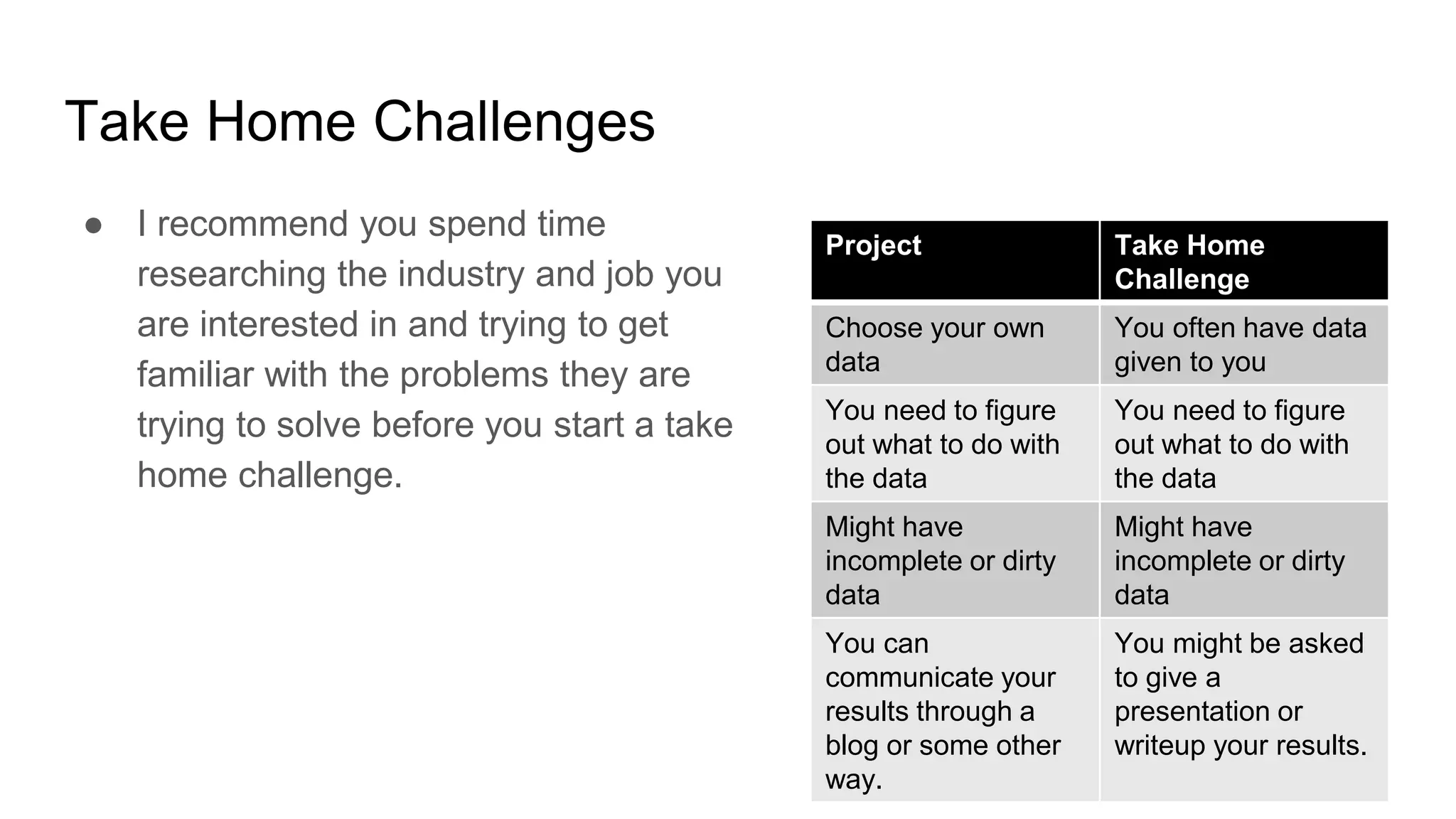
● I recommend you spend time
researching the industry and job you
are interested in and trying to get
familiar with the problems they are
trying to solve before you start a take
home challenge.
1. What is a Portfolio
2. My Portfolio
3. Identifying what to put in your
Portfolio
4. Portfolio to help networking
5. Portfolio for interviews/take
home challenges
6. Resume Advice
7. Social Media Advice
Building a Data Science Portfolio that Rocks
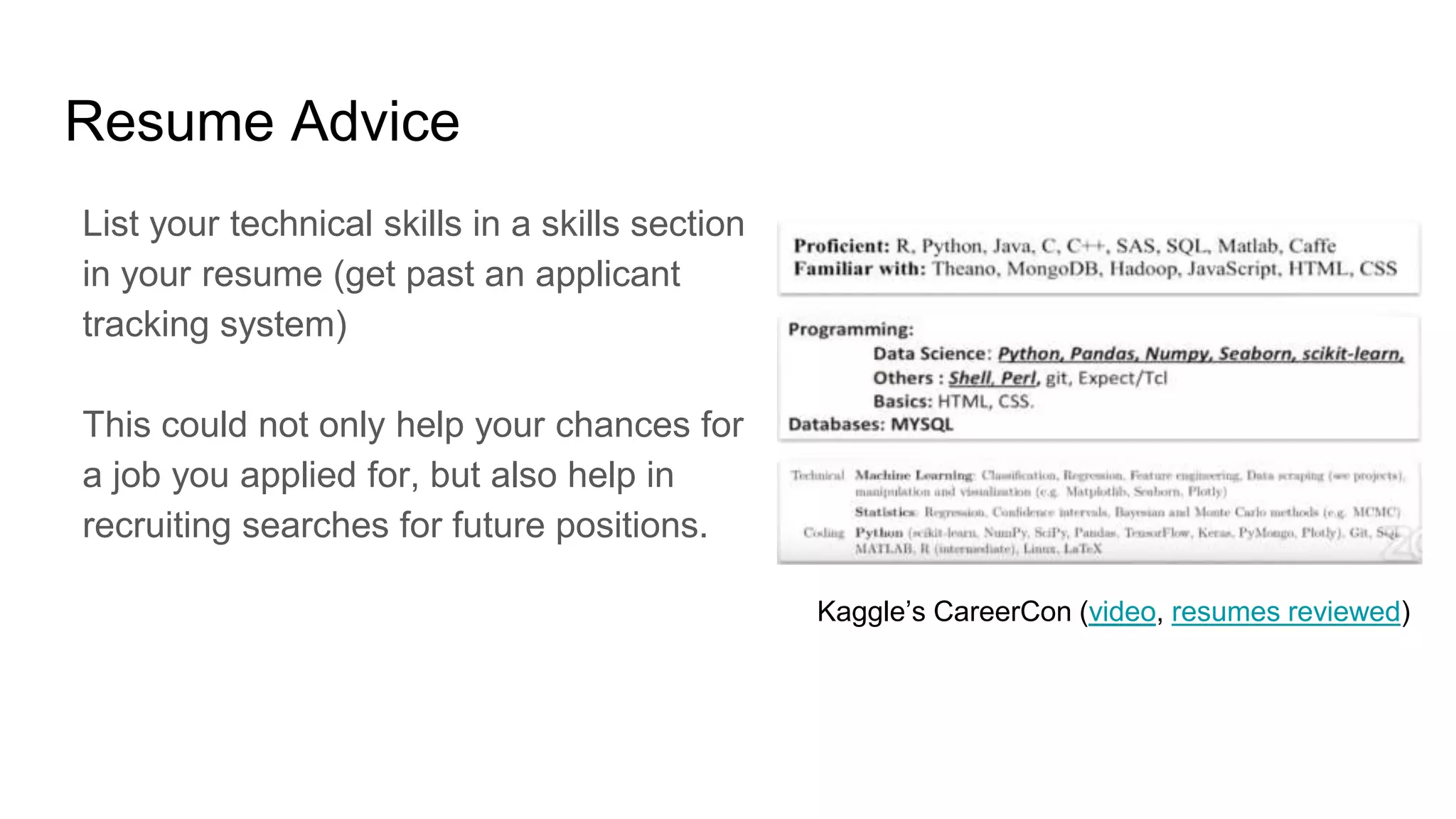
Resume Advice
List your technical skills in a skills section
in your resume (get past an applicant
tracking system)
This could not only help your chances for
a job you applied for, but also help in
recruiting searches for future positions.
Kaggle’s CareerCon (video, resumes reviewed)
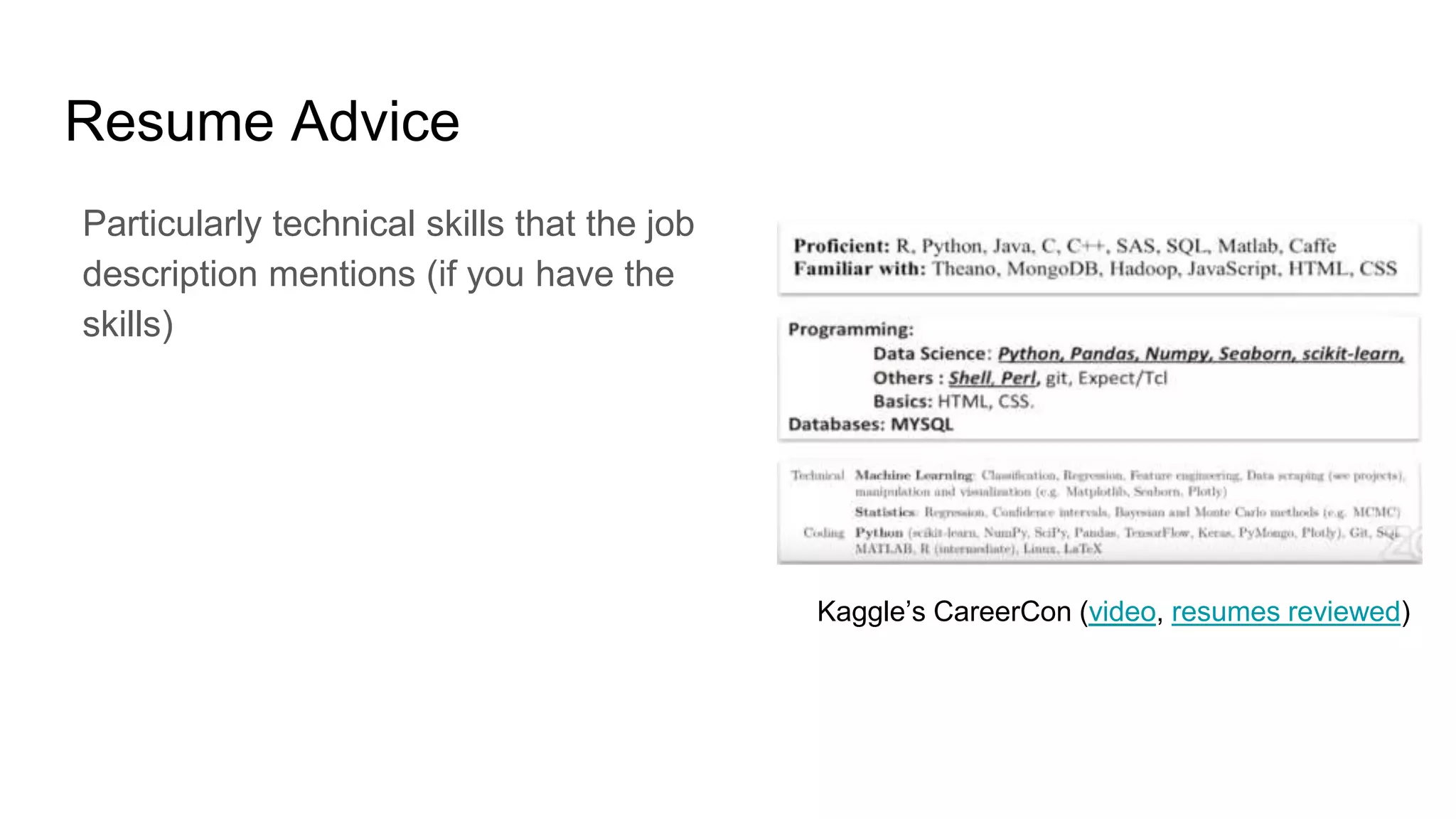
Resume Advice
Particularly technical skills that the job
description mentions (if you have the
skills)
Kaggle’s CareerCon (video, resumes reviewed)
Resume Advice
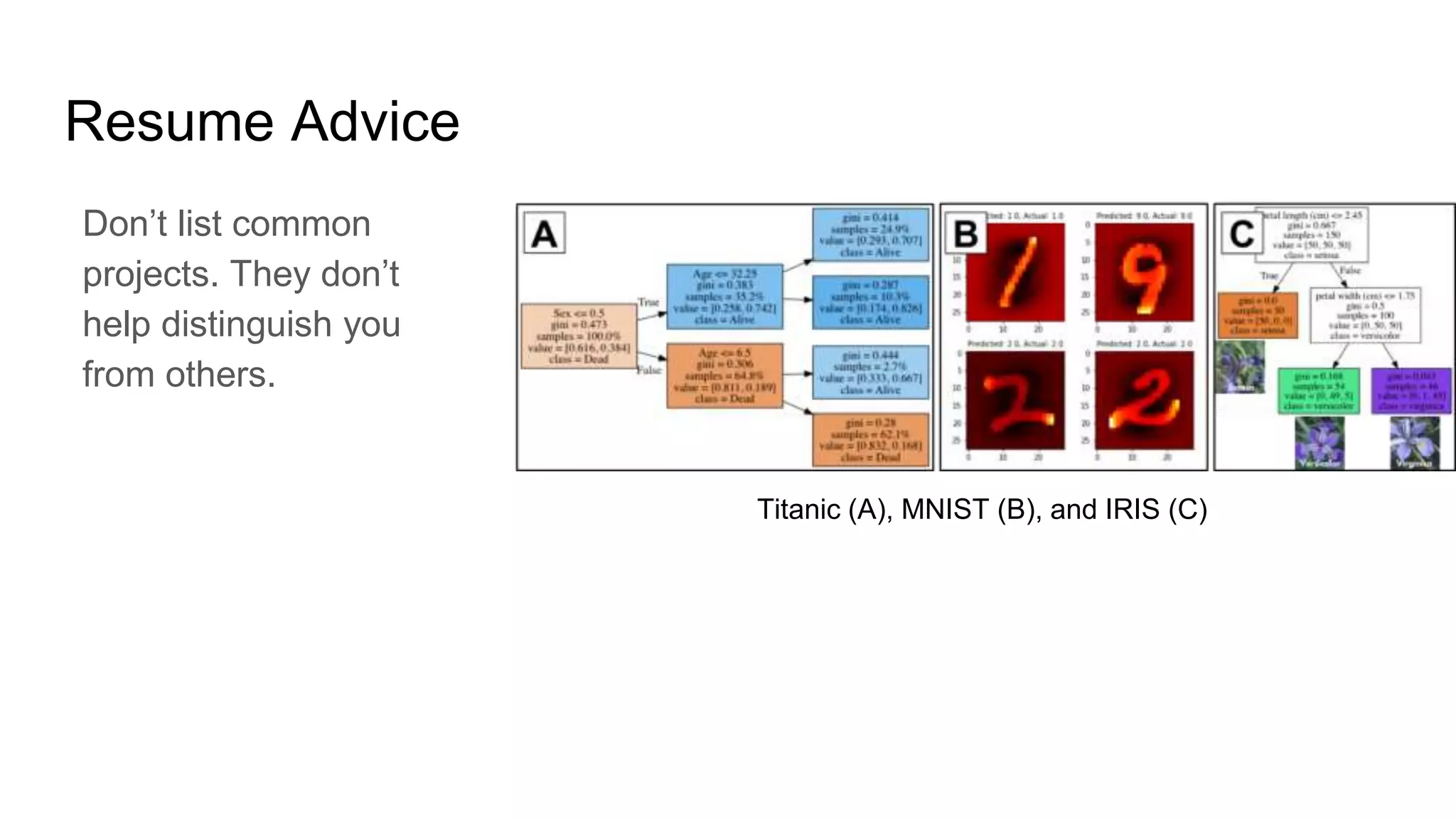
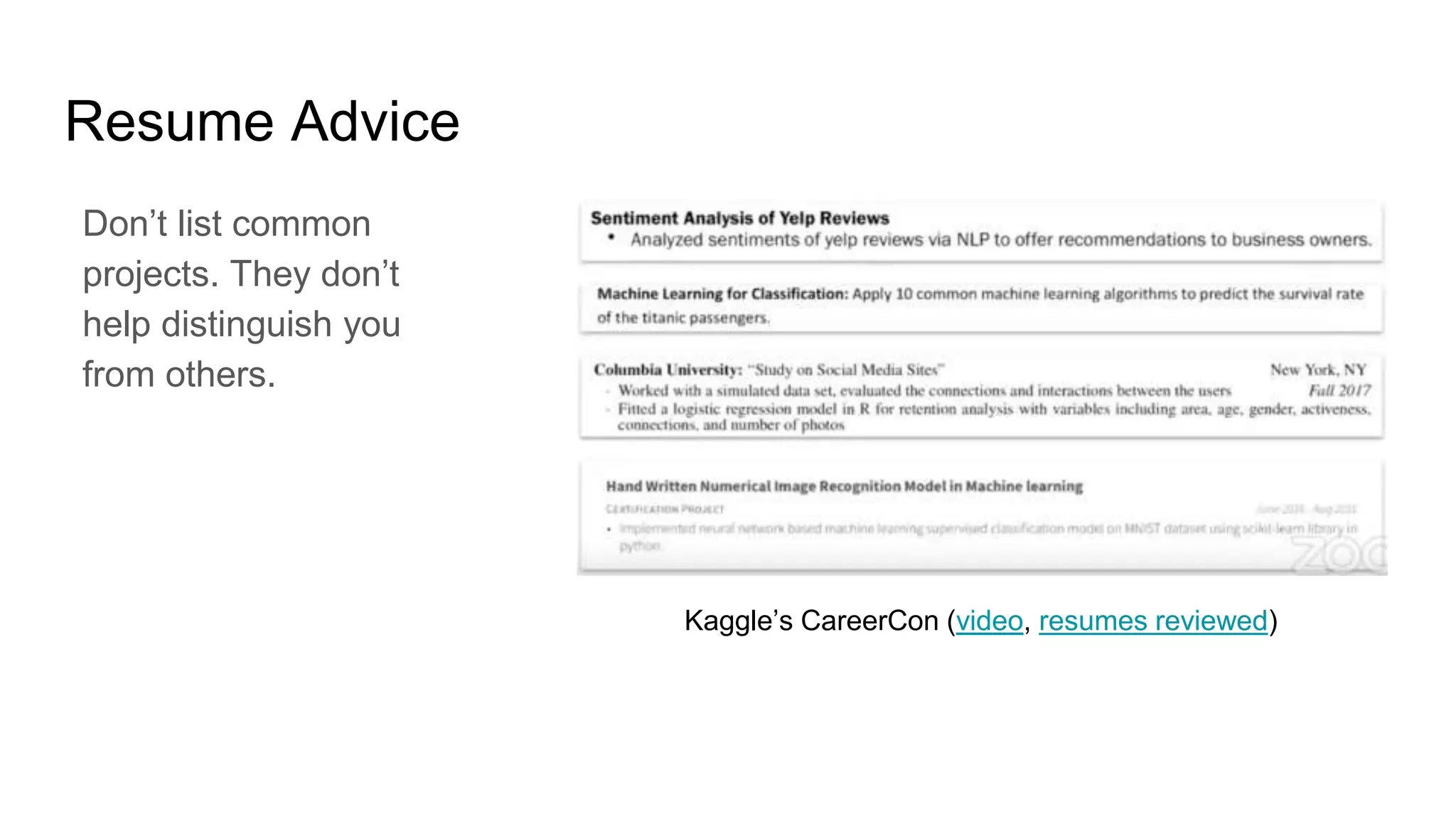
Don’t list common
projects. They don’t
help distinguish you
from others.
Titanic (A), MNIST (B), and IRIS (C)
Resume Advice
Don’t list common
projects. They don’t
help distinguish you
from others.
Titanic (A), MNIST (B), and IRIS (C)
Kaggle’s CareerCon (video, resumes reviewed)
Resume Advice
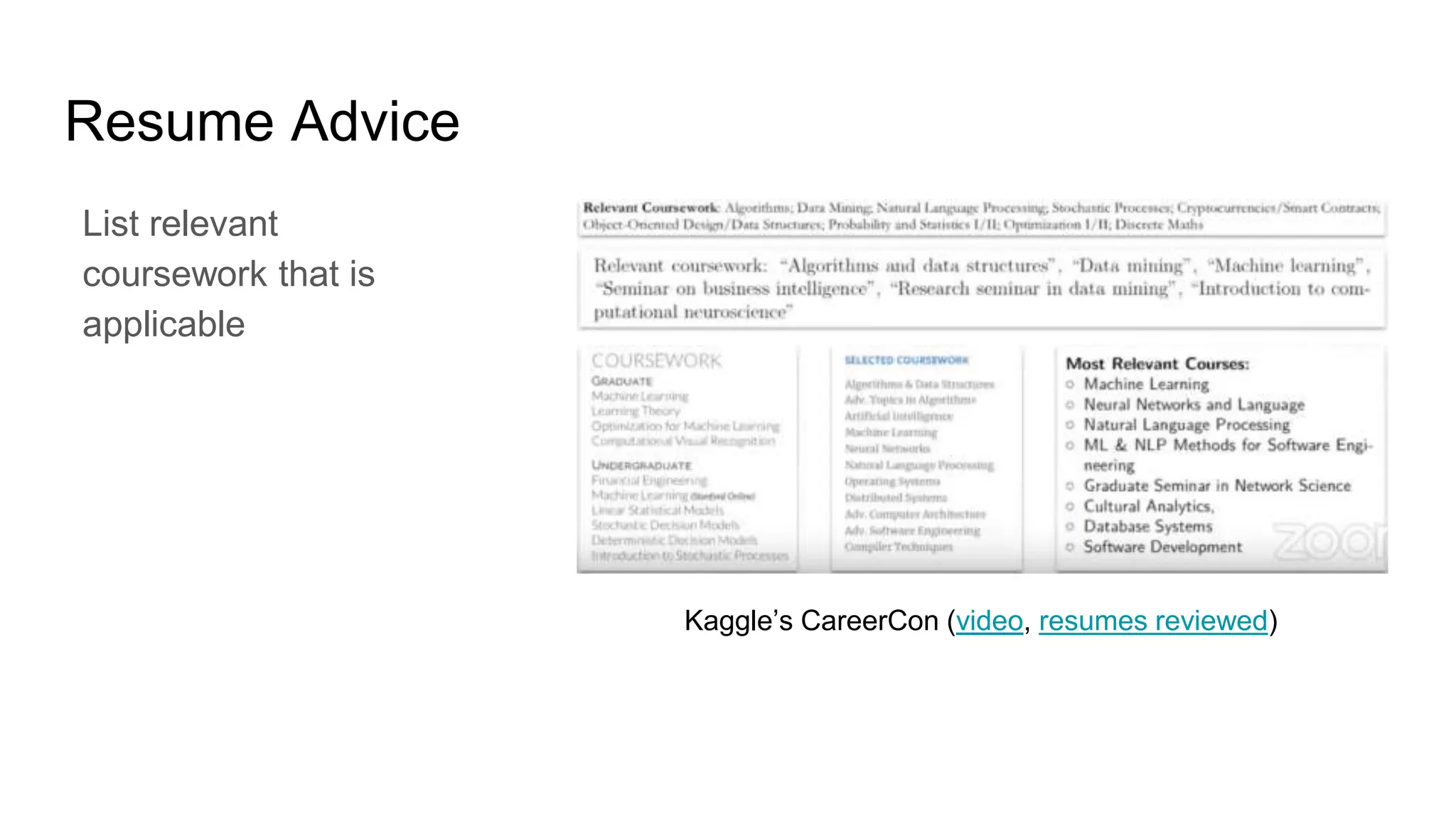
List relevant
coursework that is
applicable
Kaggle’s CareerCon (video, resumes reviewed)
Resume Advice
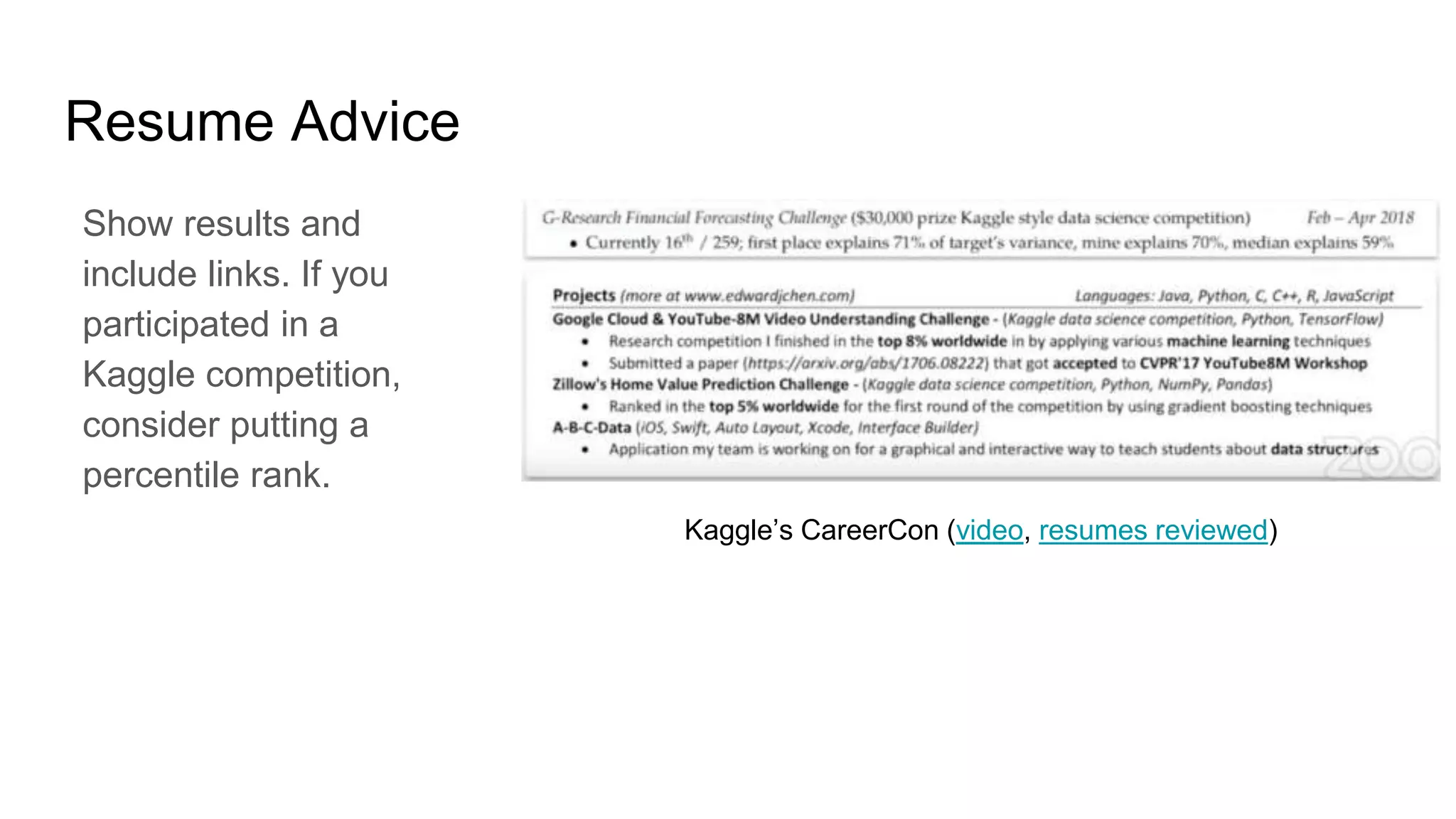
Show results and
include links. If you
participated in a
Kaggle competition,
consider putting a
percentile rank.
Kaggle’s CareerCon (video, resumes reviewed)
Resume Advice
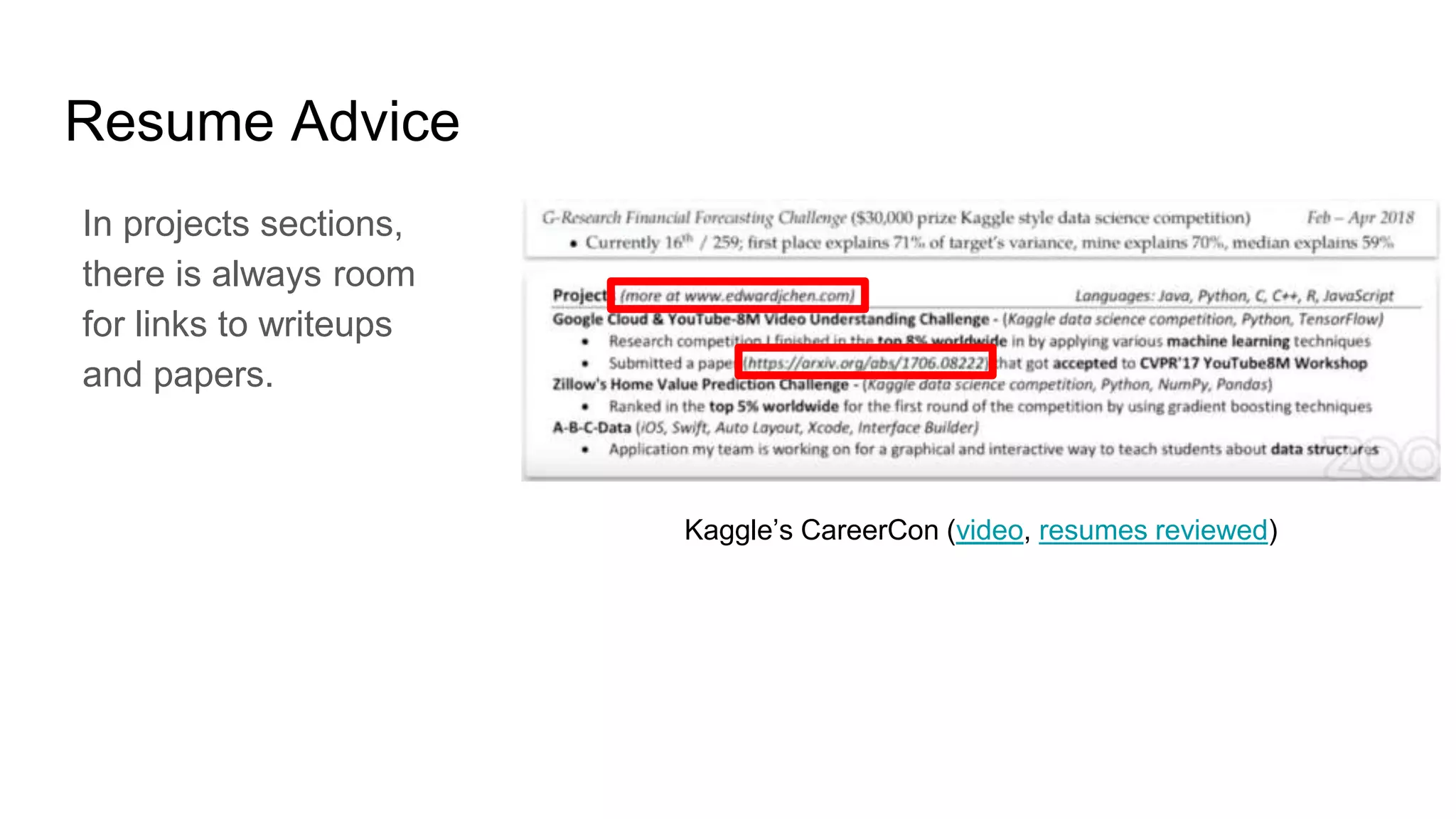
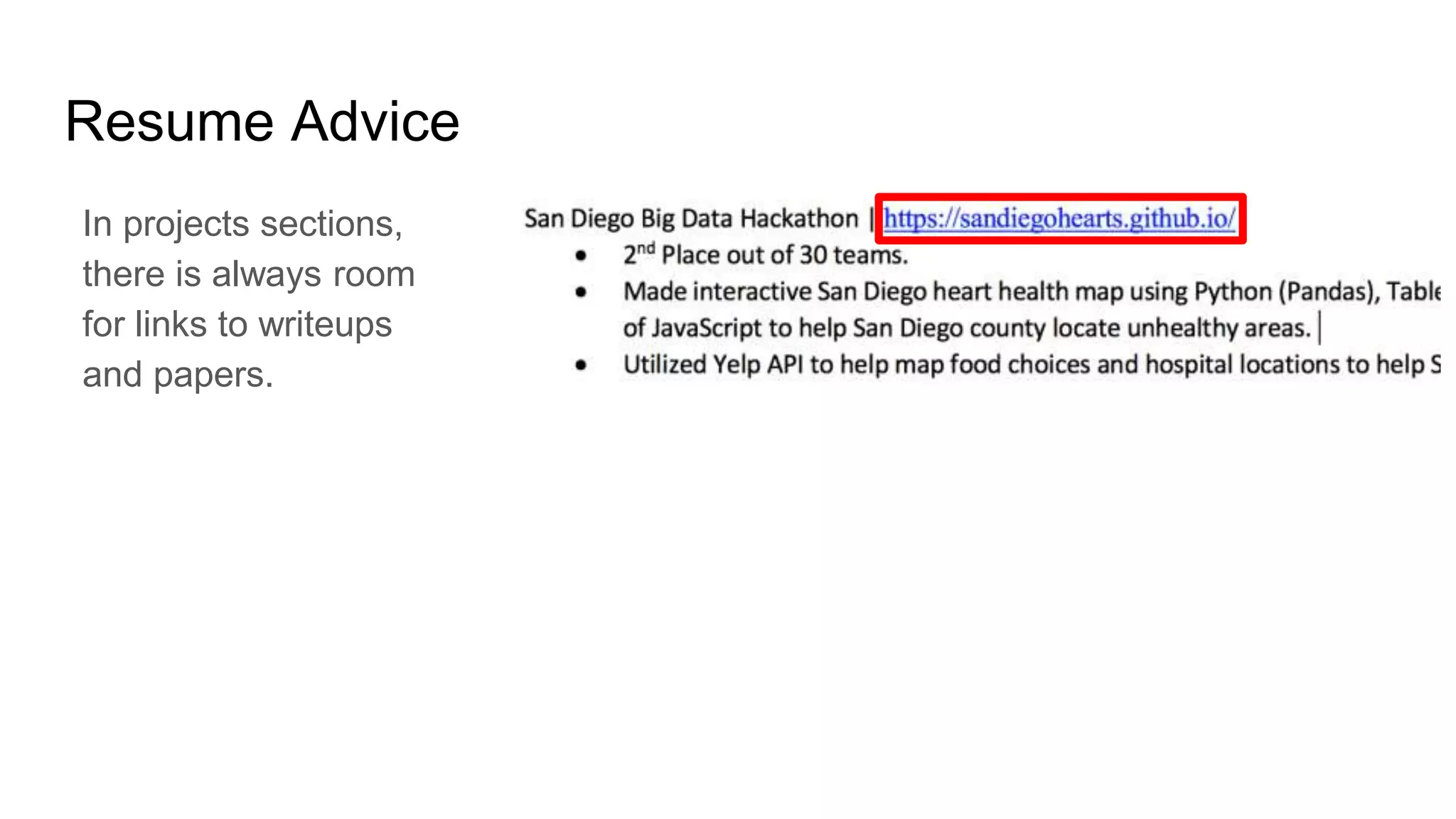
In projects sections,
there is always room
for links to writeups
and papers.
Kaggle’s CareerCon (video, resumes reviewed)
Resume Advice
In projects sections,
there is always room
for links to writeups
and papers.
Resume Advice
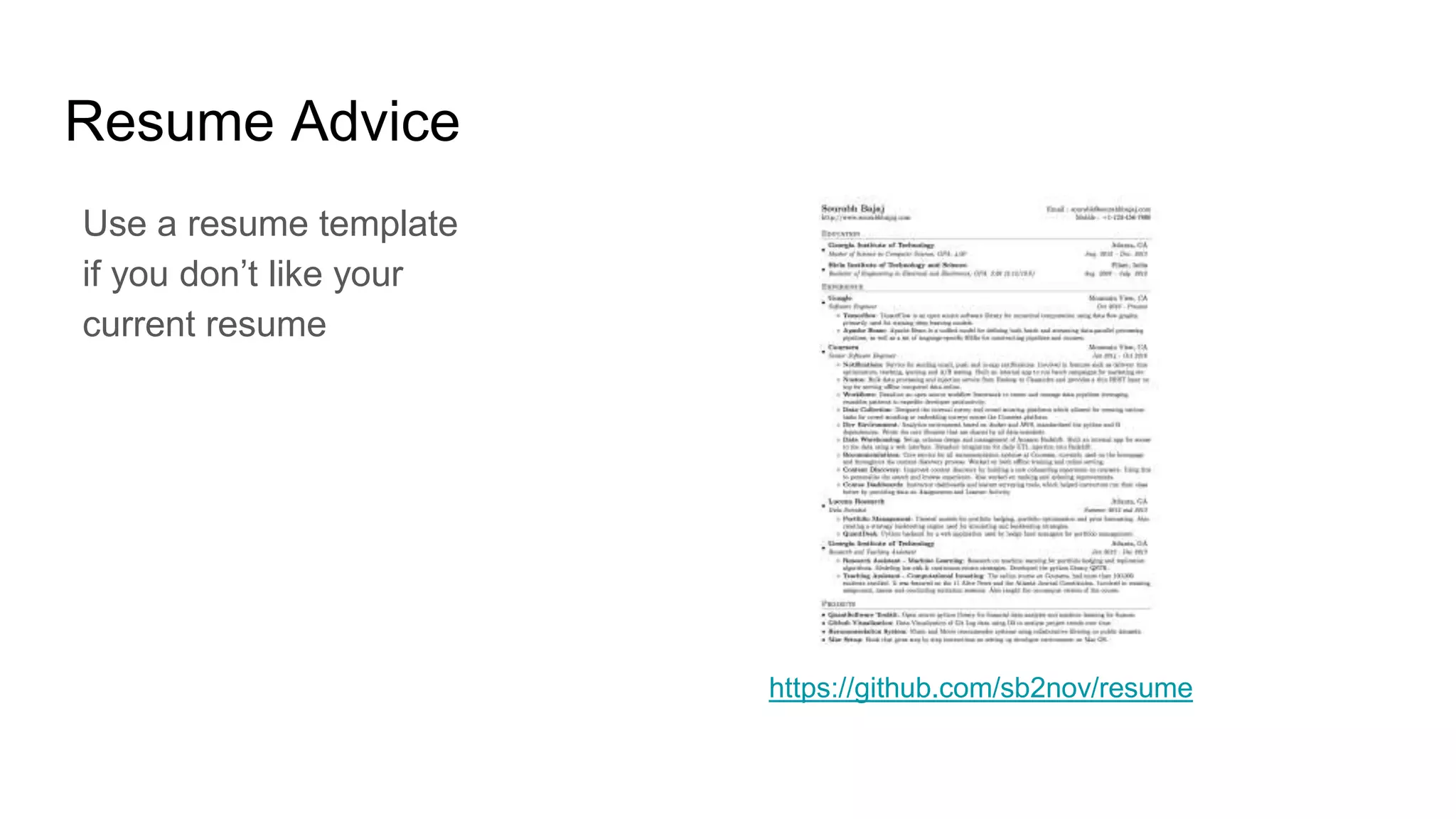
Use a resume template
if you don’t like your
current resume
https://github.com/sb2nov/resume
1. What is a Portfolio
2. My Portfolio
3. Identifying what to put in your
Portfolio
4. Portfolio to help networking
5. Portfolio for interviews/take
home challenges
6. Resume Advice
7. Social Media Advice
Building a Data Science Portfolio that Rocks
LinkedIn
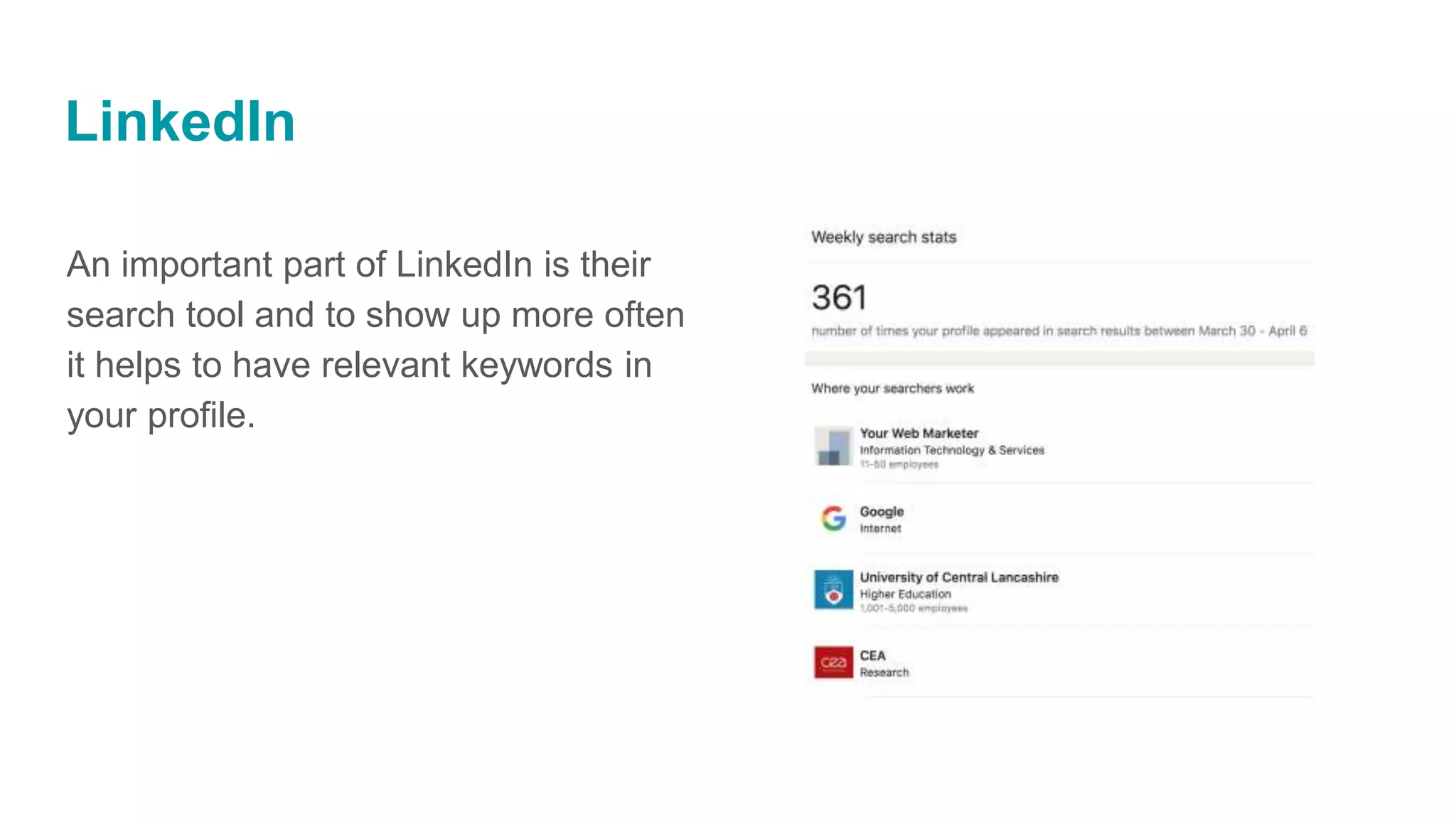
An important part of LinkedIn is their
search tool and to show up more often
it helps to have relevant keywords in
your profile.
LinkedIn
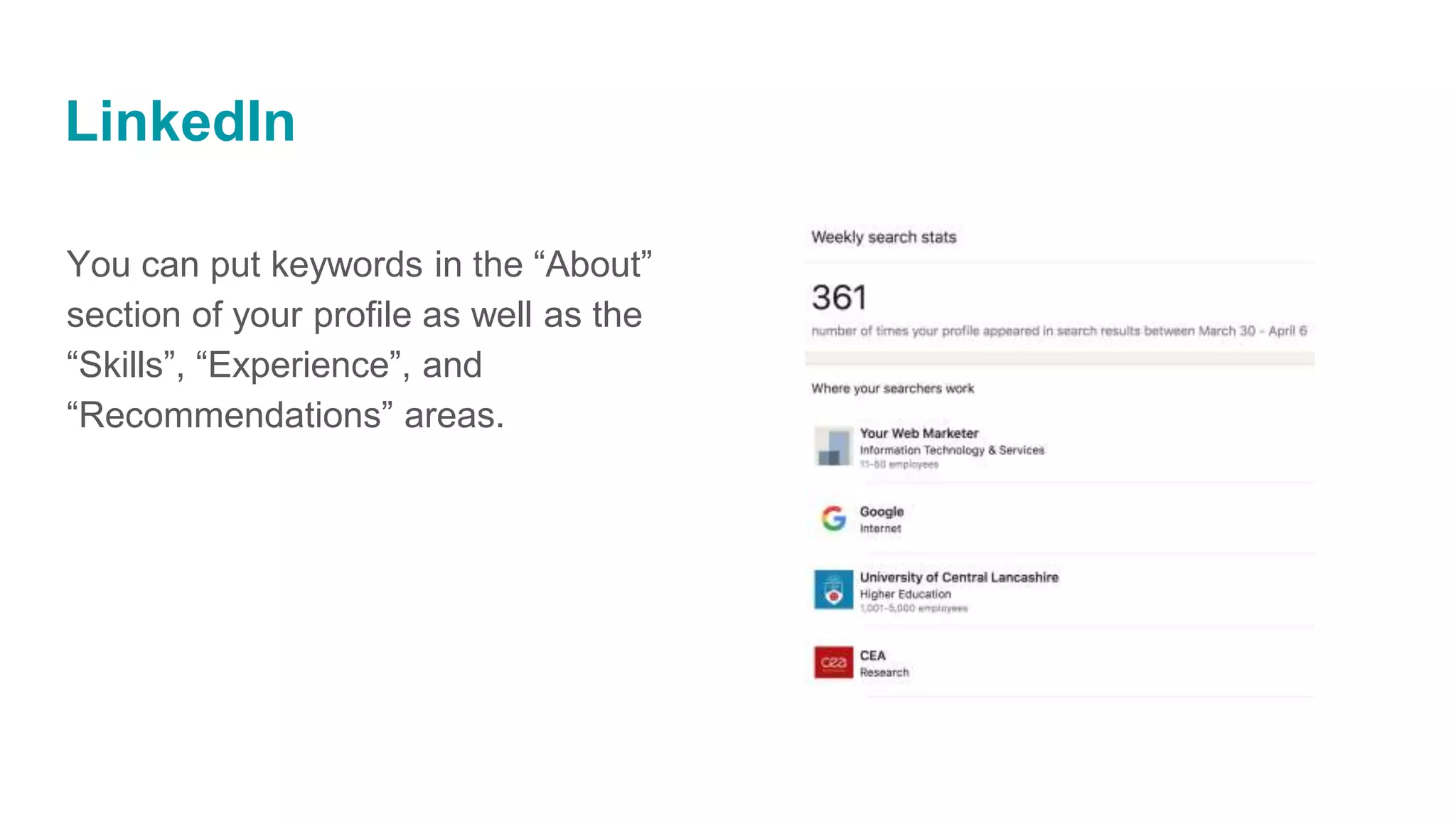
You can put keywords in the “About”
section of your profile as well as the
“Skills”, “Experience”, and
“Recommendations” areas.
LinkedIn
Udacity has a guide on making a good
LinkedIn profile. There also have a
good YouTube video on this.
LinkedIn
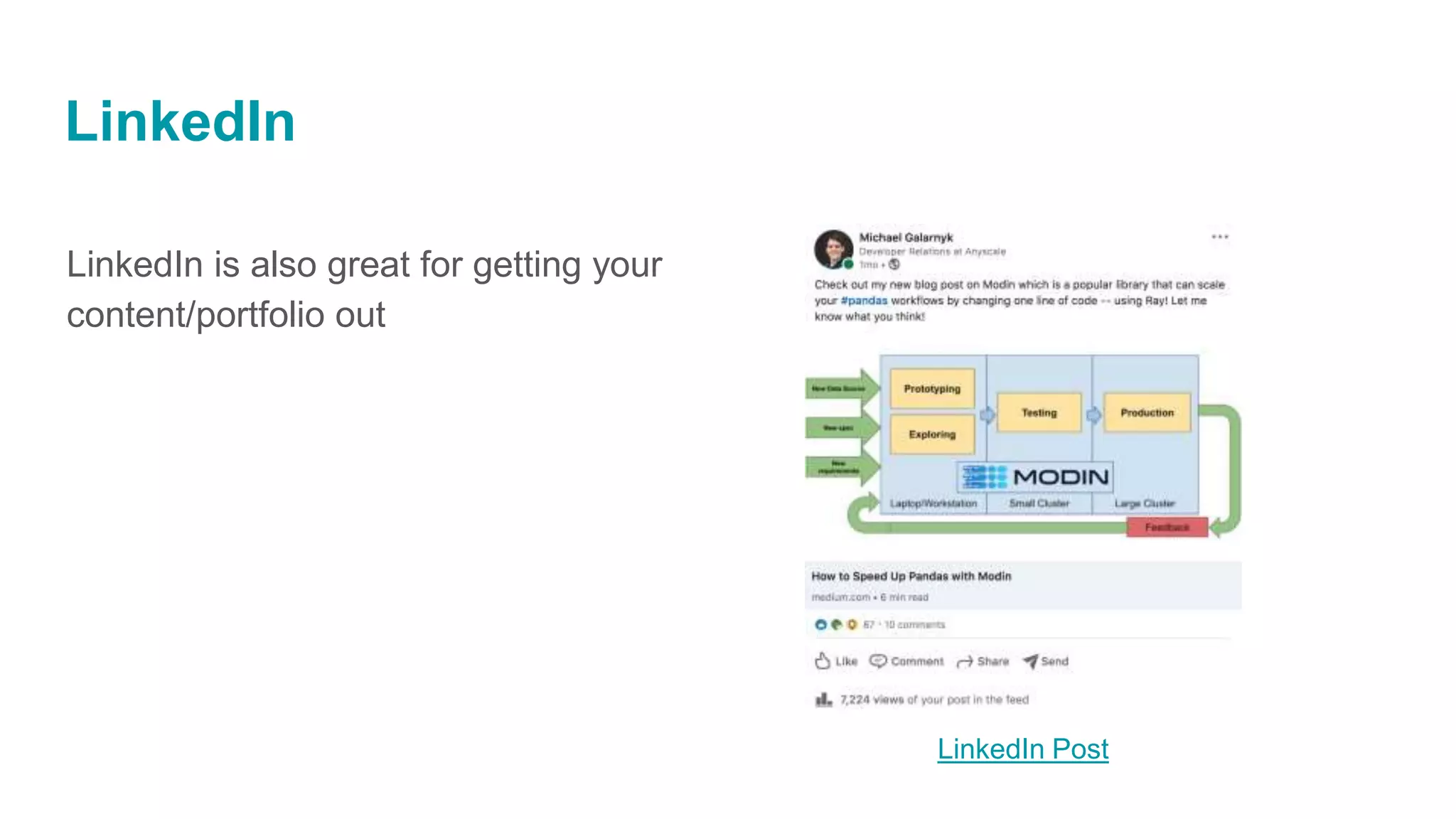
LinkedIn is also great for getting your
content/portfolio out
LinkedIn Post
GitHub
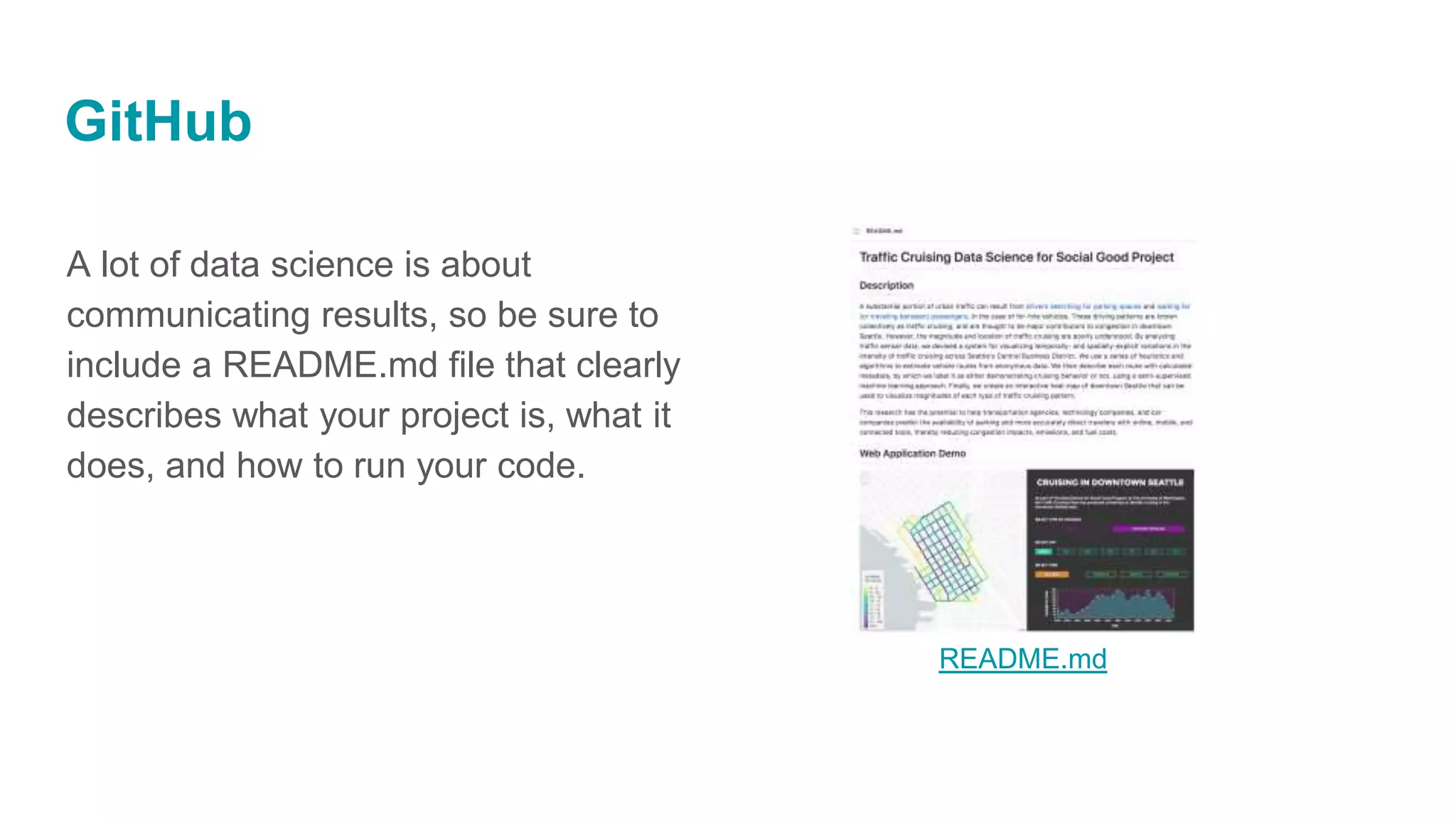
A lot of data science is about
communicating results, so be sure to
include a README.md file that clearly
describes what your project is, what it
does, and how to run your code.
README.md
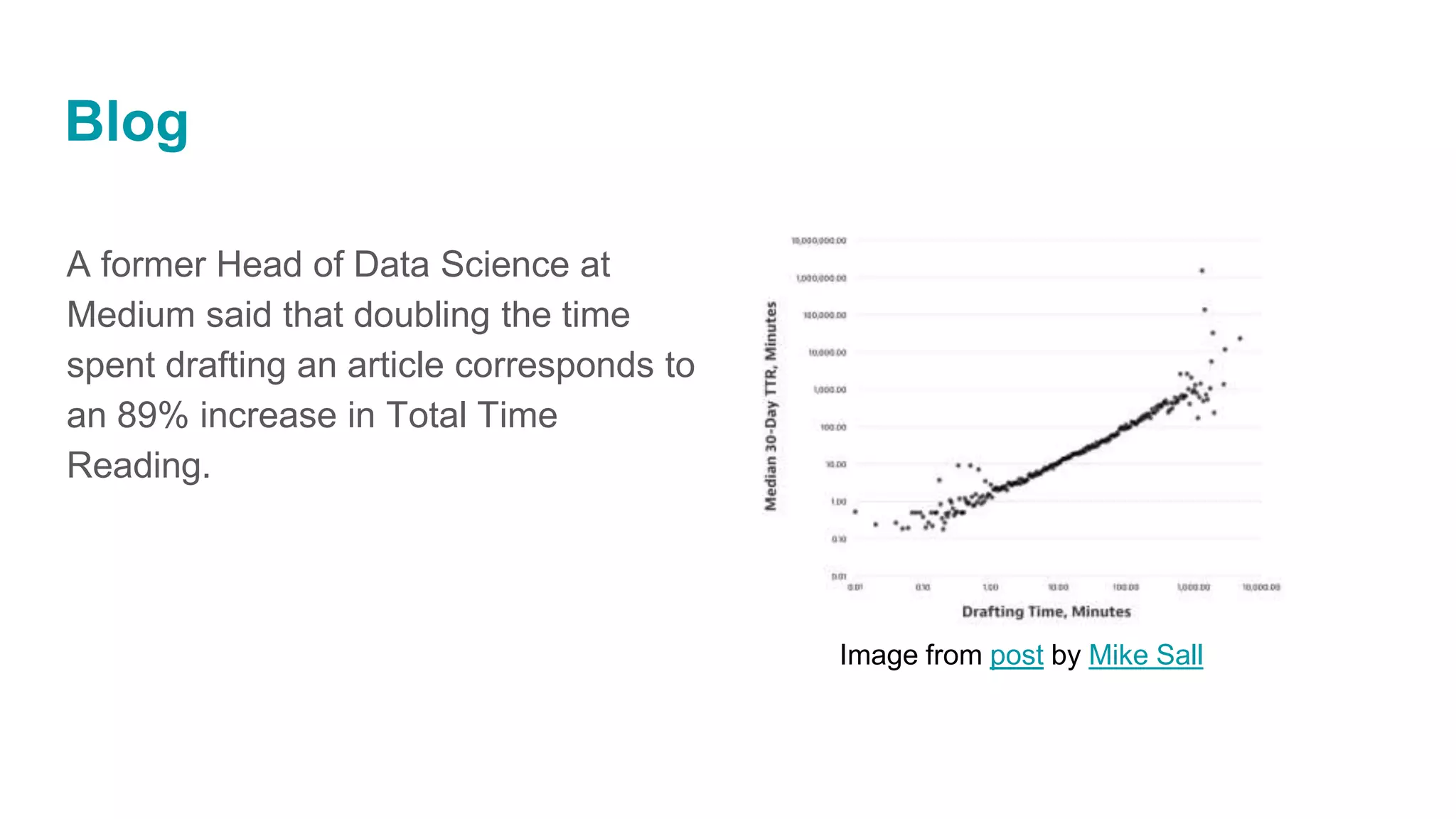
Blog
A former Head of Data Science at
Medium said that doubling the time
spent drafting an article corresponds to
an 89% increase in Total Time
Reading.
Image from post by Mike Sall
Success is an Iceberg
Don’t worry if your portfolio is perfect,
just show that you have experience,
share how you think, and you’ll be well
on your way to impressing [fill in the
blank]
Source: Instagram @orysya.stus.art
Questions?

Building a Data Science Portfolio that Rocks

  • 1.
    2.3.2021 Building a Data SciencePortfolio That Rocks!
  • 2.
    About Me ● Current:Developer Relations at Anyscale ● Previous: Data Scientist at Scripps Research Current: Writing about Distributed Computing Previous: Understanding Fitbit Data Have taught Python/Data Science/Analytics at Stanford Continuing Studies, UCSD, LinkedIn Learning, YouTube, etc.
  • 3.
    1. What isa Portfolio 2. My Portfolio 3. Identifying what to put in your Portfolio 4. Portfolio to help networking 5. Portfolio for interviews/take home challenges 6. Resume Advice 7. Social Media Advice Building a Data Science Portfolio that Rocks
  • 4.
    What is aPortfolio? ● Public evidence of your data analytics/science skills. ● You have Facebook, Pinterest, Instagram, Snapchat so why don’t you have public evidence of your skills? ● Consider making a professional online presence. Job Life There is some overlap between the different types of social media sites
  • 5.
    Goals for Buildinga Portfolio ● Show people what you can do instead of telling them you can do something ● Help you get interviews ● Networking ● Help you with interviews (take home challenges) Job Life There is some overlap between the different types of social media sites
  • 6.
    Portfolios can consistof things like ● Resume (how people find your portfolio) ● GitHub ● Kaggle ● Tableau Public ● Blogging ● LinkedIn ● Twitter ● Various Forum Accounts ● Stack Overflow ● Open Source Contributions ● Podcast appearances ● Giving Talks Job Life There is some overlap between the different types of social media sites
  • 7.
    Importance of aPortfolio The more public work you do, the higher the chance of a freak accident like that: of someone noticing your work and pointing you towards a job opportunity, or of someone who’s interviewing you having heard of work you’ve done. Tweet offering an interview for answering a question well on Stack Overflow David Robinson Principal Data Scientist at Heap
  • 8.
    ● How doyou get experience if you need experience to get your first job? ● If you don’t have any experience as a data analyst/scientist/programmer/anythi ng, then you should do independent projects. Portfolio to get around an Experience Requirement Get around ridiculous requirements
  • 9.
    1. What isa Portfolio 2. My Portfolio 3. Identifying what to put in your Portfolio 4. Portfolio to help networking 5. Portfolio for interviews/take home challenges 6. Resume Advice 7. Social Media Advice Building a Data Science Portfolio that Rocks
  • 10.
    My Portfolio (noticeits not all just my profiles) GitHub Tableau Public Medium/Blogging Stack Overflow Online Courses Personal Website
  • 11.
    My Portfolio YouTube LinkedInTwitter Google Scholar Kaggle (Working on it!) Podcast Appearances This lecture
  • 12.
  • 13.
    Employers/Hiring Managers canfind you online ● LinkedIn -> Opportunity ● GitHub-> LinkedIn/Resume ● Tableau Public -> LinkedIn/Resume ● Blog -> LinkedIn/Resume ● Stack Overflow -> Google Search ● YouTube -> LinkedIn/Resume ● Kaggle -> LinkedIn/Resume ● Everything else -> LinkedIn/Resume Job Life There is some overlap between the different types of social media sites
  • 14.
    Employers/Hiring Managers canfind you online ● You don’t need to do everything. ● An online presence can lead to more opportunities. Job Life There is some overlap between the different types of social media sites
  • 15.
    1. What isa Portfolio 2. My Portfolio 3. Identifying what to put in your Portfolio 4. Portfolio to help networking 5. Portfolio for interviews/take home challenges 6. Resume Advice 7. Social Media Advice Building a Data Science Portfolio that Rocks
  • 16.
    Identifying what toput in your Portfolio Microsoft Data Scientist Job Posting ● Design a portfolio to fit with your career goals ● Look at job postings at companies and industries you want to work at. ● Will give you some idea of what to learn and incorporate.
  • 17.
    Identifying what toput in your Portfolio Maybe understanding and using these concepts in a project can help ● Glassdoor interview questions can also give you an idea of what to include. ● Note with big companies, interviews vary drastically as there are many different teams, but still useful to look up.
  • 18.
    Identifying what toput in your Portfolio Similar things as before ● Glassdoor interview questions can also give you an idea of what to include. ● Note with big companies, interviews can vary drastically as there are many different teams, but still useful to look up.
  • 19.
    Identifying what toput in your Portfolio Projects are a usual question ● Data Science job postings and interviews vary drastically, but a lot of them want ask for projects.
  • 20.
    Identifying what toput in your Portfolio Projects are a usual question ● Data Science job postings and interviews vary drastically, but a lot of them want ask for projects.
  • 21.
    Identifying what toput in your Portfolio ● If you don’t know have any clue which companies you want to work for, you might want to showcase your skills through blogging, code on GitHub, or by taking part in a Kaggle Competition Traffic Cruising Data Science for Social Good Project (https://github.com/uwescience/TrafficCruising-DSSG2017)
  • 22.
    Types of Projectsto Include in a Portfolio I love projects where people show that they are interested in data in a way that goes beyond homework assignments. Any sort of class final project where you explore an interesting dataset and find interesting results… William Chen, Former Data Science Manager at Quora Traffic Cruising Data Science for Social Good Project (https://github.com/uwescience/TrafficCruising-DSSG2017)
  • 23.
    Sometimes you needto gather, organize, and clean your own data. Types of Projects to Include in a Portfolio Webscraping can sometimes be an option
  • 24.
    1. What isa Portfolio 2. My Portfolio 3. Identifying what to put in your Portfolio 4. Portfolio to help networking 5. Portfolio for interviews/take home challenges 6. Resume Advice 7. Social Media Advice Building a Data Science Portfolio that Rocks
  • 25.
    Portfolio to helpnetworking ● A lot of people approach networking/job hunting as “it’s not what you know, it’s who you know” ● Networking is about establishing real connections with a person or company. ● Real connections are about authentic two-way relationships. ● This means that your network should consist of people that you can help, not just people who you think can help you.
  • 26.
    Portfolio to helpnetworking ● If you have helped someone out, they might think better of you and be happier to see you succeed and potentially help you when you need help. ● Small example: If you post a blog on LinkedIn, people in your network might share it to a broader audience. ● Medium example: If you brought value to your data analytics/science community, they might be more receptive to referral requests. ● Large example: It’s possible someone in your network might reach out to you about jobs to see if you are interested, instead of the other way around.
  • 27.
    Portfolio to helpnetworking ● Note that even if you have a referral, you still need to get and pass and interview (which portfolios can help with). You can learn how to ask for a referral here.
  • 28.
    Normal ways tobuild your network (portfolio helps with this too) ● Attend conferences ● Join data related meetup groups ● Participate in college or bootcamp alumni groups, ● Connect with people through LinkedIn and Twitter.
  • 29.
    1. What isa Portfolio 2. My Portfolio 3. Identifying what to put in your Portfolio 4. Portfolio to help networking 5. Portfolio for interviews/take home challenges 6. Resume Advice 7. Social Media Advice Building a Data Science Portfolio that Rocks
  • 30.
    Take Home Challenges ●Interview processes often have case studies ● Companies often send you sample data analytics/science problems to work on ● Idea: Give challenge that resembles the work you would be doing on the job. Image Source
  • 31.
    Take Home Challenges ●Instructions might be ambiguous (intentionally). Day to day work can be ambiguous as well. ● This means you have to make some assumptions with the data. ● There might be a use case for a machine learning model or analysis, but won’t specify what you should do. ● These are similar to portfolio projects. Not saying this specific job will ask you to do a take home challenge, but it can happen in a lot of interview processes.
  • 32.
    Take Home Challenges ●Instructions might be ambiguous (intentionally). Day to day work can be ambiguous as well. ● This means you have to make some assumptions with the data. ● There might be a use case for a machine learning model or analysis, but won’t specify what you should do. Project Take Home Challenge Choose your own data You often have data given to you You need to figure out what to do with the data You need to figure out what to do with the data Might have incomplete or dirty data Might have incomplete or dirty data You can communicate your results through a blog or some other way. You might be asked to give a presentation or writeup your results.
  • 33.
    Take Home Challenges ●If they ask for a discussion of your results, know that communication of your results is important. ● You might be asked a question like “how good are your results” Project Take Home Challenge Choose your own data You often have data given to you You need to figure out what to do with the data You need to figure out what to do with the data Might have incomplete or dirty data Might have incomplete or dirty data You can communicate your results through a blog or some other way. You might be asked to give a presentation or writeup your results.
  • 34.
    Take Home Challenges ●Having a portfolio can make these challenges easier. ● Often with a portfolio project, you have to take data which may or may not be clean and try to solve some problem. ● They both usually require you to communicate how your analysis works. Project Take Home Challenge Choose your own data You often have data given to you You need to figure out what to do with the data You need to figure out what to do with the data Might have incomplete or dirty data Might have incomplete or dirty data You can communicate your results through a blog or some other way. You might be asked to give a presentation or writeup your results.
  • 35.
    Project Take Home Challenge Chooseyour own data You often have data given to you You need to figure out what to do with the data You need to figure out what to do with the data Might have incomplete or dirty data Might have incomplete or dirty data You can communicate your results through a blog or some other way. You might be asked to give a presentation or writeup your results. Take Home Challenges ● Major difference is for a case study you might be asked to give a presentation. If you can figure out the kind of people you are presenting to, you can adjust it accordingly.
  • 36.
    Project Take Home Challenge Chooseyour own data You often have data given to you You need to figure out what to do with the data You need to figure out what to do with the data Might have incomplete or dirty data Might have incomplete or dirty data You can communicate your results through a blog or some other way. You might be asked to give a presentation or writeup your results. Take Home Challenges ● I recommend you spend time researching the industry and job you are interested in and trying to get familiar with the problems they are trying to solve before you start a take home challenge.
  • 37.
    1. What isa Portfolio 2. My Portfolio 3. Identifying what to put in your Portfolio 4. Portfolio to help networking 5. Portfolio for interviews/take home challenges 6. Resume Advice 7. Social Media Advice Building a Data Science Portfolio that Rocks
  • 38.
    Resume Advice List yourtechnical skills in a skills section in your resume (get past an applicant tracking system) This could not only help your chances for a job you applied for, but also help in recruiting searches for future positions. Kaggle’s CareerCon (video, resumes reviewed)
  • 39.
    Resume Advice Particularly technicalskills that the job description mentions (if you have the skills) Kaggle’s CareerCon (video, resumes reviewed)
  • 40.
    Resume Advice Don’t listcommon projects. They don’t help distinguish you from others. Titanic (A), MNIST (B), and IRIS (C)
  • 41.
    Resume Advice Don’t listcommon projects. They don’t help distinguish you from others. Titanic (A), MNIST (B), and IRIS (C) Kaggle’s CareerCon (video, resumes reviewed)
  • 42.
    Resume Advice List relevant courseworkthat is applicable Kaggle’s CareerCon (video, resumes reviewed)
  • 43.
    Resume Advice Show resultsand include links. If you participated in a Kaggle competition, consider putting a percentile rank. Kaggle’s CareerCon (video, resumes reviewed)
  • 44.
    Resume Advice In projectssections, there is always room for links to writeups and papers. Kaggle’s CareerCon (video, resumes reviewed)
  • 45.
    Resume Advice In projectssections, there is always room for links to writeups and papers.
  • 46.
    Resume Advice Use aresume template if you don’t like your current resume https://github.com/sb2nov/resume
  • 47.
    1. What isa Portfolio 2. My Portfolio 3. Identifying what to put in your Portfolio 4. Portfolio to help networking 5. Portfolio for interviews/take home challenges 6. Resume Advice 7. Social Media Advice Building a Data Science Portfolio that Rocks
  • 48.
    LinkedIn An important partof LinkedIn is their search tool and to show up more often it helps to have relevant keywords in your profile.
  • 49.
    LinkedIn You can putkeywords in the “About” section of your profile as well as the “Skills”, “Experience”, and “Recommendations” areas.
  • 50.
    LinkedIn Udacity has aguide on making a good LinkedIn profile. There also have a good YouTube video on this.
  • 51.
    LinkedIn LinkedIn is alsogreat for getting your content/portfolio out LinkedIn Post
  • 52.
    GitHub A lot ofdata science is about communicating results, so be sure to include a README.md file that clearly describes what your project is, what it does, and how to run your code. README.md
  • 53.
    Blog A former Headof Data Science at Medium said that doubling the time spent drafting an article corresponds to an 89% increase in Total Time Reading. Image from post by Mike Sall
  • 54.
    Success is anIceberg Don’t worry if your portfolio is perfect, just show that you have experience, share how you think, and you’ll be well on your way to impressing [fill in the blank] Source: Instagram @orysya.stus.art
  • 55.

Editor's Notes

  • #2 The title got shorter when I realized How long it was
  • #3 Fitbit data
  • #5 Keep in mind that things change over time, technology and society moves fast. The standards of the past and present aren’t the standards for getting a job these days. You will notice we have twitter accounts and such. There is even overlap in professional development in social media accounts these days (you will notice people even talk about knowledge and concepts over social media platforms)
  • #6 Keep in mind that things change over time, technology and society moves fast. The standards of the past and present aren’t the standards for getting a job these days. You will notice we have twitter accounts and such. There is even overlap in professional development in social media accounts these days (you will notice people even talk about knowledge and concepts over social media platforms)
  • #7 Keep in mind that things change over time, technology and society moves fast. The standards of the past and present aren’t the standards for getting a job these days. You will notice we have twitter accounts and such. There is even overlap in professional development in social media accounts these days (you will notice people even talk about knowledge and concepts over social media platforms)
  • #8 Before
  • #9 Before
  • #14 Keep in mind that things change over time, technology and society moves fast. The standards of the past and present aren’t the standards for getting a job these days. You will notice we have twitter accounts and such. There is even overlap in professional development in social media accounts these days (you will notice people even talk about knowledge and concepts over social media platforms)
  • #15 Keep in mind that things change over time, technology and society moves fast. The standards of the past and present aren’t the standards for getting a job these days. You will notice we have twitter accounts and such. There is even overlap in professional development in social media accounts these days (you will notice people even talk about knowledge and concepts over social media platforms)
  • #17 Before
  • #18 Before
  • #19 Before
  • #20 Before
  • #21 Before
  • #22 Before
  • #23 Before
  • #24 Before
  • #49 Don’t overthink it-- it doesn’t have to be perfect, just show that you have experience, share how you think, and you’ll be well on your way to impressing any potential employer
  • #50 Don’t overthink it-- it doesn’t have to be perfect, just show that you have experience, share how you think, and you’ll be well on your way to impressing any potential employer
  • #51 Don’t overthink it-- it doesn’t have to be perfect, just show that you have experience, share how you think, and you’ll be well on your way to impressing any potential employer
  • #52 Don’t overthink it-- it doesn’t have to be perfect, just show that you have experience, share how you think, and you’ll be well on your way to impressing any potential employer
  • #53 Don’t overthink it-- it doesn’t have to be perfect, just show that you have experience, share how you think, and you’ll be well on your way to impressing any potential employer
  • #54 Don’t overthink it-- it doesn’t have to be perfect, just show that you have experience, share how you think, and you’ll be well on your way to impressing any potential employer
  • #55 Don’t overthink it-- it doesn’t have to be perfect, just show that you have experience, share how you think, and you’ll be well on your way to impressing any potential employer