A branch ofscience devoted to the
study of societies and the relationships
among individuals within those societies.
“Social sciences as those mental or
cultural sciences which deal with the
activities of the individual as member of
the group. The term social sciences thus
embrace all those subjects which deal
with the relationship of man to the
society.
A major branchof science
that deals with the
description, prediction and
understanding of natural
phenomena, basically
based on observational and
empirical evidence.
6.
1. Life Science/Biological
Science
It studies life in all its forms,
past and present. This includes
plants, animals, viruses and
bacteria, single-celled
organisms, and even cells.
7.
2. Physical Science
Thisis the systematic study
of the inorganic world, as
distinct from the study of the
organic world, which is the
province of biological science.
8.
a. Physics
The sciencein which
matter and energy are
studied both separately
and in combination with
one another.
9.
b. Astronomy
The scientificstudy of celestial
objects (such as stars, planets,
comets, and galaxies) and
phenomena that originate outside
the Earth's atmosphere (such as
the cosmic background radiation).
10.
c. Chemistry
The studyof matter and its
transformations and the
development of methods to
manipulate those transformations
to create new and useful forms of
matter.
11.
d. Earth Science
Thestudy of the Earth and
its neighbors in space. It is
an exciting science with
many interesting and
practical applications.
- refers tothe study of the
ways in which the human
experience is processed and
documented.
- encompasses the field of
philosophy, literature, religion,
art, music, history and
language.
Things in Common
-both sciences employ the scientific
model in order to gain information.
- both sciences use empirical and
measured data evidence that can be
seen and discerned by the senses.
- both sciences’ theories can be tested to
yield theoretical statements and
general positions.
Arose 300years later
Deals with subject (human being)
It is spontaneous, unpredictable and
uncontrollable, as it deals with human
emotions and behavior.
Experiential Data
Typically involves alternative methods
of observation and interaction with
people within community.
Open system
Started duringthe 16th and 17th
century.
Deals with object.
Characterized by exactness, controlled
variables, and predictability.
Experimental Data
The typical method of science is doing
repetitive and conventional laboratory
experiments.
Closed System
Things in Common
Boththe humanities and social
science are concerned with
human aspects like, law, politics,
linguistics, economics, and
psychology as well as human lives
and nature.
Influenced by anddeveloped after
the French revolution and the
Industrial revolution.
Social science deals with more
scientific approach.
Involves application of an empirical
rational, and objective methodology
(such as the use of validity and
reliability test) to present facts.
26.
To analyze, explain,and
possibly predict and produce
new knowledge of factual
information
To generate and produce
new knowledge or factual
information
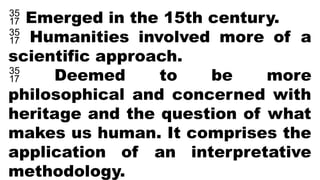
Emerged inthe 15th century.
Humanities involved more of a
scientific approach.
Deemed to be more
philosophical and concerned with
heritage and the question of what
makes us human. It comprises the
application of an interpretative
methodology.
29.
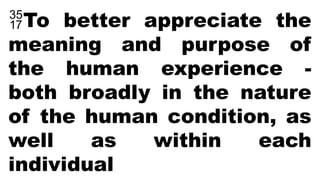
To better appreciatethe
meaning and purpose of
the human experience -
both broadly in the nature
of the human condition, as
well as within each
individual
30.
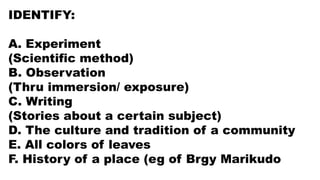
IDENTIFY:
A. Experiment
(Scientific method)
B.Observation
(Thru immersion/ exposure)
C. Writing
(Stories about a certain subject)
D. The culture and tradition of a community
E. All colors of leaves
F. History of a place (eg of Brgy Marikudo
31.
EXAMPLE:
YOU WROTE ANENTRY ON YOUR
DIARY ABOUT YOU AND YOUR
FRIEND HAVING FUN OBSERVING
AND IDENTIFYING THE STARS IN
THE SKY.
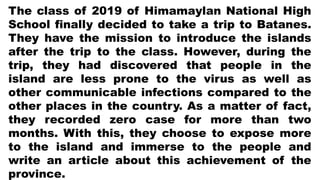
The class of2019 of Himamaylan National High
School finally decided to take a trip to Batanes.
They have the mission to introduce the islands
after the trip to the class. However, during the
trip, they had discovered that people in the
island are less prone to the virus as well as
other communicable infections compared to the
other places in the country. As a matter of fact,
they recorded zero case for more than two
months. With this, they choose to expose more
to the island and immerse to the people and
write an article about this achievement of the
province.
Essentially to understandas many
aspects of human life as can
possibly be studied, to record its
findings, and contribute to both
historical understanding as well
as to ascertain current states of
the human condition in an attempt
to better understand and/or act
upon those findings.
To know thepopulation of a
particular area;
To ascertain as to which factors are
influencing the
population of that particular area;
To explain the factors relating to
changes in population; and
To study the population trends on the
basis of the above
three factors.
The three mostimportant
functions of economics are as
follows: Just as feeding,
digestion and growth are the
vital processes of living
beings; similarly production,
consumption and growth are
the essentials of economies.
To understand basicphysical
systems that affect everyday life
(e.g. earth-sun relationships, water
cycles, wind and ocean currents). To
learn the location of places and the
physical and cultural characteristics
of those places in order to function
more effectively in our increasingly
interdependent world.
Refer to thegeneral social uses
of language, such as requesting
objects and activities, initiating
social interactions, expressing
personal feelings, describing
aspects of the world, requesting
information, and pretending.
A useful forwork. Its study helps
create good businesspeople,
professionals, and political
leaders. The number of explicit
professional jobs for historians is
considerable, but most people
who study history do not become
professional historians.
A social studyconcerning the
allocation and transfer of
power in decision making, the
roles and systems of
governance including
governments and international
organizations, political
behavior and public policies.
According to earlier
psychologists,the function of
psychology was to study the
nature, origin and destiny of the
human soul. But soul is something
metaphysical. It cannot be seen,
observed and touched and we
cannot make scientific
experiments in soul.
53.
Sociology. “socius” (people
together,associate), “logos”
(study of)
Study of groups - how they are
formed, how they change, and
how the group impacts individual
behavior.
54.
Can study societywith a wide
variety of focuses. From studying
the power elite, to the interaction
of the economy, society and the
environment, to the examination
of various rights movements,
Sociology examines the way
different aspects of society
behave and function.
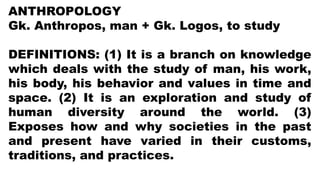
ANTHROPOLOGY
Gk. Anthropos, man+ Gk. Logos, to study
DEFINITIONS: (1) It is a branch on knowledge
which deals with the study of man, his work,
his body, his behavior and values in time and
space. (2) It is an exploration and study of
human diversity around the world. (3)
Exposes how and why societies in the past
and present have varied in their customs,
traditions, and practices.
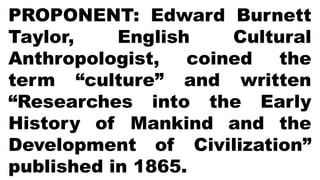
58.
PROPONENT: Edward Burnett
Taylor,English Cultural
Anthropologist, coined the
term “culture” and written
“Researches into the Early
History of Mankind and the
Development of Civilization”
published in 1865.
59.
HISTORICAL FOUNDATION: Tracesits roots
from natural history which is the study of
plants, animals and humans with reference to
their history and native environment. The
discovery and contact to new civilizations by
European explorers and colonizers led to
curiosity and questions of who these people
are, their ancestors, relation and uniqueness
with other people, and their way of life. It was
only in the 19th century that the discipline
began its formative years as a social science.
60.
BRANCHES:
1. BIOLOGICAL ANTHROPOLOGY– study of man’s
biological foundations, race evolution, genetic inheritance,
racial classifications, human adaptability and variation, the
fossil records of human evolution as well as forensic
studies.
A. Racial History – study the nature of races
B. Paleontology – study of fossils
C. Human Genetics – study of various ways of inheritance
that take place in man
D. Neuroanthropology – study of the evolution of the human
brain
E. Human Osteology – study of skeletal materials
F. Forensic Anthropology – analysis and identification of
human remains
61.
2. CULTURAL ANTHROPOLOGY– investigation
of the cultural and social organization of a
particular people.
A. Ethnography – describes the culture of an
ethnic group
B. Ethnology – analyses and compares culture
of people and how these cultures develop and
change
C. Archaeology – study of man’s culture and
society in the prehistoric times.
D. Linguistics – study of the recorded and
unrecorded languages all over the world.
62.
METHODS OF INQUIRY
1.ETHNOGRAPHIC METHOD – participant
researcher mainly conducts first-hand observation
and immersion in human activities in a particular
socio-cultural setting for the purpose of gaining an
up-close and personal familiarity and
understanding of the subjects being studied.
2. CASE STUDY – involves extensive and in-depth
documentation and analysis of specific subject in
focus at a smaller scale which is mainly conducted
by interview of informants, ocular inspection of
location, and the comparison and analysis of
available literature and databases.
63.
3. DESCRIPTIVE METHOD– involves the
systematic collection and analytic processing
of the statistical data by conducting a survey
of a sample size of respondents in order to
adequately describe a present existing socio-
cultural condition or situation.
4. HISTORICAL METHOD – entails the
reconstruction of events by piecing together
evidences of the past and examining reliable
records in order to trace and explain the
development or transformation of a socio-
cultural situation, group and community.
64.
GEOGRAPHY
L. Geo, Earth+ L. Graphein, to describe
DEFINITIONS: (1) The description and explanation
of the world’s landscapes and a scientific
description of inhabited landscapes and their
description over the globe. (2) The study of spatial
relationships whose subject matter includes
physical, biotic and societal elements and focuses
on the distribution and relationships of phenomena
according to places. (3) It is the study of the
phenomena, how its distribution come about, and
the significance of its distribution to an
65.
PROPONENT: Eratosthenes
(276 –194 BC), Greek
Geographer, chief librarian at
the Library of Alexandria and
accepted the concept that the
earth is round. He prepared
earliest maps of the known
world.
66.
HISTORICAL FOUNDATION: itis an
ancient and honorable field of learning
with its roots firmly set in classical
antiquity. People engaged in the study of
geography because it satisfies their
natural curiosity about foreign places
and different ways of life. The ancient
Greeks made the first contribution to the
subject through measuring the earth
using grids and meridians.
67.
BRANCHES:
1. PHYSICAL GEOGRAPHY–
describes and studies the surface
features of the earth.
2. HUMAN GEOGRAPHY –
describes and studies what
human beings do in and on land
and water.
68.
METHODS OF INQUIRY
1.DESCRIPTIVE GEOGRAPHY – specifies the
locations of features and populations.
2. ANALYTICAL GEOGRAPHY – asks why we
find features and populations in a specific
geographic area.
3. GEOSTATISTICS – applies statistical
methodology on the exploration of
geographic phenomena.
4. ETHNOGRAPHIC GEOGRAPHY – uses
participant observation and in-depth
interviews to provide qualitative data.
69.
HISTORY
Gk. Istoria, knowingby inquiry
DEFINITIONS: (1) The systematic inquiry of
man’s recorded past for the purpose of
establishing causal relationship, validating
historical facts and reconstruction of
chronological events. (2) It records and
explains what people have thought, said and
done. (3) It is concerned with political,
economic and social matters.
70.
PROPONENT: Herodotus (484– 425
BC), a Greek Historian that treated
historical subjects as a method of
investigation. He collected historical
materials systematically and
critically and arranged them into a
historiographic narrative. He wrote
“Histories” which is the record of
ancient traditions and culture of
Greece, Asia and Africa.
71.
HISTORICAL FOUNDATION: Influencesof Ancient
Greeks have helped spawn variant interpretations of
the nature of history which have evolved over the
centuries and continue to change today. Through the
Medieval and Renaissance periods, history was often
studied through a sacred or religious perspective.
Historians developed modern methods of
historiography in the West in the 17th and 18th
century. In the 20th century, academic historians
focused less on epic nationalistic narratives.
Recently, the field of digital history has begun to
address ways of using computer technology to pose
new questions to historical data and generate digital
scholarships.
72.
BRANCHES:
1. POLITICAL HISTORY– deals with the narrative
and analysis of political events, ideas, movements,
organs of government, voters, parties and leaders.
2. ECONOMIC HISTORY – analyses economies or
economic phenomena of the past using a
combination of historical methods, statistical
methods and the application of economic theory to
historical situations and institutions.
3. SOCIAL HISTORY – studies the experiences of
ordinary people in the past.
73.
METHODS OF INQUIRY
1.POSITIVISM – Embraces human
agency in history. Uses sources to
provide and accurate and complete
vision of the past.
2. NARRATIVE – CHRONOLOGY – The
creation of narratives of the past –
analysis plays less role as the role of
accidents is most important.
74.
METHODS OF INQUIRY
3.BIOGRAPHY – HAGIOGRAPHY – The “Great
Men” method which creates chronological
narratives. Often look at the agency of one
individual in history.
4. DIALECTICS – ANALYSIS – These are
created which become orthodoxies. New
theses then arrive to challenge these –
revisionism – and a synthesis is produced
from the old and the new. The synthesis
becomes the new thesis or paradigm and the
process of clashes (dialectics) repeats.
75.
METHODS OF INQUIRY
5.META-NARRATIVE – TOTAL HISTORY – Works of
the Annales school are characterised by a multi-
layered approach which seek to integrate long-
term, mid-term and short-term factors in a “total
history”. There is an effort to explain large
amounts of human history through the application
of theory and social sciences. Comparative studies
of similar events in disparate places.
6. NEGATIVISM – Rejects human agency in
historical affairs. Rejects all sources. Rejects the
possibility of empathetic understanding of the
76.
LINGUISTICS
Fr. Linguistique, language
DEFINITIONS:(1) The scientific study
of language in a cultural context. (2)
Provides insights and understanding
of how people perceive themselves
and the world around them. (3)The
systematic study of recorded and
unrecorded languages all over the
world.
77.
PROPONENT: Ferdinand de
Saussure(1857 – 1913), Swiss
linguist that posited that
linguistic form is arbitrary and
therefore that all languages
function in a similar fashion.
He published “Memoire sur le
systeme primitive.
78.
HISTORlCAL FOUNDATION:
Oldest linguistictexts include
Sumerian of the Old Babylon
and Vedas of the Hindus but
the first formal study of
language began in India in the
formulation of Sanskrit
morphology.
79.
BRANCHES OF LINGUISTICS:
1.EVOLUTIONARY LINGUISTICS – traces the
development of a language from its original form
and pattern.
2. HISTORICAL LINGUISTICS – explores language
changes and the relationships of language spoken
by different ethnic groups and/or nationalities.
3. SOCIO LINGUISTICS – looks at the relation
between linguistic variation and social structures.
4. PSYCHO LINGUISTICS – explores the imaginative
functioning of the language in the mind
80.
BRANCHES OF LINGUISTICS:
5.NEURO LINGUISTICS – looks into the representation of
the language in the brain.
6. ANTHROPOLOGICAL LINGUISTICS – explores how
language and culture interact for the beneficial
development in the society where the residents are the
developers.
7. APPLIED LINGUISTICS – deals with the language-related
issues as applied in everyday life particularly on language
policies on lexicography and transition.
8. BIO LINGUISTICS – refers to the study of natural
communication systems in animals as compared to human-
taught language.
81.
BRANCHES OF LINGUISTICS:
9.CLINIC LINGUISTICS – deals with the
application of linguistic theory to the field of
speech-language pathology.
10. LINGUISTIC TYPOLOGY - explores the
study of the common properties of diverse
unrelated languages.
11. STYLISTICS – refers to the style of writing
or manner of speaking suitable for an
occasion relative to a variety of standard
usage on literary style.
82.
METHODS OF INQUIRY
1.DESCRIPTIVE LINGUISTICS –
describes and explains features of
language without making subjective
judgements or whether a particular
feature or usage is good or bad.
2. PERSPECTIVE LINGUISTICS –
attempts to promote particular
linguistics usages over others, often
favoring a particular dialect
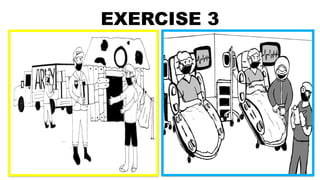
Across the WesternPacific, Philippines is one of the countries
with high number of COVID – 19 cases. As of the 29th of July 2020,
the World Health Organization recorded 83,673 cases in the nation
and ranked number 2 among the countries of the said cluster.
However, being an island nation, percentage of cases varies.
Statistics shows that the case is high in Central Visayas particularly
in the City of Cebu. As of July 26 of the same year, DOH – 7 recorded
7,458 cases, with almost half from Cebu City with 3,360 cases.
In a recent study of Lagahid, et. al., it is believed that
Cebuanos have a high sense of self-esteem, the “Garbo”, by which
Cebuanos has this dignity and pride. Throughout Philippine History,
Cebu is one of the longest existing province in the Visayas Islands,
and their native tongue, Cebuano, is 2nd wide spoken dialect in the
nation.
The government is now paving the way to fight COVID – 19.
They wanted to focus on those places with high cases of the said
pandemic.
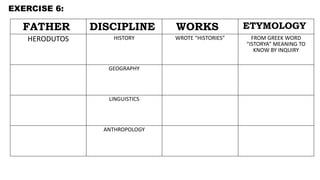
85.
EXERCISE 6:
FATHER DISCIPLINEWORKS ETYMOLOGY
HERODUTOS HISTORY WROTE “HISTORIES” FROM GREEK WORD
“ISTORYA” MEANING TO
KNOW BY INQUIRY
GEOGRAPHY
LINGUISTICS
ANTHROPOLOGY
86.
ECONOMICS
Gk. “oikanomia”, householdmanagement
DEFINITIONS: (1) The study of the proper allocation and
efficient use of scarce resources to produce commodities
for the maximum satisfaction of unlimited human needs
and wants. (2) The study of how societies use scarce
resources to produce valuable commodities and distribute
them among different people. (3) Scientific study which
deals on how individuals and society in general make
choices. (4) It is the study of how man could best allocate
and utilize the scarce resources of society to satisfy his
unlimited wants. (5) Branch of knowledge that deals with
the production, distribution and consumption of goods and
services.
87.
PROPONENT: Adam Smith(1723 –
1790), Founder of Classical School.
He constructed an explanation on
how social behavior is regulated. He
saw a world where each person
sought their own self-interest but
was constrained by morality, markets
and government. His famous writing
is “Wealth of the Nations” in 1776.
88.
HISTORICAL FOUNDATION: Economicsis not
considered as a separate discipline until 19th Century.
Greeks examined wealth accumulation and inquiries
on whether property should be on the hands of private
or public institutions. In medieval times, scholars
argued that it was a moral obligation of business to
sell goods at a just price. Economic thought evolved
through feudalism in the Middle Ages to mercantilist
theory in the Renaissance, when people were
concerned to be orient trade policy to further the
national interest. Changes in economic thought have
always accompanied changes in the economy, just as
changes in economic thought can propel change in
economic policy.
89.
BRANCHES:
1. MACROECONOMICS –deals with the
behavior of an economy as a whole with
the view of understanding the interaction
between economic aggregates such as
employment, inflation and national
income.
2. MICROECONOMICS – deals with the
behavior of individual components such
as household, firm and individual owner
of production.
90.
METHODS OF INQUIRY:
1.POSITIVE ECONOMICS – explain what
happens in the economy and why,
without making any recommendations
to economic policy, or in simple idea,
it deals about how the economy
works.
2. NORMATIVE ECONOMICS – employed
to make value judgments about the
economy and suggest solutions to
economic problems.
91.
POLITICAL SCIENCE
Gk. “polis”,city-state + L. “scire”, to study
DEFINITION: (1) Systematic study of state and government. (2) Deals
with those relations among men and groups which are subject to
control by the state, with the relations of men and groups of men to
the state itself, and with the relations of the state to other states. (3)
It is primarily concerned with the association of human being into a
“body politic”, or a political community that was organized under
government and law. (4) It is an attempt by systematic analysis to
discover in the confusing detail whatever principles may exist of
wider and more general significance, not only about the State, its
organs and institutions but also other institutions and polities as
well such as political attitudes of people and their leaders,
controversial issues and other aspects concerning the states’
operation, powers and functions. (5) It is the study of government
and political process, institutions and behavior.
92.
PROPONENT: Aristotle (384– 322 BC),
Political Scientist. Laid down the
foundation of governance and leadership.
His contribution to the discourse had
brought various philosophers to argue
that politics is not just about the
structure of a state but also about
civility, order and organization in a state.
He said, “Man by nature is a political
animal”. He wrote “The Politics”.
93.
HISTORICAL FOUNDATION: Oncepart of the many
related fields of study like history, philosophy, law and
economics, the theoretical and practical study of the
state and the politics began way back to the time of
Ancient Greeks, about 500-300 BC. During the ancient
times, men had formed basic social linkages,
inherently persuaded by the needs to associate
themselves to protect their survival and interests.
Families came to organize collective unions from
simple bands to more organized associations forming a
village who membership span to more than a hundred
that in the process ushered the birth of a city. The
chieftain who headed a village was chosen from the
ranks of leaders with the power to make laws, judge
and execute laws. The chiefdom became a state.
94.
BRANCHES:
1. PUBLIC LAW– concerned chiefly on the law itself
including the organization of government, the limitation upon
government authority and the rules of government offices
and public officials.
2. POLITICAL THEORY – study of the development of varying
political doctrines or thoughts from ancient, medieval to
contemporary political philosophies relating
to the basis, origin, form and structure, political culture or
behavior of the people in a state.
3. INTERNATIONAL RELATIONS – deals with the power
relationship between or among states in the international
community by pursuing the states’ national or potential
interests, primarily governed by foreign policies of the states
and chiefly regulated by the persuasive laws governing the
conduct of foreign relations among nation-states.
95.
4. PUBLIC ADMINISTRATION– deals with the system,
processes and dynamics of the management, operation or
administration of the affairs of the state, which include the
entire gamut or branch of the executive legislative and
judicial departments, both the institutions and employees,
which include officials.
5. POLITICAL PHILOSOPHY – sets forth the standards or
principles of behavior or accepted code or policy of a
particular society.
6. POLITICAL DYNAMICS – refers to the courses which
focus on forces at work in government and politics rather
than on structures and institutions.
7. COMPARATIVE GOVERNMENT – includes surveys of the
governmental and political systems of Asia and the Pacific,
Europe, Latin America, among others.
96.
METHODS OF INQUIRY:
1.HISTORICAL METHOD – observes and analyzes carefully
that facts of history in order to understand the present
condition together with the future course of political
organizations.
2. COMPARATIVE METHOD – established correlations of
institutional factors working hand-in-hand with the state
that affect a political phenomenon in understanding the
science of politics.
3. SCIENTIFIC METHOD – refers to the formulation of
general theory based on tested hypothesis which are
derived from organized patterns of systematically
arranged and collected relevant facts to a political
problem.
97.
4. INDUCTIVE METHOD– draws political generalization on
useful theories or insightful doctrines from basic or given
facts.
5. DEDUCTIVE METHOD – deduces particular conclusions
or explanations from probable yet steady premises in
interpreting or appreciating a given political situation.
6. THEORETICAL METHOD – uses political theories of
ancient philosophers as methods of understanding.
7. OBSERVATIONAL METHOD – employs the working of
one’s critical observation of a political situation and
interprets it based on philosophical reflection.
8. BEHAVIORAL METHOD – emphasized the social,
economic and political forces rather than the political
institutions through which such forces operate.
PROPONENT: Wilhelm Wundt(1832 – 1920), German
Psychologist. Opened the Institute for Experimental
Psychology at the University of Leipzig in Germany
in 1879. Argued that conscious mental states could
be scientifically studied during introspection.
Separated Psychology and Physiology by analyzing
the workings of the mind in a more structured way
with the emphasis being on objective measurement
and control. Trained Psychology students to make
observations that were biased by personal
interpretation or previous experience and used the
results to develop a theory of conscious thought.
Wrote “Principles of Physiological Psychology”.
100.
HISTORICAL FOUNDATION: Ithas its
roots in Ancient Greek Philosophy such
as epistemology, metaphysics, religion
and oriental philosophy. Its seeds were
sown from natural sciences such as
biology and physiology. Over the
centuries, psychology and physiology
became increasingly separated resulting
to the two conceptions of psychology
that is phenomenological (experiential)
and mechanistic (Physiological).
101.
BRANCHES:
1. GENERAL PSYCHOLOGY– explains why
and how people behave in a certain way
under certain reason.
2. CLINICAL PSYCHOLOGY – deals with the
scientific solution to a psychological problem.
3. ABNORMAL PSYCHOLOGY – determines if
the person has abnormalities
4. EVOLUTIONARY PSYCHOLOGY – focuses
on psychological stimuli in human being.
102.
5. COGNITIVE PSYCHOLOGY– deals with the
capacity to solve problem, which also includes
process like thinking, analyzing, memorizing and
many more.
6. LEGAL PSYCHOLOGY – deals with handling
psychology issues on legal matters
7. EDUCATIONAL PSYCHOLOGY – deals with usual
student problems like learning disorders, sex
education, problems on adolescence particularly
shyness and many more.
8. DEVELOPMENTAL PSYCHOLOGY – deals
primarily with human growth and changes
9. PERSONALITY PSYCHOLOGY – deals with
personality as determined using the subject’s I.Q.
103.
METHODS OF INQUIRY
1.INSPECTION METHOD – obtains data from
the participant’s feelings and experiences
2. OBSERVATION METHOD – examines,
records and analyze the subject in the
laboratory, classroom or institution.
3. EXPERIMENTAL METHOD – tests a theory
by accurate trial of controlled situation
4. SURVEY METHOD – utilizes a questionnaire
to obtain data from a large group of sample
5. EMPIRICAL METHOD – obtains data by way
of direct or indirect experience.
104.
SOCIOLOGY
L. “socius”, associateor companion + Gk. “logus”, study
DEFINITION: (1) The scientific study of society. (2)
Concerns with social institutions, social life, community
living, human interaction, group integration and dynamics,
social roles and functions, social hierarchy,
interrelationships, and interdependence of men that give
rise to a social structure and a social system, and the
processes that lead to social change. (3) Studies collective
human behavior and social influence. (4) Scientific study of
man’s behavior as a consequence of his being a member of
a social group. (5) The scientific study of human society,
its origin, structure, function and direction.
105.
PROPONENT: Auguste Comte
(1798– 1857), French sociologist
and coined the term “Sociology”.
Advocated the application of
scientific method to social life
and positivism. He also wrote
“Cours de Philosophie Positive”
published from 1830 – 1842 in 6
volumes.
106.
HISTORICAL FOUNDATION: Theintellectual, scientific and
industrial revolutions which happened in Europe in the
middle of the 19th century led to the development of
Sociology. The industrial revolution opened new
perspectives in society which offered the people new
principles, ideals and beliefs changing their outlook in life
and the way they perceive themselves, their environment
and relations with their fellowmen. The scientific
revolution empowered men to overcome their natural
limitations and improve society. The industrial revolution
led to rapid progress and economic stimulus. The
revolutions in Europe brought rapid and radical changes
which resulted to social problems, issues and social unrest
prompting some individuals to direct their attention and
investigation of social phenomena.
107.
BRANCHES:
1. SOCIAL ORGANIZATION– deals with social
institutions, social stratification and mobility,
social groups, and social relationships
2. SOCIAL PSYCHOLOGY – focuses on
collective and deviant behavior, socialization,
and social influences on personality.
3. SOCIAL CHANGE – studies the underlying
principles, processes and dynamics of social
change and its social implications.
108.
4. HUMAN ECOLOGY– deals with the relationship
and integration of human population with the
natural environment
5. POPULATION STUDIES OR DEMOGRAPHY – deals
with the study of the characteristics and growth of
a population and its social implications.
6. SOCIAL THEORY AND METHOD – formulates
social theories and explains social phenomena for
useful applications.
7. APPLIED SOCIOLOGY – involves the utilization of
sociological research in solving social problems
and improving social conditions.
109.
METHODS OF INQUIRY
1.EVOLUTIONARY APPROACH – offers explanation
how human groups come to exist, grow and develop. It
also looks for patterns of change.
2. INTERACTIONIST APPROACH – suggest no grand
theories of society since society and social and
political institutions are conceptual abstractions, and
only people and their interactions can be studies
directly.
3. FUNCTIONALIST APPROACH – views society as an
organized network of cooperating groups operating
orderly according to generally accepted norms.
4. CONFLICT APPROACH – views society as one that is
held together through the power of dominant groups.





















![Nature and functions of the Social Sciences. [Autosaved].pptx](https://cdn.slidesharecdn.com/ss_thumbnails/natureandfunctionsofthesocialsciences-220904111504-de89ce82-thumbnail.jpg?width=640&height=640&fit=bounds)


