Philips Semiconductors Product specification
Triacs BT139 series
GENERAL DESCRIPTION QUICK REFERENCE DATA
Glass passivated triacs in a plastic SYMBOL PARAMETER MAX. MAX. MAX. UNIT
envelope, intended for use in
applications requiring high BT139- 500 600 800
bidirectional transient and blocking BT139- 500F 600F 800F
voltage capability and high thermal BT139- 500G 600G 800G
cycling performance. Typical VDRM Repetitive peak off-state 500 600 800 V
applications include motor control, voltages
industrial and domestic lighting, IT(RMS) RMS on-state current 16 16 16 A
heating and static switching. ITSM Non-repetitive peak on-state 140 140 140 A
current
PINNING - TO220AB PIN CONFIGURATION SYMBOL
PIN DESCRIPTION
1 main terminal 1
2 main terminal 2
3 gate
tab main terminal 2
LIMITING VALUES
Limiting values in accordance with the Absolute Maximum System (IEC 134).
SYMBOL PARAMETER CONDITIONS MIN. MAX. UNIT
-500 -600 -800
VDRM Repetitive peak off-state - 5001
6001
800 V
voltages
IT(RMS) RMS on-state current full sine wave; Tmb ≤ 99 ˚C - 16 A
ITSM Non-repetitive peak full sine wave; Tj = 25 ˚C prior to
on-state current surge
t = 20 ms - 140 A
t = 16.7 ms - 150 A
I2
t I2
t for fusing t = 10 ms - 98 A2
s
dIT/dt Repetitive rate of rise of ITM = 20 A; IG = 0.2 A;
on-state current after dIG/dt = 0.2 A/µs
triggering T2+ G+ - 50 A/µs
T2+ G- - 50 A/µs
T2- G- - 50 A/µs
T2- G+ - 10 A/µs
IGM Peak gate current - 2 A
VGM Peak gate voltage - 5 V
PGM Peak gate power - 5 W
PG(AV) Average gate power over any 20 ms period - 0.5 W
Tstg Storage temperature -40 150 ˚C
Tj Operating junction - 125 ˚C
temperature
T1T2
G1 2 3
tab
1 Although not recommended, off-state voltages up to 800V may be applied without damage, but the triac may
switch to the on-state. The rate of rise of current should not exceed 15 A/µs.
September 1997 1 Rev 1.200
Philips Semiconductors Product specification
Triacs BT139 series
THERMAL RESISTANCES
SYMBOL PARAMETER CONDITIONS MIN. TYP. MAX. UNIT
Rth j-mb Thermal resistance full cycle - - 1.2 K/W
junction to mounting base half cycle - - 1.7 K/W
Rth j-a Thermal resistance in free air - 60 - K/W
junction to ambient
STATIC CHARACTERISTICS
Tj = 25 ˚C unless otherwise stated
SYMBOL PARAMETER CONDITIONS MIN. TYP. MAX. UNIT
BT139- ... ...F ...G
IGT Gate trigger current VD = 12 V; IT = 0.1 A
T2+ G+ - 5 35 25 50 mA
T2+ G- - 8 35 25 50 mA
T2- G- - 10 35 25 50 mA
T2- G+ - 22 70 70 100 mA
IL Latching current VD = 12 V; IGT = 0.1 A
T2+ G+ - 7 40 40 60 mA
T2+ G- - 20 60 60 90 mA
T2- G- - 8 40 40 60 mA
T2- G+ - 10 60 60 90 mA
IH Holding current VD = 12 V; IGT = 0.1 A - 6 30 30 60 mA
VT On-state voltage IT = 20 A - 1.2 1.6 V
VGT Gate trigger voltage VD = 12 V; IT = 0.1 A - 0.7 1.5 V
VD = 400 V; IT = 0.1 A; 0.25 0.4 - V
Tj = 125 ˚C
ID Off-state leakage current VD = VDRM(max); - 0.1 0.5 mA
Tj = 125 ˚C
DYNAMIC CHARACTERISTICS
Tj = 25 ˚C unless otherwise stated
SYMBOL PARAMETER CONDITIONS MIN. TYP. MAX. UNIT
BT139- ... ...F ...G
dVD/dt Critical rate of rise of VDM = 67% VDRM(max); 100 50 200 250 - V/µs
off-state voltage Tj = 125 ˚C; exponential
waveform; gate open
circuit
dVcom/dt Critical rate of change of VDM = 400 V; Tj = 95 ˚C; - - 10 20 - V/µs
commutating voltage IT(RMS) = 16 A;
dIcom/dt = 7.2 A/ms; gate
open circuit
tgt Gate controlled turn-on ITM = 20 A; VD = VDRM(max); - - - 2 - µs
time IG = 0.1 A; dIG/dt = 5 A/µs
September 1997 2 Rev 1.200
Philips Semiconductors Product specification
Triacs BT139 series
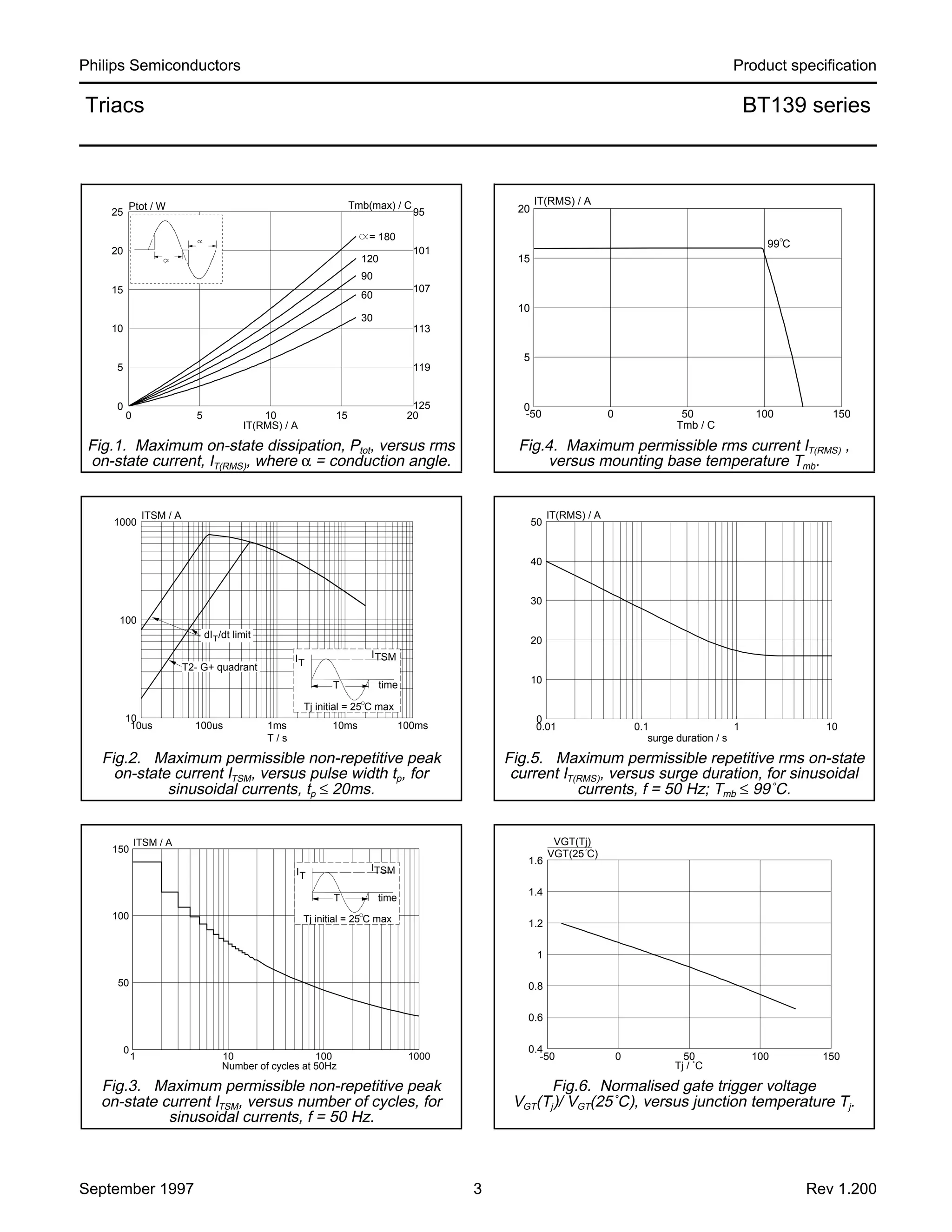
Fig.1. Maximum on-state dissipation, Ptot, versus rms
on-state current, IT(RMS), where α = conduction angle.
Fig.2. Maximum permissible non-repetitive peak
on-state current ITSM, versus pulse width tp, for
sinusoidal currents, tp ≤ 20ms.
Fig.3. Maximum permissible non-repetitive peak
on-state current ITSM, versus number of cycles, for
sinusoidal currents, f = 50 Hz.
Fig.4. Maximum permissible rms current IT(RMS) ,
versus mounting base temperature Tmb.
Fig.5. Maximum permissible repetitive rms on-state
current IT(RMS), versus surge duration, for sinusoidal
currents, f = 50 Hz; Tmb ≤ 99˚C.
Fig.6. Normalised gate trigger voltage
VGT(Tj)/ VGT(25˚C), versus junction temperature Tj.
0 5 10 15 20
0
5
10
15
20
25
= 180
120
90
60
30
BT139
IT(RMS) / A
Ptot / W Tmb(max) / C
125
119
113
107
101
95
1
-50 0 50 100 150
0
5
10
15
20
BT139
99 C
Tmb / C
IT(RMS) / A
10us 100us 1ms 10ms 100ms
10
100
1000
BT139
T / s
ITSM / A
T
ITSM
time
I
Tj initial = 25 C max
T
dI /dt limitT
T2- G+ quadrant
0.01 0.1 1 10
0
10
20
30
40
50
BT139
surge duration / s
IT(RMS) / A
1 10 100 1000
0
50
100
150
BT139
Number of cycles at 50Hz
ITSM / A
T
ITSM
time
I
Tj initial = 25 C max
T
-50 0 50 100 150
0.4
0.6
0.8
1
1.2
1.4
1.6
BT136
Tj / C
VGT(Tj)
VGT(25 C)
September 1997 3 Rev 1.200
Philips Semiconductors Product specification
Triacs BT139 series
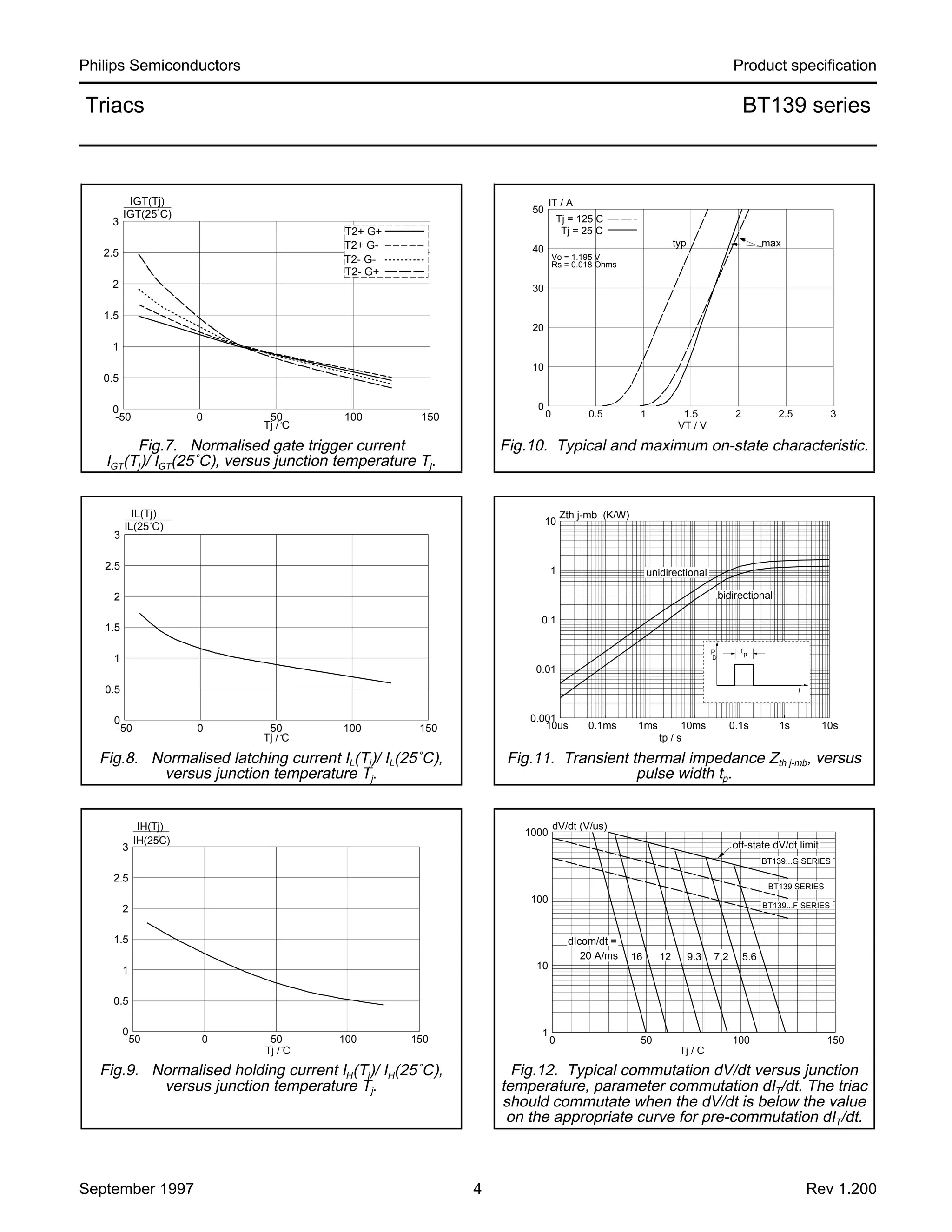
Fig.7. Normalised gate trigger current
IGT(Tj)/ IGT(25˚C), versus junction temperature Tj.
Fig.8. Normalised latching current IL(Tj)/ IL(25˚C),
versus junction temperature Tj.
Fig.9. Normalised holding current IH(Tj)/ IH(25˚C),
versus junction temperature Tj.
Fig.10. Typical and maximum on-state characteristic.
Fig.11. Transient thermal impedance Zth j-mb, versus
pulse width tp.
Fig.12. Typical commutation dV/dt versus junction
temperature, parameter commutation dIT/dt. The triac
should commutate when the dV/dt is below the value
on the appropriate curve for pre-commutation dIT/dt.
-50 0 50 100 150
0
0.5
1
1.5
2
2.5
3
BT139
Tj / C
T2+ G+
T2+ G-
T2- G-
T2- G+
IGT(Tj)
IGT(25 C)
0 0.5 1 1.5 2 2.5 3
0
10
20
30
40
50
BT139
VT / V
IT / A
Tj = 125 C
Tj = 25 C
typ max
Vo = 1.195 V
Rs = 0.018 Ohms
-50 0 50 100 150
0
0.5
1
1.5
2
2.5
3
TRIAC
Tj / C
IL(Tj)
IL(25 C)
0.001
0.01
0.1
1
10
BT139
tp / s
Zth j-mb (K/W)
10us 0.1ms 1ms 10ms 0.1s 1s 10s
t
pP
t
D
unidirectional
bidirectional
-50 0 50 100 150
0
0.5
1
1.5
2
2.5
3
TRIAC
Tj / C
IH(Tj)
IH(25C)
0 50 100 150
1
10
100
1000
Tj / C
9.3
dV/dt (V/us)
5.6
dIcom/dt =
20 A/ms 16
off-state dV/dt limit
BT139 SERIES
BT139...F SERIES
12 7.2
BT139...G SERIES
September 1997 4 Rev 1.200
Philips Semiconductors Product specification
Triacs BT139 series
MECHANICAL DATA
Dimensions in mm
Net Mass: 2 g
Fig.13. TO220AB; pin 2 connected to mounting base.
Notes
1. Refer to mounting instructions for TO220 envelopes.
2. Epoxy meets UL94 V0 at 1/8".
10,3
max
3,7
2,8
3,0
3,0 max
not tinned
1,3
max
(2x)
1 2 3
2,4
0,6
4,5
max
5,9
min
15,8
max
1,3
2,54 2,54
0,9 max (3x)
13,5
min
September 1997 5 Rev 1.200
Philips Semiconductors Product specification
Triacs BT139 series
DEFINITIONS
Data sheet status
Objective specification This data sheet contains target or goal specifications for product development.
Preliminary specification This data sheet contains preliminary data; supplementary data may be published later.
Product specification This data sheet contains final product specifications.
Limiting values
Limiting values are given in accordance with the Absolute Maximum Rating System (IEC 134). Stress above one
or more of the limiting values may cause permanent damage to the device. These are stress ratings only and
operation of the device at these or at any other conditions above those given in the Characteristics sections of
this specification is not implied. Exposure to limiting values for extended periods may affect device reliability.
Application information
Where application information is given, it is advisory and does not form part of the specification.
© Philips Electronics N.V. 1997
All rights are reserved. Reproduction in whole or in part is prohibited without the prior written consent of the
copyright owner.
The information presented in this document does not form part of any quotation or contract, it is believed to be
accurate and reliable and may be changed without notice. No liability will be accepted by the publisher for any
consequence of its use. Publication thereof does not convey nor imply any license under patent or other
industrial or intellectual property rights.
LIFE SUPPORT APPLICATIONS
These products are not designed for use in life support appliances, devices or systems where malfunction of these
products can be reasonably expected to result in personal injury. Philips customers using or selling these products
for use in such applications do so at their own risk and agree to fully indemnify Philips for any damages resulting
from such improper use or sale.
September 1997 6 Rev 1.200

Bt139

  • 1.
    Philips Semiconductors Productspecification Triacs BT139 series GENERAL DESCRIPTION QUICK REFERENCE DATA Glass passivated triacs in a plastic SYMBOL PARAMETER MAX. MAX. MAX. UNIT envelope, intended for use in applications requiring high BT139- 500 600 800 bidirectional transient and blocking BT139- 500F 600F 800F voltage capability and high thermal BT139- 500G 600G 800G cycling performance. Typical VDRM Repetitive peak off-state 500 600 800 V applications include motor control, voltages industrial and domestic lighting, IT(RMS) RMS on-state current 16 16 16 A heating and static switching. ITSM Non-repetitive peak on-state 140 140 140 A current PINNING - TO220AB PIN CONFIGURATION SYMBOL PIN DESCRIPTION 1 main terminal 1 2 main terminal 2 3 gate tab main terminal 2 LIMITING VALUES Limiting values in accordance with the Absolute Maximum System (IEC 134). SYMBOL PARAMETER CONDITIONS MIN. MAX. UNIT -500 -600 -800 VDRM Repetitive peak off-state - 5001 6001 800 V voltages IT(RMS) RMS on-state current full sine wave; Tmb ≤ 99 ˚C - 16 A ITSM Non-repetitive peak full sine wave; Tj = 25 ˚C prior to on-state current surge t = 20 ms - 140 A t = 16.7 ms - 150 A I2 t I2 t for fusing t = 10 ms - 98 A2 s dIT/dt Repetitive rate of rise of ITM = 20 A; IG = 0.2 A; on-state current after dIG/dt = 0.2 A/µs triggering T2+ G+ - 50 A/µs T2+ G- - 50 A/µs T2- G- - 50 A/µs T2- G+ - 10 A/µs IGM Peak gate current - 2 A VGM Peak gate voltage - 5 V PGM Peak gate power - 5 W PG(AV) Average gate power over any 20 ms period - 0.5 W Tstg Storage temperature -40 150 ˚C Tj Operating junction - 125 ˚C temperature T1T2 G1 2 3 tab 1 Although not recommended, off-state voltages up to 800V may be applied without damage, but the triac may switch to the on-state. The rate of rise of current should not exceed 15 A/µs. September 1997 1 Rev 1.200
  • 2.
    Philips Semiconductors Productspecification Triacs BT139 series THERMAL RESISTANCES SYMBOL PARAMETER CONDITIONS MIN. TYP. MAX. UNIT Rth j-mb Thermal resistance full cycle - - 1.2 K/W junction to mounting base half cycle - - 1.7 K/W Rth j-a Thermal resistance in free air - 60 - K/W junction to ambient STATIC CHARACTERISTICS Tj = 25 ˚C unless otherwise stated SYMBOL PARAMETER CONDITIONS MIN. TYP. MAX. UNIT BT139- ... ...F ...G IGT Gate trigger current VD = 12 V; IT = 0.1 A T2+ G+ - 5 35 25 50 mA T2+ G- - 8 35 25 50 mA T2- G- - 10 35 25 50 mA T2- G+ - 22 70 70 100 mA IL Latching current VD = 12 V; IGT = 0.1 A T2+ G+ - 7 40 40 60 mA T2+ G- - 20 60 60 90 mA T2- G- - 8 40 40 60 mA T2- G+ - 10 60 60 90 mA IH Holding current VD = 12 V; IGT = 0.1 A - 6 30 30 60 mA VT On-state voltage IT = 20 A - 1.2 1.6 V VGT Gate trigger voltage VD = 12 V; IT = 0.1 A - 0.7 1.5 V VD = 400 V; IT = 0.1 A; 0.25 0.4 - V Tj = 125 ˚C ID Off-state leakage current VD = VDRM(max); - 0.1 0.5 mA Tj = 125 ˚C DYNAMIC CHARACTERISTICS Tj = 25 ˚C unless otherwise stated SYMBOL PARAMETER CONDITIONS MIN. TYP. MAX. UNIT BT139- ... ...F ...G dVD/dt Critical rate of rise of VDM = 67% VDRM(max); 100 50 200 250 - V/µs off-state voltage Tj = 125 ˚C; exponential waveform; gate open circuit dVcom/dt Critical rate of change of VDM = 400 V; Tj = 95 ˚C; - - 10 20 - V/µs commutating voltage IT(RMS) = 16 A; dIcom/dt = 7.2 A/ms; gate open circuit tgt Gate controlled turn-on ITM = 20 A; VD = VDRM(max); - - - 2 - µs time IG = 0.1 A; dIG/dt = 5 A/µs September 1997 2 Rev 1.200
  • 3.
    Philips Semiconductors Productspecification Triacs BT139 series Fig.1. Maximum on-state dissipation, Ptot, versus rms on-state current, IT(RMS), where α = conduction angle. Fig.2. Maximum permissible non-repetitive peak on-state current ITSM, versus pulse width tp, for sinusoidal currents, tp ≤ 20ms. Fig.3. Maximum permissible non-repetitive peak on-state current ITSM, versus number of cycles, for sinusoidal currents, f = 50 Hz. Fig.4. Maximum permissible rms current IT(RMS) , versus mounting base temperature Tmb. Fig.5. Maximum permissible repetitive rms on-state current IT(RMS), versus surge duration, for sinusoidal currents, f = 50 Hz; Tmb ≤ 99˚C. Fig.6. Normalised gate trigger voltage VGT(Tj)/ VGT(25˚C), versus junction temperature Tj. 0 5 10 15 20 0 5 10 15 20 25 = 180 120 90 60 30 BT139 IT(RMS) / A Ptot / W Tmb(max) / C 125 119 113 107 101 95 1 -50 0 50 100 150 0 5 10 15 20 BT139 99 C Tmb / C IT(RMS) / A 10us 100us 1ms 10ms 100ms 10 100 1000 BT139 T / s ITSM / A T ITSM time I Tj initial = 25 C max T dI /dt limitT T2- G+ quadrant 0.01 0.1 1 10 0 10 20 30 40 50 BT139 surge duration / s IT(RMS) / A 1 10 100 1000 0 50 100 150 BT139 Number of cycles at 50Hz ITSM / A T ITSM time I Tj initial = 25 C max T -50 0 50 100 150 0.4 0.6 0.8 1 1.2 1.4 1.6 BT136 Tj / C VGT(Tj) VGT(25 C) September 1997 3 Rev 1.200
  • 4.
    Philips Semiconductors Productspecification Triacs BT139 series Fig.7. Normalised gate trigger current IGT(Tj)/ IGT(25˚C), versus junction temperature Tj. Fig.8. Normalised latching current IL(Tj)/ IL(25˚C), versus junction temperature Tj. Fig.9. Normalised holding current IH(Tj)/ IH(25˚C), versus junction temperature Tj. Fig.10. Typical and maximum on-state characteristic. Fig.11. Transient thermal impedance Zth j-mb, versus pulse width tp. Fig.12. Typical commutation dV/dt versus junction temperature, parameter commutation dIT/dt. The triac should commutate when the dV/dt is below the value on the appropriate curve for pre-commutation dIT/dt. -50 0 50 100 150 0 0.5 1 1.5 2 2.5 3 BT139 Tj / C T2+ G+ T2+ G- T2- G- T2- G+ IGT(Tj) IGT(25 C) 0 0.5 1 1.5 2 2.5 3 0 10 20 30 40 50 BT139 VT / V IT / A Tj = 125 C Tj = 25 C typ max Vo = 1.195 V Rs = 0.018 Ohms -50 0 50 100 150 0 0.5 1 1.5 2 2.5 3 TRIAC Tj / C IL(Tj) IL(25 C) 0.001 0.01 0.1 1 10 BT139 tp / s Zth j-mb (K/W) 10us 0.1ms 1ms 10ms 0.1s 1s 10s t pP t D unidirectional bidirectional -50 0 50 100 150 0 0.5 1 1.5 2 2.5 3 TRIAC Tj / C IH(Tj) IH(25C) 0 50 100 150 1 10 100 1000 Tj / C 9.3 dV/dt (V/us) 5.6 dIcom/dt = 20 A/ms 16 off-state dV/dt limit BT139 SERIES BT139...F SERIES 12 7.2 BT139...G SERIES September 1997 4 Rev 1.200
  • 5.
    Philips Semiconductors Productspecification Triacs BT139 series MECHANICAL DATA Dimensions in mm Net Mass: 2 g Fig.13. TO220AB; pin 2 connected to mounting base. Notes 1. Refer to mounting instructions for TO220 envelopes. 2. Epoxy meets UL94 V0 at 1/8". 10,3 max 3,7 2,8 3,0 3,0 max not tinned 1,3 max (2x) 1 2 3 2,4 0,6 4,5 max 5,9 min 15,8 max 1,3 2,54 2,54 0,9 max (3x) 13,5 min September 1997 5 Rev 1.200
  • 6.
    Philips Semiconductors Productspecification Triacs BT139 series DEFINITIONS Data sheet status Objective specification This data sheet contains target or goal specifications for product development. Preliminary specification This data sheet contains preliminary data; supplementary data may be published later. Product specification This data sheet contains final product specifications. Limiting values Limiting values are given in accordance with the Absolute Maximum Rating System (IEC 134). Stress above one or more of the limiting values may cause permanent damage to the device. These are stress ratings only and operation of the device at these or at any other conditions above those given in the Characteristics sections of this specification is not implied. Exposure to limiting values for extended periods may affect device reliability. Application information Where application information is given, it is advisory and does not form part of the specification. © Philips Electronics N.V. 1997 All rights are reserved. Reproduction in whole or in part is prohibited without the prior written consent of the copyright owner. The information presented in this document does not form part of any quotation or contract, it is believed to be accurate and reliable and may be changed without notice. No liability will be accepted by the publisher for any consequence of its use. Publication thereof does not convey nor imply any license under patent or other industrial or intellectual property rights. LIFE SUPPORT APPLICATIONS These products are not designed for use in life support appliances, devices or systems where malfunction of these products can be reasonably expected to result in personal injury. Philips customers using or selling these products for use in such applications do so at their own risk and agree to fully indemnify Philips for any damages resulting from such improper use or sale. September 1997 6 Rev 1.200