Download to read offline


![MUMBAI UNIVERSITY
QUESTION PAPER
NETWORK SECURITY
(APRIL – 2015 | REVISED COURSE)
B.SC.IT
(SEMESTER – V)
KjT MUMBAI B.SC.IT STUDY
FACEBOOK | TWITTER | INSTAGRAM | GOOGLE+ | YOUTUBE | SLIDESHARE | TUMBLR | GITHUB
PAGE
1
Time: 3 Hours Total Marks: 100
N.B.: (1) All Question are Compulsory.
(2) Make Suitable Assumptions Wherever Necessary And State The Assumptions Made.
(3) Answer To The Same Question Must Be Written Together.
(4) Number To The Right Indicates Marks.
(5) Draw Neat Labeled Diagrams Wherever Necessary.
(6) Use of Non – Programmable Calculator is allowed.
Q.1 ATTEMPT ANY TWO QUESTIONS: (10 MARKS)
(A) Write a note on SET Model. (5)
(B) Give various definition of Collision-Free Hash Function. (5)
(C) Write a note on PGP Certificate that will cover Introducer Trust and Certificate Trust. Give Example. (5)
(D) Sate and Explain various Fields present in an Audit Record. (5)
Q.2 ATTEMPT ANY THREE QUESTIONS: (15 MARKS)
(A) State and Explain Shift Cipher Algorithm with example. (5)
(B) State and explain steps involved in Permutation Cipher. Also give an example. (5)
(C) Explain how Key is generated using a Linear Feedback Shift Register. (5)
(D) Explain Variation available in DES. (5)
(E) State and explain Chinese Remainder Theorem with example. (5)
(F) State and Explain Vigenere Cipher Algorithm with example. (5)
Q.3 ATTEMPT ANY THREE QUESTIONS: (15 MARKS)
(A) Explain in detail the concept of the Digital Signature. (5)
(B) Write a note on Hash Function from Cryptosystem. (5)
(C) Explain in details Station-to-Station Protocol. (5)
(D) Explain Diffie-Hellman Key Exchange Algorithm with example. (5)
(E) Explain the concept of Timestamping. (5)
(F) Explain Transmission of Session Key using Kerberos. (5)
Q.4 ATTEMPT ANY THREE QUESTIONS: (15 MARKS)
(A) Define Computer Security and three Key Objective of Computer Security. (5)
(B) What is the OSI Security Architecture? (5)
(C) List and briefly define any two categories of Security Services. (5)
(D) Draw and Explain Model for Network Security. (5)
(E) State and Explain the challenges of Computer Security. (5)
(F) List and briefly define categories of Passive Security Attacks. (5)
Q.5 ATTEMPT ANY THREE QUESTIONS: (15 MARKS)
(A) Draw diagram and explain X.509 Certificate Format. (5)
(B) Explain the use of Key rings with example. (5)
(C) Write a note on S/MIME functionality and Key Management Functions. (5)
(D) What all are the advantages of Kerberos Version 5. (5)
(E) Explain any two steps of Kerberos. (5)
(F) Explain PKIX Management Functions. (5)
[TURN OVER]](https://image.slidesharecdn.com/apr-2015-180628162215/85/B-Sc-IT-Semester-V-April-2015-Revised-Course-Question-Paper-2-320.jpg)
![MUMBAI UNIVERSITY
QUESTION PAPER
ASP.NET WITH C#
(APRIL – 2015 | REVISED COURSE)
B.SC.IT
(SEMESTER – V)
KjT MUMBAI B.SC.IT STUDY
FACEBOOK | TWITTER | INSTAGRAM | GOOGLE+ | YOUTUBE | SLIDESHARE | TUMBLR | GITHUB
PAGE
1
Time: 3 Hours Total Marks: 100
N.B.: (1) All Question are Compulsory.
(2) Make Suitable Assumptions Wherever Necessary And State The Assumptions Made.
(3) Answer To The Same Question Must Be Written Together.
(4) Number To The Right Indicates Marks.
(5) Draw Neat Labeled Diagrams Wherever Necessary.
(6) Use of Non – Programmable Calculator is allowed.
Q.1 ATTEMPT ANY TWO QUESTIONS: (10 MARKS)
(A) What is a Property? Why are they referred to as Smart Fields? (5)
(B) What is the importance of Web.Config File in any Web Application? (5)
(C) What is the difference between Server Controls and User Controls? (5)
(D) What is the significance of AJAX Websites? (5)
Q.2 ATTEMPT ANY THREE QUESTIONS: (15 MARKS)
(A) What is an event? What is an Event Handler? How is it designed? (5)
(B) Define an Exception called "NoMatchException" that is thrown when a string is not equal to "India".
Write a program that uses this Exception.
(5)
(C) Explain with an example the concept of Method Overloading? (5)
(D) List and Explain the various Primitive Data Types used in C#. (5)
(E) Write a Console Program to find a Fibonacci series of entered number. (5)
(F) Explain the differences between Interface and Abstract Classes. (5)
Q.3 ATTEMPT ANY THREE QUESTIONS: (15 MARKS)
(A) What are CSS? Explain different Selectors used to write CSS. (5)
(B) Explain the terms: JIT Compiler and Garbage Collector. (5)
(C) What are Collections? Write different collections supported by C#. (5)
(D) List and Explain five properties of Textbox Control. (5)
(E) Explain HashTable collection with an example. (5)
(F) What are Assemblies? Discuss its different components. (5)
Q.4 ATTEMPT ANY THREE QUESTIONS: (15 MARKS)
(A) Explain the following properties associated with Dropdown List Control:
(i) SelectedItem
(ii) SelectedIndex
(iii) Items
(iv) SelectionMode
(5)
(B) What is the difference between RadioButton and CheckButton Controls? (5)
(C) Explain StausStrip Control. (5)
(D) What is Global.asax File? Explain its Structure. (5)
(E) What are Skins? Why are they used? (5)
(F) List and Explain Properties of Page Class. (5)
[TURN OVER]](https://image.slidesharecdn.com/apr-2015-180628162215/85/B-Sc-IT-Semester-V-April-2015-Revised-Course-Question-Paper-5-320.jpg)
![MUMBAI UNIVERSITY
QUESTION PAPER
ASP.NET WITH C#
(APRIL – 2015 | REVISED COURSE)
B.SC.IT
(SEMESTER – V)
KjT MUMBAI B.SC.IT STUDY
FACEBOOK | TWITTER | INSTAGRAM | GOOGLE+ | YOUTUBE | SLIDESHARE | TUMBLR | GITHUB
PAGE
2
Q.5 ATTEMPT ANY THREE QUESTIONS: (15 MARKS)
(A) What is a Caching? Explain its types. (5)
(B) Explain the following Validation Controls with the help of an example:
(i) Regulars Expression Validator
(ii) Compare Validator
(5)
(C) Explain in brief about Cookies. (5)
(D) What are four application Events when an Application is executed? (5)
(E) What is View State? How to preserve View State for user's own data. (5)
(F) Explain any two Site Navigation Controls in ASP.NET. (5)
Q.6 ATTEMPT ANY THREE QUESTIONS: (15 MARKS)
(A) What is LINQ? Explain the structure of a LINQ Query. (5)
(B) What is Data Binding? Explain its different types. (5)
(C) Explain ADO.NET Object Model with help of suitable diagram. (5)
(D) Explain any four properties of GridView Control. (5)
(E) How Authorization is used in case of providing Security to Web Application. (5)
(F) Write a short note on basic ADO.NET Objects. (5)
Q.7 ATTEMPT ANY THREE QUESTIONS: (15 MARKS)
(A) What are different LINQ Operators? (5)
(B) Write a snippet code to hide and display the Header Text on click Command Button using j-Query.
[Hint: use Hide() and Show()]
(5)
(C) What is an Ajax? Explain it's the importance. (5)
(D) Explain XMLHttpRequest Object with its properties and methods. (5)
(E) What are the advantages of Web Services? (5)
(F) Explain DOM Manipulation Methods in j-Query. (5)](https://image.slidesharecdn.com/apr-2015-180628162215/85/B-Sc-IT-Semester-V-April-2015-Revised-Course-Question-Paper-6-320.jpg)
![MUMBAI UNIVERSITY
QUESTION PAPER
SOFTWARE TESTING
(APRIL – 2015 | REVISED COURSE)
B.SC.IT
(SEMESTER – V)
KjT MUMBAI B.SC.IT STUDY
FACEBOOK | TWITTER | INSTAGRAM | GOOGLE+ | YOUTUBE | SLIDESHARE | TUMBLR | GITHUB
PAGE
1
Time: 3 Hours Total Marks: 100
N.B.: (1) All Question are Compulsory.
(2) Make Suitable Assumptions Wherever Necessary And State The Assumptions Made.
(3) Answer To The Same Question Must Be Written Together.
(4) Number To The Right Indicates Marks.
(5) Draw Neat Labeled Diagrams Wherever Necessary.
(6) Use of Non – Programmable Calculator is allowed.
Q.1 ATTEMPT ANY TWO QUESTIONS: (10 MARKS)
(A) Define Test Case and Test Scenario. Explain with example. (5)
(B) Discuss different Levels of testing. (5)
(C) Explain Process Improvement Cycle (PDCA). (5)
(D) Give Formal definition of Basis Path Testing. Explain this Testing Technique with help of an example. (5)
Q.2 ATTEMPT ANY THREE QUESTIONS: (15 MARKS)
(A) Explain the basic principles on which testing is based. (5)
(B) Define User Gap and Producer Gap. Explain how these gaps can be closed? (5)
(C) Explain Generic Quality Management System Structure for an organization. (5)
(D) Discuss VV Model briefly. (5)
(E) Explain the concept of Cost of Quality. (5)
(F) Discuss TQM Approach of Testing. (5)
Q.3 ATTEMPT ANY THREE QUESTIONS: (15 MARKS)
(A) Write a short note on Boundary Value Analysis. (5)
(B) Explain Decision Table Testing with example. (5)
(C) Consider a program for the determination of the largest amongst three numbers. Its input is a triple
of Positive Integers (say x, y and z) and values are from interval [1, 300]. Design the Boundary Values
(robustness) test cases.
(5)
(D) Compare and contrast Boundary Value Analysis and Equivalence Partitioning. (5)
(E) Write a short note on "Requirement Traceability Matrix". (5)
(F) A login process allows User ID and Password to authorize users. From customer requirements user
ID takes numbers and alphabets in lower case and can be 4 to 16 characters long. The password
object takes alphabets in lower case from 4 to 8 characters long. Prepare test case titles/scenario
using Equivalence Partitioning.
(5)
Q.4 ATTEMPT ANY THREE QUESTIONS: (15 MARKS)
(A) Explain Slice-Based Testing. (5)
(B) Write a short note on Path-Testing Coverage Metrics. (5)
(C) What is Data Flow Testing? Explain how to find DD-Path. (5)
(D) What is Cyclomatic Complexity? Discuss its significance. (5)
(E) Write a short note on System Testing. (5)
(F) Discuss the significance of stubs and drives with help of example. (5)
[TURN OVER]](https://image.slidesharecdn.com/apr-2015-180628162215/85/B-Sc-IT-Semester-V-April-2015-Revised-Course-Question-Paper-8-320.jpg)
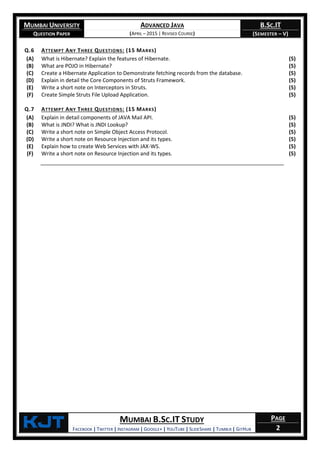
![MUMBAI UNIVERSITY
QUESTION PAPER
ADVANCED JAVA
(APRIL – 2015 | REVISED COURSE)
B.SC.IT
(SEMESTER – V)
KjT MUMBAI B.SC.IT STUDY
FACEBOOK | TWITTER | INSTAGRAM | GOOGLE+ | YOUTUBE | SLIDESHARE | TUMBLR | GITHUB
PAGE
1
Time: 3 Hours Total Marks: 100
N.B.: (1) All Question are Compulsory.
(2) Make Suitable Assumptions Wherever Necessary And State The Assumptions Made.
(3) Answer To The Same Question Must Be Written Together.
(4) Number To The Right Indicates Marks.
(5) Draw Neat Labeled Diagrams Wherever Necessary.
(6) Use of Non – Programmable Calculator is allowed.
Q.1 ATTEMPT ANY TWO QUESTIONS: (10 MARKS)
(A) Explain Immediate and Deferred Evaluation of Expression in Unified Expression Language. (5)
(B) What is JSF? Explain the benefits of Java Server Faces Technology. (5)
(C) Explain Structure and working of struts.xml file. (5)
(D) How we can use variables, literals and operators using Expression Language in JSP code? Explain it
with sample code snippets.
(5)
Q.2 ATTEMPT ANY THREE QUESTIONS: (15 MARKS)
(A) Differentiate between Heavyweight and Lightweight Components. (5)
(B) Explain JInternalFrame with its constructors. (5)
(C) Explain JTable in Swing with the steps of creating a Table. (5)
(D) What is Menu Bar? Explain the components used for creation of Menu Bar. Give simple swing Menu
Bar example.
(5)
(E) Explain in detail the Swing Components and the Containment Hierarchy. (5)
(F) Explain ActionEvent Class with an example. (5)
Q.3 ATTEMPT ANY THREE QUESTIONS: (15 MARKS)
(A) What is Servlet? What are the benefits of Servlets? Explain the working of Servlets with help of
suitable diagram.
(5)
(B) Explain the GenericServlet With its Constructors and Methods. (5)
(C) Write short note on ServletConfig explaining its Methods and Constructors. (5)
(D) What is Deployment Descriptor and Context Path? Explain. (5)
(E) Create a Servlet Application for Shopping Cart. Make suitable assumptions and state the
assumptions made.
(5)
(F) Explain any three classes and/or interfaces from Servlet API with their Constructors and Methods. (5)
Q.4 ATTEMPT ANY THREE QUESTIONS: (15 MARKS)
(A) What is JDBC? Explain the architecture of JDBC in detail. (5)
(B) What are Scrollable Resultset in JDBC? (5)
(C) Write Short Note on JDBC Transactions. (5)
(D) Differentiate between JSP and Servlet. (5)
(E) Write short note on Exception Object used in JSP. (5)
(F) What are Directives in JSP? Explain its types. (5)
Q.5 ATTEMPT ANY THREE QUESTIONS: (15 MARKS)
(A) Explain the Model View Controller Architecture. (5)
(B) Explain in details Phases of JSF Life Cycle. (5)
(C) Explain the use and Structure of faces-config.xml file. (5)
(D) What is EJB? Explain the components of Enterprise Bean Architecture. (5)
(E) Explain Packaging of Enterprise Beans. (5)
(F) Explain Message Driven Beans in detail. (5)
[Turn Over]](https://image.slidesharecdn.com/apr-2015-180628162215/85/B-Sc-IT-Semester-V-April-2015-Revised-Course-Question-Paper-11-320.jpg)
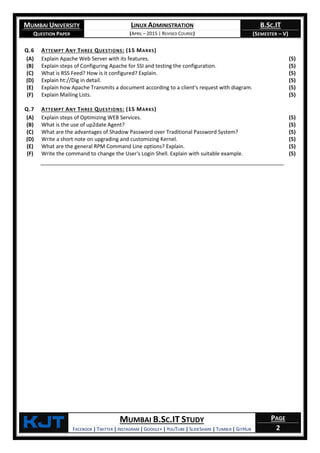
![MUMBAI UNIVERSITY
QUESTION PAPER
LINUX ADMINISTRATION
(APRIL – 2015 | REVISED COURSE)
B.SC.IT
(SEMESTER – V)
KjT MUMBAI B.SC.IT STUDY
FACEBOOK | TWITTER | INSTAGRAM | GOOGLE+ | YOUTUBE | SLIDESHARE | TUMBLR | GITHUB
PAGE
1
Time: 3 Hours Total Marks: 100
N.B.: (1) All Question are Compulsory.
(2) Make Suitable Assumptions Wherever Necessary And State The Assumptions Made.
(3) Answer To The Same Question Must Be Written Together.
(4) Number To The Right Indicates Marks.
(5) Draw Neat Labeled Diagrams Wherever Necessary.
(6) Use of Non – Programmable Calculator is allowed.
Q.1 ATTEMPT ANY TWO QUESTIONS: (10 MARKS)
(A) Explain with example how multiple user's password can be changed in a single operation. (5)
(B) Explain different types of Servers used in DNS. (5)
(C) Explain different Secure and Less Secure Services. (5)
(D) Explain RAID in detail with its advantages and disadvantages. (5)
Q.2 ATTEMPT ANY THREE QUESTIONS: (15 MARKS)
(A) Explain Virtual File System (VFS) in brief. (5)
(B) Explain GRUB and LILO Boot Loaders. (5)
(C) Explain different init Levels and state how the init level can be changed with the help of inittab file. (5)
(D) How a particular user account is handled by an administrator if the account holder has left the
company?
(5)
(E) Explain steps of Installing and Configuring Application Software. (5)
(F) Explain Features of Linux in detail with different Linux Distributions. (5)
Q.3 ATTEMPT ANY THREE QUESTIONS: (15 MARKS)
(A) What is an IP address? What are different classes of IP Address? (5)
(B) How to work with Gateway and Routers? (5)
(C) Describe syslog.conf file in details. (5)
(D) What are the advantages and disadvantages of NFS? Explain in detail. (5)
(E) Write System Environmental setting files. (5)
(F) What is Corn? How Corn files are taking care of system task explain. (5)
Q.4 ATTEMPT ANY THREE QUESTIONS: (15 MARKS)
(A) Explain use of samba server in detail, how to enable & disable samba services. (5)
(B) Explain how to configure xinted services. (5)
(C) Explain use of ssh, scp, sftp, talk, finger services. (5)
(D) Explain how to configure Time Server. (5)
(E) Explain how Linux files can be shared on Windows Machine. Explain steps of samba client. (5)
(F) Explain Configuring Linux Firewall packages. (5)
Q.5 ATTEMPT ANY THREE QUESTIONS: (15 MARKS)
(A) Explain Forward Zone and Reverse Zone of DNS. (5)
(B) Write in detail the protocols used for E-Mail System. (5)
(C) Explain different types of Servers used in DNS. State which are different files are used by these
servers.
(5)
(D) What is the use of DNS? Explain three types of DNS Servers. (5)
(E) Explain the use FTP Server. Explain the steps for vsftpd configuration. (5)
(F) Explain the configuration of Postfix Mail Server. (5)
[TURN OVER]](https://image.slidesharecdn.com/apr-2015-180628162215/85/B-Sc-IT-Semester-V-April-2015-Revised-Course-Question-Paper-14-320.jpg)

The document contains the question papers for various subjects from B.Sc. IT semester V at Mumbai University, specifically for the April 2015 exams. It covers topics in Network Security, ASP.NET with C#, Software Testing, and Advanced Java, with an emphasis on different theoretical concepts and practical applications, each section requiring students to attempt multiple questions from a selection. Each question highlights critical aspects of the respective subjects, including algorithms, protocols, and testing methodologies.
![BScIT: Semester – V (May - 2018) [IDOL: Old Course | Question Paper]](https://cdn.slidesharecdn.com/ss_thumbnails/bscit-rc-sem-v-qp-180827152122-thumbnail.jpg?width=640&height=640&fit=bounds)
![B.Sc.IT: Semester – V (October – 2016) [Revised Course | Question Paper]](https://cdn.slidesharecdn.com/ss_thumbnails/oct-2016-180628164215-thumbnail.jpg?width=640&height=640&fit=bounds)
![B.Sc.IT: Semester – V (May – 2016) [Revised Course | Question Paper]](https://cdn.slidesharecdn.com/ss_thumbnails/may-2016-180628183148-thumbnail.jpg?width=640&height=640&fit=bounds)
![B.Sc.IT: Semester – V (December – 2017) [Revised Course | Question Paper]](https://cdn.slidesharecdn.com/ss_thumbnails/dec-2017-180628185253-thumbnail.jpg?width=640&height=640&fit=bounds)
![B.Sc.IT: Semester – V (October – 2012) [Revised Course | Question Paper]](https://cdn.slidesharecdn.com/ss_thumbnails/oct-2012-180628181415-thumbnail.jpg?width=640&height=640&fit=bounds)
![B.Sc.IT: Semester - V (November – 2014) [75:25 Pattern | Question Paper]](https://cdn.slidesharecdn.com/ss_thumbnails/bscit-sem-v-qp-nov-2014-180629052331-thumbnail.jpg?width=640&height=640&fit=bounds)
![B.Sc.IT: Semester - V (April - 2014) [60:40 Pattern | Question Paper]](https://cdn.slidesharecdn.com/ss_thumbnails/bscit-sem-v-apr-2014-60-40-qp-180626105203-thumbnail.jpg?width=640&height=640&fit=bounds)
![B.Sc.IT: Semester - V (October - 2013) [60:40 Pattern | Question Paper]](https://cdn.slidesharecdn.com/ss_thumbnails/bscit-sem-v-oct-2013-60-40-qp-180626111539-thumbnail.jpg?width=640&height=640&fit=bounds)

![B.Sc.IT: Semester - V (November - 2017) [75:25 Pattern | Question Paper]](https://cdn.slidesharecdn.com/ss_thumbnails/bscit-sem-v-qp-nov-2017-180625032843-thumbnail.jpg?width=640&height=640&fit=bounds)
![B.Sc.IT: Semester – V (April - 2017) [75:25 Pattern | Question Paper]](https://cdn.slidesharecdn.com/ss_thumbnails/bscit-sem-v-qp-apr-2017-180629054517-thumbnail.jpg?width=640&height=640&fit=bounds)

![Software Testing (December – 2017) [Revised Syllabus | Question Paper]](https://cdn.slidesharecdn.com/ss_thumbnails/st-dec-2017-rs-qp-180426085545-thumbnail.jpg?width=640&height=640&fit=bounds)
![ASP.NET With C# (December – 2017) [Revised Syllabus | Question Paper]](https://cdn.slidesharecdn.com/ss_thumbnails/asp-dec-2017-rs-qp-180426085556-thumbnail.jpg?width=640&height=640&fit=bounds)
![Software Testing (Revised Syllabus) [QP / April - 2015]](https://cdn.slidesharecdn.com/ss_thumbnails/st-qp-rs-apr-2015-171003005145-thumbnail.jpg?width=640&height=640&fit=bounds)
![[Question Paper] Network Security (Revised Syllabus) [April / 2015]](https://cdn.slidesharecdn.com/ss_thumbnails/ns-rs-qp-apr-2015-170806151121-thumbnail.jpg?width=640&height=640&fit=bounds)
![Software Testing (Revised Syllabus) [QP / October - 2012]](https://cdn.slidesharecdn.com/ss_thumbnails/st-qp-rs-oct-2012-171003005141-thumbnail.jpg?width=640&height=640&fit=bounds)
![Web Programming (Question Paper) [April – 2017 | 75:25 Pattern]](https://cdn.slidesharecdn.com/ss_thumbnails/75-25-wp-apr-2017-qp-180619012839-thumbnail.jpg?width=640&height=640&fit=bounds)
![Advanced Java (Revised Syllabus) [QP / April - 2015]](https://cdn.slidesharecdn.com/ss_thumbnails/aj-qp-rs-apr-2015-171002230115-thumbnail.jpg?width=640&height=640&fit=bounds)
![ASP.NET With C# (Revised Syllabus) [QP / May - 2016]](https://cdn.slidesharecdn.com/ss_thumbnails/asp-qp-rs-may-2016-171002232705-thumbnail.jpg?width=640&height=640&fit=bounds)
![Network Security (Revised Syllabus) [QP / April - 2015]](https://cdn.slidesharecdn.com/ss_thumbnails/ns-qp-rs-apr-2015-171003004422-thumbnail.jpg?width=640&height=640&fit=bounds)
![Advanced Java (May – 2018) [IDOL: Revised Course | Question Paper]](https://cdn.slidesharecdn.com/ss_thumbnails/aj-180827152043-thumbnail.jpg?width=640&height=640&fit=bounds)
![[Question Paper] ASP.NET With C# (75:25 Pattern) [November / 2015]](https://cdn.slidesharecdn.com/ss_thumbnails/asp-qp-75-25-november-2015-170831130629-thumbnail.jpg?width=640&height=640&fit=bounds)
![Advanced Java (Revised Syllabus) [QP / May - 2016]](https://cdn.slidesharecdn.com/ss_thumbnails/aj-qp-rs-may-2016-171002230117-thumbnail.jpg?width=640&height=640&fit=bounds)
![[Question Paper] ASP.NET With C# (75:25 Pattern) [November / 2014]](https://cdn.slidesharecdn.com/ss_thumbnails/asp-qp-75-25-november-2014-170831130628-thumbnail.jpg?width=640&height=640&fit=bounds)
![[Question Paper] Network Security (Revised Syllabus) [October / 2012]](https://cdn.slidesharecdn.com/ss_thumbnails/ns-rs-qp-oct-2012-170806151125-thumbnail.jpg?width=640&height=640&fit=bounds)
![[Question Paper] ASP.NET With C# (75:25 Pattern) [April / 2016]](https://cdn.slidesharecdn.com/ss_thumbnails/asp-qp-75-25-april-2016-170831130626-thumbnail.jpg?width=640&height=640&fit=bounds)
![ASP.NET With C# (Revised Syllabus) [QP / April - 2015]](https://cdn.slidesharecdn.com/ss_thumbnails/asp-qp-rs-apr-2015-171002232703-thumbnail.jpg?width=640&height=640&fit=bounds)
![B.Sc.IT: Semester – V (April – 2014) [Revised Course | Question Paper]](https://cdn.slidesharecdn.com/ss_thumbnails/apr-2014-180628052519-thumbnail.jpg?width=640&height=640&fit=bounds)
![B.Sc.IT: Semester – V (May – 2017) [Revised Course | Question Paper]](https://cdn.slidesharecdn.com/ss_thumbnails/may-2017-180628184057-thumbnail.jpg?width=640&height=640&fit=bounds)
![B.Sc.IT: Semester – V (April - 2015) [75:25 Pattern | Question Paper]](https://cdn.slidesharecdn.com/ss_thumbnails/bscit-sem-v-qp-apr-2015-180629054044-thumbnail.jpg?width=640&height=640&fit=bounds)
![B.Sc.IT: Semester – V (November - 2017) [75:25 Pattern | Question Paper]](https://cdn.slidesharecdn.com/ss_thumbnails/bscit-sem-v-qp-nov-2017-180629053616-thumbnail.jpg?width=640&height=640&fit=bounds)
![B.SC.IT: Semester - VI (May - 2018) [IDOL - Old Course | Question Paper]](https://cdn.slidesharecdn.com/ss_thumbnails/bscit-sem-vi-may-2018-old-course-qp-180813195824-thumbnail.jpg?width=640&height=640&fit=bounds)
![ASP.NET With C# (May – 2018) [IDOL: Revised Course | Question Paper]](https://cdn.slidesharecdn.com/ss_thumbnails/asp-180827152003-thumbnail.jpg?width=640&height=640&fit=bounds)
![Network Security (May – 2018) [IDOL: Revised Course | Question Paper]](https://cdn.slidesharecdn.com/ss_thumbnails/ns-180827152026-thumbnail.jpg?width=640&height=640&fit=bounds)
![B.Sc.IT: SEMESTER - V (May - 2018) [IDOL: Old Course | Question Paper]](https://cdn.slidesharecdn.com/ss_thumbnails/sem-v-may-2018-qp-180826023112-thumbnail.jpg?width=640&height=640&fit=bounds)
![ASP.NET With C# (Revised Syllabus) [QP / May - 2017]](https://cdn.slidesharecdn.com/ss_thumbnails/asp-qp-rs-may-2017-171002232706-thumbnail.jpg?width=640&height=640&fit=bounds)

![ASP.NET With C# (November - 2017) [75:25 Pattern | Question Paper]](https://cdn.slidesharecdn.com/ss_thumbnails/75-25-asp-nov-17-qp-180624203007-thumbnail.jpg?width=640&height=640&fit=bounds)
![[Question Paper] ASP.NET With C# (75:25 Pattern) [November / 2016]](https://cdn.slidesharecdn.com/ss_thumbnails/asp-qp-75-25-november-2016-170831130549-thumbnail.jpg?width=640&height=640&fit=bounds)

![B.Sc.IT: Semester - VI (April - 2015) [IDOL - Revised Course | Question Paper]](https://cdn.slidesharecdn.com/ss_thumbnails/bscit-sem-vi-idol-apr-2015-qp-180803214455-thumbnail.jpg?width=640&height=640&fit=bounds)
![Network Security (November - 2017) [75:25 Pattern | Question Paper]](https://cdn.slidesharecdn.com/ss_thumbnails/75-25-ns-nov-2017-qp-180624202953-thumbnail.jpg?width=640&height=640&fit=bounds)

![ASP.NET With C# (75:25 Pattern) [QP / April - 2017]](https://cdn.slidesharecdn.com/ss_thumbnails/asp-qp-75-25-april-2017-171111231516-thumbnail.jpg?width=640&height=640&fit=bounds)

![ASP.NET With C# (Revised Syllabus) [QP / October - 2012]](https://cdn.slidesharecdn.com/ss_thumbnails/asp-qp-rs-oct-2012-171002232707-thumbnail.jpg?width=640&height=640&fit=bounds)

![Linux System Administration (November – 2018) [Choice Based | Question Paper]](https://cdn.slidesharecdn.com/ss_thumbnails/lsa-cbcs-nov-2018-qp-191111055022-thumbnail.jpg?width=640&height=640&fit=bounds)
![Advanced Web Programming (November – 2018) [Choice Based | Question Paper]](https://cdn.slidesharecdn.com/ss_thumbnails/awp-cbcs-nov-2018-qp-191111054947-thumbnail.jpg?width=640&height=640&fit=bounds)
![Artificial Intelligence (November – 2018) [Choice Based | Question Paper]](https://cdn.slidesharecdn.com/ss_thumbnails/ai-cbcs-nov-2018-qp-191111054942-thumbnail.jpg?width=640&height=640&fit=bounds)
![Software Project Management (November – 2018) [Choice Based | Question Paper]](https://cdn.slidesharecdn.com/ss_thumbnails/spm-cbcs-nov-2018-qp-191111054937-thumbnail.jpg?width=640&height=640&fit=bounds)
![Next Generation Technologies (November – 2018) [Choice Based | Question Paper]](https://cdn.slidesharecdn.com/ss_thumbnails/ngt-cbcs-nov-2018-qp-191111054931-thumbnail.jpg?width=640&height=640&fit=bounds)
![Internet Of Things (November – 2018) [Choice Based | Question Paper]](https://cdn.slidesharecdn.com/ss_thumbnails/iot-cbcs-nov-2018-qp-191111054925-thumbnail.jpg?width=640&height=640&fit=bounds)
![Enterprise Java (November – 2018) [Choice Based | Question Paper]](https://cdn.slidesharecdn.com/ss_thumbnails/ej-cbcs-nov-2018-qp-191111054920-thumbnail.jpg?width=640&height=640&fit=bounds)
![Enterprise Networking (May – 2019) [Choice Based | Question Paper]](https://cdn.slidesharecdn.com/ss_thumbnails/en-cbcs-may-2019-qp-190709204648-thumbnail.jpg?width=640&height=640&fit=bounds)
![Business Intelligence (May – 2019) [Choice Based | Question Paper]](https://cdn.slidesharecdn.com/ss_thumbnails/bi-cbcs-may-2019-qp-190709204624-thumbnail.jpg?width=640&height=640&fit=bounds)
![Software Quality Assurance (May – 2019) [Choice Based | Question Paper]](https://cdn.slidesharecdn.com/ss_thumbnails/sqa-cbcs-may-2019-qp-190709204616-thumbnail.jpg?width=640&height=640&fit=bounds)
![Project Management (April - 2016) [CBSGS - Paper Solution] {Mumbai University}](https://cdn.slidesharecdn.com/ss_thumbnails/pm-cbsgs-apr-2016-ps-190613193722-thumbnail.jpg?width=640&height=640&fit=bounds)
![Project Management (April - 2015) [CBSGS - Paper Solution] {Mumbai University}](https://cdn.slidesharecdn.com/ss_thumbnails/pm-cbsgs-apr-2015-ps-190613193714-thumbnail.jpg?width=640&height=640&fit=bounds)
![Project Management (October - 2017) [CBSGS - Paper Solution] {Mumbai University}](https://cdn.slidesharecdn.com/ss_thumbnails/pm-cbsgs-oct-2017-ps-190613193706-thumbnail.jpg?width=640&height=640&fit=bounds)
![Project Management (October - 2016) [CBSGS - Paper Solution] {Mumbai University}](https://cdn.slidesharecdn.com/ss_thumbnails/pm-cbsgs-oct-2016-ps-190613193656-thumbnail.jpg?width=640&height=640&fit=bounds)
![Project Management (October - 2015) [CBSGS - Paper Solution] {Mumbai University}](https://cdn.slidesharecdn.com/ss_thumbnails/pm-cbsgs-oct-2015-ps-190613193648-thumbnail.jpg?width=640&height=640&fit=bounds)
![Project Management (October - 2014) [CBSGS - Paper Solution] {Mumbai University}](https://cdn.slidesharecdn.com/ss_thumbnails/pm-cbsgs-oct-2014-ps-190613193642-thumbnail.jpg?width=640&height=640&fit=bounds)
![Project Management (May - 2018) [CBSGS - Paper Solution] {Mumbai University}](https://cdn.slidesharecdn.com/ss_thumbnails/pm-cbsgs-may-2018-ps-190613193636-thumbnail.jpg?width=640&height=640&fit=bounds)
![Project Management (April - 2017) [CBSGS - Paper Solution] {Mumbai University}](https://cdn.slidesharecdn.com/ss_thumbnails/pm-cbsgs-apr-2017-ps-190613193628-thumbnail.jpg?width=640&height=640&fit=bounds)
![Project Management (April - 2014) [CBSGS - Paper Solution] {Mumbai University}](https://cdn.slidesharecdn.com/ss_thumbnails/pm-cbsgs-apr-2014-ps-190613193621-thumbnail.jpg?width=640&height=640&fit=bounds)
![Internet Technology (Practical Questions Paper) [CBSGS - 75:25 Pattern] {2017...](https://cdn.slidesharecdn.com/ss_thumbnails/it-cbsgs-2017-manual-pq-190611111707-thumbnail.jpg?width=640&height=640&fit=bounds)


