Badalona Serveis
Assistencials
Integrated care delivery model
Badalona Serveis Assistencials
Jordi Piera, Chief Information & RD Officer
Badalona Serveis Assistencials, Catalonia
Badalona, 30/05/2018
Spanish social welfare and health care
services - Contextualisation
• The Spanish Constitution of 1978 established the right to health
protection and healthcare for all citizens.
• As laid out by the Ministry of Health, Social Services and Equality (2012),
the following principles and criteria enable citizens to exercise this right:
– Public funding, universal coverage and free healthcare services at the time of use.
– Defined rights and duties for citizens and public authorities.
– Political decentralisation of healthcare, which is devolved to the autonomous regions.
– Provision of comprehensive healthcare which strives to attain high levels of quality and is
duly evaluated and controlled.
– Integration of different public structures and health services under the National Health
System.
• Spain has a statutory national health system (SNS), which is characterized
by universal coverage and funded by taxes.
• There are 17 regional health ministries across Spain, each having primary
jurisdiction over the organization and delivery of health services within
their respective regions
Badalona Serveis Assistencials 2
Catalonia region- Contextualisation
• Catalonia is one of the 17 Autonomous Communities, with a population of
roughly 7 million inhabitants.
• This region has full competences in health services, as part of the
decentralized Spanish health system.
• The Catalan government (Generalitat de Catalunya) has developed its own
organizational model based on the historical evolution of the Catalan
health system.
• The Department of Health (DSGC) is the maximum official authority for
the definition, planning and development of healthcare services in
Catalonia.
• Servei Català de la Salut (CATSALUT) acts as a purchaser of services and
guarantees quality control while a network of public and private
organizations provides the healthcare services.
Badalona Serveis Assistencials 3
Catalonia region II - Contextualisation
Badalona Serveis Assistencials 4
Insurance Services
USER
CATALAN
HEALTHCARE
SERVICE
CONTRACTED
PROVIDERS
100%
DEPARTMENT OF HEALTH: Draws up Health Plan and Transfers
economic resources Plans
Governance
20%
Supplementary
Private Insurers
CATALAN
INSTITUTE OF
HEALTH
Private Centres
20%
70%
10%
Source : Martinez (2013) and Contel (2014)
Catalonia region III - Contextualisation
• The system is organized within 7 health regions divided into 56 health
sectors and 369 basic health areas :
– 451 primary care centers
– 831 local healthcare centers
– 96 acute care hospitals
– 96 social health centers
– 158 mental health centers
– 42 centers for inpatient mental health care
• The Health Plan for Catalonia 2011-2015 mentions that 20% of these
resources are directly owned by the government (through the ICS, National
Health Institute, the biggest provider in Catalonia)
• Foundations, health insurance companies and other private non-profit
authorities own the remaining 70%
• The social services are entrusted to the Municipalities through the
Department of Welfare and Family
Badalona Serveis Assistencials 5
Catalonia region IV - Contextualisation
Badalona Serveis Assistencials 6
Source: Department de Salut. Generalitat de Catalunya (2012).
Badalona Serveis Assistencials 7
• Based to the north of Barcelona
• Cities of Badalona, Montgat, Tiana, Teià, Masnou and Alella
• Private company property of the City Council
• 100 % public funding -> Complex financing system which varies according
to the care level
• Providing from both health and social services
Badalona Serveis Assistencials - Who
we are?
Hospital Municipal de Badalona
Badalona Serveis Assistencials 8
Hospital Municipal de Badalona
237.244 assigned population
All Badalona city
Structural resources
118 beds
8 short stay beds
16 rooms for outpatient services
27 consulting rooms
4 surgeries
30 emergency boxes
Primary care
Badalona Serveis Assistencials 9
7 primary care centers
117.823 assigned population
50% of Badalona city -> ICS has also
Primary Care centers in the city
Structural resources
59 consulting rooms
36 nursery rooms
12 odontology rooms
6 social work rooms
11 continued assistance rooms
19 polyvalent rooms
CASSIR (sexual and reproductive health)
186.309 assigned population
50% of Badalona + 100% Montgat
CAP Morera-Pomar
CAP Apenins-Montigalà
CAP Montgat
CAP Tiana
CAP Progrés-Raval
CAP Martí Julià
CAP Nova Lloreda
Centre Sociosanitari El Carme
Badalona Serveis Assistencials 10
Centre Sociosanitari El Carme
(intermediate care hospital)
529.582 assigned population
Cities of Badalona, Montgat, Tiana, Teià,
Masnou and Alella
Structural resources
209 beds
50 rooms for outpatient services
7 consulting rooms
Comprehensive care organization –
Who we are
• A network of care services that offers a coordinated service
by means of a continuum of care for a particular population.
• At BSA, this service continuum includes primary care,
specialized care, intermediate care and home care (including
social home care).
• The integration of services facilitates attention to the patient
at the most cost effective location whilst also favouring
aspects of promotion or prevention.
• This new organizational focus boosts innovation aspects on
both a collective and an individual level.
• This constant revision obliges the incorporation of the
patients’ and citizens’ view.
Badalona Serveis Assistencials 11
Some numbers from 2018
General information:
12,120 discharges
8,805 Hospital Municipal de Badalona
1,666 Centre Sociosanitari El Carme
(intermediate care hospital)
1,739 SAID (Integral home care service)
873,769 outpatient visits
709,048 primary care
150,713 Hospital Municipal de Badalona
12,235 CASSIR (Sexual health)
1,769 Centre Sociosanitari El Carme
(intermediate care hospital)
5,157 surgery
58,824 emergencies
22,139 continued assistances
27/10/2014 Badalona Serveis Assistencials 12
Home care Service:
Social services:
5,356 dependency evaluations
8,906 services to the dependents
1,243 help at home (family workers)
6,172 telecare setting
156 meals at home
234 cleaning at home
154 home fixings (3rd sector)
119 social isolation and social exclusion (3rd
sector)
54 GPS tracking system
234 cultural mediation
Health services:
293 early discharge program
293 rehabilitation at home
975 home hospitalization
188 geriatrics team
333 special tests
221 palliative care team
760 ATDOM
373 residential team
416 Regional Case Management
172 Oncologic Regional Case Management
290Telemonitoring
EU funded projects (2015):
1,200 patients in the ReAAL project (active)
100 patients in the BeyondSilos project (active)
200 patients in the Mastermind project (active)
100 patients in the Do Change project (active)
100 patients in the UseCare project (active)
Situation before at year 2000
Badalona Serveis Assistencials 13
Health care silo:
• BSA integral healthcare
organisation (3 classic levels)
• 1,170 professionals including:
– GPs
– Specialists
– Nurses
– Social workers (at PC and ICH)
– Structural staff
• 70M € funding (low complexity
at Hospital)
• 1,200 € per capita
• Providing classic healthcare
services
• Geriatricians pushing for
changing the model
Social care silo:
• City Council in charge of the
social services
• 65 professionals including:
– Social workers
– Family workers
• 4,7M € funding for
subcontracting:
– Telecare (panic button)
– Meals at home
– Cleaning at home
Why merging the health and the
social care sector?
• Badalona City Council:
– Unique holder of the healthcare provision through BSA
– In charge of the provision of social services which are entrusted to the
municipalities
• Bad outcomes in terms of efficiency > Duplication of structures
• Bad outcomes in terms of efficacy > Lack of coordination
Badalona Serveis Assistencials 14
• Need of centring the model into the patient
• Shared decision between BSA and the City Council to merge both
provisions of care into a single delivery
• Political decision of merging both departments at a political level into a
single one
Year 2000
Situation after 2003 (numbers from
2015)
Badalona Serveis Assistencials 15
• Breaking the brick wall separating both silos -> Centring the model on the
patient
• Creation of the Home Care Department to deliver the integrated services
• BSA integral care organisation (3 classic levels + home care level)
• 1,200 professionals including:
– GPs
– Specialists
– Nurses
– Social workers (at PC and ICH and Hospital)
– Structural staff
• 67M € funding in total
• 3,5M € of those for subcontracting 3rd party providers in the social field
• 1,030 € per capita
• Home Care Department “losing” 500,000€/year in internal accountancy
because of the healthcare services -> Perversion of the financing system
How did we manage it? – Integrated
care
Badalona Serveis Assistencials 16
Strategic Lines
2003 - 2007
Efficent use of
comprehensive model
organization
Interesting
organization for
employees
Commitment to
customers
New targets according
to the health sector
Enviroment
envolvement
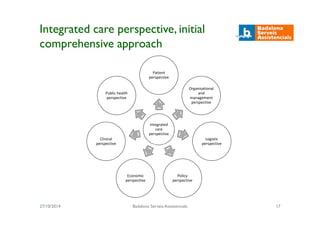
Integrated care perspective, initial
comprehensive approach
27/10/2014 Badalona Serveis Assistencials 17
Integrated
care
perspective
Patient
perspective
Organisational
and
management
perspective
Logistic
perspective
Policy
perspective
Economic
perspective
Clinical
perspective
Public health
perspective
Integrated care perspective, actual
comprehensive approach
27/10/2014 Badalona Serveis Assistencials 18
Case management – Integrated care
Badalona Serveis Assistencials 19
Case management is the
procedure where the nurse
coordinates the provision of
care to guarantee the
accomplishment of needs,
through the control of
symptoms and the management
of the most adequate resources,
to empower the autonomy of
patients.
How did we organize it – Integrated
care
• Nurse leading the coordination
• Multidisciplinary teams doing continuous assessment and
reassessment of needs
• Different pathways / programs have been put in place to tailor
them according to the patients needs
• Put the patient in the middle of the care process
• Engage the family and the community assets within the care
process
• Continuous evaluation to improve the services provided
• Homecare Department to coordinate the provision of
services
Badalona Serveis Assistencials 20
The Homecare Department
2007 2008 20132011 2015 2016 20182003
HEALTH SERVICES
Home hospitalization
Frail geriatric patient
setting
Palliative care
Complex chronic patients
(COPD)
1st ATDOM team
Early discharge team
SOCIAL SERVICES
Help at home
Cleans at home
Telecare
Meals at home
HEALTH SERVICES
Complex chronic patients
(COPD+stroke+heart
failure)
2nd ATDOM team
SOCIAL SERVICES
SIMAP (GPS tracking)
Technical help
Integral home help
Home fixings
EU projects:
HSH and Aladdin
HEALTH
SERVICES
Regional
case
managem
ent
EU
projects:
ReAAL
HEALTH
SERVICES
Residence
team
New ATDOM
model
Big roll-out
Regional Case
Management
EU projects:
Mastermind
BeyondSilos
EU projects:
Insup-C
(collaboration)
ACT
(collaboration)
Do Change
Usecare
EU projects:
ImpleMentAll
SELFIE2020
Reference Site
URBACT Good
Practice
Catalog of homecare services –
Integrated care
Badalona Serveis Assistencials 22
Social services:
Help at home
Telecare setting
Meals at home
Cleaning at home
Home fixings (3rd sector)
Social isolation and social
exclusion avoidance (3rd
sector)
GPS tracking system
Health services:
Early discharge program
Home hospitalization
Special tests
Geriatrics team
Palliative care team
ATDOM program
Residential team
Regional Case Management
Oncologic Regional Case
Management
Telemonitoring
Inclusion process supported by ICT
– Homecare service
Badalona Serveis Assistencials 23
Emerg
encies
Intermediate
care
Specialized care
Primary
care
Social
Services
CM
Health services
provision
Social services
provision
General inclusion
criteria
Enrolment in
tailored pathway
Integrated
Care
Record
Other
providers
Stratification
tool
Some outcomes from the integration
Badalona Serveis Assistencials 24
• Regional Case Management Program:
– Characteristics of the patients: 76 years ratio, 52% woman, 1,38% prevalence, 20%
with social problems
– Interventions done: 86%VGI, 76% flu vaccine, 85% pneumococcus vaccine, 54% ATDOM
program, 78% full assessment program
– Results: 12% reduction GP, 8% reduction nurse (PC), 40% reduction emergencies, 56%
reduction of non-programed hospital admissions, 23% increased QOL, 89% increased
satisfaction with the service, 59% increased death at home
• Early discharge Program:
– Characteristics of the patients: Acute episode (normally hip fracture), living alone or
with couple, risk of dependency
– Interventions done: Family worker at home, home hospitalization (including specialist
and nurse), rehabilitation team at home
– Results: 67% increased complete rehabilitation (for patients between 70 and 83), 28%
reduction relapse, ratio of 6,7 weeks to rehabilitation, 27% decreased mortality rate
Conclusions
• The initial driver of integrated care in this case was a policy
commitment towards a patient-centric model which would
enable the continuum of care at a local level (municipality)
• Reorganisational process and the governance mechanism
established have been the main drivers of integrated care
• Health and social care professionals play a leading role in
facilitating integrated care deployment
• Interoperable information systems has fostered the full
deployment of integrated care
• Absence of major conflicts between the distribution of
resources and the alignment of incentives
Badalona Serveis Assistencials 25
Conclusions (graphically)
Badalona Serveis Assistencials 26
Some highlights – Integrated care
• Achieving a full integration of health and social services is a
slow process
• It’s better to start with health services
• Problems for achieving it are organizational and cultural
• Expect huge resistance from professionals
• Integrated common care pathways should be developed
• A continuous review process should be put in place to keep
monitoring and improving the services / programs
• IT is a tool that will help you within the process, but not the
solution (EMR. SCR, ICR and shared care plan are central)
• Proper quality and cost-benefit evaluation needs to be
conducted
Badalona Serveis Assistencials 27
Organisation of the teams
27/10/2014 Badalona Serveis Assistencials 28
Primary care
Intermediate
care hospital
Hospital
- GPs
- Nurses
- Specialists
- Social worker
- Case Managers
- ATDOM team
Homecare
Department
- Specialists
- Nurses
- Social worker
- Case Managers
- Rehabilitation
team
- Specialists
- Nurses
- Social worker
- Case Managers
- Rehabilitation
team
- Dependency
evaluators
- Residential
team
- Home
hospitalization
- Palliative care
Chronic Care Model - Aims
• The main objective of the CCM programme is to offer an integral care model
through the provision of social and healthcare services, to patients with multiple
chronic conditions, based on the optimization and integration of resources to give
a fast response to the needs of the inhabitants in the region.
• Specific objectives:
– Position the patient in the middle of the care model
– Plan and realize the interventions focused on identify, prevent and treat in
advance the acute episodes to avoid further hospitalizations
– Design and realize individual integrated care plans based on the evaluation of
each particular need and the integral geriatric evaluation (VGI)
– Promote the independent life of those patients as much as possible maintaining
good quality of life
– Coordinate the work of the interdisciplinary teams doing the interventions
– Guarantee and provide a continuum of services
Badalona Serveis Assistencials 29
Regional case management model
Badalona Serveis Assistencials 30
• Regional model, no service segmentation.
• Integration and regional focus
• Predictive stratification tool available regionally-wide
• Proactive enrolment of users into the program
• Case Managers at every Primary Care Centre and at the
Homecare Department
• Within the Regional Case Management, GPs keep being
responsible of the patients
• Continuous evaluation process
• Coordination between healthcare levels, social care, third
sector providers, external providers, etc.
Stratification tool
6/5/2018 ACT Programme 31
Stratification tool
6/5/2018 ACT Programme 32
Stratification tool
6/5/2018 ACT Programme 33
Regional Case management - Case
manager activities
Activity Amount
Phone calls 33%
Home visits 24%
Self-management 31%
Primary care visits 10%
Other 2%
Badalona Serveis Assistencials 34
Strategy – Research & Innovation
Badalona Serveis Assistencials 35
The Research & Innovation
Department
• Improve the services delivered to the population
• Position the organisation as a reference into the eHealth world
• Take advantage of the flexibility of the organisation and the penetration
within the community
• Generate an innovation culture that can benefit the professional and the
organization
• Instigate and promote a spirit of innovation amongst the professional
personnel
• Establish internal and external partnerships
• Empower staff into project management
• Detect opportunities that can break into the market
Badalona Serveis Assistencials 36
Internal process - Innovation
Badalona Serveis Assistencials 37
Professionals Web BSA
Clients / users
Innovation Proposal
(full name, position, e-
mail, description, etc)
Form, suggestion
box type
Notification
ofreceipt
Notification of
group members Record
Notification
ofreceipt
We need your ideas
Opportunity / innovation
How ?
Intranet
Internal Evaluation - Innovation
Badalona Serveis Assistencials 38
We need your ideas
Organizational / others
Opportunity / innovation
Internal innovation results up to
2013 - Innovation
• Total ideas received: 53
• Process innovation: 29 (23 deployed)
• Service innovation: 18 (11 deployed)
• Product innovation: 6 (2 deployed and 1 in
process)
Badalona Serveis Assistencials 39
External innovation - Innovation
• Improve the services provided to our target
population
• Improve the relationship with regional stakeholders
(public agencies and companies)
• Find external partners (national and international) to
boost the innovation process
• Empower the staff and increase the knowledge and
knowhow of the organization
• Be able to research and deploy solutions where the
public funding doesn’t arrive
Badalona Serveis Assistencials 40
External innovation results up to
2014 - Innovation
• More than 100 national partnerships
• More than 15 international partnerships
• 16 National funded projects granted
• 7 EU funded projects granted (from AAL, FP7,
DG Sanco health programme, H2020 and
AAL2)
• 3 EU funded projects collaborations
• 11 active projects with external partners
Badalona Serveis Assistencials 41
What we got from the European
projects - Innovation
• Aladdin: new ways to deal with cognitive decline through IT
• Home Sweet Home: first time we used a telemonitoring solution
• ReAAL: investigate on new AAL solutions + big roll out
• Mastermind: improve the services provided to depressed patients
• BeyondSilos: keep improving our integrated care services portfolio. Keep
investigation on ways to fund telemonitoring solutions
• ACT: improve our knowledge regarding chronic management and on
stratification tools
• DO change: improve the management of hypertensive patients and HF
patients with new devices and behavior change mHealth solutions
• Usecare: predictive algorithms for early risk detection and prevention
• ImpleMentAll: implementation science in eMental Health
Badalona Serveis Assistencials 42
Some highlights - innovation
• Innovation is a culture that should be spread all around your
organization
• Identify good partners regionally surrounding you.That will
make you look stronger and more reliable for
investment/funding
• Design good strategic plans to know where you want to go
• Go outside and find people that can help you
• European funded projects are the perfect environment to
meet relevant partners
• Regionally capacity to represent all the different roles:
research, policy makers, service providers and end-users
• Don’t be afraid to have young people on charge
Badalona Serveis Assistencials 43
EuropeanTelemedicine Conference
Badalona Serveis Assistencials 44
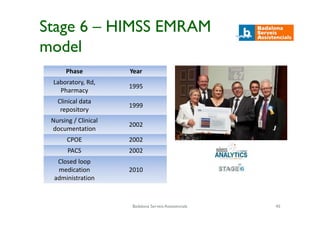
Stage 6 – HIMSS EMRAM
model
Phase Year
Laboratory, Rd,
Pharmacy
1995
Clinical data
repository
1999
Nursing / Clinical
documentation
2002
CPOE 2002
PACS 2002
Closed loop
medication
administration
2010
Badalona Serveis Assistencials 45
Thank you!
Jordi Piera Jiménez
Director of ICT and R&D&i
jpiera@bsa.cat - http://www.bsa.cat/international
Cell.: +34 651041515
Skype: jpieraj
Badalona Serveis Assistencials 46

BSA: Integrated care delivery model

  • 1.
    Badalona Serveis Assistencials Integrated caredelivery model Badalona Serveis Assistencials Jordi Piera, Chief Information & RD Officer Badalona Serveis Assistencials, Catalonia Badalona, 30/05/2018
  • 2.
    Spanish social welfareand health care services - Contextualisation • The Spanish Constitution of 1978 established the right to health protection and healthcare for all citizens. • As laid out by the Ministry of Health, Social Services and Equality (2012), the following principles and criteria enable citizens to exercise this right: – Public funding, universal coverage and free healthcare services at the time of use. – Defined rights and duties for citizens and public authorities. – Political decentralisation of healthcare, which is devolved to the autonomous regions. – Provision of comprehensive healthcare which strives to attain high levels of quality and is duly evaluated and controlled. – Integration of different public structures and health services under the National Health System. • Spain has a statutory national health system (SNS), which is characterized by universal coverage and funded by taxes. • There are 17 regional health ministries across Spain, each having primary jurisdiction over the organization and delivery of health services within their respective regions Badalona Serveis Assistencials 2
  • 3.
    Catalonia region- Contextualisation •Catalonia is one of the 17 Autonomous Communities, with a population of roughly 7 million inhabitants. • This region has full competences in health services, as part of the decentralized Spanish health system. • The Catalan government (Generalitat de Catalunya) has developed its own organizational model based on the historical evolution of the Catalan health system. • The Department of Health (DSGC) is the maximum official authority for the definition, planning and development of healthcare services in Catalonia. • Servei Català de la Salut (CATSALUT) acts as a purchaser of services and guarantees quality control while a network of public and private organizations provides the healthcare services. Badalona Serveis Assistencials 3
  • 4.
    Catalonia region II- Contextualisation Badalona Serveis Assistencials 4 Insurance Services USER CATALAN HEALTHCARE SERVICE CONTRACTED PROVIDERS 100% DEPARTMENT OF HEALTH: Draws up Health Plan and Transfers economic resources Plans Governance 20% Supplementary Private Insurers CATALAN INSTITUTE OF HEALTH Private Centres 20% 70% 10% Source : Martinez (2013) and Contel (2014)
  • 5.
    Catalonia region III- Contextualisation • The system is organized within 7 health regions divided into 56 health sectors and 369 basic health areas : – 451 primary care centers – 831 local healthcare centers – 96 acute care hospitals – 96 social health centers – 158 mental health centers – 42 centers for inpatient mental health care • The Health Plan for Catalonia 2011-2015 mentions that 20% of these resources are directly owned by the government (through the ICS, National Health Institute, the biggest provider in Catalonia) • Foundations, health insurance companies and other private non-profit authorities own the remaining 70% • The social services are entrusted to the Municipalities through the Department of Welfare and Family Badalona Serveis Assistencials 5
  • 6.
    Catalonia region IV- Contextualisation Badalona Serveis Assistencials 6 Source: Department de Salut. Generalitat de Catalunya (2012).
  • 7.
    Badalona Serveis Assistencials7 • Based to the north of Barcelona • Cities of Badalona, Montgat, Tiana, Teià, Masnou and Alella • Private company property of the City Council • 100 % public funding -> Complex financing system which varies according to the care level • Providing from both health and social services Badalona Serveis Assistencials - Who we are?
  • 8.
    Hospital Municipal deBadalona Badalona Serveis Assistencials 8 Hospital Municipal de Badalona 237.244 assigned population All Badalona city Structural resources 118 beds 8 short stay beds 16 rooms for outpatient services 27 consulting rooms 4 surgeries 30 emergency boxes
  • 9.
    Primary care Badalona ServeisAssistencials 9 7 primary care centers 117.823 assigned population 50% of Badalona city -> ICS has also Primary Care centers in the city Structural resources 59 consulting rooms 36 nursery rooms 12 odontology rooms 6 social work rooms 11 continued assistance rooms 19 polyvalent rooms CASSIR (sexual and reproductive health) 186.309 assigned population 50% of Badalona + 100% Montgat CAP Morera-Pomar CAP Apenins-Montigalà CAP Montgat CAP Tiana CAP Progrés-Raval CAP Martí Julià CAP Nova Lloreda
  • 10.
    Centre Sociosanitari ElCarme Badalona Serveis Assistencials 10 Centre Sociosanitari El Carme (intermediate care hospital) 529.582 assigned population Cities of Badalona, Montgat, Tiana, Teià, Masnou and Alella Structural resources 209 beds 50 rooms for outpatient services 7 consulting rooms
  • 11.
    Comprehensive care organization– Who we are • A network of care services that offers a coordinated service by means of a continuum of care for a particular population. • At BSA, this service continuum includes primary care, specialized care, intermediate care and home care (including social home care). • The integration of services facilitates attention to the patient at the most cost effective location whilst also favouring aspects of promotion or prevention. • This new organizational focus boosts innovation aspects on both a collective and an individual level. • This constant revision obliges the incorporation of the patients’ and citizens’ view. Badalona Serveis Assistencials 11
  • 12.
    Some numbers from2018 General information: 12,120 discharges 8,805 Hospital Municipal de Badalona 1,666 Centre Sociosanitari El Carme (intermediate care hospital) 1,739 SAID (Integral home care service) 873,769 outpatient visits 709,048 primary care 150,713 Hospital Municipal de Badalona 12,235 CASSIR (Sexual health) 1,769 Centre Sociosanitari El Carme (intermediate care hospital) 5,157 surgery 58,824 emergencies 22,139 continued assistances 27/10/2014 Badalona Serveis Assistencials 12 Home care Service: Social services: 5,356 dependency evaluations 8,906 services to the dependents 1,243 help at home (family workers) 6,172 telecare setting 156 meals at home 234 cleaning at home 154 home fixings (3rd sector) 119 social isolation and social exclusion (3rd sector) 54 GPS tracking system 234 cultural mediation Health services: 293 early discharge program 293 rehabilitation at home 975 home hospitalization 188 geriatrics team 333 special tests 221 palliative care team 760 ATDOM 373 residential team 416 Regional Case Management 172 Oncologic Regional Case Management 290Telemonitoring EU funded projects (2015): 1,200 patients in the ReAAL project (active) 100 patients in the BeyondSilos project (active) 200 patients in the Mastermind project (active) 100 patients in the Do Change project (active) 100 patients in the UseCare project (active)
  • 13.
    Situation before atyear 2000 Badalona Serveis Assistencials 13 Health care silo: • BSA integral healthcare organisation (3 classic levels) • 1,170 professionals including: – GPs – Specialists – Nurses – Social workers (at PC and ICH) – Structural staff • 70M € funding (low complexity at Hospital) • 1,200 € per capita • Providing classic healthcare services • Geriatricians pushing for changing the model Social care silo: • City Council in charge of the social services • 65 professionals including: – Social workers – Family workers • 4,7M € funding for subcontracting: – Telecare (panic button) – Meals at home – Cleaning at home
  • 14.
    Why merging thehealth and the social care sector? • Badalona City Council: – Unique holder of the healthcare provision through BSA – In charge of the provision of social services which are entrusted to the municipalities • Bad outcomes in terms of efficiency > Duplication of structures • Bad outcomes in terms of efficacy > Lack of coordination Badalona Serveis Assistencials 14 • Need of centring the model into the patient • Shared decision between BSA and the City Council to merge both provisions of care into a single delivery • Political decision of merging both departments at a political level into a single one Year 2000
  • 15.
    Situation after 2003(numbers from 2015) Badalona Serveis Assistencials 15 • Breaking the brick wall separating both silos -> Centring the model on the patient • Creation of the Home Care Department to deliver the integrated services • BSA integral care organisation (3 classic levels + home care level) • 1,200 professionals including: – GPs – Specialists – Nurses – Social workers (at PC and ICH and Hospital) – Structural staff • 67M € funding in total • 3,5M € of those for subcontracting 3rd party providers in the social field • 1,030 € per capita • Home Care Department “losing” 500,000€/year in internal accountancy because of the healthcare services -> Perversion of the financing system
  • 16.
    How did wemanage it? – Integrated care Badalona Serveis Assistencials 16 Strategic Lines 2003 - 2007 Efficent use of comprehensive model organization Interesting organization for employees Commitment to customers New targets according to the health sector Enviroment envolvement
  • 17.
    Integrated care perspective,initial comprehensive approach 27/10/2014 Badalona Serveis Assistencials 17 Integrated care perspective Patient perspective Organisational and management perspective Logistic perspective Policy perspective Economic perspective Clinical perspective Public health perspective
  • 18.
    Integrated care perspective,actual comprehensive approach 27/10/2014 Badalona Serveis Assistencials 18
  • 19.
    Case management –Integrated care Badalona Serveis Assistencials 19 Case management is the procedure where the nurse coordinates the provision of care to guarantee the accomplishment of needs, through the control of symptoms and the management of the most adequate resources, to empower the autonomy of patients.
  • 20.
    How did weorganize it – Integrated care • Nurse leading the coordination • Multidisciplinary teams doing continuous assessment and reassessment of needs • Different pathways / programs have been put in place to tailor them according to the patients needs • Put the patient in the middle of the care process • Engage the family and the community assets within the care process • Continuous evaluation to improve the services provided • Homecare Department to coordinate the provision of services Badalona Serveis Assistencials 20
  • 21.
    The Homecare Department 20072008 20132011 2015 2016 20182003 HEALTH SERVICES Home hospitalization Frail geriatric patient setting Palliative care Complex chronic patients (COPD) 1st ATDOM team Early discharge team SOCIAL SERVICES Help at home Cleans at home Telecare Meals at home HEALTH SERVICES Complex chronic patients (COPD+stroke+heart failure) 2nd ATDOM team SOCIAL SERVICES SIMAP (GPS tracking) Technical help Integral home help Home fixings EU projects: HSH and Aladdin HEALTH SERVICES Regional case managem ent EU projects: ReAAL HEALTH SERVICES Residence team New ATDOM model Big roll-out Regional Case Management EU projects: Mastermind BeyondSilos EU projects: Insup-C (collaboration) ACT (collaboration) Do Change Usecare EU projects: ImpleMentAll SELFIE2020 Reference Site URBACT Good Practice
  • 22.
    Catalog of homecareservices – Integrated care Badalona Serveis Assistencials 22 Social services: Help at home Telecare setting Meals at home Cleaning at home Home fixings (3rd sector) Social isolation and social exclusion avoidance (3rd sector) GPS tracking system Health services: Early discharge program Home hospitalization Special tests Geriatrics team Palliative care team ATDOM program Residential team Regional Case Management Oncologic Regional Case Management Telemonitoring
  • 23.
    Inclusion process supportedby ICT – Homecare service Badalona Serveis Assistencials 23 Emerg encies Intermediate care Specialized care Primary care Social Services CM Health services provision Social services provision General inclusion criteria Enrolment in tailored pathway Integrated Care Record Other providers Stratification tool
  • 24.
    Some outcomes fromthe integration Badalona Serveis Assistencials 24 • Regional Case Management Program: – Characteristics of the patients: 76 years ratio, 52% woman, 1,38% prevalence, 20% with social problems – Interventions done: 86%VGI, 76% flu vaccine, 85% pneumococcus vaccine, 54% ATDOM program, 78% full assessment program – Results: 12% reduction GP, 8% reduction nurse (PC), 40% reduction emergencies, 56% reduction of non-programed hospital admissions, 23% increased QOL, 89% increased satisfaction with the service, 59% increased death at home • Early discharge Program: – Characteristics of the patients: Acute episode (normally hip fracture), living alone or with couple, risk of dependency – Interventions done: Family worker at home, home hospitalization (including specialist and nurse), rehabilitation team at home – Results: 67% increased complete rehabilitation (for patients between 70 and 83), 28% reduction relapse, ratio of 6,7 weeks to rehabilitation, 27% decreased mortality rate
  • 25.
    Conclusions • The initialdriver of integrated care in this case was a policy commitment towards a patient-centric model which would enable the continuum of care at a local level (municipality) • Reorganisational process and the governance mechanism established have been the main drivers of integrated care • Health and social care professionals play a leading role in facilitating integrated care deployment • Interoperable information systems has fostered the full deployment of integrated care • Absence of major conflicts between the distribution of resources and the alignment of incentives Badalona Serveis Assistencials 25
  • 26.
  • 27.
    Some highlights –Integrated care • Achieving a full integration of health and social services is a slow process • It’s better to start with health services • Problems for achieving it are organizational and cultural • Expect huge resistance from professionals • Integrated common care pathways should be developed • A continuous review process should be put in place to keep monitoring and improving the services / programs • IT is a tool that will help you within the process, but not the solution (EMR. SCR, ICR and shared care plan are central) • Proper quality and cost-benefit evaluation needs to be conducted Badalona Serveis Assistencials 27
  • 28.
    Organisation of theteams 27/10/2014 Badalona Serveis Assistencials 28 Primary care Intermediate care hospital Hospital - GPs - Nurses - Specialists - Social worker - Case Managers - ATDOM team Homecare Department - Specialists - Nurses - Social worker - Case Managers - Rehabilitation team - Specialists - Nurses - Social worker - Case Managers - Rehabilitation team - Dependency evaluators - Residential team - Home hospitalization - Palliative care
  • 29.
    Chronic Care Model- Aims • The main objective of the CCM programme is to offer an integral care model through the provision of social and healthcare services, to patients with multiple chronic conditions, based on the optimization and integration of resources to give a fast response to the needs of the inhabitants in the region. • Specific objectives: – Position the patient in the middle of the care model – Plan and realize the interventions focused on identify, prevent and treat in advance the acute episodes to avoid further hospitalizations – Design and realize individual integrated care plans based on the evaluation of each particular need and the integral geriatric evaluation (VGI) – Promote the independent life of those patients as much as possible maintaining good quality of life – Coordinate the work of the interdisciplinary teams doing the interventions – Guarantee and provide a continuum of services Badalona Serveis Assistencials 29
  • 30.
    Regional case managementmodel Badalona Serveis Assistencials 30 • Regional model, no service segmentation. • Integration and regional focus • Predictive stratification tool available regionally-wide • Proactive enrolment of users into the program • Case Managers at every Primary Care Centre and at the Homecare Department • Within the Regional Case Management, GPs keep being responsible of the patients • Continuous evaluation process • Coordination between healthcare levels, social care, third sector providers, external providers, etc.
  • 31.
  • 32.
  • 33.
  • 34.
    Regional Case management- Case manager activities Activity Amount Phone calls 33% Home visits 24% Self-management 31% Primary care visits 10% Other 2% Badalona Serveis Assistencials 34
  • 35.
    Strategy – Research& Innovation Badalona Serveis Assistencials 35
  • 36.
    The Research &Innovation Department • Improve the services delivered to the population • Position the organisation as a reference into the eHealth world • Take advantage of the flexibility of the organisation and the penetration within the community • Generate an innovation culture that can benefit the professional and the organization • Instigate and promote a spirit of innovation amongst the professional personnel • Establish internal and external partnerships • Empower staff into project management • Detect opportunities that can break into the market Badalona Serveis Assistencials 36
  • 37.
    Internal process -Innovation Badalona Serveis Assistencials 37 Professionals Web BSA Clients / users Innovation Proposal (full name, position, e- mail, description, etc) Form, suggestion box type Notification ofreceipt Notification of group members Record Notification ofreceipt We need your ideas Opportunity / innovation How ? Intranet
  • 38.
    Internal Evaluation -Innovation Badalona Serveis Assistencials 38 We need your ideas Organizational / others Opportunity / innovation
  • 39.
    Internal innovation resultsup to 2013 - Innovation • Total ideas received: 53 • Process innovation: 29 (23 deployed) • Service innovation: 18 (11 deployed) • Product innovation: 6 (2 deployed and 1 in process) Badalona Serveis Assistencials 39
  • 40.
    External innovation -Innovation • Improve the services provided to our target population • Improve the relationship with regional stakeholders (public agencies and companies) • Find external partners (national and international) to boost the innovation process • Empower the staff and increase the knowledge and knowhow of the organization • Be able to research and deploy solutions where the public funding doesn’t arrive Badalona Serveis Assistencials 40
  • 41.
    External innovation resultsup to 2014 - Innovation • More than 100 national partnerships • More than 15 international partnerships • 16 National funded projects granted • 7 EU funded projects granted (from AAL, FP7, DG Sanco health programme, H2020 and AAL2) • 3 EU funded projects collaborations • 11 active projects with external partners Badalona Serveis Assistencials 41
  • 42.
    What we gotfrom the European projects - Innovation • Aladdin: new ways to deal with cognitive decline through IT • Home Sweet Home: first time we used a telemonitoring solution • ReAAL: investigate on new AAL solutions + big roll out • Mastermind: improve the services provided to depressed patients • BeyondSilos: keep improving our integrated care services portfolio. Keep investigation on ways to fund telemonitoring solutions • ACT: improve our knowledge regarding chronic management and on stratification tools • DO change: improve the management of hypertensive patients and HF patients with new devices and behavior change mHealth solutions • Usecare: predictive algorithms for early risk detection and prevention • ImpleMentAll: implementation science in eMental Health Badalona Serveis Assistencials 42
  • 43.
    Some highlights -innovation • Innovation is a culture that should be spread all around your organization • Identify good partners regionally surrounding you.That will make you look stronger and more reliable for investment/funding • Design good strategic plans to know where you want to go • Go outside and find people that can help you • European funded projects are the perfect environment to meet relevant partners • Regionally capacity to represent all the different roles: research, policy makers, service providers and end-users • Don’t be afraid to have young people on charge Badalona Serveis Assistencials 43
  • 44.
  • 45.
    Stage 6 –HIMSS EMRAM model Phase Year Laboratory, Rd, Pharmacy 1995 Clinical data repository 1999 Nursing / Clinical documentation 2002 CPOE 2002 PACS 2002 Closed loop medication administration 2010 Badalona Serveis Assistencials 45
  • 46.
    Thank you! Jordi PieraJiménez Director of ICT and R&D&i jpiera@bsa.cat - http://www.bsa.cat/international Cell.: +34 651041515 Skype: jpieraj Badalona Serveis Assistencials 46