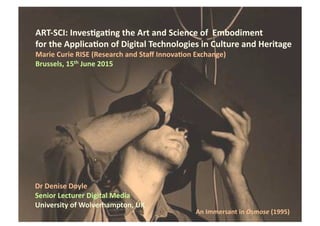
An	
  Immersant	
  in	
  Osmose	
  (1995)	
  
ART-­‐SCI:	
  Inves8ga8ng	
  the	
  Art	
  and	
  Science	
  of	
  	
  Embodiment	
  	
  
for	
  the	
  Applica8on	
  of	
  Digital	
  Technologies	
  in	
  Culture	
  and	
  Heritage	
  
Marie	
  Curie	
  RISE	
  (Research	
  and	
  Staff	
  Innova8on	
  Exchange)	
  	
  
Brussels,	
  15th	
  June	
  2015	
  
Dr	
  Denise	
  Doyle	
  
Senior	
  Lecturer	
  Digital	
  Media	
  
University	
  of	
  Wolverhampton,	
  UK	
  
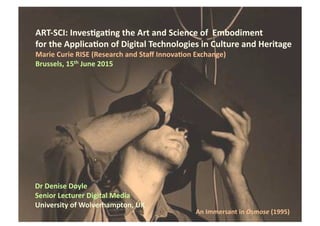
An	
  Immersant	
  in	
  Osmose	
  (1995)	
  
ART-­‐SCI:	
  Inves8ga8ng	
  the	
  Art	
  and	
  Science	
  of	
  	
  Embodiment	
  	
  
for	
  the	
  Applica8on	
  of	
  Digital	
  Technologies	
  in	
  Culture	
  and	
  Heritage	
  
Marie	
  Curie	
  RISE	
  (Research	
  and	
  Staff	
  Innova8on	
  Exchange)	
  	
  
Brussels,	
  15th	
  June	
  2015	
  
Dr	
  Denise	
  Doyle	
  
Senior	
  Lecturer	
  Digital	
  Media	
  
University	
  of	
  Wolverhampton,	
  UK	
  
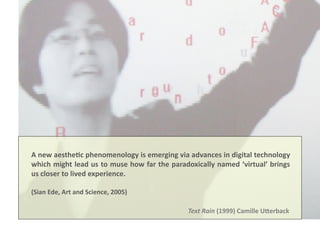
Text	
  Rain	
  (1999)	
  Camille	
  USerback	
  
A	
  new	
  aesthe8c	
  phenomenology	
  is	
  emerging	
  via	
  advances	
  in	
  digital	
  technology	
  
which	
  might	
  lead	
  us	
  to	
  muse	
  how	
  far	
  the	
  paradoxically	
  named	
  ‘virtual’	
  brings	
  
us	
  closer	
  to	
  lived	
  experience.	
  
(Sian	
  Ede,	
  Art	
  and	
  Science,	
  2005)	
  	
  
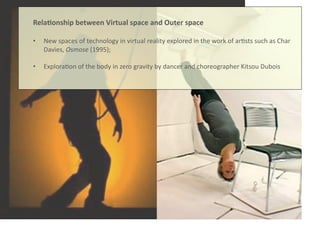
Rela8onship	
  between	
  Virtual	
  space	
  and	
  Outer	
  space	
  
•  New	
  spaces	
  of	
  technology	
  in	
  virtual	
  reality	
  explored	
  in	
  the	
  work	
  of	
  ar8sts	
  such	
  as	
  Char	
  
Davies,	
  Osmose	
  (1995);	
  
•  Explora8on	
  of	
  the	
  body	
  in	
  zero	
  gravity	
  by	
  dancer	
  and	
  choreographer	
  Kitsou	
  Dubois	
  
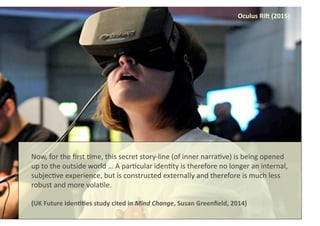
Oculus	
  Ri[	
  (2015)	
  
Now,	
  for	
  the	
  first	
  8me,	
  this	
  secret	
  story-­‐line	
  (of	
  inner	
  narra8ve)	
  is	
  being	
  opened	
  
up	
  to	
  the	
  outside	
  world	
  …	
  A	
  par8cular	
  iden8ty	
  is	
  therefore	
  no	
  longer	
  an	
  internal,	
  
subjec8ve	
  experience,	
  but	
  is	
  constructed	
  externally	
  and	
  therefore	
  is	
  much	
  less	
  
robust	
  and	
  more	
  vola8le.	
  
(UK	
  Future	
  Iden88es	
  study	
  cited	
  in	
  Mind	
  Change,	
  Susan	
  Greenfield,	
  2014)	
  	
  
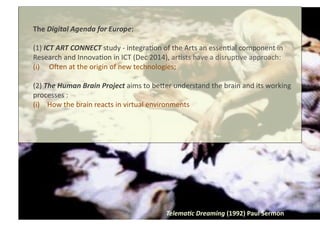
Telema4c	
  Dreaming	
  (1992)	
  Paul	
  Sermon	
  
The	
  Digital	
  Agenda	
  for	
  Europe:	
  
(1)	
  ICT	
  ART	
  CONNECT	
  study	
  -­‐	
  integra8on	
  of	
  the	
  Arts	
  an	
  essen8al	
  component	
  in	
  
Research	
  and	
  Innova8on	
  in	
  ICT	
  (Dec	
  2014),	
  ar8sts	
  have	
  a	
  disrup8ve	
  approach:	
  
(i)  OUen	
  at	
  the	
  origin	
  of	
  new	
  technologies;	
  
(2)	
  The	
  Human	
  Brain	
  Project	
  aims	
  to	
  beVer	
  understand	
  the	
  brain	
  and	
  its	
  working	
  
processes	
  :	
  
(i)	
   	
  How	
  the	
  brain	
  reacts	
  in	
  virtual	
  environments	
  
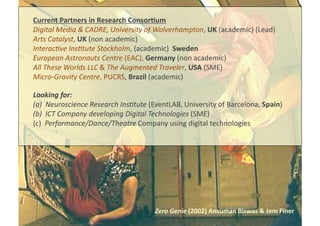
Zero	
  Genie	
  (2002)	
  Ansuman	
  Biswas	
  &	
  Jem	
  Finer	
  
Current	
  Partners	
  in	
  Research	
  Consor8um	
  
Digital	
  Media	
  &	
  CADRE,	
  University	
  of	
  Wolverhampton,	
  UK	
  (academic)	
  (Lead)	
  
Arts	
  Catalyst,	
  UK	
  (non	
  academic)	
  	
  
Interac@ve	
  Ins@tute	
  Stockholm,	
  (academic)	
  	
  Sweden	
  
European	
  Astronauts	
  Centre	
  (EAC),	
  Germany	
  (non	
  academic)	
  
All	
  These	
  Worlds	
  LLC	
  &	
  The	
  Augmented	
  Traveler,	
  USA	
  (SME)	
  
Micro-­‐Gravity	
  Centre,	
  PUCRS,	
  Brazil	
  (academic)	
  
Looking	
  for:	
  
(a)  Neuroscience	
  Research	
  Ins@tute	
  (EventLAB,	
  University	
  of	
  Barcelona,	
  Spain)	
  
(b)  ICT	
  Company	
  developing	
  Digital	
  Technologies	
  (SME)	
  
(c)	
  	
  Performance/Dance/Theatre	
  Company	
  using	
  digital	
  technologies	
  
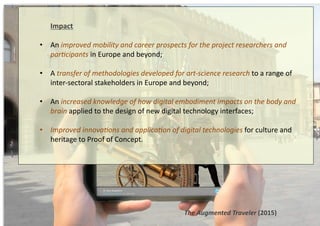
The	
  Augmented	
  Traveler	
  (2015)	
  
	
  Impact	
  
•  An	
  improved	
  mobility	
  and	
  career	
  prospects	
  for	
  the	
  project	
  researchers	
  and	
  
par@cipants	
  in	
  Europe	
  and	
  beyond;	
  	
  
•  A	
  transfer	
  of	
  methodologies	
  developed	
  for	
  art-­‐science	
  research	
  to	
  a	
  range	
  of	
  
inter-­‐sectoral	
  stakeholders	
  in	
  Europe	
  and	
  beyond;	
  	
  
•  An	
  increased	
  knowledge	
  of	
  how	
  digital	
  embodiment	
  impacts	
  on	
  the	
  body	
  and	
  
brain	
  applied	
  to	
  the	
  design	
  of	
  new	
  digital	
  technology	
  interfaces;	
  
•  Improved	
  innova@ons	
  and	
  applica@on	
  of	
  digital	
  technologies	
  for	
  culture	
  and	
  
heritage	
  to	
  Proof	
  of	
  Concept.	
  
Contact	
  Details	
  
Dr	
  Denise	
  Doyle	
  
Digital	
  Theory,	
  Technology	
  and	
  Prac8ce	
  Research	
  Cluster	
  
Centre	
  for	
  Art	
  and	
  Design	
  Research	
  and	
  Experimenta8on	
  (CADRE)	
  
University	
  of	
  Wolverhampton,	
  UK	
  
Email:	
  D.Doyle@wlv.ac.uk	
  
Work:	
  ++44	
  (0)1902	
  322	
  443	
  
Mobile:	
  ++44	
  (0)7950	
  685	
  915	
  
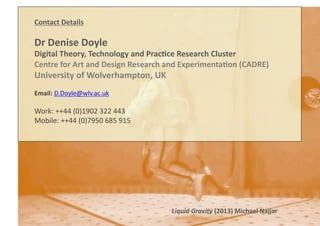
Liquid	
  Gravity	
  (2013)	
  Michael	
  Najjar	
  

ART-­‐SCI: Investigating the Art and Science of Embodiment for the Application of Digital Technologies in Culture and Heritage

  • 1.
    An  Immersant  in  Osmose  (1995)   ART-­‐SCI:  Inves8ga8ng  the  Art  and  Science  of    Embodiment     for  the  Applica8on  of  Digital  Technologies  in  Culture  and  Heritage   Marie  Curie  RISE  (Research  and  Staff  Innova8on  Exchange)     Brussels,  15th  June  2015   Dr  Denise  Doyle   Senior  Lecturer  Digital  Media   University  of  Wolverhampton,  UK  
  • 2.
    An  Immersant  in  Osmose  (1995)   ART-­‐SCI:  Inves8ga8ng  the  Art  and  Science  of    Embodiment     for  the  Applica8on  of  Digital  Technologies  in  Culture  and  Heritage   Marie  Curie  RISE  (Research  and  Staff  Innova8on  Exchange)     Brussels,  15th  June  2015   Dr  Denise  Doyle   Senior  Lecturer  Digital  Media   University  of  Wolverhampton,  UK  
  • 3.
    Text  Rain  (1999)  Camille  USerback   A  new  aesthe8c  phenomenology  is  emerging  via  advances  in  digital  technology   which  might  lead  us  to  muse  how  far  the  paradoxically  named  ‘virtual’  brings   us  closer  to  lived  experience.   (Sian  Ede,  Art  and  Science,  2005)    
  • 4.
    Rela8onship  between  Virtual  space  and  Outer  space   •  New  spaces  of  technology  in  virtual  reality  explored  in  the  work  of  ar8sts  such  as  Char   Davies,  Osmose  (1995);   •  Explora8on  of  the  body  in  zero  gravity  by  dancer  and  choreographer  Kitsou  Dubois  
  • 5.
    Oculus  Ri[  (2015)   Now,  for  the  first  8me,  this  secret  story-­‐line  (of  inner  narra8ve)  is  being  opened   up  to  the  outside  world  …  A  par8cular  iden8ty  is  therefore  no  longer  an  internal,   subjec8ve  experience,  but  is  constructed  externally  and  therefore  is  much  less   robust  and  more  vola8le.   (UK  Future  Iden88es  study  cited  in  Mind  Change,  Susan  Greenfield,  2014)    
  • 6.
    Telema4c  Dreaming  (1992)  Paul  Sermon   The  Digital  Agenda  for  Europe:   (1)  ICT  ART  CONNECT  study  -­‐  integra8on  of  the  Arts  an  essen8al  component  in   Research  and  Innova8on  in  ICT  (Dec  2014),  ar8sts  have  a  disrup8ve  approach:   (i)  OUen  at  the  origin  of  new  technologies;   (2)  The  Human  Brain  Project  aims  to  beVer  understand  the  brain  and  its  working   processes  :   (i)    How  the  brain  reacts  in  virtual  environments  
  • 7.
    Zero  Genie  (2002)  Ansuman  Biswas  &  Jem  Finer   Current  Partners  in  Research  Consor8um   Digital  Media  &  CADRE,  University  of  Wolverhampton,  UK  (academic)  (Lead)   Arts  Catalyst,  UK  (non  academic)     Interac@ve  Ins@tute  Stockholm,  (academic)    Sweden   European  Astronauts  Centre  (EAC),  Germany  (non  academic)   All  These  Worlds  LLC  &  The  Augmented  Traveler,  USA  (SME)   Micro-­‐Gravity  Centre,  PUCRS,  Brazil  (academic)   Looking  for:   (a)  Neuroscience  Research  Ins@tute  (EventLAB,  University  of  Barcelona,  Spain)   (b)  ICT  Company  developing  Digital  Technologies  (SME)   (c)    Performance/Dance/Theatre  Company  using  digital  technologies  
  • 8.
    The  Augmented  Traveler  (2015)    Impact   •  An  improved  mobility  and  career  prospects  for  the  project  researchers  and   par@cipants  in  Europe  and  beyond;     •  A  transfer  of  methodologies  developed  for  art-­‐science  research  to  a  range  of   inter-­‐sectoral  stakeholders  in  Europe  and  beyond;     •  An  increased  knowledge  of  how  digital  embodiment  impacts  on  the  body  and   brain  applied  to  the  design  of  new  digital  technology  interfaces;   •  Improved  innova@ons  and  applica@on  of  digital  technologies  for  culture  and   heritage  to  Proof  of  Concept.  
  • 9.
    Contact  Details   Dr  Denise  Doyle   Digital  Theory,  Technology  and  Prac8ce  Research  Cluster   Centre  for  Art  and  Design  Research  and  Experimenta8on  (CADRE)   University  of  Wolverhampton,  UK   Email:  D.Doyle@wlv.ac.uk   Work:  ++44  (0)1902  322  443   Mobile:  ++44  (0)7950  685  915   Liquid  Gravity  (2013)  Michael  Najjar