Newspaper Conventions:
Broadsheets
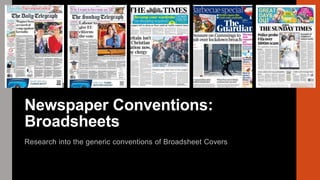
Research into the generic conventions of Broadsheet Covers
Mastheads
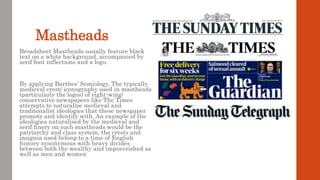
Broadsheet Mastheads usually feature black
text on a white background, accompanied by
serif font inflections and a logo.
By applying Barthes' Semiology, The typically
medieval crest/ iconography used in mastheads
(particularly the logos) of right-wing/
conservative newspapers like The Times
attempts to naturalise medieval and
traditonalist ideologies that these newspaper
promote and identify with. An example of the
ideologies naturalised by the medieval and
serif finery on such mastheads would be the
patriarchy and class system, the crests and
insignia used belong to a time of English
history synonymous with heavy divides
between both the wealthy and impoverished as
well as men and women
Register
Broadsheet newspapers are more formal
and reserved with their wording and tone.
This is largely due to the way they present
their news as information as opposed to
tabloid newspapers that are presented as
entertainment.
For example, looking at this cover page from
a copy of The Guardian, a left-wing
broadsheet newspaper, we can see that there
are no puns or comedic language in the
headlines, it is merely presenting information
with the purpose to inform about the
'Pressure on [Dominic] Cummings to quit
over lockdown breach'.
News Agenda
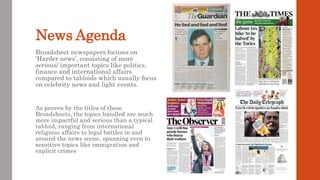
Broadsheet newspapers focuses on
'Harder news', consisting of more
serious/ important topics like politics,
finance and international affairs
compared to tabloids which usually focus
on celebrity news and light events.
As proven by the titles of these
Broadsheets, the topics handled are much
more impactful and serious than a typical
tabloid, ranging from international
religious affairs to legal battles in and
around the news scene, spanning even to
sensitive topics like immigration and
explicit crimes
Headlines
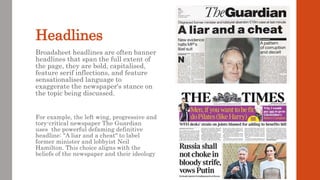
Broadsheet headlines are often banner
headlines that span the full extent of
the page, they are bold, capitalised,
feature serif inflections, and feature
sensationalised language to
exaggerate the newspaper's stance on
the topic being discussed.
For example, the left wing, progressive and
tory-critical newspaper The Guardian
uses the powerful defaming definitive
headline: "A liar and a cheat" to label
former minister and lobbyist Neil
Hamilton. This choice aligns with the
beliefs of the newspaper and their ideology
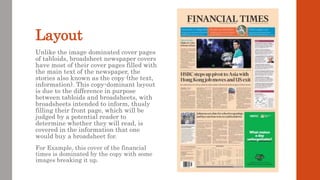
Layout
Unlike the image dominated cover pages
of tabloids, broadsheet newspaper covers
have most of their cover pages filled with
the main text of the newspaper, the
stories also known as the copy (the text,
information). This copy-dominant layout
is due to the difference in purpose
between tabloids and broadsheets, with
broadsheets intended to inform, thusly
filling their front page, which will be
judged by a potential reader to
determine whether they will read, is
covered in the information that one
would buy a broadsheet for.
For Example, this cover of the financial
times is dominated by the copy with some
images breaking it up.
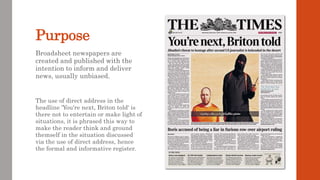
Purpose
Broadsheet newspapers are
created and published with the
intention to inform and deliver
news, usually unbiased.
The use of direct address in the
headline 'You're next, Briton told' is
there not to entertain or make light of
situations, it is phrased this way to
make the reader think and ground
themself in the situation discussed
via the use of direct address, hence
the formal and informative register.
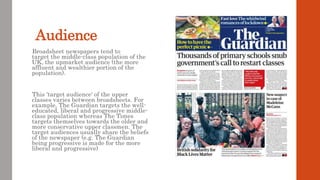
Audience
Broadsheet newspapers tend to
target the middle-class population of the
UK, the upmarket audience (the more
affluent and wealthier portion of the
population).
This 'target audience' of the upper
classes varies between broadsheets. For
example, The Guardian targets the well-
educated, liberal and progressive middle-
class population whereas The Times
targets themselves towards the older and
more conservative upper classmen. The
target audiences usually share the beliefs
of the newspaper (e.g. The Guardian
being progressive is made for the more
liberal and progressive)
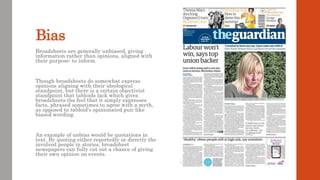
Bias
Broadsheets are generally unbiased, giving
information rather than opinions, aligned with
their purpose: to inform.
Though broadsheets do somewhat express
opinions aligning with their ideological
standpoint, but there is a certain objectivist
standpoint that tabloids lack which gives
broadsheets the feel that it simply expresses
facts, phrased sometimes to agree with a myth,
as opposed to tabloid's opinionated pun-like
biased wording.
An example of unbias would be quotations in
text. By quoting either reportedly or directly the
involved people in stories, broadsheet
newspapers can fully cut out a chance of giving
their own opinion on events.
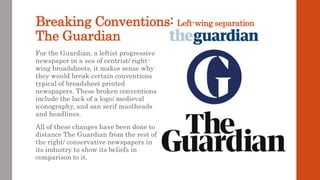
Breaking Conventions: Left-wing separation
The Guardian
For the Guardian, a leftist progressive
newspaper in a sea of centrist/ right-
wing broadsheets, it makes sense why
they would break certain conventions
typical of broadsheet printed
newspapers. These broken conventions
include the lack of a logo/ medieval
iconography, and san serif mastheads
and headlines.
All of these changes have been done to
distance The Guardian from the rest of
the right/ conservative newspapers in
its industry to show its beliefs in
comparison to it.
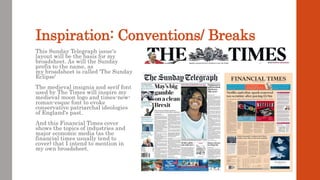
Inspiration: Conventions/ Breaks
This Sunday Telegraph issue's
layout will be the basis for my
broadsheet. As will the Sunday
prefix to the name, as
my broadsheet is called 'The Sunday
Eclipse'
The medieval insignia and serif font
used by The Times will inspire my
medieval moon logo and times-new-
roman-esque font to evoke
conservative patriarchal ideologies
of England's past.
And this Financial Times cover
shows the topics of industries and
major economic media (as the
financial times usually tend to
cover) that I intend to mention in
my own broadsheet.

Broadsheet PPT.pptx

  • 1.
    Newspaper Conventions: Broadsheets Research intothe generic conventions of Broadsheet Covers
  • 2.
    Mastheads Broadsheet Mastheads usuallyfeature black text on a white background, accompanied by serif font inflections and a logo. By applying Barthes' Semiology, The typically medieval crest/ iconography used in mastheads (particularly the logos) of right-wing/ conservative newspapers like The Times attempts to naturalise medieval and traditonalist ideologies that these newspaper promote and identify with. An example of the ideologies naturalised by the medieval and serif finery on such mastheads would be the patriarchy and class system, the crests and insignia used belong to a time of English history synonymous with heavy divides between both the wealthy and impoverished as well as men and women
  • 3.
    Register Broadsheet newspapers aremore formal and reserved with their wording and tone. This is largely due to the way they present their news as information as opposed to tabloid newspapers that are presented as entertainment. For example, looking at this cover page from a copy of The Guardian, a left-wing broadsheet newspaper, we can see that there are no puns or comedic language in the headlines, it is merely presenting information with the purpose to inform about the 'Pressure on [Dominic] Cummings to quit over lockdown breach'.
  • 4.
    News Agenda Broadsheet newspapersfocuses on 'Harder news', consisting of more serious/ important topics like politics, finance and international affairs compared to tabloids which usually focus on celebrity news and light events. As proven by the titles of these Broadsheets, the topics handled are much more impactful and serious than a typical tabloid, ranging from international religious affairs to legal battles in and around the news scene, spanning even to sensitive topics like immigration and explicit crimes
  • 5.
    Headlines Broadsheet headlines areoften banner headlines that span the full extent of the page, they are bold, capitalised, feature serif inflections, and feature sensationalised language to exaggerate the newspaper's stance on the topic being discussed. For example, the left wing, progressive and tory-critical newspaper The Guardian uses the powerful defaming definitive headline: "A liar and a cheat" to label former minister and lobbyist Neil Hamilton. This choice aligns with the beliefs of the newspaper and their ideology
  • 6.
    Layout Unlike the imagedominated cover pages of tabloids, broadsheet newspaper covers have most of their cover pages filled with the main text of the newspaper, the stories also known as the copy (the text, information). This copy-dominant layout is due to the difference in purpose between tabloids and broadsheets, with broadsheets intended to inform, thusly filling their front page, which will be judged by a potential reader to determine whether they will read, is covered in the information that one would buy a broadsheet for. For Example, this cover of the financial times is dominated by the copy with some images breaking it up.
  • 7.
    Purpose Broadsheet newspapers are createdand published with the intention to inform and deliver news, usually unbiased. The use of direct address in the headline 'You're next, Briton told' is there not to entertain or make light of situations, it is phrased this way to make the reader think and ground themself in the situation discussed via the use of direct address, hence the formal and informative register.
  • 8.
    Audience Broadsheet newspapers tendto target the middle-class population of the UK, the upmarket audience (the more affluent and wealthier portion of the population). This 'target audience' of the upper classes varies between broadsheets. For example, The Guardian targets the well- educated, liberal and progressive middle- class population whereas The Times targets themselves towards the older and more conservative upper classmen. The target audiences usually share the beliefs of the newspaper (e.g. The Guardian being progressive is made for the more liberal and progressive)
  • 9.
    Bias Broadsheets are generallyunbiased, giving information rather than opinions, aligned with their purpose: to inform. Though broadsheets do somewhat express opinions aligning with their ideological standpoint, but there is a certain objectivist standpoint that tabloids lack which gives broadsheets the feel that it simply expresses facts, phrased sometimes to agree with a myth, as opposed to tabloid's opinionated pun-like biased wording. An example of unbias would be quotations in text. By quoting either reportedly or directly the involved people in stories, broadsheet newspapers can fully cut out a chance of giving their own opinion on events.
  • 10.
    Breaking Conventions: Left-wingseparation The Guardian For the Guardian, a leftist progressive newspaper in a sea of centrist/ right- wing broadsheets, it makes sense why they would break certain conventions typical of broadsheet printed newspapers. These broken conventions include the lack of a logo/ medieval iconography, and san serif mastheads and headlines. All of these changes have been done to distance The Guardian from the rest of the right/ conservative newspapers in its industry to show its beliefs in comparison to it.
  • 11.
    Inspiration: Conventions/ Breaks ThisSunday Telegraph issue's layout will be the basis for my broadsheet. As will the Sunday prefix to the name, as my broadsheet is called 'The Sunday Eclipse' The medieval insignia and serif font used by The Times will inspire my medieval moon logo and times-new- roman-esque font to evoke conservative patriarchal ideologies of England's past. And this Financial Times cover shows the topics of industries and major economic media (as the financial times usually tend to cover) that I intend to mention in my own broadsheet.