Brief discussion on cloud technologies, pricing and other
1.
Cloud Use
Case forGlobal
Financial
Fintech
Company
Satvik Kundargi
Manoj Kulkarni
Premchand Jalla
2.
Agenda
• Introduction
• CurrentTech Stack and
Challenges
• Cloud Service and
Deployment Models
• AWS Service Selection
• Cost Estimation
• Benefits of Cloud Transition
• Conclusion and
Recommendations
3.
Introduction
• Our client,a leading global fintech company, operates a real-time
trading platform, managing massive amounts of financial data across
multiple regions.
• With data centers located in New York, London, and Singapore, they
face increasing operational costs, performance issues during peak
trading hours, and compliance challenges.
• To meet growing business demands, they plan to transition to the
cloud for better scalability, performance, and cost efficiency. AWS is the
preferred cloud provider due to its comprehensive set of cloud services
and global infrastructure.
4.
Current
Tech Stack
and
Challenges
• TechStack:
• 3 on-premises data centers: New York, London,
Singapore
• 500 physical servers running critical applications
• 2PB (Petabytes) of on-premises storage
• Challenges:
• High-latency during peak trading hours is affecting
transaction speeds, leading to customer
dissatisfaction.
• Scaling resources to meet demand spikes is limited,
hindering the platform’s growth potential.
• Operational costs for data center maintenance,
upgrades, and staffing amount to $10 million annually.
• The company struggles to comply with global
regulatory frameworks like GDPR and PCI DSS.
5.
Cloud Service and
DeploymentModels
• Cloud Service Models:
• IaaS (Infrastructure as a Service): Provides virtualized computing resources over the internet.
• PaaS (Platform as a Service): Allows for building and deploying applications without managing the underlying
infrastructure.
• SaaS (Software as a Service): Delivers software applications over the internet.
• Cloud Deployment Models:
• Public Cloud: Cloud resources operated by third-party cloud providers.
• Private Cloud: Cloud infrastructure operated solely for one organization.
• Hybrid Cloud: Combines public and private clouds for flexibility, scalability, and security.
• Recommended Solution:
• A hybrid approach using IaaS for critical infrastructure (real-time trading), PaaS for data analytics (risk management and financial data
processing), and SaaS for CRM modernization.
6.
Why AWS for
Fintech?
•Global Availability: AWS offers a global network of data centers, ensuring low-
latency and high availability across key financial hubs.
• Compliance: AWS complies with major regulatory frameworks like GDPR, PCI
DSS, and FINRA, making it suitable for financial services.
• Scalability: AWS allows rapid scaling to meet fluctuating trading volumes, with
the ability to auto-scale resources based on demand.
• Security: AWS provides a suite of security tools, including IAM (Identity and
Access Management) and KMS (Key Management Service) to secure sensitive
financial data.
• Disaster Recovery: Built-in disaster recovery solutions ensure business
continuity during outages or failures.
7.
AWS Service
Selection
• Compute:
•Amazon EC2: Elastic Compute Cloud for running scalable applications with auto-
scaling capabilities to adjust compute capacity based on demand.
• AWS Lambda: Serverless compute service for running code without provisioning
servers.
• Storage:
• Amazon S3: Object storage service for scalability, data security, and durability.
• Amazon EBS: Elastic Block Store for persistent storage attached to EC2 instances.
• Amazon S3 Glacier: Long-term storage for archival data with cost-efficient
storage.
8.
AWS Service
Selection
• Databases:
•Amazon RDS: Managed relational database service for transactional workloads.
• Amazon DynamoDB: NoSQL database for low-latency access to large volumes of financial data.
• Networking:
• Amazon VPC: Virtual Private Cloud for isolating cloud resources securely.
• AWS CloudFront: Content delivery network (CDN) for faster content delivery to global users.
• AWS Global Accelerator: Reduces latency by directing traffic through AWS global infrastructure.
• Security:
• AWS IAM: Manage user permissions and security policies.
• AWS KMS: Key management and encryption for securing financial data.
• AWS CloudTrail: Logging service to track user activity and API usage for compliance auditing.
9.
Cost Estimation
Overview
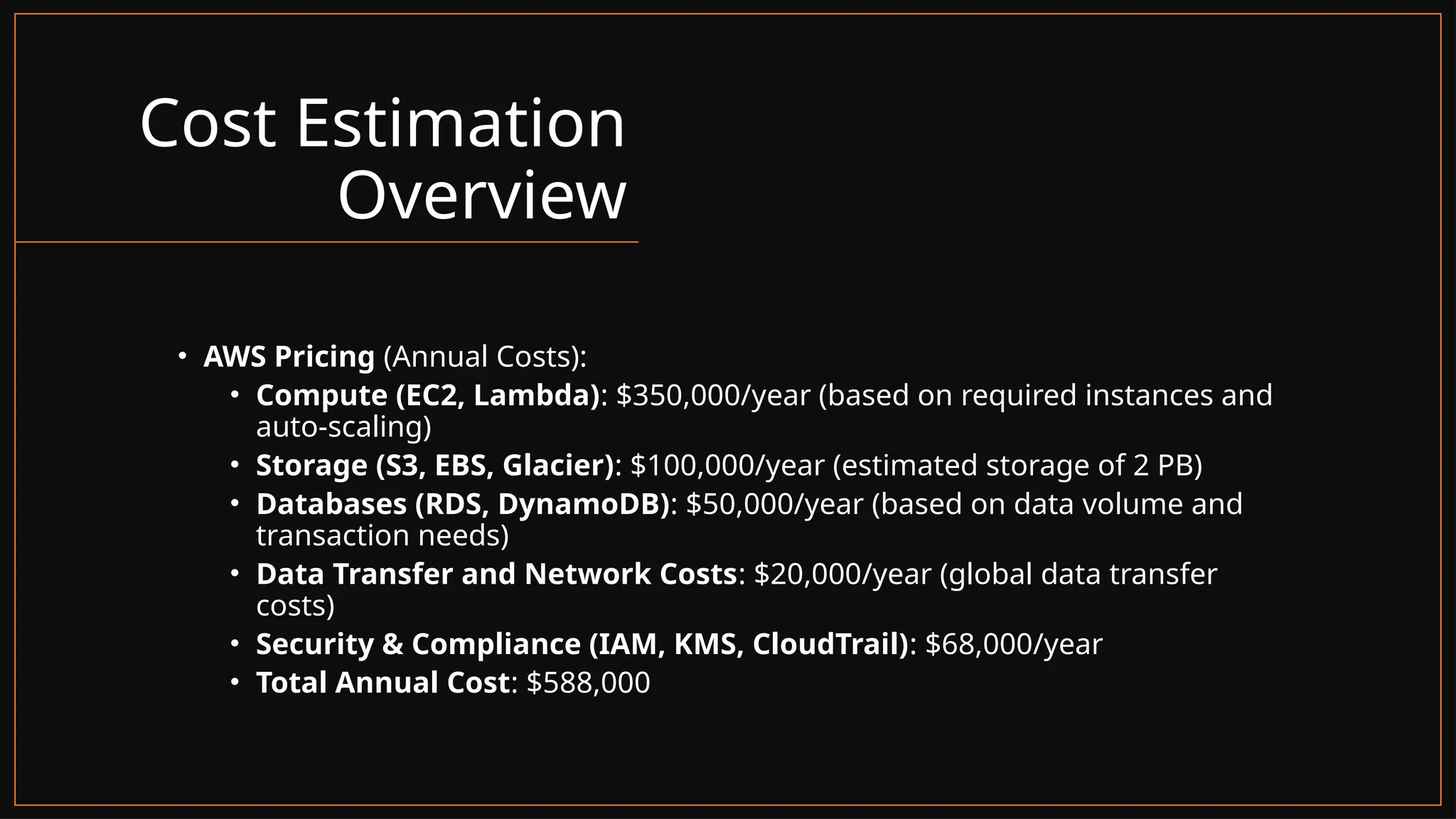
• AWSPricing (Annual Costs):
• Compute (EC2, Lambda): $350,000/year (based on required instances and
auto-scaling)
• Storage (S3, EBS, Glacier): $100,000/year (estimated storage of 2 PB)
• Databases (RDS, DynamoDB): $50,000/year (based on data volume and
transaction needs)
• Data Transfer and Network Costs: $20,000/year (global data transfer
costs)
• Security & Compliance (IAM, KMS, CloudTrail): $68,000/year
• Total Annual Cost: $588,000
10.
Cost Savings
• On-PremisesCosts:
• $10 million/year for data center maintenance, staffing, and upgrades.
• AWS Cloud Costs:
• $588,000/year (as per cost breakdown)
• Total Savings:
• A 90% reduction in operational costs, allowing the company to invest more in business
expansion, R&D, and other critical functions.
• Cost-Saving Strategies:
• Using Reserved Instances and Savings Plans to further reduce compute costs.
• Employing S3 lifecycle management to automatically move data from S3 to Glacier, saving
storage costs.
11.
Scalability and
Performance
• Auto-Scaling:AWS's auto-scaling ensures that during peak trading hours,
the infrastructure scales automatically, eliminating downtime.
• Global Accelerator & CloudFront: These services reduce latency by
routing traffic through the AWS global network.
• Load Balancing: Elastic Load Balancing helps distribute incoming
application traffic for increased fault tolerance and performance.
12.
Enhanced Data
Analytics
• DataAnalytics Services:
• Amazon Redshift: Data warehousing service for processing large datasets and
running complex queries.
• AWS Glue: Fully managed ETL (extract, transform, load) service to prepare and
process data.
• Amazon SageMaker: For building and training machine learning models for
predictive analytics and financial risk management.
• Impact:
• Faster data processing for risk management and regulatory compliance.
• Real-time data analysis for making informed business decisions.
13.
CRM
Modernization
• AWS Tools:
•Amazon Connect: Cloud-based contact center service that scales
automatically based on the customer support needs.
• Amazon Pinpoint: Real-time analytics and personalized marketing
campaigns for better customer experience.
• Impact:
• Real-time CRM integration improves customer engagement.
• Personalized services increase customer satisfaction and loyalty.
14.
Disaster Recovery &
BusinessContinuity
• AWS DR Solutions:
• Elastic Disaster Recovery (DRS): Enables fast recovery of on-premises
systems and workloads in the cloud during disruptions.
• Multi-AZ Deployments: Ensures data redundancy and failover capabilities
across multiple availability zones.
• Impact:
• Near-instant recovery of systems in case of disaster, minimizing downtime.
• Improved business continuity with reduced disaster recovery costs.
15.
Security and
Compliance
• SecurityServices:
• IAM for managing user permissions and policies.
• KMS for encrypting sensitive financial data.
• CloudTrail for tracking and auditing all actions within AWS, ensuring
compliance with regulations like GDPR and PCI DSS.
• Impact:
• The company benefits from AWS's compliance certifications, reducing
regulatory risk.
• AWS’s robust security services ensure the safety of customer financial data and
the protection of assets.
16.
Conclusion and
Recommendations
• KeyBenefits:
• AWS provides a flexible and scalable solution to meet the company’s growing demands.
• Significant cost savings: a 90% reduction in annual operational costs.
• Improved latency and performance during peak trading hours.
• Compliance with global financial regulations, enhancing security.
• Enhanced data analytics capabilities for better decision-making and customer experience.
• Recommendation:
• Move forward with AWS's hybrid cloud deployment, leveraging the full power of IaaS for
scalability and reliability while maintaining control over sensitive data. The company
should focus on scaling performance, ensuring data compliance, and optimizing
operational costs.