BRICKS
BRICKS
• Introduction
• Size of the brick
• Manufacture of brick
• Classification of brick
• Tests on brick
• Qualities of good brick
• Uses of bricks
• Special types of bricks
Introduction
• The common brick is one of the oldest building
material
• Leading building material
• High strength, low cost, easy availability
• Made from soil
Introduction
Constituents of brick earth
• Alumina – 20 to 30 %
• Silica -50 to 60 %
• Lime - < 5 %
• Oxides of iron – 5 to 6 %
• Magnesia – 5 %
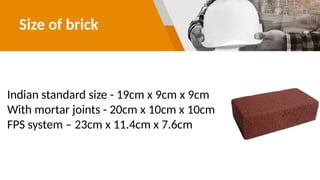
Size of brick
Indian standard size - 19cm x 9cm x 9cm
With mortar joints - 20cm x 10cm x 10cm
FPS system – 23cm x 11.4cm x 7.6cm
Manufacture of bricks
1. Preparation of brick earth
2. Moulding of bricks
3. Drying of bricks
4. Burning of bricks
Manufacture of bricks
Preparation of brick earth
• Removal of loose soil
• Digging , spreading and cleaning
• Weathering
• Blending and tempering
Manufacture of bricks
Moulding of bricks
• Hand moulding
• Machine moulding
Manufacture of bricks
Drying of bricks
• Dry under sunlight in specially prepared yards
• Dried for a period of 5 to 12 days
• In rotary kiln, drying and burning done at same place
Manufacture of bricks
Burning of bricks
• Clamp burning
clamps are temporary structures
stacked in layers with certain gap
firewood is inserted in these gaps and fired
burning for 6 to 8 weeks
Manufacture of bricks
Burning of bricks
• Kiln burning
kilns are permanent structures
burning continuously in kilns
bricks from kilns are of correct size and perfect shape
rate of burning is also high in kiln
Classification of bricks
1. Unburnt or sun dried bricks
2. Burnt bricks
a. First class bricks
b. Second class bricks
c. Third class bricks
d. Fourth class bricks (Over burnt bricks)
Classification of bricks
Unburnt or sun dried bricks
These are dried under sunlight
These are used for temporary and cheap construction
It is also used for filling works
Classification of bricks
First class bricks
First class bricks are well burnt having smooth and even
surface
These should not absorb water more than 20 % of its
weight when immersed in cold water
Minimum compressive strength of these bricks should
be 10.5 N/mm2
Classification of bricks
Second class bricks
Second class bricks are with slight irregularities in
shape,size,colour and surface finish
These should not absorb water more than 22 % of its
weight when immersed in cold water for 24 hours
Minimum compressive strength of these bricks should
be 7 N/mm2
Classification of bricks
Third class bricks
Third class bricks are not burnt properly
These should not absorb water more than 24 % of its
weight when immersed in cold water for 24 hours
Minimum compressive strength of these bricks should
be 3.5 N/mm2
Classification of bricks
Fourth class bricks
Fourth class bricks are over burnt bricks
Dark in colour with irregular size and shape
Over burnt bricks are not used for building construction
These are used as aggregate in concrete and for flooring
Tests on bricks
• Crushing strength test
• Water absorption test
• Hardness test
• Test for presence of soluble salt
• Shape and size
• Soundness test
• Toughness
• Structure
Tests on bricks
Crushing strength test
Tested by Compression Testing Machine (CTM)
On brick, a load is applied till it breaks and the maximum
load is noted
Compressive strength is obtained by dividing this load by
the area of the face of the brick
The minimum compressive strength should be 3.5 N/mm2
Tests on bricks
Water absorption test
To find out the amount of water absorbed by the brick
To do this weight of the brick is noted then kept it in
water for 16 hours , after that it is taken out and
weighed and the increase in weight is found out. it is
expressed as percentage of water absorption. The
permissible value is 20%
Tests on bricks
Hardness test
This is to find out the hardness of the brick.scratch it in
by fingernails.if no impression is left on brick, then it is
hard
Tests on bricks
Test for presence of soluble salt
This test is done to find out the efflorescence in bricks
To do this brick is immersed in water for 24 hours
Taken out and dried under shade
After drying if a thin layer of white or gray powder is
seen on the surface of the brick, there are soluble salts
in the brick
Tests on bricks
Test for presence of soluble salt
Different grades are assumed based on the coverage of
white deposits on the surface
% of white layer on the surface Efflorescence
10% Slight
50% Moderate
>50% heavy
Tests on bricks
Shape and size
This is to find out the irregularities in shape and size
20 bricks of size 19cm x 9cm x 9cm are randomly
selected & stacked length wise along the width and
along the height. For good quality bricks, the total
dimension should be within these lengths
Tests on bricks
Shape and size
Length : 3680mm to 3920mm
width: 1740mm to 1860mm
Height: 1740mm to 1860mm
Tests on bricks
Soundness test
Two bricks are taken and knocked with each other .it
should not break and to give a metallic ringing sound
Tests on bricks
Toughness test
A brick is taken and dropped flat from a height of 1m on
a firm platform. If it does not break, then it is tough
Tests on bricks
structure
When a brick is broken, it should be homogenous,
compact and free from holes and lumps etc
Qualities of good bricks
• Brick should have uniform copper colour
• It should be free from cracks, void and grits
• It should have even surface with sharp and square
edges
• It should be of standard size
• Bricks when broken should show a bright
homogeneous structure
Qualities of good bricks
• Bricks should be sufficiently hard. When it is
scratched with fingernail no impression should be left
on brick surface
• Bricks should give clear bell ringing sound when
knocked with each other
• Bricks should be sound proof and have low thermal
conductivity
Uses of bricks
• Bricks are used for construction of walls, foundations
of structures
• Used in construction of bridges and dams
• Used for paving and road works
• Firebricks are used for furnaces, chimneys, etc
• Bricks are used for ornamental works
Special type of bricks
• Hollow brick
• Perforated brick
• Cow nose brick
• Bull nose brick
• Paving brick
Special type of bricks
• Hollow block brick
• Coping brick
• Sand lime brick
• Refractory brick
• Soild block brick
THANK YOU

bricks ppt for all civil engineering students

  • 1.
  • 2.
    BRICKS • Introduction • Sizeof the brick • Manufacture of brick • Classification of brick • Tests on brick • Qualities of good brick • Uses of bricks • Special types of bricks
  • 3.
    Introduction • The commonbrick is one of the oldest building material • Leading building material • High strength, low cost, easy availability • Made from soil
  • 4.
    Introduction Constituents of brickearth • Alumina – 20 to 30 % • Silica -50 to 60 % • Lime - < 5 % • Oxides of iron – 5 to 6 % • Magnesia – 5 %
  • 5.
    Size of brick Indianstandard size - 19cm x 9cm x 9cm With mortar joints - 20cm x 10cm x 10cm FPS system – 23cm x 11.4cm x 7.6cm
  • 6.
    Manufacture of bricks 1.Preparation of brick earth 2. Moulding of bricks 3. Drying of bricks 4. Burning of bricks
  • 7.
    Manufacture of bricks Preparationof brick earth • Removal of loose soil • Digging , spreading and cleaning • Weathering • Blending and tempering
  • 8.
    Manufacture of bricks Mouldingof bricks • Hand moulding • Machine moulding
  • 9.
    Manufacture of bricks Dryingof bricks • Dry under sunlight in specially prepared yards • Dried for a period of 5 to 12 days • In rotary kiln, drying and burning done at same place
  • 10.
    Manufacture of bricks Burningof bricks • Clamp burning clamps are temporary structures stacked in layers with certain gap firewood is inserted in these gaps and fired burning for 6 to 8 weeks
  • 11.
    Manufacture of bricks Burningof bricks • Kiln burning kilns are permanent structures burning continuously in kilns bricks from kilns are of correct size and perfect shape rate of burning is also high in kiln
  • 12.
    Classification of bricks 1.Unburnt or sun dried bricks 2. Burnt bricks a. First class bricks b. Second class bricks c. Third class bricks d. Fourth class bricks (Over burnt bricks)
  • 13.
    Classification of bricks Unburntor sun dried bricks These are dried under sunlight These are used for temporary and cheap construction It is also used for filling works
  • 14.
    Classification of bricks Firstclass bricks First class bricks are well burnt having smooth and even surface These should not absorb water more than 20 % of its weight when immersed in cold water Minimum compressive strength of these bricks should be 10.5 N/mm2
  • 15.
    Classification of bricks Secondclass bricks Second class bricks are with slight irregularities in shape,size,colour and surface finish These should not absorb water more than 22 % of its weight when immersed in cold water for 24 hours Minimum compressive strength of these bricks should be 7 N/mm2
  • 16.
    Classification of bricks Thirdclass bricks Third class bricks are not burnt properly These should not absorb water more than 24 % of its weight when immersed in cold water for 24 hours Minimum compressive strength of these bricks should be 3.5 N/mm2
  • 17.
    Classification of bricks Fourthclass bricks Fourth class bricks are over burnt bricks Dark in colour with irregular size and shape Over burnt bricks are not used for building construction These are used as aggregate in concrete and for flooring
  • 18.
    Tests on bricks •Crushing strength test • Water absorption test • Hardness test • Test for presence of soluble salt • Shape and size • Soundness test • Toughness • Structure
  • 19.
    Tests on bricks Crushingstrength test Tested by Compression Testing Machine (CTM) On brick, a load is applied till it breaks and the maximum load is noted Compressive strength is obtained by dividing this load by the area of the face of the brick The minimum compressive strength should be 3.5 N/mm2
  • 20.
    Tests on bricks Waterabsorption test To find out the amount of water absorbed by the brick To do this weight of the brick is noted then kept it in water for 16 hours , after that it is taken out and weighed and the increase in weight is found out. it is expressed as percentage of water absorption. The permissible value is 20%
  • 21.
    Tests on bricks Hardnesstest This is to find out the hardness of the brick.scratch it in by fingernails.if no impression is left on brick, then it is hard
  • 22.
    Tests on bricks Testfor presence of soluble salt This test is done to find out the efflorescence in bricks To do this brick is immersed in water for 24 hours Taken out and dried under shade After drying if a thin layer of white or gray powder is seen on the surface of the brick, there are soluble salts in the brick
  • 23.
    Tests on bricks Testfor presence of soluble salt Different grades are assumed based on the coverage of white deposits on the surface % of white layer on the surface Efflorescence 10% Slight 50% Moderate >50% heavy
  • 24.
    Tests on bricks Shapeand size This is to find out the irregularities in shape and size 20 bricks of size 19cm x 9cm x 9cm are randomly selected & stacked length wise along the width and along the height. For good quality bricks, the total dimension should be within these lengths
  • 25.
    Tests on bricks Shapeand size Length : 3680mm to 3920mm width: 1740mm to 1860mm Height: 1740mm to 1860mm
  • 26.
    Tests on bricks Soundnesstest Two bricks are taken and knocked with each other .it should not break and to give a metallic ringing sound
  • 27.
    Tests on bricks Toughnesstest A brick is taken and dropped flat from a height of 1m on a firm platform. If it does not break, then it is tough
  • 28.
    Tests on bricks structure Whena brick is broken, it should be homogenous, compact and free from holes and lumps etc
  • 29.
    Qualities of goodbricks • Brick should have uniform copper colour • It should be free from cracks, void and grits • It should have even surface with sharp and square edges • It should be of standard size • Bricks when broken should show a bright homogeneous structure
  • 30.
    Qualities of goodbricks • Bricks should be sufficiently hard. When it is scratched with fingernail no impression should be left on brick surface • Bricks should give clear bell ringing sound when knocked with each other • Bricks should be sound proof and have low thermal conductivity
  • 31.
    Uses of bricks •Bricks are used for construction of walls, foundations of structures • Used in construction of bridges and dams • Used for paving and road works • Firebricks are used for furnaces, chimneys, etc • Bricks are used for ornamental works
  • 32.
    Special type ofbricks • Hollow brick • Perforated brick • Cow nose brick • Bull nose brick • Paving brick
  • 33.
    Special type ofbricks • Hollow block brick • Coping brick • Sand lime brick • Refractory brick • Soild block brick
  • 34.