Data-Generating
Patents
[forthcoming 111 NORTHWESTERN LAW REVIEW __ (2017)]
Brenda M. Simon
Associate Professor, TJSL
Non-Resident Fellow, Stanford Law School
Ted Sichelman
Professor, USD Law
May 6, 2016
— Data-Generating Patents:
— Patented inventions that by design
generate valuable data by their
operation or use.
Overview
— The Phenomenon of Data Generating Patents
and Their Legal and Economic Effects
— Discerning the Problematic from the
Unproblematic
— Recommendations
3
Trade Secrets and Patents
— Substitution Theory
— Economic Complements
4
Data-Generating Patents
— Patented inventions that by design
generate valuable data by their
operation or use.
— Examples
5
Possible Concerns
— Patent principles are in an uneasy
tension with protecting this type of
data
— Effects on limiting disclosure
— Innovation balance possibly altered
6
Possible Concerns
— Traditional trade secret safeguards
generally do not apply to data
generated from patented inventions
— Reverse engineering restricted
— Independent discovery limited
7
Possible Concerns
— Data-generating patents may be
leveraged to provide additional
market power in the generation of
trade secrets
— Is there a need for additional legal
protection to incentivize the production
of this kind of information?
8
Discerning Problematic from Unproblematic
Data-Generating Inventions
— Use of data in unforeseeable markets
— Preemptive effect on marketplace
competition for the data
9
Discerning Problematic from Unproblematic
Data-Generating Inventions
— Unforeseeable Data Markets:
— Examines whether the patent provides
the ability to use data in an area that is
not directly related to the market covered
by the patented invention
— The greater the extent to which the
invention allows for use of data in
unforeseeable markets, the more likely the
invention is problematic
10
Discerning Problematic from Unproblematic
Data-Generating Inventions
— Data Market Preemption:
— Examines the effect on competition in the
market for the data
— not the preemptive effect of the invention
itself
— The greater the preemptive effect on
marketplace competition related to the
data, the more likely the invention is
problematic
11
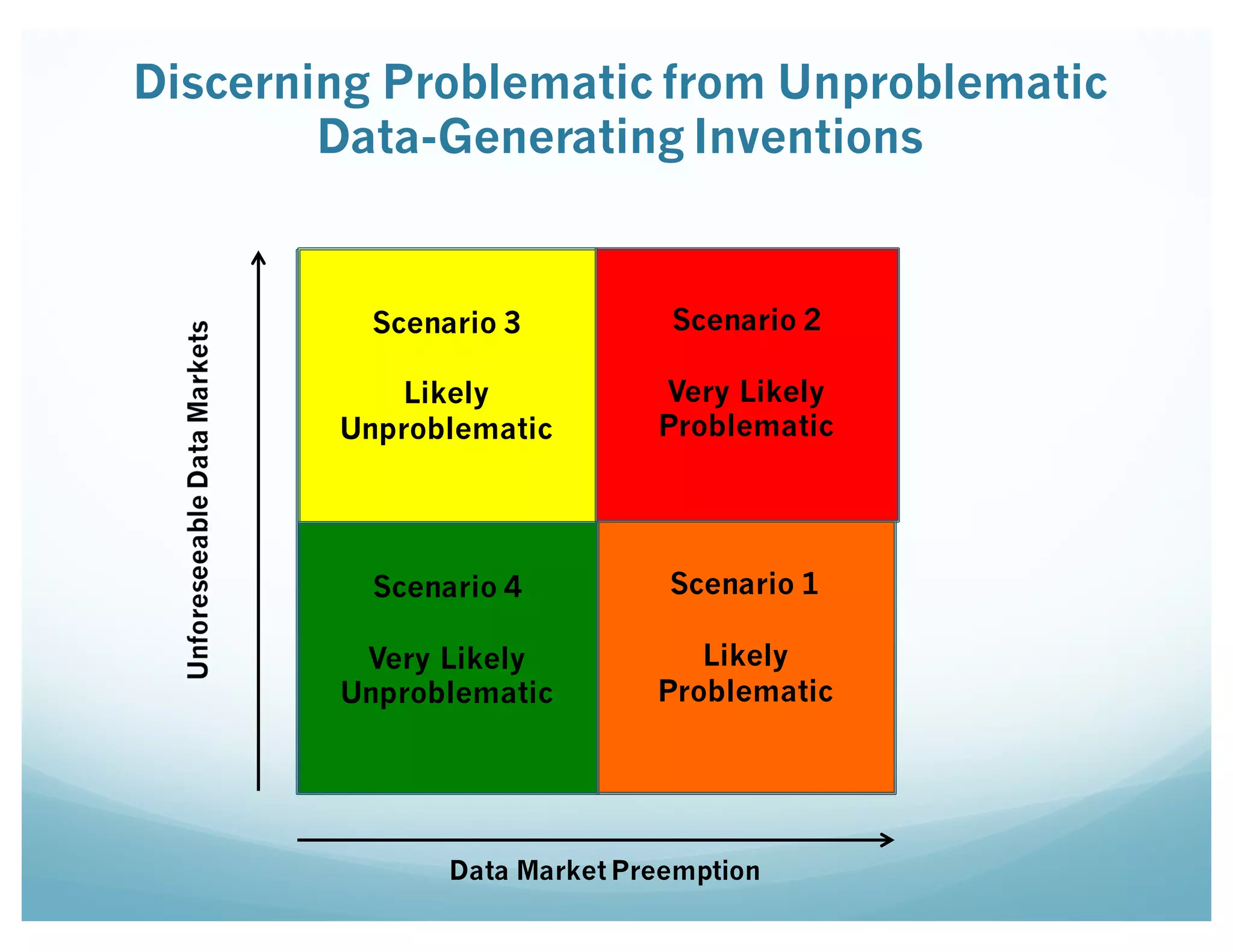
Scenario 3
Likely
Unproblematic
Scenario 2
Very Likely
Problematic
Data Market Preemption
Scenario 1
Likely
Problematic
Scenario 4
Very Likely
Unproblematic
Discerning Problematic from Unproblematic
Data-Generating Inventions
Proposals to Address Problematic Data-
Generating Patents
— Innovation-related concerns
— Disclosure-related concerns
— No ideal solution, but ex post
generally preferable to ex ante
13
Discussion
— brendamsimon(at)gmail.com
— tsichelman(at)sandiego.edu
14

Brenda M. Simon, "The Pathologies of Biomedical ‘Data-Generating’ Patents: Leveraging Intellectual Property and Big Data to Extend Market Power"

  • 1.
    Data-Generating Patents [forthcoming 111 NORTHWESTERNLAW REVIEW __ (2017)] Brenda M. Simon Associate Professor, TJSL Non-Resident Fellow, Stanford Law School Ted Sichelman Professor, USD Law May 6, 2016
  • 2.
    — Data-Generating Patents: —Patented inventions that by design generate valuable data by their operation or use.
  • 3.
    Overview — The Phenomenonof Data Generating Patents and Their Legal and Economic Effects — Discerning the Problematic from the Unproblematic — Recommendations 3
  • 4.
    Trade Secrets andPatents — Substitution Theory — Economic Complements 4
  • 5.
    Data-Generating Patents — Patentedinventions that by design generate valuable data by their operation or use. — Examples 5
  • 6.
    Possible Concerns — Patentprinciples are in an uneasy tension with protecting this type of data — Effects on limiting disclosure — Innovation balance possibly altered 6
  • 7.
    Possible Concerns — Traditionaltrade secret safeguards generally do not apply to data generated from patented inventions — Reverse engineering restricted — Independent discovery limited 7
  • 8.
    Possible Concerns — Data-generatingpatents may be leveraged to provide additional market power in the generation of trade secrets — Is there a need for additional legal protection to incentivize the production of this kind of information? 8
  • 9.
    Discerning Problematic fromUnproblematic Data-Generating Inventions — Use of data in unforeseeable markets — Preemptive effect on marketplace competition for the data 9
  • 10.
    Discerning Problematic fromUnproblematic Data-Generating Inventions — Unforeseeable Data Markets: — Examines whether the patent provides the ability to use data in an area that is not directly related to the market covered by the patented invention — The greater the extent to which the invention allows for use of data in unforeseeable markets, the more likely the invention is problematic 10
  • 11.
    Discerning Problematic fromUnproblematic Data-Generating Inventions — Data Market Preemption: — Examines the effect on competition in the market for the data — not the preemptive effect of the invention itself — The greater the preemptive effect on marketplace competition related to the data, the more likely the invention is problematic 11
  • 12.
    Scenario 3 Likely Unproblematic Scenario 2 VeryLikely Problematic Data Market Preemption Scenario 1 Likely Problematic Scenario 4 Very Likely Unproblematic Discerning Problematic from Unproblematic Data-Generating Inventions
  • 13.
    Proposals to AddressProblematic Data- Generating Patents — Innovation-related concerns — Disclosure-related concerns — No ideal solution, but ex post generally preferable to ex ante 13
  • 14.