BREEDING IN
PLUM
INTRODUCTION
 SCIENTIFIC NAME: prunus sp.
 FAMILY: ROSACEAE
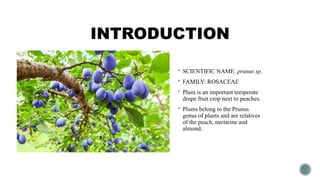
 Plum is an important temperate
drupe fruit crop next to peaches.
 Plums belong to the Prunus
genus of plants and are relatives
of the peach, nectarine and
almond.
 It was introduced to India by Alexander Court in
his orchard at Mashobra.
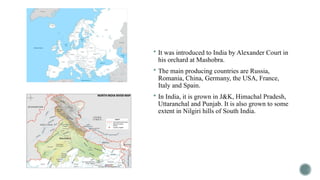
 The main producing countries are Russia,
Romania, China, Germany, the USA, France,
Italy and Spain.
 In India, it is grown in J&K, Himachal Pradesh,
Uttaranchal and Punjab. It is also grown to some
extent in Nilgiri hills of South India.
IMPORTANT AND USES
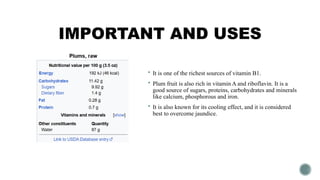
 It is one of the richest sources of vitamin B1.
 Plum fruit is also rich in vitamin A and riboflavin. It is a
good source of sugars, proteins, carbohydrates and minerals
like calcium, phosphorous and iron.
 It is also known for its cooling effect, and it is considered
best to overcome jaundice.
MORPHOLOGICAL
CHARACTERS
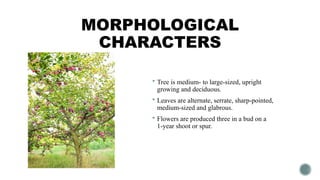
 Tree is medium- to large-sized, upright
growing and deciduous.
 Leaves are alternate, serrate, sharp-pointed,
medium-sized and glabrous.
 Flowers are produced three in a bud on a
1-year shoot or spur.
FLOWER BIOLOGY
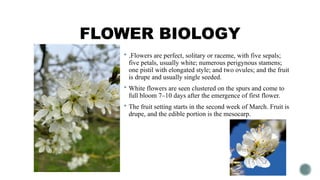
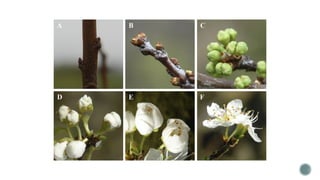
 .Flowers are perfect, solitary or raceme, with five sepals;
five petals, usually white; numerous perigynous stamens;
one pistil with elongated style; and two ovules; and the fruit
is drupe and usually single seeded.
 White flowers are seen clustered on the spurs and come to
full bloom 7–10 days after the emergence of first flower.
 The fruit setting starts in the second week of March. Fruit is
drupe, and the edible portion is the mesocarp.
BREEDING OBJECTIVES
INTRODUCTION
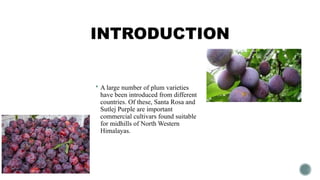
 A large number of plum varieties
have been introduced from different
countries. Of these, Santa Rosa and
Sutlej Purple are important
commercial cultivars found suitable
for midhills of North Western
Himalayas.
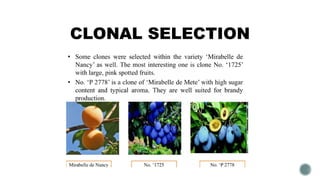
CLONAL SELECTION
TRANSGENIC PLUMS
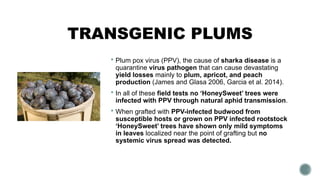
 Plum pox virus (PPV), the cause of sharka disease is a
quarantine virus pathogen that can cause devastating
yield losses mainly to plum, apricot, and peach
production (James and Glasa 2006, Garcia et al. 2014).
 In all of these field tests no ‘HoneySweet’ trees were
infected with PPV through natural aphid transmission.
 When grafted with PPV-infected budwood from
susceptible hosts or grown on PPV infected rootstock
‘HoneySweet’ trees have shown only mild symptoms
in leaves localized near the point of grafting but no
systemic virus spread was detected.
 Based on evaluations of fruit quality and
productivity ‘Honey Sweet’ is not only
protected against PPV but also has the
attributes of fruit quality and yield that
make is suitable for commercial
production.
 Honey Sweet has proved to be effective,
durable, and safe regarding food and
environment. We look forward to its
approval for cultivation in Europe and
the EU.
BREEDING OBJECTIVES AND METHODS IN PLUM.pptx

BREEDING OBJECTIVES AND METHODS IN PLUM.pptx

  • 1.
  • 2.
    INTRODUCTION  SCIENTIFIC NAME:prunus sp.  FAMILY: ROSACEAE  Plum is an important temperate drupe fruit crop next to peaches.  Plums belong to the Prunus genus of plants and are relatives of the peach, nectarine and almond.
  • 5.
     It wasintroduced to India by Alexander Court in his orchard at Mashobra.  The main producing countries are Russia, Romania, China, Germany, the USA, France, Italy and Spain.  In India, it is grown in J&K, Himachal Pradesh, Uttaranchal and Punjab. It is also grown to some extent in Nilgiri hills of South India.
  • 6.
    IMPORTANT AND USES It is one of the richest sources of vitamin B1.  Plum fruit is also rich in vitamin A and riboflavin. It is a good source of sugars, proteins, carbohydrates and minerals like calcium, phosphorous and iron.  It is also known for its cooling effect, and it is considered best to overcome jaundice.
  • 7.
    MORPHOLOGICAL CHARACTERS  Tree ismedium- to large-sized, upright growing and deciduous.  Leaves are alternate, serrate, sharp-pointed, medium-sized and glabrous.  Flowers are produced three in a bud on a 1-year shoot or spur.
  • 8.
    FLOWER BIOLOGY  .Flowersare perfect, solitary or raceme, with five sepals; five petals, usually white; numerous perigynous stamens; one pistil with elongated style; and two ovules; and the fruit is drupe and usually single seeded.  White flowers are seen clustered on the spurs and come to full bloom 7–10 days after the emergence of first flower.  The fruit setting starts in the second week of March. Fruit is drupe, and the edible portion is the mesocarp.
  • 10.
  • 11.
    INTRODUCTION  A largenumber of plum varieties have been introduced from different countries. Of these, Santa Rosa and Sutlej Purple are important commercial cultivars found suitable for midhills of North Western Himalayas.
  • 12.
  • 13.
    TRANSGENIC PLUMS  Plumpox virus (PPV), the cause of sharka disease is a quarantine virus pathogen that can cause devastating yield losses mainly to plum, apricot, and peach production (James and Glasa 2006, Garcia et al. 2014).  In all of these field tests no ‘HoneySweet’ trees were infected with PPV through natural aphid transmission.  When grafted with PPV-infected budwood from susceptible hosts or grown on PPV infected rootstock ‘HoneySweet’ trees have shown only mild symptoms in leaves localized near the point of grafting but no systemic virus spread was detected.
  • 14.
     Based onevaluations of fruit quality and productivity ‘Honey Sweet’ is not only protected against PPV but also has the attributes of fruit quality and yield that make is suitable for commercial production.  Honey Sweet has proved to be effective, durable, and safe regarding food and environment. We look forward to its approval for cultivation in Europe and the EU.