BBREAKREAK VVENEN AANALYSNALYSIISSEE
AA PPRESENTATRESENTATIIONON BBYY,
RAVINDRA BABURAVINDRA BABU
PGDM – 1PGDM – 1STST
SEMSEM
INTRODUCTION..
 Break-even analysis is a useful tool to study the relationship
between fixed costs, variable costs and returns.
 Break even analysis gives the analysis of the Sales Volume
where the Variable Costs and Fixed Costs of the Products are
recovered.
 You can use break-even analysis to determine how much
product or service you need to sell at a specific price to meet
all costs.
INTRODUCTION.
 Break-even analysis is a mathematical
formula that discloses how much output
must be sold for the business to break
even.
 Break-even is reached when the money
coming in equals the money going out.
BREAK EVEN POINT
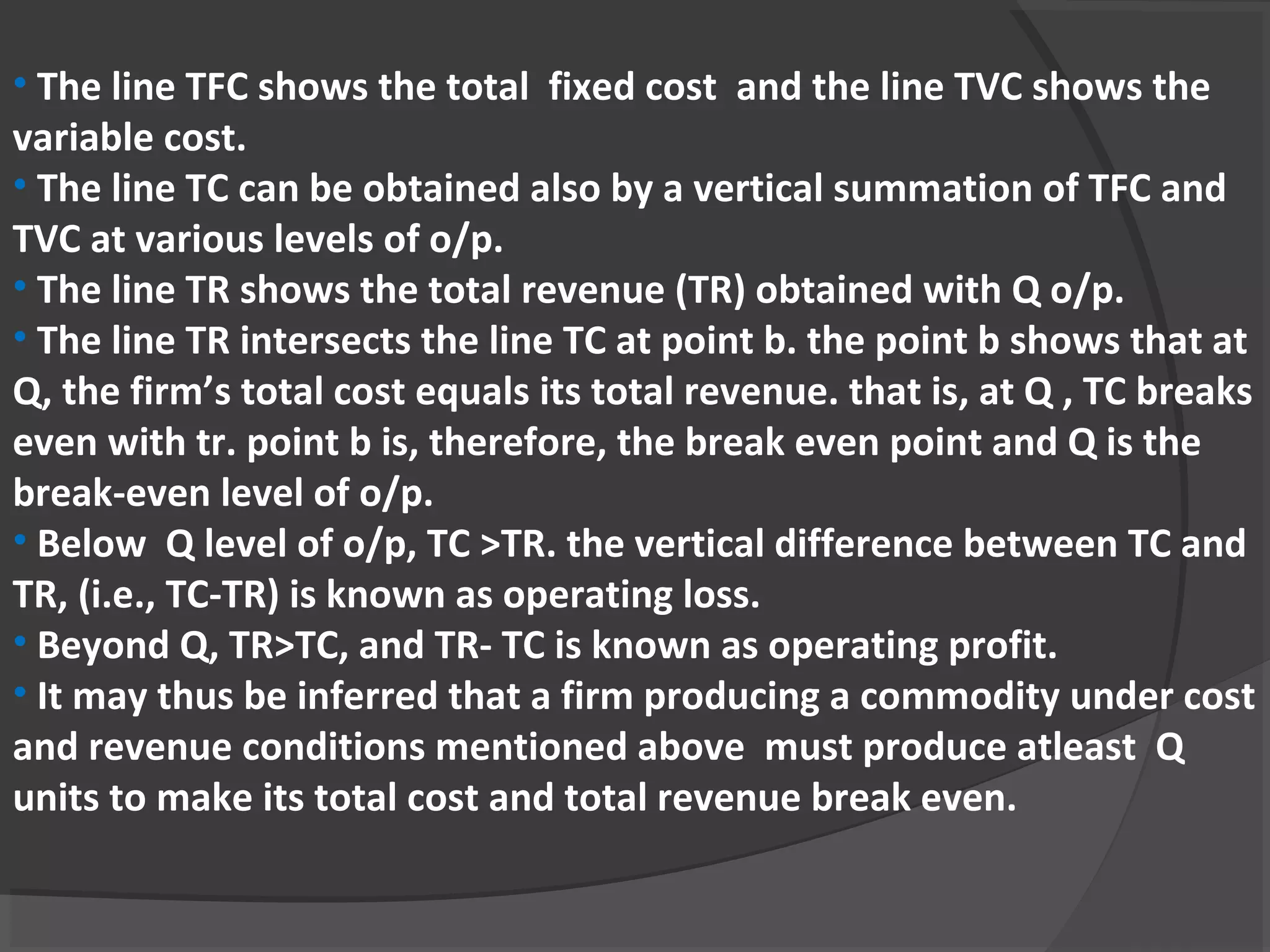
 It may be defined as the level of sales at which
the total revenue is equal to total costs and the
net income is zero.
 It is the point of activity where total revenue and
total expenses are equal.
 This is also known as “No Profit and No Loss”
zone.
 Breakeven Point = Fixed Costs/(Selling Price per
unit - Variable Cost per unit)
FIXED COST
Cost that do not change when production
or sales levels do change, such as rent,
property tax, insurance, or interest
expense. The fixed costs are summarized
for a specific time period (generally one
month).
VARIABLE COST
Variable costs are costs directly related
to production units. Typical variable
costs include direct labor and direct
materials. The variable cost times the
number of units sold will equal the Total
Variable Cost. Total Variable costs plus
Fixed costs make up the total cost of
production.
BREAK EVEN CHART
 In its simplest form, the break-even chart is a graphical
representation of costs at various levels of activity shown on the
same chart as the variation of income (or sales, revenue) with the
same variation in activity. The point at which neither profit nor
loss is made is known as the "break-even point" and is
represented on the chart below by the intersection of the two
lines
 In the diagram , the line OA represents the variation of income at
varying levels of production activity ("output"). OB represents the
total fixed costs in the business. As output increases, variable
costs are incurred, meaning that total costs (fixed + variable) also
increase. At low levels of output, Costs are greater than Income.
At the point of intersection, P, costs are exactly equal to income,
and hence neither profit nor loss is made.
BREAK EVEN CHART
COMPUTATION OF BREAK EVEN ANALYSIS
In the linear Cost-Volume-Profit Analysis model , the
break-even point (in terms of Unit Sales (X)) can be
directly computed in terms of Total Revenue (TR) and
Total Costs (TC) as:
where:
TFC is Total Fixed Costs,
P is Unit Sale Price, and
V is Unit Variable Cost
LINEAR BREAK-EVEN ANALYSIS
• Over small enough range of output levels,
TR and TC may be linear, assuming :
– Constant selling price (MR)
– Constant marginal cost (MC)
– Firm produces only one product
– No time lags between investment and resulting
revenue stream
LINEAR BEA EQUATION
ASSUME : TR=15Q, TFC=100, TVC=10Q.
THAT IS, IN TERMS OF TR AND TC FUNCTIONS,
TR = TC
HENCE,
TC=TFC+TVC
15Q = 100 + 10Q
5Q = 100
Q = 20
THUS, 20 IS THE BREAK-EVEN OUTPUT. GIVEN TR & TC FUNCTIONS,
PRODUCTION BEYOND 20 UNITS WILL YIELD INCREASING PROFITS,
(AT LEAST IN THE SHORT RUN).
TR
700
OP. PROFIT
TC
600
500
TVC
400
B
C& R
300
200 OP. LOSS
100 TFC
50
Q
10 20 30 40
output
LINEAR GRAPHLINEAR GRAPH
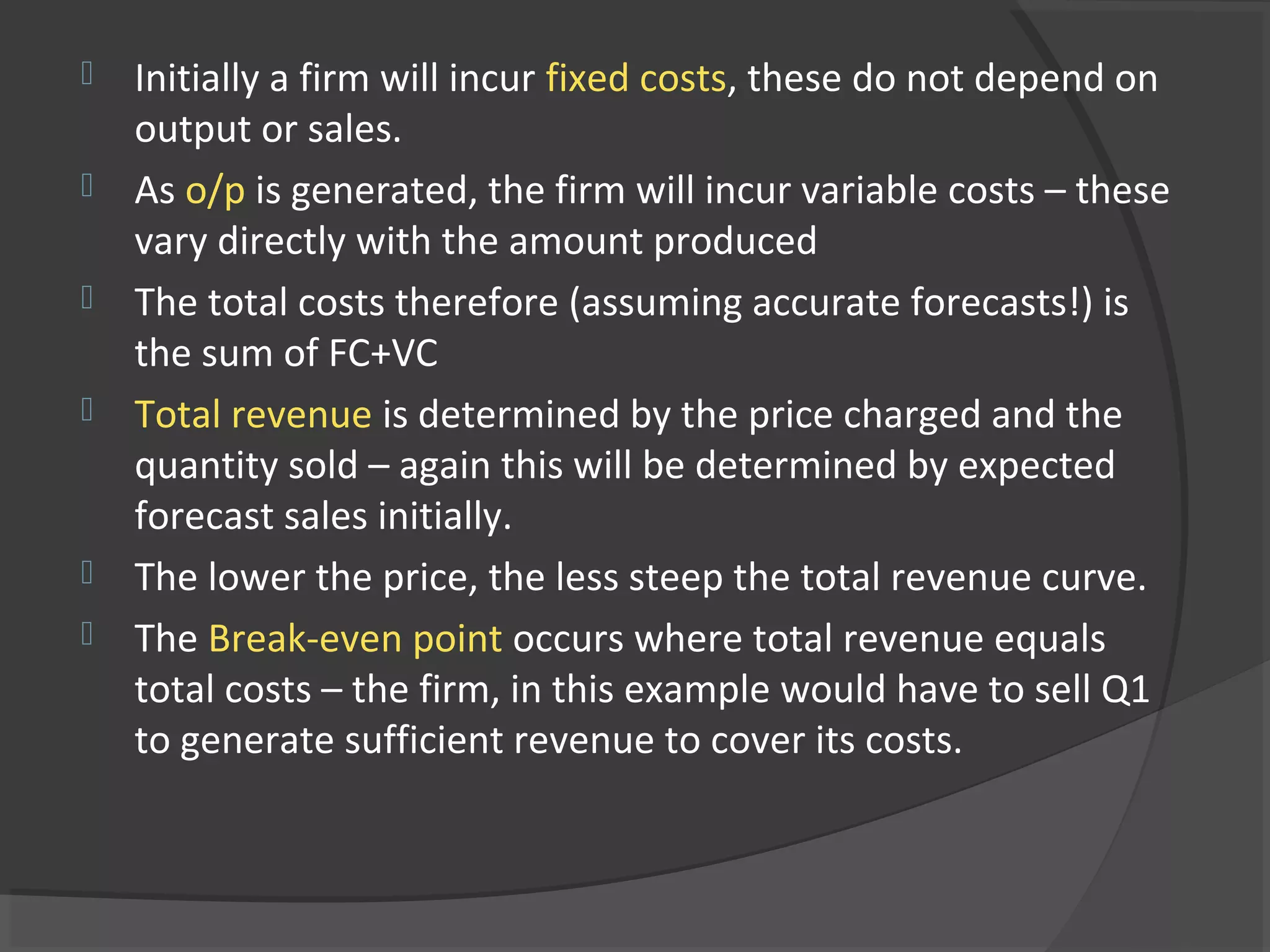
• The line TFC shows the total  fixed cost  and the line TVC shows the 
variable cost.
• The line TC can be obtained also by a vertical summation of TFC and 
TVC at various levels of o/p. 
• The line TR shows the total revenue (TR) obtained with Q o/p.
• The line TR intersects the line TC at point b. the point b shows that at 
Q, the firm’s total cost equals its total revenue. that is, at Q , TC breaks 
even with tr. point b is, therefore, the break even point and Q is the 
break-even level of o/p. 
• Below  Q level of o/p, TC >TR. the vertical difference between TC and 
TR, (i.e., TC-TR) is known as operating loss. 
• Beyond Q, TR>TC, and TR- TC is known as operating profit. 
• It may thus be inferred that a firm producing a commodity under cost 
and revenue conditions mentioned above  must produce atleast  Q 
units to make its total cost and total revenue break even.
BREAK-EVEN ANALYSIS
Costs/Revenue
Output/Sales
FC
VC
TCTR TR
Q1
E
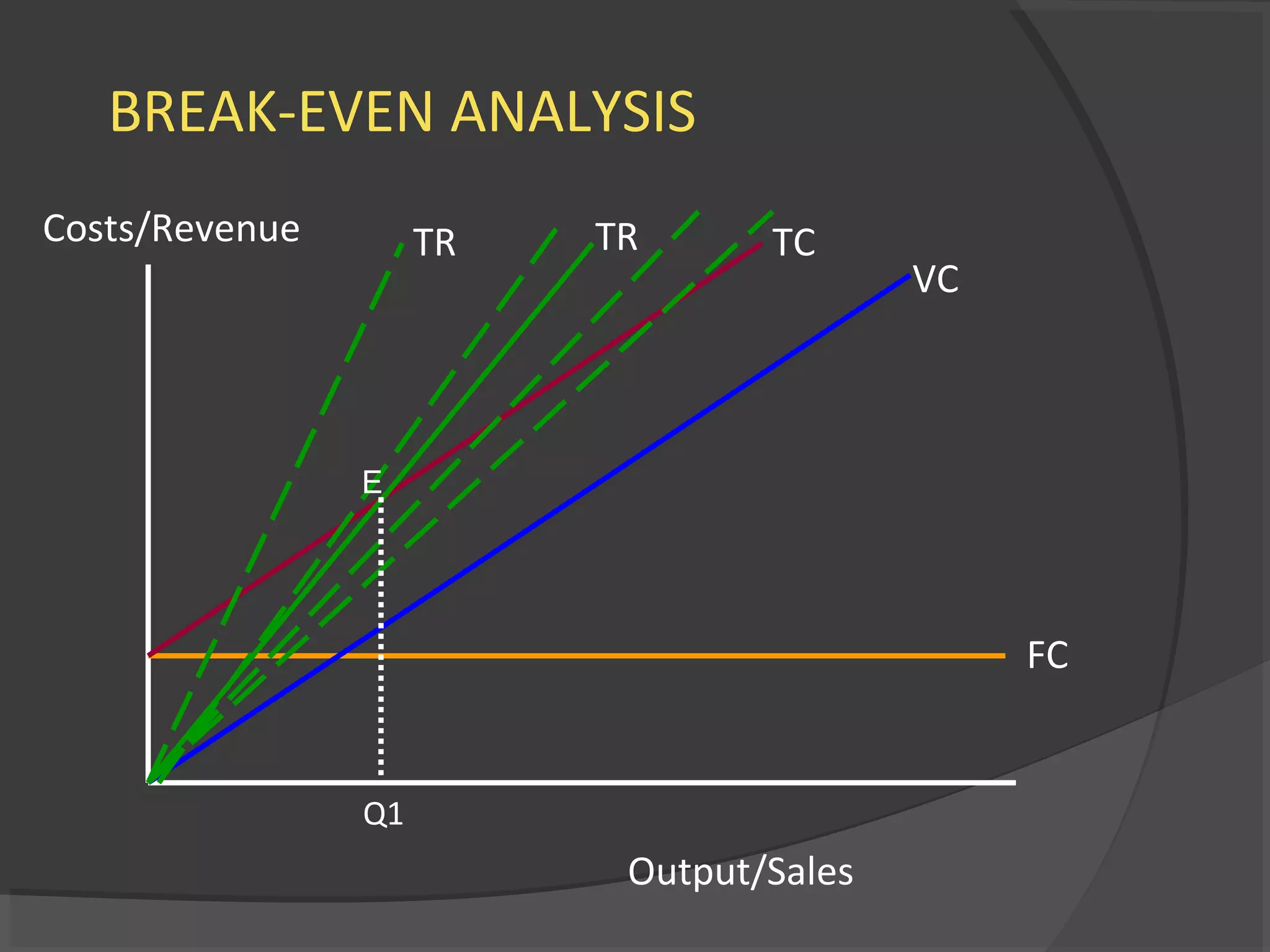
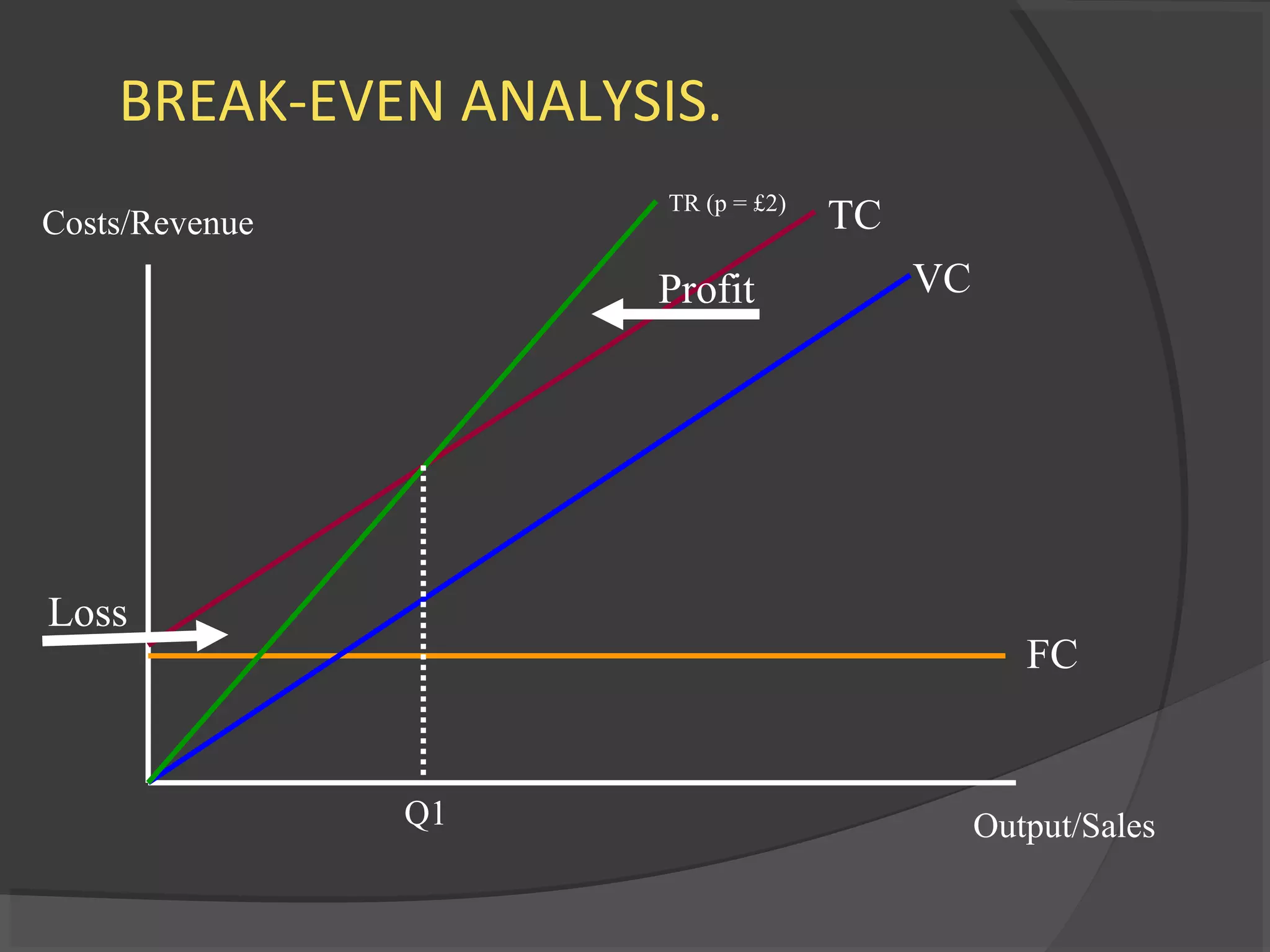
 Initially a firm will incur fixed costs, these do not depend on
output or sales.
 As o/p is generated, the firm will incur variable costs – these
vary directly with the amount produced
 The total costs therefore (assuming accurate forecasts!) is
the sum of FC+VC
 Total revenue is determined by the price charged and the
quantity sold – again this will be determined by expected
forecast sales initially.
 The lower the price, the less steep the total revenue curve.
 The Break-even point occurs where total revenue equals
total costs – the firm, in this example would have to sell Q1
to generate sufficient revenue to cover its costs.
BREAK-EVEN ANALYSIS
• Study of
interrelationships
among a firm’s sales,
costs, and operating
profit at various levels
of output
• Break-even point is
the Q where TR = TC
(Q1 to Q2 on graph)
TR
TC
Q
$’s
Profit
Q1 Q2
TC
B2
TOTAL TR
C & R
BI
F TFC
0
Q1 Q2
OUTPUT PER TIME UNIT
BEA - NON LINEAR GRAPH
• TFC line shows the fixed cost and the vertical distance between TC and
TFC measures the TVC.
• The curve TR shows the total sale proceeds or the total revenue (TR) at
different levels of o/p and price.
• The vertical distance between the TR and TC measures the profit or
loss for various levels of output .
• TR and TC curves intersect each other at two points, b1 and b2, where
TR = TC. these are the lower and upper break-even points.
• For the whole range of O/P b/w OQ1 (corresponding to break-even
point, b1) an OQ2 (corresponding to break-even point b2), TR>TC. It
implies that a firm produces more than OQ1 and less than OQ2 will
make profits. In other words, the profitable range of output lies
between OQ1 and OQ2 units of output. Producing less or more then
these limit will result in losses.
BEP AND PRICING..
• Importance of Price Elasticity of Demand:
• Higher prices might mean fewer sales to break-
even but those sales may take a longer time to
achieve.
• Lower prices might encourage more customers
but higher volume needed before sufficient
revenue generated to break-even
BEP AND PRICING..
Costs/Revenue
Output/Sales
FC
VC
TCTR (p = £2)
Q1
TR (p = £1)
Q3
If the firm chose to set prices lower (say £1) it would need to sell
more units before covering its costs
BEP AND PRICING.
Costs/Revenue
Output/Sales
FC
VC
TC
TR (p = Rs.2)
Q1
TR (p = Rs.3)
Q2
If the firm chose to set price higher than Rs.2 (say Rs.3) the TR curve would be
steeper – they would not have to sell as many units to break even.
BREAK-EVEN ANALYSIS.
Costs/Revenue
Output/Sales
FC
VC
TCTR (p = £2)
Q1
Loss
Profit
BREAK-EVEN ANALYSIS
Links of BE to pricing strategies and elasticity
• Penetration pricing – ‘high’ volume, ‘low’ price –
more sales to break even
• Market Skimming – ‘high’ price ‘low’ volumes –
fewer sales to break even
• Elasticity – what is likely to happen to sales when
prices are increased or decreased?
APPLICATION OF BEA..
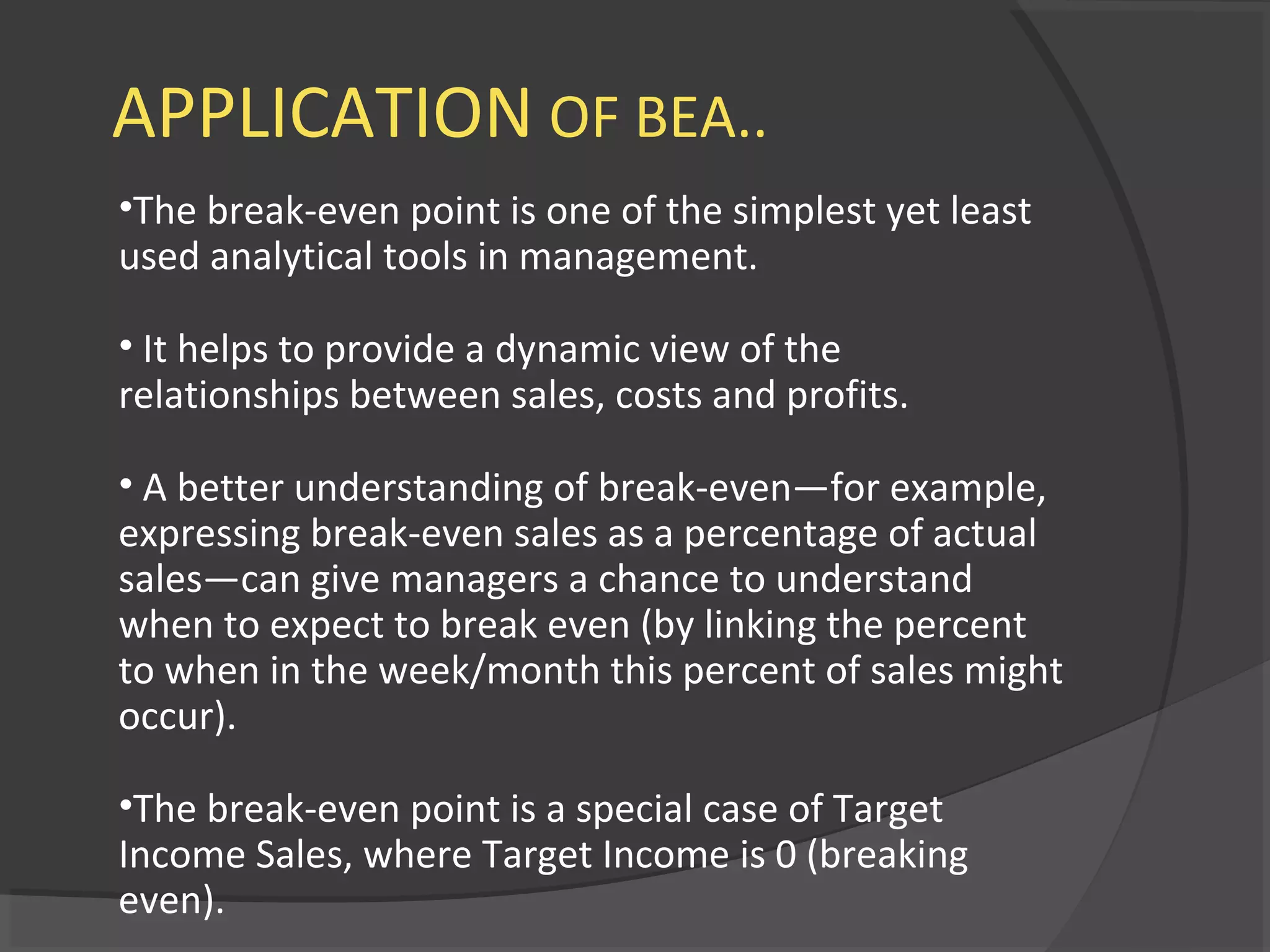
•The break-even point is one of the simplest yet least
used analytical tools in management.
• It helps to provide a dynamic view of the
relationships between sales, costs and profits.
• A better understanding of break-even—for example,
expressing break-even sales as a percentage of actual
sales—can give managers a chance to understand
when to expect to break even (by linking the percent
to when in the week/month this percent of sales might
occur).
•The break-even point is a special case of Target
Income Sales, where Target Income is 0 (breaking
even).
ASSUMPTION.
 The cost and revenue function are linear.
 The total cost is divided into fixed and
variable costs.
 The selling price is constant.
 The volume of sales and volume of
production are identical.
 Average and marginal productivity of
factors are constant.
 Factor price is constant..
• IT IS STATIC AND UNREALISTIC
• Break-even analysis is only a supply side (i.e. costs only)
analysis, as it tells you nothing about what sales are actually
likely to be for the product at these various prices.
• It assumes that fixed costs (FC) are constant
•It assumes that the quantity of goods produced is equal to
the quantity of goods sold (i.e., there is no change in the
quantity of goods held in inventory at the beginning of the
period and the quantity of goods held in inventory at the
end of the period).
..
ALGEBRAIC SOLUTION.
• Equate total revenue and total cost functions and solve for Q
 TR = P x Q
 TC = FC + (VC x Q)
 TR = TC
 P x Q = FC + VC x Q
 Q(P-VC)=FC
 Q=FC/(P-VC)
 BREAK EVEN SALES=FC*SALES/(SALES-VC)
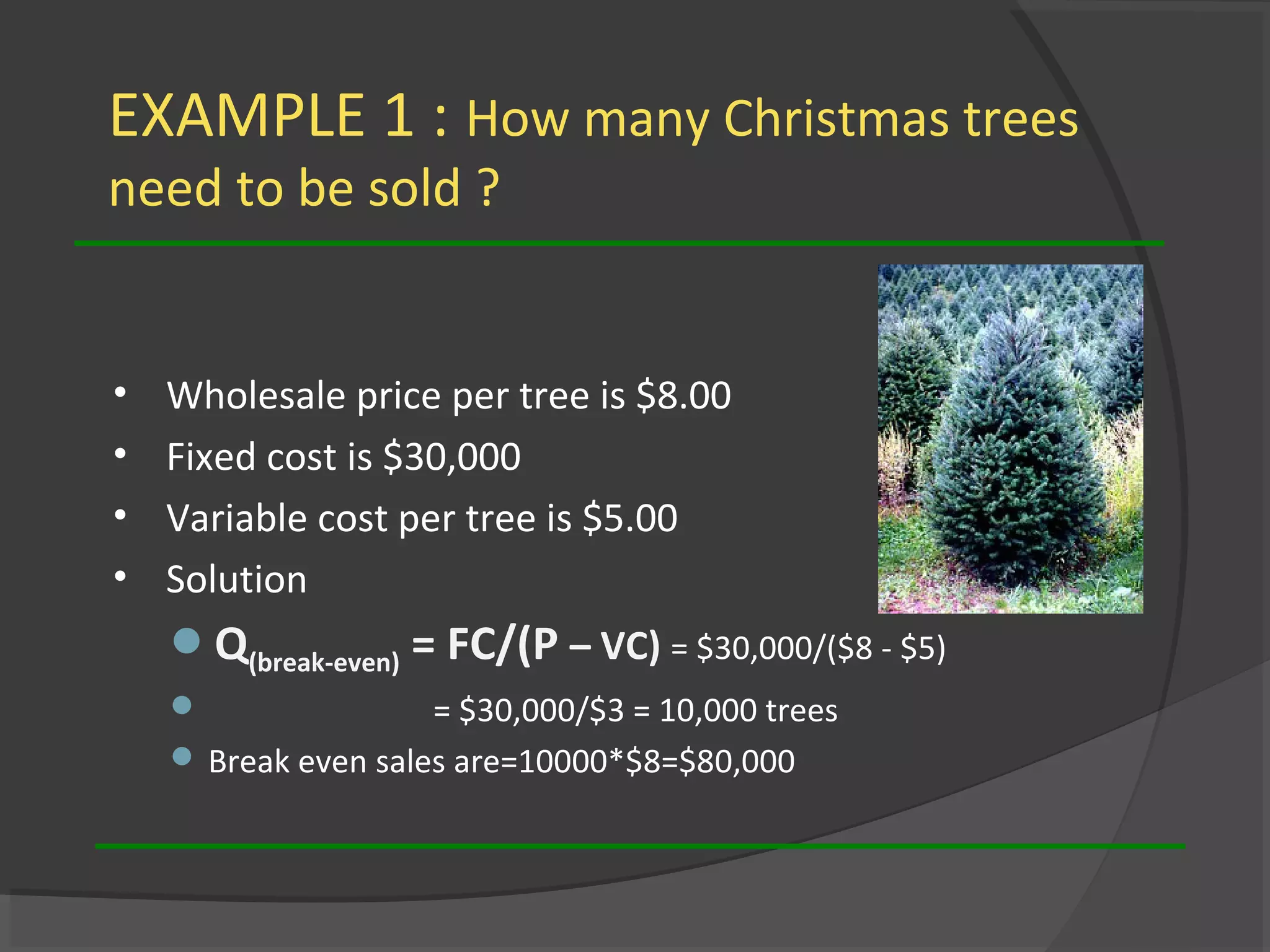
EXAMPLE 1 : How many Christmas trees
need to be sold ?
• Wholesale price per tree is $8.00
• Fixed cost is $30,000
• Variable cost per tree is $5.00
• Solution
Q(break-even) = FC/(P – VC) = $30,000/($8 - $5)
 = $30,000/$3 = 10,000 trees
 Break even sales are=10000*$8=$80,000
THANK YOU

Break even (2)

  • 1.
    BBREAKREAK VVENEN AANALYSNALYSIISSEE AAPPRESENTATRESENTATIIONON BBYY, RAVINDRA BABURAVINDRA BABU PGDM – 1PGDM – 1STST SEMSEM
  • 2.
    INTRODUCTION..  Break-even analysisis a useful tool to study the relationship between fixed costs, variable costs and returns.  Break even analysis gives the analysis of the Sales Volume where the Variable Costs and Fixed Costs of the Products are recovered.  You can use break-even analysis to determine how much product or service you need to sell at a specific price to meet all costs.
  • 3.
    INTRODUCTION.  Break-even analysisis a mathematical formula that discloses how much output must be sold for the business to break even.  Break-even is reached when the money coming in equals the money going out.
  • 4.
    BREAK EVEN POINT It may be defined as the level of sales at which the total revenue is equal to total costs and the net income is zero.  It is the point of activity where total revenue and total expenses are equal.  This is also known as “No Profit and No Loss” zone.  Breakeven Point = Fixed Costs/(Selling Price per unit - Variable Cost per unit)
  • 5.
    FIXED COST Cost thatdo not change when production or sales levels do change, such as rent, property tax, insurance, or interest expense. The fixed costs are summarized for a specific time period (generally one month). VARIABLE COST Variable costs are costs directly related to production units. Typical variable costs include direct labor and direct materials. The variable cost times the number of units sold will equal the Total Variable Cost. Total Variable costs plus Fixed costs make up the total cost of production.
  • 6.
    BREAK EVEN CHART In its simplest form, the break-even chart is a graphical representation of costs at various levels of activity shown on the same chart as the variation of income (or sales, revenue) with the same variation in activity. The point at which neither profit nor loss is made is known as the "break-even point" and is represented on the chart below by the intersection of the two lines  In the diagram , the line OA represents the variation of income at varying levels of production activity ("output"). OB represents the total fixed costs in the business. As output increases, variable costs are incurred, meaning that total costs (fixed + variable) also increase. At low levels of output, Costs are greater than Income. At the point of intersection, P, costs are exactly equal to income, and hence neither profit nor loss is made.
  • 7.
  • 8.
    COMPUTATION OF BREAKEVEN ANALYSIS In the linear Cost-Volume-Profit Analysis model , the break-even point (in terms of Unit Sales (X)) can be directly computed in terms of Total Revenue (TR) and Total Costs (TC) as: where: TFC is Total Fixed Costs, P is Unit Sale Price, and V is Unit Variable Cost
  • 9.
    LINEAR BREAK-EVEN ANALYSIS •Over small enough range of output levels, TR and TC may be linear, assuming : – Constant selling price (MR) – Constant marginal cost (MC) – Firm produces only one product – No time lags between investment and resulting revenue stream
  • 10.
    LINEAR BEA EQUATION ASSUME: TR=15Q, TFC=100, TVC=10Q. THAT IS, IN TERMS OF TR AND TC FUNCTIONS, TR = TC HENCE, TC=TFC+TVC 15Q = 100 + 10Q 5Q = 100 Q = 20 THUS, 20 IS THE BREAK-EVEN OUTPUT. GIVEN TR & TC FUNCTIONS, PRODUCTION BEYOND 20 UNITS WILL YIELD INCREASING PROFITS, (AT LEAST IN THE SHORT RUN).
  • 11.
    TR 700 OP. PROFIT TC 600 500 TVC 400 B C& R 300 200OP. LOSS 100 TFC 50 Q 10 20 30 40 output LINEAR GRAPHLINEAR GRAPH
  • 12.
    • The line TFC shows the total  fixed cost  and the line TVC shows the  variable cost. • The line TC can be obtained also by a vertical summation of TFC and  TVC at various levels of o/p.  • The line TR shows the total revenue (TR) obtained with Q o/p. • The line TR intersects the line TC at point b. the point b shows that at  Q, the firm’s total cost equals its total revenue. that is, at Q , TC breaks  even with tr. point b is, therefore, the break even point and Q is the  break-even level of o/p.  • Below  Q level of o/p, TC >TR. the vertical difference between TC and  TR, (i.e., TC-TR) is known as operating loss.  • Beyond Q, TR>TC, and TR- TC is known as operating profit.  • It may thus be inferred that a firm producing a commodity under cost  and revenue conditions mentioned above  must produce atleast  Q  units to make its total cost and total revenue break even.
  • 13.
  • 14.
     Initially afirm will incur fixed costs, these do not depend on output or sales.  As o/p is generated, the firm will incur variable costs – these vary directly with the amount produced  The total costs therefore (assuming accurate forecasts!) is the sum of FC+VC  Total revenue is determined by the price charged and the quantity sold – again this will be determined by expected forecast sales initially.  The lower the price, the less steep the total revenue curve.  The Break-even point occurs where total revenue equals total costs – the firm, in this example would have to sell Q1 to generate sufficient revenue to cover its costs.
  • 15.
    BREAK-EVEN ANALYSIS • Studyof interrelationships among a firm’s sales, costs, and operating profit at various levels of output • Break-even point is the Q where TR = TC (Q1 to Q2 on graph) TR TC Q $’s Profit Q1 Q2
  • 16.
    TC B2 TOTAL TR C &R BI F TFC 0 Q1 Q2 OUTPUT PER TIME UNIT BEA - NON LINEAR GRAPH
  • 17.
    • TFC lineshows the fixed cost and the vertical distance between TC and TFC measures the TVC. • The curve TR shows the total sale proceeds or the total revenue (TR) at different levels of o/p and price. • The vertical distance between the TR and TC measures the profit or loss for various levels of output . • TR and TC curves intersect each other at two points, b1 and b2, where TR = TC. these are the lower and upper break-even points. • For the whole range of O/P b/w OQ1 (corresponding to break-even point, b1) an OQ2 (corresponding to break-even point b2), TR>TC. It implies that a firm produces more than OQ1 and less than OQ2 will make profits. In other words, the profitable range of output lies between OQ1 and OQ2 units of output. Producing less or more then these limit will result in losses.
  • 18.
    BEP AND PRICING.. •Importance of Price Elasticity of Demand: • Higher prices might mean fewer sales to break- even but those sales may take a longer time to achieve. • Lower prices might encourage more customers but higher volume needed before sufficient revenue generated to break-even
  • 19.
    BEP AND PRICING.. Costs/Revenue Output/Sales FC VC TCTR(p = £2) Q1 TR (p = £1) Q3 If the firm chose to set prices lower (say £1) it would need to sell more units before covering its costs
  • 20.
    BEP AND PRICING. Costs/Revenue Output/Sales FC VC TC TR(p = Rs.2) Q1 TR (p = Rs.3) Q2 If the firm chose to set price higher than Rs.2 (say Rs.3) the TR curve would be steeper – they would not have to sell as many units to break even.
  • 21.
  • 22.
    BREAK-EVEN ANALYSIS Links ofBE to pricing strategies and elasticity • Penetration pricing – ‘high’ volume, ‘low’ price – more sales to break even • Market Skimming – ‘high’ price ‘low’ volumes – fewer sales to break even • Elasticity – what is likely to happen to sales when prices are increased or decreased?
  • 23.
    APPLICATION OF BEA.. •Thebreak-even point is one of the simplest yet least used analytical tools in management. • It helps to provide a dynamic view of the relationships between sales, costs and profits. • A better understanding of break-even—for example, expressing break-even sales as a percentage of actual sales—can give managers a chance to understand when to expect to break even (by linking the percent to when in the week/month this percent of sales might occur). •The break-even point is a special case of Target Income Sales, where Target Income is 0 (breaking even).
  • 24.
    ASSUMPTION.  The costand revenue function are linear.  The total cost is divided into fixed and variable costs.  The selling price is constant.  The volume of sales and volume of production are identical.  Average and marginal productivity of factors are constant.  Factor price is constant..
  • 25.
    • IT ISSTATIC AND UNREALISTIC • Break-even analysis is only a supply side (i.e. costs only) analysis, as it tells you nothing about what sales are actually likely to be for the product at these various prices. • It assumes that fixed costs (FC) are constant •It assumes that the quantity of goods produced is equal to the quantity of goods sold (i.e., there is no change in the quantity of goods held in inventory at the beginning of the period and the quantity of goods held in inventory at the end of the period). ..
  • 26.
    ALGEBRAIC SOLUTION. • Equatetotal revenue and total cost functions and solve for Q  TR = P x Q  TC = FC + (VC x Q)  TR = TC  P x Q = FC + VC x Q  Q(P-VC)=FC  Q=FC/(P-VC)  BREAK EVEN SALES=FC*SALES/(SALES-VC)
  • 27.
    EXAMPLE 1 :How many Christmas trees need to be sold ? • Wholesale price per tree is $8.00 • Fixed cost is $30,000 • Variable cost per tree is $5.00 • Solution Q(break-even) = FC/(P – VC) = $30,000/($8 - $5)  = $30,000/$3 = 10,000 trees  Break even sales are=10000*$8=$80,000
  • 28.