BREADMAKING
"Let me live upon bread and barley of white
my ale made of grain red“
History of breadmaking
Brief history of breadmaking
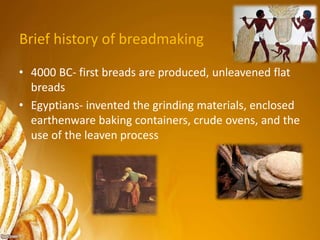
• 4000 BC- first breads are produced, unleavened flat
breads
• Egyptians- invented the grinding materials, enclosed
earthenware baking containers, crude ovens, and the
use of the leaven process
Brief history of baking
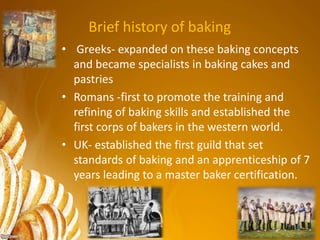
• Greeks- expanded on these baking concepts
and became specialists in baking cakes and
pastries
• Romans -first to promote the training and
refining of baking skills and established the
first corps of bakers in the western world.
• UK- established the first guild that set
standards of baking and an apprenticeship of 7
years leading to a master baker certification.
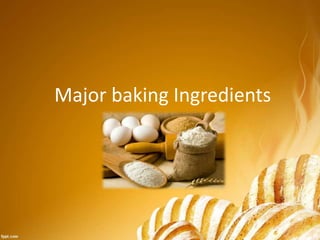
Major baking Ingredients
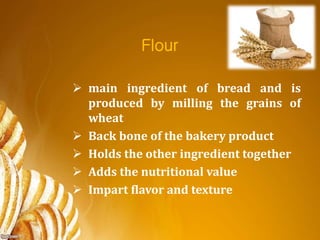
Flour
 main ingredient of bread and is
produced by milling the grains of
wheat
 Back bone of the bakery product
 Holds the other ingredient together
 Adds the nutritional value
 Impart flavor and texture
Water
 Hydrate the flour
 Activates the yeast
 Helps develop the gluten, to permit
swelling of the starch and provide a
medium for the various reaction to take
place
Salt (2% w/w)
 Helps control the yeast activity-
stabilize yeast fermentation
 Improves the taste
 Controls the production of unwanted
acids in dough
 Participates in the lipid binding of the
dough
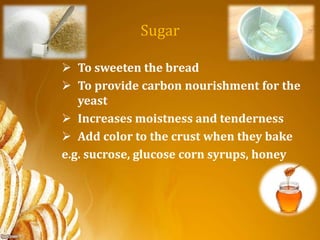
Sugar
 To sweeten the bread
 To provide carbon nourishment for the
yeast
 Increases moistness and tenderness
 Add color to the crust when they bake
e.g. sucrose, glucose corn syrups, honey
Fats (3% w/w)
 Fat acts as a tenderizer, adds volume,
structure, flakiness, flavor and color
 It also plays a role in heat transfer
 It adds resistance to staling
 In some cases they act as a leavening
agent
 Enhanced slicing properties
E.g. Butter, lard, vegetable oils
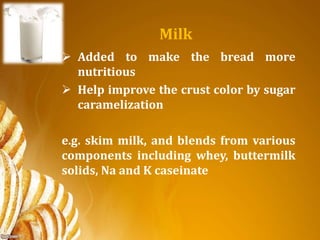
Milk
 Added to make the bread more
nutritious
 Help improve the crust color by sugar
caramelization
e.g. skim milk, and blends from various
components including whey, buttermilk
solids, Na and K caseinate
Leavening agents
• Leavening- is the production of gases in
baked goods which increases volume
leaveners can be divided into 3 categories:
 Physical
 Chemical
 biological- using yeast to leaven the
bread
Yeast
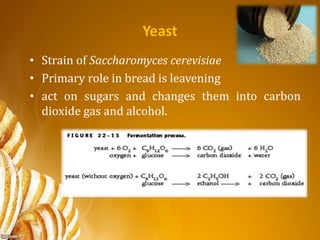
• Strain of Saccharomyces cerevisiae
• Primary role in bread is leavening
• act on sugars and changes them into carbon
dioxide gas and alcohol.
Factors that affect the leavening action of yeast
1. The nature of the sugar available
- glucose is the preferred substrate for
yeast
-when no sugar added in the dough, the
yeast will utilize the maltose in the flour
-Maltose is produced by the action of
amylases on the wheat
Factors that affect the leavening action of yeast
2. Osmotic pressure
-high osmotic pressure inhibit yeast action
 5% sugar –baker’s yeast produce CO2 more
rapidly
 More than 2% salt- inhibitory to yeast, so salt
is added late in the dough fermentation
process
Factors that affect the leavening action of yeast
3. Effect of nitrogen and other nutrients
-short fermentation requires no nutrients
-longer fermentations, the addition of
minerals and nitrogen source increases gas
production.
E.g. Ammonium, amino acids and thiamine
from flour
Factors that affect the leavening action of yeast
4. Effect of fungal inhibitors (anti-
mycotic agents)
-anti-mycotics added are inhibitory to
yeasts
-0.19% (based on flour weight) of
calcium propionate (widely used anti-
mycotic)
Factors that affect the leavening action of yeast
5. Yeast concentration
- yeast weight for baking rarely exceeds 3%
flour weight
-provided that enough sugar is added, the
higher the yeast concentration, the more
rapid is the leavening
Principal enzyme present in yeast:
a. Invertase- changes sucrose into an invert sugar
which is directly fermentable by yeast.
b. Maltase- changes the malt sugar, or maltose,
present in malt syrup and the traces of malt sugar
present in flour and other ingredients into dextrose.
c. Zymase- acts upon invert sugar and dextrose and
convert them into carbon dioxide gas, which causes
the dough to rise and expand.
Forms and class of yeasts
 Active yeasts include -porous and free
flowing
• Baker’s yeast
• Brewer’s yeast
• Yeasts for alcoholic beverages
 Inactive yeasts, such as:
• Dried brewer’s yeast
• Primary- grown yeasts
Yeast
Dry (active) yeasts – most available type of yeast
- stored at room temp. but keeps longer when
refrigerated / frozen
- Water warmed to 115 F(46°C) is ideal for
rehydrating and activating dry yeast
-Once hydrated it should not be exposed to temp.
below 100 F(38°C) w/c lower its activity and
result in a sticky dough.
Bread making processes
1. Pre-fermentation(sponge mixing)
-a portion of the ingredient is mixed with a yeast,
with or w/o flour to produce an inoculum
- The yeast becomes adaptive to the growth
conditions of the dough and rapidly multiplies.
Bread making processes
2. Dough mixing
- rest of the ingredients are mixed together
with the inoculum to form the dough
-stage when maximum gluten development is
sought
Bread making processes
3.Cutting and rounding- the dough formed are cut
into specific weights and rounded by machines
4. Molding –dough is flattened to a sheet then
molded into circles and placed in baking pan
Bread making processes
5. First(intermediate) proofing- the dough is
allowed to rest about 15 min. at about 27°C.
-done in overhead proofer
6. Second proofing- consists of holding the dough
for about 1 hour at 35-43°C and in an
atmosphere of high humidity
Bread making processes
7.Baking- the final step in bread making
process in which the dough piece is
transformed into a light readily digestible and
flavorful product under the influence of heat.
-subjected to average temperature of 215-225
°C for 17-23 min.
8. Cooling, slicing, wrapping- bread is de-
panned cooled and packed
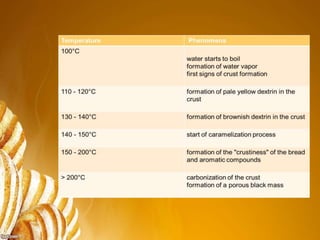
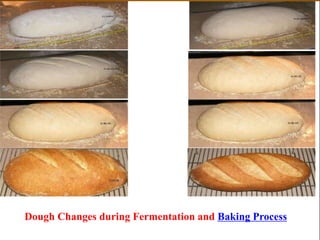
Dough Changes during Fermentation and Baking Process
References
• Okafor Ndoka.Fermented Foods and their
processing.Biotechnology. Volume III
• Brown,A.2011. Understanding Food:
Preparation and Principle.Philippine
ed.Cengage Learning Asia Pte.Ltd
The end

bread-template.pptx

  • 1.
  • 2.
    "Let me liveupon bread and barley of white my ale made of grain red“ History of breadmaking
  • 3.
    Brief history ofbreadmaking • 4000 BC- first breads are produced, unleavened flat breads • Egyptians- invented the grinding materials, enclosed earthenware baking containers, crude ovens, and the use of the leaven process
  • 4.
    Brief history ofbaking • Greeks- expanded on these baking concepts and became specialists in baking cakes and pastries • Romans -first to promote the training and refining of baking skills and established the first corps of bakers in the western world. • UK- established the first guild that set standards of baking and an apprenticeship of 7 years leading to a master baker certification.
  • 5.
  • 6.
    Flour  main ingredientof bread and is produced by milling the grains of wheat  Back bone of the bakery product  Holds the other ingredient together  Adds the nutritional value  Impart flavor and texture
  • 7.
    Water  Hydrate theflour  Activates the yeast  Helps develop the gluten, to permit swelling of the starch and provide a medium for the various reaction to take place
  • 8.
    Salt (2% w/w) Helps control the yeast activity- stabilize yeast fermentation  Improves the taste  Controls the production of unwanted acids in dough  Participates in the lipid binding of the dough
  • 9.
    Sugar  To sweetenthe bread  To provide carbon nourishment for the yeast  Increases moistness and tenderness  Add color to the crust when they bake e.g. sucrose, glucose corn syrups, honey
  • 10.
    Fats (3% w/w) Fat acts as a tenderizer, adds volume, structure, flakiness, flavor and color  It also plays a role in heat transfer  It adds resistance to staling  In some cases they act as a leavening agent  Enhanced slicing properties E.g. Butter, lard, vegetable oils
  • 11.
    Milk  Added tomake the bread more nutritious  Help improve the crust color by sugar caramelization e.g. skim milk, and blends from various components including whey, buttermilk solids, Na and K caseinate
  • 12.
    Leavening agents • Leavening-is the production of gases in baked goods which increases volume leaveners can be divided into 3 categories:  Physical  Chemical  biological- using yeast to leaven the bread
  • 13.
    Yeast • Strain ofSaccharomyces cerevisiae • Primary role in bread is leavening • act on sugars and changes them into carbon dioxide gas and alcohol.
  • 14.
    Factors that affectthe leavening action of yeast 1. The nature of the sugar available - glucose is the preferred substrate for yeast -when no sugar added in the dough, the yeast will utilize the maltose in the flour -Maltose is produced by the action of amylases on the wheat
  • 15.
    Factors that affectthe leavening action of yeast 2. Osmotic pressure -high osmotic pressure inhibit yeast action  5% sugar –baker’s yeast produce CO2 more rapidly  More than 2% salt- inhibitory to yeast, so salt is added late in the dough fermentation process
  • 16.
    Factors that affectthe leavening action of yeast 3. Effect of nitrogen and other nutrients -short fermentation requires no nutrients -longer fermentations, the addition of minerals and nitrogen source increases gas production. E.g. Ammonium, amino acids and thiamine from flour
  • 17.
    Factors that affectthe leavening action of yeast 4. Effect of fungal inhibitors (anti- mycotic agents) -anti-mycotics added are inhibitory to yeasts -0.19% (based on flour weight) of calcium propionate (widely used anti- mycotic)
  • 18.
    Factors that affectthe leavening action of yeast 5. Yeast concentration - yeast weight for baking rarely exceeds 3% flour weight -provided that enough sugar is added, the higher the yeast concentration, the more rapid is the leavening
  • 19.
    Principal enzyme presentin yeast: a. Invertase- changes sucrose into an invert sugar which is directly fermentable by yeast. b. Maltase- changes the malt sugar, or maltose, present in malt syrup and the traces of malt sugar present in flour and other ingredients into dextrose. c. Zymase- acts upon invert sugar and dextrose and convert them into carbon dioxide gas, which causes the dough to rise and expand.
  • 20.
    Forms and classof yeasts  Active yeasts include -porous and free flowing • Baker’s yeast • Brewer’s yeast • Yeasts for alcoholic beverages  Inactive yeasts, such as: • Dried brewer’s yeast • Primary- grown yeasts
  • 21.
    Yeast Dry (active) yeasts– most available type of yeast - stored at room temp. but keeps longer when refrigerated / frozen - Water warmed to 115 F(46°C) is ideal for rehydrating and activating dry yeast -Once hydrated it should not be exposed to temp. below 100 F(38°C) w/c lower its activity and result in a sticky dough.
  • 22.
    Bread making processes 1.Pre-fermentation(sponge mixing) -a portion of the ingredient is mixed with a yeast, with or w/o flour to produce an inoculum - The yeast becomes adaptive to the growth conditions of the dough and rapidly multiplies.
  • 23.
    Bread making processes 2.Dough mixing - rest of the ingredients are mixed together with the inoculum to form the dough -stage when maximum gluten development is sought
  • 24.
    Bread making processes 3.Cuttingand rounding- the dough formed are cut into specific weights and rounded by machines 4. Molding –dough is flattened to a sheet then molded into circles and placed in baking pan
  • 25.
    Bread making processes 5.First(intermediate) proofing- the dough is allowed to rest about 15 min. at about 27°C. -done in overhead proofer 6. Second proofing- consists of holding the dough for about 1 hour at 35-43°C and in an atmosphere of high humidity
  • 26.
    Bread making processes 7.Baking-the final step in bread making process in which the dough piece is transformed into a light readily digestible and flavorful product under the influence of heat. -subjected to average temperature of 215-225 °C for 17-23 min. 8. Cooling, slicing, wrapping- bread is de- panned cooled and packed
  • 28.
    Dough Changes duringFermentation and Baking Process
  • 29.
    References • Okafor Ndoka.FermentedFoods and their processing.Biotechnology. Volume III • Brown,A.2011. Understanding Food: Preparation and Principle.Philippine ed.Cengage Learning Asia Pte.Ltd
  • 30.

Editor's Notes

  • #4 The history of bread goes back at least 30,000 years. 
  • #7 For bread baking, the flour should be a wheat flour which is high in gluten(protein) as this is the substance that gives bread its fine texture and supports the ingredients during rising. There are many types of flours with different characteristics, they give the baked product different flavors and textures
  • #8 Combines all the dry ingredient together
  • #9 It has a retarding effect on fermentation so it is added at the end of the mixing process. Small amounts of salt are added to flour mixtures for: Too much salt inhibits yeast activity, reducing the amount of carbon dioxide gas produced and decreasing the volume of the loaf. Certain baked recipes have more sugar in the formula, so salt helps cut down the excessive sweetness
  • #10 Sugars also create tenderness because they weaken gluten structure Browning thru sugar caramelization of the crust Sugar is supplied by the use of include white granulated sugar, icing sugar, brown sugars, corn syrup and honey
  • #11 Coat gluten to keep it from becoming over developed Example are butter, lard, vegetableoils
  • #27 Within this baking process the natural structures of the major dough constituents are altered irreversibly by a series of physical, chemical and biochemical interactions.