A pioneer interactive proposal in brazilian graphic design education
                                    Ana Beatriz Pereira de Andrade

                                 DSc in Social Psychology (in course) – UERJ
                                 (Universidade do Estado do Rio de Janeiro)
                               MSc in Communication and Culture – ECO/UFRJ
                    (Escola de Comunicação / Universidade Federal do Rio de Janeiro)
                 Teacher and Head Master in Graphic Design and Visual Arts – IPU/UNESA
                      (Instituto Politécnico Universitário / Universidade Estácio de Sá)


Abstract

We present the structure of a pioneer and specific course in graphic design, which includes interaction
between subjects. Design history and brazilian law system are mentioned. The intention is to expose
concept, project method, objectives and activities that are responsible for the identity of the course.

Key words

Graphic Design Education, Interaction of Subjects, Continuous Studies

1. Graphic Design Education in Brazil and Our Specific Purpose

In Brazil, Design Education formal starter in 60´s at ESDI – Escola Superior de Desenho Industrial,
affiliated to the Rio de Janeiro state University – UERJ (Universidade do Estado do Rio de Janeiro).
The major ideas to compose the first structure came from two different origins.            In one side the
thoughts of Alexandre Wollner, from Ulm School, and, on the other hand, from Aloisio Magalhães - a
self made designer.
As Wollner, Karl Bergmiller and Max Bill, both from Ulm School, were very important to establish the
initial concepts and its adaptation for the brazilian reality, like local industries and demands. Aloisio
Magalhães, working with them, founded an specific Design office named PVDI. Aloisio used his
personal contacts with institutions and governmental agencies to difund our graphic design results.
Also, he participated of many international meetings showing students and professional works.
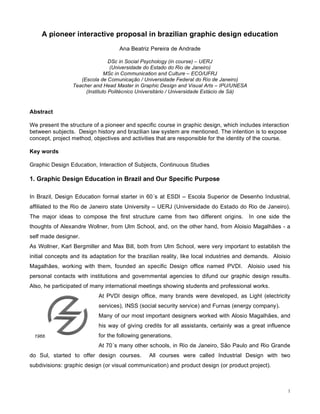
                           At PVDI design office, many brands were developed, as Light (electricity
                           services), INSS (social security service) and Furnas (energy company).
                           Many of our most important designers worked with Alosio Magalhães, and
                           his way of giving credits for all assistants, certainly was a great influence
 1966                      for the following generations.
                           At 70´s many other schools, in Rio de Janeiro, São Paulo and Rio Grande
do Sul, started to offer design courses.        All courses were called Industrial Design with two
subdivisions: graphic design (or visual communication) and product design (or product project).


                                                                                                         1
Till today, Design in Brazil is not legally recognized as a formal activity, so in our legal system we are
not allowed to have a structure of a council. On its origins, many professional associations had start
and finish. Nowadays, we can verify some regional and national initiatives to integrate Design and
Industry. Also, academic and professional communities are always trying to upgrade recognition of
Design activities.
The point is that after computer graphics possibilities, many other related activities started to be
named as Design.      Architects, for example, when working with interiors are here called interior
designers. Fashion stylists are called fashion designers, even scene directors are called designers.
It seems that, in Brazil, the specific design education, as its origins all around the world, have lost a
little of its identity. Although, to be important to mention that we promote some scientific meetings and
have publications, and also, a permanent concern about research and with the criteria to Master and
PhD courses. We recently conquered a specific representation in governmental agencies – CAPES
and CNPq – that provide founds for academic research and researchers.
The Ministério da Educação – MEC, brazilian Minister of education, register, in all the country, 318
four- year courses using the term Design and 46 named Industrial Design.
A specific law, called LDB (number 9394, recent version of 1996), authorized a new possibility for
educational system in general. It means an offer of a course shorter than a four year regular under
graduation.
So, in 1998, Universidade Estácio de Sá, a private University, founded the Instituto Politécnico
Universitário, where professors had the opportunity to purpose new courses. Based in accessibility,
efficacy and employment, the IPU offer 84 undergraduate courses, in very specific fields, with low
prices and shorter time than traditional under graduation (2 ½ years).
A group of professors identify that Graphic Design could be considered as a specific field of work, and
that we could contribute for the education in design.
In January, 1999, starts the Design Graphic Course of the Instituto Politécnico Universitário composed
by a specific academic structure based on a document elaborated by Specialists Design Commission
(DSc. Rita Couto, DSc. Gustavo Bomfim and DSc. Vicente Cauduro). Its document purposes that
subjects can be separated in 4 groups: history and theory; graphic planning and project; usability and
production. We introduced an extra group related with design management.


2. Formal Structure

The course is offered in two different neighborhoods in Rio de Janeiro (campus Centro I and campus
Barra V): in the morning – between 7 and 12 am – and at night – between 7 and 11 pm.


                                                                                                         2
Thus, the academic structure is based on 5 groups of subjects: visual language (4 credits); graphic
project and production (11 credits); image and computer graphics (11 credits); management and law
studies (4 credits) and essential theories (12 credits).
The 42 credits are distributed in 5 terms. In each one we purpose integrated projects joining the
contents of the specific term and the former one. The subjects are pre-established in each of the
terms. In periodic meetings among teachers, we exchange experiences and ideas of integrated
projects for each term. The first exams are composed by theoretical tests and practical ones, and for
the second the projects join principles of many of the subjects.
For the beginning, are 9 subjects: two of visual language and drawing; three of art, gestalt and
communication theory; typography; photography; graphic expression and materials; bases of
computer graphics. The main purpose is to develop graphic and visual expression. At the end of this
first term, the students develop a poster and a flyer, examinated for each professor considered
specific skills. The contents must consider a social concern as violence, health, childhood, among
many other possibilities. In theory, we ask students to find institutions and other kind of groups that
can provide real information about the situation choose, and also is been requested a visual research
and analyses. They should present the results and explain technical, graphic
options and the conceptual intentions.
In the second term, they start to learn desktop publishing, where the main
project is about brand visual system. We purpose the real experience of finding
a small business – can be informal – which should be visited regularly. All
knowledge from the first term are considered.
The following project is devoted to books and magazines design. In computer
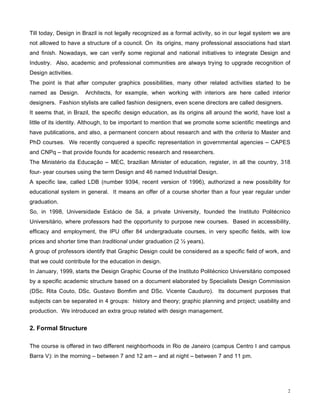
graphics they are also learning multimedia and animation. We also push them to      Project developed
                                                                                    with students of
                            real situations and social concerns.                    Fashion Course.
                            The last two terms allow them the possibility to
                            choose their own interests, and develop more complex projects. At the end,
                            they have a subject dedicated to organize a portfolio and a formal
                            curriculum.


                            3. Creators and Creatures

                            The group of professors is mostly graduated at the Pontifícia Universidade
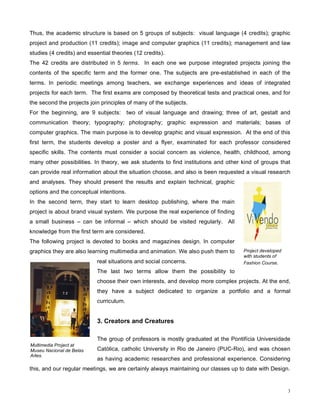
Multimedia Project at
Museu Nacional de Belas     Católica, catholic University in Rio de Janeiro (PUC-Rio), and was chosen
Artes.
                            as having academic researches and professional experience. Considering
this, and our regular meetings, we are certainly always maintaining our classes up to date with Design.


                                                                                                        3
Eighty percent of the group is formed by graphic designers and we have a significant number of
Masters and PhD in Design (2 PhD and 8 Masters). It’s relevant to mention that in Brazil we only have
one Master and PhD program offered at PUC-Rio.
We are a group of 38 teachers and each of us is responsible for two subjects at least. It means that
even in a private university structure, that in Brazil don’t offer employment guarantees, during those 7
years, we built a kind of identity to this specific course.
Our group of students is very heterogeneous. Some already works on the field, generally in clerical
positions in the graphic industry, but we receive also people without previous knowledge, looking for a
free-lance activity.
                       So far, we have already graduated around 600 graphic designers. Eighty percent of
                       these are already working in the field:    some have started their own business,
                       some are in free-lance activity, and others have achieved better positions at
                       companies, and these are the clerks mentioned above.
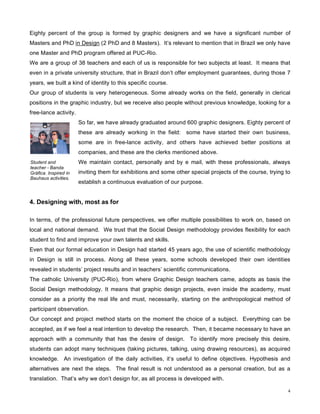
Student and            We maintain contact, personally and by e mail, with these professionals, always
teacher - Banda
Gráfica. Inspired in   inviting them for exhibitions and some other special projects of the course, trying to
Bauhaus activities.
                       establish a continuous evaluation of our purpose.


4. Designing with, most as for

In terms, of the professional future perspectives, we offer multiple possibilities to work on, based on
local and national demand. We trust that the Social Design methodology provides flexibility for each
student to find and improve your own talents and skills.
Even that our formal education in Design had started 45 years ago, the use of scientific methodology
in Design is still in process. Along all these years, some schools developed their own identities
revealed in students’ project results and in teachers’ scientific communications.
The catholic University (PUC-Rio), from where Graphic Design teachers came, adopts as basis the
Social Design methodology. It means that graphic design projects, even inside the academy, must
consider as a priority the real life and must, necessarily, starting on the anthropological method of
participant observation.
Our concept and project method starts on the moment the choice of a subject. Everything can be
accepted, as if we feel a real intention to develop the research. Then, it became necessary to have an
approach with a community that has the desire of design. To identify more precisely this desire,
students can adopt many techniques (taking pictures, talking, using drawing resources), as acquired
knowledge. An investigation of the daily activities, it’s useful to define objectives. Hypothesis and
alternatives are next the steps. The final result is not understood as a personal creation, but as a
translation. That’s why we don’t design for, as all process is developed with.

                                                                                                            4
5. Interactions

The methodology adopted gives importance to desire and dream. In a certain way, we believe that we
are offering a possibility for each of students to build their own identity as a graphic designer. A
professional with abilities and capacities to find opportunities and develop them, as projects, in a
creative way.
Even considering the hard structure of the course, we purpose a intense immersion in Graphic Design
along the 2 years duration. So, other activities for the week ends are organized. Can be marked:
   a. Graphic Design Experimental Office
       On Saturdays, a group of voluntary students, supervised by a professor,
       develop graphic projects for the University.      It’s a way to improve
       professional responsibilities.
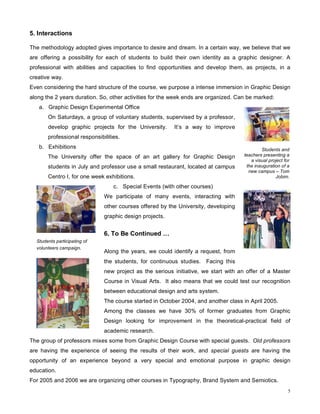
   b. Exhibitions                                                                           Students and
       The University offer the space of an art gallery for Graphic Design          teachers presenting a
                                                                                       a visual project for
       students in July and professor use a small restaurant, located at campus      the inauguration of a
                                                                                      new campus – Tom
       Centro I, for one week exhibitions.                                                         Jobim.

                                  c. Special Events (with other courses)
                              We participate of many events, interacting with
                              other courses offered by the University, developing
                              graphic design projects.


                              6. To Be Continued …
  Students participating of
  volunteers campaign.
                              Along the years, we could identify a request, from
                              the students, for continuous studies. Facing this
                              new project as the serious initiative, we start with an offer of a Master
                              Course in Visual Arts. It also means that we could test our recognition
                              between educational design and arts system.
                              The course started in October 2004, and another class in April 2005.
                              Among the classes we have 30% of former graduates from Graphic
                              Design looking for improvement in the theoretical-practical field of
                              academic research.
The group of professors mixes some from Graphic Design Course with special guests. Old professors
are having the experience of seeing the results of their work, and special guests are having the
opportunity of an experience beyond a very special and emotional purpose in graphic design
education.
For 2005 and 2006 we are organizing other courses in Typography, Brand System and Semiotics.
                                                                                                          5
7. Referencies

ABC da ADG. Glossário de termos e verbetes utilizados em design gráfico. São Paulo: ADG, 2000.

AZEVEDO, Wilton. Os signos do design. São Paulo: Global, 1998.

BAER, Lorenzo. Produção Gráfica. São Paulo; SENAC, 1999.

BOMFIM, Gustavo A. Idéias e formas na história do design: uma investigação estética. João Pessoa: Editora
      Universitária UFPB, 1998.

CASTELO BRANCO, Renato et alli. (org.). História da Propaganda no Brasil. São Paulo: TA Queiroz, 1990.

COUTO, Rita et alli. Formas do Design: por uma metodologia interdisciplinar. Rio de Janeiro: 2Ab/PUC-Rio, 1999.

DENIS, Rafael Cardoso. Uma introdução à história do design. São Paulo: Edgard Blücher, 2000.

DIAS PINO, Wlademir e FELÍCIO DOS SANTOS, João. A marca e o logotipo brasileiros. Guanabara: Rio Velho, 1974.

DONDIS, Donis. Sintaxe da Linguagem Visual. São Paulo: Martins Fontes, 1997.

ESCOREL, Ana Luiza. O efeito multiplicador do design. São Paulo: SENAC, 2000.

FARIAS, Priscila. Tipografia digital: o impacto das novas tecnologias. Rio de Janeiro: 2Ab, 1998.

FERLAUTO, Cláudio. A gráfica do livro / o livro da gráfica. São Paulo: Hamburg Gráfica Editora, 2002.

FONTENELLE, Isleide A. O Nome da Marca: Mc Donald´s, fetichismo e cultura descartável. São Paulo: Boitempo,
      2002.

GOMES FILHO, João. Gestalt do Objeto: sistema de leitura visual da forma. São Paulo: Escrituras, 2000.

HURLBURT, Alan. Layout: o design da página impressa. São Paulo: Nobel, 1989.

KIT PRÁTICA PROFISSIONAL. Associação dos Designers Gráficos. São Paulo, 1998.

LEITE, João de Souza et alli (org.). A Herança do Olhar: o Design de Aloisio Magalhães. São Paulo: SENAC, 2003.

MUNARI, Bruno. Das coisas nascem coisas. Lisboa: Edições 70, 1981.
_____________. Design e Comunicação Visual. São Paulo Martins Fontes, 1968.

NETO, Mário Carramilo. Produção Gráfica II. São Paulo: Global, 1997.

NIEMEYER, Lucy. Design no Brasil: origens e instalação. Rio de Janeiro: 2Ab, 1997.

OSTROWER, Fayga. A sensibilidade do intelecto. Rio de Janeiro: Campus, 1998.
______________. Universos da Arte. Rio de Janeiro: Campus, 1991.

PEDROSA, Israel. Da cor à cor inexistente. Rio de Janeiro: Leo Christiano Editorial, 2002.

PEON, Maria Luisa. Sistemas de identidade visual. Rio de Janeiro: 2Ab, 2000.

PETIT, Francesc. Marca e meus personagens. São Paulo: Futura, 2004.

RIBEIRO, Milton. Planejamento Gráfico Visual. Brasília: Linha Gráfica Editora, 1987.

ROCHA, Carlos Souza. Plasticidade do papel e design. Lisboa: Plátamo, 2000.

SOUZA, Pedro L. P. ESDI: biografia de uma idéia. Rio de Janeiro: EdUERJ, 1996.

STRUNCK, Gilberto. Identidade visual: a direção do olhar. Rio de Janeiro: Europa, 1989.
________________. Marca Registrada. Rio de Janeiro: Rio de Janeiro: Europa, 1996.
_______________. Viver de Design. Rio de Janeiro: 2Ab, 1999.
_______________. Como criar identidades visuais para marcas de sucesso. Rio de Janeiro: Rio Books, 2001.

                                                                                                                  6
VILLAS BOAS, André. Utopia e disciplina. Rio de Janeiro: 2Ab, 1998.
________________. O que é e o que nunca foi design gráfico. Ri ode Janeiro: 2Ab, 2001.

WICK , Rainer. Pedagogia da Bauhaus. São Paulo: Martins Fontes, 1998.


http://www. mec.gov.br


                                                                                         7

A Pioneer Interactive Propose in Brazilian Graphic Design Education

  • 1.
    A pioneer interactiveproposal in brazilian graphic design education Ana Beatriz Pereira de Andrade DSc in Social Psychology (in course) – UERJ (Universidade do Estado do Rio de Janeiro) MSc in Communication and Culture – ECO/UFRJ (Escola de Comunicação / Universidade Federal do Rio de Janeiro) Teacher and Head Master in Graphic Design and Visual Arts – IPU/UNESA (Instituto Politécnico Universitário / Universidade Estácio de Sá) Abstract We present the structure of a pioneer and specific course in graphic design, which includes interaction between subjects. Design history and brazilian law system are mentioned. The intention is to expose concept, project method, objectives and activities that are responsible for the identity of the course. Key words Graphic Design Education, Interaction of Subjects, Continuous Studies 1. Graphic Design Education in Brazil and Our Specific Purpose In Brazil, Design Education formal starter in 60´s at ESDI – Escola Superior de Desenho Industrial, affiliated to the Rio de Janeiro state University – UERJ (Universidade do Estado do Rio de Janeiro). The major ideas to compose the first structure came from two different origins. In one side the thoughts of Alexandre Wollner, from Ulm School, and, on the other hand, from Aloisio Magalhães - a self made designer. As Wollner, Karl Bergmiller and Max Bill, both from Ulm School, were very important to establish the initial concepts and its adaptation for the brazilian reality, like local industries and demands. Aloisio Magalhães, working with them, founded an specific Design office named PVDI. Aloisio used his personal contacts with institutions and governmental agencies to difund our graphic design results. Also, he participated of many international meetings showing students and professional works. At PVDI design office, many brands were developed, as Light (electricity services), INSS (social security service) and Furnas (energy company). Many of our most important designers worked with Alosio Magalhães, and his way of giving credits for all assistants, certainly was a great influence 1966 for the following generations. At 70´s many other schools, in Rio de Janeiro, São Paulo and Rio Grande do Sul, started to offer design courses. All courses were called Industrial Design with two subdivisions: graphic design (or visual communication) and product design (or product project). 1
  • 2.
    Till today, Designin Brazil is not legally recognized as a formal activity, so in our legal system we are not allowed to have a structure of a council. On its origins, many professional associations had start and finish. Nowadays, we can verify some regional and national initiatives to integrate Design and Industry. Also, academic and professional communities are always trying to upgrade recognition of Design activities. The point is that after computer graphics possibilities, many other related activities started to be named as Design. Architects, for example, when working with interiors are here called interior designers. Fashion stylists are called fashion designers, even scene directors are called designers. It seems that, in Brazil, the specific design education, as its origins all around the world, have lost a little of its identity. Although, to be important to mention that we promote some scientific meetings and have publications, and also, a permanent concern about research and with the criteria to Master and PhD courses. We recently conquered a specific representation in governmental agencies – CAPES and CNPq – that provide founds for academic research and researchers. The Ministério da Educação – MEC, brazilian Minister of education, register, in all the country, 318 four- year courses using the term Design and 46 named Industrial Design. A specific law, called LDB (number 9394, recent version of 1996), authorized a new possibility for educational system in general. It means an offer of a course shorter than a four year regular under graduation. So, in 1998, Universidade Estácio de Sá, a private University, founded the Instituto Politécnico Universitário, where professors had the opportunity to purpose new courses. Based in accessibility, efficacy and employment, the IPU offer 84 undergraduate courses, in very specific fields, with low prices and shorter time than traditional under graduation (2 ½ years). A group of professors identify that Graphic Design could be considered as a specific field of work, and that we could contribute for the education in design. In January, 1999, starts the Design Graphic Course of the Instituto Politécnico Universitário composed by a specific academic structure based on a document elaborated by Specialists Design Commission (DSc. Rita Couto, DSc. Gustavo Bomfim and DSc. Vicente Cauduro). Its document purposes that subjects can be separated in 4 groups: history and theory; graphic planning and project; usability and production. We introduced an extra group related with design management. 2. Formal Structure The course is offered in two different neighborhoods in Rio de Janeiro (campus Centro I and campus Barra V): in the morning – between 7 and 12 am – and at night – between 7 and 11 pm. 2
  • 3.
    Thus, the academicstructure is based on 5 groups of subjects: visual language (4 credits); graphic project and production (11 credits); image and computer graphics (11 credits); management and law studies (4 credits) and essential theories (12 credits). The 42 credits are distributed in 5 terms. In each one we purpose integrated projects joining the contents of the specific term and the former one. The subjects are pre-established in each of the terms. In periodic meetings among teachers, we exchange experiences and ideas of integrated projects for each term. The first exams are composed by theoretical tests and practical ones, and for the second the projects join principles of many of the subjects. For the beginning, are 9 subjects: two of visual language and drawing; three of art, gestalt and communication theory; typography; photography; graphic expression and materials; bases of computer graphics. The main purpose is to develop graphic and visual expression. At the end of this first term, the students develop a poster and a flyer, examinated for each professor considered specific skills. The contents must consider a social concern as violence, health, childhood, among many other possibilities. In theory, we ask students to find institutions and other kind of groups that can provide real information about the situation choose, and also is been requested a visual research and analyses. They should present the results and explain technical, graphic options and the conceptual intentions. In the second term, they start to learn desktop publishing, where the main project is about brand visual system. We purpose the real experience of finding a small business – can be informal – which should be visited regularly. All knowledge from the first term are considered. The following project is devoted to books and magazines design. In computer graphics they are also learning multimedia and animation. We also push them to Project developed with students of real situations and social concerns. Fashion Course. The last two terms allow them the possibility to choose their own interests, and develop more complex projects. At the end, they have a subject dedicated to organize a portfolio and a formal curriculum. 3. Creators and Creatures The group of professors is mostly graduated at the Pontifícia Universidade Multimedia Project at Museu Nacional de Belas Católica, catholic University in Rio de Janeiro (PUC-Rio), and was chosen Artes. as having academic researches and professional experience. Considering this, and our regular meetings, we are certainly always maintaining our classes up to date with Design. 3
  • 4.
    Eighty percent ofthe group is formed by graphic designers and we have a significant number of Masters and PhD in Design (2 PhD and 8 Masters). It’s relevant to mention that in Brazil we only have one Master and PhD program offered at PUC-Rio. We are a group of 38 teachers and each of us is responsible for two subjects at least. It means that even in a private university structure, that in Brazil don’t offer employment guarantees, during those 7 years, we built a kind of identity to this specific course. Our group of students is very heterogeneous. Some already works on the field, generally in clerical positions in the graphic industry, but we receive also people without previous knowledge, looking for a free-lance activity. So far, we have already graduated around 600 graphic designers. Eighty percent of these are already working in the field: some have started their own business, some are in free-lance activity, and others have achieved better positions at companies, and these are the clerks mentioned above. Student and We maintain contact, personally and by e mail, with these professionals, always teacher - Banda Gráfica. Inspired in inviting them for exhibitions and some other special projects of the course, trying to Bauhaus activities. establish a continuous evaluation of our purpose. 4. Designing with, most as for In terms, of the professional future perspectives, we offer multiple possibilities to work on, based on local and national demand. We trust that the Social Design methodology provides flexibility for each student to find and improve your own talents and skills. Even that our formal education in Design had started 45 years ago, the use of scientific methodology in Design is still in process. Along all these years, some schools developed their own identities revealed in students’ project results and in teachers’ scientific communications. The catholic University (PUC-Rio), from where Graphic Design teachers came, adopts as basis the Social Design methodology. It means that graphic design projects, even inside the academy, must consider as a priority the real life and must, necessarily, starting on the anthropological method of participant observation. Our concept and project method starts on the moment the choice of a subject. Everything can be accepted, as if we feel a real intention to develop the research. Then, it became necessary to have an approach with a community that has the desire of design. To identify more precisely this desire, students can adopt many techniques (taking pictures, talking, using drawing resources), as acquired knowledge. An investigation of the daily activities, it’s useful to define objectives. Hypothesis and alternatives are next the steps. The final result is not understood as a personal creation, but as a translation. That’s why we don’t design for, as all process is developed with. 4
  • 5.
    5. Interactions The methodologyadopted gives importance to desire and dream. In a certain way, we believe that we are offering a possibility for each of students to build their own identity as a graphic designer. A professional with abilities and capacities to find opportunities and develop them, as projects, in a creative way. Even considering the hard structure of the course, we purpose a intense immersion in Graphic Design along the 2 years duration. So, other activities for the week ends are organized. Can be marked: a. Graphic Design Experimental Office On Saturdays, a group of voluntary students, supervised by a professor, develop graphic projects for the University. It’s a way to improve professional responsibilities. b. Exhibitions Students and The University offer the space of an art gallery for Graphic Design teachers presenting a a visual project for students in July and professor use a small restaurant, located at campus the inauguration of a new campus – Tom Centro I, for one week exhibitions. Jobim. c. Special Events (with other courses) We participate of many events, interacting with other courses offered by the University, developing graphic design projects. 6. To Be Continued … Students participating of volunteers campaign. Along the years, we could identify a request, from the students, for continuous studies. Facing this new project as the serious initiative, we start with an offer of a Master Course in Visual Arts. It also means that we could test our recognition between educational design and arts system. The course started in October 2004, and another class in April 2005. Among the classes we have 30% of former graduates from Graphic Design looking for improvement in the theoretical-practical field of academic research. The group of professors mixes some from Graphic Design Course with special guests. Old professors are having the experience of seeing the results of their work, and special guests are having the opportunity of an experience beyond a very special and emotional purpose in graphic design education. For 2005 and 2006 we are organizing other courses in Typography, Brand System and Semiotics. 5
  • 6.
    7. Referencies ABC daADG. Glossário de termos e verbetes utilizados em design gráfico. São Paulo: ADG, 2000. AZEVEDO, Wilton. Os signos do design. São Paulo: Global, 1998. BAER, Lorenzo. Produção Gráfica. São Paulo; SENAC, 1999. BOMFIM, Gustavo A. Idéias e formas na história do design: uma investigação estética. João Pessoa: Editora Universitária UFPB, 1998. CASTELO BRANCO, Renato et alli. (org.). História da Propaganda no Brasil. São Paulo: TA Queiroz, 1990. COUTO, Rita et alli. Formas do Design: por uma metodologia interdisciplinar. Rio de Janeiro: 2Ab/PUC-Rio, 1999. DENIS, Rafael Cardoso. Uma introdução à história do design. São Paulo: Edgard Blücher, 2000. DIAS PINO, Wlademir e FELÍCIO DOS SANTOS, João. A marca e o logotipo brasileiros. Guanabara: Rio Velho, 1974. DONDIS, Donis. Sintaxe da Linguagem Visual. São Paulo: Martins Fontes, 1997. ESCOREL, Ana Luiza. O efeito multiplicador do design. São Paulo: SENAC, 2000. FARIAS, Priscila. Tipografia digital: o impacto das novas tecnologias. Rio de Janeiro: 2Ab, 1998. FERLAUTO, Cláudio. A gráfica do livro / o livro da gráfica. São Paulo: Hamburg Gráfica Editora, 2002. FONTENELLE, Isleide A. O Nome da Marca: Mc Donald´s, fetichismo e cultura descartável. São Paulo: Boitempo, 2002. GOMES FILHO, João. Gestalt do Objeto: sistema de leitura visual da forma. São Paulo: Escrituras, 2000. HURLBURT, Alan. Layout: o design da página impressa. São Paulo: Nobel, 1989. KIT PRÁTICA PROFISSIONAL. Associação dos Designers Gráficos. São Paulo, 1998. LEITE, João de Souza et alli (org.). A Herança do Olhar: o Design de Aloisio Magalhães. São Paulo: SENAC, 2003. MUNARI, Bruno. Das coisas nascem coisas. Lisboa: Edições 70, 1981. _____________. Design e Comunicação Visual. São Paulo Martins Fontes, 1968. NETO, Mário Carramilo. Produção Gráfica II. São Paulo: Global, 1997. NIEMEYER, Lucy. Design no Brasil: origens e instalação. Rio de Janeiro: 2Ab, 1997. OSTROWER, Fayga. A sensibilidade do intelecto. Rio de Janeiro: Campus, 1998. ______________. Universos da Arte. Rio de Janeiro: Campus, 1991. PEDROSA, Israel. Da cor à cor inexistente. Rio de Janeiro: Leo Christiano Editorial, 2002. PEON, Maria Luisa. Sistemas de identidade visual. Rio de Janeiro: 2Ab, 2000. PETIT, Francesc. Marca e meus personagens. São Paulo: Futura, 2004. RIBEIRO, Milton. Planejamento Gráfico Visual. Brasília: Linha Gráfica Editora, 1987. ROCHA, Carlos Souza. Plasticidade do papel e design. Lisboa: Plátamo, 2000. SOUZA, Pedro L. P. ESDI: biografia de uma idéia. Rio de Janeiro: EdUERJ, 1996. STRUNCK, Gilberto. Identidade visual: a direção do olhar. Rio de Janeiro: Europa, 1989. ________________. Marca Registrada. Rio de Janeiro: Rio de Janeiro: Europa, 1996. _______________. Viver de Design. Rio de Janeiro: 2Ab, 1999. _______________. Como criar identidades visuais para marcas de sucesso. Rio de Janeiro: Rio Books, 2001. 6
  • 7.
    VILLAS BOAS, André.Utopia e disciplina. Rio de Janeiro: 2Ab, 1998. ________________. O que é e o que nunca foi design gráfico. Ri ode Janeiro: 2Ab, 2001. WICK , Rainer. Pedagogia da Bauhaus. São Paulo: Martins Fontes, 1998. http://www. mec.gov.br 7