Nation branding and country
  image: Opportunities and
limitations of a media-centric
           approach


             Keith Dinnie
    Temple University, Tokyo, Japan
2
Nations have always competed
            with each other
 The shifting balance between ‘hard’ and
  ‘soft’ power
 Investment attraction
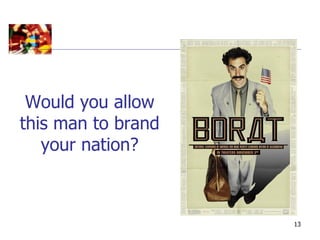
 Export promotion
 Tourism


                                            3
Many countries do not know
             what to do
 The use of brand management techniques
  is relatively new
 Many governments are not familiar with
  these techniques
 Every country should develop its own
  original nation branding strategy


                                       4
A blind faith in the power of
                advertising

 Much public money is spent on expensive
  advertising campaigns
 However, very little evaluation is made of
  the effectiveness of these ad campaigns


                                               5
Public relations consultancies
 Generate positive media coverage
 Develop ongoing relationships with
  journalists and editors
 But reality must underpin the spin


                                        6
A more balanced approach is
                required
 A media-centric approach operates via:
  – Paid-for advertising in relevant media
  – News management through PR officers and/or
    consultants
 However, the range of nation branding
  tools extends far beyond a media-centric
  approach


                                             7
Complementary nation
      branding tools and techniques
 Activation of diaspora networks
 Improved coordination between different
  stakeholder groups
 Cultural diplomacy
 Increasing the entrepreneurialism of
  Embassy networks


                                            8
Key concepts in nation
                  branding
   Identity versus image
   The identity-image gap
   The facets of nation-brand identity
   Deconstructing nation-brand image
   Positioning the nation-brand


                                          9
3 key elements of branding
  theory

 Brand identity
 Brand image
 Brand positioning


                               10
Identity versus image

 A simple but robust perspective:
  – Identity refers to what something truly is, its
    essence
  – Image refers to how something is perceived
 There is frequently a gap between these
  two states


                                                      11
The identity-image gap

 This tends to be a negative factor
 Many nations struggle with the frustration
  of not being perceived correctly by the
  rest of the world
 Stereotypes and clichés can dominate
  perceptions of some nations


                                               12
Would you allow
this man to brand
   your nation?


                    13
Nation branding attempts to
      reduce the identity-image gap
 By identifying prejudices and
  misperceptions
 By enabling nations to dismantle and
  oppose the negative forces that could:
  – Hold back the nation’s economic development
  – Damage the nation’s standing in the world
    community


                                              14
Constructing the nation-brand
       narrative
 Narrative identity theory
 Imaginative & creative input in brand
  identity development
 Poets, novelists, and other creative writers
  could play a significant role in enhancing
  their nation’s reputation


                                             15
The facets of nation-brand
       identity
 Nation-brand identity is built upon a limited
  range of all the constituent parts of national
  identity
 External audiences are unwilling to process huge
  amounts of information about a country’s
  history, culture, society


                                                 16
Deconstructing nation-brand
     image
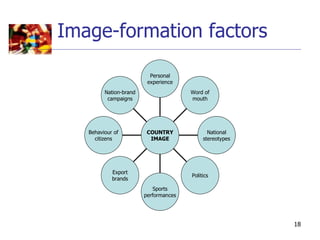
 The mental representations (images) that
  people have of countries can derive from
  various influencing factors
 Nations have varying degrees of control
  over these influencing factors


                                             17
Image-formation factors

                          Personal
                         experience
         Nation-brand                  Word of
          campaigns                    mouth


   Behaviour of          COUNTRY              National
     citizens             IMAGE             stereotypes


            Export
                                       Politics
            brands
                            Sports
                        performances


                                                          18
Assessing brand image via
       brand personification
 ‘Brand personification’ is a qualitative research
  technique
 The question: “If brand X were a person, what
  kind of person would it be?”
 Product brands have been using this technique
  for years – there is no reason why it could not
  be applied to nation-brands


                                                      19
Perceptions of Brand Spain
    amongst Japanese
   students aged 18-25

“If Spain was a person, what kind
      of person would it be?”

                                20
“Spain is a cheerful girl, she
 always smiles for everyone,
she makes everyone happy.”


                                 21
“Passionate dancer. It is
because the image of Spain is
          passion.”


                            22
“A girl, aged 25 years old. Beautiful
    and sexy. Likes dancing and
   singing. She has 5 boy friends
  who are waiting for the day they
            can date her.”


                                    23
“Man, 30 years old, wears red
  clothes. He is confident in
           himself.”


                                24
“A man in his middle age
   drinking and singing
 every day, all day long.”


                         25
Perceptions of Brand
    Portugal amongst
 Japanese students aged
          18-25

“If Portugal was a person, what
   kind of person would it be?”
                                  26
“A young very ambitious
       woman.”


                          27
“Spain’s younger sister, but a
        bit more calm.”


                             28
“Mysterious”


               29
“Thoughtful person who likes
    to communicate with
          others.”


                           30
“Male. Quiet and a big guy. In
his 40s. Wise man. Has a wife.
 The wife is very beautiful. Has
  few friends but very close.”


                               31
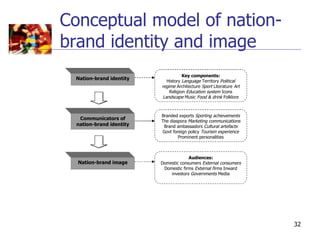
Conceptual model of nation-
brand identity and image
                                     Key components:
 Nation-brand identity       History Language Territory Political
                          regime Architecture Sport Literature Art
                              Religion Education system Icons
                           Landscape Music Food & drink Folklore


                          Branded exports Sporting achievements
   Communicators of       The diaspora Marketing communications
  nation-brand identity     Brand ambassadors Cultural artefacts
                           Govt foreign policy Tourism experience
                                   Prominent personalities


                                       Audiences:
  Nation-brand image      Domestic consumers External consumers
                           Domestic firms External firms Inward
                              investors Governments Media


                                                                     32
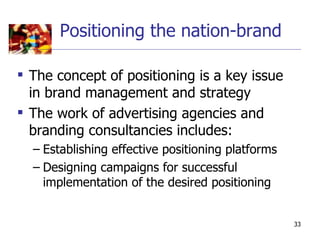
Positioning the nation-brand

 The concept of positioning is a key issue
  in brand management and strategy
 The work of advertising agencies and
  branding consultancies includes:
  – Establishing effective positioning platforms
  – Designing campaigns for successful
    implementation of the desired positioning


                                                   33
Positioning defined

 “Positioning is the act of designing the
  company’s offering and image to occupy a
  distinctive place in the mind of the target
  market”
              – Kotler & Keller, 2006


                                            34
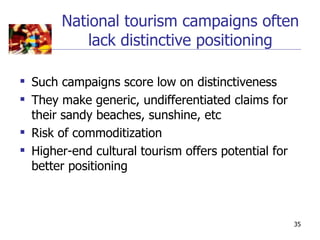
National tourism campaigns often
           lack distinctive positioning

 Such campaigns score low on distinctiveness
 They make generic, undifferentiated claims for
  their sandy beaches, sunshine, etc
 Risk of commoditization
 Higher-end cultural tourism offers potential for
  better positioning


                                                     35
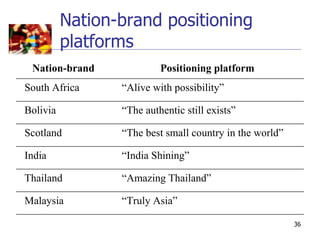
Nation-brand positioning
          platforms
 Nation-brand             Positioning platform
South Africa     “Alive with possibility”

Bolivia          “The authentic still exists”

Scotland         “The best small country in the world”

India            “India Shining”

Thailand         “Amazing Thailand”

Malaysia         “Truly Asia”

                                                         36
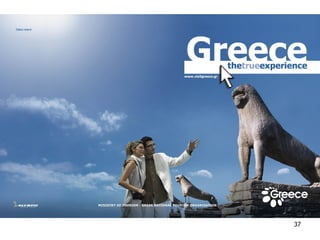
37
The New France – Breaking
     Through the Perception Barrier
 Mr Philippe Favre, French Ambassador for
  international investment, Chairman and
  CEO of Invest in France Agency


                                         38
Background
 Now the world’s 5th largest economy, France is a
  modern and dynamic country located at the
  heart of the largest market in the world –
  Europe
 It has reinvented itself over the past few years:
  – Significant privatizations & reforms across key sectors
    to become more internationally competitive
  – Business formalities have been simplified
  – First-class infrastructure & talented workforce

                                                         39
The perception gap

 France’s leading edge technology and
  innovation in healthcare is familiar to
  investors in China and Japan
 However, this is overlooked by companies
  in the USA and the UK, who are
  preoccupied with outdated perceptions
  that go against the modern actuality of
  France
                                         40
Changing the world’s opinion

 The French government recognized that
  correcting the discrepancy between the
  myth and the reality of France’s image
  was important for:
  – The success of its economy
  – Inward investment levels


                                           41
Invest in France Agency (IFA)

 Government organization responsible for
  promoting international investment and helping
  foreign investors succeed in France
 As part of its mission, IFA has helped erase
  misconceptions about France over the past 3
  years with the rollout of an image campaign:
  – “The New France. Where the smart money goes.”


                                                    42
Collaborative approach
 With a total budget of 35 million Euros,
  the campaign was developed & run by IFA
  in collaboration with several French
  government bodies, including:
  – UBIFrance, Maison de la France, information
    service dept, Ministry of Foreign Affairs,
    French Economic Mission, Sopexa,
    EDUFrance, Treasury Directorate, etc


                                                  43
Campaign goals

 Raise France’s economic profile among 5
  leading target investment countries:
  – USA, UK, Germany, Japan, China
 Improve foreign investor opinions of
  France
 Create solid relationships with foreign
  investors for long-term dialogue

                                            44
Campaign strategy
 Focus on boosting visibility & credibility
 Tangible facts and testimonials from
  international corporations already doing business
  in France
 Senior executives from 12 reputable global
  companies (e.g., FedEx, Toyota, Xerox, GE,
  Sony) described:
  – The ease of setting up; the access to qualified talent;
    the convenience of a central location

                                                          45
Emphasizing France’s
        attractiveness
   Flexible labor laws
   Superior healthcare system
   Diverse business clusters
   Statistical benchmarks displaying
    competitiveness in categories such as:
    – Real-estate costs, employee salaries, tax rates


                                                   46
High-impact advertisements

 Over 185 ads endorsed “The New France”
  in top economic news publications:
  – Financial Times, Wall Street Journal,
    Handelsblatt, Nikkei
 Billboard ads also appeared at major
  airports in:
  – USA, UK, Japan, China, and Roissy Charles de
    Gaulle airport in Paris

                                               47
Supplementary marcoms tools

 Sector videos
 A comprehensive multilingual
  communications kit
 A book available in 5 languages
 A microsite, www.thenewfrance.com


                                      48
Face-to-face contacts

 IFA executives met with economic leaders
  and potential investors at nearly 150 high-
  profile events during the campaign,
  including:
  – World Economic Forum in Davos
  – Business Week Leadership Forum
  – Fortune Innovation Forum


                                            49
Campaign results

 61% of respondents in USA and UK said it
  made them view France in a new light
 40,000 new jobs created in France in 2006
  from foreign investment projects, a 33%
  increase over 2005


                                          50
Conclusions
 Media strategy needs to be balanced by
  face-to-face contacts
 Allocate resources to building long term
  relationships with investors and other
  target audiences
 Develop a collaborative approach between
  different Government Ministries and
  Departments
                                         51
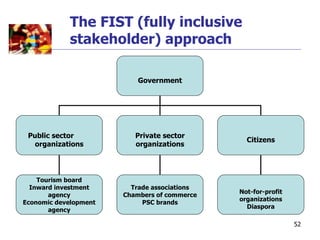
The FIST (fully inclusive
            stakeholder) approach

                           Government


 Public sector            Private sector
                                                Citizens
   organizations          organizations


    Tourism board
  Inward investment      Trade associations
                                              Not-for-profit
       agency          Chambers of commerce
                                              organizations
Economic development        PSC brands
                                                Diaspora
       agency

                                                               52
Thank you for your attention

           END


                               53

brand management

  • 1.
    Nation branding andcountry image: Opportunities and limitations of a media-centric approach Keith Dinnie Temple University, Tokyo, Japan
  • 2.
  • 3.
    Nations have alwayscompeted with each other  The shifting balance between ‘hard’ and ‘soft’ power  Investment attraction  Export promotion  Tourism 3
  • 4.
    Many countries donot know what to do  The use of brand management techniques is relatively new  Many governments are not familiar with these techniques  Every country should develop its own original nation branding strategy 4
  • 5.
    A blind faithin the power of advertising  Much public money is spent on expensive advertising campaigns  However, very little evaluation is made of the effectiveness of these ad campaigns 5
  • 6.
    Public relations consultancies Generate positive media coverage  Develop ongoing relationships with journalists and editors  But reality must underpin the spin 6
  • 7.
    A more balancedapproach is required  A media-centric approach operates via: – Paid-for advertising in relevant media – News management through PR officers and/or consultants  However, the range of nation branding tools extends far beyond a media-centric approach 7
  • 8.
    Complementary nation branding tools and techniques  Activation of diaspora networks  Improved coordination between different stakeholder groups  Cultural diplomacy  Increasing the entrepreneurialism of Embassy networks 8
  • 9.
    Key concepts innation branding  Identity versus image  The identity-image gap  The facets of nation-brand identity  Deconstructing nation-brand image  Positioning the nation-brand 9
  • 10.
    3 key elementsof branding theory  Brand identity  Brand image  Brand positioning 10
  • 11.
    Identity versus image A simple but robust perspective: – Identity refers to what something truly is, its essence – Image refers to how something is perceived  There is frequently a gap between these two states 11
  • 12.
    The identity-image gap This tends to be a negative factor  Many nations struggle with the frustration of not being perceived correctly by the rest of the world  Stereotypes and clichés can dominate perceptions of some nations 12
  • 13.
    Would you allow thisman to brand your nation? 13
  • 14.
    Nation branding attemptsto reduce the identity-image gap  By identifying prejudices and misperceptions  By enabling nations to dismantle and oppose the negative forces that could: – Hold back the nation’s economic development – Damage the nation’s standing in the world community 14
  • 15.
    Constructing the nation-brand narrative  Narrative identity theory  Imaginative & creative input in brand identity development  Poets, novelists, and other creative writers could play a significant role in enhancing their nation’s reputation 15
  • 16.
    The facets ofnation-brand identity  Nation-brand identity is built upon a limited range of all the constituent parts of national identity  External audiences are unwilling to process huge amounts of information about a country’s history, culture, society 16
  • 17.
    Deconstructing nation-brand image  The mental representations (images) that people have of countries can derive from various influencing factors  Nations have varying degrees of control over these influencing factors 17
  • 18.
    Image-formation factors Personal experience Nation-brand Word of campaigns mouth Behaviour of COUNTRY National citizens IMAGE stereotypes Export Politics brands Sports performances 18
  • 19.
    Assessing brand imagevia brand personification  ‘Brand personification’ is a qualitative research technique  The question: “If brand X were a person, what kind of person would it be?”  Product brands have been using this technique for years – there is no reason why it could not be applied to nation-brands 19
  • 20.
    Perceptions of BrandSpain amongst Japanese students aged 18-25 “If Spain was a person, what kind of person would it be?” 20
  • 21.
    “Spain is acheerful girl, she always smiles for everyone, she makes everyone happy.” 21
  • 22.
    “Passionate dancer. Itis because the image of Spain is passion.” 22
  • 23.
    “A girl, aged25 years old. Beautiful and sexy. Likes dancing and singing. She has 5 boy friends who are waiting for the day they can date her.” 23
  • 24.
    “Man, 30 yearsold, wears red clothes. He is confident in himself.” 24
  • 25.
    “A man inhis middle age drinking and singing every day, all day long.” 25
  • 26.
    Perceptions of Brand Portugal amongst Japanese students aged 18-25 “If Portugal was a person, what kind of person would it be?” 26
  • 27.
    “A young veryambitious woman.” 27
  • 28.
    “Spain’s younger sister,but a bit more calm.” 28
  • 29.
  • 30.
    “Thoughtful person wholikes to communicate with others.” 30
  • 31.
    “Male. Quiet anda big guy. In his 40s. Wise man. Has a wife. The wife is very beautiful. Has few friends but very close.” 31
  • 32.
    Conceptual model ofnation- brand identity and image Key components: Nation-brand identity History Language Territory Political regime Architecture Sport Literature Art Religion Education system Icons Landscape Music Food & drink Folklore Branded exports Sporting achievements Communicators of The diaspora Marketing communications nation-brand identity Brand ambassadors Cultural artefacts Govt foreign policy Tourism experience Prominent personalities Audiences: Nation-brand image Domestic consumers External consumers Domestic firms External firms Inward investors Governments Media 32
  • 33.
    Positioning the nation-brand The concept of positioning is a key issue in brand management and strategy  The work of advertising agencies and branding consultancies includes: – Establishing effective positioning platforms – Designing campaigns for successful implementation of the desired positioning 33
  • 34.
    Positioning defined  “Positioningis the act of designing the company’s offering and image to occupy a distinctive place in the mind of the target market” – Kotler & Keller, 2006 34
  • 35.
    National tourism campaignsoften lack distinctive positioning  Such campaigns score low on distinctiveness  They make generic, undifferentiated claims for their sandy beaches, sunshine, etc  Risk of commoditization  Higher-end cultural tourism offers potential for better positioning 35
  • 36.
    Nation-brand positioning platforms Nation-brand Positioning platform South Africa “Alive with possibility” Bolivia “The authentic still exists” Scotland “The best small country in the world” India “India Shining” Thailand “Amazing Thailand” Malaysia “Truly Asia” 36
  • 37.
  • 38.
    The New France– Breaking Through the Perception Barrier  Mr Philippe Favre, French Ambassador for international investment, Chairman and CEO of Invest in France Agency 38
  • 39.
    Background  Now theworld’s 5th largest economy, France is a modern and dynamic country located at the heart of the largest market in the world – Europe  It has reinvented itself over the past few years: – Significant privatizations & reforms across key sectors to become more internationally competitive – Business formalities have been simplified – First-class infrastructure & talented workforce 39
  • 40.
    The perception gap France’s leading edge technology and innovation in healthcare is familiar to investors in China and Japan  However, this is overlooked by companies in the USA and the UK, who are preoccupied with outdated perceptions that go against the modern actuality of France 40
  • 41.
    Changing the world’sopinion  The French government recognized that correcting the discrepancy between the myth and the reality of France’s image was important for: – The success of its economy – Inward investment levels 41
  • 42.
    Invest in FranceAgency (IFA)  Government organization responsible for promoting international investment and helping foreign investors succeed in France  As part of its mission, IFA has helped erase misconceptions about France over the past 3 years with the rollout of an image campaign: – “The New France. Where the smart money goes.” 42
  • 43.
    Collaborative approach  Witha total budget of 35 million Euros, the campaign was developed & run by IFA in collaboration with several French government bodies, including: – UBIFrance, Maison de la France, information service dept, Ministry of Foreign Affairs, French Economic Mission, Sopexa, EDUFrance, Treasury Directorate, etc 43
  • 44.
    Campaign goals  RaiseFrance’s economic profile among 5 leading target investment countries: – USA, UK, Germany, Japan, China  Improve foreign investor opinions of France  Create solid relationships with foreign investors for long-term dialogue 44
  • 45.
    Campaign strategy  Focuson boosting visibility & credibility  Tangible facts and testimonials from international corporations already doing business in France  Senior executives from 12 reputable global companies (e.g., FedEx, Toyota, Xerox, GE, Sony) described: – The ease of setting up; the access to qualified talent; the convenience of a central location 45
  • 46.
    Emphasizing France’s attractiveness  Flexible labor laws  Superior healthcare system  Diverse business clusters  Statistical benchmarks displaying competitiveness in categories such as: – Real-estate costs, employee salaries, tax rates 46
  • 47.
    High-impact advertisements  Over185 ads endorsed “The New France” in top economic news publications: – Financial Times, Wall Street Journal, Handelsblatt, Nikkei  Billboard ads also appeared at major airports in: – USA, UK, Japan, China, and Roissy Charles de Gaulle airport in Paris 47
  • 48.
    Supplementary marcoms tools Sector videos  A comprehensive multilingual communications kit  A book available in 5 languages  A microsite, www.thenewfrance.com 48
  • 49.
    Face-to-face contacts  IFAexecutives met with economic leaders and potential investors at nearly 150 high- profile events during the campaign, including: – World Economic Forum in Davos – Business Week Leadership Forum – Fortune Innovation Forum 49
  • 50.
    Campaign results  61%of respondents in USA and UK said it made them view France in a new light  40,000 new jobs created in France in 2006 from foreign investment projects, a 33% increase over 2005 50
  • 51.
    Conclusions  Media strategyneeds to be balanced by face-to-face contacts  Allocate resources to building long term relationships with investors and other target audiences  Develop a collaborative approach between different Government Ministries and Departments 51
  • 52.
    The FIST (fullyinclusive stakeholder) approach Government Public sector Private sector Citizens organizations organizations Tourism board Inward investment Trade associations Not-for-profit agency Chambers of commerce organizations Economic development PSC brands Diaspora agency 52
  • 53.
    Thank you foryour attention END 53