Brand Love Series:
Beyond Loyalty A Periscope Thought Leadership Presentation
February 2019
PERISCOPE | 2 of 24
PERISCOPE | 2 of 24
The first major scientific study on brand
love was published 20 years ago
Even so, few fully grasp why it is such a
powerful game-changing concept
Brand love was first identified by academics
Most
still
don’t
know
what it
means
or why it
matters
PERISCOPE | 3 of 24
PERISCOPE | 3 of 24
Aaron Ahuvia, Ph.D. gathered data on love, attraction,
and romantic relationships
But wanted to put his knowledge to wider use
“I decided to study how the psychology of love could help us
understand why people were attracted to certain products and
services. It turned out that although there was lots of research on
love, and lots of research on consumer preferences, I was the first
person to do empirical research on the psychology of love when
people love something rather than someone.” – Aaron Ahuvia, Ph.D.
A young researcher studying online dating in the early
90s generalized his research from people to brands
PERISCOPE | 4 of 24
PERISCOPE | 4 of 24
Today, Brand Love
should be your
brand’s #1 KPI
But, it’s more difficult to
quantify than awareness or
conversion
PERISCOPE | 5 of 24
PERISCOPE | 5 of 24
First, the goal was satisfaction…
But satisfaction is tied to expectations and should be cost of entry
Then, brands started chasing loyalty.
It’s easier to sell to existing customers than to new ones, loyal
customers spend more and are more valuable to the bottom line
Think of Brand Love as Loyalty 2.0
AMY SNOW | 6
Satisfaction and loyalty are
relatively easy to measure,
and proving ROI is an effective
way to get everyone on board.
PERISCOPE | 7 of 24
PERISCOPE | 7 of 24
But then,
everything changed.
Omnichannel retailing became
the norm
Competition was everywhere
Social media became a necessary
part of the conversation not just
between people, but between
people and brands
The purchase journey became an
infinity loop and less linear
The stakes were suddenly way
higher
PERISCOPE | 8 of 24
PERISCOPE | 8 of 24
Consumers began
interacting with brands like
they interact with people
Transactional consumer relationships were
replaced with values-based relationships
It became more and more difficult to
pinpoint why consumers are loyal to certain
brands and what that looks like
Traditional satisfaction and loyalty metrics
were no longer enough
PERISCOPE | 9 of 24
PERISCOPE | 9 of 24
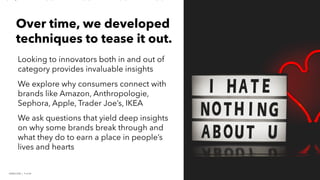
Looking to innovators both in and out of
category provides invaluable insights
We explore why consumers connect with
brands like Amazon, Anthropologie,
Sephora, Apple, Trader Joe’s, IKEA
We ask questions that yield deep insights
on why some brands break through and
what they do to earn a place in people’s
lives and hearts
Over time, we developed
techniques to tease it out.
PERISCOPE | 10 of 24
It goes like this…
What brands get you? What brands could you not live without?
If they disappeared tomorrow, would you be sad? Why?
How does your relationship with this brand change your life?
Where do they fit into your life?
What did they do to earn that place in your heart?
You could get the same product from someone else…why does
it have to be them?
How do they tell you they love you?
PERISCOPE | 11 of 24
This technique works across brands and categories (fashion, retail,
food and beverage, CPG, tech, automotive, financial), with the same
themes emerging time and time again
Which means there is an underlying framework brands can
leverage to build brand love
This helps consumers articulate how and why
they become emotionally attached to brands
PERISCOPE | 12 of 24
Let’s go back to Dr. Ahuvia…
His later work uncovered the psychological structure
of brand love
He created mathematical models to dimensionalize
brand love using structural equation modeling
He found seven core elements:
1. Self–brand integration
2. Passion-driven behaviors
3. Positive emotional connection
4. Long-term relationship
5. Positive overall attitude valence
6. Attitude certainty and confidence (strength)
7. Anticipated separation distress
PERISCOPE | 13 of 24
Of these, four dimensions jump out:
Long-term relationship, anticipated separation
distress, positive overall attitude valence, and
attitude certainty and confidence…
These describe TRUST.
Just as relationships between people hinge on
trust, trust is critically important in relationships
with brands
Trust is the single biggest component of
brand love
PERISCOPE | 14 of 24
The same chemicals associated
with love between people are
affected when people trust
organizations and companies
Both human love and brand love
produce spikes in oxytocin, and
that spike is triggered by trust
Trust contributes to
brand love for the same
biological reasons as
interpersonal love
PERISCOPE | 15 of 24
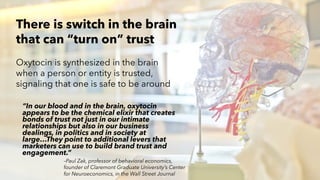
Oxytocin is synthesized in the brain
when a person or entity is trusted,
signaling that one is safe to be around
There is switch in the brain
that can “turn on” trust
“In our blood and in the brain, oxytocin
appears to be the chemical elixir that creates
bonds of trust not just in our intimate
relationships but also in our business
dealings, in politics and in society at
large…They point to additional levers that
marketers can use to build brand trust and
engagement.”
–Paul Zak, professor of behavioral economics,
founder of Claremont Graduate University’s Center
for Neuroeconomics, in the Wall Street Journal
PERISCOPE | 16 of 24
What does this sound like in consumers’ words?
“Someone got my credit card number and was trying to buy a
bunch of expensive stuff online. Chase called me and asked me if
I made a purchase. I said no and they wiped it clean. Just like that.
It made me feel safe with my credit cards. That is the only one I
use to purchase stuff online now and I will never leave Chase.”
“I ordered a bike for my daughter for Christmas from Amazon and
it was two days before Christmas and it still hadn’t arrived. I called
and spoke with someone who was very helpful. She ordered me a
replacement bike, had it overnighted at no charge, and my
daughter had her bike. When the other one arrived a week too
late, I called and asked what I should do. They told me to donate it
to charity. Now, that’s a company I want to do business with! That’s
a company I trust to come through for me and do the right thing.”
PERISCOPE | 17 of 24
According to Amy Cuddy, a Harvard Business
School professor who studies trust…
Humans want to be perceived as warm and
competent
Warmth, she says, is “trustworthiness,” and
actually the most important factor in how people
evaluate you
Often, trustworthiness matters
even more than competence
“From an evolutionary perspective, it is
more crucial to our survival to know
whether a person deserves our trust.”
-Amy Cuddy
PERISCOPE | 18 of 24
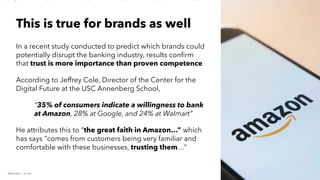
This is true for brands as well
In a recent study conducted to predict which brands could
potentially disrupt the banking industry, results confirm
that trust is more importance than proven competence
According to Jeffrey Cole, Director of the Center for the
Digital Future at the USC Annenberg School,
“35% of consumers indicate a willingness to bank
at Amazon, 28% at Google, and 24% at Walmart”
He attributes this to “the great faith in Amazon…” which
has says ”comes from customers being very familiar and
comfortable with these businesses, trusting them…”
PERISCOPE | 19 of 24
“After the financial crisis, major institutions and
corporations suffered a loss of trust almost without
precedent…Fueled by social media and amplified by
mainstream media, companies discovered just how
quickly they could lose control of their message.”
- Stuart Smith, Global CEO of Ogilvy PR
One way to quantify trust is through earned
influence
in times of uncertainty
And trust is even
more important
PERISCOPE | 20 of 24
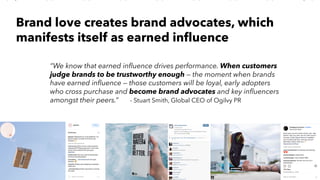
“We know that earned influence drives performance. When customers
judge brands to be trustworthy enough — the moment when brands
have earned influence — those customers will be loyal, early adopters
who cross purchase and become brand advocates and key influencers
amongst their peers.” - Stuart Smith, Global CEO of Ogilvy PR
Brand love creates brand advocates, which
manifests itself as earned influence
PERISCOPE | 21 of 24
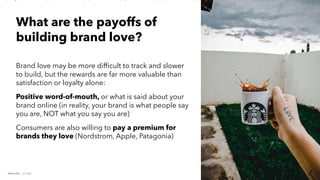
Brand love may be more difficult to track and slower
to build, but the rewards are far more valuable than
satisfaction or loyalty alone:
Positive word-of-mouth, or what is said about your
brand online (in reality, your brand is what people say
you are, NOT what you say you are)
Consumers are also willing to pay a premium for
brands they love (Nordstrom, Apple, Patagonia)
What are the payoffs of
building brand love?
PERISCOPE | 22 of 24
Another very important benefit beloved brands
enjoy is what researchers call “resistance” or how
much slack consumers give you when mistakes
happen, as they inevitably do
Building brand love establishes a longer term
relationship that, as with people, means minor
missteps are less likely to fracture the
relationship
Most importantly, brand love encourages consumers
to grant forgiveness for missteps
AMY SNOW | 23
So, how have leading
brands built brand love?
Next time…
the five dimensions
of brand love.
a periscope thought leadership series
PERISCOPE | 24 of 24
Los Angeles, CA
323.327.5115
www.theperiscopeagency.com

Brand Love: Beyond Loyalty

  • 1.
    Brand Love Series: BeyondLoyalty A Periscope Thought Leadership Presentation February 2019
  • 2.
    PERISCOPE | 2of 24 PERISCOPE | 2 of 24 The first major scientific study on brand love was published 20 years ago Even so, few fully grasp why it is such a powerful game-changing concept Brand love was first identified by academics Most still don’t know what it means or why it matters
  • 3.
    PERISCOPE | 3of 24 PERISCOPE | 3 of 24 Aaron Ahuvia, Ph.D. gathered data on love, attraction, and romantic relationships But wanted to put his knowledge to wider use “I decided to study how the psychology of love could help us understand why people were attracted to certain products and services. It turned out that although there was lots of research on love, and lots of research on consumer preferences, I was the first person to do empirical research on the psychology of love when people love something rather than someone.” – Aaron Ahuvia, Ph.D. A young researcher studying online dating in the early 90s generalized his research from people to brands
  • 4.
    PERISCOPE | 4of 24 PERISCOPE | 4 of 24 Today, Brand Love should be your brand’s #1 KPI But, it’s more difficult to quantify than awareness or conversion
  • 5.
    PERISCOPE | 5of 24 PERISCOPE | 5 of 24 First, the goal was satisfaction… But satisfaction is tied to expectations and should be cost of entry Then, brands started chasing loyalty. It’s easier to sell to existing customers than to new ones, loyal customers spend more and are more valuable to the bottom line Think of Brand Love as Loyalty 2.0
  • 6.
    AMY SNOW |6 Satisfaction and loyalty are relatively easy to measure, and proving ROI is an effective way to get everyone on board.
  • 7.
    PERISCOPE | 7of 24 PERISCOPE | 7 of 24 But then, everything changed. Omnichannel retailing became the norm Competition was everywhere Social media became a necessary part of the conversation not just between people, but between people and brands The purchase journey became an infinity loop and less linear The stakes were suddenly way higher
  • 8.
    PERISCOPE | 8of 24 PERISCOPE | 8 of 24 Consumers began interacting with brands like they interact with people Transactional consumer relationships were replaced with values-based relationships It became more and more difficult to pinpoint why consumers are loyal to certain brands and what that looks like Traditional satisfaction and loyalty metrics were no longer enough
  • 9.
    PERISCOPE | 9of 24 PERISCOPE | 9 of 24 Looking to innovators both in and out of category provides invaluable insights We explore why consumers connect with brands like Amazon, Anthropologie, Sephora, Apple, Trader Joe’s, IKEA We ask questions that yield deep insights on why some brands break through and what they do to earn a place in people’s lives and hearts Over time, we developed techniques to tease it out.
  • 10.
    PERISCOPE | 10of 24 PERISCOPE | 10 of 24 It goes like this… What brands get you? What brands could you not live without? If they disappeared tomorrow, would you be sad? Why? How does your relationship with this brand change your life? Where do they fit into your life? What did they do to earn that place in your heart? You could get the same product from someone else…why does it have to be them? How do they tell you they love you?
  • 11.
    PERISCOPE | 11of 24 PERISCOPE | 11 of 24 This technique works across brands and categories (fashion, retail, food and beverage, CPG, tech, automotive, financial), with the same themes emerging time and time again Which means there is an underlying framework brands can leverage to build brand love This helps consumers articulate how and why they become emotionally attached to brands
  • 12.
    PERISCOPE | 12of 24 PERISCOPE | 12 of 24 Let’s go back to Dr. Ahuvia… His later work uncovered the psychological structure of brand love He created mathematical models to dimensionalize brand love using structural equation modeling He found seven core elements: 1. Self–brand integration 2. Passion-driven behaviors 3. Positive emotional connection 4. Long-term relationship 5. Positive overall attitude valence 6. Attitude certainty and confidence (strength) 7. Anticipated separation distress
  • 13.
    PERISCOPE | 13of 24 PERISCOPE | 13 of 24 Of these, four dimensions jump out: Long-term relationship, anticipated separation distress, positive overall attitude valence, and attitude certainty and confidence… These describe TRUST. Just as relationships between people hinge on trust, trust is critically important in relationships with brands Trust is the single biggest component of brand love
  • 14.
    PERISCOPE | 14of 24 PERISCOPE | 14 of 24 The same chemicals associated with love between people are affected when people trust organizations and companies Both human love and brand love produce spikes in oxytocin, and that spike is triggered by trust Trust contributes to brand love for the same biological reasons as interpersonal love
  • 15.
    PERISCOPE | 15of 24 PERISCOPE | 15 of 24 Oxytocin is synthesized in the brain when a person or entity is trusted, signaling that one is safe to be around There is switch in the brain that can “turn on” trust “In our blood and in the brain, oxytocin appears to be the chemical elixir that creates bonds of trust not just in our intimate relationships but also in our business dealings, in politics and in society at large…They point to additional levers that marketers can use to build brand trust and engagement.” –Paul Zak, professor of behavioral economics, founder of Claremont Graduate University’s Center for Neuroeconomics, in the Wall Street Journal
  • 16.
    PERISCOPE | 16of 24 What does this sound like in consumers’ words? “Someone got my credit card number and was trying to buy a bunch of expensive stuff online. Chase called me and asked me if I made a purchase. I said no and they wiped it clean. Just like that. It made me feel safe with my credit cards. That is the only one I use to purchase stuff online now and I will never leave Chase.” “I ordered a bike for my daughter for Christmas from Amazon and it was two days before Christmas and it still hadn’t arrived. I called and spoke with someone who was very helpful. She ordered me a replacement bike, had it overnighted at no charge, and my daughter had her bike. When the other one arrived a week too late, I called and asked what I should do. They told me to donate it to charity. Now, that’s a company I want to do business with! That’s a company I trust to come through for me and do the right thing.”
  • 17.
    PERISCOPE | 17of 24 According to Amy Cuddy, a Harvard Business School professor who studies trust… Humans want to be perceived as warm and competent Warmth, she says, is “trustworthiness,” and actually the most important factor in how people evaluate you Often, trustworthiness matters even more than competence “From an evolutionary perspective, it is more crucial to our survival to know whether a person deserves our trust.” -Amy Cuddy
  • 18.
    PERISCOPE | 18of 24 PERISCOPE | 18 of 24 This is true for brands as well In a recent study conducted to predict which brands could potentially disrupt the banking industry, results confirm that trust is more importance than proven competence According to Jeffrey Cole, Director of the Center for the Digital Future at the USC Annenberg School, “35% of consumers indicate a willingness to bank at Amazon, 28% at Google, and 24% at Walmart” He attributes this to “the great faith in Amazon…” which has says ”comes from customers being very familiar and comfortable with these businesses, trusting them…”
  • 19.
    PERISCOPE | 19of 24 PERISCOPE | 19 of 24 “After the financial crisis, major institutions and corporations suffered a loss of trust almost without precedent…Fueled by social media and amplified by mainstream media, companies discovered just how quickly they could lose control of their message.” - Stuart Smith, Global CEO of Ogilvy PR One way to quantify trust is through earned influence in times of uncertainty And trust is even more important
  • 20.
    PERISCOPE | 20of 24 PERISCOPE | 20 of 24 “We know that earned influence drives performance. When customers judge brands to be trustworthy enough — the moment when brands have earned influence — those customers will be loyal, early adopters who cross purchase and become brand advocates and key influencers amongst their peers.” - Stuart Smith, Global CEO of Ogilvy PR Brand love creates brand advocates, which manifests itself as earned influence
  • 21.
    PERISCOPE | 21of 24 PERISCOPE | 21 of 24 Brand love may be more difficult to track and slower to build, but the rewards are far more valuable than satisfaction or loyalty alone: Positive word-of-mouth, or what is said about your brand online (in reality, your brand is what people say you are, NOT what you say you are) Consumers are also willing to pay a premium for brands they love (Nordstrom, Apple, Patagonia) What are the payoffs of building brand love?
  • 22.
    PERISCOPE | 22of 24 PERISCOPE | 22 of 24 Another very important benefit beloved brands enjoy is what researchers call “resistance” or how much slack consumers give you when mistakes happen, as they inevitably do Building brand love establishes a longer term relationship that, as with people, means minor missteps are less likely to fracture the relationship Most importantly, brand love encourages consumers to grant forgiveness for missteps
  • 23.
    AMY SNOW |23 So, how have leading brands built brand love? Next time… the five dimensions of brand love. a periscope thought leadership series
  • 24.
    PERISCOPE | 24of 24 Los Angeles, CA 323.327.5115 www.theperiscopeagency.com