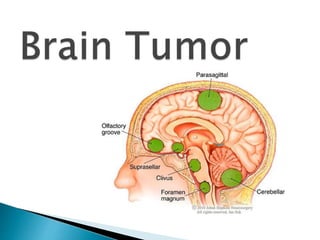
A brain tumor is a
localized intracranial
lesion which occupies
space with the skull and
tends to cause a rise in
intracranial pressure.
 Being male
 Race
 Age
 Family history
 Being exposed to radiation or
certain chemicals at work
Brain tumors can be benign or malignant
Benign brain tumors:
 Benign brain tumors do not contain cancer cells:
usually, benign tumors can be removed, and
they seldom grow back.
 The border or edge of a benign brain tumor can
be clearly seen. Cells from benign tumors do not
invade tissues around them or spread to other
parts of the body.
However, benign tumors can press on sensitive
areas of the brain and cause serious health
problems.
 Unlike benign tumors in most other parts of the
body, benign brain tumors are sometimes life
threatening.
 Very rarely, a benign brain tumor may become
malignant.
Malignant brain tumors:
 Malignant brain tumors are generally more
serious and often is life threatening. It may be
primary (the tumor originate from the brain
tissue) or secondary (metastasis from others
tumor elsewhere in the body).
 They are likely to grow rapidly and invade the
surrounding healthy brain tissue.
 Very rarely, cancer cells may break away from
a malignant brain tumor and spread to other
parts of the brain, to the spinal cord, or even
to other parts of the body.
 Symptoms related to increased intracranial
pressure such as:
 Decrease in level of
consciousness such as confusion
and lethargy.
 Headache most common in the
early morning and made worse
by coughing or straining
◦Vomiting
◦Papilledema ( edema of optic
nerve) and visual disturbance
◦Alteration in mental status.
Localized symptoms such as:
 Aphasia
 Personality changes as in case
of frontal lobe tumor
 Sensory defects ( smell,
hearing).
 Seizures.
 Motor abnormalities
◦ Physical exam
◦ Neurological examination
◦ Brain CT scan
◦ MRI on brain
◦ Angiogram
◦ Spinal tap
◦ Biopsy
 A variety of medical treatment
modalities, including chemotherapy
and radiotherapy, are used alone or
in combination with surgical
resection.
 Supportive care include:
 Steroids
 Anticonvulsant drugs
Assessment
Nursing intervention
 Post operative Nursing
care considerations
brain_tumor.pptx

brain_tumor.pptx

  • 3.
    A brain tumoris a localized intracranial lesion which occupies space with the skull and tends to cause a rise in intracranial pressure.
  • 4.
     Being male Race  Age  Family history  Being exposed to radiation or certain chemicals at work
  • 7.
    Brain tumors canbe benign or malignant Benign brain tumors:  Benign brain tumors do not contain cancer cells: usually, benign tumors can be removed, and they seldom grow back.  The border or edge of a benign brain tumor can be clearly seen. Cells from benign tumors do not invade tissues around them or spread to other parts of the body.
  • 8.
    However, benign tumorscan press on sensitive areas of the brain and cause serious health problems.  Unlike benign tumors in most other parts of the body, benign brain tumors are sometimes life threatening.  Very rarely, a benign brain tumor may become malignant.
  • 9.
    Malignant brain tumors: Malignant brain tumors are generally more serious and often is life threatening. It may be primary (the tumor originate from the brain tissue) or secondary (metastasis from others tumor elsewhere in the body).  They are likely to grow rapidly and invade the surrounding healthy brain tissue.
  • 10.
     Very rarely,cancer cells may break away from a malignant brain tumor and spread to other parts of the brain, to the spinal cord, or even to other parts of the body.
  • 15.
     Symptoms relatedto increased intracranial pressure such as:  Decrease in level of consciousness such as confusion and lethargy.  Headache most common in the early morning and made worse by coughing or straining
  • 16.
    ◦Vomiting ◦Papilledema ( edemaof optic nerve) and visual disturbance ◦Alteration in mental status.
  • 17.
    Localized symptoms suchas:  Aphasia  Personality changes as in case of frontal lobe tumor  Sensory defects ( smell, hearing).  Seizures.  Motor abnormalities
  • 19.
    ◦ Physical exam ◦Neurological examination ◦ Brain CT scan ◦ MRI on brain ◦ Angiogram ◦ Spinal tap ◦ Biopsy
  • 20.
     A varietyof medical treatment modalities, including chemotherapy and radiotherapy, are used alone or in combination with surgical resection.  Supportive care include:  Steroids  Anticonvulsant drugs
  • 23.
    Assessment Nursing intervention  Postoperative Nursing care considerations