Bowel
&
Ano-Rectal Dysfunction
โ€ข Not enough research or evidence
โ€ข traditional view that โ€˜the bowels should be opened once a day
โ€ข Most important measure is Prevention
โ€ข 1 to 3 days to pass through the gut
โ€ข Continence depends on safe storage of the waste material in
the colon and rectum
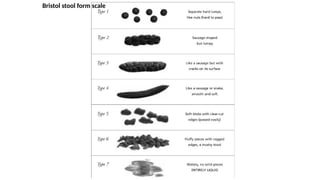
Bristol stool form scale
Storage factors contribute to the maintenance of anorectal
continence:
โ€ข consistency of stools depends on how long the faecal material
remains in the colon
โ€ข mass movements are triggered by the gastrocolic reflex
โ€ข Anal continence so long as closure pressure at anus greater
than by the periodic mass movements of gut through colon to
rectum
โ€ข as little as 11โ€“68 mL and the maximal sensation at 250โ€“510
mL
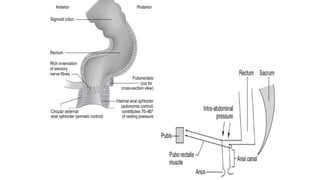
โ€ข The resting pressure of internal anal sphincter (IAS)
contributes 70โ€“85%
โ€ข The distension of rectum elicits recto anal inhibitory reflex
(RAIR) resulting in relaxation of the IAS.
โ€ข upper portion of the IAS releases three or four times an hour
to allow โ€˜samplingโ€™
โ€ข EAS can be contracted voluntarily
โ€ข Can be as much as twice the total resting pressure but can
be maintained for only a relatively short time.
โ€ข The anorectal angle supported by the puborectalis muscle,
produces a flap valve. (60 and 105ยฐ) increse with filling
โ€ข The vascular anal cushions
โ€ข An intact nerve supply autonomic and somatic
โ€ข cohesive contact of the moist rectal walls.
โ€ข The consistency of stool (i.e. soft yet formed but not liquid).
โ€ข Normal activity of the colon
โ€ข individual is cognitively intact
Defecation
โ€ข opening the bowels
โ€ข three times a day to three times a week for 94% of the
population
โ€ข Women defaecate less often
โ€ข activity of getting up in the morning and having breakfast
stimulates mass peristaltic movements
โ€ข If evacuation is inconvenient or impractical, defaecation can be
deferred by repeated strong voluntary squeezes of the external
anal Sphincter reversing peristalsis and resumption of
contraction of the IAS.
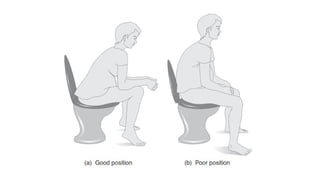
โ€ข Widening of the anorectal angle
โ€ข Knees above hips
โ€ข Foot stool
โ€ข pelvic floor musculature relaxes such that the floor
descends 1โ€“2 cm to the plane of the ischial tuberosities
โ€ข increases the anorectal angle and the anal canal widen
โ€ข EAS and puborectalis muscles will then release.
โ€ข Peristalsis
โ€ข โ€˜brace and bulgeโ€™ breath holding,descent of the
diaphragm, lateral widening of the waist with bulging of
the lower abdomen, descent of the pelvic floor, and
isometric activity in the pubo-, ilio- and ischiococcygeus
muscles to give support to the rectum.
Bowel & Anorectal Dysfuction
โ€ข two main groupings:
-Difficulty in evacuating faecal material
-Inability to store flatus or faecal material
โ€ข Anal incontinenceis the term used to describe the involuntary
loss of flatus, liquid or solid per anus that is a social or hygienic
problem.
โ€ข โ€ขAnismusis the term used to describe incoordinate activity of
anal sphincters and the levator ani muscles such that they fail
to relax when defaecation is attempted.
Constipation
โ€ข Functional (non-pathological) constipation is defined as including two
or more of the following symptoms for at least 12 weeks in the last 12
months
โ€ข straining in 1/4 defaecations
โ€ข lumpy or hard stools in 1/4 defaecations
โ€ข sensation of incomplete evacuation in 1/4 evacuations
โ€ข sensation of anorectal obstruction/blockade in 1/4 defaecations
โ€ข manual manoeuvres to facilitate 1/4 defaecations
โ€ข 3 defaecations per week.
โ€ข โ€ขDescending perineum syndrome is the term used to describe abnormal
descent and bulging of the perineum associated with defaecation.
โ€ข โ€ขDyscheziais the term used to describe difficulty with rectal evacuation
resulting from a long period of voluntary suppression of the urge to
defaecate, and a distended rectum.
โ€ข โ€ขFaecal incontinenceis the term used to describe the involuntary loss of
liquid or solid per anus.
โ€ข โ€ขMegacolonis an abnormal massive dilation of the colon that may be
congenital, toxic or acquired.
โ€ข โ€ขMegarectum is an abnormal dilation of the rectum.
โ€ข โ€ขParadoxical puborectalis contraction is a problem of the puborectalis
muscle failing to relax to allow defaecation.
โ€ข โ€ขParadoxical anal sphincter contractionis a problem of the anal
sphincter failing to relax to allow defaecation.
โ€ข โ€ขPassive soilingdescribes losing stool or liquid per anus without feeling
the urge to defaecate.
โ€ข โ€ขPelvic floor dyssynergia describes uncoordinated pelvic floor muscle
activity.
FACTORS CONTRIBUTING TO
DIFFICULTIES IN DEFAECATION
Abnormal Defecation Techniques
โ€ข Occurring in up to 20% of the population
โ€ข If a person has an uncoordinated defaecation pattern,
there is a failure of anal relaxation with lowered levator
ani while retaining sufficient rectal support
โ€ข as a result, defecation will be difficult and will cause the
person to strain.
โ€ข intensive abdominal training, or expiratory effort lead
to a rigid abdominal wall result in a barrier to
diaphragm able to descend against the abdominal
contents to bulge the lower abdominal wall forwards
โ€ข At rest the anus should be approximately two
centimetres above the ischial tuberosities
โ€ข Toilet sitting
โ€ข Many women use perineal pressure (perineal splinting) to
effect bowel emptying
โ€ข Women with a rectocoele often use digital posterior vaginal
wall pressure to give support and assist rectal emptying
โ€ข others with severe constipation assist emptying by extracting
stool with their fingers per anus.
Abuse
โ€ข often unreported
โ€ข an abnormal learned response may occur after
sexual assault or abuse
โ€ข anismus, paradoxical puborectalis contraction and
pelvic floor dyssynergia on attempted defaecation as
the pelvic floor muscles fail to release
โ€ข abusive or unwanted penetrative sexual activity.
โ€ข Eating Disorders
โ€ข with eating disorders complain of constipation
โ€ข anorexia nervosa, Binge eaters (obesity related to
constipation)
Food & Drink
โ€ข Insufficient fluid intake cause constipation.
โ€ข coffee (both caffeinated and decaffeinated) affects gut
motility
โ€ข Low calorie intake rather than low fibre consumption has
been shown to be related to constipation in the elderly
โ€ข a daily fibre intake of 25 g could increase stool frequency
in those with chronic functional constipation; this could
be significantly improved by a fluid intake of 1.5โ€“2 litres
per day.
โ€ข Ignoring the call to stool/workplace leads to
constipation
โ€ข Shift working can further affect the normal โ€˜body clockโ€™
IBS
โ€ข 10% of people, with a female predominance
โ€ข with spastic constipation having abdominal pain related to bowel
spasm,
โ€ข those with painless diarrhoea complaining of stool frequency
without abdominal pain.
โ€ข Pain felt in either the right or left iliac fossa or right hypochondrium
โ€ข abdominal distension, pain relief with Megacolon and
megarectum ,bowel movements, loose, frequent bowel movements
or constipation, passage of mucus, excessive flatus, small volumes
of pencil-like stools and urgency.
โ€ข Blood in the stools is not a symptom of IBS
โ€ข multifactorial in its causation
โ€ข irritable bladder associated with the IBS
โ€ข Megacolon/rectum (dilated segment shows normal phasic
contractility but decreased colonic tone)
โ€ข Menstruation (Constipation inc premenstrually)
โ€ข Neurological Conditions (Parkinsonโ€™s disease, multiple sclerosis and
spinal cord injury)
โ€ข Psycohtic Disorders (27%)
โ€ข Elderly
โ€ข Prolapse - A rectocoele is a herniation of the anterior rectal wall
and the posterior vaginal wall into the vagina.
โ€ข This tear in the rectovaginal septum most commonly occurs above
the attachment to the perineal body
โ€ข Constipation and straining and Prolonged straining (bearing
down/pushing) at childbirth and psothysterectomy a contributory
factor
Pain associated with
anal fissure
โ€ข An anal fissure is a split or tear in the lining of the lowest part of the
anal canal and may be caused by severe constipation or childbirth.
โ€ข heals itself it is said to have been an acute
โ€ข if the fissure becomes permanent it is said to be a chronic fissure
โ€ข Pregnancy & Postpartum - Constipation and a feeling of bloating are
common complaints
โ€ข 42% in multiparous & 26% in primiparous
โ€ข decreasing colonic peristalsis owing to the effect of progesterone on
the smooth muscle of the gut.
โ€ข increase in water absorption due to increased levels of aldosterone
and angiotensin
โ€ข After delivery the common practice of giving codeine based
analgesia may exacerbate any existing problems with constipation.
CONSEQUENCES OF
CONSTIPATION
โ€ข Prolonged
โ€ข excessive straining
โ€ข need to use digital help to defecate.
โ€ข incomplete emptying
โ€ข abdominal cramping and pain
โ€ข Bloating
โ€ข Perineal pain and nausea.
โ€ข physical symptoms of muscle tension, palpitations, a churning stomach
โ€ข and fatigue
โ€ข emotional symptoms of irritability, worry and less enthusiasm for life
โ€ข cognitive symptoms of poor concentration, indecisiveness and memory
โ€ข changes
โ€ข behavioural symptoms of agitation, lethargy and poor sleep.
ANAL INCONTINENCE
โ€ข lack of control of flatus or stool
โ€ข risk of telltale sounds and smell
โ€ข complete emptying of the bowel with little or no warning and
in an inappropriate place.
FACTORS
CONTRIBUTING TO
ANAL INCONTINENCE
โ€ข Age - resting anal closure pressure and maximum squeeze pressure decline
with age and slowed pudendal N conduction
โ€ข Anal sphincter dysfunction - childbirth, perianal surgery (e.g. for an anal
fissure, fistula or haemorrhoids), forced
โ€ข unwanted anal intercourse or accidental injury.
โ€ข Damage to the external sphincter tends to present as urge incontinence
because the control once the IAS has relaxed is impaired.
โ€ข Damage to the IAS presents as incontinence of flatus or passive soiling
(even the passing of solid stool), often following defaecation or on activity,
because closure of the IAS for the next storage phase is compromised.
โ€ข Childbirth - as a result of a perineal tear or an episiotomy
which extends from vagina to the anus.
โ€ข If the sphincter is involved in any way, the lesion should be
classified as a โ€˜third degree tearโ€™.
โ€ข Surgery
โ€ข Accidents
โ€ข Trauma
โ€ข Habitual Straining
Liquid stool/Diarrhoea
โ€ข very frequent bowel evacuation or the passage of very loose
watery, poorly formed stools, or both.
โ€ข associated with faecal incontinence
โ€ข commonest cause is an infection, viral or bacterial
โ€ข Sufferers of any condition which results in inflammation and
ulceration of segments of the intestinal tract (e.g. Crohnโ€™s
disease, ulcerative colitis, tumours or radiation enteritis) may
experience episodes of diarrhoea
Functional faecal
incontinence
โ€ข This term covers all faecal incontinence resulting from failure to reach an appropriate place to defaecate in time,
in the absence of any of the factors discussed above.
โ€ข consideration include:
โ€ข toilet and bed heights,
โ€ข toilet location,
โ€ข clear and unambiguous gender signposting,
โ€ข lighting and flooring,
โ€ข accessibility
โ€ข adequate manoeuvring space,
โ€ข the bed and the bedding,
โ€ข Clothing and footwear,
โ€ข medication and fluids taken,
โ€ข eyesight and hearing, orientation and any help available if needed.
โ€ข Occupational Therapist
PHYSIOTHERAPY ASSESSMENT
โ€ข History
โ€ข Bowel habit diary.
โ€ข Do they ever pass blood or see blood or mucus in their stools?
โ€ข Do they ever have pain before or during opening their bowels?
โ€ข How often do they open their bowels and have there been any recent changes?
โ€ข What is the stool consistency ?
โ€ข Have they any symptoms of faecal urgency and for how long are they able to defer?
โ€ข Are they having any faecal loss, is it liquid or solid and are they aware of it happening; how often is it happening and
how much is lost?
โ€ข In what circumstances do they experience the loss?
โ€ข Any blood or mucus?
โ€ข Can they control flatus and can they discriminate between flatus, solid and liquid?
โ€ข Do they ever have difficulty emptying their bowels; do they strain, use perineal pressure, vaginal pressure or need to
empty their bowels manually?
โ€ข Do they wear any pads or appliances and how much help are they?
โ€ข Do they have/have they had haemorrhoids?
โ€ข Do they ever feel a heaviness or anything protruding from the anus or vagina?
โ€ข Do they ever strain to empty their bowels?
โ€ข In what position do they empty their bowels?
โ€ข Do they feel that they completely empty?
โ€ข Do they ever experience any abdominal bloating?
โ€ข Do they use a lot of toilet paper to cleanse the anal area?
โ€ข Do they ever have any skin soreness or other skin problems in the anal region?
PHYSICAL
EXAMINATION
โ€ข gait and posture.
โ€ข lower back may reveal evidence of spina bifida occulta
โ€ข abdominal examination should be undertaken with the patient in supine lying to detect
any surgical incisions and the presence of any abnormal masses including a full bladder.
โ€ข A neurological assessment will include testing the
โ€ข S4 dermatome by testing the perianal region, asking patients if they can feel both sides
equally.
โ€ข S3 dermatome is checked by sensory testing of the upper two-thirds of the inner surface of
the thigh and S2 by checking of the lateral surface of the buttock, lateral thigh, posterior
calf and plantar heel.
โ€ข Myotomes
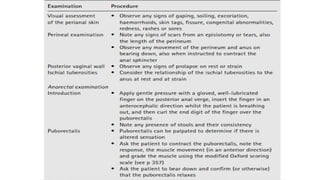
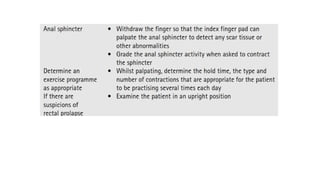
โ€ข Anorectal Examination in left Side lying
Treatment
โ€ข Diet
โ€ข Appropriate soluble and insoluble fibre should be part of a well-balanced diet including
five pieces of fruit or portions of vegetables per day.
โ€ข Prebiotics, which are non-digestiblecarbohydrates that stimulate the growth of desirable
bacteria in the gut,
โ€ข Probiotics, which are supplements of โ€˜friendlyโ€™ bacteria, help the colonic bacteria to
maintain normal digestion.
โ€ข Prebiotics are bananas, asparagus, garlic, wheat, tomatoes, onions, chicory and Jerusalem
artichokes.
โ€ข Probiotics are usually bought as live bacteria added to foods, drinks
โ€ข and yoghurts (e.g. Actimel, Yakult, Bio yoghurts).
BOWEL RETRAINING
โ€ข healthy diet and toileting 20โ€“30 minutes after a meal or warm drink, especially
breakfast, to utilise the gastrocolic response
โ€ข necessary for those suffering with bowel frequency and urgency
โ€ข Sit on the toilet and hold on for as long as you can. Whatever you can manage
double it and double it again aiming for 5 minutes.
โ€ข When you have mastered this, try holding on for 10 minutes (something to read
may be helpful).
โ€ข When able, try to hold on for 5 minutes whilst in the bathroom but not sat on the
toilet.
โ€ข When able to hold on for 10 minutes away from the toilet, move further away from
the bathroom.
Defaecation technique
โ€ข sitting with forearm support on the knees, feet resting on the floor, the throat closed,
and diaphragm moving down together with a lower abdominal โ€˜brace and bulgeโ€™.
โ€ข Training:
โ€ข sitting on a chair
โ€ข feet supported on a footstool of approximately 15 cm with heels raised
โ€ข hips flexed to more than 90ยฐ
โ€ข the weight of the upper trunk supported on the forearms, resting on the abducted thighs
โ€ข neutral spinal curves.
โ€ข lateral bracing with brief 1โ€“2 second holds and sustained 10โ€“20-seconds holds
โ€ข anal release facilitated by lower abdominal bulging
โ€ข practice of the combination of bracing and bulging
Anal sphincter exercise
โ€ข sit resting back in the chair
โ€ข squeezing as though to stop passing wind or stool
โ€ข same whilst reducing foot pressure on the floor
โ€ข strong holds of maximal length, longer contractions of approximately
half the maximum hold for endurance and finally fast contractions.
โ€ข length and number of contractions are increased and the rest periods
shortened.
โ€ข at least 20 seconds
โ€ข 3 times a day
Biofeedback
โ€ข The biofeedback may be via
โ€ข an anal pressure probe or EMG surface electrodes, either intra-
anally or externally on the anal sphincter.
Massage for
constipation
โ€ข encourage peristalsis, release spasm, relieve flatulence, precipitate bowel opening,
may be used in retraining bowel function
โ€ข As effective as laxatives
1. stroking from the stomach to the groin to encourage initial relaxation
2. when relaxation is felt, effleurage along the colon starting in the right iliac fossa and then
travelling along the ascending, transverse and descending sections of colon
3. following the effleurage strokes by circular kneeding along the line of the colon in the same
direction as previously
4. more effleurage as previously
5. side-to-side stroking across the abdominal wall.
โ€ข Never in isolation
โ€ข recent abdominal surgery is a contraindication to massage
โ€ข Electrical stimulation has been used for many years as a
method of re-education of muscle by raising cortical
awareness, normalising reflex activity and having a direct affect
on the muscle stimulated
โ€ข Anal electrodes
โ€ข Use a frequency of 35โ€“40 Hz with a pulse duration of 250 s
with a non-fatiguing duty cycle
Rectal Sensivity Training
โ€ข If there is a problem with reduced sensation to rectal filling,
sensitivity training is used to re-educate the contraction of the EAS
in response to rectal distension
โ€ข achieved by using a simple device: a rectal balloon attached to a
plastic tube with a three-way tap to enable air to be introduced by
a syringe. Acondom covers the balloon and proximal tube to ensure
good infection control and assist in the removal of the device.
โ€ข The aim is for the patient to gradually recognise smaller volumes of
air/water. These volumes should be recorded At each attendance.
โ€ข If a rectum is โ€˜overactiveโ€™, similar sensory training can be used with
gradually increased volumes being introduced whilst the patient is
asked to contract the sphincter and โ€˜hold onโ€™.
Anal Plugs & Anal Cones
THE END

Bowel&Ano-Rectal Dysfunction (2)qjlkhfvoiuh.pptx

  • 1.
  • 2.
    โ€ข Not enoughresearch or evidence โ€ข traditional view that โ€˜the bowels should be opened once a day โ€ข Most important measure is Prevention โ€ข 1 to 3 days to pass through the gut โ€ข Continence depends on safe storage of the waste material in the colon and rectum
  • 3.
  • 4.
    Storage factors contributeto the maintenance of anorectal continence: โ€ข consistency of stools depends on how long the faecal material remains in the colon โ€ข mass movements are triggered by the gastrocolic reflex โ€ข Anal continence so long as closure pressure at anus greater than by the periodic mass movements of gut through colon to rectum โ€ข as little as 11โ€“68 mL and the maximal sensation at 250โ€“510 mL โ€ข The resting pressure of internal anal sphincter (IAS) contributes 70โ€“85% โ€ข The distension of rectum elicits recto anal inhibitory reflex (RAIR) resulting in relaxation of the IAS. โ€ข upper portion of the IAS releases three or four times an hour to allow โ€˜samplingโ€™
  • 5.
    โ€ข EAS canbe contracted voluntarily โ€ข Can be as much as twice the total resting pressure but can be maintained for only a relatively short time. โ€ข The anorectal angle supported by the puborectalis muscle, produces a flap valve. (60 and 105ยฐ) increse with filling โ€ข The vascular anal cushions โ€ข An intact nerve supply autonomic and somatic โ€ข cohesive contact of the moist rectal walls. โ€ข The consistency of stool (i.e. soft yet formed but not liquid). โ€ข Normal activity of the colon โ€ข individual is cognitively intact
  • 7.
    Defecation โ€ข opening thebowels โ€ข three times a day to three times a week for 94% of the population โ€ข Women defaecate less often โ€ข activity of getting up in the morning and having breakfast stimulates mass peristaltic movements โ€ข If evacuation is inconvenient or impractical, defaecation can be deferred by repeated strong voluntary squeezes of the external anal Sphincter reversing peristalsis and resumption of contraction of the IAS. โ€ข Widening of the anorectal angle โ€ข Knees above hips โ€ข Foot stool
  • 9.
    โ€ข pelvic floormusculature relaxes such that the floor descends 1โ€“2 cm to the plane of the ischial tuberosities โ€ข increases the anorectal angle and the anal canal widen โ€ข EAS and puborectalis muscles will then release. โ€ข Peristalsis โ€ข โ€˜brace and bulgeโ€™ breath holding,descent of the diaphragm, lateral widening of the waist with bulging of the lower abdomen, descent of the pelvic floor, and isometric activity in the pubo-, ilio- and ischiococcygeus muscles to give support to the rectum.
  • 10.
    Bowel & AnorectalDysfuction โ€ข two main groupings: -Difficulty in evacuating faecal material -Inability to store flatus or faecal material
  • 11.
    โ€ข Anal incontinenceisthe term used to describe the involuntary loss of flatus, liquid or solid per anus that is a social or hygienic problem. โ€ข โ€ขAnismusis the term used to describe incoordinate activity of anal sphincters and the levator ani muscles such that they fail to relax when defaecation is attempted.
  • 12.
    Constipation โ€ข Functional (non-pathological)constipation is defined as including two or more of the following symptoms for at least 12 weeks in the last 12 months โ€ข straining in 1/4 defaecations โ€ข lumpy or hard stools in 1/4 defaecations โ€ข sensation of incomplete evacuation in 1/4 evacuations โ€ข sensation of anorectal obstruction/blockade in 1/4 defaecations โ€ข manual manoeuvres to facilitate 1/4 defaecations โ€ข 3 defaecations per week.
  • 13.
    โ€ข โ€ขDescending perineumsyndrome is the term used to describe abnormal descent and bulging of the perineum associated with defaecation. โ€ข โ€ขDyscheziais the term used to describe difficulty with rectal evacuation resulting from a long period of voluntary suppression of the urge to defaecate, and a distended rectum. โ€ข โ€ขFaecal incontinenceis the term used to describe the involuntary loss of liquid or solid per anus. โ€ข โ€ขMegacolonis an abnormal massive dilation of the colon that may be congenital, toxic or acquired. โ€ข โ€ขMegarectum is an abnormal dilation of the rectum. โ€ข โ€ขParadoxical puborectalis contraction is a problem of the puborectalis muscle failing to relax to allow defaecation. โ€ข โ€ขParadoxical anal sphincter contractionis a problem of the anal sphincter failing to relax to allow defaecation. โ€ข โ€ขPassive soilingdescribes losing stool or liquid per anus without feeling the urge to defaecate. โ€ข โ€ขPelvic floor dyssynergia describes uncoordinated pelvic floor muscle activity.
  • 14.
  • 15.
    Abnormal Defecation Techniques โ€ขOccurring in up to 20% of the population โ€ข If a person has an uncoordinated defaecation pattern, there is a failure of anal relaxation with lowered levator ani while retaining sufficient rectal support โ€ข as a result, defecation will be difficult and will cause the person to strain. โ€ข intensive abdominal training, or expiratory effort lead to a rigid abdominal wall result in a barrier to diaphragm able to descend against the abdominal contents to bulge the lower abdominal wall forwards โ€ข At rest the anus should be approximately two centimetres above the ischial tuberosities
  • 16.
    โ€ข Toilet sitting โ€ขMany women use perineal pressure (perineal splinting) to effect bowel emptying โ€ข Women with a rectocoele often use digital posterior vaginal wall pressure to give support and assist rectal emptying โ€ข others with severe constipation assist emptying by extracting stool with their fingers per anus.
  • 17.
    Abuse โ€ข often unreported โ€ขan abnormal learned response may occur after sexual assault or abuse โ€ข anismus, paradoxical puborectalis contraction and pelvic floor dyssynergia on attempted defaecation as the pelvic floor muscles fail to release โ€ข abusive or unwanted penetrative sexual activity. โ€ข Eating Disorders โ€ข with eating disorders complain of constipation โ€ข anorexia nervosa, Binge eaters (obesity related to constipation)
  • 18.
    Food & Drink โ€ขInsufficient fluid intake cause constipation. โ€ข coffee (both caffeinated and decaffeinated) affects gut motility โ€ข Low calorie intake rather than low fibre consumption has been shown to be related to constipation in the elderly โ€ข a daily fibre intake of 25 g could increase stool frequency in those with chronic functional constipation; this could be significantly improved by a fluid intake of 1.5โ€“2 litres per day. โ€ข Ignoring the call to stool/workplace leads to constipation โ€ข Shift working can further affect the normal โ€˜body clockโ€™
  • 19.
    IBS โ€ข 10% ofpeople, with a female predominance โ€ข with spastic constipation having abdominal pain related to bowel spasm, โ€ข those with painless diarrhoea complaining of stool frequency without abdominal pain. โ€ข Pain felt in either the right or left iliac fossa or right hypochondrium โ€ข abdominal distension, pain relief with Megacolon and megarectum ,bowel movements, loose, frequent bowel movements or constipation, passage of mucus, excessive flatus, small volumes of pencil-like stools and urgency. โ€ข Blood in the stools is not a symptom of IBS โ€ข multifactorial in its causation โ€ข irritable bladder associated with the IBS
  • 20.
    โ€ข Megacolon/rectum (dilatedsegment shows normal phasic contractility but decreased colonic tone) โ€ข Menstruation (Constipation inc premenstrually) โ€ข Neurological Conditions (Parkinsonโ€™s disease, multiple sclerosis and spinal cord injury) โ€ข Psycohtic Disorders (27%) โ€ข Elderly โ€ข Prolapse - A rectocoele is a herniation of the anterior rectal wall and the posterior vaginal wall into the vagina. โ€ข This tear in the rectovaginal septum most commonly occurs above the attachment to the perineal body โ€ข Constipation and straining and Prolonged straining (bearing down/pushing) at childbirth and psothysterectomy a contributory factor
  • 21.
    Pain associated with analfissure โ€ข An anal fissure is a split or tear in the lining of the lowest part of the anal canal and may be caused by severe constipation or childbirth. โ€ข heals itself it is said to have been an acute โ€ข if the fissure becomes permanent it is said to be a chronic fissure โ€ข Pregnancy & Postpartum - Constipation and a feeling of bloating are common complaints โ€ข 42% in multiparous & 26% in primiparous โ€ข decreasing colonic peristalsis owing to the effect of progesterone on the smooth muscle of the gut. โ€ข increase in water absorption due to increased levels of aldosterone and angiotensin โ€ข After delivery the common practice of giving codeine based analgesia may exacerbate any existing problems with constipation.
  • 22.
    CONSEQUENCES OF CONSTIPATION โ€ข Prolonged โ€ขexcessive straining โ€ข need to use digital help to defecate. โ€ข incomplete emptying โ€ข abdominal cramping and pain โ€ข Bloating โ€ข Perineal pain and nausea. โ€ข physical symptoms of muscle tension, palpitations, a churning stomach โ€ข and fatigue โ€ข emotional symptoms of irritability, worry and less enthusiasm for life โ€ข cognitive symptoms of poor concentration, indecisiveness and memory โ€ข changes โ€ข behavioural symptoms of agitation, lethargy and poor sleep.
  • 23.
    ANAL INCONTINENCE โ€ข lackof control of flatus or stool โ€ข risk of telltale sounds and smell โ€ข complete emptying of the bowel with little or no warning and in an inappropriate place.
  • 24.
    FACTORS CONTRIBUTING TO ANAL INCONTINENCE โ€ขAge - resting anal closure pressure and maximum squeeze pressure decline with age and slowed pudendal N conduction โ€ข Anal sphincter dysfunction - childbirth, perianal surgery (e.g. for an anal fissure, fistula or haemorrhoids), forced โ€ข unwanted anal intercourse or accidental injury. โ€ข Damage to the external sphincter tends to present as urge incontinence because the control once the IAS has relaxed is impaired. โ€ข Damage to the IAS presents as incontinence of flatus or passive soiling (even the passing of solid stool), often following defaecation or on activity, because closure of the IAS for the next storage phase is compromised.
  • 25.
    โ€ข Childbirth -as a result of a perineal tear or an episiotomy which extends from vagina to the anus. โ€ข If the sphincter is involved in any way, the lesion should be classified as a โ€˜third degree tearโ€™. โ€ข Surgery โ€ข Accidents โ€ข Trauma โ€ข Habitual Straining
  • 26.
    Liquid stool/Diarrhoea โ€ข veryfrequent bowel evacuation or the passage of very loose watery, poorly formed stools, or both. โ€ข associated with faecal incontinence โ€ข commonest cause is an infection, viral or bacterial โ€ข Sufferers of any condition which results in inflammation and ulceration of segments of the intestinal tract (e.g. Crohnโ€™s disease, ulcerative colitis, tumours or radiation enteritis) may experience episodes of diarrhoea
  • 27.
    Functional faecal incontinence โ€ข Thisterm covers all faecal incontinence resulting from failure to reach an appropriate place to defaecate in time, in the absence of any of the factors discussed above. โ€ข consideration include: โ€ข toilet and bed heights, โ€ข toilet location, โ€ข clear and unambiguous gender signposting, โ€ข lighting and flooring, โ€ข accessibility โ€ข adequate manoeuvring space, โ€ข the bed and the bedding, โ€ข Clothing and footwear, โ€ข medication and fluids taken, โ€ข eyesight and hearing, orientation and any help available if needed. โ€ข Occupational Therapist
  • 28.
    PHYSIOTHERAPY ASSESSMENT โ€ข History โ€ขBowel habit diary. โ€ข Do they ever pass blood or see blood or mucus in their stools? โ€ข Do they ever have pain before or during opening their bowels? โ€ข How often do they open their bowels and have there been any recent changes? โ€ข What is the stool consistency ? โ€ข Have they any symptoms of faecal urgency and for how long are they able to defer? โ€ข Are they having any faecal loss, is it liquid or solid and are they aware of it happening; how often is it happening and how much is lost? โ€ข In what circumstances do they experience the loss? โ€ข Any blood or mucus? โ€ข Can they control flatus and can they discriminate between flatus, solid and liquid? โ€ข Do they ever have difficulty emptying their bowels; do they strain, use perineal pressure, vaginal pressure or need to empty their bowels manually? โ€ข Do they wear any pads or appliances and how much help are they? โ€ข Do they have/have they had haemorrhoids? โ€ข Do they ever feel a heaviness or anything protruding from the anus or vagina? โ€ข Do they ever strain to empty their bowels? โ€ข In what position do they empty their bowels? โ€ข Do they feel that they completely empty? โ€ข Do they ever experience any abdominal bloating? โ€ข Do they use a lot of toilet paper to cleanse the anal area? โ€ข Do they ever have any skin soreness or other skin problems in the anal region?
  • 29.
    PHYSICAL EXAMINATION โ€ข gait andposture. โ€ข lower back may reveal evidence of spina bifida occulta โ€ข abdominal examination should be undertaken with the patient in supine lying to detect any surgical incisions and the presence of any abnormal masses including a full bladder. โ€ข A neurological assessment will include testing the โ€ข S4 dermatome by testing the perianal region, asking patients if they can feel both sides equally. โ€ข S3 dermatome is checked by sensory testing of the upper two-thirds of the inner surface of the thigh and S2 by checking of the lateral surface of the buttock, lateral thigh, posterior calf and plantar heel. โ€ข Myotomes โ€ข Anorectal Examination in left Side lying
  • 32.
    Treatment โ€ข Diet โ€ข Appropriatesoluble and insoluble fibre should be part of a well-balanced diet including five pieces of fruit or portions of vegetables per day. โ€ข Prebiotics, which are non-digestiblecarbohydrates that stimulate the growth of desirable bacteria in the gut, โ€ข Probiotics, which are supplements of โ€˜friendlyโ€™ bacteria, help the colonic bacteria to maintain normal digestion. โ€ข Prebiotics are bananas, asparagus, garlic, wheat, tomatoes, onions, chicory and Jerusalem artichokes. โ€ข Probiotics are usually bought as live bacteria added to foods, drinks โ€ข and yoghurts (e.g. Actimel, Yakult, Bio yoghurts).
  • 33.
    BOWEL RETRAINING โ€ข healthydiet and toileting 20โ€“30 minutes after a meal or warm drink, especially breakfast, to utilise the gastrocolic response โ€ข necessary for those suffering with bowel frequency and urgency โ€ข Sit on the toilet and hold on for as long as you can. Whatever you can manage double it and double it again aiming for 5 minutes. โ€ข When you have mastered this, try holding on for 10 minutes (something to read may be helpful). โ€ข When able, try to hold on for 5 minutes whilst in the bathroom but not sat on the toilet. โ€ข When able to hold on for 10 minutes away from the toilet, move further away from the bathroom.
  • 34.
    Defaecation technique โ€ข sittingwith forearm support on the knees, feet resting on the floor, the throat closed, and diaphragm moving down together with a lower abdominal โ€˜brace and bulgeโ€™. โ€ข Training: โ€ข sitting on a chair โ€ข feet supported on a footstool of approximately 15 cm with heels raised โ€ข hips flexed to more than 90ยฐ โ€ข the weight of the upper trunk supported on the forearms, resting on the abducted thighs โ€ข neutral spinal curves. โ€ข lateral bracing with brief 1โ€“2 second holds and sustained 10โ€“20-seconds holds โ€ข anal release facilitated by lower abdominal bulging โ€ข practice of the combination of bracing and bulging
  • 35.
    Anal sphincter exercise โ€ขsit resting back in the chair โ€ข squeezing as though to stop passing wind or stool โ€ข same whilst reducing foot pressure on the floor โ€ข strong holds of maximal length, longer contractions of approximately half the maximum hold for endurance and finally fast contractions. โ€ข length and number of contractions are increased and the rest periods shortened. โ€ข at least 20 seconds โ€ข 3 times a day
  • 36.
    Biofeedback โ€ข The biofeedbackmay be via โ€ข an anal pressure probe or EMG surface electrodes, either intra- anally or externally on the anal sphincter.
  • 37.
    Massage for constipation โ€ข encourageperistalsis, release spasm, relieve flatulence, precipitate bowel opening, may be used in retraining bowel function โ€ข As effective as laxatives 1. stroking from the stomach to the groin to encourage initial relaxation 2. when relaxation is felt, effleurage along the colon starting in the right iliac fossa and then travelling along the ascending, transverse and descending sections of colon 3. following the effleurage strokes by circular kneeding along the line of the colon in the same direction as previously 4. more effleurage as previously 5. side-to-side stroking across the abdominal wall. โ€ข Never in isolation โ€ข recent abdominal surgery is a contraindication to massage
  • 38.
    โ€ข Electrical stimulationhas been used for many years as a method of re-education of muscle by raising cortical awareness, normalising reflex activity and having a direct affect on the muscle stimulated โ€ข Anal electrodes โ€ข Use a frequency of 35โ€“40 Hz with a pulse duration of 250 s with a non-fatiguing duty cycle
  • 39.
    Rectal Sensivity Training โ€ขIf there is a problem with reduced sensation to rectal filling, sensitivity training is used to re-educate the contraction of the EAS in response to rectal distension โ€ข achieved by using a simple device: a rectal balloon attached to a plastic tube with a three-way tap to enable air to be introduced by a syringe. Acondom covers the balloon and proximal tube to ensure good infection control and assist in the removal of the device. โ€ข The aim is for the patient to gradually recognise smaller volumes of air/water. These volumes should be recorded At each attendance. โ€ข If a rectum is โ€˜overactiveโ€™, similar sensory training can be used with gradually increased volumes being introduced whilst the patient is asked to contract the sphincter and โ€˜hold onโ€™.
  • 40.
    Anal Plugs &Anal Cones THE END