In digital image processing, boundary representation (also called contour representation) refers to describing an object in an image by representing only its outer boundary (edges) instead of storing the entire set of pixels inside the region.
NADAR SARASWATHI COLLEGEOF ARTS AND SCIENCE
TITLE: Boundary Representation in
Digital Image Processing
By:
S.Sharmila
II M. Sc (cs)
Digital Image Processing
Introduction to ImageBoundaries and Their Significance
Image boundaries are the fundamental lines or curves that define object
shapes within a digital image. They serve as critical information carriers,
delineating distinct regions and providing structural context. Accurate
boundary detection and representation are paramount for numerous
image processing and computer vision tasks.
Understanding these boundaries is the first step towards unlocking
deeper insights from visual data.
4.
Why Represent Boundaries?Applications in DIP
Object Recognition
Precisely identifying and classifying objects based on their
unique shapes and contours.
Medical Imaging
Delimiting organs, tumours, or anomalies for accurate
diagnosis and treatment planning.
Robotics & Automation
Enabling robots to interact with objects by understanding
their physical forms and boundaries.
Geographic Information Systems (GIS)
Mapping land parcels, urban areas, and environmental
features for spatial analysis.
5.
Overview of BoundaryRepresentation Techniques
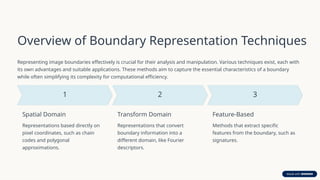
Representing image boundaries effectively is crucial for their analysis and manipulation. Various techniques exist, each with
its own advantages and suitable applications. These methods aim to capture the essential characteristics of a boundary
while often simplifying its complexity for computational efficiency.
Spatial Domain
Representations based directly on
pixel coordinates, such as chain
codes and polygonal
approximations.
Transform Domain
Representations that convert
boundary information into a
different domain, like Fourier
descriptors.
Feature-Based
Methods that extract specific
features from the boundary, such as
signatures.
6.
Chain Codes: ASimple Representation Method
Chain codes represent a boundary by a sequence of directional codes, tracing the
perimeter of an object. Each code indicates the direction from one boundary pixel to
the next, typically using 4-connectivity or 8-connectivity.
• Compact representation for simple shapes.
• Easy to derive and store.
• Sensitive to noise and rotation, which can alter the code sequence significantly.
7.
Polygonal Approximations: SimplifyingBoundary Shapes
Polygonal approximations simplify complex boundaries into a series of straight line segments. This technique reduces data redundancy and noise, making the
boundary more manageable for analysis and storage. The goal is to retain the essential shape characteristics with fewer points.
• Reduces data points, simplifying storage and processing.
• Insensitive to minor boundary irregularities, focusing on global shape.
• Algorithms often involve iteratively removing points or merging segments based on
error criteria.
• Useful for shape matching and recognition tasks where exact pixel-level detail is not
required.
8.
Signatures: Capturing ShapeInformation
A signature is a 1D functional representation of a 2D boundary.
It's typically generated by plotting the distance from the centroid
of an object to its boundary points as a function of the angle, or by
mapping the curvature along the perimeter.
• Invariant to translation (if using centroid).
• Can be made invariant to rotation by starting at a specific
reference point.
• Sensitive to scaling, requiring normalization for scale invariance.
• Useful for describing overall shape characteristics in a compact
form.
9.
Fourier Descriptors:
Frequency Domain
Representation
FourierDescriptors (FDs) represent a boundary in the frequency
domain. The coordinates of the boundary points are treated as a
complex sequence, and a Discrete Fourier Transform (DFT) is applied.
The resulting Fourier coefficients are then used as descriptors.
• Provides a powerful way to represent shape invariant to translation,
rotation, and scaling.
• Low-frequency components capture the overall shape, while high-
frequency components describe fine details.
• Robust to noise and can be truncated to achieve a desired level of
detail.
• Widely used in shape analysis and pattern recognition due to their
mathematical properties and invariance capabilities.
10.
Practical Considerations forChoosing a Boundary
Representation
Computational Efficiency
Consider the time and resources required for generation and
processing, especially for real-time applications.
Accuracy & Detail
Evaluate how precisely the representation captures the original
boundary, balancing detail with simplification needs.
Invariance Properties
Choose a method that is robust to translation, rotation, and
scaling if these factors are irrelevant to the task.
Application Specifics
The choice heavily depends on the downstream application
(e.g., medical imaging vs. simple object counting).
No single representation is optimal for all scenarios; the best choice is often a trade-off based on specific requirements.
11.
Conclusion and FutureDirections in Boundary
Analysis
Boundary representation is a cornerstone of digital image processing, enabling a myriad of applications from medical
diagnostics to autonomous navigation. As technology advances, so too do the techniques for more precise and robust
boundary analysis.
• Continued research into AI and deep learning for automated and more accurate boundary detection, even in complex
scenarios.
• Development of hybrid representation methods that combine the strengths of different techniques for enhanced performance.
• Focus on real-time processing capabilities for dynamic environments and applications.
• Integration with 3D and volumetric data for more comprehensive spatial understanding.
The future promises even more sophisticated tools for understanding and interacting with the visual world through its
defined boundaries.