GLOBALSOFT TECHNOLOGIES 
IEEE PROJECTS & SOFTWARE DEVELOPMENTS 
IEEE FINAL YEAR PROJECTS|IEEE ENGINEERING PROJECTS|IEEE STUDENTS PROJECTS|IEEE 
BULK PROJECTS|BE/BTECH/ME/MTECH/MS/MCA PROJECTS|CSE/IT/ECE/EEE PROJECTS 
CELL: +91 98495 39085, +91 99662 35788, +91 98495 57908, +91 97014 40401 
Visit: www.finalyearprojects.org Mail to:ieeefinalsemprojects@gmail.com 
Boundary Cutting for Packet Classification 
ABSTRACT: 
Decision-tree-based packet classification algorithms such as HiCuts, HyperCuts, 
and EffiCuts show excellent search performance by exploiting the geometrical 
representation of rules in a classifier and searching for a geometric subspace to 
which each input packet belongs. However, decision tree algorithms involve 
complicated heuristics for determining the field and number of cuts. Moreover, 
fixed interval-based cutting not relating to the actual space that each rule covers is 
ineffective and results in a huge storage requirement. A new efficient packet 
classification algorithm using boundary cutting is proposed in this paper. The 
proposed algorithm finds out the space that each rule covers and performs the 
cutting according to the space boundary. Hence, the cutting in the proposed 
algorithm is deterministic rather than involving the complicated heuristics, and it is 
more effective in providing improved search performance and more efficient in 
memory requirement. For rule sets with 1000–100 000 rules, simulation results 
show that the proposed boundary cutting algorithm provides a packet classification 
through 10–23 on-chip memory accesses and 1–4 off-chip memory accesses in 
average.
EXISTING SYSTEM: 
 Our study analyzed various decision-tree-based packet classification 
algorithms. If a decision tree is properly partitioned so that the internal tree 
nodes are stored in an on-chip memory and a large rule database is stored in 
an off-chip memory, the decision tree algorithm can provide very high-speed 
search performance. Moreover, decision tree algorithms naturally enable 
both the highest-priority match and the multimatch packet classification. 
Earlier decision tree algorithms such as HiCuts and HyperCuts select the 
field and number of cuts based on a locally optimized decision, which 
compromises the search speed and the memory requirement. This process 
requires a fair amount of preprocessing, which involves complicated 
heuristics related to each given rule set. 
DISADVANTAGES OF EXISTING SYSTEM: 
 The computation required for the pre-processing consumes much memory 
and construction time, making it difficult. 
 Algorithms to be extended to large rule sets because of memory problems in 
building the decision trees. 
 The cutting is based on a fixed interval, which does not consider the actual 
space that each rule covers; hence it is ineffective. 
PROPOSED SYSTEM:
 In this paper, we propose a new efficient packet classification algorithm 
based on boundary cutting. Cutting in the proposed algorithm is based on the 
disjoint space covered by each rule. 
 Hence, the packet classification table using the proposed algorithm is 
deterministically built and does not require the complicated heuristics used 
by earlier decision tree algorithms. 
ADVANTAGES OF PROPOSED SYSTEM: 
 The boundary cutting of the proposed algorithm is more effective than that 
of earlier algorithms since it is based on rule boundaries rather than fixed 
intervals. Hence, the amount of required memory is significantly reduced. 
 Although BC loses the indexing ability at internal nodes, the binary search at 
internal nodes provides good search performance 
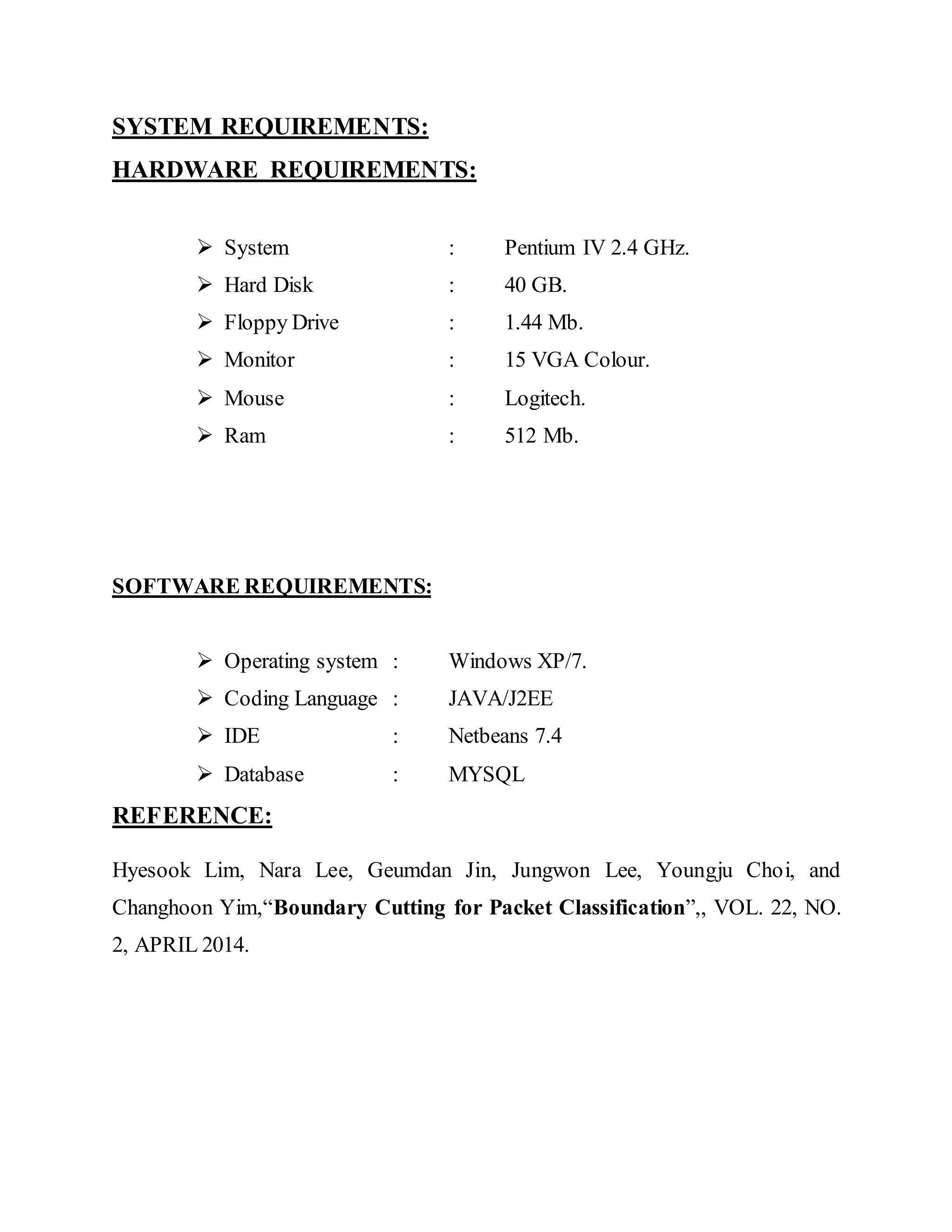
SYSTEM ARCHITECTURE:
SYSTEM REQUIREMENTS: 
HARDWARE REQUIREMENTS: 
 System : Pentium IV 2.4 GHz. 
 Hard Disk : 40 GB. 
 Floppy Drive : 1.44 Mb. 
 Monitor : 15 VGA Colour. 
 Mouse : Logitech. 
 Ram : 512 Mb. 
SOFTWARE REQUIREMENTS: 
 Operating system : Windows XP/7. 
 Coding Language : JAVA/J2EE 
 IDE : Netbeans 7.4 
 Database : MYSQL 
REFERENCE: 
Hyesook Lim, Nara Lee, Geumdan Jin, Jungwon Lee, Youngju Choi, and 
Changhoon Yim,“Boundary Cutting for Packet Classification”,, VOL. 22, NO. 
2, APRIL 2014.

2014 IEEE JAVA NETWORKING COMPUTING PROJECT Boundary cutting for packet classification

  • 1.
    GLOBALSOFT TECHNOLOGIES IEEEPROJECTS & SOFTWARE DEVELOPMENTS IEEE FINAL YEAR PROJECTS|IEEE ENGINEERING PROJECTS|IEEE STUDENTS PROJECTS|IEEE BULK PROJECTS|BE/BTECH/ME/MTECH/MS/MCA PROJECTS|CSE/IT/ECE/EEE PROJECTS CELL: +91 98495 39085, +91 99662 35788, +91 98495 57908, +91 97014 40401 Visit: www.finalyearprojects.org Mail to:ieeefinalsemprojects@gmail.com Boundary Cutting for Packet Classification ABSTRACT: Decision-tree-based packet classification algorithms such as HiCuts, HyperCuts, and EffiCuts show excellent search performance by exploiting the geometrical representation of rules in a classifier and searching for a geometric subspace to which each input packet belongs. However, decision tree algorithms involve complicated heuristics for determining the field and number of cuts. Moreover, fixed interval-based cutting not relating to the actual space that each rule covers is ineffective and results in a huge storage requirement. A new efficient packet classification algorithm using boundary cutting is proposed in this paper. The proposed algorithm finds out the space that each rule covers and performs the cutting according to the space boundary. Hence, the cutting in the proposed algorithm is deterministic rather than involving the complicated heuristics, and it is more effective in providing improved search performance and more efficient in memory requirement. For rule sets with 1000–100 000 rules, simulation results show that the proposed boundary cutting algorithm provides a packet classification through 10–23 on-chip memory accesses and 1–4 off-chip memory accesses in average.
  • 2.
    EXISTING SYSTEM: Our study analyzed various decision-tree-based packet classification algorithms. If a decision tree is properly partitioned so that the internal tree nodes are stored in an on-chip memory and a large rule database is stored in an off-chip memory, the decision tree algorithm can provide very high-speed search performance. Moreover, decision tree algorithms naturally enable both the highest-priority match and the multimatch packet classification. Earlier decision tree algorithms such as HiCuts and HyperCuts select the field and number of cuts based on a locally optimized decision, which compromises the search speed and the memory requirement. This process requires a fair amount of preprocessing, which involves complicated heuristics related to each given rule set. DISADVANTAGES OF EXISTING SYSTEM:  The computation required for the pre-processing consumes much memory and construction time, making it difficult.  Algorithms to be extended to large rule sets because of memory problems in building the decision trees.  The cutting is based on a fixed interval, which does not consider the actual space that each rule covers; hence it is ineffective. PROPOSED SYSTEM:
  • 3.
     In thispaper, we propose a new efficient packet classification algorithm based on boundary cutting. Cutting in the proposed algorithm is based on the disjoint space covered by each rule.  Hence, the packet classification table using the proposed algorithm is deterministically built and does not require the complicated heuristics used by earlier decision tree algorithms. ADVANTAGES OF PROPOSED SYSTEM:  The boundary cutting of the proposed algorithm is more effective than that of earlier algorithms since it is based on rule boundaries rather than fixed intervals. Hence, the amount of required memory is significantly reduced.  Although BC loses the indexing ability at internal nodes, the binary search at internal nodes provides good search performance SYSTEM ARCHITECTURE:
  • 4.
    SYSTEM REQUIREMENTS: HARDWAREREQUIREMENTS:  System : Pentium IV 2.4 GHz.  Hard Disk : 40 GB.  Floppy Drive : 1.44 Mb.  Monitor : 15 VGA Colour.  Mouse : Logitech.  Ram : 512 Mb. SOFTWARE REQUIREMENTS:  Operating system : Windows XP/7.  Coding Language : JAVA/J2EE  IDE : Netbeans 7.4  Database : MYSQL REFERENCE: Hyesook Lim, Nara Lee, Geumdan Jin, Jungwon Lee, Youngju Choi, and Changhoon Yim,“Boundary Cutting for Packet Classification”,, VOL. 22, NO. 2, APRIL 2014.