TOPIC How to Evaluate Return
on Investment (ROI) for
Your Public Relations.
© 2005 Boscobel Marketing Communications, Inc. All rights reserved. All product names or logos are trademarks or registered trademarks of their respective owners.
A WH ITE PAPER SER I ES FROM BOSCOBEL
MAR KETI NG COMMU N ICATIONS
BLUEPRINTS
for SUCCESS
BLUEPRINTS FOR SUCCESS
2ROI for Public Relations ■ Boscobel Marketing Communications ■ 301.588.2900 ■ www.boscobel.com
I. INTRODUCTION ......................................................................................................3
II. ESTABLISHING GOALS ..........................................................................................3
III. IMPROVING PERCEPTION....................................................................................4
IV. MEDIA COVERAGE..............................................................................................4
Monitoring Clips and Circulation Reports ................................................6
Ad Equivalency..........................................................................................................7
Clip Analysis.............................................................................................................. 8
V.V.V WEB SITE HITS ....................................................................................................8
VI. BOTTOM LINE...................................................................................................10
BLUEPRINTS FOR SUCCESS
3ROI for Public Relations ■ Boscobel Marketing Communications ■ 301.588.2900 ■ www.boscobel.com
I. Introduction
Many people believe that Return On Investment (ROI) for public relations is just a
pipe dream. They want to believe in it, because they hope it exists. But how can they
be sure? It’s tough to quantify because few metrics have been set to really measure
ROI for public relations. Still, every year, millions are spent on campaigns without
quantifiable results.
Well, at Boscobel, we have been tracking our clients’ ROI for 27 years.
Joyce Bosc, president of Boscobel Marketing Communications, puts it this way:
“Historically, public relations firms have been very reluctant to talk about ROI,
but with the decline of advertising budgets, I think it has made the public relations
industry think a lot more strategically about the matter. Clients deserve to understand
exactly how their investment is doing.”
In the days when Madison Avenue was riding high, public relations was treated as
an afterthought. It was a nice supplemental way of getting your brand noticed in
addition to the myriad of glossy print and television ads. Often, it was used only when
a company was in crisis mode. But as advertising budgets got squeezed, the role of
public relations began to evolve.
No longer a supporting character in the marketing communications landscape, public
relations has increasingly become a primary means of getting organizations noticed or
branded. In some cases, because of the high cost of creating and placing ads, PR may
be the only means to launch a product or service.
However, just because it may be the only option for some organizations, public
relations firms still need to justify the investment.
II. Establishing Goals
How does a pole-vaulter measure how high she can jump? She sets the bar.
The first step towards measuring ROI for public relations is to establish a set of goals.
Once goals are set, you will be better positioned to evaluate your public relations
efforts using performance-based metrics. As you embark on your new PR initiative,
what does your organization want to accomplish?
A few examples may include:
1) Improving Audience Perceptions — Before launching your campaign, have a
market research company conduct a survey of reporters and industry analysts. What
are their impressions of your organization? Sometimes, conducting focus groups
With the decline
of advertising
budgets, I think it
has made the public
relations industry
think a lot more
strategically about
quantifying results.
BLUEPRINTS FOR SUCCESS
4ROI for Public Relations ■ Boscobel Marketing Communications ■ 301.588.2900 ■ www.boscobel.com
of your target audience will help you understand not only how your audience feels
about you, but also what they expect from you. Six months after the launch of your
campaign, conduct a similar audit. Have people’s perceptions of your organization
changed? How do you stack up against your competitors?
2) Getting More Media Coverage — Review your total media impressions from your
previous year’s campaign and use that as your benchmark for the new campaign. For
instance, if you received 100 media impressions last year, you may want to double that
number in the next six months.
3) Increasing Web Site Hits — Now that you’re receiving media coverage, start
measuring the amount of Web impressions you get after a big article or speaking
opportunity (especially if your Web site is mentioned). Are you noticing an increase in
traffic compared to when you’re not in the news?
4) Expanding the Bottom line — Has the campaign opened the door to new
prospects? Has your sales cycle been shortened? Have your competitors noticed all
your new press?
All of these examples are possible goals to accomplish within your public relations
campaign.
The important thing is to determine what your objectives are before entering any
public relations venture. Once you have a clear sense of what your goals are, you will
then be able to determine if the money you spent was put to good use.
III. Improving Perception
The first step in establishing performance metrics for a public relations campaign
is to create pre- and post-benchmarks. Gather a group of key stakeholders for your
organization to determine your top three competitors. Then scan publications
to compare the media coverage you receive versus the attention garnered by your
competition.
How does your core audience perceive your organization today? How would you like
it to be perceived? Remember, analysis of any public relations campaign should not be
just an audit of past performance, but a means to form a plan for future endeavors.
According to William Black, former VP of PR21 (now Zeno Group), “the opportunity
in media analysis is to take information and look ahead to the future, make forward-
looking recommendations and give strategic advice.”
IV. Media Coverage
Perhaps above all else, organizations recognize public relations as a means of getting
media coverage. In the pursuit of measuring ROI for public relations, media clips
present tangible evidence that something is being generated for the amount of money
spent on a campaign.
Analysis of any
public relations
campaign should not
be just an audit of past
performance, but a
means to form a plan
for future endeavors.
BLUEPRINTS FOR SUCCESS
5ROI for Public Relations ■ Boscobel Marketing Communications ■ 301.588.2900 ■ www.boscobel.com
Counting the number of media placements is an important metric in assessing public
relations ROI, but can the numbers be misleading?
Let’s say you score a mention in the New York Times. Congratulations! This is one of
the world’s most influential publications with enormous readership. But take a look at
the article! Does it deliver your organization’s core message? How does your mention
compare to that of competitors also mentioned in the article? Is it positive or negative?
Just as there’s no way to assure top-tier media coverage, there’s no guarantee that the
coverage you do receive will be positive. But there are plenty of things that can be
done to increase the likelihood of a positive review. With some planning and carefully
devised tactics, you can get the coverage you deserve and gain a positive return on your
investment. However, if you put together a hasty public relations strategy, you may
still get coverage. But, it may not be the kind you were hoping for.
Your ultimate goal should be to reach your primary stakeholders with a message that is
on point and delivers the information you want them to know.
Another way to calculate the success of your PR efforts is to see how many feature
articles you can get placed for your organization. A good way to do this is to research
the editorial calendars of targeted publications to see what stories they plan to run in
the coming year. If your organization is a good fit for one of those features, position
yourself to that publication as an expert in your field. Doing so can help you with
many more PR opportunities.
According to Rodger Roeser, former president of Eisen Management Group, “unless
the entity you are trying to promote has an enormous ego and is shooting for press
for press’ sake — hoping simply to see their photograph and read their witty banter in
their favorite trade pub — ROI is measured by much further reaching endeavors than
simple ‘hits’.”
Roeser goes on to note that, unfortunately, this is how most organizations compute
their success. However, he adds, “a ‘hit’ in your targeted media is the fulfillment of a
tactic, a strategy — whatever your [organization] calls it — it is means to a measurable
end and not the end itself. Media relations are completely ineffective to the bottom
line if not used within a strong and creative strategy to accomplish a worthwhile and
salient objective (especially in this economy). For example, to increase sales of widgets
by 75 percent over current benchmark by X date.”
In order for PR activities to be considered a success, Roeser suggests that they must
make a measurable difference to the bottom line, by promoting cohesiveness and assist
in the development of corporate-wide objectives. How can press coverage assist in
these objectives?
Your ultimate goal
should be to reach
your primary
stakeholders with
a message that is on
point and delivers the
information you want
them to know.
BLUEPRINTS FOR SUCCESS
6ROI for Public Relations ■ Boscobel Marketing Communications ■ 301.588.2900 ■ www.boscobel.com
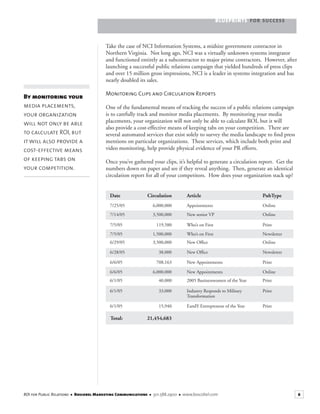
Take the case of NCI Information Systems, a midsize government contractor in
Northern Virginia. Not long ago, NCI was a virtually unknown systems integrator
and functioned entirely as a subcontractor to major prime contractors. However, after
launching a successful public relations campaign that yielded hundreds of press clips
and over 15 million gross impressions, NCI is a leader in systems integration and has
nearly doubled its sales.
Monitoring Clips and Circulation Reports
One of the fundamental means of tracking the success of a public relations campaign
is to carefully track and monitor media placements. By monitoring your media
placements, your organization will not only be able to calculate ROI, but it will
also provide a cost-effective means of keeping tabs on your competition. There are
several automated services that exist solely to survey the media landscape to find press
mentions on particular organizations. These services, which include both print and
video monitoring, help provide physical evidence of your PR efforts.
Once you’ve gathered your clips, it’s helpful to generate a circulation report. Get the
numbers down on paper and see if they reveal anything. Then, generate an identical
circulation report for all of your competitors. How does your organization stack up?
Date Circulation Article PubType
7/25/05 6,000,000 Appointments Online
7/14/05 3,500,000 New senior VP Online
7/5/05 119,580 Who’s on First Print
7/5/05 1,500,000 Who’s on First Newsletter
6/29/05 3,500,000 New Office Online
6/28/05 38,000 New Office Newsletter
6/6/05 708,163 New Appointments Print
6/6/05 6,000,000 New Appointments Online
6/1/05 40,000 2005 Businesswomen of the Year Print
6/1/05 33,000 Industry Responds to Military
Transformation
Print
6/1/05 15,940 EandY Entrepreneur of the Year Print
Total: 21,454,683
By monitoring your
media placements,
your organization
will not only be able
to calculate ROI, but
it will also provide a
cost-effective means
of keeping tabs on
your competition.
BLUEPRINTS FOR SUCCESS
7ROI for Public Relations ■ Boscobel Marketing Communications ■ 301.588.2900 ■ www.boscobel.com
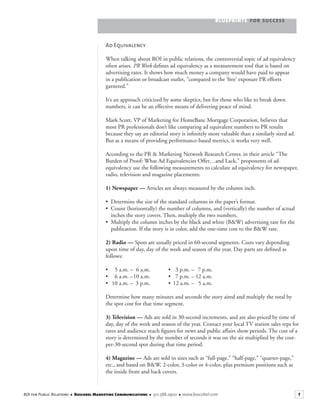
Ad Equivalency
When talking about ROI in public relations, the controversial topic of ad equivalency
often arises. PR Week defines ad equivalency as a measurement tool that is based onPR Week defines ad equivalency as a measurement tool that is based onPR Week
advertising rates. It shows how much money a company would have paid to appear
in a publication or broadcast outlet, “compared to the ‘free’ exposure PR efforts
garnered.”
It’s an approach criticized by some skeptics, but for those who like to break down
numbers, it can be an effective means of delivering peace of mind.
Mark Scott, VP of Marketing for HomeBanc Mortgage Corporation, believes that
most PR professionals don’t like comparing ad equivalent numbers to PR results
because they say an editorial story is infinitely more valuable than a similarly sized ad.
But as a means of providing performance-based metrics, it works very well.
According to the PR & Marketing Network Research Center, in their article “The
Burden of Proof: What Ad Equivalencies Offer…and Lack,” proponents of ad
equivalency use the following measurements to calculate ad equivalency for newspaper,
radio, television and magazine placements:
1) Newspaper — Articles are always measured by the column inch.
• Determine the size of the standard columns in the paper’s format.
• Count (horizontally) the number of columns, and (vertically) the number of actual
inches the story covers. Then, multiply the two numbers.
• Multiply the column inches by the black and white (B&W) advertising rate for the
publication. If the story is in color, add the one-time cost to the B&W rate.
2) Radio — Spots are usually priced in 60-second segments. Costs vary depending
upon time of day, day of the week and season of the year. Day parts are defined as
follows:
• 5 a.m. – 6 a.m. • 3 p.m. – 7 p.m.
• 6 a.m. –10 a.m. • 7 p.m. – 12 a.m.
• 10 a.m. – 3 p.m. • 12 a.m. – 5 a.m.
Determine how many minutes and seconds the story aired and multiply the total by
the spot cost for that time segment.
3) Television — Ads are sold in 30-second increments, and are also priced by time of
day, day of the week and season of the year. Contact your local TV station sales reps for
rates and audience reach figures for news and public affairs show periods. The cost of a
story is determined by the number of seconds it was on the air multiplied by the cost-
per-30-second spot during that time period.
4) Magazine — Ads are sold in sizes such as “full-page,” “half-page,” “quarter-page,”
etc., and based on B&W, 2-color, 3-color or 4-color, plus premium positions such as
the inside front and back covers.
BLUEPRINTS FOR SUCCESS
8ROI for Public Relations ■ Boscobel Marketing Communications ■ 301.588.2900 ■ www.boscobel.com
• Horizontally count the number of standard columns in the magazine. (Or, use the
standard column inch width of 2 9/16 inches). Vertically, measure the number of
inches of type. Multiply the numbers.
• Obtain the “full-page” ad rates for B&W, 2-color, 3-color and 4-color ads. Simply
divide the “full-page” rates by the number of total column inches to get your “per-
column-inch” rate.
The article goes on to warn that while ad equivalency is a good way to assign a number
to the amount of ink you receive, it does little in terms of providing context. For
that reason, a comprehensive analysis of your media coverage is the crucial next step
towards calculating ROI.
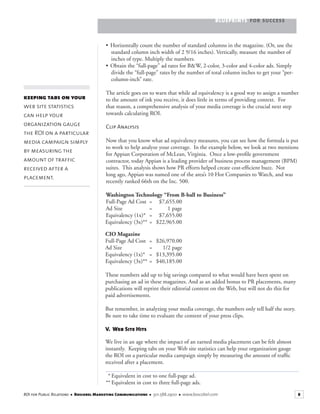
Clip Analysis
Now that you know what ad equivalency measures, you can see how the formula is put
to work to help analyze your coverage. In the example below, we look at two mentions
for Appian Corporation of McLean, Virginia. Once a low-profile government
contractor, today Appian is a leading provider of business process management (BPM)
suites. This analysis shows how PR efforts helped create cost-efficient buzz. Not
long ago, Appian was named one of the area’s 10 Hot Companies to Watch, and was
recently ranked 66th on the Inc. 500.
Washington Technology “From B-ball to Business”
Full-Page Ad Cost = $7,655.00
Ad Size = 1 page
Equivalency (1x)* = $7,655.00
Equivalency (3x)** = $22,965.00
CIO Magazine
Full-Page Ad Cost = $26,970.00
Ad Size = 1/2 page
Equivalency (1x)* = $13,395.00
Equivalency (3x)** = $40,185.00
These numbers add up to big savings compared to what would have been spent on
purchasing an ad in these magazines. And as an added bonus to PR placements, many
publications will reprint their editorial content on the Web, but will not do this for
paid advertisements.
But remember, in analyzing your media coverage, the numbers only tell half the story.
Be sure to take time to evaluate the content of your press clips.
V. Web Site Hits
We live in an age where the impact of an earned media placement can be felt almost
instantly. Keeping tabs on your Web site statistics can help your organization gauge
the ROI on a particular media campaign simply by measuring the amount of traffic
received after a placement.
* Equivalent in cost to one full-page ad.
** Equivalent in cost to three full-page ads.
keeping tabs on your
web site statistics
can help your
organization gauge
the ROI on a particular
media campaign simply
by measuring the
amount of traffic
received after a
placement.
BLUEPRINTS FOR SUCCESS
9ROI for Public Relations ■ Boscobel Marketing Communications ■ 301.588.2900 ■ www.boscobel.com
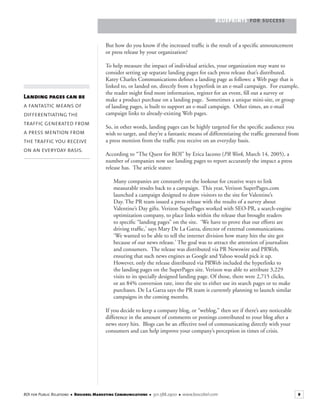
But how do you know if the increased traffic is the result of a specific announcement
or press release by your organization?
To help measure the impact of individual articles, your organization may want to
consider setting up separate landing pages for each press release that’s distributed.
Katey Charles Communications defines a landing page as follows: a Web page that is
linked to, or landed on, directly from a hyperlink in an e-mail campaign. For example,
the reader might find more information, register for an event, fill out a survey or
make a product purchase on a landing page. Sometimes a unique mini-site, or group
of landing pages, is built to support an e-mail campaign. Other times, an e-mail
campaign links to already-existing Web pages.
So, in other words, landing pages can be highly targeted for the specific audience you
wish to target, and they’re a fantastic means of differentiating the traffic generated from
a press mention from the traffic you receive on an everyday basis.
According to “The Quest for ROI” by Erica Iacono (PR Week, March 14, 2005), aPR Week, March 14, 2005), aPR Week
number of companies now use landing pages to report accurately the impact a press
release has. The article states:
Many companies are constantly on the lookout for creative ways to link
measurable results back to a campaign. This year, Verizon SuperPages.com
launched a campaign designed to draw visitors to the site for Valentine’s
Day. The PR team issued a press release with the results of a survey about
Valentine’s Day gifts. Verizon SuperPages worked with SEO-PR, a search-engine
optimization company, to place links within the release that brought readers
to specific “landing pages” on the site. ‘We have to prove that our efforts are
driving traffic,’ says Mary De La Garza, director of external communications.
‘We wanted to be able to tell the internet division how many hits the site got
because of our news release.’ The goal was to attract the attention of journalists
and consumers. The release was distributed via PR Newswire and PRWeb,
ensuring that such news engines as Google and Yahoo would pick it up.
However, only the release distributed via PRWeb included the hyperlinks to
the landing pages on the SuperPages site. Verizon was able to attribute 3,229
visits to its specially designed landing page. Of those, there were 2,715 clicks,
or an 84% conversion rate, into the site to either use its search pages or to make
purchases. De La Garza says the PR team is currently planning to launch similar
campaigns in the coming months.
If you decide to keep a company blog, or “weblog,” then see if there’s any noticeable
difference in the amount of comments or postings contributed to your blog after a
news story hits. Blogs can be an effective tool of communicating directly with your
consumers and can help improve your company’s perception in times of crisis.
Landing pages can be
a fantastic means of
differentiating the
traffic generated from
a press mention from
the traffic you receive
on an everyday basis.
BLUEPRINTS FOR SUCCESS
10ROI for Public Relations ■ Boscobel Marketing Communications ■ 301.588.2900 ■ www.boscobel.com
VI. Bottom Line
Truth be told, public relations is not a cure-all for weak sales. But, an effective
campaign can aid in getting your customers closer to saying “yes” to what you have to
offer. By increasing awareness and getting your organization recognized, the impact
on your ROI can be seen through increased sales and an improved perception of your
organization’s products and services.
It helps to tailor your public relations strategy to achieve your goals and shows how
well you have achieved them. By increasing awareness of your organization, or perhaps
changing a negative perception to a positive, you are one step closer to gaining a new
customer — and capturing the market.
About Boscobel
Boscobel Marketing Communications, Inc., is one of the Washington, DC-area’s
leading and most respected branding and PR firms. Now in its 27th year, Boscobel
provides integrated branding, public relations, marketing and advertising solutions
to federal contractors, government agencies, commercial clients and associations.
Founded by noted branding authority Joyce Bosc, the firm’s senior-level staff
provides creative, comprehensive and effective solutions. It is best known for its
landmark work in branding and launching America Online and many products
for GE. Other client successes include AT&T, IBM, Intelsat General, SAIC, the
U.S. Coast Guard, the U.S. Customs Service, and numerous associations and non-
profits.

How to Evaluate Return on Investment (ROI) for Your Public Relations

  • 1.
    TOPIC How toEvaluate Return on Investment (ROI) for Your Public Relations. © 2005 Boscobel Marketing Communications, Inc. All rights reserved. All product names or logos are trademarks or registered trademarks of their respective owners. A WH ITE PAPER SER I ES FROM BOSCOBEL MAR KETI NG COMMU N ICATIONS BLUEPRINTS for SUCCESS
  • 2.
    BLUEPRINTS FOR SUCCESS 2ROIfor Public Relations ■ Boscobel Marketing Communications ■ 301.588.2900 ■ www.boscobel.com I. INTRODUCTION ......................................................................................................3 II. ESTABLISHING GOALS ..........................................................................................3 III. IMPROVING PERCEPTION....................................................................................4 IV. MEDIA COVERAGE..............................................................................................4 Monitoring Clips and Circulation Reports ................................................6 Ad Equivalency..........................................................................................................7 Clip Analysis.............................................................................................................. 8 V.V.V WEB SITE HITS ....................................................................................................8 VI. BOTTOM LINE...................................................................................................10
  • 3.
    BLUEPRINTS FOR SUCCESS 3ROIfor Public Relations ■ Boscobel Marketing Communications ■ 301.588.2900 ■ www.boscobel.com I. Introduction Many people believe that Return On Investment (ROI) for public relations is just a pipe dream. They want to believe in it, because they hope it exists. But how can they be sure? It’s tough to quantify because few metrics have been set to really measure ROI for public relations. Still, every year, millions are spent on campaigns without quantifiable results. Well, at Boscobel, we have been tracking our clients’ ROI for 27 years. Joyce Bosc, president of Boscobel Marketing Communications, puts it this way: “Historically, public relations firms have been very reluctant to talk about ROI, but with the decline of advertising budgets, I think it has made the public relations industry think a lot more strategically about the matter. Clients deserve to understand exactly how their investment is doing.” In the days when Madison Avenue was riding high, public relations was treated as an afterthought. It was a nice supplemental way of getting your brand noticed in addition to the myriad of glossy print and television ads. Often, it was used only when a company was in crisis mode. But as advertising budgets got squeezed, the role of public relations began to evolve. No longer a supporting character in the marketing communications landscape, public relations has increasingly become a primary means of getting organizations noticed or branded. In some cases, because of the high cost of creating and placing ads, PR may be the only means to launch a product or service. However, just because it may be the only option for some organizations, public relations firms still need to justify the investment. II. Establishing Goals How does a pole-vaulter measure how high she can jump? She sets the bar. The first step towards measuring ROI for public relations is to establish a set of goals. Once goals are set, you will be better positioned to evaluate your public relations efforts using performance-based metrics. As you embark on your new PR initiative, what does your organization want to accomplish? A few examples may include: 1) Improving Audience Perceptions — Before launching your campaign, have a market research company conduct a survey of reporters and industry analysts. What are their impressions of your organization? Sometimes, conducting focus groups With the decline of advertising budgets, I think it has made the public relations industry think a lot more strategically about quantifying results.
  • 4.
    BLUEPRINTS FOR SUCCESS 4ROIfor Public Relations ■ Boscobel Marketing Communications ■ 301.588.2900 ■ www.boscobel.com of your target audience will help you understand not only how your audience feels about you, but also what they expect from you. Six months after the launch of your campaign, conduct a similar audit. Have people’s perceptions of your organization changed? How do you stack up against your competitors? 2) Getting More Media Coverage — Review your total media impressions from your previous year’s campaign and use that as your benchmark for the new campaign. For instance, if you received 100 media impressions last year, you may want to double that number in the next six months. 3) Increasing Web Site Hits — Now that you’re receiving media coverage, start measuring the amount of Web impressions you get after a big article or speaking opportunity (especially if your Web site is mentioned). Are you noticing an increase in traffic compared to when you’re not in the news? 4) Expanding the Bottom line — Has the campaign opened the door to new prospects? Has your sales cycle been shortened? Have your competitors noticed all your new press? All of these examples are possible goals to accomplish within your public relations campaign. The important thing is to determine what your objectives are before entering any public relations venture. Once you have a clear sense of what your goals are, you will then be able to determine if the money you spent was put to good use. III. Improving Perception The first step in establishing performance metrics for a public relations campaign is to create pre- and post-benchmarks. Gather a group of key stakeholders for your organization to determine your top three competitors. Then scan publications to compare the media coverage you receive versus the attention garnered by your competition. How does your core audience perceive your organization today? How would you like it to be perceived? Remember, analysis of any public relations campaign should not be just an audit of past performance, but a means to form a plan for future endeavors. According to William Black, former VP of PR21 (now Zeno Group), “the opportunity in media analysis is to take information and look ahead to the future, make forward- looking recommendations and give strategic advice.” IV. Media Coverage Perhaps above all else, organizations recognize public relations as a means of getting media coverage. In the pursuit of measuring ROI for public relations, media clips present tangible evidence that something is being generated for the amount of money spent on a campaign. Analysis of any public relations campaign should not be just an audit of past performance, but a means to form a plan for future endeavors.
  • 5.
    BLUEPRINTS FOR SUCCESS 5ROIfor Public Relations ■ Boscobel Marketing Communications ■ 301.588.2900 ■ www.boscobel.com Counting the number of media placements is an important metric in assessing public relations ROI, but can the numbers be misleading? Let’s say you score a mention in the New York Times. Congratulations! This is one of the world’s most influential publications with enormous readership. But take a look at the article! Does it deliver your organization’s core message? How does your mention compare to that of competitors also mentioned in the article? Is it positive or negative? Just as there’s no way to assure top-tier media coverage, there’s no guarantee that the coverage you do receive will be positive. But there are plenty of things that can be done to increase the likelihood of a positive review. With some planning and carefully devised tactics, you can get the coverage you deserve and gain a positive return on your investment. However, if you put together a hasty public relations strategy, you may still get coverage. But, it may not be the kind you were hoping for. Your ultimate goal should be to reach your primary stakeholders with a message that is on point and delivers the information you want them to know. Another way to calculate the success of your PR efforts is to see how many feature articles you can get placed for your organization. A good way to do this is to research the editorial calendars of targeted publications to see what stories they plan to run in the coming year. If your organization is a good fit for one of those features, position yourself to that publication as an expert in your field. Doing so can help you with many more PR opportunities. According to Rodger Roeser, former president of Eisen Management Group, “unless the entity you are trying to promote has an enormous ego and is shooting for press for press’ sake — hoping simply to see their photograph and read their witty banter in their favorite trade pub — ROI is measured by much further reaching endeavors than simple ‘hits’.” Roeser goes on to note that, unfortunately, this is how most organizations compute their success. However, he adds, “a ‘hit’ in your targeted media is the fulfillment of a tactic, a strategy — whatever your [organization] calls it — it is means to a measurable end and not the end itself. Media relations are completely ineffective to the bottom line if not used within a strong and creative strategy to accomplish a worthwhile and salient objective (especially in this economy). For example, to increase sales of widgets by 75 percent over current benchmark by X date.” In order for PR activities to be considered a success, Roeser suggests that they must make a measurable difference to the bottom line, by promoting cohesiveness and assist in the development of corporate-wide objectives. How can press coverage assist in these objectives? Your ultimate goal should be to reach your primary stakeholders with a message that is on point and delivers the information you want them to know.
  • 6.
    BLUEPRINTS FOR SUCCESS 6ROIfor Public Relations ■ Boscobel Marketing Communications ■ 301.588.2900 ■ www.boscobel.com Take the case of NCI Information Systems, a midsize government contractor in Northern Virginia. Not long ago, NCI was a virtually unknown systems integrator and functioned entirely as a subcontractor to major prime contractors. However, after launching a successful public relations campaign that yielded hundreds of press clips and over 15 million gross impressions, NCI is a leader in systems integration and has nearly doubled its sales. Monitoring Clips and Circulation Reports One of the fundamental means of tracking the success of a public relations campaign is to carefully track and monitor media placements. By monitoring your media placements, your organization will not only be able to calculate ROI, but it will also provide a cost-effective means of keeping tabs on your competition. There are several automated services that exist solely to survey the media landscape to find press mentions on particular organizations. These services, which include both print and video monitoring, help provide physical evidence of your PR efforts. Once you’ve gathered your clips, it’s helpful to generate a circulation report. Get the numbers down on paper and see if they reveal anything. Then, generate an identical circulation report for all of your competitors. How does your organization stack up? Date Circulation Article PubType 7/25/05 6,000,000 Appointments Online 7/14/05 3,500,000 New senior VP Online 7/5/05 119,580 Who’s on First Print 7/5/05 1,500,000 Who’s on First Newsletter 6/29/05 3,500,000 New Office Online 6/28/05 38,000 New Office Newsletter 6/6/05 708,163 New Appointments Print 6/6/05 6,000,000 New Appointments Online 6/1/05 40,000 2005 Businesswomen of the Year Print 6/1/05 33,000 Industry Responds to Military Transformation Print 6/1/05 15,940 EandY Entrepreneur of the Year Print Total: 21,454,683 By monitoring your media placements, your organization will not only be able to calculate ROI, but it will also provide a cost-effective means of keeping tabs on your competition.
  • 7.
    BLUEPRINTS FOR SUCCESS 7ROIfor Public Relations ■ Boscobel Marketing Communications ■ 301.588.2900 ■ www.boscobel.com Ad Equivalency When talking about ROI in public relations, the controversial topic of ad equivalency often arises. PR Week defines ad equivalency as a measurement tool that is based onPR Week defines ad equivalency as a measurement tool that is based onPR Week advertising rates. It shows how much money a company would have paid to appear in a publication or broadcast outlet, “compared to the ‘free’ exposure PR efforts garnered.” It’s an approach criticized by some skeptics, but for those who like to break down numbers, it can be an effective means of delivering peace of mind. Mark Scott, VP of Marketing for HomeBanc Mortgage Corporation, believes that most PR professionals don’t like comparing ad equivalent numbers to PR results because they say an editorial story is infinitely more valuable than a similarly sized ad. But as a means of providing performance-based metrics, it works very well. According to the PR & Marketing Network Research Center, in their article “The Burden of Proof: What Ad Equivalencies Offer…and Lack,” proponents of ad equivalency use the following measurements to calculate ad equivalency for newspaper, radio, television and magazine placements: 1) Newspaper — Articles are always measured by the column inch. • Determine the size of the standard columns in the paper’s format. • Count (horizontally) the number of columns, and (vertically) the number of actual inches the story covers. Then, multiply the two numbers. • Multiply the column inches by the black and white (B&W) advertising rate for the publication. If the story is in color, add the one-time cost to the B&W rate. 2) Radio — Spots are usually priced in 60-second segments. Costs vary depending upon time of day, day of the week and season of the year. Day parts are defined as follows: • 5 a.m. – 6 a.m. • 3 p.m. – 7 p.m. • 6 a.m. –10 a.m. • 7 p.m. – 12 a.m. • 10 a.m. – 3 p.m. • 12 a.m. – 5 a.m. Determine how many minutes and seconds the story aired and multiply the total by the spot cost for that time segment. 3) Television — Ads are sold in 30-second increments, and are also priced by time of day, day of the week and season of the year. Contact your local TV station sales reps for rates and audience reach figures for news and public affairs show periods. The cost of a story is determined by the number of seconds it was on the air multiplied by the cost- per-30-second spot during that time period. 4) Magazine — Ads are sold in sizes such as “full-page,” “half-page,” “quarter-page,” etc., and based on B&W, 2-color, 3-color or 4-color, plus premium positions such as the inside front and back covers.
  • 8.
    BLUEPRINTS FOR SUCCESS 8ROIfor Public Relations ■ Boscobel Marketing Communications ■ 301.588.2900 ■ www.boscobel.com • Horizontally count the number of standard columns in the magazine. (Or, use the standard column inch width of 2 9/16 inches). Vertically, measure the number of inches of type. Multiply the numbers. • Obtain the “full-page” ad rates for B&W, 2-color, 3-color and 4-color ads. Simply divide the “full-page” rates by the number of total column inches to get your “per- column-inch” rate. The article goes on to warn that while ad equivalency is a good way to assign a number to the amount of ink you receive, it does little in terms of providing context. For that reason, a comprehensive analysis of your media coverage is the crucial next step towards calculating ROI. Clip Analysis Now that you know what ad equivalency measures, you can see how the formula is put to work to help analyze your coverage. In the example below, we look at two mentions for Appian Corporation of McLean, Virginia. Once a low-profile government contractor, today Appian is a leading provider of business process management (BPM) suites. This analysis shows how PR efforts helped create cost-efficient buzz. Not long ago, Appian was named one of the area’s 10 Hot Companies to Watch, and was recently ranked 66th on the Inc. 500. Washington Technology “From B-ball to Business” Full-Page Ad Cost = $7,655.00 Ad Size = 1 page Equivalency (1x)* = $7,655.00 Equivalency (3x)** = $22,965.00 CIO Magazine Full-Page Ad Cost = $26,970.00 Ad Size = 1/2 page Equivalency (1x)* = $13,395.00 Equivalency (3x)** = $40,185.00 These numbers add up to big savings compared to what would have been spent on purchasing an ad in these magazines. And as an added bonus to PR placements, many publications will reprint their editorial content on the Web, but will not do this for paid advertisements. But remember, in analyzing your media coverage, the numbers only tell half the story. Be sure to take time to evaluate the content of your press clips. V. Web Site Hits We live in an age where the impact of an earned media placement can be felt almost instantly. Keeping tabs on your Web site statistics can help your organization gauge the ROI on a particular media campaign simply by measuring the amount of traffic received after a placement. * Equivalent in cost to one full-page ad. ** Equivalent in cost to three full-page ads. keeping tabs on your web site statistics can help your organization gauge the ROI on a particular media campaign simply by measuring the amount of traffic received after a placement.
  • 9.
    BLUEPRINTS FOR SUCCESS 9ROIfor Public Relations ■ Boscobel Marketing Communications ■ 301.588.2900 ■ www.boscobel.com But how do you know if the increased traffic is the result of a specific announcement or press release by your organization? To help measure the impact of individual articles, your organization may want to consider setting up separate landing pages for each press release that’s distributed. Katey Charles Communications defines a landing page as follows: a Web page that is linked to, or landed on, directly from a hyperlink in an e-mail campaign. For example, the reader might find more information, register for an event, fill out a survey or make a product purchase on a landing page. Sometimes a unique mini-site, or group of landing pages, is built to support an e-mail campaign. Other times, an e-mail campaign links to already-existing Web pages. So, in other words, landing pages can be highly targeted for the specific audience you wish to target, and they’re a fantastic means of differentiating the traffic generated from a press mention from the traffic you receive on an everyday basis. According to “The Quest for ROI” by Erica Iacono (PR Week, March 14, 2005), aPR Week, March 14, 2005), aPR Week number of companies now use landing pages to report accurately the impact a press release has. The article states: Many companies are constantly on the lookout for creative ways to link measurable results back to a campaign. This year, Verizon SuperPages.com launched a campaign designed to draw visitors to the site for Valentine’s Day. The PR team issued a press release with the results of a survey about Valentine’s Day gifts. Verizon SuperPages worked with SEO-PR, a search-engine optimization company, to place links within the release that brought readers to specific “landing pages” on the site. ‘We have to prove that our efforts are driving traffic,’ says Mary De La Garza, director of external communications. ‘We wanted to be able to tell the internet division how many hits the site got because of our news release.’ The goal was to attract the attention of journalists and consumers. The release was distributed via PR Newswire and PRWeb, ensuring that such news engines as Google and Yahoo would pick it up. However, only the release distributed via PRWeb included the hyperlinks to the landing pages on the SuperPages site. Verizon was able to attribute 3,229 visits to its specially designed landing page. Of those, there were 2,715 clicks, or an 84% conversion rate, into the site to either use its search pages or to make purchases. De La Garza says the PR team is currently planning to launch similar campaigns in the coming months. If you decide to keep a company blog, or “weblog,” then see if there’s any noticeable difference in the amount of comments or postings contributed to your blog after a news story hits. Blogs can be an effective tool of communicating directly with your consumers and can help improve your company’s perception in times of crisis. Landing pages can be a fantastic means of differentiating the traffic generated from a press mention from the traffic you receive on an everyday basis.
  • 10.
    BLUEPRINTS FOR SUCCESS 10ROIfor Public Relations ■ Boscobel Marketing Communications ■ 301.588.2900 ■ www.boscobel.com VI. Bottom Line Truth be told, public relations is not a cure-all for weak sales. But, an effective campaign can aid in getting your customers closer to saying “yes” to what you have to offer. By increasing awareness and getting your organization recognized, the impact on your ROI can be seen through increased sales and an improved perception of your organization’s products and services. It helps to tailor your public relations strategy to achieve your goals and shows how well you have achieved them. By increasing awareness of your organization, or perhaps changing a negative perception to a positive, you are one step closer to gaining a new customer — and capturing the market. About Boscobel Boscobel Marketing Communications, Inc., is one of the Washington, DC-area’s leading and most respected branding and PR firms. Now in its 27th year, Boscobel provides integrated branding, public relations, marketing and advertising solutions to federal contractors, government agencies, commercial clients and associations. Founded by noted branding authority Joyce Bosc, the firm’s senior-level staff provides creative, comprehensive and effective solutions. It is best known for its landmark work in branding and launching America Online and many products for GE. Other client successes include AT&T, IBM, Intelsat General, SAIC, the U.S. Coast Guard, the U.S. Customs Service, and numerous associations and non- profits.