Using Bond Laddering Strategies for Fixed Income Investments presented by:
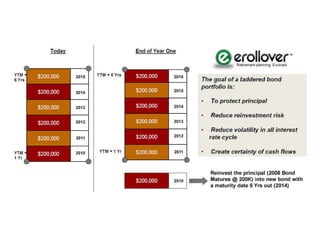
A bond ladder works by spreading investment funds among bonds that will mature at different times between one and thirty years from now.
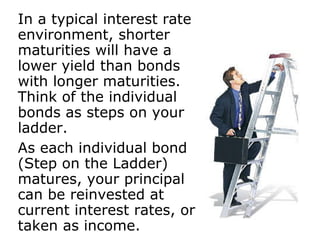
In a typical interest rate environment, shorter maturities will have a lower yield than bonds with longer maturities. Think of the individual bonds as steps on your ladder.  As each individual bond (Step on the Ladder) matures, your principal can be reinvested at current interest rates, or taken as income.
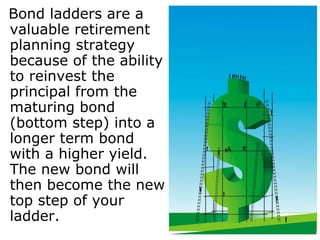
Bond ladders are a valuable retirement planning strategy because of the ability to reinvest the principal from the maturing bond (bottom step) into a longer term bond with a higher yield. The new bond will then become the new top step of your ladder.
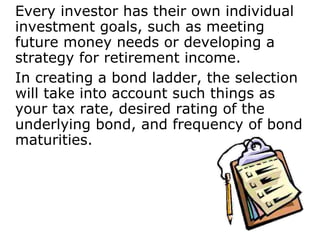
Every investor has their own individual investment goals, such as meeting future money needs or developing a strategy for retirement income.  In creating a bond ladder, the selection will take into account such things as your tax rate, desired rating of the underlying bond, and frequency of bond maturities.
The following are examples of some of the fixed income products that can construct your ladder:  CD’s U.S. Treasury Bills, Notes, and Bonds Corporate Bonds Municipal Bonds Government Agency Bonds
Why Use a Bond Ladder? If interest rates go down over the next few years, you will already have locked in higher rates — and the current market value of your fixed income portfolio will be rising. If interest rates stay the same, you will be earning longer term yields, so your return should exceed what you would be earning if you left your investment short term. If interest rates go up, the current market value of your fixed income portfolio will be falling. However, as each step on the ladder matures, you will have money to invest at higher rates.
 
Final thoughts on a Bond Laddering Strategy Generally speaking, a bond ladder shouldn't be attempted if investors can’t fully diversify their portfolio by investing in both stocks and bonds.  The money needed to start a bond ladder that would have at least five steps is typically between $50,000-$100,000.  As with any investment make sure that all your eggs aren't in one basket (asset allocation), so that you can control exposure to risk, and have access to available fund liquidity if needed.
Thank You [email_address] www.twitter.com/erollover http://www.erollover.com

Bond Laddering

  • 1.
    Using Bond LadderingStrategies for Fixed Income Investments presented by:
  • 2.
    A bond ladderworks by spreading investment funds among bonds that will mature at different times between one and thirty years from now.
  • 3.
    In a typicalinterest rate environment, shorter maturities will have a lower yield than bonds with longer maturities. Think of the individual bonds as steps on your ladder. As each individual bond (Step on the Ladder) matures, your principal can be reinvested at current interest rates, or taken as income.
  • 4.
    Bond ladders area valuable retirement planning strategy because of the ability to reinvest the principal from the maturing bond (bottom step) into a longer term bond with a higher yield. The new bond will then become the new top step of your ladder.
  • 5.
    Every investor hastheir own individual investment goals, such as meeting future money needs or developing a strategy for retirement income. In creating a bond ladder, the selection will take into account such things as your tax rate, desired rating of the underlying bond, and frequency of bond maturities.
  • 6.
    The following areexamples of some of the fixed income products that can construct your ladder:  CD’s U.S. Treasury Bills, Notes, and Bonds Corporate Bonds Municipal Bonds Government Agency Bonds
  • 7.
    Why Use aBond Ladder? If interest rates go down over the next few years, you will already have locked in higher rates — and the current market value of your fixed income portfolio will be rising. If interest rates stay the same, you will be earning longer term yields, so your return should exceed what you would be earning if you left your investment short term. If interest rates go up, the current market value of your fixed income portfolio will be falling. However, as each step on the ladder matures, you will have money to invest at higher rates.
  • 8.
  • 9.
    Final thoughts ona Bond Laddering Strategy Generally speaking, a bond ladder shouldn't be attempted if investors can’t fully diversify their portfolio by investing in both stocks and bonds. The money needed to start a bond ladder that would have at least five steps is typically between $50,000-$100,000. As with any investment make sure that all your eggs aren't in one basket (asset allocation), so that you can control exposure to risk, and have access to available fund liquidity if needed.
  • 10.
    Thank You [email_address]www.twitter.com/erollover http://www.erollover.com