How anyone can participate in the regulatory process
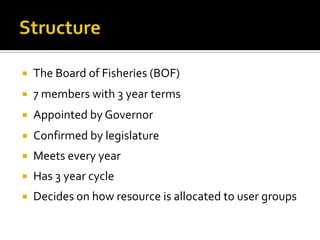
   The Board of Fisheries (BOF)
   7 members with 3 year terms
   Appointed by Governor
   Confirmed by legislature
   Meets every year
   Has 3 year cycle
   Decides on how resource is allocated to user groups
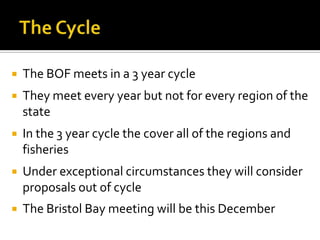
   The BOF meets in a 3 year cycle
   They meet every year but not for every region of the
    state
   In the 3 year cycle the cover all of the regions and
    fisheries
   Under exceptional circumstances they will consider
    proposals out of cycle
   The Bristol Bay meeting will be this December
   There are 82 Advisory Committees (AC)
   They provide local knowledge and expertise on
    issues
   They also provide a local forum to discuss issues
   Their testimony is important in the BOF process
   AC’s meet generally once a year in Bristol Bay
   They get reports form the department and other
    agencies
   Members are elected by the public
   They can generate proposals for BOF or Board of
    Game
   The AC is likely to generate proposals
   The AC comments on all relevant proposals
   The AC provides written testimony to the BOF
   The AC may send a rep to provide oral testimony
    to the BOF and participate in the meeting
   Any individual or group can submit a proposal
   The proposals can change regulations
   Statutes are changed by the legislature
   View the form in reading materials as well as
    example proposals
   Proposals are solicited with a call for proposals
   Proposals need to be submitted by the deadline
    usually in the spring
   Proposals are sorted to the appropriate area
   Area M, Bristol Bay, AYK,
   Department staff are given the proposals to
    comment on
   The Department submits written reports and
    written proposal comments to the BOF
   Individuals or groups are also welcome to submit
    written comments
   All comments are public record
   The BOF meeting begins with department oral
    reports
   The next part of the meeting is public testimony
   The BOF then can form committees to discuss
    proposals by groups e.g. herring, sport fish
   The BOF can hear proposals as committee of the
    whole
   Committees consist of members of the public and
    members of the BOF
   Public signs up to be on committees and the BOF
    selects individuals trying to get a representative
    from all stakeholders
   The committee meets and discusses the proposals
    assigned to it
   The committee may reach consensus or not
   They may make a recommendation to the BOF
    or not
   The department writes a report with the Board
    members for public distribution
   Public can comment on the reports
   After the committee reports are out the BOF will
    decide on proposals
   The BOF has a formal public meeting
   Each proposal is introduced
   The BOF members discuss and debate the
    proposals
   Then vote to approve, or amend and approve
   If a proposal is not approved that is it
   If a proposals is approved or amended and
    approved
   Staff and department of law work to get the
    correct language into regulation.
   The BOF approves the idea but the specific
    language that is in regulation can take some
    work
   The public may submit written and oral
    comments
   The public may also talk with and lobby
    individual BOF members
   The committee process is also an important
    place to advocate for or against proposals
   A proposal opens any regulation to debate
   Once a proposal brings up a regulation for debate
   Proposal can be amended to do anything with
    regulation
   Example 2009: Proposal remove protection for Togiak
    District Bristol Bay
   Protection prevents permit holders from transferring
    into Togiak prior to July 24
   The proposal was amended such that the protection
    was extended until July 27

Bof Process

  • 1.
    How anyone canparticipate in the regulatory process
  • 2.
    The Board of Fisheries (BOF)  7 members with 3 year terms  Appointed by Governor  Confirmed by legislature  Meets every year  Has 3 year cycle  Decides on how resource is allocated to user groups
  • 3.
    The BOF meets in a 3 year cycle  They meet every year but not for every region of the state  In the 3 year cycle the cover all of the regions and fisheries  Under exceptional circumstances they will consider proposals out of cycle  The Bristol Bay meeting will be this December
  • 4.
    There are 82 Advisory Committees (AC)  They provide local knowledge and expertise on issues  They also provide a local forum to discuss issues  Their testimony is important in the BOF process
  • 5.
    AC’s meet generally once a year in Bristol Bay  They get reports form the department and other agencies  Members are elected by the public  They can generate proposals for BOF or Board of Game
  • 6.
    The AC is likely to generate proposals  The AC comments on all relevant proposals  The AC provides written testimony to the BOF  The AC may send a rep to provide oral testimony to the BOF and participate in the meeting
  • 7.
    Any individual or group can submit a proposal  The proposals can change regulations  Statutes are changed by the legislature  View the form in reading materials as well as example proposals
  • 8.
    Proposals are solicited with a call for proposals  Proposals need to be submitted by the deadline usually in the spring  Proposals are sorted to the appropriate area  Area M, Bristol Bay, AYK,  Department staff are given the proposals to comment on
  • 9.
    The Department submits written reports and written proposal comments to the BOF  Individuals or groups are also welcome to submit written comments  All comments are public record
  • 10.
    The BOF meeting begins with department oral reports  The next part of the meeting is public testimony  The BOF then can form committees to discuss proposals by groups e.g. herring, sport fish  The BOF can hear proposals as committee of the whole
  • 11.
    Committees consist of members of the public and members of the BOF  Public signs up to be on committees and the BOF selects individuals trying to get a representative from all stakeholders  The committee meets and discusses the proposals assigned to it
  • 12.
    The committee may reach consensus or not  They may make a recommendation to the BOF or not  The department writes a report with the Board members for public distribution  Public can comment on the reports
  • 13.
    After the committee reports are out the BOF will decide on proposals  The BOF has a formal public meeting  Each proposal is introduced  The BOF members discuss and debate the proposals  Then vote to approve, or amend and approve
  • 14.
    If a proposal is not approved that is it  If a proposals is approved or amended and approved  Staff and department of law work to get the correct language into regulation.  The BOF approves the idea but the specific language that is in regulation can take some work
  • 15.
    The public may submit written and oral comments  The public may also talk with and lobby individual BOF members  The committee process is also an important place to advocate for or against proposals  A proposal opens any regulation to debate
  • 16.
    Once a proposal brings up a regulation for debate  Proposal can be amended to do anything with regulation  Example 2009: Proposal remove protection for Togiak District Bristol Bay  Protection prevents permit holders from transferring into Togiak prior to July 24  The proposal was amended such that the protection was extended until July 27