Collaborative Advantage:

The Art of Alliances
Competing on the edge:
                         • Improvisation

The ability to survive   • Co-adaptation
change and re-invent
a firm constantly over
time                     • Experimentation

                         • Regeneration

                         • Time pacing
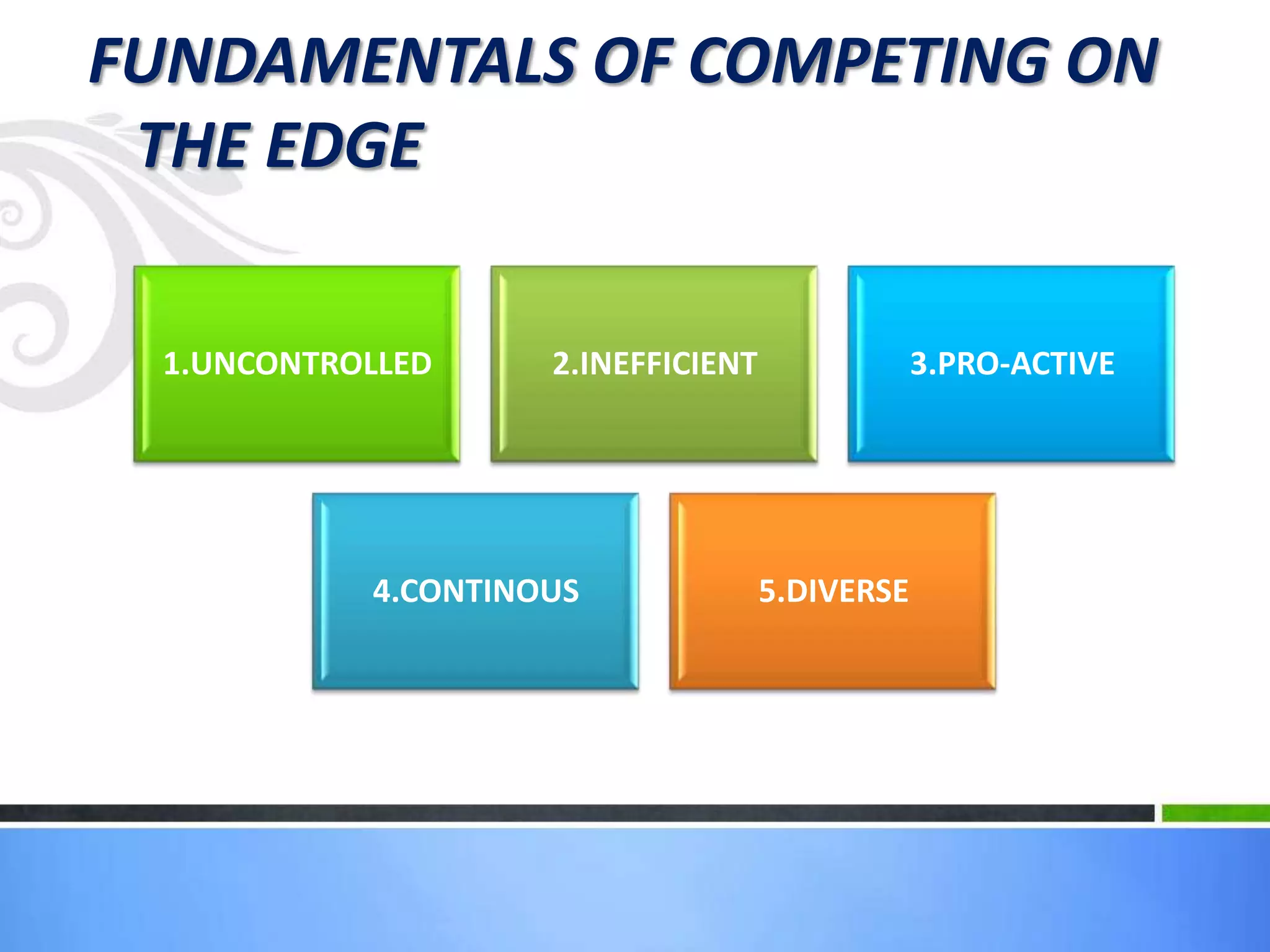
FUNDAMENTALS OF COMPETING ON
 THE EDGE

 1.UNCONTROLLED     2.INEFFICIENT               3.PRO-ACTIVE


           4.CONTINOUS              5.DIVERSE
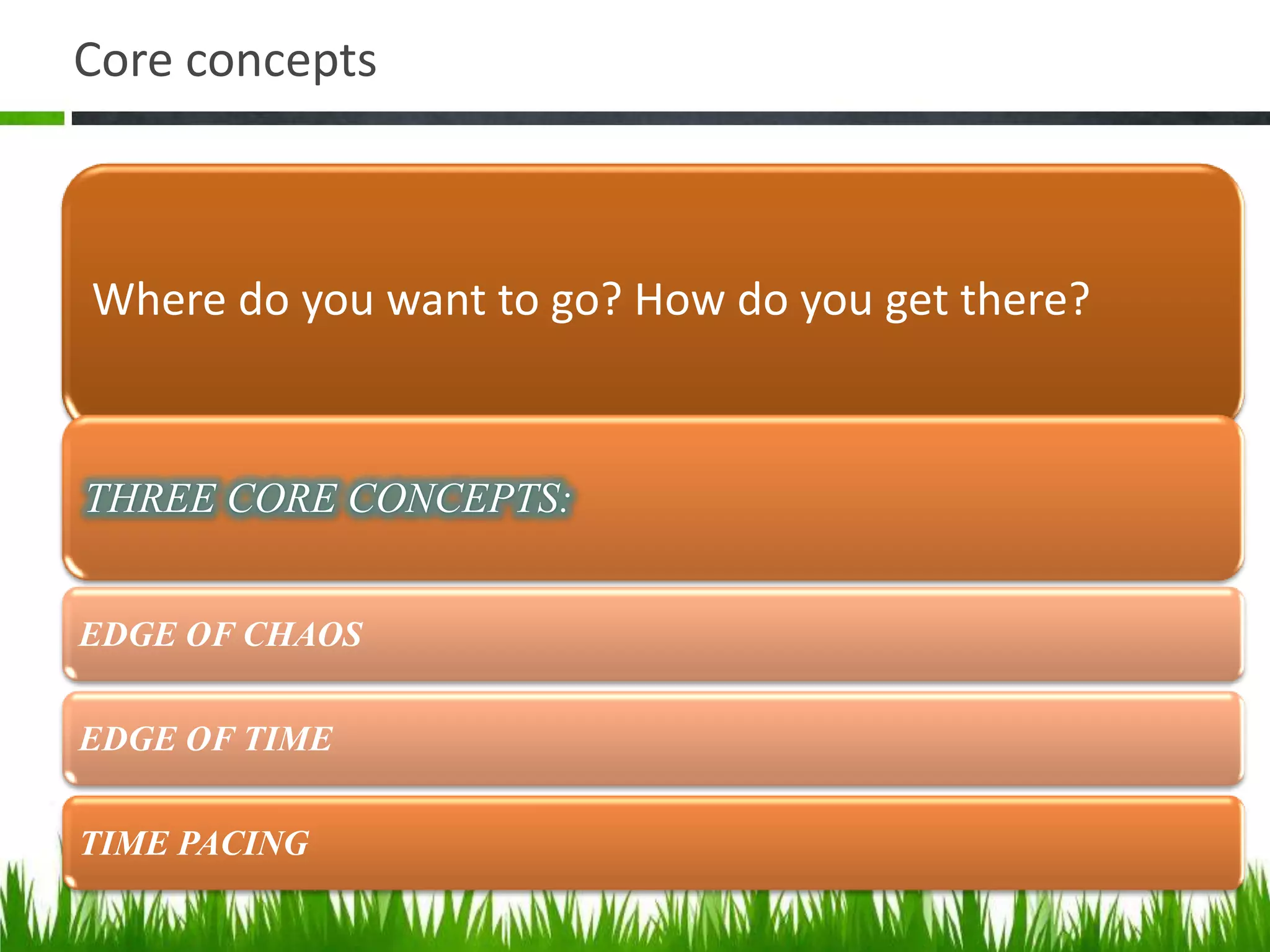
Core concepts


Where do you want to go? How do you get there?


THREE CORE CONCEPTS:


EDGE OF CHAOS

EDGE OF TIME

TIME PACING
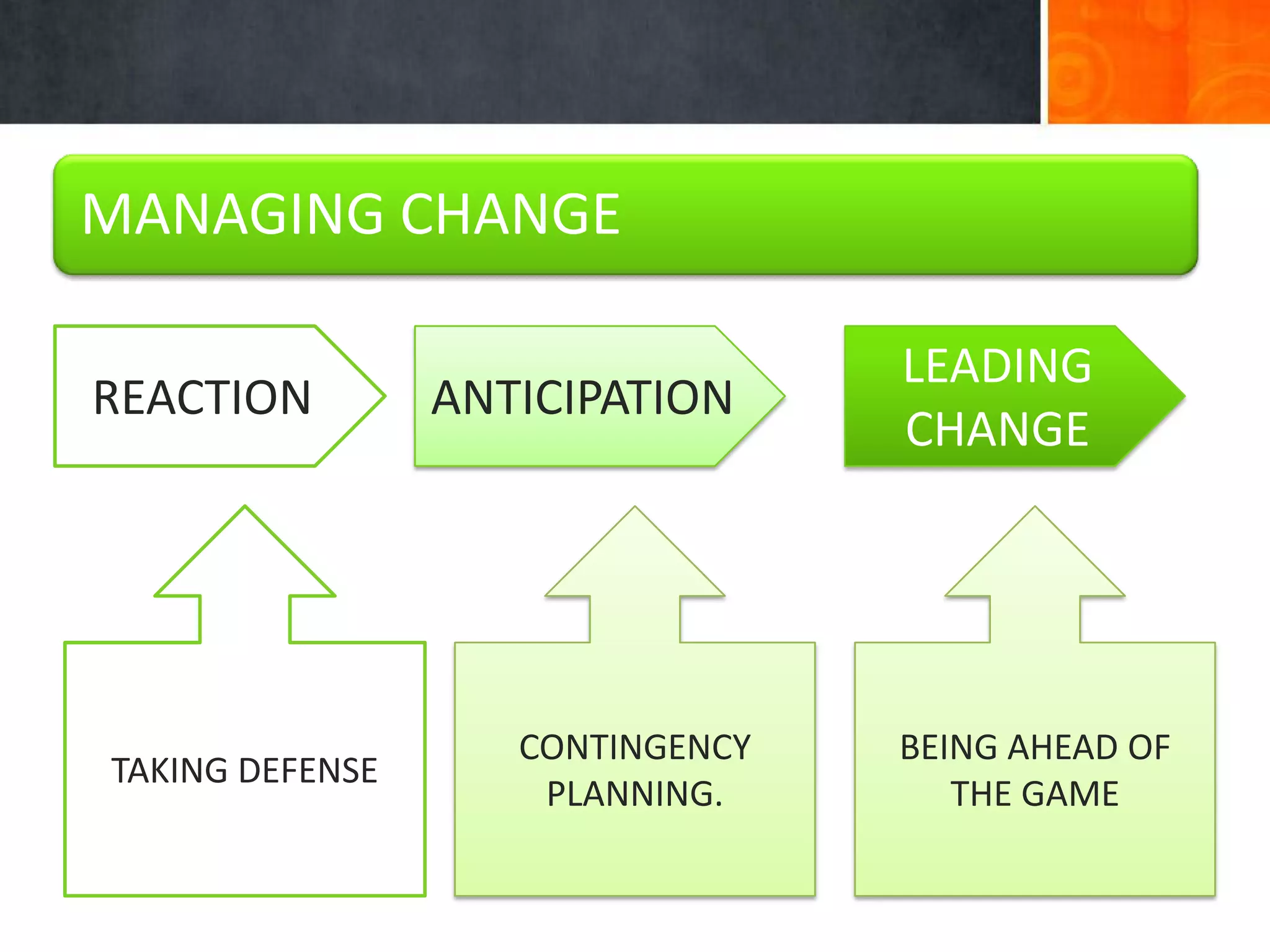
MANAGING CHANGE

                                  LEADING
REACTION         ANTICIPATION
                                  CHANGE


                    CONTINGENCY   BEING AHEAD OF
TAKING DEFENSE
                     PLANNING.       THE GAME
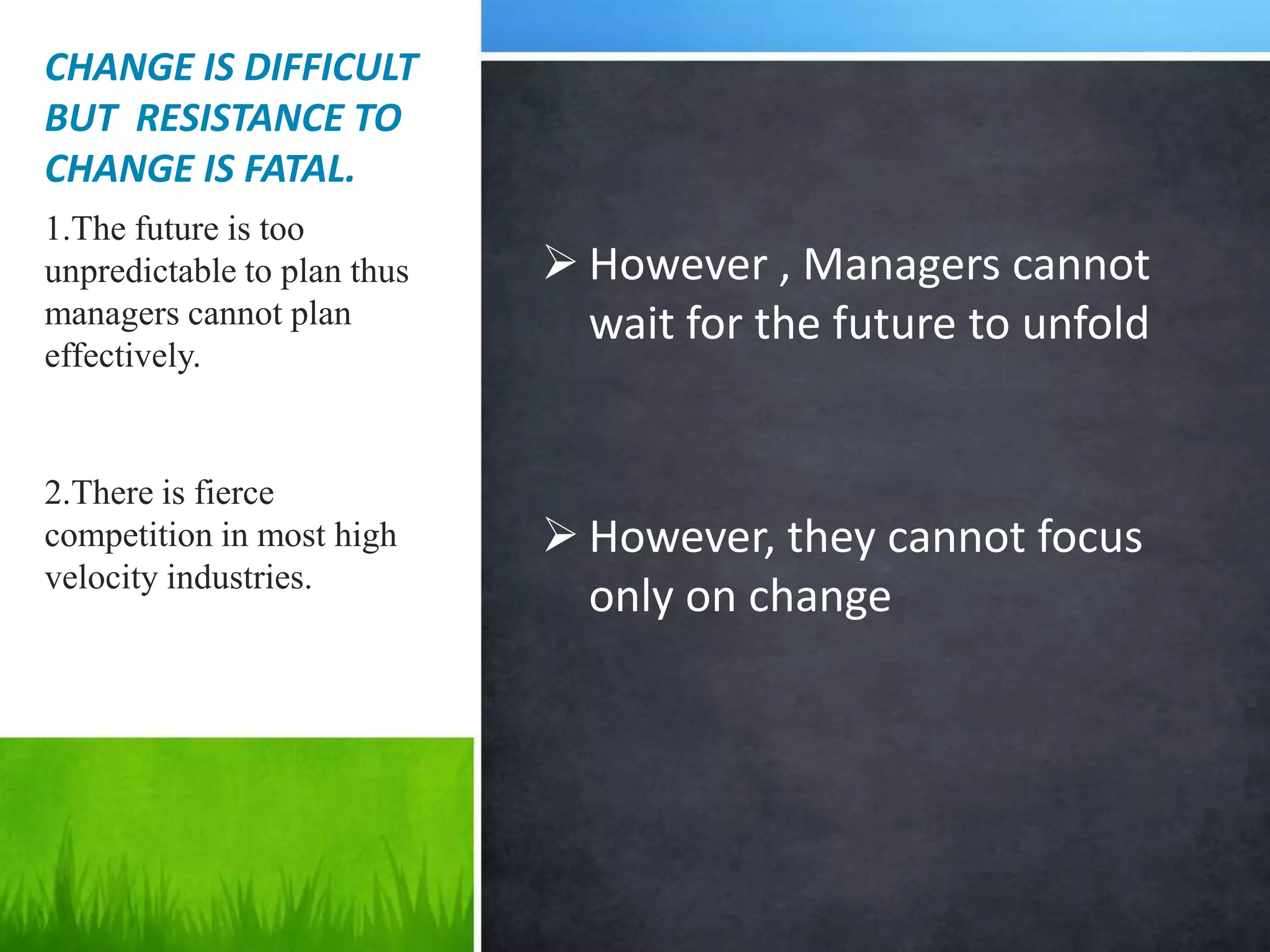
CHANGE IS DIFFICULT
BUT RESISTANCE TO
CHANGE IS FATAL.
1.The future is too
unpredictable to plan thus    However , Managers cannot
managers cannot plan           wait for the future to unfold
effectively.


2.There is fierce
competition in most high      However, they cannot focus
velocity industries.
                               only on change
Edge of chaos


- An organization is only partially structured.

-The natural state between order and chaos, a
 compromise between structure and surprise.

-An intermediate zone should be maintained
 where the system is most vibrant, surprising
 and flexible.
Edge of time


-Thinking simultaneously about multiple time
 horizons.

-The challenge is to balance on the edge of
 the past the present and the future.

-The intermediate zone where managers look
 backward to the past and forward into the
 future while concentrating on today.
Time pacing.


-Change is triggered by passage of time rather
 than occurrence of events.
- Creating an internal rhythm that drives the
 momentum for change.
-Systems evolve most effectively by shedding
 off what was useful in the past and adopting
 what will be useful in the future.
Cont’d

• Variation is enhanced, making evolution more
  effective (filling the inefficiency during the process)
• Keep what works and adopt what will be useful in
  future
• Slower and more gradual change process
• Stretches managerial thinking across a longer time
  frame
• The key is to remain at the edge of time (where past
  and future are still connected)
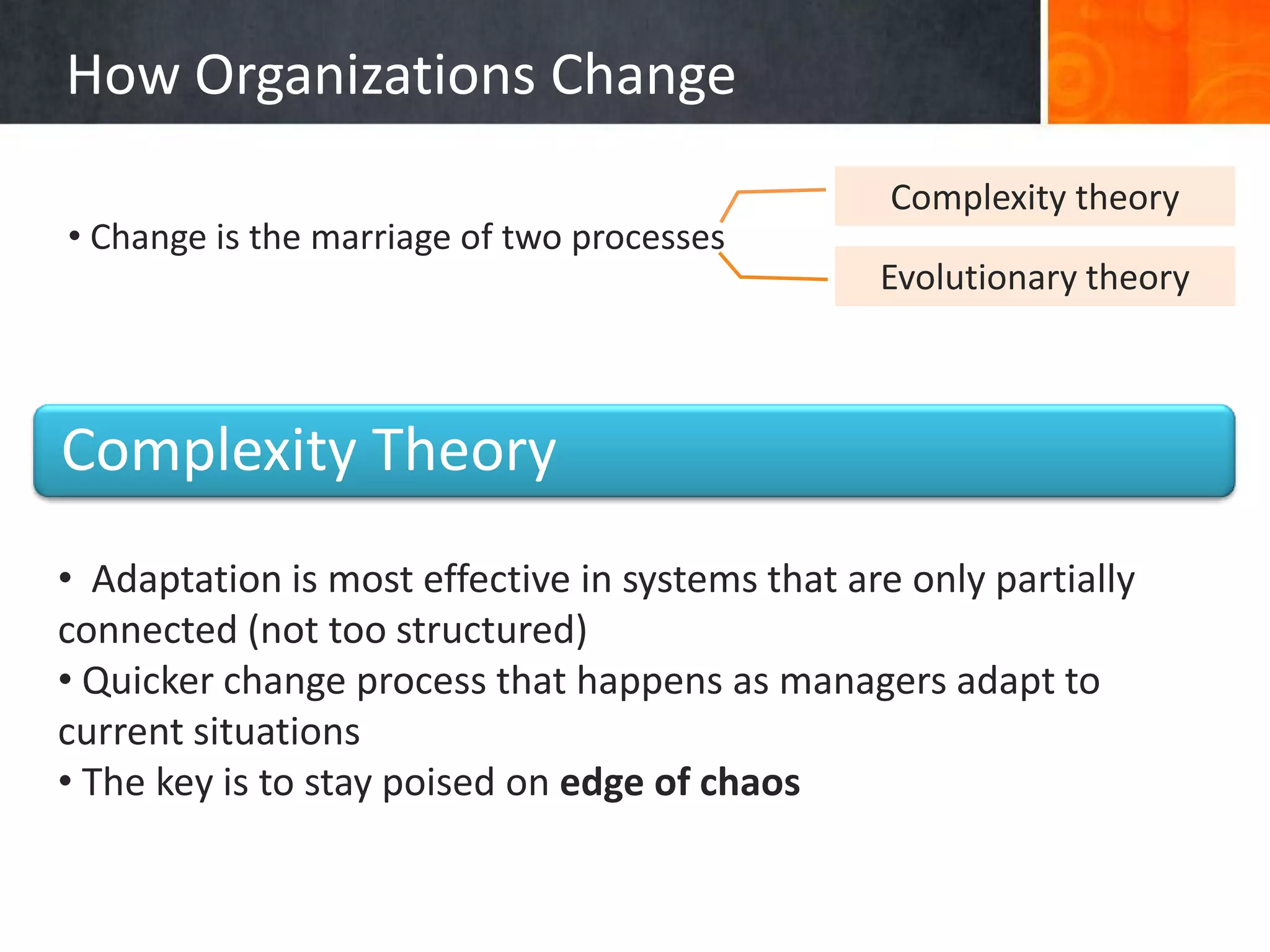
How Organizations Change
                                                  Complexity theory
• Change is the marriage of two processes
                                                 Evolutionary theory


Complexity Theory
• Adaptation is most effective in systems that are only partially
connected (not too structured)
• Quicker change process that happens as managers adapt to
current situations
• The key is to stay poised on edge of chaos
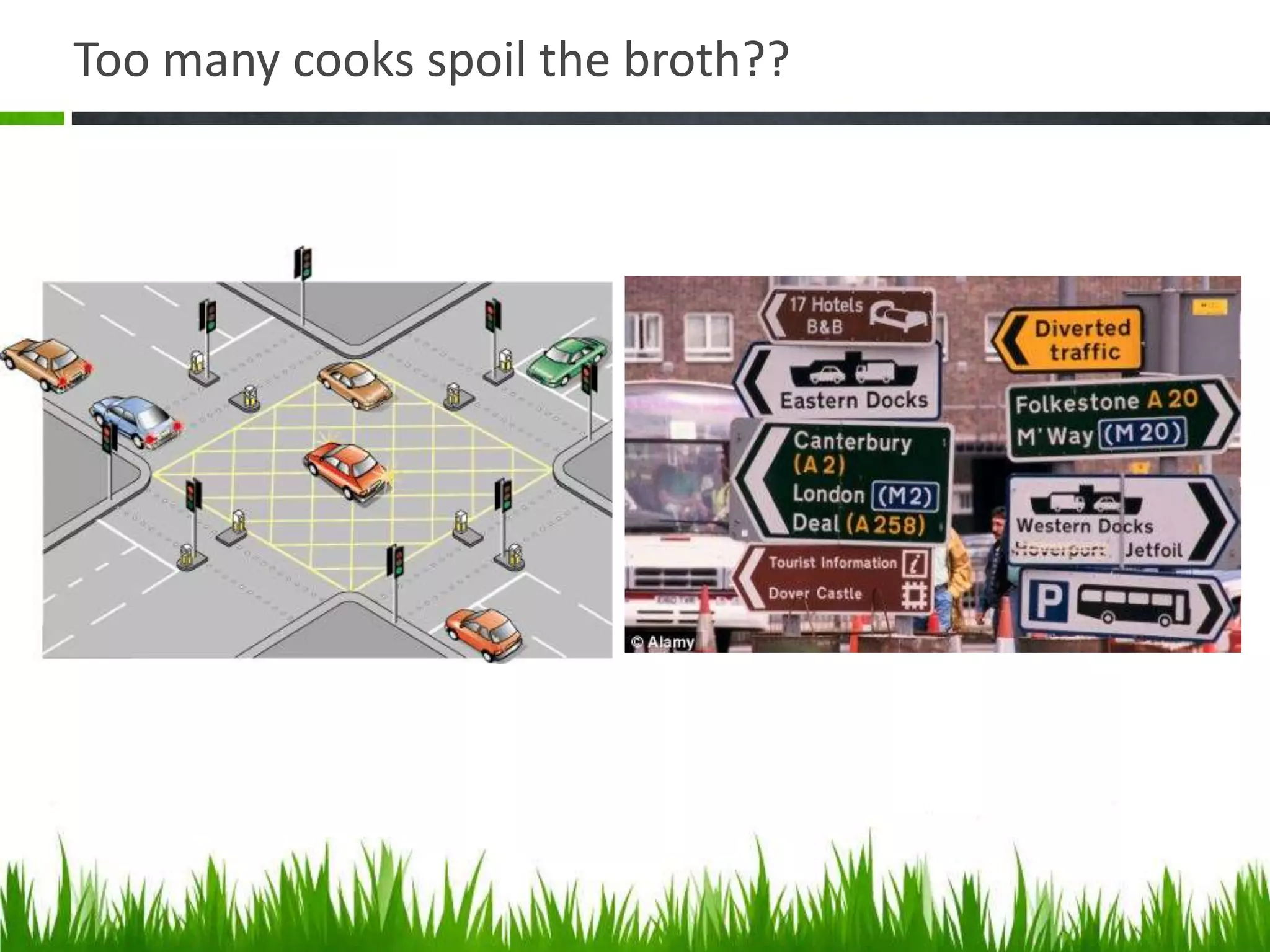
Too many cooks spoil the broth??
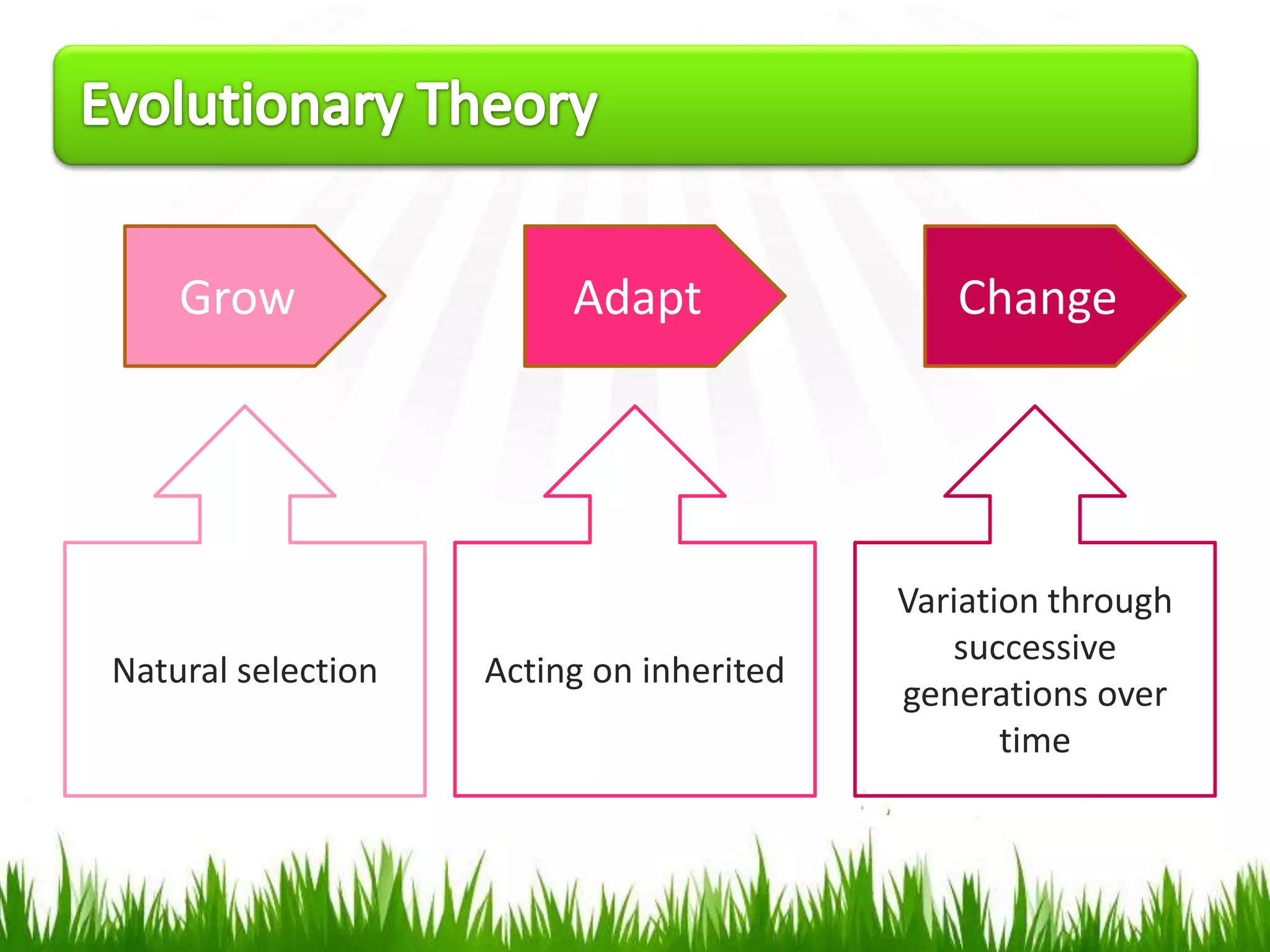
Grow                 Adapt               Change


                                          Variation through
                                             successive
Natural selection   Acting on inherited
                                          generations over
                                                 time
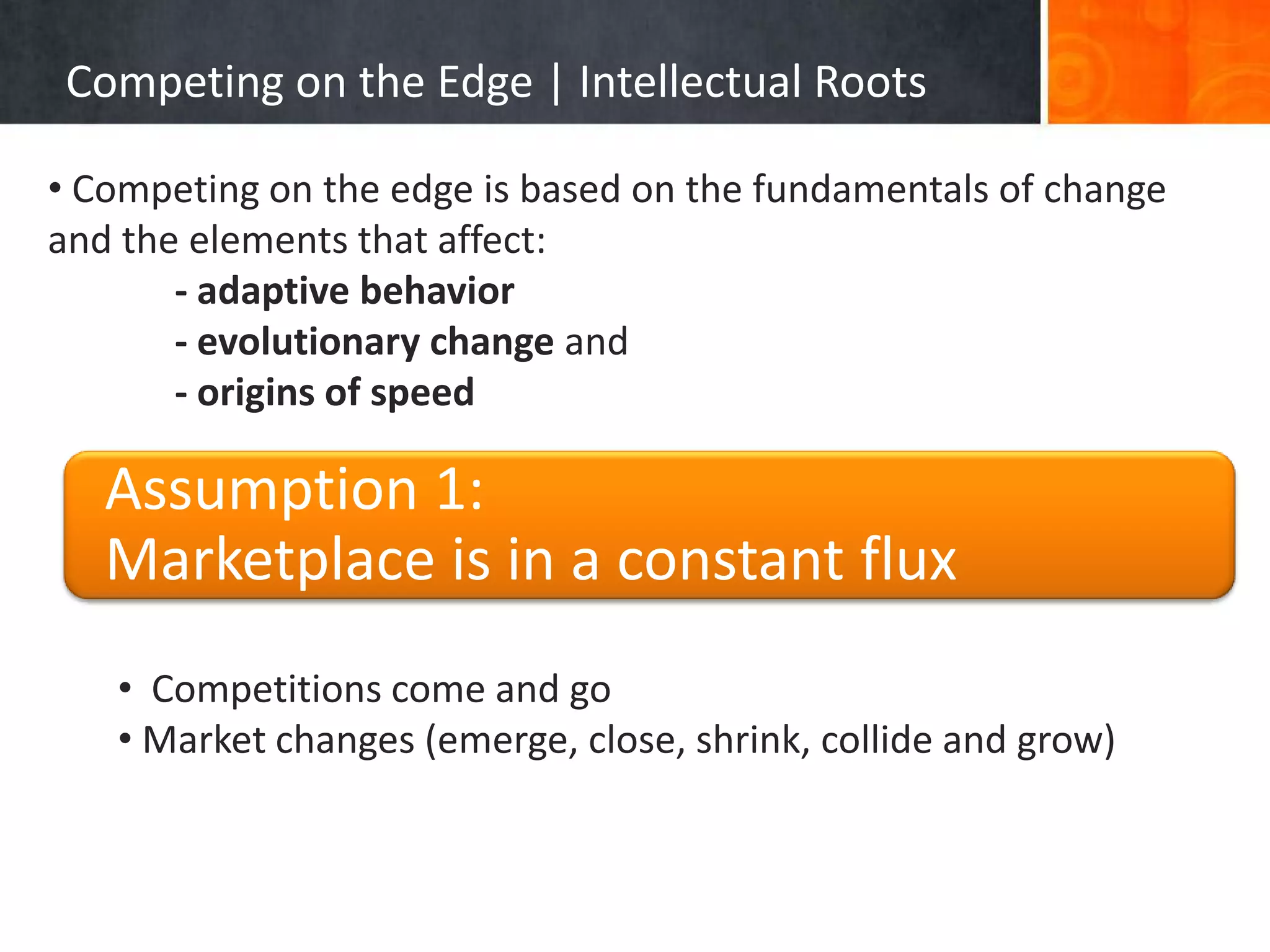
Competing on the Edge | Intellectual Roots

• Competing on the edge is based on the fundamentals of change
and the elements that affect:
       - adaptive behavior
       - evolutionary change and
       - origins of speed

   Assumption 1:
   Marketplace is in a constant flux
   • Competitions come and go
   • Market changes (emerge, close, shrink, collide and grow)
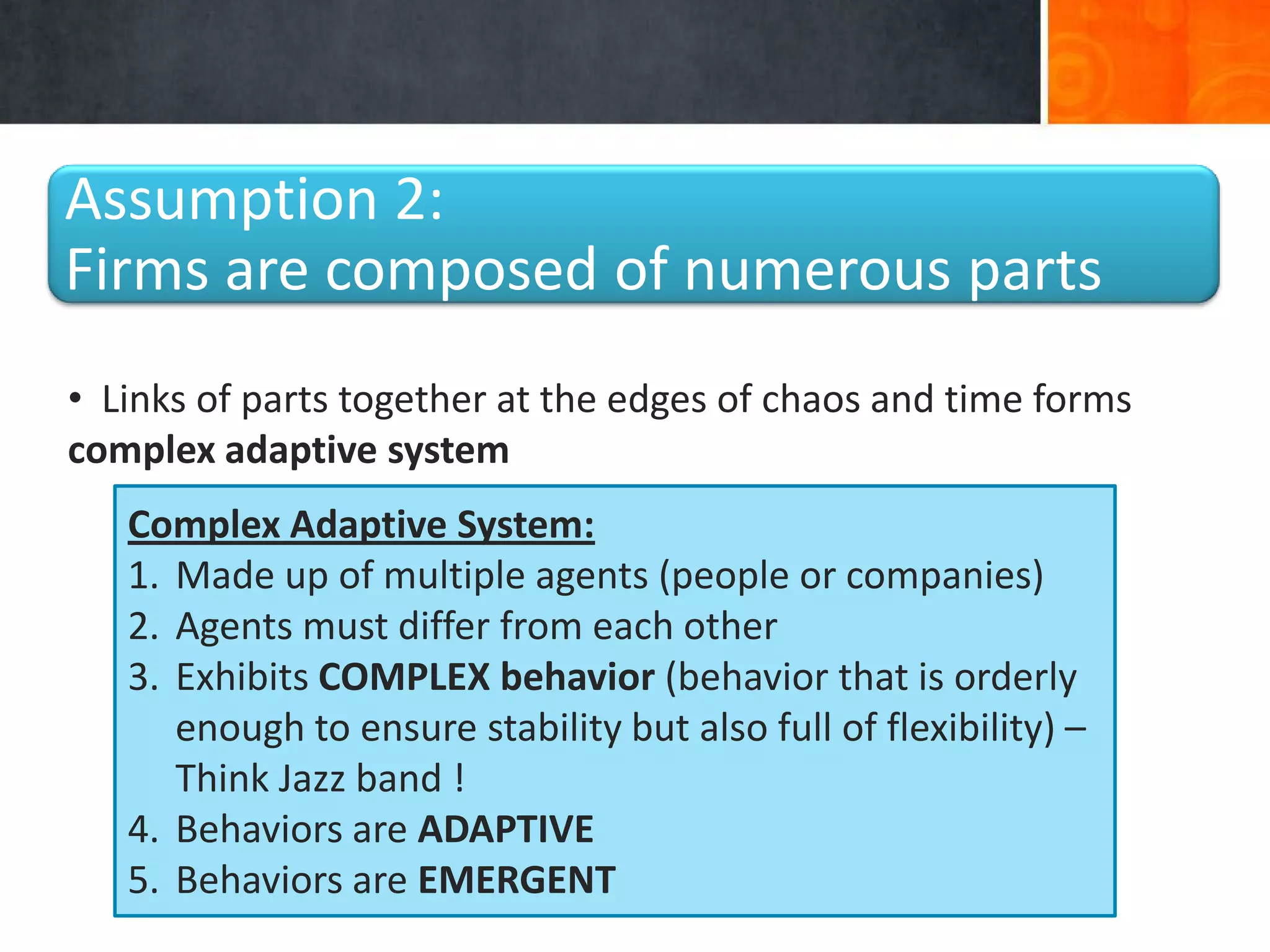
Assumption 2:
Firms are composed of numerous parts
• Links of parts together at the edges of chaos and time forms
complex adaptive system
   Complex Adaptive System:
   1. Made up of multiple agents (people or companies)
   2. Agents must differ from each other
   3. Exhibits COMPLEX behavior (behavior that is orderly
      enough to ensure stability but also full of flexibility) –
      Think Jazz band !
   4. Behaviors are ADAPTIVE
   5. Behaviors are EMERGENT
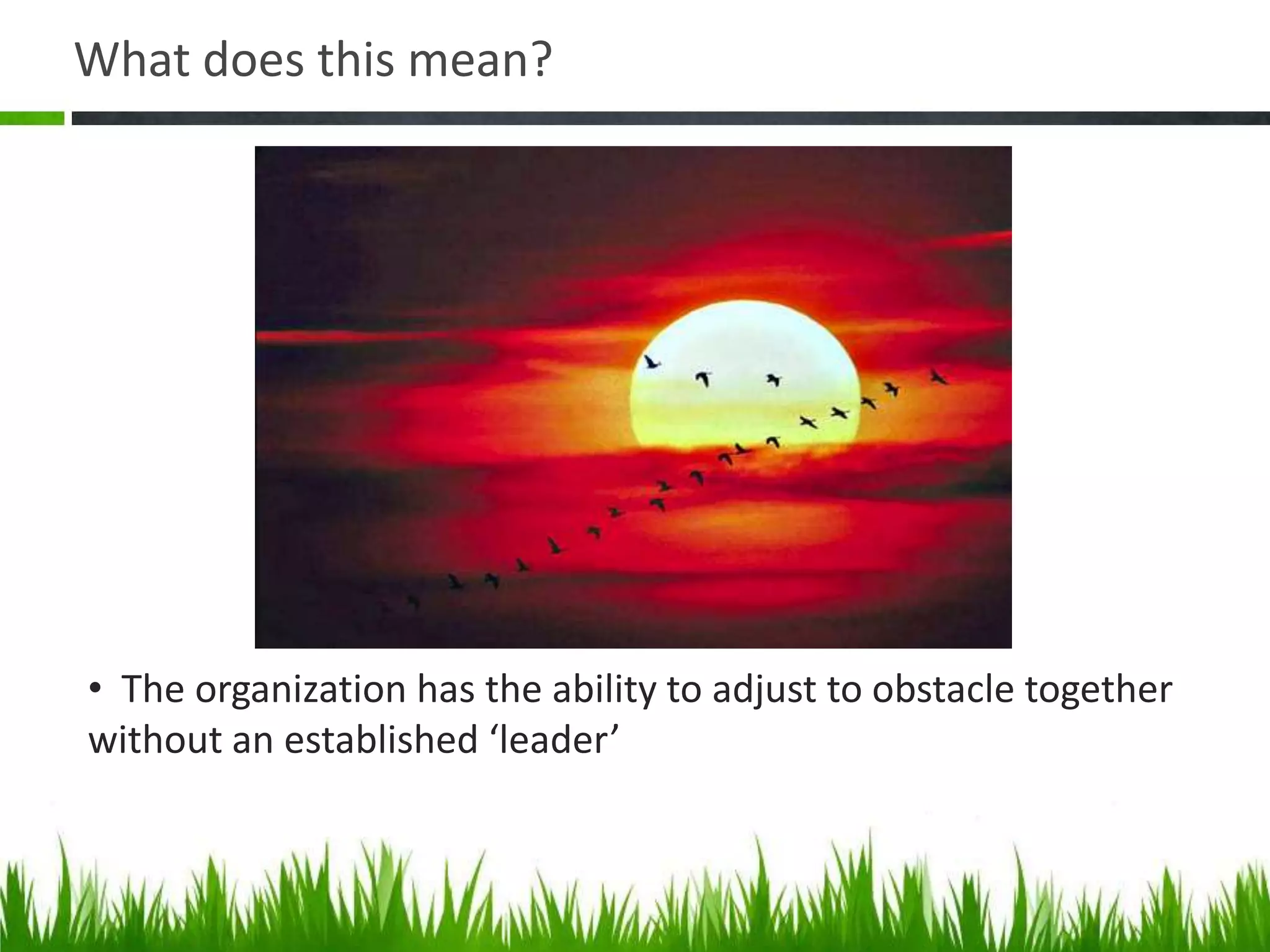
What does this mean?


• The organization has the ability to adjust to obstacle together
without an established ‘leader’
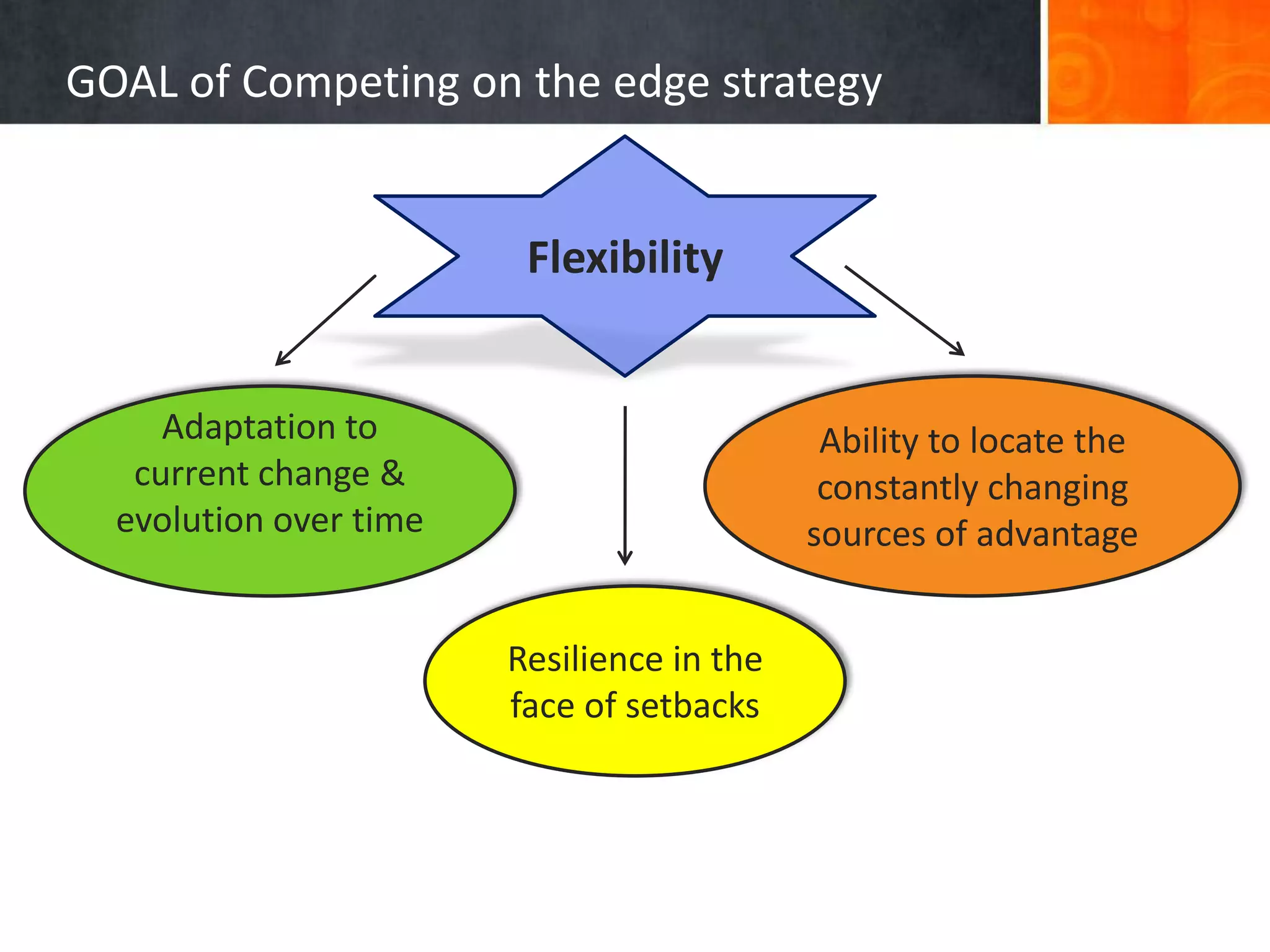
GOAL of Competing on the edge strategy


                         Flexibility


     Adaptation to                           Ability to locate the
   current change &                          constantly changing
  evolution over time                       sources of advantage


                        Resilience in the
                        face of setbacks
Poised on the Edges at 3M

                     How did the managers do it?
                               CHAOS
                     • Scientists : Allowed to spend 15%
                       of their time on anything
                     • Business run with lots of
                       freedom & loose planning
                     • Grants for external projects
                     • Allowing change to happen will
                       flexibility
                     • This is pursuing edge of chaos
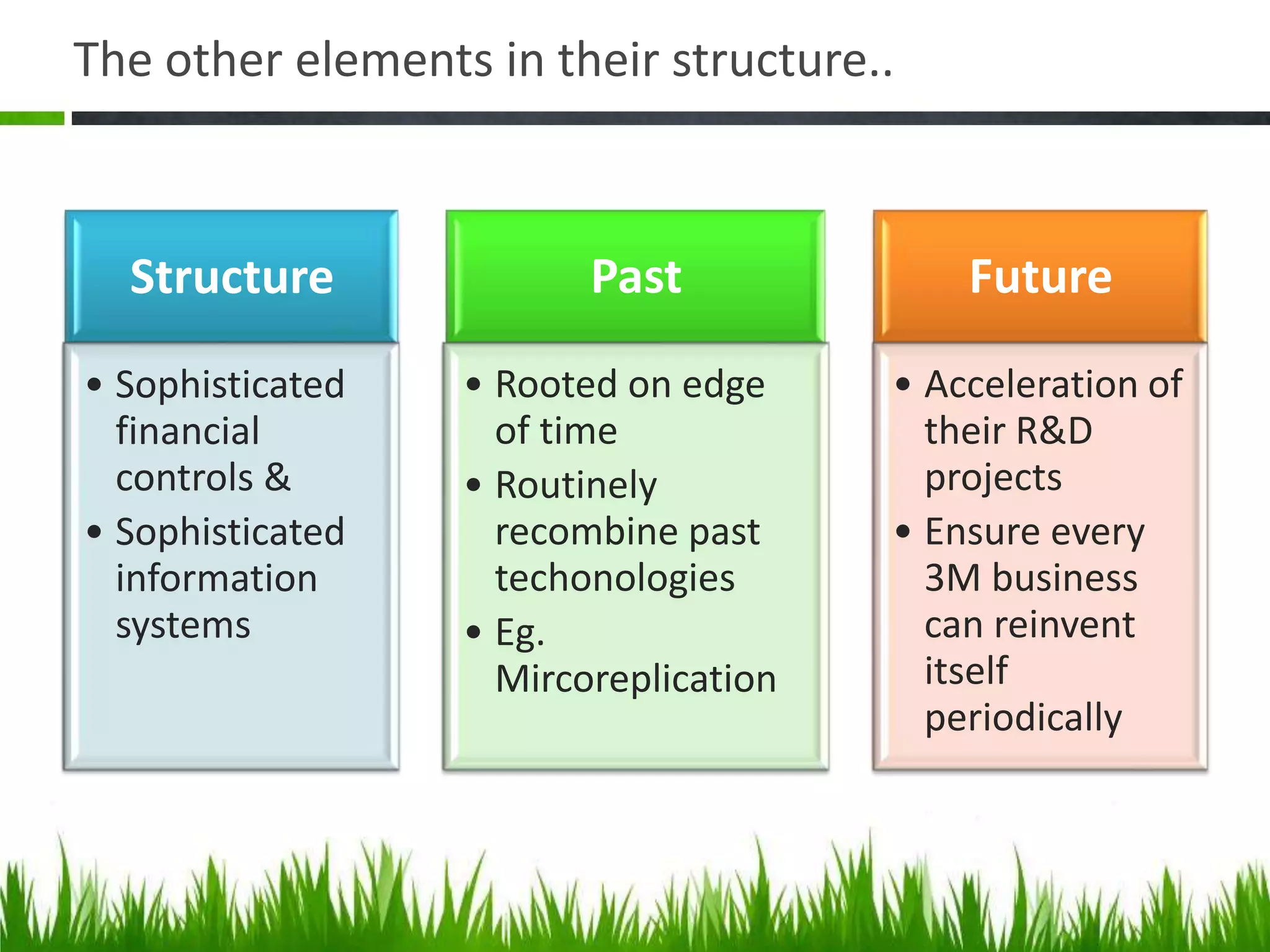
The other elements in their structure..


  Structure              Past              Future
• Sophisticated   • Rooted on edge     • Acceleration of
  financial         of time              their R&D
  controls &      • Routinely            projects
• Sophisticated     recombine past     • Ensure every
  information       techonologies        3M business
  systems         • Eg.                  can reinvent
                    Mircoreplication     itself
                                         periodically
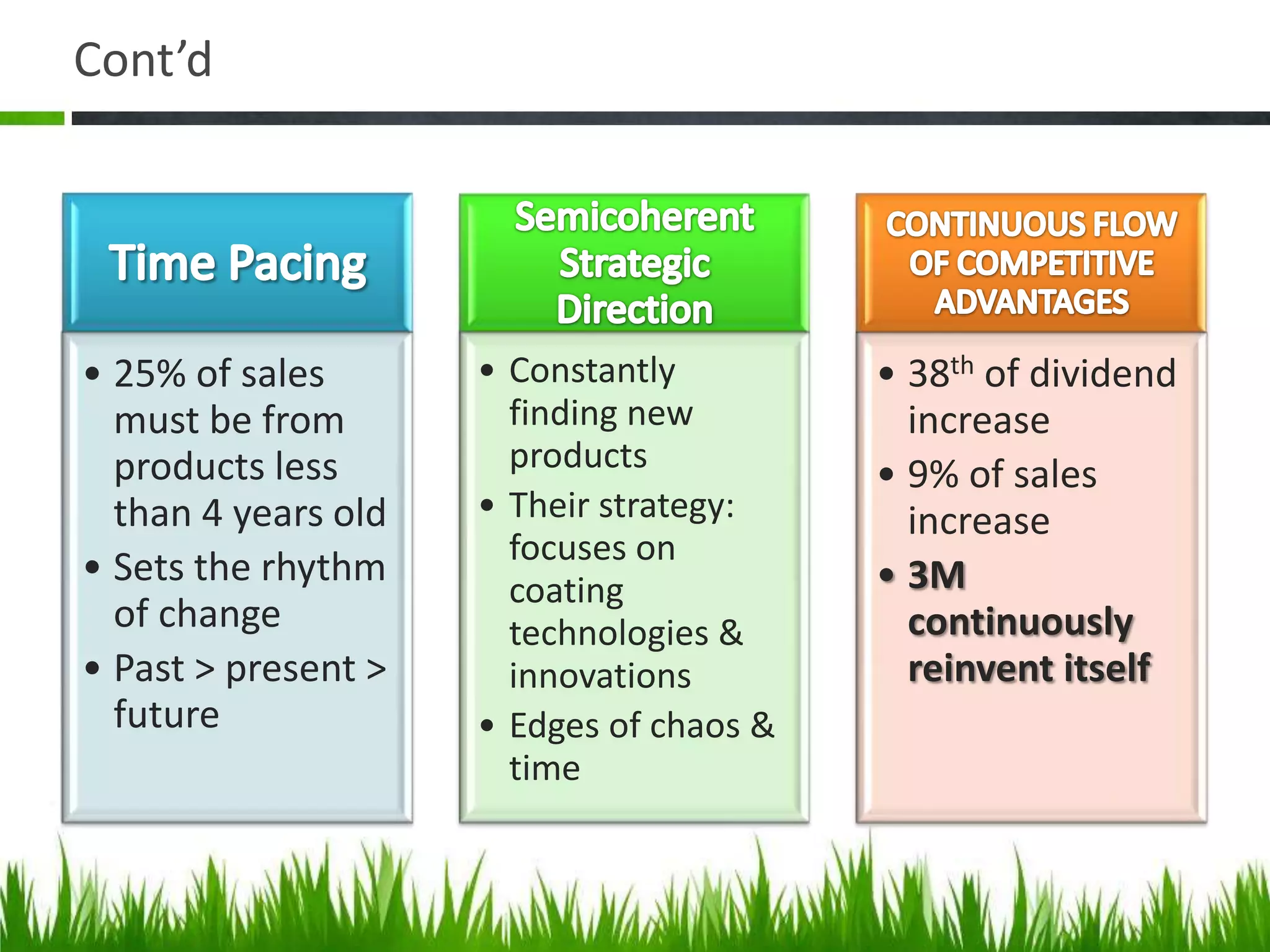
Cont’d


• 25% of sales       • Constantly         • 38th of dividend
  must be from         finding new          increase
  products less        products
                                          • 9% of sales
  than 4 years old   • Their strategy:      increase
                       focuses on
• Sets the rhythm                         • 3M
                       coating
  of change            technologies &       continuously
• Past > present >     innovations          reinvent itself
  future             • Edges of chaos &
                       time
Conclusion


       Where do you want to go?


       How are you going to get
       there?
2nd Reading
An Introduction…


• An alliance is not necessarily a merger or acquisition. It can
  also be an agreement between businesses to work
  collectively to achieve their objectives (mutually common or
  different).
• Either way, a good business alliance can give a firm
  Collaborative Advantage.
• What to consider when establishing an alliance?
   – Not just cost minimisation, improved funding, better productivity…
   – Human factors are also important!
  Barriers to effective use of relationships is social, not strategic factors
  Distinctions between organisational classes can interfere with adaptive
  capability
                                                                             -Kanter-
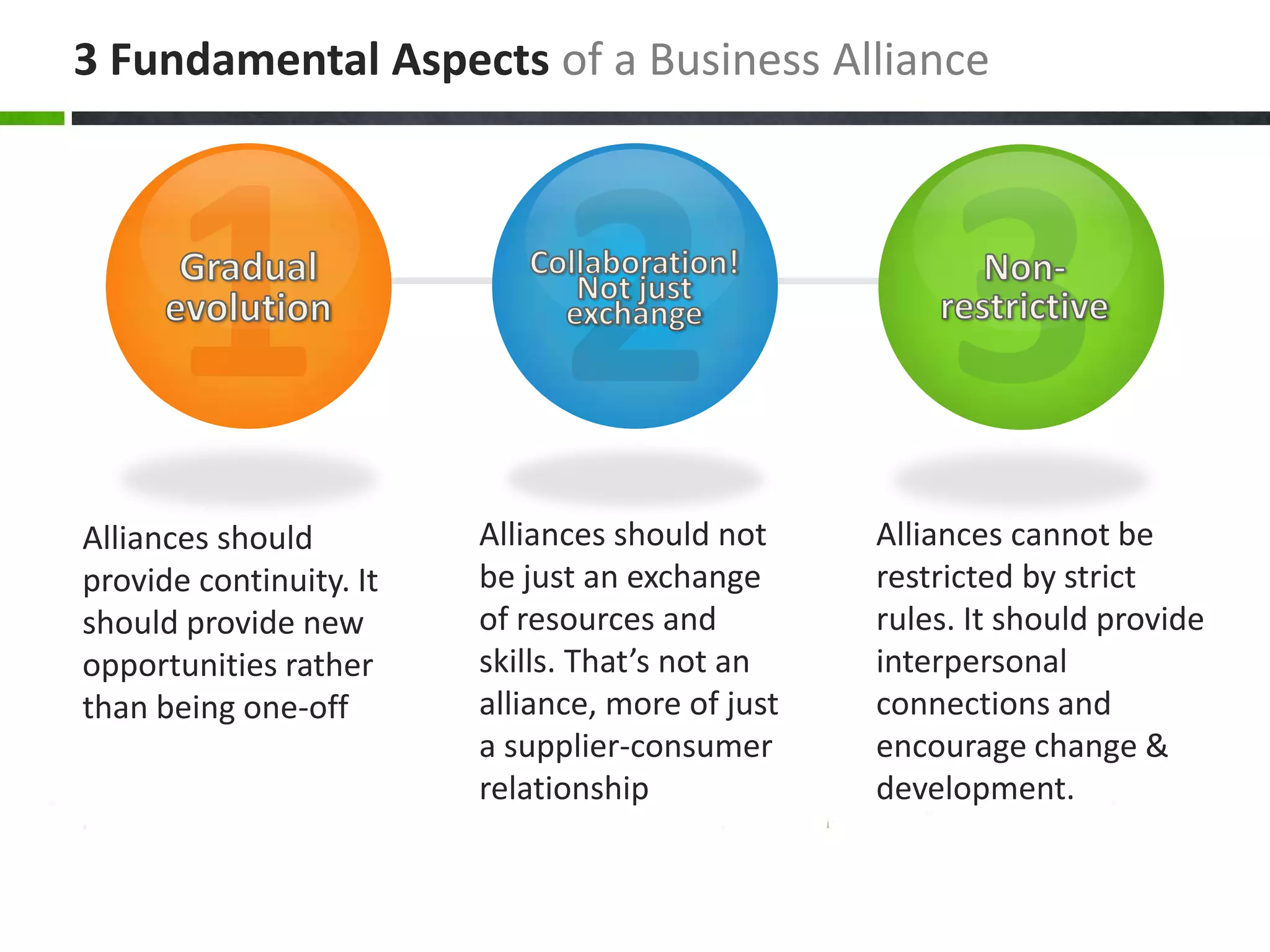
3 Fundamental Aspects of a Business Alliance


Alliances should         Alliances should not     Alliances cannot be
provide continuity. It   be just an exchange      restricted by strict
should provide new       of resources and         rules. It should provide
opportunities rather     skills. That’s not an    interpersonal
than being one-off       alliance, more of just   connections and
                         a supplier-consumer      encourage change &
                         relationship             development.
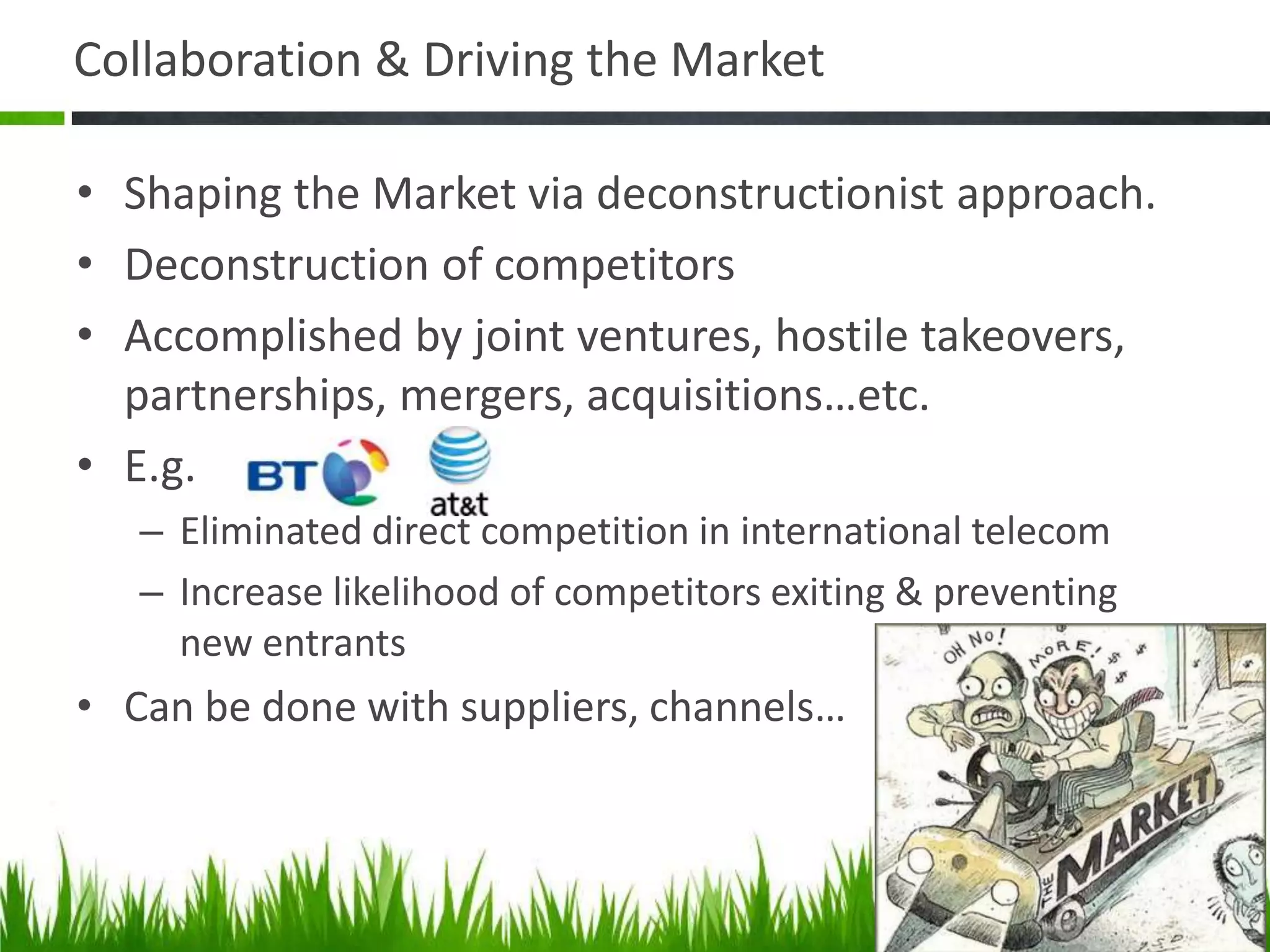
Collaboration & Driving the Market

• Shaping the Market via deconstructionist approach.
• Deconstruction of competitors
• Accomplished by joint ventures, hostile takeovers,
  partnerships, mergers, acquisitions…etc.
• E.g.
   – Eliminated direct competition in international telecom
   – Increase likelihood of competitors exiting & preventing
     new entrants
• Can be done with suppliers, channels…
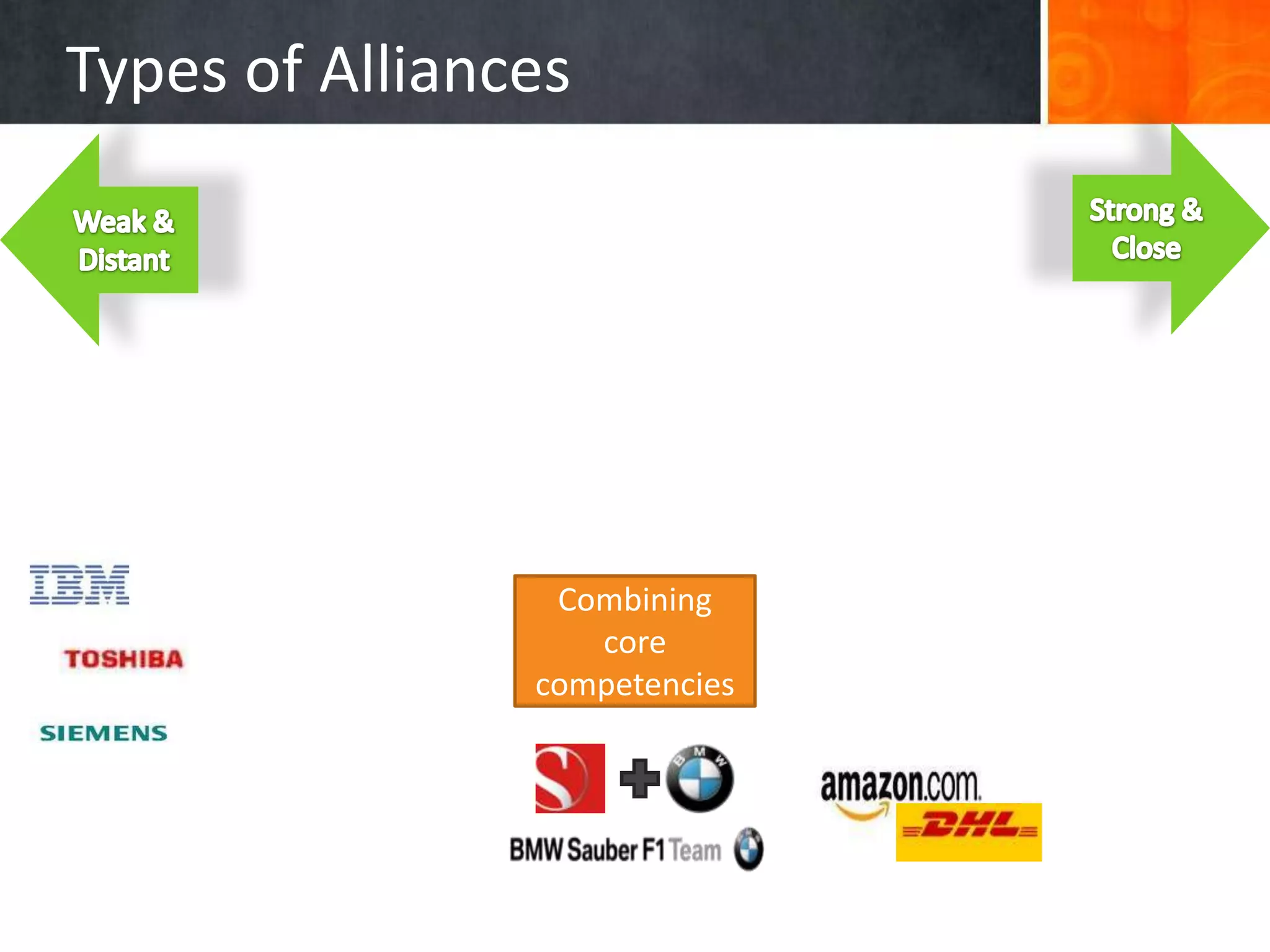
Types of Alliances


                 Combining
                   core
                competencies
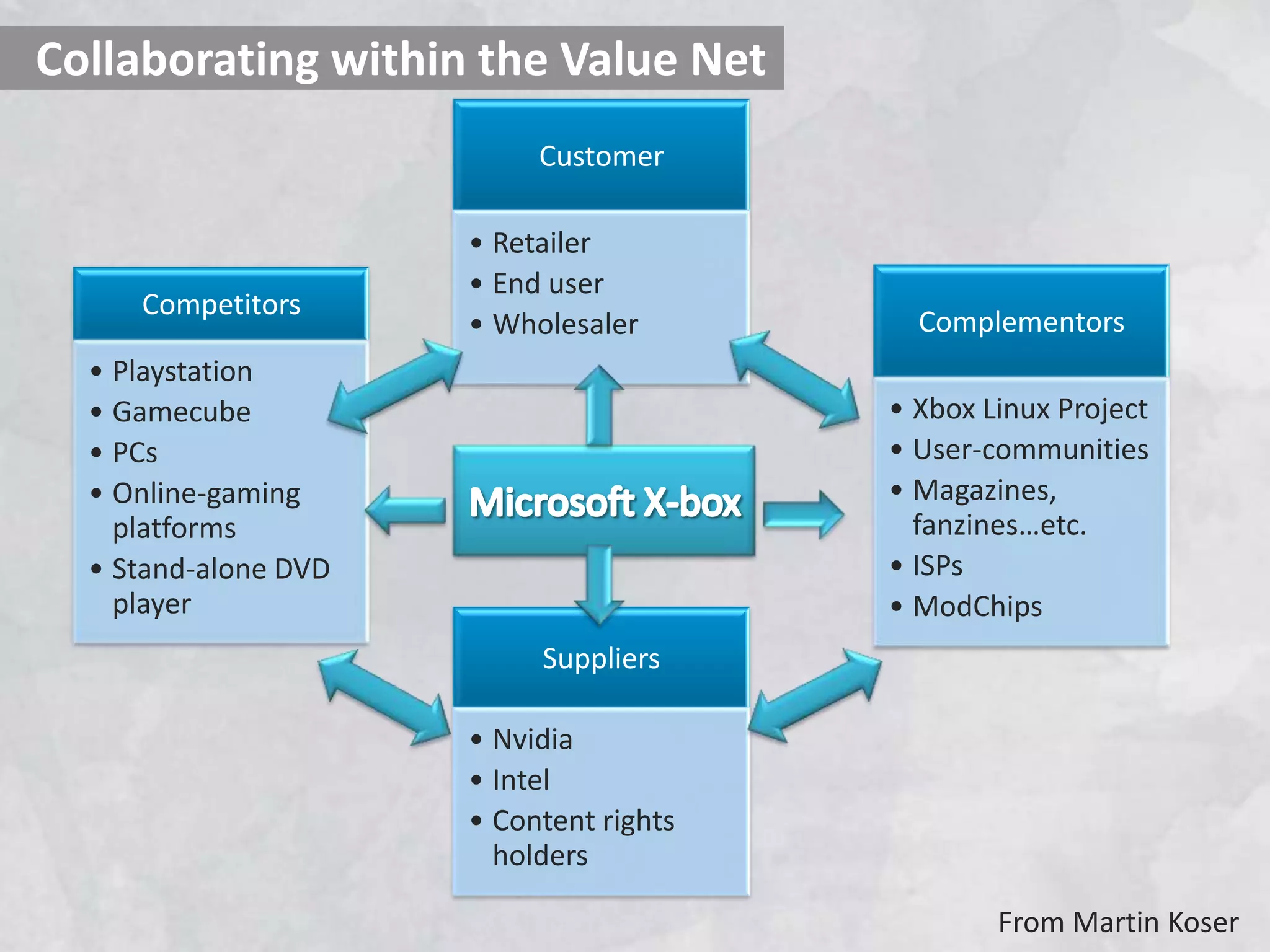
Collaborating within the Value Net
                           Customer

                      • Retailer
                      • End user
     Competitors
                      • Wholesaler         Complementors
  • Playstation
  • Gamecube                             • Xbox Linux Project
  • PCs                                  • User-communities
  • Online-gaming                        • Magazines,
    platforms                              fanzines…etc.
  • Stand-alone DVD                      • ISPs
    player                               • ModChips
                           Suppliers

                      • Nvidia
                      • Intel
                      • Content rights
                        holders

                                                 From Martin Koser
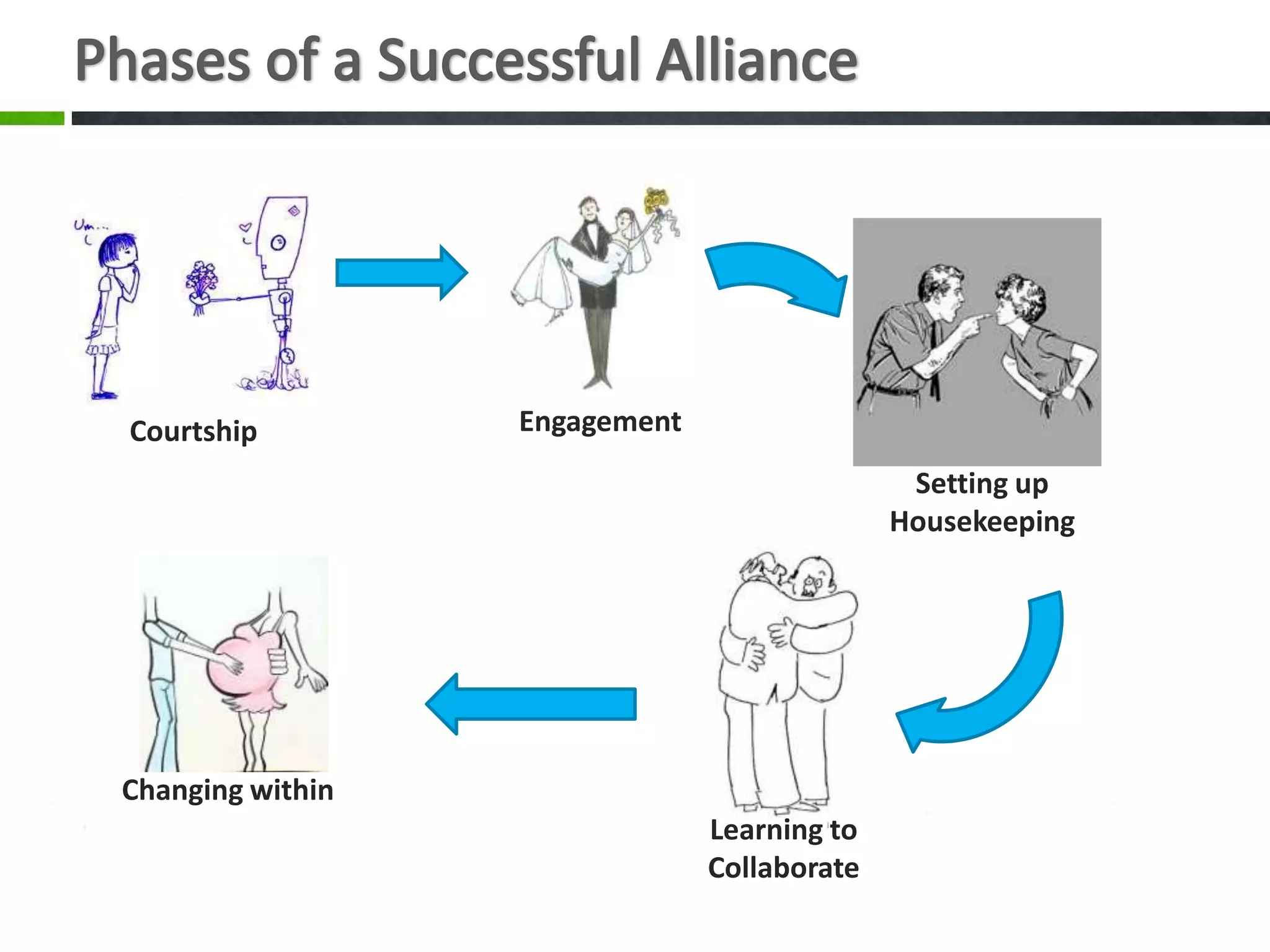
Courtship         Engagement
                                              Setting up
                                             Housekeeping


Changing within
                               Learning to
                               Collaborate
Courtship
• The stage where a suitable partner firm is
  discovered
• Business alliances are more commonly initiated like
  romantic relationships; from optimistic ambition,
  feelings or intuition.
• It is important for firm’s executives to hit it off at a
  personal level.
• Relationship compatibility is not measured just by
  numbers and statistics.
• Strategic and financial analyses just contribute a
  level of confidence.
Criteria for partner selection


1. Self-Analysis
 • Important to assess the firm itself: Find out the
   firm’s resource levels, internal SWOT analysis,
   objectives…etc.
 • Calls for a deep evaluation of the industry (their
   own and the targeted industry).
 • Focus on a shortlist of potential partners and
   evaluate them. You wouldn’t want any surprises!
Criteria for partner selection

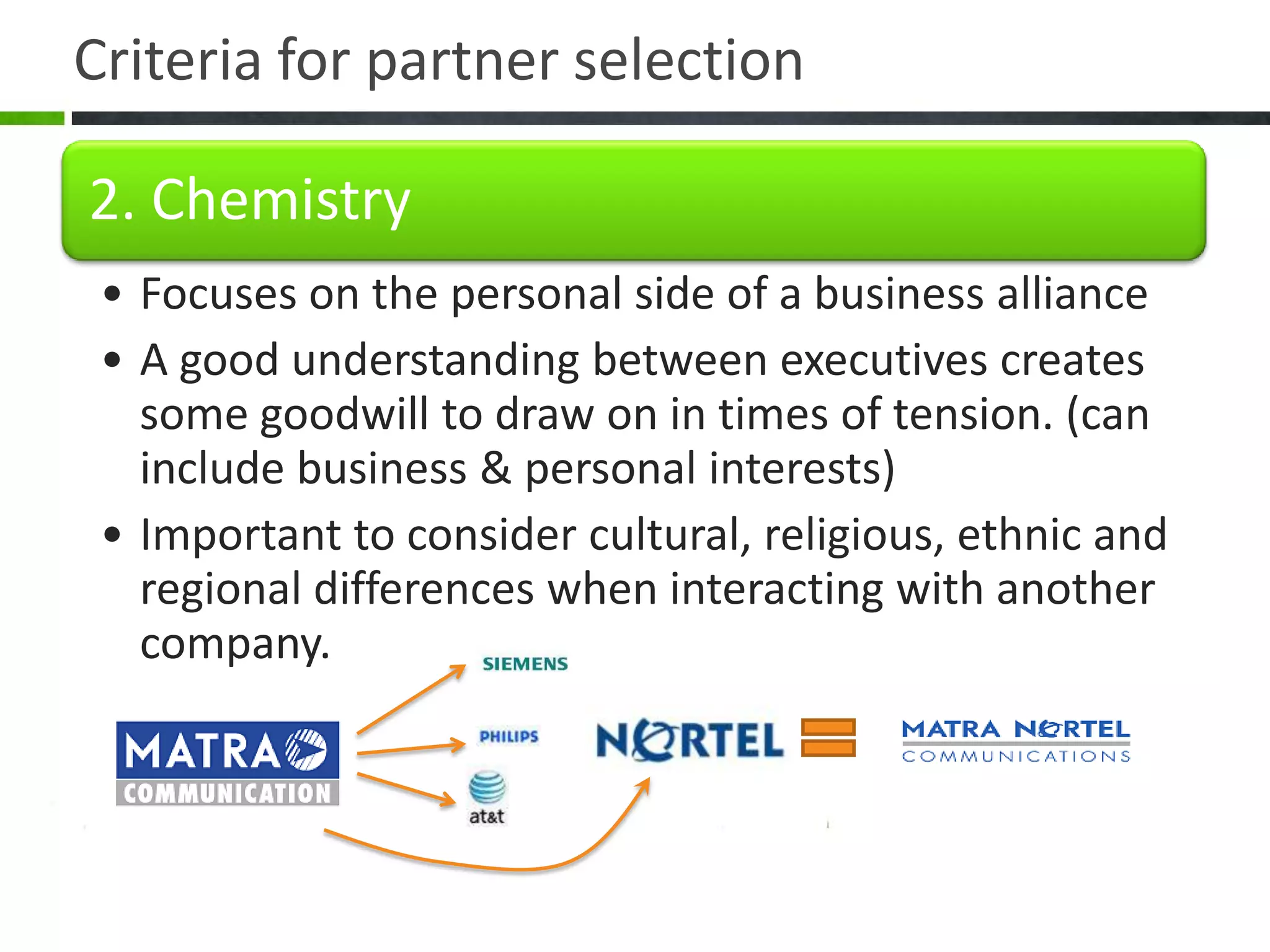
2. Chemistry
 • Focuses on the personal side of a business alliance
 • A good understanding between executives creates
   some goodwill to draw on in times of tension. (can
   include business & personal interests)
 • Important to consider cultural, religious, ethnic and
   regional differences when interacting with another
   company.
Criteria for partner selection

3. Compatibility
• Compatibility on financial terms is important
• But so too are intangible measures such as:
  • Historical
  • Philosophical
  • Strategic
  • E.g: common experiences, values and principles
    and future aspirations
Engagement
• The alliance becomes formally institutionalised.
• Relationship becomes complicated when
  stakeholders enter the picture.
• The management can follow certain steps to ensure
  the relationship keeps it balance between personal
  and institutional:
   – Meeting the Family
   – Establishing the Vows
Meeting the Family
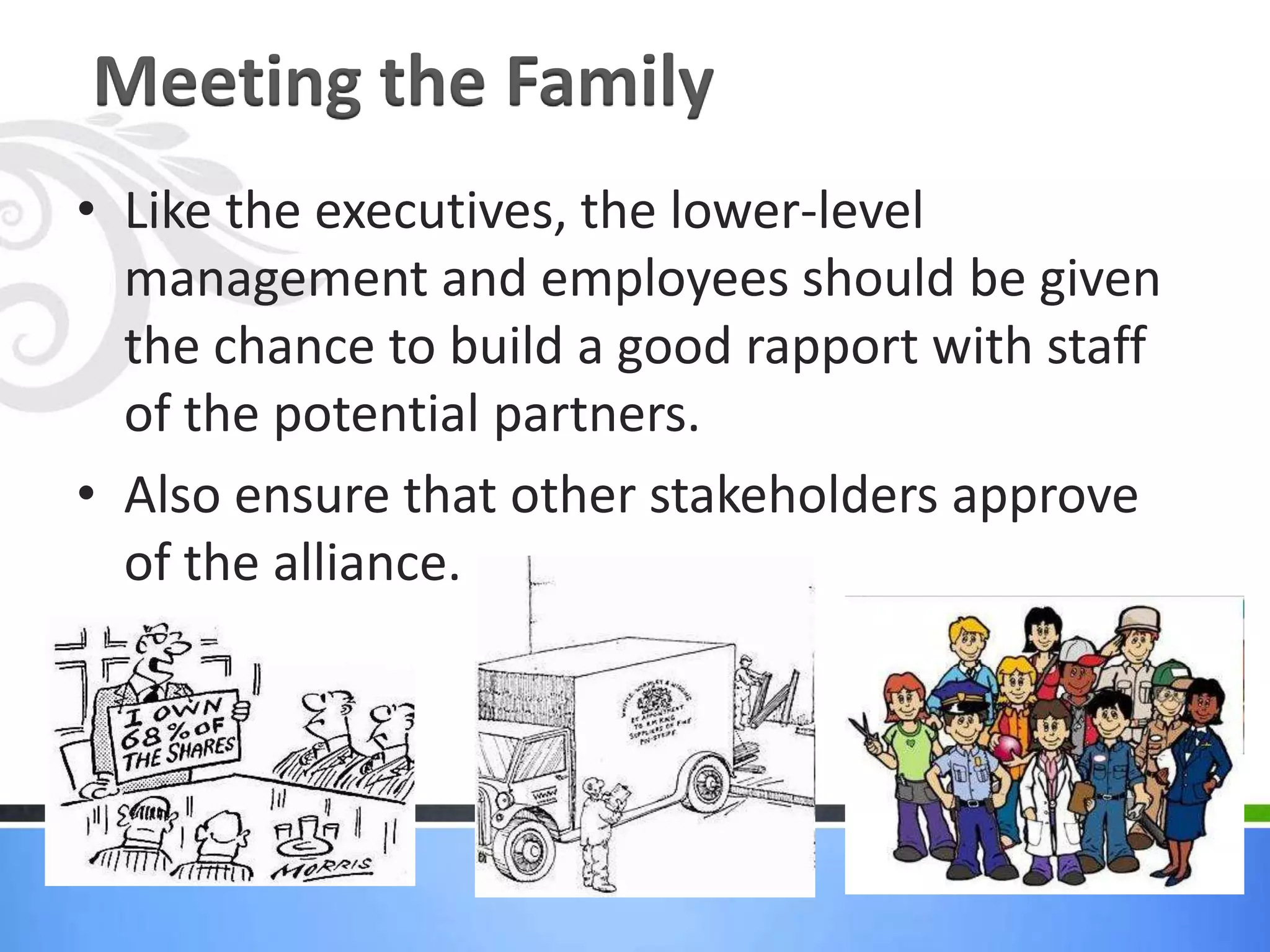
• Like the executives, the lower-level
  management and employees should be given
  the chance to build a good rapport with staff
  of the potential partners.
• Also ensure that other stakeholders approve
  of the alliance.
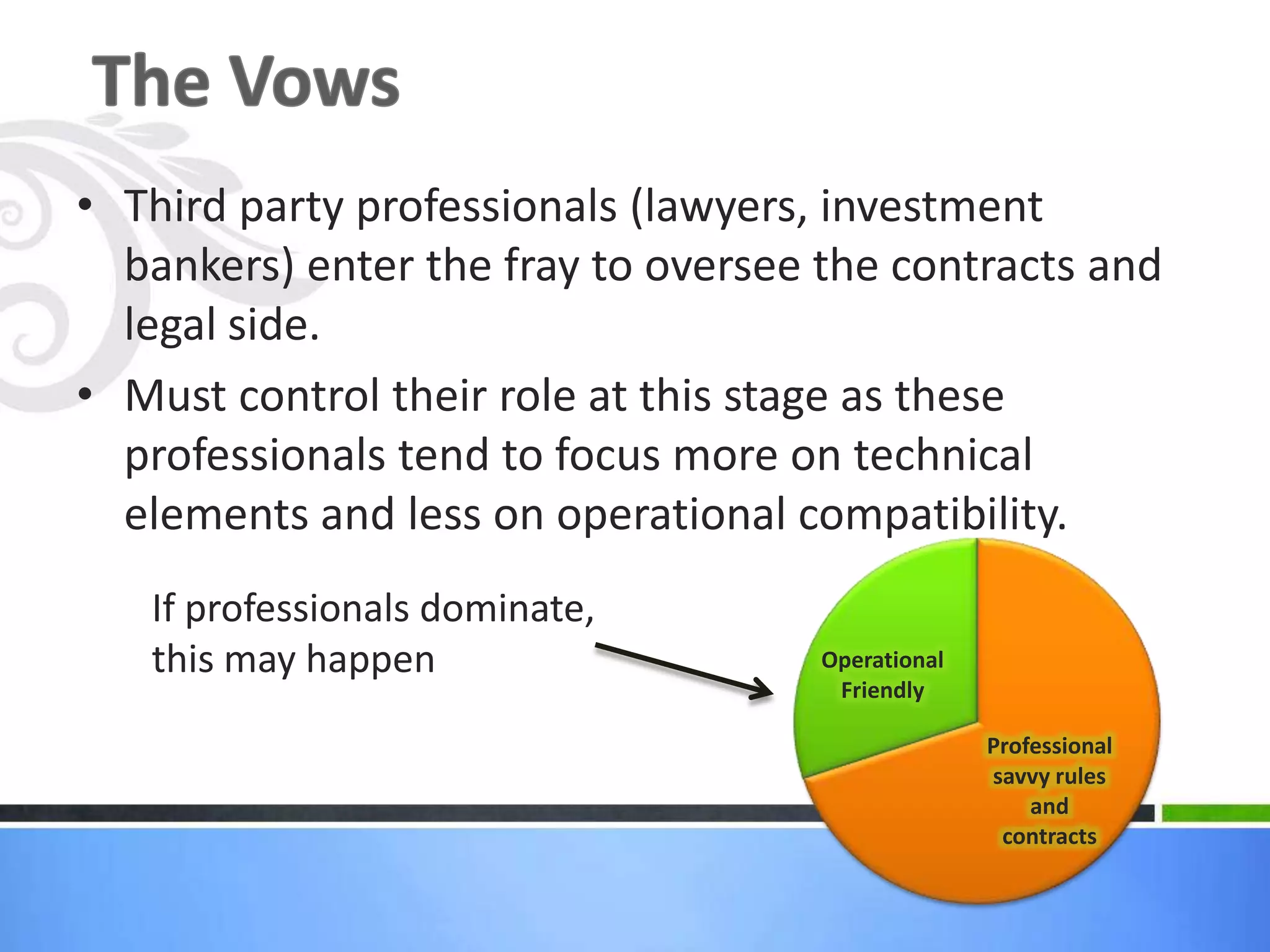
• Third party professionals (lawyers, investment
  bankers) enter the fray to oversee the contracts and
  legal side.
• Must control their role at this stage as these
  professionals tend to focus more on technical
  elements and less on operational compatibility.
   If professionals dominate,
   this may happen                   Operational
                                      Friendly

                                                   Professional
                                                   savvy rules
                                                       and
                                                    contracts
1. Incorporate a specific joint
The Vows                activity
Ways to ensure the
best agreement is
                     2. Include a commitment to
established
                        expand the relationship

                     3. Incorporate clear signs of
                        independence for partners.
Setting up Housekeeping

• As companies get past the initial set-up, there are
  bound to be some barriers when the actual alliance
  is put into practice.

• These obstructions include:
   1. Problems of Broader Involvement
   2. Discovery of differences
   3. Respect vs. Resentment
Problems of Broader Involvement

• This involves the problems which arise among
  employees of the partnering firms.
• Problems may arise due to:
  – Insufficient opportunities for staff to create a
    good working rapport
  – Employees may have a different perspective about
    the alliance compared to the executives
  – Employees may focus on the company that
    primarily hired them instead of the partner firm
  – Some staff may oppose the alliance
Discovery of differences

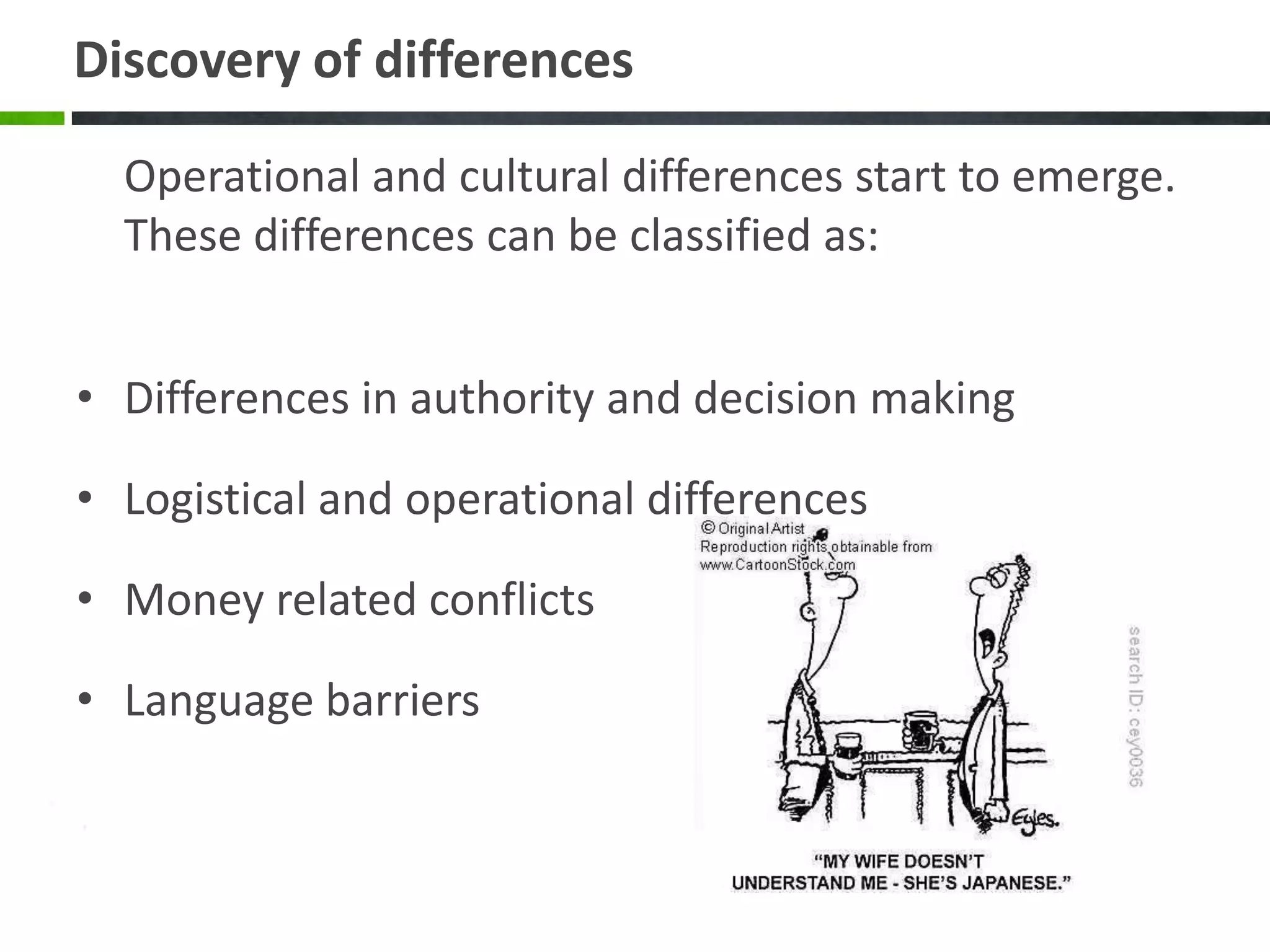
  Operational and cultural differences start to emerge.
  These differences can be classified as:


• Differences in authority and decision making

• Logistical and operational differences

• Money related conflicts

• Language barriers
Respect vs. Resentment

• Resentment from the different groups of
  employees may arise from:
  – Stereotyping
  – Blaming the “outsiders”

• Higher-level management should encourage their
  respective employees to be open and supportive
  of partner firm’s staff, regardless of background
  or nationality.
• Respecting other’s work will help them feel
  appreciated and contribute more to the venture.
Learning to Collaborate
• Firms have to develop procedures to eliminate
  organisational and interpersonal disparities to obtain
  the maximum value of the alliance.

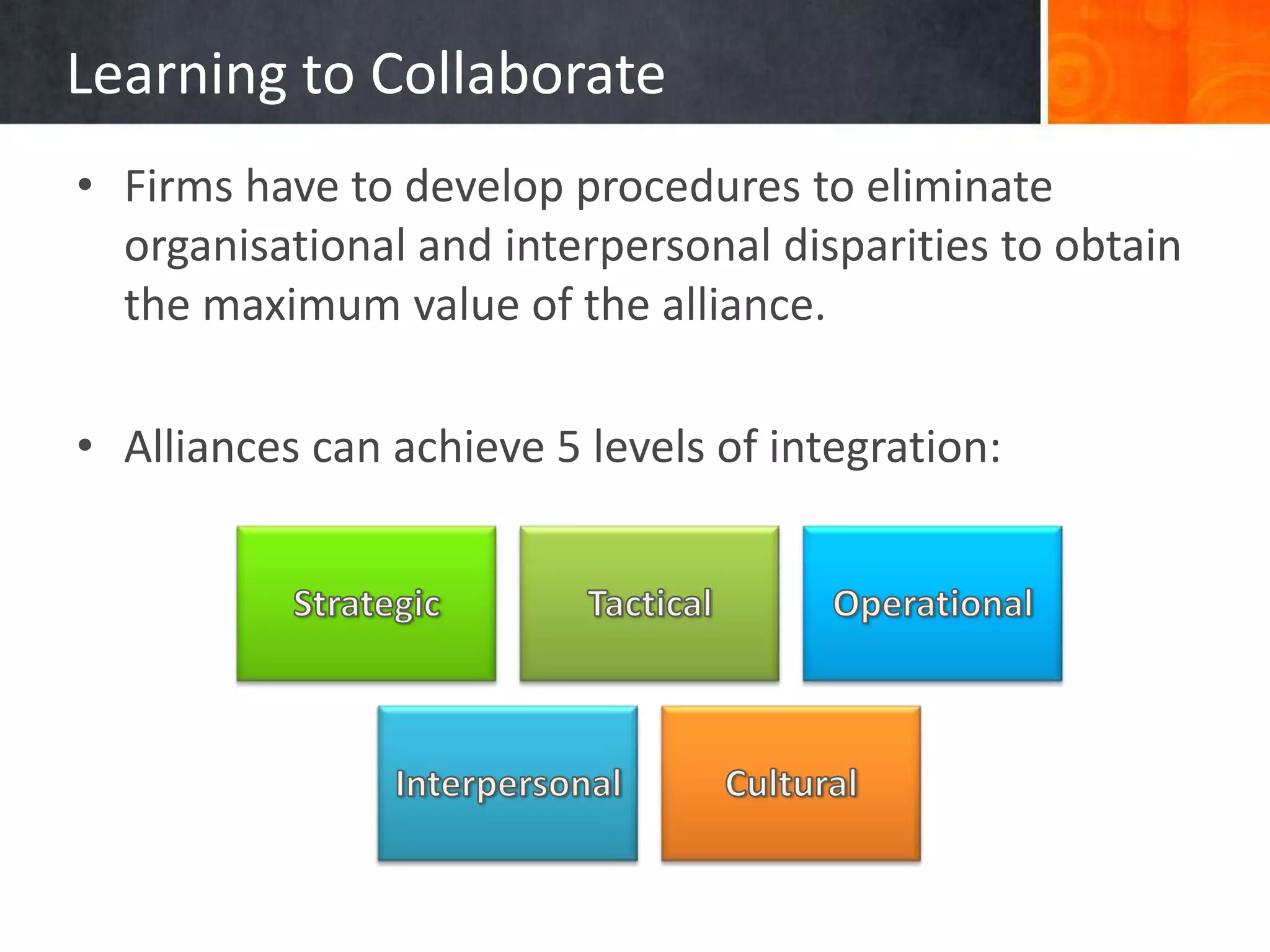
• Alliances can achieve 5 levels of integration:
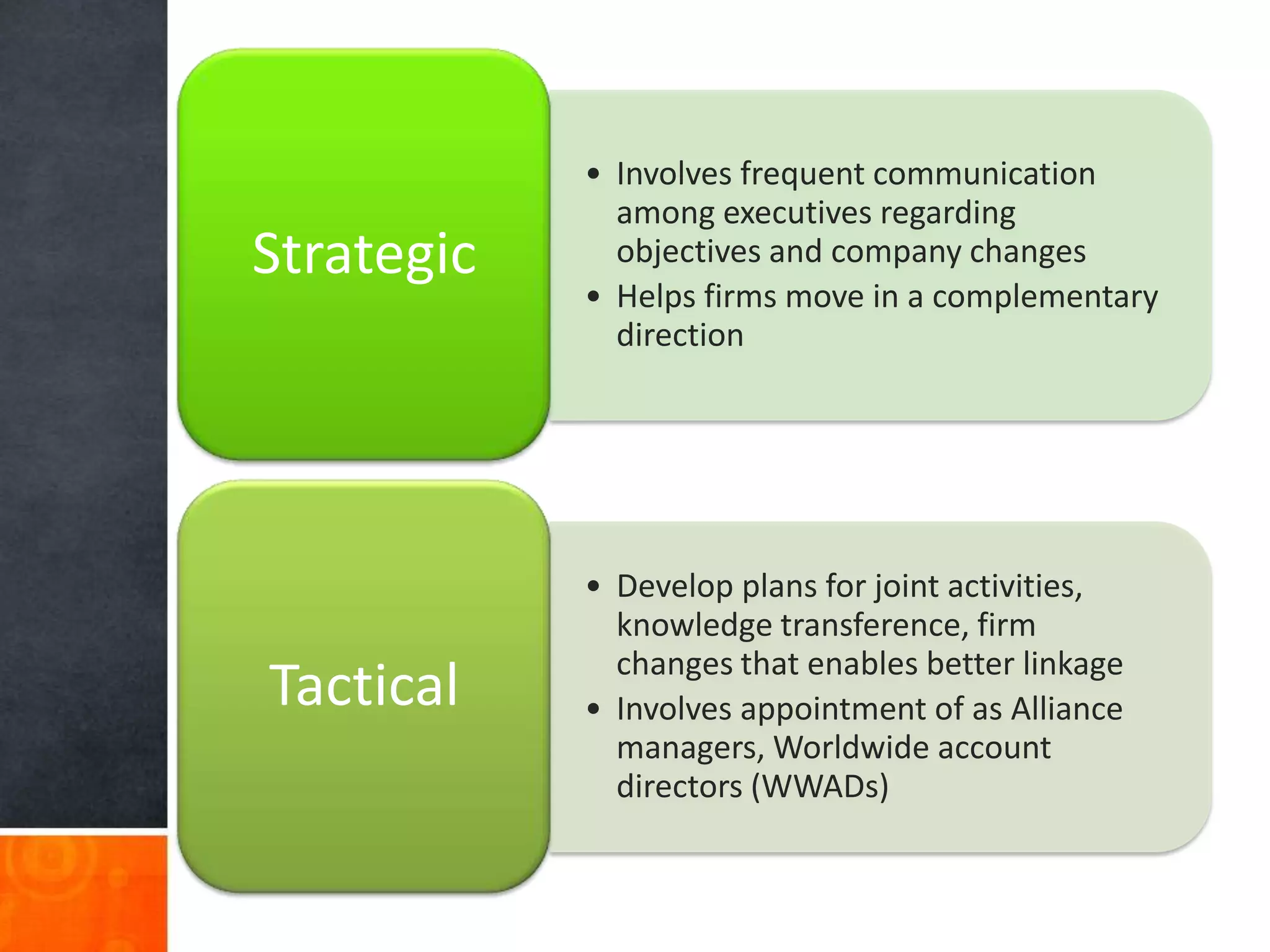
• Involves frequent communication
              among executives regarding
Strategic     objectives and company changes
            • Helps firms move in a complementary
              direction


            • Develop plans for joint activities,
              knowledge transference, firm
              changes that enables better linkage
Tactical    • Involves appointment of as Alliance
              managers, Worldwide account
              directors (WWADs)
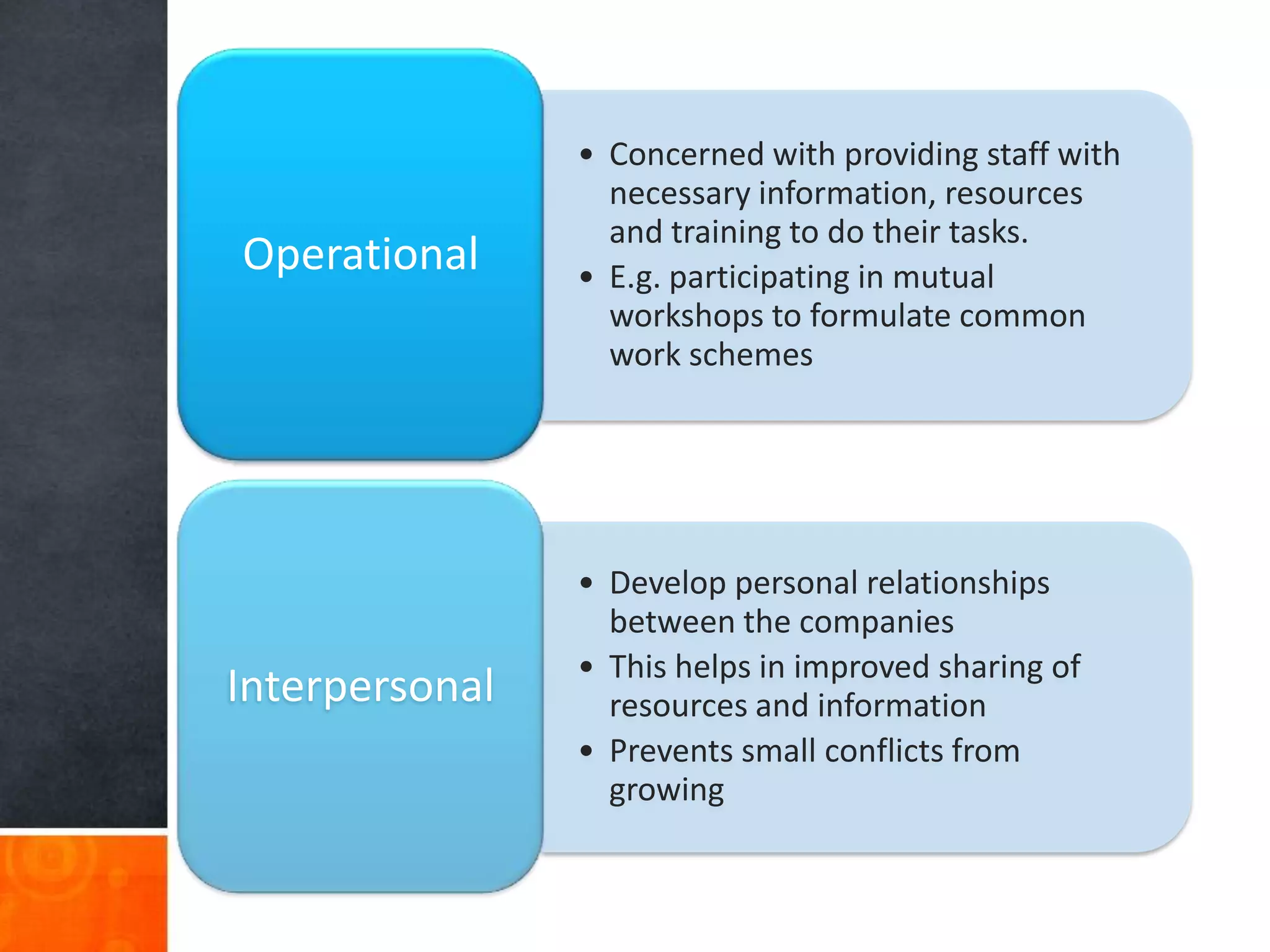
• Concerned with providing staff with
                  necessary information, resources
                  and training to do their tasks.
Operational     • E.g. participating in mutual
                  workshops to formulate common
                  work schemes


                • Develop personal relationships
                  between the companies
                • This helps in improved sharing of
Interpersonal     resources and information
                • Prevents small conflicts from
                  growing
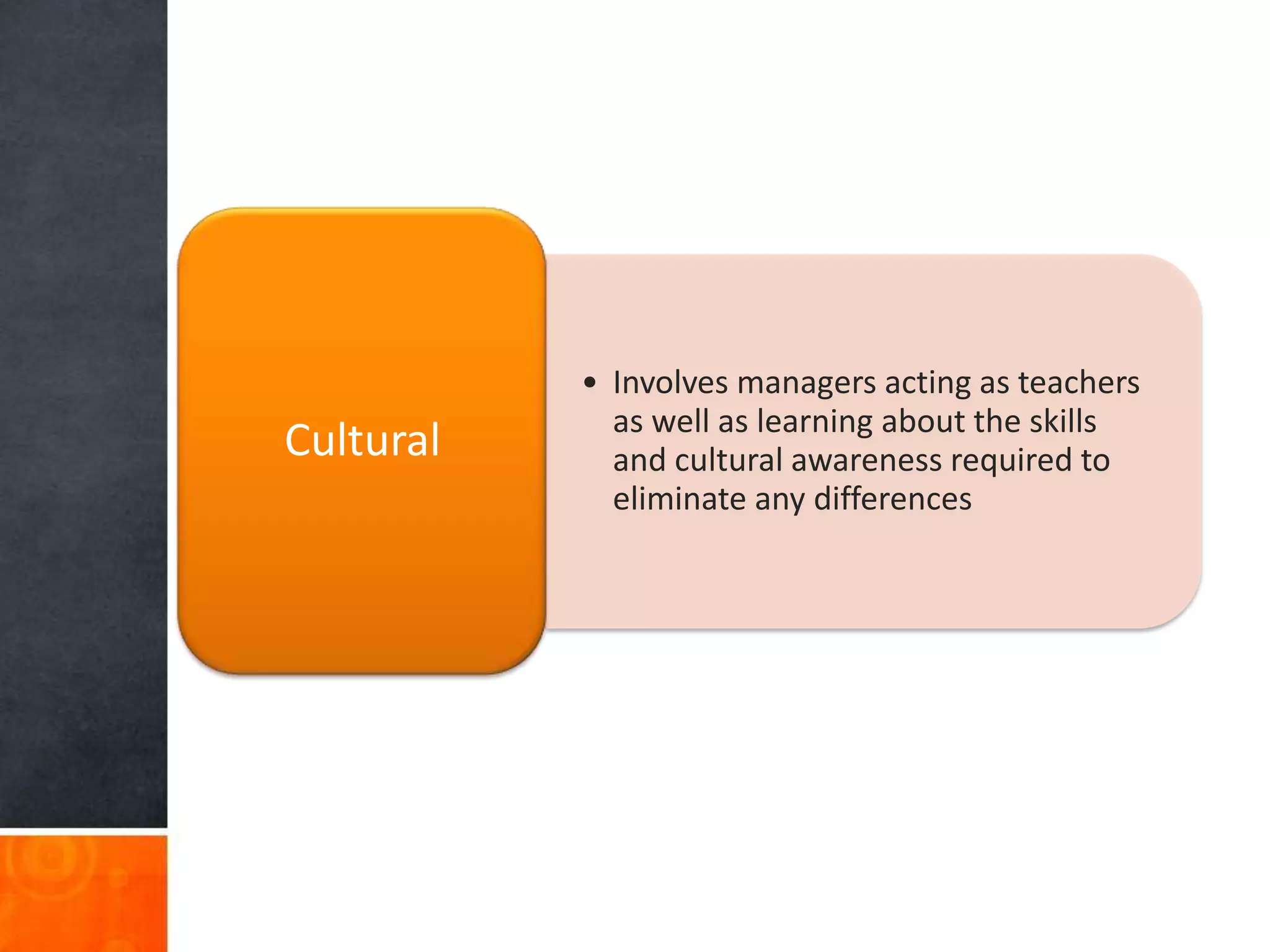
• Involves managers acting as teachers
             as well as learning about the skills
Cultural     and cultural awareness required to
             eliminate any differences
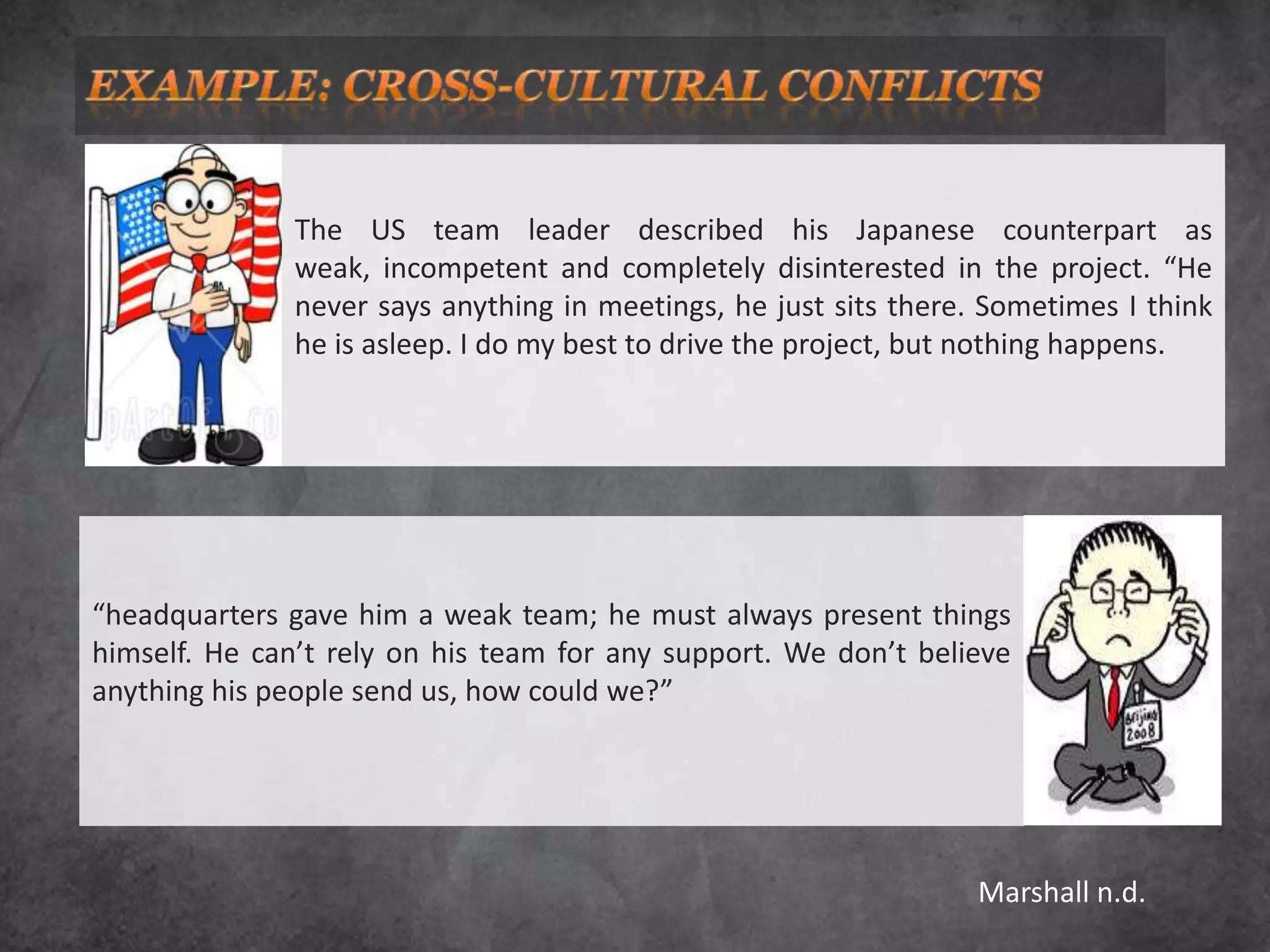
The US team leader described his Japanese counterpart as
              weak, incompetent and completely disinterested in the project. “He
              never says anything in meetings, he just sits there. Sometimes I think
              he is asleep. I do my best to drive the project, but nothing happens.


“headquarters gave him a weak team; he must always present things
himself. He can’t rely on his team for any support. We don’t believe
anything his people send us, how could we?”


                                                                  Marshall n.d.
Both sides were interpreting the other’s behaviour
strictly in terms of their own corporate and national
cultural assumptions.
  Where the Japanese executive was demonstrating
confidence and support for his team the Americans
saw passivity and disinterest.
  In trying to correct that perceived problem the
American executive unintentionally convinced the
Japanese that the American team members were not
up to the task at hand – anything that did not come
from the American executive himself could not be
trusted
                                           Marshall n.d.
Changing within
• An alliance will produce changes which were
  unexpected at the start of the collaboration.

• Manager should exchange ideas in order to garner
  the full value from the partnership.

Empowerment of Relationship Managers
• Managers must be able to adapt their firm’s
  methods accordingly to venture-specific tasks
• E.g. Northern Telecom gives independence to its
  managers in Turkey and China branches to alter the
  working procedures.
Changing within
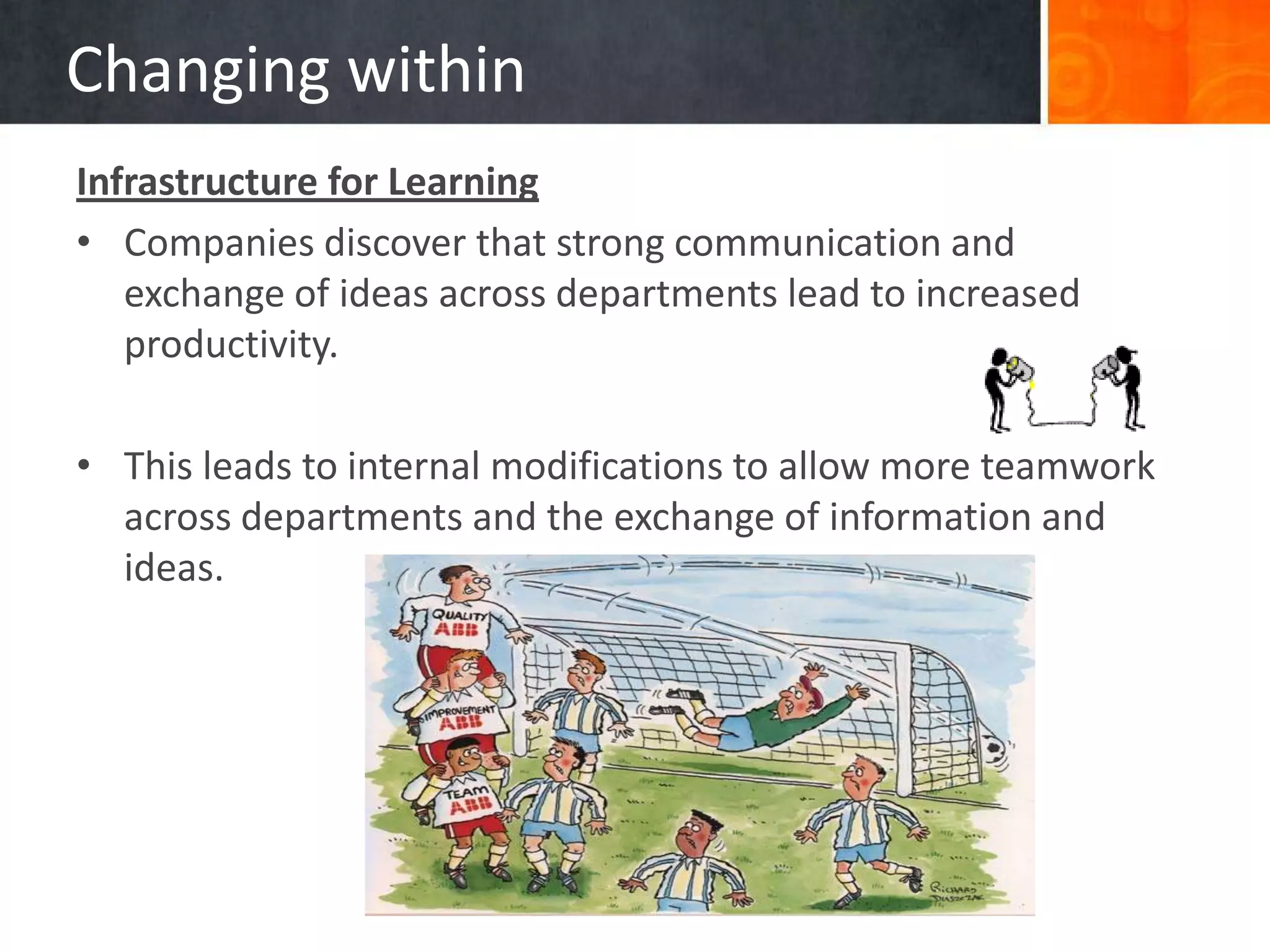
Infrastructure for Learning
• Companies discover that strong communication and
   exchange of ideas across departments lead to increased
   productivity.

• This leads to internal modifications to allow more teamwork
  across departments and the exchange of information and
  ideas.
THANK YOU
Q&A

Bmpp presentation week9

  • 1.
  • 6.
    Competing on theedge: • Improvisation The ability to survive • Co-adaptation change and re-invent a firm constantly over time • Experimentation • Regeneration • Time pacing
  • 7.
    FUNDAMENTALS OF COMPETINGON THE EDGE 1.UNCONTROLLED 2.INEFFICIENT 3.PRO-ACTIVE 4.CONTINOUS 5.DIVERSE
  • 8.
    Core concepts Where doyou want to go? How do you get there? THREE CORE CONCEPTS: EDGE OF CHAOS EDGE OF TIME TIME PACING
  • 9.
    MANAGING CHANGE LEADING REACTION ANTICIPATION CHANGE CONTINGENCY BEING AHEAD OF TAKING DEFENSE PLANNING. THE GAME
  • 10.
    CHANGE IS DIFFICULT BUTRESISTANCE TO CHANGE IS FATAL. 1.The future is too unpredictable to plan thus  However , Managers cannot managers cannot plan wait for the future to unfold effectively. 2.There is fierce competition in most high  However, they cannot focus velocity industries. only on change
  • 11.
    Edge of chaos -An organization is only partially structured. -The natural state between order and chaos, a compromise between structure and surprise. -An intermediate zone should be maintained where the system is most vibrant, surprising and flexible.
  • 12.
    Edge of time -Thinkingsimultaneously about multiple time horizons. -The challenge is to balance on the edge of the past the present and the future. -The intermediate zone where managers look backward to the past and forward into the future while concentrating on today.
  • 13.
    Time pacing. -Change istriggered by passage of time rather than occurrence of events. - Creating an internal rhythm that drives the momentum for change. -Systems evolve most effectively by shedding off what was useful in the past and adopting what will be useful in the future.
  • 14.
    Cont’d • Variation isenhanced, making evolution more effective (filling the inefficiency during the process) • Keep what works and adopt what will be useful in future • Slower and more gradual change process • Stretches managerial thinking across a longer time frame • The key is to remain at the edge of time (where past and future are still connected)
  • 15.
    How Organizations Change Complexity theory • Change is the marriage of two processes Evolutionary theory Complexity Theory • Adaptation is most effective in systems that are only partially connected (not too structured) • Quicker change process that happens as managers adapt to current situations • The key is to stay poised on edge of chaos
  • 16.
    Too many cooksspoil the broth??
  • 17.
    Grow Adapt Change Variation through successive Natural selection Acting on inherited generations over time
  • 18.
    Competing on theEdge | Intellectual Roots • Competing on the edge is based on the fundamentals of change and the elements that affect: - adaptive behavior - evolutionary change and - origins of speed Assumption 1: Marketplace is in a constant flux • Competitions come and go • Market changes (emerge, close, shrink, collide and grow)
  • 19.
    Assumption 2: Firms arecomposed of numerous parts • Links of parts together at the edges of chaos and time forms complex adaptive system Complex Adaptive System: 1. Made up of multiple agents (people or companies) 2. Agents must differ from each other 3. Exhibits COMPLEX behavior (behavior that is orderly enough to ensure stability but also full of flexibility) – Think Jazz band ! 4. Behaviors are ADAPTIVE 5. Behaviors are EMERGENT
  • 20.
    What does thismean? • The organization has the ability to adjust to obstacle together without an established ‘leader’
  • 21.
    GOAL of Competingon the edge strategy Flexibility Adaptation to Ability to locate the current change & constantly changing evolution over time sources of advantage Resilience in the face of setbacks
  • 22.
    Poised on theEdges at 3M How did the managers do it? CHAOS • Scientists : Allowed to spend 15% of their time on anything • Business run with lots of freedom & loose planning • Grants for external projects • Allowing change to happen will flexibility • This is pursuing edge of chaos
  • 23.
    The other elementsin their structure.. Structure Past Future • Sophisticated • Rooted on edge • Acceleration of financial of time their R&D controls & • Routinely projects • Sophisticated recombine past • Ensure every information techonologies 3M business systems • Eg. can reinvent Mircoreplication itself periodically
  • 24.
    Cont’d • 25% ofsales • Constantly • 38th of dividend must be from finding new increase products less products • 9% of sales than 4 years old • Their strategy: increase focuses on • Sets the rhythm • 3M coating of change technologies & continuously • Past > present > innovations reinvent itself future • Edges of chaos & time
  • 25.
    Conclusion Where do you want to go? How are you going to get there?
  • 26.
  • 27.
    An Introduction… • Analliance is not necessarily a merger or acquisition. It can also be an agreement between businesses to work collectively to achieve their objectives (mutually common or different). • Either way, a good business alliance can give a firm Collaborative Advantage. • What to consider when establishing an alliance? – Not just cost minimisation, improved funding, better productivity… – Human factors are also important! Barriers to effective use of relationships is social, not strategic factors Distinctions between organisational classes can interfere with adaptive capability -Kanter-
  • 28.
    3 Fundamental Aspectsof a Business Alliance Alliances should Alliances should not Alliances cannot be provide continuity. It be just an exchange restricted by strict should provide new of resources and rules. It should provide opportunities rather skills. That’s not an interpersonal than being one-off alliance, more of just connections and a supplier-consumer encourage change & relationship development.
  • 29.
    Collaboration & Drivingthe Market • Shaping the Market via deconstructionist approach. • Deconstruction of competitors • Accomplished by joint ventures, hostile takeovers, partnerships, mergers, acquisitions…etc. • E.g. – Eliminated direct competition in international telecom – Increase likelihood of competitors exiting & preventing new entrants • Can be done with suppliers, channels…
  • 30.
    Types of Alliances Combining core competencies
  • 31.
    Collaborating within theValue Net Customer • Retailer • End user Competitors • Wholesaler Complementors • Playstation • Gamecube • Xbox Linux Project • PCs • User-communities • Online-gaming • Magazines, platforms fanzines…etc. • Stand-alone DVD • ISPs player • ModChips Suppliers • Nvidia • Intel • Content rights holders From Martin Koser
  • 32.
    Courtship Engagement Setting up Housekeeping Changing within Learning to Collaborate
  • 33.
    Courtship • The stagewhere a suitable partner firm is discovered • Business alliances are more commonly initiated like romantic relationships; from optimistic ambition, feelings or intuition. • It is important for firm’s executives to hit it off at a personal level. • Relationship compatibility is not measured just by numbers and statistics. • Strategic and financial analyses just contribute a level of confidence.
  • 34.
    Criteria for partnerselection 1. Self-Analysis • Important to assess the firm itself: Find out the firm’s resource levels, internal SWOT analysis, objectives…etc. • Calls for a deep evaluation of the industry (their own and the targeted industry). • Focus on a shortlist of potential partners and evaluate them. You wouldn’t want any surprises!
  • 35.
    Criteria for partnerselection 2. Chemistry • Focuses on the personal side of a business alliance • A good understanding between executives creates some goodwill to draw on in times of tension. (can include business & personal interests) • Important to consider cultural, religious, ethnic and regional differences when interacting with another company.
  • 36.
    Criteria for partnerselection 3. Compatibility • Compatibility on financial terms is important • But so too are intangible measures such as: • Historical • Philosophical • Strategic • E.g: common experiences, values and principles and future aspirations
  • 37.
    Engagement • The alliancebecomes formally institutionalised. • Relationship becomes complicated when stakeholders enter the picture. • The management can follow certain steps to ensure the relationship keeps it balance between personal and institutional: – Meeting the Family – Establishing the Vows
  • 38.
    Meeting the Family •Like the executives, the lower-level management and employees should be given the chance to build a good rapport with staff of the potential partners. • Also ensure that other stakeholders approve of the alliance.
  • 39.
    • Third partyprofessionals (lawyers, investment bankers) enter the fray to oversee the contracts and legal side. • Must control their role at this stage as these professionals tend to focus more on technical elements and less on operational compatibility. If professionals dominate, this may happen Operational Friendly Professional savvy rules and contracts
  • 40.
    1. Incorporate aspecific joint The Vows activity Ways to ensure the best agreement is 2. Include a commitment to established expand the relationship 3. Incorporate clear signs of independence for partners.
  • 41.
    Setting up Housekeeping •As companies get past the initial set-up, there are bound to be some barriers when the actual alliance is put into practice. • These obstructions include: 1. Problems of Broader Involvement 2. Discovery of differences 3. Respect vs. Resentment
  • 42.
    Problems of BroaderInvolvement • This involves the problems which arise among employees of the partnering firms. • Problems may arise due to: – Insufficient opportunities for staff to create a good working rapport – Employees may have a different perspective about the alliance compared to the executives – Employees may focus on the company that primarily hired them instead of the partner firm – Some staff may oppose the alliance
  • 43.
    Discovery of differences Operational and cultural differences start to emerge. These differences can be classified as: • Differences in authority and decision making • Logistical and operational differences • Money related conflicts • Language barriers
  • 44.
    Respect vs. Resentment •Resentment from the different groups of employees may arise from: – Stereotyping – Blaming the “outsiders” • Higher-level management should encourage their respective employees to be open and supportive of partner firm’s staff, regardless of background or nationality. • Respecting other’s work will help them feel appreciated and contribute more to the venture.
  • 45.
    Learning to Collaborate •Firms have to develop procedures to eliminate organisational and interpersonal disparities to obtain the maximum value of the alliance. • Alliances can achieve 5 levels of integration:
  • 46.
    • Involves frequentcommunication among executives regarding Strategic objectives and company changes • Helps firms move in a complementary direction • Develop plans for joint activities, knowledge transference, firm changes that enables better linkage Tactical • Involves appointment of as Alliance managers, Worldwide account directors (WWADs)
  • 47.
    • Concerned withproviding staff with necessary information, resources and training to do their tasks. Operational • E.g. participating in mutual workshops to formulate common work schemes • Develop personal relationships between the companies • This helps in improved sharing of Interpersonal resources and information • Prevents small conflicts from growing
  • 48.
    • Involves managersacting as teachers as well as learning about the skills Cultural and cultural awareness required to eliminate any differences
  • 49.
    The US teamleader described his Japanese counterpart as weak, incompetent and completely disinterested in the project. “He never says anything in meetings, he just sits there. Sometimes I think he is asleep. I do my best to drive the project, but nothing happens. “headquarters gave him a weak team; he must always present things himself. He can’t rely on his team for any support. We don’t believe anything his people send us, how could we?” Marshall n.d.
  • 50.
    Both sides wereinterpreting the other’s behaviour strictly in terms of their own corporate and national cultural assumptions. Where the Japanese executive was demonstrating confidence and support for his team the Americans saw passivity and disinterest. In trying to correct that perceived problem the American executive unintentionally convinced the Japanese that the American team members were not up to the task at hand – anything that did not come from the American executive himself could not be trusted Marshall n.d.
  • 51.
    Changing within • Analliance will produce changes which were unexpected at the start of the collaboration. • Manager should exchange ideas in order to garner the full value from the partnership. Empowerment of Relationship Managers • Managers must be able to adapt their firm’s methods accordingly to venture-specific tasks • E.g. Northern Telecom gives independence to its managers in Turkey and China branches to alter the working procedures.
  • 52.
    Changing within Infrastructure forLearning • Companies discover that strong communication and exchange of ideas across departments lead to increased productivity. • This leads to internal modifications to allow more teamwork across departments and the exchange of information and ideas.
  • 53.