Download to read offline


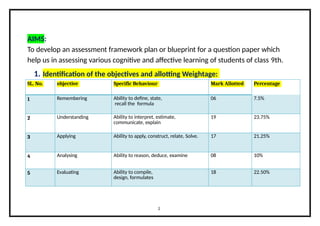
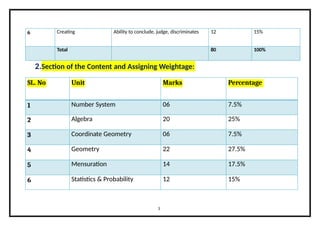
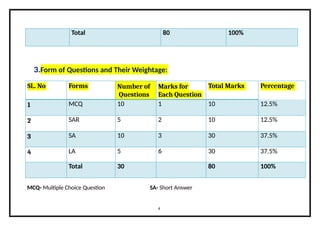
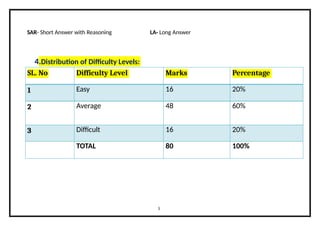
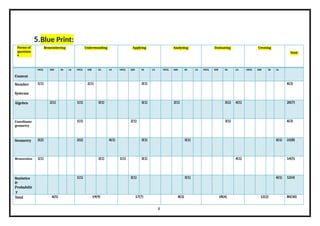
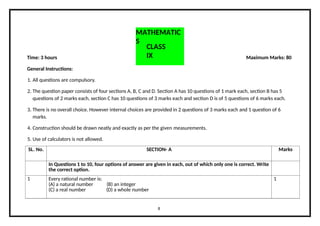
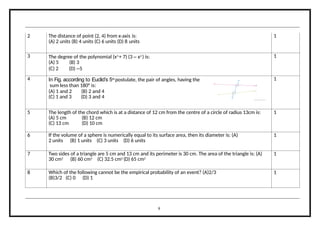
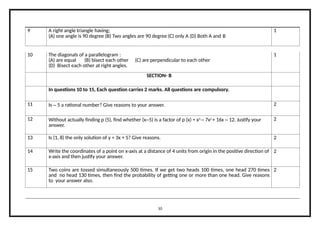
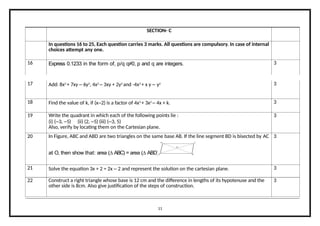
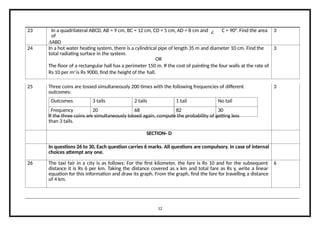
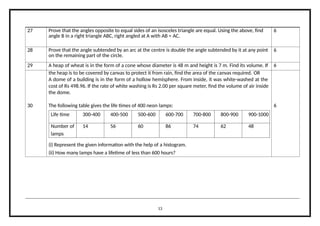

Question paper analysis and blue print/Submitted for pedagogy of mathematics/Under the supervisor of Dr Mahendra kakkela ✍️ Assistant Professor/This document is owned by Pedagogy of Mathematics Dr Mahendra sir / blueprint in education, also known as a test specification or table of specifications, is a detailed plan for a question paper that outlines the content, objectives, and cognitive levels to be assessed. It serves as a guide for the question paper's construction, ensuring that all important aspects of the syllabus are covered and that the assessment is fair, balanced, and aligned with learning outcomes. Key Aspects of a Blueprint: Content Coverage: Specifies the topics or units to be included in the question paper and their respective weightage. Cognitive Levels: Defines the level of understanding or application required to answer the questions, often categorized by Bloom's Taxonomy (e.g., Knowledge, Comprehension, Application). Question Types: Determines the types of questions to be included (e.g., multiple choice, short answer, essay) and their weightage. Marks Distribution: Specifies the total marks for the paper and how they are distributed across different sections or question types. Difficulty Levels: Indicates the difficulty level of the questions (e.g., easy, moderate, difficult) and their distribution. Benefits of Using a Blueprint: Standardization: Ensures that all question papers follow a consistent format and are aligned with learning objectives. Clarity: Provides a clear roadmap for both the test creator and the students, making it easier to understand what will be assessed. Validity: Helps to ensure that the assessment measures what it is intended to measure and is representative of the curriculum. Fairness: Reduces bias and ensures that all important topics and objectives are assessed. Analysis: Facilitates the analysis of the question paper's effectiveness and identification of areas for improvement. Question Paper Analysis: After the question paper is administered, it's crucial to analyze its performance to ensure its effectiveness and identify areas for improvement. This analysis typically involves: Evaluating the questions: Checking for clarity, ambiguity, fairness, and alignment with learning objectives. Analyzing student performance: Examining the frequency of correct and incorrect responses, identifying common misconceptions, and assessing the difficulty level of the questions. Comparing analysis to blueprint: Ensuring that the question paper aligns with the blueprint's specifications and that the analysis confirms its validity. Making adjustments: Modifying future question papers based on the analysis to improve their quality and effectiveness.


