Amit Kumar Pandey - 09653443066
Blue Light Control
Addicted to your smartphone, tablet or computer? Worried about LED’s? Wondered
what damage blue light could cause?
Are you constantly on your laptop and every other minute checking your phone or tablet? Not only that
but do you sit inside under artificial light? We all know that light can be both harmful and beneficial for our
vision as well as our overall health. After doing our research, here is what we can tell you about the
effects of blue light.
Light is essential for various functions.
 It helps us to see better,
 It helps us with our visual acuity and contrast acuity,
 It helps us perceivecolours,
 It helps with various non-visual functions of the body. For example, light helps to regulateour sleep/wake cycle, whichin turn helps to maintain and regulate
memory, mood and hormonal balance.
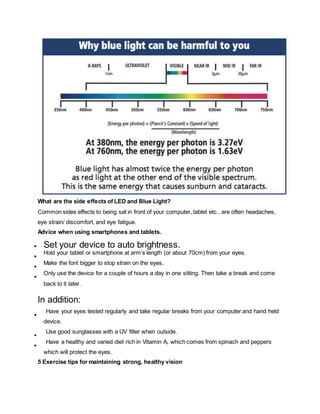
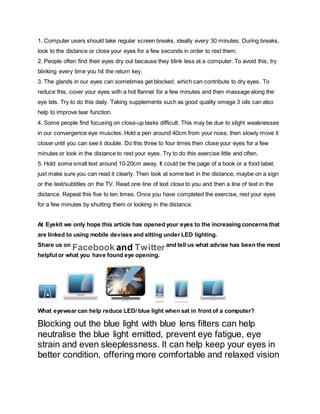
To put this into context, you need a basic grasp of the electromagnetic spectrum. It ranges from low-frequency waves such as radio waves (TV Signals) to micro-
wav es (mobilephones), infrared(cableTV) and visible light. It thenmoves to themore dangerous, high frequency end, from ultraviolet (sunbeds) to X-Rays and
gamma radiation (which kills cancer cells).
Blue light and sunlight produce light at the same frequency range. Sunlight contains UV and
blue light. UV light is part of the non-visible light spectrum and we are exposed toit every day when we're out in the sun. It can cause damage to our eyes,
particularly thecornea and the lens. The cumulative effect of UVexposurecan contribute to cataracts as well as thepotential for pingueculaand pterygium. Blue
light (blue v iolet) which comes from our smartphones and computers is part of the visible light spectrum, which reaches deeper into the eye andits cumulative
ef f ect can cause damage to the retina. Furthermore, in certain wavelengths, bluelight is implicated in thedevelopment of age-relatedmacular degeneration
(AMD).
UV light affects the front of the eye (cataract formation), while blue light causes damage to the back of the eye (risk of AMD).
Nowadays, there's an increase in the use of digital devices and modern lighting—such as LED lights and compact
fluorescent lamps (CFLs)—mostofwhich emita high level of blue light. CFLs contain about25% of harmful blue light
and LEDs contain about35% of harmful blue light.Interestingly, the cooler the white LED, the higher the blue
proportion. And by 2020, 90% of all of our lightsources are estimated to be LED lighting.
Giv en that oureyes are exposed to various sources that emit this blue-violet light (e.g., the sun, LED lighting, CFLs) and combine that with the use of tablets, TVs,
computer screens and smart phones, there's no doubt our exposureto blue-violet light is on the increase. This cumulative and constant exposure to the blue-violet
light is going to accumulate over time and has thepotential to cause damage to the retinal cells, whichis going to slowly lead to retinal cell deathand can in turn
lead to AMD.
What are the side effects of LED and Blue Light?
Common sides effects to being sat in front of your computer, tablet etc.. are often headaches,
eye strain/ discomfort, and eye fatigue.
Advice when using smartphones and tablets.
 Set your device to auto brightness.

Hold your tablet or smartphone at arm’s length (or about 70cm) from your eyes.

Make the font bigger to stop strain on the eyes.

Only use the device for a couple of hours a day in one sitting. Then take a break and come
back to it later.
In addition:

Have your eyes tested regularly and take regular breaks from your computer and hand held
device.

Use good sunglasses with a UV filter when outside.

Have a healthy and varied diet rich in Vitamin A, which comes from spinach and peppers
which will protect the eyes.
5 Exercise tips for maintaining strong, healthy vision
1. Computer users should take regular screen breaks, ideally every 30 minutes. During breaks,
look to the distance or close your eyes for a few seconds in order to rest them.
2. People often find their eyes dry out because they blink less at a computer. To avoid this, try
blinking every time you hit the return key.
3. The glands in our eyes can sometimes get blocked, which can contribute to dry eyes. To
reduce this, cover your eyes with a hot flannel for a few minutes and then massage along the
eye lids. Try to do this daily. Taking supplements such as good quality omega 3 oils can also
help to improve tear function.
4. Some people find focusing on close-up tasks difficult. This may be due to slight weaknesses
in our convergence eye muscles. Hold a pen around 40cm from your nose, then slowly move it
closer until you can see it double. Do this three to four times then close your eyes for a few
minutes or look in the distance to rest your eyes. Try to do this exercise little and often.
5. Hold some small text around 10-20cm away. It could be the page of a book or a food label,
just make sure you can read it clearly. Then look at some text in the distance, maybe on a sign
or the text/subtitles on the TV. Read one line of text close to you and then a line of text in the
distance. Repeat this five to ten times. Once you have completed the exercise, rest your eyes
for a few minutes by shutting them or looking in the distance.
At Eyekit we only hope this article has opened your eyes to the increasing concerns that
are linked to using mobile devises and sitting under LED lighting.
Share us on
Facebook and Twitterand tell us what advise has been the most
helpful or what you have found eye opening.
What eyewear can help reduce LED/ blue light when sat in front of a computer?
Blocking out the blue light with blue lens filters can help
neutralise the blue light emitted, prevent eye fatigue, eye
strain and even sleeplessness. It can help keep your eyes in
better condition, offering more comfortable and relaxed vision
and a better contrast perception when using everyday digital
devises.
What prescription filters can help and what we recommend for indoor use?
Such filters vary in colour from yellow to red, depending on
the amount of absorption required. We can offer a number of
specialist lenses from our protective lense series (PLS). When
you place your prescription order consider including one of
the following tints:
1. Blue light control coating for clear lenses
We have introduced a range of Standard 1.5 index, Thin & Lite 1.6 index and Super Thin & Lite
1.67 index prescription packages that include Hoya's Blue Control filters. The 1.5 index lenses
are clear though higher index lenses develop a light yellow tinge. They are ideal for:
 Stay-at-home parents (smartphones, tablets, laptops)
 Students (smartphones, TVs, laptops)
 Gamers (TVs, flat screencomputers)
 Young professionals (laptops, smartphones, tablets, GPS)
 Kids/teenagers (TVs, smartphones, tablets)
 Office workers (flat screen computers)
 Pensioners (TVs, flat screencomputers, tablets, laptops)
2. PLS (UV) 450 - Yellow 86%
Yellow lens absorbing up to 450nm is a light comfort tint. With a light transmission of 86% this
lens is almost clear. It has also passed the traffic light recognition test and is ideal for people
who:

do a lot of reading and watching television

spend a lot of time on mobile phones, tablets and computers.

work under fluorescent lighting in offices and supermarkets.
3. PLS 410 - Rose 50%
Rose lens absorbing up to 600 nm is a stronger tint and should be considered for the following:

fluorescent lighting

light flicker

eye strain

tension headache

photophobia - blepharospasm
(
when ordering these tints specified above...click on the colour
chosen when specifying your prescription and then in the comments box you can specify in
detail which one you’d prefer).

Blue light

  • 1.
    Amit Kumar Pandey- 09653443066 Blue Light Control Addicted to your smartphone, tablet or computer? Worried about LED’s? Wondered what damage blue light could cause? Are you constantly on your laptop and every other minute checking your phone or tablet? Not only that but do you sit inside under artificial light? We all know that light can be both harmful and beneficial for our vision as well as our overall health. After doing our research, here is what we can tell you about the effects of blue light. Light is essential for various functions.  It helps us to see better,  It helps us with our visual acuity and contrast acuity,  It helps us perceivecolours,  It helps with various non-visual functions of the body. For example, light helps to regulateour sleep/wake cycle, whichin turn helps to maintain and regulate memory, mood and hormonal balance.
  • 2.
    To put thisinto context, you need a basic grasp of the electromagnetic spectrum. It ranges from low-frequency waves such as radio waves (TV Signals) to micro- wav es (mobilephones), infrared(cableTV) and visible light. It thenmoves to themore dangerous, high frequency end, from ultraviolet (sunbeds) to X-Rays and gamma radiation (which kills cancer cells). Blue light and sunlight produce light at the same frequency range. Sunlight contains UV and blue light. UV light is part of the non-visible light spectrum and we are exposed toit every day when we're out in the sun. It can cause damage to our eyes, particularly thecornea and the lens. The cumulative effect of UVexposurecan contribute to cataracts as well as thepotential for pingueculaand pterygium. Blue light (blue v iolet) which comes from our smartphones and computers is part of the visible light spectrum, which reaches deeper into the eye andits cumulative ef f ect can cause damage to the retina. Furthermore, in certain wavelengths, bluelight is implicated in thedevelopment of age-relatedmacular degeneration (AMD). UV light affects the front of the eye (cataract formation), while blue light causes damage to the back of the eye (risk of AMD). Nowadays, there's an increase in the use of digital devices and modern lighting—such as LED lights and compact fluorescent lamps (CFLs)—mostofwhich emita high level of blue light. CFLs contain about25% of harmful blue light and LEDs contain about35% of harmful blue light.Interestingly, the cooler the white LED, the higher the blue proportion. And by 2020, 90% of all of our lightsources are estimated to be LED lighting. Giv en that oureyes are exposed to various sources that emit this blue-violet light (e.g., the sun, LED lighting, CFLs) and combine that with the use of tablets, TVs, computer screens and smart phones, there's no doubt our exposureto blue-violet light is on the increase. This cumulative and constant exposure to the blue-violet light is going to accumulate over time and has thepotential to cause damage to the retinal cells, whichis going to slowly lead to retinal cell deathand can in turn lead to AMD.
  • 3.
    What are theside effects of LED and Blue Light? Common sides effects to being sat in front of your computer, tablet etc.. are often headaches, eye strain/ discomfort, and eye fatigue. Advice when using smartphones and tablets.  Set your device to auto brightness.  Hold your tablet or smartphone at arm’s length (or about 70cm) from your eyes.  Make the font bigger to stop strain on the eyes.  Only use the device for a couple of hours a day in one sitting. Then take a break and come back to it later. In addition:  Have your eyes tested regularly and take regular breaks from your computer and hand held device.  Use good sunglasses with a UV filter when outside.  Have a healthy and varied diet rich in Vitamin A, which comes from spinach and peppers which will protect the eyes. 5 Exercise tips for maintaining strong, healthy vision
  • 4.
    1. Computer usersshould take regular screen breaks, ideally every 30 minutes. During breaks, look to the distance or close your eyes for a few seconds in order to rest them. 2. People often find their eyes dry out because they blink less at a computer. To avoid this, try blinking every time you hit the return key. 3. The glands in our eyes can sometimes get blocked, which can contribute to dry eyes. To reduce this, cover your eyes with a hot flannel for a few minutes and then massage along the eye lids. Try to do this daily. Taking supplements such as good quality omega 3 oils can also help to improve tear function. 4. Some people find focusing on close-up tasks difficult. This may be due to slight weaknesses in our convergence eye muscles. Hold a pen around 40cm from your nose, then slowly move it closer until you can see it double. Do this three to four times then close your eyes for a few minutes or look in the distance to rest your eyes. Try to do this exercise little and often. 5. Hold some small text around 10-20cm away. It could be the page of a book or a food label, just make sure you can read it clearly. Then look at some text in the distance, maybe on a sign or the text/subtitles on the TV. Read one line of text close to you and then a line of text in the distance. Repeat this five to ten times. Once you have completed the exercise, rest your eyes for a few minutes by shutting them or looking in the distance. At Eyekit we only hope this article has opened your eyes to the increasing concerns that are linked to using mobile devises and sitting under LED lighting. Share us on Facebook and Twitterand tell us what advise has been the most helpful or what you have found eye opening. What eyewear can help reduce LED/ blue light when sat in front of a computer? Blocking out the blue light with blue lens filters can help neutralise the blue light emitted, prevent eye fatigue, eye strain and even sleeplessness. It can help keep your eyes in better condition, offering more comfortable and relaxed vision
  • 5.
    and a bettercontrast perception when using everyday digital devises. What prescription filters can help and what we recommend for indoor use? Such filters vary in colour from yellow to red, depending on the amount of absorption required. We can offer a number of specialist lenses from our protective lense series (PLS). When you place your prescription order consider including one of the following tints: 1. Blue light control coating for clear lenses We have introduced a range of Standard 1.5 index, Thin & Lite 1.6 index and Super Thin & Lite 1.67 index prescription packages that include Hoya's Blue Control filters. The 1.5 index lenses are clear though higher index lenses develop a light yellow tinge. They are ideal for:  Stay-at-home parents (smartphones, tablets, laptops)  Students (smartphones, TVs, laptops)  Gamers (TVs, flat screencomputers)  Young professionals (laptops, smartphones, tablets, GPS)  Kids/teenagers (TVs, smartphones, tablets)  Office workers (flat screen computers)  Pensioners (TVs, flat screencomputers, tablets, laptops) 2. PLS (UV) 450 - Yellow 86% Yellow lens absorbing up to 450nm is a light comfort tint. With a light transmission of 86% this lens is almost clear. It has also passed the traffic light recognition test and is ideal for people who:  do a lot of reading and watching television  spend a lot of time on mobile phones, tablets and computers.  work under fluorescent lighting in offices and supermarkets. 3. PLS 410 - Rose 50% Rose lens absorbing up to 600 nm is a stronger tint and should be considered for the following:  fluorescent lighting  light flicker  eye strain  tension headache  photophobia - blepharospasm
  • 6.
    ( when ordering thesetints specified above...click on the colour chosen when specifying your prescription and then in the comments box you can specify in detail which one you’d prefer).