Blog Task 2 Jj Benzimra A PowerPoint presentation to explore how effective the combination of my main product and ancillary texts is.
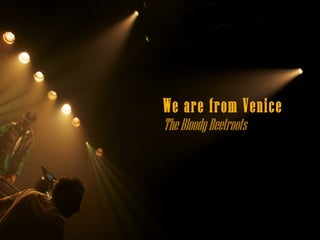
We are from Venice The Bloody Beetroots
The Video My pop video was set to the song “We are From Venice” by  The Bloody Beetroots . The Video aimed to convey the message of the song, which is that the world is in a state of chaos, and also establish the image of the artist, but the main aspiration of the video was to sell the song. The song is gritty and urban, and we tried to portray this in our video through the use of documentary style camerawork and a narrative structure imposed by a DJ (Pictured)
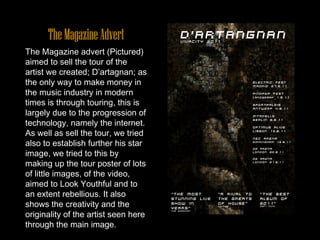
The Magazine Advert The Magazine advert (Pictured) aimed to sell the tour of the artist we created; D’artagnan; as the only way to make money in the music industry in modern times is through touring, this is largely due to the progression of technology, namely the internet. As well as sell the tour, we tried also to establish further his star image, we tried to this by making up the tour poster of lots of little images, of the video, aimed to Look Youthful and to an extent rebellious. It also shows the creativity and the originality of the artist seen here through the main image.
The Digipak The Main point of the Digipak was to catch a would be consumer’s eye. We attempted to do this by making the front cover stand out as much as possible. by using the black, white and red design, we have also commented on the star image of the artist, he is edgy, rebellious and hugely original. Although you may not be able to see the DJ’s face in full, you can tell that he is a handsome individual, thus promoting his image through sexual magnetism as well.
Carlsson Theory “ Music Video is a many-facetedmultidiscursive phenomenon. Some generally acknowledged “facts” about music video are that: 1.music videos communicate through TV-Screen and TV-Speakers; 2. music videos are a form of low-brow popular culture; 3. The reception of music videos depends on the beholder (music video may be beautiful or ugly, art or trash etc.)“ Carlsson explains that there are three types of performer in popular music videos, the Commercial Exhibitionist (Lady Gaga, Madonna), the Televised Bard (Bob Dylan, Bruce Springsteen) and the Electronic Shaman (Beatles, u2).
Carlsson Theory Continued As an example of Carlsson Theory, my pop video portrays the main performer in two of Carlsson's defined areas of artist. The artist is primarily an electronic  shaman, despite the lack of lyrics, the message is clear that the DJ is in a higher ground beyond that of the contrasting gangs, the DJ is always seen as positive, and he is even sometimes an ethereal figure shrouded in light, promoting the goodness in a seemingly never-ending conflict.
Carlsson Theory Continued The second way that our artist may be viewed is as a televised bard. This is because he is seen in the middle ground in the midst of a conflict, and in a sense he is imposing the narrative upon the viewer, making him a televised bard.
Star Image The term star refers to the semi-mythological set of meanings constructed around music performers in order to sell the performer to a large and loyal audience. Dyer states that a star is an  image,  not a real person,  constructed  (as any other aspect of fiction is) out of a  range of materials . (e.g. advertising, magazines, as well as featuring music in films and television). Stars are  commodities  produced and consumed on the strength of their own meaning.
Star Image Continued In my pop video, a number of Dyer’s listed aspects of music stardom are featured. For example, there is a lot going on in this video, with essentially a lot left misunderstood, portraying youthfulness. There is no sign of authority or control here, showing rebellion, an anti-authoritarian attitude, aggression and anger, and a disregard for social values and polite behavior. There is also creativity and talent present in the performance, as we see he is a talented DJ as well as writing an original song.
Star Image Continued Another aspect that makes the star image of our artist more accessible and causes fans to empathize with him, is when they read about where he is from. He was brought up in Elephant and Castle by his uncle, due to his mother’s addiction to methamphetamines and his father being killed in action in the war in Afghanistan. He stole a Daft Punk CD when he was ten because he “liked the cover”, and has made house music ever since. He is self-taught grade eight music theory and piano, and he was discovered opening for a minor act at Fabric in London.
Star Image through Digipak We tried to make the cover for our digipak as creative and original as possible, we also tried to make it look edgy and something that is eye catching. We also feel that the colors represent the video, for example the black and white represent the context, and that there is nothing more to the conflict other than the black and white, and the red headphones add another dimension as they portray the DJ as something wholly different and new, and as previously stated, edgy.
Star Image through Magazine Advert We tried a variety of options for the magazine advert (one of the earlier designs pictured) but in the end, we collectively decided that we needed it to be different, so that is when we came up with the idea for a picture mosaic. We felt it was different and something that people would want to look at on the back of a magazine. This represents the artist as original, and the pose on his face perhaps brings you back to his “success against the odds” story.
Universal Myths Claude Levi-Strauss identifies myths as narratives that belong to cultures rather than individuals, which tend to be passed down through generations. Through his works he identified a large number of social structures (importance of kin, nurturing role of females, taboo on incest etc). He also believed that myths were more than just entertainment for a culture, instead he claimed they perform a valuable social function by embodying values and ideas which are important for particular societies, often in the form of binary oppositions. By dealing with these values through the fictional forms of myths, a society can defuse potential conflict and tension.
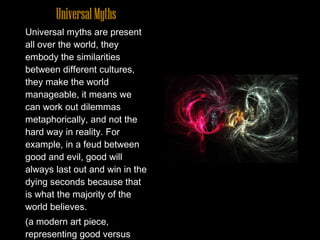
Universal Myths Universal myths are present all over the world, they embody the similarities between different cultures, they make the world manageable, it means we can work out dilemmas metaphorically, and not the hard way in reality. For example, in a feud between good and evil, good will always last out and win in the dying seconds because that is what the majority of the world believes.  (a modern art piece, representing good versus evil)
Universal Myths in Modern Media Universal myths come through media in many ways, they immediately come through in the subject and the narrative, they then come through in the following ways: the resolutions of the narrative; the characters; the archetypes and stereotypes and finally the dialogue.
Universal Myths in My Pop Video In my pop video there are two universal myths conveyed through the narrative, and the stereotypes. The first myth, and the most prominent, occurs in the conflict scenes, that is that all gangs are purely violent, that they have no ulterior motive, they are just chaotic for the sake of being chaotic. The second myth is subverted, there is usually a struggle between good and evil, but the narrative in our pop video suggest that there is only evil, there may be an overseer attempting to quell the conflict, but in the end the conflict remains because only evil remains.

Blog Task 2

  • 1.
    Blog Task 2Jj Benzimra A PowerPoint presentation to explore how effective the combination of my main product and ancillary texts is.
  • 2.
    We are fromVenice The Bloody Beetroots
  • 3.
    The Video Mypop video was set to the song “We are From Venice” by The Bloody Beetroots . The Video aimed to convey the message of the song, which is that the world is in a state of chaos, and also establish the image of the artist, but the main aspiration of the video was to sell the song. The song is gritty and urban, and we tried to portray this in our video through the use of documentary style camerawork and a narrative structure imposed by a DJ (Pictured)
  • 4.
    The Magazine AdvertThe Magazine advert (Pictured) aimed to sell the tour of the artist we created; D’artagnan; as the only way to make money in the music industry in modern times is through touring, this is largely due to the progression of technology, namely the internet. As well as sell the tour, we tried also to establish further his star image, we tried to this by making up the tour poster of lots of little images, of the video, aimed to Look Youthful and to an extent rebellious. It also shows the creativity and the originality of the artist seen here through the main image.
  • 5.
    The Digipak TheMain point of the Digipak was to catch a would be consumer’s eye. We attempted to do this by making the front cover stand out as much as possible. by using the black, white and red design, we have also commented on the star image of the artist, he is edgy, rebellious and hugely original. Although you may not be able to see the DJ’s face in full, you can tell that he is a handsome individual, thus promoting his image through sexual magnetism as well.
  • 6.
    Carlsson Theory “Music Video is a many-facetedmultidiscursive phenomenon. Some generally acknowledged “facts” about music video are that: 1.music videos communicate through TV-Screen and TV-Speakers; 2. music videos are a form of low-brow popular culture; 3. The reception of music videos depends on the beholder (music video may be beautiful or ugly, art or trash etc.)“ Carlsson explains that there are three types of performer in popular music videos, the Commercial Exhibitionist (Lady Gaga, Madonna), the Televised Bard (Bob Dylan, Bruce Springsteen) and the Electronic Shaman (Beatles, u2).
  • 7.
    Carlsson Theory ContinuedAs an example of Carlsson Theory, my pop video portrays the main performer in two of Carlsson's defined areas of artist. The artist is primarily an electronic shaman, despite the lack of lyrics, the message is clear that the DJ is in a higher ground beyond that of the contrasting gangs, the DJ is always seen as positive, and he is even sometimes an ethereal figure shrouded in light, promoting the goodness in a seemingly never-ending conflict.
  • 8.
    Carlsson Theory ContinuedThe second way that our artist may be viewed is as a televised bard. This is because he is seen in the middle ground in the midst of a conflict, and in a sense he is imposing the narrative upon the viewer, making him a televised bard.
  • 9.
    Star Image Theterm star refers to the semi-mythological set of meanings constructed around music performers in order to sell the performer to a large and loyal audience. Dyer states that a star is an image, not a real person, constructed (as any other aspect of fiction is) out of a range of materials . (e.g. advertising, magazines, as well as featuring music in films and television). Stars are commodities produced and consumed on the strength of their own meaning.
  • 10.
    Star Image ContinuedIn my pop video, a number of Dyer’s listed aspects of music stardom are featured. For example, there is a lot going on in this video, with essentially a lot left misunderstood, portraying youthfulness. There is no sign of authority or control here, showing rebellion, an anti-authoritarian attitude, aggression and anger, and a disregard for social values and polite behavior. There is also creativity and talent present in the performance, as we see he is a talented DJ as well as writing an original song.
  • 11.
    Star Image ContinuedAnother aspect that makes the star image of our artist more accessible and causes fans to empathize with him, is when they read about where he is from. He was brought up in Elephant and Castle by his uncle, due to his mother’s addiction to methamphetamines and his father being killed in action in the war in Afghanistan. He stole a Daft Punk CD when he was ten because he “liked the cover”, and has made house music ever since. He is self-taught grade eight music theory and piano, and he was discovered opening for a minor act at Fabric in London.
  • 12.
    Star Image throughDigipak We tried to make the cover for our digipak as creative and original as possible, we also tried to make it look edgy and something that is eye catching. We also feel that the colors represent the video, for example the black and white represent the context, and that there is nothing more to the conflict other than the black and white, and the red headphones add another dimension as they portray the DJ as something wholly different and new, and as previously stated, edgy.
  • 13.
    Star Image throughMagazine Advert We tried a variety of options for the magazine advert (one of the earlier designs pictured) but in the end, we collectively decided that we needed it to be different, so that is when we came up with the idea for a picture mosaic. We felt it was different and something that people would want to look at on the back of a magazine. This represents the artist as original, and the pose on his face perhaps brings you back to his “success against the odds” story.
  • 14.
    Universal Myths ClaudeLevi-Strauss identifies myths as narratives that belong to cultures rather than individuals, which tend to be passed down through generations. Through his works he identified a large number of social structures (importance of kin, nurturing role of females, taboo on incest etc). He also believed that myths were more than just entertainment for a culture, instead he claimed they perform a valuable social function by embodying values and ideas which are important for particular societies, often in the form of binary oppositions. By dealing with these values through the fictional forms of myths, a society can defuse potential conflict and tension.
  • 15.
    Universal Myths Universalmyths are present all over the world, they embody the similarities between different cultures, they make the world manageable, it means we can work out dilemmas metaphorically, and not the hard way in reality. For example, in a feud between good and evil, good will always last out and win in the dying seconds because that is what the majority of the world believes. (a modern art piece, representing good versus evil)
  • 16.
    Universal Myths inModern Media Universal myths come through media in many ways, they immediately come through in the subject and the narrative, they then come through in the following ways: the resolutions of the narrative; the characters; the archetypes and stereotypes and finally the dialogue.
  • 17.
    Universal Myths inMy Pop Video In my pop video there are two universal myths conveyed through the narrative, and the stereotypes. The first myth, and the most prominent, occurs in the conflict scenes, that is that all gangs are purely violent, that they have no ulterior motive, they are just chaotic for the sake of being chaotic. The second myth is subverted, there is usually a struggle between good and evil, but the narrative in our pop video suggest that there is only evil, there may be an overseer attempting to quell the conflict, but in the end the conflict remains because only evil remains.