

Planning for Your
     Future


 _______________________________
              Name

 _______________________________
              Class
Purple Sheet
                                                April 20, 2010


    Dear Parents,

          Your son/daughter will be completing a budget project in
    math. The purpose of this project is to provide baseline
    knowledge of the expenses and the benefits of a budget. While
    we all hope our children will earn a good wage, we also know that
    sometimes we are subjected to circumstances that greatly impact
    our incomes. The goal of this project is to encourage problem
    solving and instill a real life situation into our curricula.
          Sometime in April or the first part of May, the English
    classes will complete an investigation of careers. Knowledge of
    expenses will help students be aware of the impact finances have
    on life and how education impacts career choices.
          In February, the math classes developed a 4-Year-Plan for
    high school. This activity encouraged the students to explore the
    courses available at the high school setting before registering
    for their freshman year. Entrance requirements to the various
    post-secondary education options were also discussed.
          As a staff, we will be discussing the different facets of
    careers and emphasize that earnings are only one of many
    important aspects of a career that should be investigated before
    choosing a field of work. Quality of life must also be considered.
          We hope these activities in math and English will develop
    connections between our coursework and our student’s futures.

    Sincerely,

    The 8th Grade Math and English Departments
    Will James
Yellow Sheet
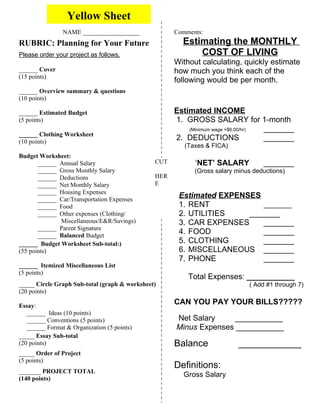
                NAME __________________              Comments:
RUBRIC: Planning for Your Future                       Estimating the MONTHLY
Please order your project as follows.                      COST OF LIVING
                                                     Without calculating, quickly estimate
______ Cover                                         how much you think each of the
(15 points)
                                                     following would be per month.
______ Overview summary & questions
(10 points)

______ Estimated Budget                              Estimated INCOME
(5 points)                                           1. GROSS SALARY for 1-month
                                                         (Minimum wage =$6.00/hr) _______
______ Clothing Worksheet
(10 points)
                                                     2. DEDUCTIONS                _______
                                                        (Taxes & FICA)
Budget Worksheet:
       ______ Annual Salary                    CUT         ‘NET’ SALARY           _______
       ______ Gross Monthly Salary                         (Gross salary minus deductions)
       ______ Deductions                       HER
       ______ Net Monthly Salary               E
       ______ Housing Expenses
       ______ Car/Transportation Expenses
                                                      Estimated EXPENSES
       ______ Food                                    1. RENT            ________
       ______ Other expenses (Clothing/               2. UTILITIES    _______
              Miscellaneous/E&R/Savings)              3. CAR EXPENSES    _______
       ______ Parent Signature
       ______ Balanced Budget
                                                      4. FOOD            _______
______ Budget Worksheet Sub-total:)                   5. CLOTHING        _______
(55 points)                                           6. MISCELLANEOUS _______
                                                      7. PHONE           _______
______ Itemized Miscellaneous List
(5 points)
                                                         Total Expenses: ___________
_____ Circle Graph Sub-total (graph & worksheet)                             ( Add #1 through 7)
(20 points)

Essay:
                                                     CAN YOU PAY YOUR BILLS?????
   ______ Ideas (10 points)
   ______ Conventions (5 points)                     Net Salary     ___________
   ______ Format & Organization (5 points)           Minus Expenses ___________
_____ Essay Sub-total
(20 points)                                          Balance              ____________
_____ Order of Project
(5 points)
                                                     Definitions:
_______ PROJECT TOTAL
(140 points)
                                                       Gross Salary
Net Salary

     FICA


So... Planning for Your Future   Estimate Page 1   So... You want to be a Millionaire   Estimate Page 1
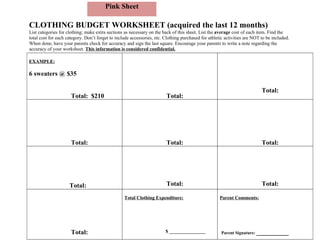
Pink Sheet

CLOTHING BUDGET WORKSHEET (acquired the last 12 months)
List categories for clothing; make extra sections as necessary on the back of this sheet. List the average cost of each item. Find the
total cost for each category. Don’t forget to include accessories, etc. Clothing purchased for athletic activities are NOT to be included.
When done, have your parents check for accuracy and sign the last square. Encourage your parents to write a note regarding the
accuracy of your worksheet. This information is considered confidential.

EXAMPLE:

6 sweaters @ $35

                                                                                                                           Total:
                      Total: $210                                       Total:


                      Total:                                            Total:                                             Total:


                     Total:                                             Total:                                             Total:

                                                  Total Clothing Expenditure:                        Parent Comments:


                      Total:                                            $ _______________            Parent Signature: __________
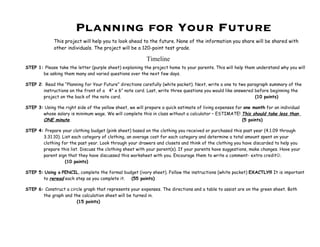
Planning for Your Future
             This project will help you to look ahead to the future. None of the information you share will be shared with
             other individuals. The project will be a 120-point test grade.

                                                          Timeline
STEP 1: Please take the letter (purple sheet) explaining the project home to your parents. This will help them understand why you will
       be asking them many and varied questions over the next few days.

STEP 2: Read the “Planning for Your Future” directions carefully (white packet). Next, write a one to two paragraph summary of the
       instructions on the front of a 4” x 6” note card. Last, write three questions you would like answered before beginning the
       project on the back of the note card.                                                                 (10 points)

STEP 3: Using the right side of the yellow sheet, we will prepare a quick estimate of living expenses for one month for an individual
       whose salary is minimum wage. We will complete this in class without a calculator – ESTIMATE! This should take less than
       ONE minute.                                                                                       (5 points)

STEP 4: Prepare your clothing budget (pink sheet) based on the clothing you received or purchased this past year (4.1.09 through
       3.31.10). List each category of clothing, an average cost for each category and determine a total amount spent on your
       clothing for the past year. Look through your drawers and closets and think of the clothing you have discarded to help you
       prepare this list. Discuss the clothing sheet with your parent(s). If your parents have suggestions, make changes. Have your
       parent sign that they have discussed this worksheet with you. Encourage them to write a comment- extra credit.
                  (10 points)

STEP 5: Using a PENCIL, complete the formal budget (ivory sheet). Follow the instructions (white packet) EXACTLY!!! It is important
       to reread each step as you complete it. (55 points)

STEP 6: Construct a circle graph that represents your expenses. The directions and a table to assist are on the green sheet. Both
       the graph and the calculation sheet will be turned in.
                       (15 points)
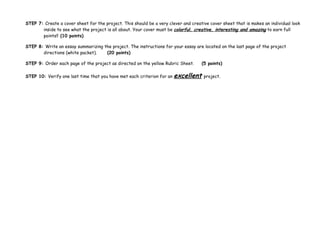
STEP 7: Create a cover sheet for the project. This should be a very clever and creative cover sheet that is makes an individual look
       inside to see what the project is all about. Your cover must be colorful, creative, interesting and amazing to earn full
       points!! (10 points)

STEP 8: Write an essay summarizing the project. The instructions for your essay are located on the last page of the project
       directions (white packet).   (20 points)

STEP 9: Order each page of the project as directed on the yellow Rubric Sheet.      (5 points)

STEP 10: Verify one last time that you have met each criterion for an   excellent project.
Planning for Your Future
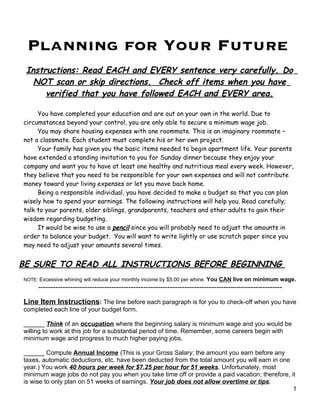
 Instructions: Read EACH and EVERY sentence very carefully. Do
   NOT scan or skip directions. Check off items when you have
      verified that you have followed EACH and EVERY area.

     You have completed your education and are out on your own in the world. Due to
circumstances beyond your control, you are only able to secure a minimum wage job.
     You may share housing expenses with one roommate. This is an imaginary roommate –
not a classmate. Each student must complete his or her own project.
     Your family has given you the basic items needed to begin apartment life. Your parents
have extended a standing invitation to you for Sunday dinner because they enjoy your
company and want you to have at least one healthy and nutritious meal every week. However,
they believe that you need to be responsible for your own expenses and will not contribute
money toward your living expenses or let you move back home.
     Being a responsible individual, you have decided to make a budget so that you can plan
wisely how to spend your earnings. The following instructions will help you. Read carefully;
talk to your parents, older siblings, grandparents, teachers and other adults to gain their
wisdom regarding budgeting.
     It would be wise to use a pencil since you will probably need to adjust the amounts in
order to balance your budget. You will want to write lightly or use scratch paper since you
may need to adjust your amounts several times.


BE SURE TO READ ALL INSTRUCTIONS BEFORE BEGINNING.
NOTE: Excessive whining will reduce your monthly income by $5.00 per whine.   You CAN live on minimum wage.
      ----------------------------------------------------------------------------------------------------

Line Item Instructions: The line before each paragraph is for you to check-off when you have
completed each line of your budget form.

______ Think of an occupation where the beginning salary is minimum wage and you would be
willing to work at this job for a substantial period of time. Remember, some careers begin with
minimum wage and progress to much higher paying jobs.

______ Compute Annual Income (This is your Gross Salary; the amount you earn before any
taxes, automatic deductions, etc. have been deducted from the total amount you will earn in one
year.) You work 40 hours per week for $7.25 per hour for 51 weeks. Unfortunately, most
minimum wage jobs do not pay you when you take time off or provide a paid vacation; therefore, it
is wise to only plan on 51 weeks of earnings. Your job does not allow overtime or tips.
                                                                                                1
______ Compute Gross Monthly Salary (Divide your yearly salary by twelve, round to the
nearest cent.)

______ Determine your ‘Net’ salary. First, calculate each payroll deduction listed. You will need
to take your gross monthly salary and multiply it by the percentage listed on the Budget Sheet
(round to the nearest cent). Find the total deductions that your employer will deduct from your
paycheck. Subtract the total deducted amount from your gross monthly salary; this is your ‘net’
salary. Your ‘Net’ monthly salary is your spendable income.

______ Rent: Find your ‘dream’ apartment/duplex/house from the newspaper ads, cut it out, and
tape or glue it in the space provided next to the rent line on your Budget Worksheet. You may
need help understanding the ad lingo. Many abbreviations are used; get help from an adult!
Remember to keep cost, location, safety, and size in mind when making your choice. You may
choose to have ONE roommate. If you do, you may split the rent and utilities but remember,
utilities will cost more for two people than for one. This is an imaginary roommate – not a
classmate. Each student must complete his or her own project. Place a check in the box on your
Budget Sheet IF you are choosing to have a roommate.
       Students always seem to ask if they can live in a motorhome or a camper. NO, that is not an
option. (This is my project and I get to make the rules.) 
       Extra Credit: Ask you parents to drive you by ‘your apartment’ and either take a picture and
email it to me @ horstl@billings.k12.mt.us or have your parents write a note that you have seen
the location and the exterior of the apartment. Is this an apartment you would really live in?

______ Next, determine the cost of utilities. ‘Utilities’ for this project include the following:
electricity, natural gas, and water. Be sure to discuss this cost with an adult. Your parents will be
able to help you determine a reasonable amount. Some apartments have some of the utilities
included in your monthly rent payment. If your apartment has a utility included, write, “Paid in
rent” on the line for the appropriate utilities. Caution: Telephone and Cable TV are not
considered utilities.

______ Determine the cost of your telephone/cell phone service. Check an old statement from
the telephone provider. Your parents probably have a statement available for you to use as a
research tool or go on-line and comparison shop! Additional charges apply for call forwarding,
caller ID, call waiting, unlimited texting, data plan, etc. If you plan to use these services you will
need to include them in your budgeted telephone amount. If you will be using a cell phone,
remember every minute you go over your ‘allowed minutes’ will be very expensive. Be sure to
compare plans. I think you will find that if you have the privilege of a cell phone, provided by your
parents, that you are very fortunate! If you have your phone service packaged in with your Internet
and cable TV write “Included in cable package” on the telephone line of your Budget Sheet.
      You are NOT allowed to stay on your parents cell phone plan for this project. Remember,
your parents raised you to be responsible and independent!

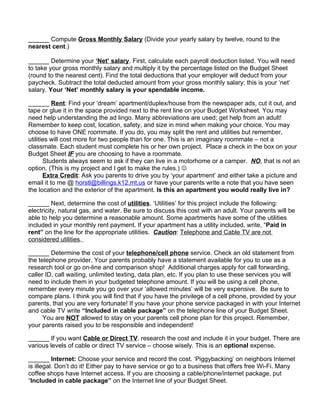
______ If you want Cable or Direct TV, research the cost and include it in your budget. There are
various levels of cable or direct TV service – choose wisely. This is an optional expense.

______ Internet: Choose your service and record the cost. ‘Piggybacking’ on neighbors Internet
is illegal. Don’t do it! Either pay to have service or go to a business that offers free Wi-Fi. Many
coffee shops have Internet access. If you are choosing a cable/phone/internet package, put
“Included in cable package” on the Internet line of your Budget Sheet.
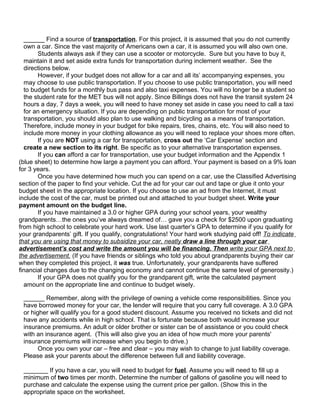
______ Find a source of transportation. For this project, it is assumed that you do not currently
  own a car. Since the vast majority of Americans own a car, it is assumed you will also own one.
       Students always ask if they can use a scooter or motorcycle. Sure but you have to buy it,
  maintain it and set aside extra funds for transportation during inclement weather. See the
  directions below.
       However, if your budget does not allow for a car and all its’ accompanying expenses, you
  may choose to use public transportation. If you choose to use public transportation, you will need
  to budget funds for a monthly bus pass and also taxi expenses. You will no longer be a student so
  the student rate for the MET bus will not apply. Since Billings does not have the transit system 24
  hours a day, 7 days a week, you will need to have money set aside in case you need to call a taxi
  for an emergency situation. If you are depending on public transportation for most of your
  transportation, you should also plan to use walking and bicycling as a means of transportation.
  Therefore, include money in your budget for bike repairs, tires, chains, etc. You will also need to
  include more money in your clothing allowance as you will need to replace your shoes more often.
       If you are NOT using a car for transportation, cross out the ‘Car Expense’ section and
  create a new section to its right. Be specific as to your alternative transportation expenses.
       If you can afford a car for transportation, use your budget information and the Appendix 1
(blue sheet) to determine how large a payment you can afford. Your payment is based on a 9% loan
for 3 years.
       Once you have determined how much you can spend on a car, use the Classified Advertising
section of the paper to find your vehicle. Cut the ad for your car out and tape or glue it onto your
budget sheet in the appropriate location. If you choose to use an ad from the Internet, it must
include the cost of the car, must be printed out and attached to your budget sheet. Write your
payment amount on the budget line.
       If you have maintained a 3.0 or higher GPA during your school years, your wealthy
grandparents…the ones you’ve always dreamed of… gave you a check for $2500 upon graduating
from high school to celebrate your hard work. Use last quarter’s GPA to determine if you qualify for
your grandparents’ gift. If you qualify, congratulations! Your hard work studying paid off! To indicate
that you are using that money to subsidize your car, neatly draw a line through your car
advertisement’s cost and write the amount you will be financing. Then write your GPA next to
the advertisement. (If you have friends or siblings who told you about grandparents buying their car
when they completed this project, it was true. Unfortunately, your grandparents have suffered
financial changes due to the changing economy and cannot continue the same level of generosity.)
       If your GPA does not qualify you for the grandparent gift, write the calculated payment
  amount on the appropriate line and continue to budget wisely.

 ______ Remember, along with the privilege of owning a vehicle come responsibilities. Since you
 have borrowed money for your car, the lender will require that you carry full coverage. A 3.0 GPA
 or higher will qualify you for a good student discount. Assume you received no tickets and did not
 have any accidents while in high school. That is fortunate because both would increase your
 insurance premiums. An adult or older brother or sister can be of assistance or you could check
 with an insurance agent. (This will also give you an idea of how much more your parents'
 insurance premiums will increase when you begin to drive.)
       Once you own your car – free and clear – you may wish to change to just liability coverage.
 Please ask your parents about the difference between full and liability coverage.

 _______ If you have a car, you will need to budget for fuel. Assume you will need to fill up a
 minimum of two times per month. Determine the number of gallons of gasoline you will need to
 purchase and calculate the expense using the current price per gallon. (Show this in the
 appropriate space on the worksheet.
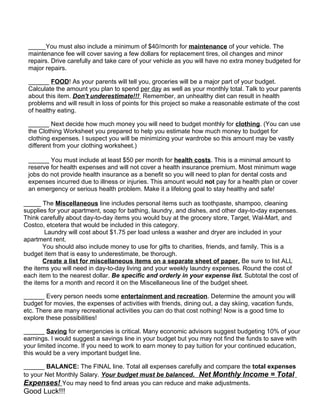
_____You must also include a minimum of $40/month for maintenance of your vehicle. The
 maintenance fee will cover saving a few dollars for replacement tires, oil changes and minor
 repairs. Drive carefully and take care of your vehicle as you will have no extra money budgeted for
 major repairs.

 ______ FOOD! As your parents will tell you, groceries will be a major part of your budget.
 Calculate the amount you plan to spend per day as well as your monthly total. Talk to your parents
 about this item. Don't underestimate!!! Remember, an unhealthy diet can result in health
 problems and will result in loss of points for this project so make a reasonable estimate of the cost
 of healthy eating.

 ______ Next decide how much money you will need to budget monthly for clothing. (You can use
 the Clothing Worksheet you prepared to help you estimate how much money to budget for
 clothing expenses. I suspect you will be minimizing your wardrobe so this amount may be vastly
 different from your clothing worksheet.)

 ______ You must include at least $50 per month for health costs. This is a minimal amount to
 reserve for health expenses and will not cover a health insurance premium. Most minimum wage
 jobs do not provide health insurance as a benefit so you will need to plan for dental costs and
 expenses incurred due to illness or injuries. This amount would not pay for a health plan or cover
 an emergency or serious health problem. Make it a lifelong goal to stay healthy and safe!

_____ The Miscellaneous line includes personal items such as toothpaste, shampoo, cleaning
supplies for your apartment, soap for bathing, laundry, and dishes, and other day-to-day expenses.
Think carefully about day-to-day items you would buy at the grocery store, Target, Wal-Mart, and
Costco, etcetera that would be included in this category.
        Laundry will cost about $1.75 per load unless a washer and dryer are included in your
apartment rent.
       You should also include money to use for gifts to charities, friends, and family. This is a
budget item that is easy to underestimate, be thorough.
       Create a list for miscellaneous items on a separate sheet of paper. Be sure to list ALL
the items you will need in day-to-day living and your weekly laundry expenses. Round the cost of
each item to the nearest dollar. Be specific and orderly in your expense list. Subtotal the cost of
the items for a month and record it on the Miscellaneous line of the budget sheet.

______ Every person needs some entertainment and recreation. Determine the amount you will
budget for movies, the expenses of activities with friends, dining out, a day skiing, vacation funds,
etc. There are many recreational activities you can do that cost nothing! Now is a good time to
explore these possibilities!

______ Saving for emergencies is critical. Many economic advisors suggest budgeting 10% of your
earnings. I would suggest a savings line in your budget but you may not find the funds to save with
your limited income. If you need to work to earn money to pay tuition for your continued education,
this would be a very important budget line.

______ BALANCE: The FINAL line. Total all expenses carefully and compare the total expenses
to your Net Monthly Salary. Your budget must be balanced. Net Monthly Income = Total
Expenses! You may need to find areas you can reduce and make adjustments.
Good Luck!!!
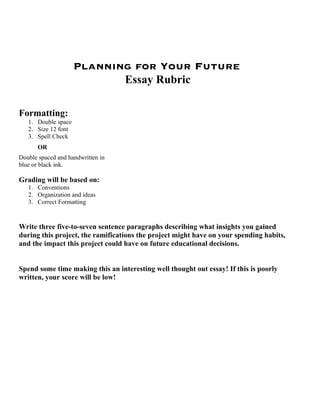
Planning for Your Future
                            Essay Rubric

Formatting:
   1. Double space
   2. Size 12 font
   3. Spell Check
       OR
Double spaced and handwritten in
blue or black ink.

Grading will be based on:
   1. Conventions
   2. Organization and ideas
   3. Correct Formatting


Write three five-to-seven sentence paragraphs describing what insights you gained
during this project, the ramifications the project might have on your spending habits,
and the impact this project could have on future educational decisions.


Spend some time making this an interesting well thought out essay! If this is poorly
written, your score will be low!
Name: _______________ ________________                                      Pencil only
       OCCUPATION         : _______________
                  This must be a career you are willing to work at for a substantial period of time.
                  (Remember, some careers begin with minimum wage and progress to good paying jobs.)
                                                                                                              Ivory Sheet
 B     ______________________
                                              ANNUAL INCOME:

 U                                            GROSS MONTHLY INCOME: ________________

 D             Monthly Payroll Deductions:
       _ederal Income Taxes – 7%......... __________
       F
 G     _ICA– 7.65%....................................___________
       F
       _ (Social Security 6.2% + Medicaid 1.45%)
 E     _ tate Income Taxes – 2%.............___________
       S
 T     _Optional: Retirement Plan ..........___________
       *
                                                                    TOTAL DEDUCTIONS: ___________

                                                       NET MONTHLY SALARY: __________________
 S     MONTHLY EXPENSES:
 H                Housing Expenses:
                         Rent (Include clipping)………………………. _______  Roommate
 E


                                                                                                                    Paste Housing Ad
                         Utilities:
 E                                Gas…………………………………………… _______


                                                                                                                          Here
                                  Electricity …………………………..… _______
 T                                Water ……………………………………. _______
                         Telephone ………………………………………….… _______
                         Cable TV …………………………………………….… _______
                         Internet................................................. _ _______
                                                                                 Housing Expenses:_________
                  Transportation Expense: (Include clipping as needed)
                         Payment ………………………………………………… _______
                         Insurance ……………………………………………… _______
                         Gas [__ gallons @ ____ / gallon} …… _______
                         Maintenance [at least the minimum]… _______
                                                    Transportation Expenses:_________
                  Other Expenses:
                         Food [____ per day]…………………………… __________
                                                                                                        Paste
                                                                                                        Here

                                                                                                         Car


                           Clothing …………………………………………………… __________
                                                                                                         Ad


Did you            verify
  your instructions??? Health Costs………………………………………………__________
     Double check!!!
                           Miscellaneous ……………………………………………__________
                               (Create itemized list on back)
                           Entertainment and Recreation…………… __________

                           Savings ……………………………………………………….__________
                                                                           Other Expenses: __________

                                                                    TOTAL EXPENSES: _______________
                                                                    (Housing + Transportation + Other)
PARENTS/Significant Adult:                      Please verify that these
projected expenses are reasonable for your son/daughter if they were self-
supporting and earned minimum wage.

           _____________________________________________________________________________


                                                                                           BALANCE: _____________
            NET INCOME MINUS EXPENSES MUST
                    EQUAL ZERO!.
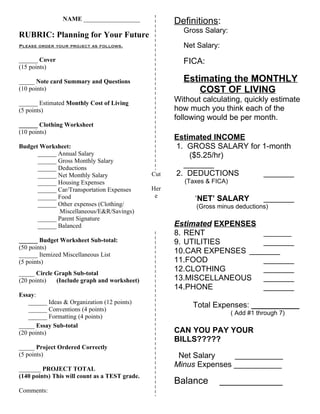
NAME __________________               Definitions:
                                                        Gross Salary:
RUBRIC: Planning for Your Future
Please order your project as follows.                   Net Salary:
______ Cover                                            FICA:
(15 points)

_____ Note card Summary and Questions                   Estimating the MONTHLY
(10 points)                                                 COST OF LIVING
______ Estimated Monthly Cost of Living
                                                      Without calculating, quickly estimate
(5 points)                                            how much you think each of the
                                                      following would be per month.
______ Clothing Worksheet
(10 points)
                                                      Estimated INCOME
Budget Worksheet:                                     1. GROSS SALARY for 1-month
      ______ Annual Salary                                ($5.25/hr)
      ______ Gross Monthly Salary
      ______ Deductions
                                                        _______
      ______ Net Monthly Salary                 Cut   2. DEDUCTIONS       _______
      ______ Housing Expenses                            (Taxes & FICA)
      ______ Car/Transportation Expenses        Her
      ______ Food                                e
                                                            ‘NET’ SALARY             _______
      ______ Other expenses (Clothing/                      (Gross minus deductions)
             Miscellaneous/E&R/Savings)
      ______ Parent Signature
      ______ Balanced                                 Estimated EXPENSES
                                                      8. RENT            ________
______ Budget Worksheet Sub-total:                    9. UTILITIES       _______
(50 points)
______ Itemized Miscellaneous List
                                                      10.CAR EXPENSES _______
(5 points)                                            11.FOOD            _______
_____ Circle Graph Sub-total
                                                      12.CLOTHING        _______
(20 points)   (Include graph and worksheet)           13.MISCELLANEOUS   _______
                                                      14.PHONE           _______
Essay:
    ______ Ideas & Organization (12 points)
    ______ Conventions (4 points)
                                                           Total Expenses: ___________
                                                                          ( Add #1 through 7)
    ______ Formatting (4 points)
_____ Essay Sub-total
(20 points)                                           CAN YOU PAY YOUR
                                                      BILLS?????
_____ Project Ordered Correctly
(5 points)                                             Net Salary    ___________
_______ PROJECT TOTAL
                                                      Minus Expenses ___________
(140 points) This will count as a TEST grade.
                                                      Balance       ____________
Comments:
Planning for Your Future
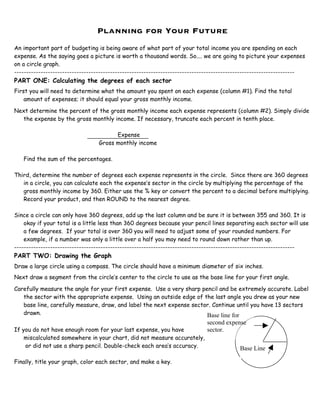
An important part of budgeting is being aware of what part of your total income you are spending on each
expense. As the saying goes a picture is worth a thousand words. So.... we are going to picture your expenses
on a circle graph.
---------------------------------------------------------------------------------------------------------------------
PART ONE: Calculating the degrees of each sector
First you will need to determine what the amount you spent on each expense (column #1). Find the total
    amount of expenses; it should equal your gross monthly income.

Next determine the percent of the gross monthly income each expense represents (column #2). Simply divide
  the expense by the gross monthly income. If necessary, truncate each percent in tenth place.

                                        Expense
                                  Gross monthly income

   Find the sum of the percentages.

Third, determine the number of degrees each expense represents in the circle. Since there are 360 degrees
   in a circle, you can calculate each the expense’s sector in the circle by multiplying the percentage of the
   gross monthly income by 360. Either use the % key or convert the percent to a decimal before multiplying.
   Record your product, and then ROUND to the nearest degree.

Since a circle can only have 360 degrees, add up the last column and be sure it is between 355 and 360. It is
    okay if your total is a little less than 360 degrees because your pencil lines separating each sector will use
    a few degrees. If your total is over 360 you will need to adjust some of your rounded numbers. For
    example, if a number was only a little over a half you may need to round down rather than up.
---------------------------------------------------------------------------------------------------------------------
PART TWO: Drawing the Graph
Draw a large circle using a compass. The circle should have a minimum diameter of six inches.
Next draw a segment from the circle’s center to the circle to use as the base line for your first angle.

Carefully measure the angle for your first expense. Use a very sharp pencil and be extremely accurate. Label
   the sector with the appropriate expense. Using an outside edge of the last angle you drew as your new
   base line, carefully measure, draw, and label the next expense sector. Continue until you have 13 sectors
   drawn.                                                              Base line for
                                                                             second expense
If you do not have enough room for your last expense, you have         sector.
    miscalculated somewhere in your chart, did not measure accurately,
    or did not use a sharp pencil. Double-check each area’s accuracy.                     Base Line

Finally, title your graph, color each sector, and make a key.
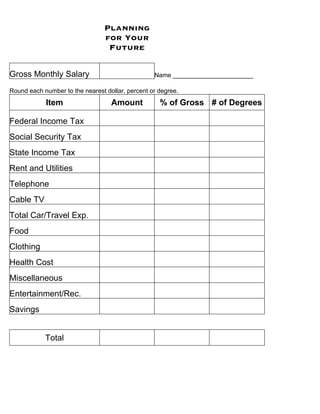
Planning
                                 for Your
                                  Future

Gross Monthly Salary                              Name _______________________

Round each number to the nearest dollar, percent or degree.
            Item                   Amount           % of Gross # of Degrees

Federal Income Tax
Social Security Tax
State Income Tax
Rent and Utilities
Telephone
Cable TV
Total Car/Travel Exp.
Food
Clothing
Health Cost
Miscellaneous
Entertainment/Rec.
Savings


            Total
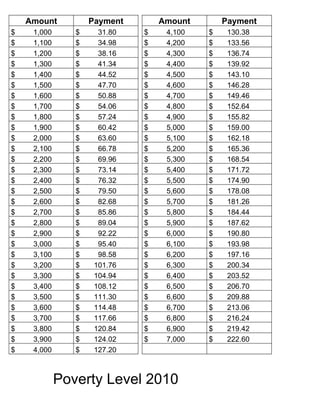
Appendix 1
Monthly payment on a 3-year loan at 9% interest.
Amount          Payment       Amount       Payment
$    1,000      $     31.80   $    4,100   $    130.38
$    1,100      $     34.98   $    4,200   $    133.56
$    1,200      $     38.16   $    4,300   $    136.74
$    1,300      $     41.34   $    4,400   $    139.92
$    1,400      $     44.52   $    4,500   $    143.10
$    1,500      $     47.70   $    4,600   $    146.28
$    1,600      $     50.88   $    4,700   $    149.46
$    1,700      $     54.06   $    4,800   $    152.64
$    1,800      $     57.24   $    4,900   $    155.82
$    1,900      $     60.42   $    5,000   $    159.00
$    2,000      $     63.60   $    5,100   $    162.18
$    2,100      $     66.78   $    5,200   $    165.36
$    2,200      $     69.96   $    5,300   $    168.54
$    2,300      $     73.14   $    5,400   $    171.72
$    2,400      $     76.32   $    5,500   $    174.90
$    2,500      $     79.50   $    5,600   $    178.08
$    2,600      $     82.68   $    5,700   $    181.26
$    2,700      $     85.86   $    5,800   $    184.44
$    2,800      $     89.04   $    5,900   $    187.62
$    2,900      $     92.22   $    6,000   $    190.80
$    3,000      $     95.40   $    6,100   $    193.98
$    3,100      $     98.58   $    6,200   $    197.16
$    3,200      $    101.76   $    6,300   $    200.34
$    3,300      $    104.94   $    6,400   $    203.52
$    3,400      $    108.12   $    6,500   $    206.70
$    3,500      $    111.30   $    6,600   $    209.88
$    3,600      $    114.48   $    6,700   $    213.06
$    3,700      $    117.66   $    6,800   $    216.24
$    3,800      $    120.84   $    6,900   $    219.42
$    3,900      $    124.02   $    7,000   $    222.60
$    4,000      $    127.20


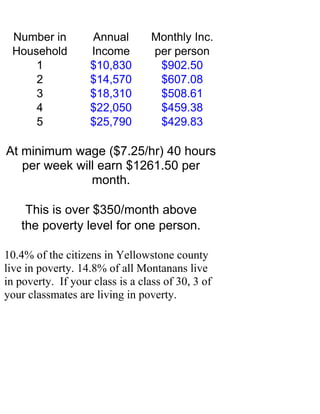
             Poverty Level 2010
Number in         Annual         Monthly Inc.
 Household         Income         per person
     1             $10,830         $902.50
     2             $14,570         $607.08
     3             $18,310         $508.61
     4             $22,050         $459.38
     5             $25,790         $429.83

At minimum wage ($7.25/hr) 40 hours
   per week will earn $1261.50 per
               month.

    This is over $350/month above
   the poverty level for one person.

10.4% of the citizens in Yellowstone county
live in poverty. 14.8% of all Montanans live
in poverty. If your class is a class of 30, 3 of
your classmates are living in poverty.

Blog budget project.final

  • 1.
    Planning for Your Future _______________________________ Name _______________________________ Class
  • 2.
    Purple Sheet April 20, 2010 Dear Parents, Your son/daughter will be completing a budget project in math. The purpose of this project is to provide baseline knowledge of the expenses and the benefits of a budget. While we all hope our children will earn a good wage, we also know that sometimes we are subjected to circumstances that greatly impact our incomes. The goal of this project is to encourage problem solving and instill a real life situation into our curricula. Sometime in April or the first part of May, the English classes will complete an investigation of careers. Knowledge of expenses will help students be aware of the impact finances have on life and how education impacts career choices. In February, the math classes developed a 4-Year-Plan for high school. This activity encouraged the students to explore the courses available at the high school setting before registering for their freshman year. Entrance requirements to the various post-secondary education options were also discussed. As a staff, we will be discussing the different facets of careers and emphasize that earnings are only one of many important aspects of a career that should be investigated before choosing a field of work. Quality of life must also be considered. We hope these activities in math and English will develop connections between our coursework and our student’s futures. Sincerely, The 8th Grade Math and English Departments Will James
  • 3.
    Yellow Sheet NAME __________________ Comments: RUBRIC: Planning for Your Future Estimating the MONTHLY Please order your project as follows. COST OF LIVING Without calculating, quickly estimate ______ Cover how much you think each of the (15 points) following would be per month. ______ Overview summary & questions (10 points) ______ Estimated Budget Estimated INCOME (5 points) 1. GROSS SALARY for 1-month (Minimum wage =$6.00/hr) _______ ______ Clothing Worksheet (10 points) 2. DEDUCTIONS _______ (Taxes & FICA) Budget Worksheet: ______ Annual Salary CUT ‘NET’ SALARY _______ ______ Gross Monthly Salary (Gross salary minus deductions) ______ Deductions HER ______ Net Monthly Salary E ______ Housing Expenses ______ Car/Transportation Expenses Estimated EXPENSES ______ Food 1. RENT ________ ______ Other expenses (Clothing/ 2. UTILITIES _______ Miscellaneous/E&R/Savings) 3. CAR EXPENSES _______ ______ Parent Signature ______ Balanced Budget 4. FOOD _______ ______ Budget Worksheet Sub-total:) 5. CLOTHING _______ (55 points) 6. MISCELLANEOUS _______ 7. PHONE _______ ______ Itemized Miscellaneous List (5 points) Total Expenses: ___________ _____ Circle Graph Sub-total (graph & worksheet) ( Add #1 through 7) (20 points) Essay: CAN YOU PAY YOUR BILLS????? ______ Ideas (10 points) ______ Conventions (5 points) Net Salary ___________ ______ Format & Organization (5 points) Minus Expenses ___________ _____ Essay Sub-total (20 points) Balance ____________ _____ Order of Project (5 points) Definitions: _______ PROJECT TOTAL (140 points) Gross Salary
  • 4.
    Net Salary FICA So... Planning for Your Future Estimate Page 1 So... You want to be a Millionaire Estimate Page 1
  • 5.
    Pink Sheet CLOTHING BUDGETWORKSHEET (acquired the last 12 months) List categories for clothing; make extra sections as necessary on the back of this sheet. List the average cost of each item. Find the total cost for each category. Don’t forget to include accessories, etc. Clothing purchased for athletic activities are NOT to be included. When done, have your parents check for accuracy and sign the last square. Encourage your parents to write a note regarding the accuracy of your worksheet. This information is considered confidential. EXAMPLE: 6 sweaters @ $35 Total: Total: $210 Total: Total: Total: Total: Total: Total: Total: Total Clothing Expenditure: Parent Comments: Total: $ _______________ Parent Signature: __________
  • 6.
    Planning for YourFuture This project will help you to look ahead to the future. None of the information you share will be shared with other individuals. The project will be a 120-point test grade. Timeline STEP 1: Please take the letter (purple sheet) explaining the project home to your parents. This will help them understand why you will be asking them many and varied questions over the next few days. STEP 2: Read the “Planning for Your Future” directions carefully (white packet). Next, write a one to two paragraph summary of the instructions on the front of a 4” x 6” note card. Last, write three questions you would like answered before beginning the project on the back of the note card. (10 points) STEP 3: Using the right side of the yellow sheet, we will prepare a quick estimate of living expenses for one month for an individual whose salary is minimum wage. We will complete this in class without a calculator – ESTIMATE! This should take less than ONE minute. (5 points) STEP 4: Prepare your clothing budget (pink sheet) based on the clothing you received or purchased this past year (4.1.09 through 3.31.10). List each category of clothing, an average cost for each category and determine a total amount spent on your clothing for the past year. Look through your drawers and closets and think of the clothing you have discarded to help you prepare this list. Discuss the clothing sheet with your parent(s). If your parents have suggestions, make changes. Have your parent sign that they have discussed this worksheet with you. Encourage them to write a comment- extra credit. (10 points) STEP 5: Using a PENCIL, complete the formal budget (ivory sheet). Follow the instructions (white packet) EXACTLY!!! It is important to reread each step as you complete it. (55 points) STEP 6: Construct a circle graph that represents your expenses. The directions and a table to assist are on the green sheet. Both the graph and the calculation sheet will be turned in. (15 points)
  • 7.
    STEP 7: Createa cover sheet for the project. This should be a very clever and creative cover sheet that is makes an individual look inside to see what the project is all about. Your cover must be colorful, creative, interesting and amazing to earn full points!! (10 points) STEP 8: Write an essay summarizing the project. The instructions for your essay are located on the last page of the project directions (white packet). (20 points) STEP 9: Order each page of the project as directed on the yellow Rubric Sheet. (5 points) STEP 10: Verify one last time that you have met each criterion for an excellent project.
  • 8.
    Planning for YourFuture Instructions: Read EACH and EVERY sentence very carefully. Do NOT scan or skip directions. Check off items when you have verified that you have followed EACH and EVERY area. You have completed your education and are out on your own in the world. Due to circumstances beyond your control, you are only able to secure a minimum wage job. You may share housing expenses with one roommate. This is an imaginary roommate – not a classmate. Each student must complete his or her own project. Your family has given you the basic items needed to begin apartment life. Your parents have extended a standing invitation to you for Sunday dinner because they enjoy your company and want you to have at least one healthy and nutritious meal every week. However, they believe that you need to be responsible for your own expenses and will not contribute money toward your living expenses or let you move back home. Being a responsible individual, you have decided to make a budget so that you can plan wisely how to spend your earnings. The following instructions will help you. Read carefully; talk to your parents, older siblings, grandparents, teachers and other adults to gain their wisdom regarding budgeting. It would be wise to use a pencil since you will probably need to adjust the amounts in order to balance your budget. You will want to write lightly or use scratch paper since you may need to adjust your amounts several times. BE SURE TO READ ALL INSTRUCTIONS BEFORE BEGINNING. NOTE: Excessive whining will reduce your monthly income by $5.00 per whine. You CAN live on minimum wage. ---------------------------------------------------------------------------------------------------- Line Item Instructions: The line before each paragraph is for you to check-off when you have completed each line of your budget form. ______ Think of an occupation where the beginning salary is minimum wage and you would be willing to work at this job for a substantial period of time. Remember, some careers begin with minimum wage and progress to much higher paying jobs. ______ Compute Annual Income (This is your Gross Salary; the amount you earn before any taxes, automatic deductions, etc. have been deducted from the total amount you will earn in one year.) You work 40 hours per week for $7.25 per hour for 51 weeks. Unfortunately, most minimum wage jobs do not pay you when you take time off or provide a paid vacation; therefore, it is wise to only plan on 51 weeks of earnings. Your job does not allow overtime or tips. 1
  • 9.
    ______ Compute GrossMonthly Salary (Divide your yearly salary by twelve, round to the nearest cent.) ______ Determine your ‘Net’ salary. First, calculate each payroll deduction listed. You will need to take your gross monthly salary and multiply it by the percentage listed on the Budget Sheet (round to the nearest cent). Find the total deductions that your employer will deduct from your paycheck. Subtract the total deducted amount from your gross monthly salary; this is your ‘net’ salary. Your ‘Net’ monthly salary is your spendable income. ______ Rent: Find your ‘dream’ apartment/duplex/house from the newspaper ads, cut it out, and tape or glue it in the space provided next to the rent line on your Budget Worksheet. You may need help understanding the ad lingo. Many abbreviations are used; get help from an adult! Remember to keep cost, location, safety, and size in mind when making your choice. You may choose to have ONE roommate. If you do, you may split the rent and utilities but remember, utilities will cost more for two people than for one. This is an imaginary roommate – not a classmate. Each student must complete his or her own project. Place a check in the box on your Budget Sheet IF you are choosing to have a roommate. Students always seem to ask if they can live in a motorhome or a camper. NO, that is not an option. (This is my project and I get to make the rules.)  Extra Credit: Ask you parents to drive you by ‘your apartment’ and either take a picture and email it to me @ horstl@billings.k12.mt.us or have your parents write a note that you have seen the location and the exterior of the apartment. Is this an apartment you would really live in? ______ Next, determine the cost of utilities. ‘Utilities’ for this project include the following: electricity, natural gas, and water. Be sure to discuss this cost with an adult. Your parents will be able to help you determine a reasonable amount. Some apartments have some of the utilities included in your monthly rent payment. If your apartment has a utility included, write, “Paid in rent” on the line for the appropriate utilities. Caution: Telephone and Cable TV are not considered utilities. ______ Determine the cost of your telephone/cell phone service. Check an old statement from the telephone provider. Your parents probably have a statement available for you to use as a research tool or go on-line and comparison shop! Additional charges apply for call forwarding, caller ID, call waiting, unlimited texting, data plan, etc. If you plan to use these services you will need to include them in your budgeted telephone amount. If you will be using a cell phone, remember every minute you go over your ‘allowed minutes’ will be very expensive. Be sure to compare plans. I think you will find that if you have the privilege of a cell phone, provided by your parents, that you are very fortunate! If you have your phone service packaged in with your Internet and cable TV write “Included in cable package” on the telephone line of your Budget Sheet. You are NOT allowed to stay on your parents cell phone plan for this project. Remember, your parents raised you to be responsible and independent! ______ If you want Cable or Direct TV, research the cost and include it in your budget. There are various levels of cable or direct TV service – choose wisely. This is an optional expense. ______ Internet: Choose your service and record the cost. ‘Piggybacking’ on neighbors Internet is illegal. Don’t do it! Either pay to have service or go to a business that offers free Wi-Fi. Many coffee shops have Internet access. If you are choosing a cable/phone/internet package, put “Included in cable package” on the Internet line of your Budget Sheet.
  • 10.
    ______ Find asource of transportation. For this project, it is assumed that you do not currently own a car. Since the vast majority of Americans own a car, it is assumed you will also own one. Students always ask if they can use a scooter or motorcycle. Sure but you have to buy it, maintain it and set aside extra funds for transportation during inclement weather. See the directions below. However, if your budget does not allow for a car and all its’ accompanying expenses, you may choose to use public transportation. If you choose to use public transportation, you will need to budget funds for a monthly bus pass and also taxi expenses. You will no longer be a student so the student rate for the MET bus will not apply. Since Billings does not have the transit system 24 hours a day, 7 days a week, you will need to have money set aside in case you need to call a taxi for an emergency situation. If you are depending on public transportation for most of your transportation, you should also plan to use walking and bicycling as a means of transportation. Therefore, include money in your budget for bike repairs, tires, chains, etc. You will also need to include more money in your clothing allowance as you will need to replace your shoes more often. If you are NOT using a car for transportation, cross out the ‘Car Expense’ section and create a new section to its right. Be specific as to your alternative transportation expenses. If you can afford a car for transportation, use your budget information and the Appendix 1 (blue sheet) to determine how large a payment you can afford. Your payment is based on a 9% loan for 3 years. Once you have determined how much you can spend on a car, use the Classified Advertising section of the paper to find your vehicle. Cut the ad for your car out and tape or glue it onto your budget sheet in the appropriate location. If you choose to use an ad from the Internet, it must include the cost of the car, must be printed out and attached to your budget sheet. Write your payment amount on the budget line. If you have maintained a 3.0 or higher GPA during your school years, your wealthy grandparents…the ones you’ve always dreamed of… gave you a check for $2500 upon graduating from high school to celebrate your hard work. Use last quarter’s GPA to determine if you qualify for your grandparents’ gift. If you qualify, congratulations! Your hard work studying paid off! To indicate that you are using that money to subsidize your car, neatly draw a line through your car advertisement’s cost and write the amount you will be financing. Then write your GPA next to the advertisement. (If you have friends or siblings who told you about grandparents buying their car when they completed this project, it was true. Unfortunately, your grandparents have suffered financial changes due to the changing economy and cannot continue the same level of generosity.) If your GPA does not qualify you for the grandparent gift, write the calculated payment amount on the appropriate line and continue to budget wisely. ______ Remember, along with the privilege of owning a vehicle come responsibilities. Since you have borrowed money for your car, the lender will require that you carry full coverage. A 3.0 GPA or higher will qualify you for a good student discount. Assume you received no tickets and did not have any accidents while in high school. That is fortunate because both would increase your insurance premiums. An adult or older brother or sister can be of assistance or you could check with an insurance agent. (This will also give you an idea of how much more your parents' insurance premiums will increase when you begin to drive.) Once you own your car – free and clear – you may wish to change to just liability coverage. Please ask your parents about the difference between full and liability coverage. _______ If you have a car, you will need to budget for fuel. Assume you will need to fill up a minimum of two times per month. Determine the number of gallons of gasoline you will need to purchase and calculate the expense using the current price per gallon. (Show this in the appropriate space on the worksheet.
  • 11.
    _____You must alsoinclude a minimum of $40/month for maintenance of your vehicle. The maintenance fee will cover saving a few dollars for replacement tires, oil changes and minor repairs. Drive carefully and take care of your vehicle as you will have no extra money budgeted for major repairs. ______ FOOD! As your parents will tell you, groceries will be a major part of your budget. Calculate the amount you plan to spend per day as well as your monthly total. Talk to your parents about this item. Don't underestimate!!! Remember, an unhealthy diet can result in health problems and will result in loss of points for this project so make a reasonable estimate of the cost of healthy eating. ______ Next decide how much money you will need to budget monthly for clothing. (You can use the Clothing Worksheet you prepared to help you estimate how much money to budget for clothing expenses. I suspect you will be minimizing your wardrobe so this amount may be vastly different from your clothing worksheet.) ______ You must include at least $50 per month for health costs. This is a minimal amount to reserve for health expenses and will not cover a health insurance premium. Most minimum wage jobs do not provide health insurance as a benefit so you will need to plan for dental costs and expenses incurred due to illness or injuries. This amount would not pay for a health plan or cover an emergency or serious health problem. Make it a lifelong goal to stay healthy and safe! _____ The Miscellaneous line includes personal items such as toothpaste, shampoo, cleaning supplies for your apartment, soap for bathing, laundry, and dishes, and other day-to-day expenses. Think carefully about day-to-day items you would buy at the grocery store, Target, Wal-Mart, and Costco, etcetera that would be included in this category. Laundry will cost about $1.75 per load unless a washer and dryer are included in your apartment rent. You should also include money to use for gifts to charities, friends, and family. This is a budget item that is easy to underestimate, be thorough. Create a list for miscellaneous items on a separate sheet of paper. Be sure to list ALL the items you will need in day-to-day living and your weekly laundry expenses. Round the cost of each item to the nearest dollar. Be specific and orderly in your expense list. Subtotal the cost of the items for a month and record it on the Miscellaneous line of the budget sheet. ______ Every person needs some entertainment and recreation. Determine the amount you will budget for movies, the expenses of activities with friends, dining out, a day skiing, vacation funds, etc. There are many recreational activities you can do that cost nothing! Now is a good time to explore these possibilities! ______ Saving for emergencies is critical. Many economic advisors suggest budgeting 10% of your earnings. I would suggest a savings line in your budget but you may not find the funds to save with your limited income. If you need to work to earn money to pay tuition for your continued education, this would be a very important budget line. ______ BALANCE: The FINAL line. Total all expenses carefully and compare the total expenses to your Net Monthly Salary. Your budget must be balanced. Net Monthly Income = Total Expenses! You may need to find areas you can reduce and make adjustments. Good Luck!!!
  • 12.
    Planning for YourFuture Essay Rubric Formatting: 1. Double space 2. Size 12 font 3. Spell Check OR Double spaced and handwritten in blue or black ink. Grading will be based on: 1. Conventions 2. Organization and ideas 3. Correct Formatting Write three five-to-seven sentence paragraphs describing what insights you gained during this project, the ramifications the project might have on your spending habits, and the impact this project could have on future educational decisions. Spend some time making this an interesting well thought out essay! If this is poorly written, your score will be low!
  • 13.
    Name: _______________ ________________ Pencil only OCCUPATION : _______________ This must be a career you are willing to work at for a substantial period of time. (Remember, some careers begin with minimum wage and progress to good paying jobs.) Ivory Sheet B ______________________ ANNUAL INCOME: U GROSS MONTHLY INCOME: ________________ D Monthly Payroll Deductions: _ederal Income Taxes – 7%......... __________ F G _ICA– 7.65%....................................___________ F _ (Social Security 6.2% + Medicaid 1.45%) E _ tate Income Taxes – 2%.............___________ S T _Optional: Retirement Plan ..........___________ * TOTAL DEDUCTIONS: ___________ NET MONTHLY SALARY: __________________ S MONTHLY EXPENSES: H Housing Expenses: Rent (Include clipping)………………………. _______  Roommate E Paste Housing Ad Utilities: E Gas…………………………………………… _______ Here Electricity …………………………..… _______ T Water ……………………………………. _______ Telephone ………………………………………….… _______ Cable TV …………………………………………….… _______ Internet................................................. _ _______ Housing Expenses:_________ Transportation Expense: (Include clipping as needed) Payment ………………………………………………… _______ Insurance ……………………………………………… _______ Gas [__ gallons @ ____ / gallon} …… _______ Maintenance [at least the minimum]… _______ Transportation Expenses:_________ Other Expenses: Food [____ per day]…………………………… __________ Paste Here Car Clothing …………………………………………………… __________ Ad Did you verify your instructions??? Health Costs………………………………………………__________ Double check!!! Miscellaneous ……………………………………………__________ (Create itemized list on back) Entertainment and Recreation…………… __________ Savings ……………………………………………………….__________ Other Expenses: __________ TOTAL EXPENSES: _______________ (Housing + Transportation + Other)
  • 14.
    PARENTS/Significant Adult: Please verify that these projected expenses are reasonable for your son/daughter if they were self- supporting and earned minimum wage. _____________________________________________________________________________ BALANCE: _____________ NET INCOME MINUS EXPENSES MUST EQUAL ZERO!.
  • 15.
    NAME __________________ Definitions: Gross Salary: RUBRIC: Planning for Your Future Please order your project as follows. Net Salary: ______ Cover FICA: (15 points) _____ Note card Summary and Questions Estimating the MONTHLY (10 points) COST OF LIVING ______ Estimated Monthly Cost of Living Without calculating, quickly estimate (5 points) how much you think each of the following would be per month. ______ Clothing Worksheet (10 points) Estimated INCOME Budget Worksheet: 1. GROSS SALARY for 1-month ______ Annual Salary ($5.25/hr) ______ Gross Monthly Salary ______ Deductions _______ ______ Net Monthly Salary Cut 2. DEDUCTIONS _______ ______ Housing Expenses (Taxes & FICA) ______ Car/Transportation Expenses Her ______ Food e ‘NET’ SALARY _______ ______ Other expenses (Clothing/ (Gross minus deductions) Miscellaneous/E&R/Savings) ______ Parent Signature ______ Balanced Estimated EXPENSES 8. RENT ________ ______ Budget Worksheet Sub-total: 9. UTILITIES _______ (50 points) ______ Itemized Miscellaneous List 10.CAR EXPENSES _______ (5 points) 11.FOOD _______ _____ Circle Graph Sub-total 12.CLOTHING _______ (20 points) (Include graph and worksheet) 13.MISCELLANEOUS _______ 14.PHONE _______ Essay: ______ Ideas & Organization (12 points) ______ Conventions (4 points) Total Expenses: ___________ ( Add #1 through 7) ______ Formatting (4 points) _____ Essay Sub-total (20 points) CAN YOU PAY YOUR BILLS????? _____ Project Ordered Correctly (5 points) Net Salary ___________ _______ PROJECT TOTAL Minus Expenses ___________ (140 points) This will count as a TEST grade. Balance ____________ Comments:
  • 16.
    Planning for YourFuture An important part of budgeting is being aware of what part of your total income you are spending on each expense. As the saying goes a picture is worth a thousand words. So.... we are going to picture your expenses on a circle graph. --------------------------------------------------------------------------------------------------------------------- PART ONE: Calculating the degrees of each sector First you will need to determine what the amount you spent on each expense (column #1). Find the total amount of expenses; it should equal your gross monthly income. Next determine the percent of the gross monthly income each expense represents (column #2). Simply divide the expense by the gross monthly income. If necessary, truncate each percent in tenth place. Expense Gross monthly income Find the sum of the percentages. Third, determine the number of degrees each expense represents in the circle. Since there are 360 degrees in a circle, you can calculate each the expense’s sector in the circle by multiplying the percentage of the gross monthly income by 360. Either use the % key or convert the percent to a decimal before multiplying. Record your product, and then ROUND to the nearest degree. Since a circle can only have 360 degrees, add up the last column and be sure it is between 355 and 360. It is okay if your total is a little less than 360 degrees because your pencil lines separating each sector will use a few degrees. If your total is over 360 you will need to adjust some of your rounded numbers. For example, if a number was only a little over a half you may need to round down rather than up. --------------------------------------------------------------------------------------------------------------------- PART TWO: Drawing the Graph Draw a large circle using a compass. The circle should have a minimum diameter of six inches. Next draw a segment from the circle’s center to the circle to use as the base line for your first angle. Carefully measure the angle for your first expense. Use a very sharp pencil and be extremely accurate. Label the sector with the appropriate expense. Using an outside edge of the last angle you drew as your new base line, carefully measure, draw, and label the next expense sector. Continue until you have 13 sectors drawn. Base line for second expense If you do not have enough room for your last expense, you have sector. miscalculated somewhere in your chart, did not measure accurately, or did not use a sharp pencil. Double-check each area’s accuracy. Base Line Finally, title your graph, color each sector, and make a key.
  • 17.
    Planning for Your Future Gross Monthly Salary Name _______________________ Round each number to the nearest dollar, percent or degree. Item Amount % of Gross # of Degrees Federal Income Tax Social Security Tax State Income Tax Rent and Utilities Telephone Cable TV Total Car/Travel Exp. Food Clothing Health Cost Miscellaneous Entertainment/Rec. Savings Total
  • 18.
    Appendix 1 Monthly paymenton a 3-year loan at 9% interest.
  • 19.
    Amount Payment Amount Payment $ 1,000 $ 31.80 $ 4,100 $ 130.38 $ 1,100 $ 34.98 $ 4,200 $ 133.56 $ 1,200 $ 38.16 $ 4,300 $ 136.74 $ 1,300 $ 41.34 $ 4,400 $ 139.92 $ 1,400 $ 44.52 $ 4,500 $ 143.10 $ 1,500 $ 47.70 $ 4,600 $ 146.28 $ 1,600 $ 50.88 $ 4,700 $ 149.46 $ 1,700 $ 54.06 $ 4,800 $ 152.64 $ 1,800 $ 57.24 $ 4,900 $ 155.82 $ 1,900 $ 60.42 $ 5,000 $ 159.00 $ 2,000 $ 63.60 $ 5,100 $ 162.18 $ 2,100 $ 66.78 $ 5,200 $ 165.36 $ 2,200 $ 69.96 $ 5,300 $ 168.54 $ 2,300 $ 73.14 $ 5,400 $ 171.72 $ 2,400 $ 76.32 $ 5,500 $ 174.90 $ 2,500 $ 79.50 $ 5,600 $ 178.08 $ 2,600 $ 82.68 $ 5,700 $ 181.26 $ 2,700 $ 85.86 $ 5,800 $ 184.44 $ 2,800 $ 89.04 $ 5,900 $ 187.62 $ 2,900 $ 92.22 $ 6,000 $ 190.80 $ 3,000 $ 95.40 $ 6,100 $ 193.98 $ 3,100 $ 98.58 $ 6,200 $ 197.16 $ 3,200 $ 101.76 $ 6,300 $ 200.34 $ 3,300 $ 104.94 $ 6,400 $ 203.52 $ 3,400 $ 108.12 $ 6,500 $ 206.70 $ 3,500 $ 111.30 $ 6,600 $ 209.88 $ 3,600 $ 114.48 $ 6,700 $ 213.06 $ 3,700 $ 117.66 $ 6,800 $ 216.24 $ 3,800 $ 120.84 $ 6,900 $ 219.42 $ 3,900 $ 124.02 $ 7,000 $ 222.60 $ 4,000 $ 127.20 Poverty Level 2010
  • 20.
    Number in Annual Monthly Inc. Household Income per person 1 $10,830 $902.50 2 $14,570 $607.08 3 $18,310 $508.61 4 $22,050 $459.38 5 $25,790 $429.83 At minimum wage ($7.25/hr) 40 hours per week will earn $1261.50 per month. This is over $350/month above the poverty level for one person. 10.4% of the citizens in Yellowstone county live in poverty. 14.8% of all Montanans live in poverty. If your class is a class of 30, 3 of your classmates are living in poverty.