BLOCKCHAIN
FUNDAMENTALS AND USE-CASES
Main Root Of WEB 3.0
Introduction
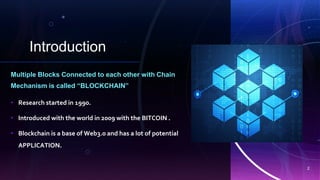
Multiple Blocks Connected to each other with Chain
Mechanism is called “BLOCKCHAIN”
• Research started in 1990.
• Introduced with the world in 2009 with the BITCOIN .
• Blockchain is a base of Web3.0 and has a lot of potential
APPLICATION.
2
Components of Blockchain
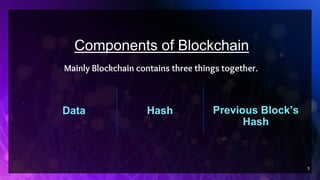
Mainly Blockchain contains three things together.
Data Hash Previous Block’s
Hash
3
How It Works
d
• A node initiates a transaction and signs it with its private key.
• A block representing the transaction is created on the platform.
• The transaction is broadcasted to the peers within the network based
on any present criteria.
• The peer nodes then validate the transaction.
• After transaction is confirmed, the data is included in the block.
• Block gets added to the ledger and adds hash as well as previous hash.
4
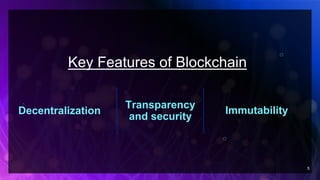
Key Features of Blockchain
h
Decentralization
Transparency
and security
Immutability
5
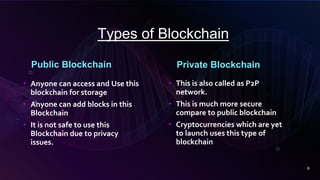
Types of Blockchain
Public Blockchain Private Blockchain
• Anyone can access and Use this
blockchain for storage
• Anyone can add blocks in this
Blockchain
• It is not safe to use this
Blockchain due to privacy
issues.
• This is also called as P2P
network.
• This is much more secure
compare to public blockchain
• Cryptocurrencies which are yet
to launch uses this type of
blockchain
6
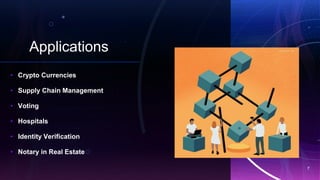
Applications
d
• Crypto Currencies
• Supply Chain Management
• Voting
• Hospitals
• Identity Verification
• Notary in Real Estate
7
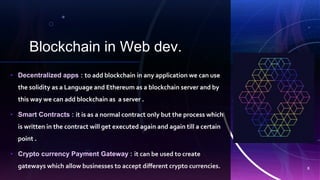
Blockchain in Web dev.
d
• Decentralized apps : to add blockchain in any application we can use
the solidity as a Language and Ethereum as a blockchain server and by
this way we can add blockchain as a server .
• Smart Contracts : it is as a normal contract only but the process which
is written in the contract will get executed again and again till a certain
point .
• Crypto currency Payment Gateway : it can be used to create
gateways which allow businesses to accept different crypto currencies. 8
Challenges and Limitations
d
• Awareness
• Scalability
• Slow Speed
• Privacy
• Regulatory Issues
• Energy Consumption 9
Conclusion
d
• Blockchain technology has the potential to revolutionize
the way we store and share data. As more businesses and
individuals adopt blockchain technology, we can expect to
see more innovative applications of this technology in the
future. However, it is important to be aware of the
limitations and challenges that exist as well.
10
Thank you
11

Blockchain Webdev.pptx

  • 1.
  • 2.
    Introduction Multiple Blocks Connectedto each other with Chain Mechanism is called “BLOCKCHAIN” • Research started in 1990. • Introduced with the world in 2009 with the BITCOIN . • Blockchain is a base of Web3.0 and has a lot of potential APPLICATION. 2
  • 3.
    Components of Blockchain MainlyBlockchain contains three things together. Data Hash Previous Block’s Hash 3
  • 4.
    How It Works d •A node initiates a transaction and signs it with its private key. • A block representing the transaction is created on the platform. • The transaction is broadcasted to the peers within the network based on any present criteria. • The peer nodes then validate the transaction. • After transaction is confirmed, the data is included in the block. • Block gets added to the ledger and adds hash as well as previous hash. 4
  • 5.
    Key Features ofBlockchain h Decentralization Transparency and security Immutability 5
  • 6.
    Types of Blockchain PublicBlockchain Private Blockchain • Anyone can access and Use this blockchain for storage • Anyone can add blocks in this Blockchain • It is not safe to use this Blockchain due to privacy issues. • This is also called as P2P network. • This is much more secure compare to public blockchain • Cryptocurrencies which are yet to launch uses this type of blockchain 6
  • 7.
    Applications d • Crypto Currencies •Supply Chain Management • Voting • Hospitals • Identity Verification • Notary in Real Estate 7
  • 8.
    Blockchain in Webdev. d • Decentralized apps : to add blockchain in any application we can use the solidity as a Language and Ethereum as a blockchain server and by this way we can add blockchain as a server . • Smart Contracts : it is as a normal contract only but the process which is written in the contract will get executed again and again till a certain point . • Crypto currency Payment Gateway : it can be used to create gateways which allow businesses to accept different crypto currencies. 8
  • 9.
    Challenges and Limitations d •Awareness • Scalability • Slow Speed • Privacy • Regulatory Issues • Energy Consumption 9
  • 10.
    Conclusion d • Blockchain technologyhas the potential to revolutionize the way we store and share data. As more businesses and individuals adopt blockchain technology, we can expect to see more innovative applications of this technology in the future. However, it is important to be aware of the limitations and challenges that exist as well. 10
  • 11.